Tag: Digital

  • TDSAT permits LCO to seek TV signals directly from distributor

    TDSAT permits LCO to seek TV signals directly from distributor

    NEW DELHI: The Telecom Disputes Settlement and Appellate Tribunal (TDSAT) has said that SRE Digital Cable Communications is entitled in law to ask Sun TV for supply of signals directly despite the fact that it has been receiving these signals from another multi system operator (MSO).


    TDSAT chairman Aftab Alam and members Kuldip Singh and B B Srivastava said however that this is subject to the operator satisfying the conditions mandated in the Regulations.


    Listing the matter for 21 December, the Tribunal said, “It will be open to Sun Distribution Services Pvt Ltd to make an inspection of the LCO’s system and to be satisfied that it is compliant with the regulatory norms.”


    On the next date, the LCO’s counsel Sujeet Kumar Mishra will also produce the invoices of A.C.T. Digital with the materials showing that payments are duly made against those invoices.


    The Tribunal also noted that the area in which the petitioner is operating is to come under the DAS regime in the third phase from 1 January, 2016. “It is, therefore, reasonable to assume that the petitioner would have a digital head-end in place. As a matter of fact, Mr. Mishra states that such is the position and the petitioner is capable of retransmitting any signals, including those received from SUN in digital mode.”


    However, it said that Sun could not be denied the request to examine the systems.


    In pursuance of the order passed on 29 October, Sun counsel Abhishek Malhotra filed an affidavit stating that the petitioner is receiving Sun’s signals from A.C.T. Digital. 


    Mishra admitted to the Tribunal that the petitioner had been receiving Sun’s signals from A.C.T. Digital from the month of November 2015. “Evidently, the earlier statements made on behalf of the petitioner were not correct,” the Tribunal noted.

  • GroupM ups U.K. ad growth forecast to 7% for 2015 & 2016

    GroupM ups U.K. ad growth forecast to 7% for 2015 & 2016

    MUMBAI: U.K advertising spending in 2015 is anticipated to grow by seven per cent, and in 2016 GroupM predicts strong demand for digital advertising will usher another year of strong advertising growth (also seven per cent), pushing total U.K. advertising investment above ?17 billion. 

    The new GroupM forecast released raises the prior 2015 estimate by one point (six to seven per cent) and raises the 2016 outlook by two points (five to seven per cent).

    If GroupM’s forecasts prove accurate, 2016 will mark the fifth straight year in which U.K. ad spending has outpaced the Kingdom’s gross domestic product (GDP) growth (2012-2016). The U.K. is again the fastest-growing mature advertising market worldwide and is among the world’s fastest-growing markets full stop.

    “Digital technology and media platforms continue to expand the role media plays in marketing and as a result media investment is both growing and shifting. Digital advertising represents a tremendous opportunity for clients to create more targeted media campaigns that activate consumers, but it has also added enormous complexity and our group continues to solve this with strategy, innovation and investment. The year ahead is a promising one for growth of overall media investment as we work with clients to tap into empowering economic trends we see empowering U.K. consumerism,” said GroupM, United Kingdom CEO Nick Theakstone. 

    GroupM identified a number of economic factors underpinning its U.K. predictions. The nation currently enjoys the highest recorded employment rate in its history with 74 per cent of the working-aged populace in jobs. Additionally, workers’ real wages have risen near to their 2008 peak, while consumer-price inflation has not similarly risen, at least not yet. Low energy prices and property wealth are additional tailwinds for a very positive outlook on U.K. consumerism, and as a result GroupM believes U.K. consumers will be spending more next year. U.K. advertisers will marshal their efforts to seize this opportunity with a strong increase in media investment.

    GroupM’s forecasted distribution of advertising investment growth across media formats is detailed below:

    With this updated forecast, GroupM introduces a new category dubbed ‘Pure-Play Internet,’ which is ‘Digital’ minus TV and print content repatriated back to its parent media. This allows for broadcaster VOD and digital platforms to be considered together with ‘TV,’ and likewise for print media to have the benefit of their digital assets when viewing the pace of their contraction.

    GroupM believes this more sober view of how ad investment is shifting across categories better supports industry dialogue and trend analysis. However, while delineating Pure Play Internet gives legacy media a fairer consideration, the impact is slight on the still rapid growth of the internet category which is estimated to be 13 per cent in 2016. On like-for-like comparison, this is a slight deceleration from 2013 to 2014, but Pure Play Internet will still grow far faster than second-fastest-growing TV which will realize 7.4 per cent growth in 2016. It should be noted that the growth performance of TV is strong in its own right, and the prediction holds for a fractional share gain in 2015 and 2016.

    “The influence of digital is everywhere. It suggests that legacy media channels must think and behave like media brands or what could be dubbed ‘audience brands.’ Digital’s influence is also pulling trading toward a more common GRP basis versus the idiosyncratic variety of the present, creating urgency to discriminate between correlation and causality, and driving demand for better reporting standards,” said Futures director Adam Smith. “With this year’s U.K. forecast we seek to make better sense of the investment trends across categories with ‘Pure Play Internet.’ We feel this is essential as content continues to rise with the browsing appetites of our increasingly digital culture.”

  • Tanushree Radhakrishnan returns to ZenithOptimedia as SVP

    Tanushree Radhakrishnan returns to ZenithOptimedia as SVP

    MUMBAI: The ZenithOptimedia Group is expanding and consolidating its digital operations in India. The global media services network has recently hired media veteran Tanushree Radhakrishnan, who was serving GroupM India earlier, as MEC North digital head.  Radhakrishnan will report to Zenith Optimedia Group, digital companies Performics and Resultrix, MD Tanmay Mohanty. 

    This is her second innings with the ZenithOptimedia Group. She was previously employed with the organisation between 2008-2013 and was instrumental in the phase when Resultrix was being integrated into the group.


    Mohanty says that Radhakrishnan will help the group deliver holistic value to the clients and develop a 360-degree offering basket in line with the Live ROI philosophy. “The group is witnessing unprecedented growth all around, whether it is increase in spends from existing clients, the rush of new business or talent. Be it the setup of a media technology division in Bangalore this year or the launch of Performics Mobile last year or the Centre of Excellence teams, there is a lot of vibrancy and energy flowing within, and I am sure that Radhakrishnan will now be a part of it. She has rich and varied experience across all key verticals of digital marketing and we are delighted to have her on board. Her real strength lies in delivering high ROI for clients.” He explains.

    Radhakrishnan concludes, “After having spent fantastic five years during my earlier stint, I’m excited to be back with the ZenithOptimedia Group. Performics is one digital organisation that really invests into its products and has the best in class tools and technologies. So am really thrilled about setting up and leading their Programmatic offering and Product Standardization, which is the need of the hour and will help us add value to our clients. It’s indeed a splendid opportunity to work with people who have a great vision and contribute to bring the ZOG Live ROI philosophy to life.”

  • Viacom18 christens VOD platform as VOOT

    Viacom18 christens VOD platform as VOOT

    MUMBAI: The digital space in India is going through a revolution of sorts. Broadcasters as well as content companies are firming up their plans to provide content to consumers on the go. The latest to join the bandwagon is Viacom18 Digital Ventures, which has christened its new digital video-on-demand (VOD) platform as VOOT, going by the popular expression used by today’s digital generation to express happiness, enthusiasm and triumph.


    Besides being the singular and exclusive destination for Viacom 18 network’s content portfolio, VOOT will also have an aggressive original programming strategy.


    The brand identity for VOOT, which is expected to go live in the coming months, has been created by Brand Gym and Elephant Design.


    Over the past few months, Viacom18 Digital Ventures has been working with a set of strategic partners on the brand design and logo with the aim of keeping it distinctive, differentiated and in-sync with the brand mission to create a fun filled world of entertainment.


    In July, Viacom18 appointed IndiaCast Media Distribution group COO Gaurav Gandhi as the chief operating officer of Viacom18 Digital Ventures. The company also recently mandated Monika Shergill to drive content and programming strategy as content head for the digital business.


    Viacom 18 group CEO Sudhanshu Vats said, “As one of the fastest growing media companies in the country, for us at Viacom18, digital content creation, delivery and access are essential focus areas for driving growth. With VOOT, we set out to leverage an already digitally engaged audience with our content offerings. VOOT will not only be the singular and exclusive destination for Viacom18’s content portfolio, but will have an equally strong focus on original programming created especially for the platform. The brand mission of VOOT is to create a whole new world of entertainment, filled with happy discoveries and addictive content.”


    Gandhi added, The idea of creating this new brand VOOT comes from our desire to create a new, alternate and differentiated world of entertainment for audiences in the digital space. The core essence of the brand is ‘infectious fun’ and ‘happiness’, and this is something that not only flows through in our bright and colourful logo, but will also resonate in our content philosophy. Just like the expression VOOT, the entire philosophy and experience of the service promises to be joyous and celebratory in nature. The digital video market, both in terms of audiences and revenues, is set to explode over the coming years. VOOT will not only target to gain a sizeable share of this market over the years, but also lead the way and set new trends in original content creation in this space.”


    Working with technology, content and branding partners in India and across the globe, VOOT will deliver high quality content to consumers on a wide variety of connected devices over Wi-Fi, 4G, 3G and 2G networks.

  • International industry experts to set the direction for the future of media and entertainment content in Asia at ATF 2015

    International industry experts to set the direction for the future of media and entertainment content in Asia at ATF 2015

    MUMBAI: Asia TV Forum & Market (ATF) 2015, has announced that the industry’s notable business leader, D.J. Lee, President of CJ E&M Media Contents Business will be kicking off ATF’s pre-market conference as keynote speaker on 1 Dec 2015 at the Marina Bay Sands.


    Keynote Speaker – D.J. Lee

    As Asia’s leading creation  and marketing company, CJ E&M’s media division currently operates 17 television channels and provides approximately 3,000 hours of content a year to various diversified media platforms such as cable, IPTV, and digital media.

    With an ambitious global expansion strategy along with initiatives such as digital-first original  production  under Lee’s guidance, CJ E&M rechristened their Multi-Channel Network (MCN) this year to DIA TV (Digital Influence & Artist TV) to focus on creating strategic  business  partnerships and  opportunities with digital  content creation platforms such as United States’ YouTube, China’s YouKu and France’s DailyMotion.By partnering content creators via the many digital platforms available, CJ  E&M  hopes to provide independent digital producers the opportunities to market their product by providing them with more support in areas such as funding, programming, digital rights management and cross-promotion.

    A veteran in the broadcast industry in Korea, Lee has a career spanning more than 20 years in the television  business.  Before becoming  the President  of Asia’s  leading  content  and media company, CJ E&M Media Content Business, Lee was a forerunner, pioneer and innovator of the Korean broadcasting  industry,  bringing  Total Variety Network (tvN), the country’s  leading content channel, to greater heights and surpassing Free-to-Air giants in terms of ratings and advertising revenue. Being the first to bring international formats into Korea to be localised, while also creating the first international Research & Development department, D.J. Lee has always been a forerunner in the industry, continually seeking to grow one of the region’s most successful broadcast industries.

    With local broadcasting networks in Southeast Asia seeking to augment their original content, Lee’s  address on the topic, Into the Future of Television: An Asian Empire’s Move Forward, will seek to provide insights based on his extensive experiences in cable, formats and the digital sphere.

    Said Mr Lee, “Evolution and Adaptation are two key traits to have in an industry such as ours. Be it the successful localisation of international formats or integrating existing formats into brand new concepts, it is all about providing engaging and contemporary content for your audiences. It’ll be my first time speaking at  ATF  and I’m looking forward to meeting  the  entire entertainment content industry there.”

     
    “With ATF being the premier platform for content providers, buyers and broadcasting networks all around the region, participants can look forward to engaging in knowledge transfer and interactive masterclasses as they learn insights from the industry’s thought leaders through the conference, while the market promises endless possibilities for partnerships and content deals. Attendees can expect to get ahead of the curve with the valuable insights that  D.J. Lee will share,” said Yeow Hui Leng, Senior Project Director of Asia TV Forum & Market  and ScreenSingapore,Reed Exhibitions.


    Empowering TV, Going Digital

    As consumer patterns evolve and technological advancements continue to play a strong role in moulding viewer preferences, digital involvement will be a key aspect for buyers and sellers alike within the film and TV industry in the years ahead. In line with this growing trend, Christopher Smith, Head of Digital & Branded Content Asia, Endemol Beyond (Singapore) and Shane Mitchell, Head, Digital, MediaCorp (Singapore) will share insights on how industry players can continue to innovate in order to meet the changing consumer needs for new technologies.

    With the growth of the digital age and seamless integration of all media types, it is important to understand the regional strategies, as well as possible barriers of entries, in achieving a fully integrated  system.  While  content  and  brands  engage  in  deeper  conversations  with  the consumers through the proliferation of digital devices and platforms, the appropriate use of social media to increase engagement and generate traction will be crucial for the industry. Philip Kitcher, VP Asia Pacific, Stylehaul (USA) and Marini Ramlan, GM of Media Prima Digital (Malaysia), will join a panel of other speakers to tackle the various issues of the digital dimension. Leading regional OTT companies will also be speaking on the key regional strategies and deployment as well as the barriers of entry in the realm that thrives on seamlessness.

    Other notable speakers during the pre-market conference include Steve Macallister, CEO, All3Media International (UK) and Dave Winnan, Executive Producer, International Formats, ITV Studios (UK), who will also join Qiu Yuan Yuan, General Manager, Jiangsu Broadcasting International Co., Ltd, for an insightful pairing of two significant pillars of the industry.

     
    On the other hand of the spectrum, Maggie Xiong, Senior Director, International Acquisitions, Youku Tudou (China) and Jose Mari Abacan, 1st Vice President for Program Management, GMA Network, Inc. (Philippines), will join other panellists in a discussion about the evolution of the buyer market within the TV industry. During the session, they will provide information required into tailoring television productions to suit the wants and needs of various content buyers for various genres.


    Engaging Formats, Reaching Younger Audience

     
    2015 has been a turning point in the world television with the digital wave now touching TV formats business-wise. Formats players are pumping in significant budget for original engaging content production to build audience loyalty, identify talents, and increase intellectual property. Formats experts will be sharing on how the game will change in 2016 at Formats@ATF. With Asia’s  hunger for kids’ content, the younger viewers have never had it so good. Danny Stack, Writer/Director (UK), will take participants through a masterclass that covers the main elements of good storytelling, which will not only engage children, but also audiences of all ages. Stack will share personal experiences of how he has coped and kept up with the evolution of television through the years, to continue writing and producing top-notch quality programmes such as Octonauts and Thunderbirds Are Go.

     
    The future of Asian television is here, with digital formats paving the way. Embracing the power of digital platforms  will be a key focus at this year’s ATF and participants  will understand and learn how to better conceptualise the inner workings of the future of Asian television.

    Participants can expect to glean a great deal of information from the many speakers and thought leaders that will be present at Asia TV’s premier conference and marketplace. The 2015 edition of the ATF promises to see an even bigger turnout as it returns as part of the second edition of the Singapore Media Festival, so be sure to purchase your tickets at  www.asiatvforum.com to experience the future of Asian Television.

  • Infosys & Huawei jointly develop hi-speed for stadiums

    Infosys & Huawei jointly develop hi-speed for stadiums

    NEW DELHI: High-speed Wi-Fi access has been jointly developed by Infosys and Chinese telecom network vendor Huawei for stadiums.


    “The software product integrates Huawei’s Agile network with our entertainment experience platform to offer high-speed Wi-Fi access and smart services for users in stadiums and exhibition centres,” Infosys said in a statement.


    With rising mobile consumption and advanced digital marketing standards, internet services will need end-to-end solutions, including wireless networks and innovative services, it said.


    “Need for better connected stadiums made us offer wide local area network infrastructure for enhanced user experience, with multi-tenant, cloud-based platform with managed operations and services,” it added.


    “Entertainment hubs offer an opportunity for traditional entities to transform with a digital layer. Potential to deliver value to attendees and entertainment centre owners increases owing to intersection of physical and digital,” Infosys Engineering Services Global Head Sudip Singh said.


    Logging on to the Wi-Fi network through a mobile app is the authentication for end users, enabling them to avail online services.


    The app also offers services for in-stadium engagements like social media, campaigns, shopping and other services.


    Huawei has deployed Wi-Fi networks in 20 stadiums worldwide, including Borussia Dortmund in Germany, AFC Ajax in the Netherlands, St. Louis Rams of NFL in the US and Gold Coast Suns in Australia besides in China.


    “The critical point of the smart solution is to link people, games, terminals and displays in a stadium through a wireless network. Operators and sponsors can achieve effective operations through the digital platform,” said Huawei’s Agile network general manager Ma Da.

  • eBay rolls out digital ad to educate consumers on refurbished products

    eBay rolls out digital ad to educate consumers on refurbished products

    NEW DELHI: eBay India, which had launched its ‘ebay Choices’ campaign in August to bring refurbished supply on its platform www.ebay.in; today launched a digital advertisement to educate consumers on the ‘refurbished’ category. 


    Link to the film: https://www.youtube.com/watch?v=AHP2_eeHs5Q&feature=emupload_owner


    Since launch of eBay Choices, ebay.in has witnessed tremendous response and demand for refurbished products. The category itself has grown from 6000 listings to over 25000 listings and has grown by 200 per cent over the last two months. The demand for refurbished products has been unparalleled especially from Tier II and III cities of India.


    Looking at the growing consumer interest and basis consumer feedback, there was a need to communicate of what really is ‘refurbished.’ The new digital film showcases the offerings in the refurbished segment through a story of a regular Indian family. 


    Consumers can view the ad film across eBay India’s digital platforms on YouTube and social media channels.


    eBay India marketing director Shivani Suri said, “We are extremely excited as our refurbished ad film goes live today on all digital platforms. Through this film, we aim to strike a chord with Indian consumers and further educate them about our diverse offerings in the refurbished space. This segment has seen a huge surge in consumer demand among Indian audiences and owing to the recent festive fever the demand of refurbished goods has reached an all-time high.”


    eBay India has tied-up with over 15 organised partners such as GreenDust, ValueCart, Budli, My Return Solutions amongst others to bring in consistent supply of refurbished products on ebay.in.

  • Broadcasters ready to extend existing analogue agreements in view of tardy pace of agreements, DAS Task Force told

    Broadcasters ready to extend existing analogue agreements in view of tardy pace of agreements, DAS Task Force told

    New Delhi: With less than three months to go for the deadline of Phase III of Digital Addressable System, the Indian Broadcasting Foundation has said that broadcasters are ready to extend the existing analogue interconnect agreements with multisystem operators for transition from analogue to digital service in view of the slow progress in signing of interconnect agreements.


     The commitment was made in the last meeting of the Task Force set up by the Information and Broadcasting Ministry in its meeting on 22 September. The minutes of the meeting were placed on the Ministry website today.


    The meeting was presided over by special secretary J S Mathur who asked the Telecom Regulatory Authority of India (TRAI) to convene a meeting of broadcasters and MSOs resolve issues. (It may be recalled that TRAI had earlier asked both broadcasters and MSOs to approach it in case of any problems with regard to interconnect agreements.


    Referring to the low number of interconnect agreements, Mathur remarked that without signing of agreements between broadcasters and MSOs, the progress on digitisation was not possible.


    Agreeing there had been slow progress in signing of agreements with major MSOs as the latter were awaiting the decision in a case before the Telecom Disputes Settlement and Arbitration Tribunal, the IBF said broadcasters had signed provisional agreements with many applicant operators, who have digitised their networks under the condition that they would get registered as MSOs for DAS operation before the cut-off date for Phase III.


    IBF was asked to submit an area-wise list indicating the status of signing of agreements to the Ministry. The meeting was told that just 62 of the 300-odd multi system operators had signed agreements with broadcasters.


    Mathur expressed his gratitude to the Indian Broadcasting Foundation for developing the advertisement on cable TV digitization in Phase lll areas and airing it on their member channels. He said All India Radio and Doordarshan were already giving advertisements on cable digitisation on their channels and they need to scale it up. The IBF representative said the Ads had been planned in bilingual format but IBF will consider making it multilingual as requested.


    Joint Secretary (Broadcasting) R Jaya said as a next step towards publicity awareness campaign, broadcasters and MSOs should now inform the cable TV users in Phase III areas through scroll messages on their channels to get STBs installed in their homes before the cut-off date.


    Jaya mentioned that MSOs registration by the Ministry was open. In case broadcasters have entered into agreements with non-registered operators they should ensure that they have applied for MSO registration with MIB. She advised broadcasters to impress upon these operators to immediately register themselves as MSOs with the Ministry failing which they cannot operate digital services.


    Meanwhile announcing that the toll free help line is expected to start operating soon, Jaya told the meeting that seven regional workshops had been held so far with Nodal officers in different cities, and these officers had been advised to provide the right of way (RoW) to the MSOs/LCOs under the provisions of the Cable Television Networks (Regulation) Act 1995 and also give details of those Phase III areas in their districts where no registered MSO is operating.


    The nodal officials were told to disseminate a clear message that the cut off dates are final and the analogue cable viewers should change to digital before the cutoff date.


    She said twelve regional units including the central unit in Delhi have been established for monitoring the implementation of DAS Phase III areas under Mission Digitisation project.


    Referring to the fact that seven regional workshops had been held so far, she said Nodal officers were being advised to provide the right of way (Row) to the MSOs/LCOs under the provisions of the Cable Television Networks (Regulation) Act 1995 and, also intimate Phase III areas in their districts where no registered MSO is operating. The nodal officials were also told to disseminate a clear message that the cut off dates are final and the analogue cable viewers should change to digital before the cutoff date.


    The workshops have been held at Chandigarh, Lucknow, Ahmedabad, Jaipur, Bhopal, Shillong and Hyderabad. A workshop at Patna had to be cancelled due to elections in the state. The workshops had been successful in sensitizing the state nodal officers about their role and responsibilities In the pre and post digitization period in phase lll areas.


    The Siticable representative said broadcasters have not responded to their requests for interconnect agreements for phase III areas so far and so they are unable to fix the channel package rates and get the SAF and CAF forms filled up from subscribers as required under DAS regulations. He questioned the propriety of running of digital cable service by cable operators without first getting registered from MIB as per the DAS regulations,


    The representative of the Telecom Authority of India said it was up to broadcasters and MSOs to continue existing interconnect agreement even after transition from analogue to digital. He added that there was no impropriety in running the digital service by an operator before the cutoff date without registration from the Ministry.


    The representative of IMCL said it had signed 60% of interconnect agreements with broadcasters in Phase III areas. Regarding interconnect agreements with other broadcasters they requested TRAI to intervene.


    The representative of MOCF mentioned that MSOs were not signing interconnect agreements with LCOs and TRAI should intervene and prescribe a standard interconnect agreement.


    A representative of the cable operator association from Assam said since no agreements were being signed in Assam despite requests from MSOs, broadcasters should nominate a nodal officer to deal with the issue at regional level.


    ASSOCHAM said it had along with a Cable Operators Federation already started a Chetna Yatra which was planned mandatorily to cover 450 cities sensitizing the consumers and operators alike about the cable digitisation in Phase III areas by 31 December. He added that a comprehensive report on this will be submitted to the Ministry.


    Members made various suggestions about the awareness campaign. A representative of the local cable operators association from Assam said that to make this effective, the TV Ads should be in regional languages. He wanted to know whether the Chetna Yatra planned to cover north east also.


    A representative of ARTBI said it did not have the facility to dub the ad in different regional languages but said its member channels would run it if this was provided to them.

  • ‘M&E industry’s $100 billion dream remains elusive with choking of investment:’ Star India COO Sanjay Gupta

    ‘M&E industry’s $100 billion dream remains elusive with choking of investment:’ Star India COO Sanjay Gupta

    MUMBAI: Despite the India Shining and Digital India waves that the country has been witnessing, the $100 billion dream has remained elusive for the Indian media and entertainment (M&E) industry.

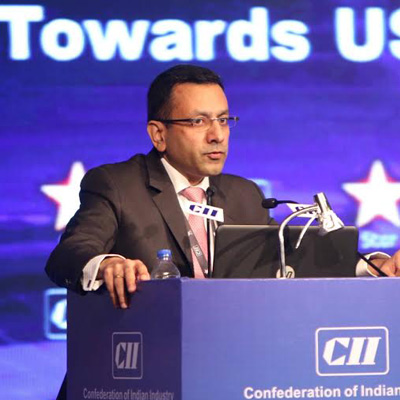
    Speaking at a CII conclave in New Delhi today, Star India COO Sanjay Gupta lamented this fact that saying that from 0.8 per cent of GDP three years ago, the industry had resolved to grow to 1.5 per cent within a decade. However, in the past three years, media as a percentage of GDP has instead fallen by two basis points and the $100 billion dream has continued to remain distant.

    “The biggest hurdle has been the choking of investment. To meet ambitious targets, a business either needs to generate large profits internally, which are then invested back into the business or they grow on the back of external investments – national or international. But the M&E industry boasts of neither,” he said

    CII National Committee on Media and Entertainment and Group CEO, Viacom 18 Group CEO and CII National Committee on Media and Entertainment chairman Sudhanshu Vats, Prasar Bharati CEO Jawahar Sircar, Information and Broadcasting Ministry special secretary JS Mathur and Minister of State for Information and Broadcasting Rajyavardhan Singh Rathore were among those present at the summit.

    During the past 15 years, the M&E sector has barely seen any new entrants and only around $4 billion in foreign direct investment (FDI). To garner $100 billion, the industry needs to invest at least $50 billion over the next decade – something that seems farfetched, given the present circumstances. “With M&E remaining an unattractive destination for investments, investors have no interest to invest in a fragmented and unprofitable business. Despite the 12 per cent year-on-year growth touted for the industry, the sector is paradoxically riddled with a host of unprofitable verticals. For example, sports is a $2 billion industry that could easily grow to around $10 in the next five years. Be it Hockey, Football, Kabaddi or Badminton, the new sporting leagues are being lapped up by the audiences,” Gupta said.

    Yet, the M&E industry has been unable to take off on the back of these investments. “Although Star India has been investing almost Rs 200 crore every season for the past two years, dividends are not commensurate. For this to happen, one needs to scale up the volume of content. In other words, more teams, more players and more days of Kabaddi are required annually to capitalize on this opportunity,” Gupta added.

    “A bizarre challenge confronts us here, however. Although Punjab and Haryana contribute large numbers of Kabaddi players, one cannot add more teams based in either of these two states because they do not have a single indoor stadium that could host a Kabaddi match. In Mumbai, the game is hosted at the NSCI Dome, but the biggest constraint is the availability of this facility for a reasonably long period of time. One venue for a city with more than 1,000 Kabaddi clubs simply does not make sense. In this case, consumer interest and the ability to invest are no hurdles, but the fact that the sporting infrastructure required is simply non-existent. Worse, there are no plans to address this situation,” Gupta continued.

    The movie business is no different. With around 7,000 screens, India has one of the world’s lowest screen densities. Despite breakthrough movies such as Queen, PK or Bajrangi Bhaijaan, revenues are stagnant, although the cost of producing these movies has soared dramatically in the past decade. Therefore, a $2 billion industry that sets a billion hearts racing earns zero profits.

    Even news channels fare no better. Without a robust business model, news channel have no money to invest in their business. Whether English or regional, number one channel or last, none of the channels make any money because none earn any money from subscription. Globally, subscription contributes as much as 60-70 per cent of the total earnings of a news channel.

    Television distribution is roughly a third of the total value of the media industry. In the past few years, immense investments have been made in both direct to home (DTH) and the cable business. But the tragedy of this sector is that even after many years of continued investment not a single company or business makes any money. Since the sector is considered a basic need from a consumer viewpoint, the prices at which content is sold by creators to platforms is regulated – prices frozen in 2003 haven’t changed in the past 12 years. In the same 12-year period, even the price of milk has jumped from Rs 12-15 a litre to Rs 35-40 a litre. 

    “Such anomalies are making the sector bleed. But no one seems to care,” Gupta lamented. “In Delhi, for example, the new government has doubled entertainment tax. Consequently, almost 30 per cent of revenue is paid as entertainment tax. The lack of political alignment and consistency of policy in the sector makes it impossible to plan a sustainable business model.”

    In 2015, where millions across the country receive their daily dose of news from Facebook feed, radio broadcasters can only air news snippets from All India Radio (AIR). “In the US, radio has gone hyper local and people spend an hour daily listening to radio. This gives a fillip to local brands since a quick and cheap platform is available to build their business. In India, conversely, there are a limited number of radio stations and limited content that can be aired – and without any news. It is no surprise then that even in large cities where FM exists, the time spent on radio per person is five minutes. Can any industry on Earth make money in such circumstances?” he asked.

    Gupta concluded by asserting, “Unless we unblock minds, we cannot unblock capital.”

    Accordingly, there is an urgent need to make distribution profitable, position animation as the next wave of export-oriented growth, support a serious scale-up of exhibition screens and sports stadiums and allow content innovation in radio. A hugely attractive pitch for domestic and international investors is required, giving them clarity on the policy environment for the next 10 years and confidence of generating sizeable returns on the investments.

    All stakeholders, businesses, policymakers and regulators need to stop being happy with the status quo and incrementalism. In the new era backed by technology, every sector from automobiles to financial institutions and even grocery shopping have witnessed dramatic growth and serious disruptions on the back of serious flow of capital.

    “M&E too needs to see brave new entrepreneurs, disruptive ideas and unconventional business models but this will only happen if we unblock the capital,” stressed Gupta.

  • ‘The more local digital advertising gets, the more effective it will be:’ Amagi co-founder KA Srinivasan

    ‘The more local digital advertising gets, the more effective it will be:’ Amagi co-founder KA Srinivasan

    In this era of digitisation, the advertisement ecosystem has taken a big leap with digital advertising entering the fray. There was a time when people used to read advertisements, and then with the advent of television came visual ads, which could only be shared by word of mouth. Now with access to internet, ads can be read, seen and shared with help of just one device.


    With brands choosing the digital platform to announce launches of new products with help of email marketing, search engine marketing mobile and web marketing, have now given ads a new dimension to reach people. Digital advertising has broken the limitation of time slot for ads and has increased reach by leaps and bounds.


    Amagi co-founder KA Srinvasan spoke to  Indiantelevision.com about geo-targeted marketing, brands shifting towards digital marketing and much more.


    Excerpts:


    Many channels are tying up with Amagi for geo targeting. Property Now from Times Network is one of them. Do you think split broadcasting will be the way forward?


    Hyper local advertising will be the future of broadcast and television; in general it is going to be more geo targeted. Customised content created as per consumer’s preference is going to have a lot of impact. With the concept of geo generic mass content, as content becomes more local, the ad’s visibility for viewers will increase. Nowadays, content is created based on country, city and regional level not just in India but across the globe. The original goal for over-the-top (OTT) in digital world is to personalise lifestyle and provide content depending on consumer’s interest, preferences and their past watching behavior.


    What do you think will define the new era of effective advertisement?


    The change that we have observed is the more local advertisements get, the more effective it will become. Many of our advertisers are targeting specific local audience. It is effective from both advertising and communications perspective. Viewers will identify the product and advertisers will have a much better brand name at regional levels. From a content owner’s perspective, more advertisers will be able to reach out and from a broadcaster’s perspective, the future is all about getting local in terms of content.


    Now after installation of your technology in multiple system operators’ (MSO) headend, how do you plan to seize digital?


    Keeping that in mind, we launched a product called Thunderstorm, which allows television content owners and television networks to provide personalised advertising in the digital space. Our customers will be able to deliver their content over mobiles, tablet, and television screens and on web. However, there is one problem with monetising the content as the ads, which are telecast on television and which go on the sites are the same. The same goes with handsets. Everyone is watching the same ad on mobile but it is not giving any revenue. We have built a platform that allows advertising networks to have completely different advertising depending on the targeted audience and geographical area.


    Is Amagi focusing more on the digital space now?


    We are enabling content on advertising for television and helping local network owners to ‘hyper local’ the ad content. As content viewing shifts more towards digital, we are trying to bring the product in a more personalised way in digital. Our aim is to personalise and localise cable, television and digital.


    From many years the ten second ad slot has been ruling television and continues to do so. What more will the digital medium adapt?


    Today, the digital media is used as a distribution platform by television networks. What we are trying to do is, using the same content in different versions and using the digital platform for distribution of these ads. In terms of distribution, digital can do much better experimentation and inter-activity than what traditional television offers. Many advertisers are not only creating one commercial but creating multiple versions of it. On the digital platform, attention time span is going to be very limited as compared to traditional television. And because of this broadcasters and advertisers are experimenting. They are trying to create content, which can get the brand name in just five seconds, so that the user does not skip it.

    Digital allows fine grain targeting and that is the reason why we are able to do a lot more interesting stories. It is going to evolve and shift the platform from television to digital. We will then see more of digital specific content. 


    How many broadcasters do you have on board right now?


    We have around 20 plus broadcasters and multiple television channels across many countries. And at the end of this financial year we will have 40 plus channels. And many of them are from traditional satellite and television that are shifting towards the digital platform.


    You talked about the product Thunderstorm for creating personalising content for advertising. What are the new innovations that Amagi is currently focusing on?


    We have partnered with television networks to conceptualise content better. Geo targeting is focusing on satellite to help advertisers in creating personal advertising. We aim to eliminate satellite completely and move to digital where they can use closed bar internet technology. By using that platform, they can deliver their content in fraction of the cost to operators and consumers not only in India but around the world. Many big platforms are leveraging ahead from traditional television and satellite. We see rapid growth in terms of digital advertising in future.