Tag: Digital TV

  • GTPL Hathway is gearing up to make a major HIT

    GTPL Hathway is gearing up to make a major HIT

    MUMBAI: In India’s noisy and fragmented cable TV business, where margins are wafer-thin and infrastructure is patchy, a quiet revolution is taking place above our heads. Quite literally. India’s largest cable and broadband heavyweight ) GTPL Hathway is choosing to break free from the grid by betting Rs 100 crore on a satellite-led future—launching a full-scale headend-in-the-sky (HITS) operation designed to reach the parts of India that cable lines and fibre have long ignored.

    This isn’t just an upgrade—it’s a strategic reinvention. One that could upend the rules of TV distribution across Bharat.

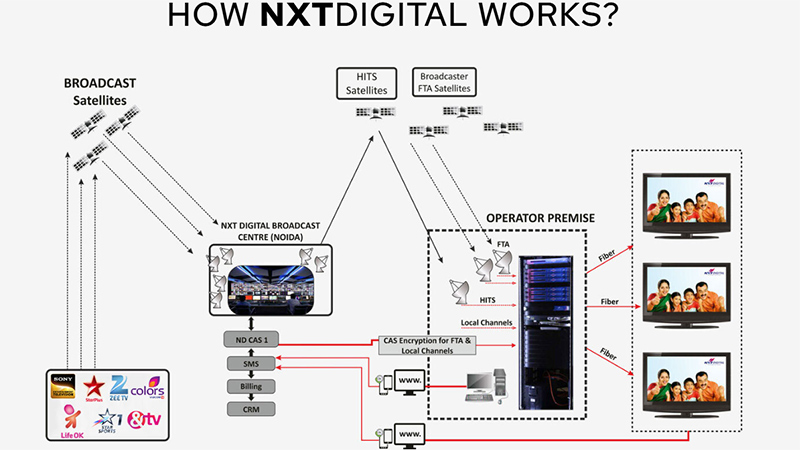
    From a sleek new uplink facility in Ahmedabad, GTPL is readying to transmit up to 900 encrypted, multiplexed channels using 12 leased C-band transponders from Indonesian satellite operator Telkomsat. The satellite signal is then beamed directly to local cable operators (LCOs), who deliver the final mile using existing coaxial or fibre lines.

    It’s a model that minimises capital investment on the ground while maximising reach—especially in India’s 130–135 million “TV-dark” homes, a figure larger than the total households of Japan and the UK combined.

    GTPL’s move brings it squarely into competition with the Hinduja-owned Nxt Digital, India’s sole HITS player until now, with a subscriber base of 2.4 million. Nxt has played a steady game—providing shared uplink infrastructure, cost-effective Cope (cable operator premises equipment) units priced between Rs 10.6–14 lakh, and STBs from Chinese OEMs like Changhong and Telesystems.

    Its model helped reduce per-subscriber costs dramatically—from Rs 17 to just Rs 7 in some cases—offering a lifeline to smaller MSOs (multi-system operators) struggling to comply with the regulatory shift to digital. But Nxt’s footprint, while impactful, has remained modest.

    GTPL is playing a different hand: scale. With 9.6 million cable TV subscribers already on its rolls and strongholds in Gujarat, Maharashtra, West Bengal and Bihar, the company intends to transition its entire base to HITS delivery over the next 24–36 months.

    The vision? To be India’s largest HITS network—leapfrogging not only NXT, but also traditional satellite and cable architectures in one swoop.

    This pivot is part of GTPL’s broader Rs 350 crore capex outlay for FY25, which also includes new broadband infrastructure and set-top boxes. The numbers make a compelling case: annual bandwidth costs, currently pegged at Rs 85–90 crore, are expected to drop by half.

    Projected revenues from the satellite platform are equally promising. At 750,000 subscribers, GTPL expects to generate Rs 99 crore annually. That rises to Rs 132 crore with 1 million users. Add Rs 12 crore more from leasing infra services to 50 smaller MSOs (each paying Rs 2 lakh per month), and the business case becomes hard to ignore. Even under conservative adoption rates, the Rs 100 crore investment could be recouped within 12 months.

    GTPL’s HITS play isn’t just about broadcast—it’s also about backend tech. The company is deploying a hybrid business model: retailing bundled TV channel packs to consumers via LCOs while offering platform-as-a-service tools to smaller MSOs. These include uplinking, encryption, conditional access system (CAS) and subscriber management system (SMS) solutions—effectively turning GTPL into a SaaS player for the cable industry.

    In a sector plagued by fragmentation, opaque billing, and outdated infrastructure, this modular model could be just the reset smaller operators need to stay compliant, competitive, and cost-efficient.

    India’s content delivery puzzle has long had three flawed pieces. OTT remains hobbled by poor last-mile broadband in rural areas, with even state-run BharatNet struggling to scale. DTH, while more pervasive, has long suffered from weather interference, installation costs, and churn. Cable TV, once the lifeline of urban India, is now chafing under regulatory pressure and infrastructure bottlenecks.

    Enter HITS—a model that combines the robustness of satellite delivery with the flexibility of LCO-based distribution. It’s weather-resistant, quick to deploy, and doesn’t require laying new wires in hard-to-reach zones.

    As a middle path, HITS may well become the delivery standard for Bharat—the vast, value-driven, and still under-connected expanse of Indian television.

    Surprisingly, GTPL’s skyward expansion has not been met with resistance. The All India Digital Cable Federation (AIDCF) has raised concerns around broader issues like OTT content regulation and fair play by broadcasters—but not specifically about the HITS model. Major networks such as Zee, Sony, and Disney Star have voiced concerns over the pricing dynamics introduced under TRAI’s NTO 3.0 framework, but formal objections to GTPL’s satellite platform are absent.

    The company, for its part, holds a valid grant of permission agreement (GOPA) from the ministry of information & broadcasting (MIB) and has participated in various TRAI and MIB consultations, signalling alignment with the regulatory ecosystem.

    GTPL’s pricing strategy will be region-specific, with affordability and adaptability built in. Final LCO-facing Cope and channel package rates will be finalised once broadcasters declare new pay channel prices. While margins may initially be tight, the long-term play is rooted in volume, retention, and backend monetisation.

    This isn’t a short-term stunt—it’s a structural realignment of India’s content delivery infrastructure.

    GTPL’s satellite push is more than just a tech upgrade—it’s a masterstroke of timing, vision, and market understanding. With one eye on underserved consumers and the other on the backend tech stack, the company is positioning itself as both a broadcaster and a platform.

    As India’s media future heads skyward, GTPL’s HITS move may well become the blueprint for digital inclusion across Bharat.

    (If you are an Anime fan and love Anime like Demon Slayer, Spy X Family, Hunter X Hunter, Tokyo Revengers, Dan Da Dan and Slime, Buy your favourite Anime merchandise on AnimeOriginals.com.)

  • India, Africa growth propels Bharti Airtel to  strong Q3 FY25

    India, Africa growth propels Bharti Airtel to strong Q3 FY25

    MUMBAI:  It is one of the two telco bellwethers in India, the other being Jio. And it appears to be doing very well, thank you going by Bharti Airtel Ltd’s  consolidated results for the third quarter ended 31 December 2024. It reported significant growth driven by momentum in India and stable performance in Africa.

    Financial Highlights:

    * Consolidated revenue rose 19.1 per cent  year-on-year (YoY) to Rs 45,129 crore, up 8.8 per cent  sequentially.
    * Consolidated EBITDA stood at Rs 24,880 crore, marking a 24.1 per cent  YoY increase, with a margin of 55.1 per cent.
    * EBITDA after lease expenses (EBITDAaL) increased by 26.1 per cent  YoY to Rs 21,474 crore, reflecting a margin of 47.6 per cent .
    * EBIT grew 33.3 per cent  YoY to Rs 13,126 crore, with a margin of 29.1 per cent .
    * Net income (before exceptional items) reached Rs 5,514 crore, up 121.3 per cent  YoY.
    * Capex for the quarter totalled Rs 9,161 crore.

    India Business Performance:
    * Revenue from India operations rose 24.6 per cent  YoY to Rs 34,654 crore.
    * Mobile services revenue increased by 21.4 per cent  YoY, driven by tariff adjustments, higher smartphone adoption, and portfolio premiumisation.
    * Mobile average revenue per user (ARPU) improved to Rs 245, up from Rs 208 in Q3 FY24.
    * Mobile data consumption surged by 23.2 per cent  YoY, with average consumption per customer at 24.5 GB per month.
    * EBITDA rose 32.3 per cent  YoY to Rs 19,850 crore, with an EBITDA margin of 57.3 per cent .
    * EBITDAaL stood at Rs 17,641 crore, with a margin of 50.9 per cent .
    * Capex for India operations was Rs 7,980 crore.
     

    Segment Highlights:

    * Homes Business: Revenue grew by 18.7 per cent  YoY, with 674,000 net customer additions driven by fibre-to-the-home (FTTH) and fixed wireless access (FWA). The customer base reached 9.2 million.
    * Airtel Business: Revenue increased by 8.7 per cent  YoY despite global pressures. Emerging digital services, including cloud and security, showed strong growth.
    * Digital TV: Revenue declined by 2.9 per cent  YoY to Rs 761 crore. The customer base stood at 15.8 million.
    * Passive Infrastructure Services: Contributed 5.7 per cent  YoY and 5 per cent  quarter-on-quarter (QoQ) to India revenue growth.

    Africa Operations:
    * Revenue in constant currency rose by 21.3 per cent  YoY.
    * EBITDA margin stood at 47.1 per cent , while EBIT margin was 29.4 per cent .
    * Customer base reached 163.1 million.
    * Capex for Africa operations totalled Rs 1,181 crore.

    Operational Achievements:
    * Bharti Airtel rolled out approximately 5,200 towers and 16,300 mobile broadband stations during the quarter.
    * The company expanded its fibre network by 47,100 km YoY.
    * The anti-spam tool notified 252 million customers and identified over 1 million spammers.
    * Airtel’s AI-driven network detected over 7 million spam SMS daily.
    * Zee5 was added to the Airtel Xstream Play platform, enhancing content offerings.

    Debt Management:
    * Net debt to EBITDAaL ratio (excluding lease obligations) stood at 1.56 times.
    * The company prepaid Rs 3,626 crore towards deferred spectrum liabilities.

    Vice-chairman &  managing director Gopal Vittal commented: “We delivered a strong quarter with consolidated revenue of Rs 45,129 crore. Our India mobile business showed robust performance, driven by tariff adjustments and premiumisation. We continued to lead the industry with ARPU growth and added 6.5 million smartphone users. Homes business saw accelerated customer additions, while Airtel Business navigated global headwinds with stability.

    “Our strong cash generation and prudent capital allocation allowed us to continue deleveraging and prepay high-cost spectrum dues. Further tariff corrections are necessary to sustain investments and create long-term value for the industry,” he added.

  • NxtDigital launches its flagship integrated solution ‘OneDigital’

    NxtDigital launches its flagship integrated solution ‘OneDigital’

    Mumbai: Hinduja Group’s NxtDigital has announced the introduction of its flagship integrated solution, OneDigital. This customised customer solution provides a wide range of services, including wi-fi, digital TV, OTT, voice/intercom, broadband, and CCTV.

    When compared to broadband packages, which range in speed from 10 mbps to 1 gbps, the TV solution offers clients up to 650 TV channels in both standard and high definition.

    Customers can access over 3,00,000 hours of OTT content from top global and regional platforms through OneDigital on any device.

    Customers can still be reachable over an IP or telecom network and have a personalised landline number with the help of its partners’ VOIP (voice over internet protocol) service, which is available nationwide. ONEDigital may offer customised CCTV solutions and wi-fi-enabled internet access in public spaces as part of the solution.

    Speaking at the launch of OneDigital at SCAT 2022, NxtDigital’s broadband subsidiary OneOTT Intertainment chief operating officer and OneDigital project lead Sanjeev Agarwal said, “Consumer preferences are radically changing in the way they not only consume but also access and engage digital services at home or at work. OneDigital has been designed specifically based on that premise to give customers access to all digital solutions for their home and office through a single business conduit  facilitating true digital convergence and much needed convenience.”

    He further added, “The USP is that this is a bespoke end-to-end solution and can be tailored based on a customer’s specific needs—whether for home or a small, medium, or large business. This is the start and we will, of course, continue to add more products to the OneDigital portfolio over time.”

    The company also unveiled its future OTT content aggregator app, which will enable users to access OTT content from leading local and international platforms.

    The app, which will soon be accessible online, will allow users access to over 3,00,000 hours of international and local material at first and pave the way for the integration of education, gaming, and other apps within the solution.

    The company has already built an ecosystem of partners to provide quality VOIP and CCTV hardware and software solutions. In order to fulfil customer demands from pre-sales and installation to service support and troubleshooting, NXTDIGITAL has started training its digital franchisees throughout its TV and broadband businesses. OneDigital is now being introduced in Mumbai and will be made available in additional significant cities by the end of the year.

    NxtDigital chief operating officer NK Rouse said, “We have over the years built a robust infrastructure, a strong subscriber base, and a national network of franchisees, all backed by best-in-class technology, including our HITS platform and our award-winning NxtHubs.”

    He further added, “OneDigital and NxtPlatly are extensions of our solutions portfolio, focusing on emerging technologies and the need to develop solutions with an eye on the future. We have also commenced training our franchisee partners to make the paradigm shift to digital solutions providers, ready for the next decade of growth that will also include broadband over satellite.”

    The award-winning NxtHubs that NxtDigital owns and operates, which just passed 100 locations and already provide digital TV, broadband, and OTT solutions in the majority of locations, will try to offer one digital solution.

    NxtDigital is hoping to leverage the strength of its planned broadband-over-satellite service to augment the solution in countries where terrestrial connectivity may be an issue.

  • Important to have a product portfolio that can stand the next decade of digital growth:  NxtDigital CEO

    Important to have a product portfolio that can stand the next decade of digital growth: NxtDigital CEO

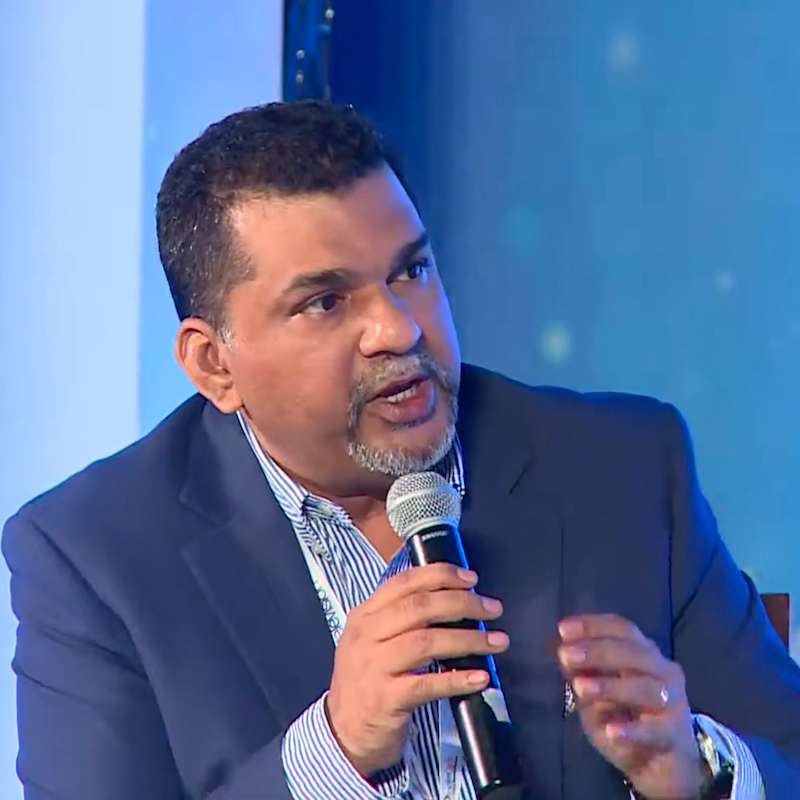
    Mumbai: NxtDigital has upskilled 30-35 per cent of its workforce in digital technology, in addition to making a complete shift to the pre-paid model through enabling digital payment mechanisms, said MD and CEO Vynsley Fernandes as he talked about the company’s transformation from a cable company into a digital platforms company.

    Fernandes was in a fireside chat with Indiantelevision.com group founder CEO and editor-in-chief Anil Wanvari at the 18th edition of Video & Broadband Summit (VBS 2022) organised by Indiantelevision.com on Wednesday.

    Pandemic as the trigger point

    The digital metamorphosis of NxtDigital, as well as the ecosystem as a whole, started a couple of years back in 2019 when the new tariff regime (NTO) was introduced, but it was the pandemic that actually gave impetus to it. “One of the biggest learnings from the pandemic was that digital aspirations are not limited to the city dweller. The tier 2, 3, and 4 towns, even though poorly connected to both TV and broadband, are equally aspirational. At least 60 per cent of our base comes from the semi-urban, semi-rural and rural markets, and yet there’s still significant growth that has to be achieved,” said Fernandes.

    Realising the importance of supporting these markets, the company set up digital Nxthubs at locations across India to deliver digital TV with up to 650 channels, broadband, and OTT.

    Also read : NxtDigital launches 40 NxtHubs across India

    The pandemic also forced the traditional distribution platforms that were facing challenges due to changing consumer preferences, to look at new strategies for growth, and new technology for fresh, and innovative products. This, combined with the realisation that customers increasingly want a single window to manage their multiple products and solutions, led NxtDigital to launch three new offerings including an advanced android set-top box, TV stick, and a combo product providing access to around 700 TV channels, OTT content (including regional) and broadband with speeds up to 1000 Mbps. The company had also introduced a work-from-home bundle during the pandemic.

    “We have been extremely cognisant of the fact that times are changing, and we need to be at the forefront to be able to harness technology to deliver the best experience to customers,” said Fernandes.

    Also read : Nxtdigital launches ‘live’ TV stick and Android STB

    Working with broadcasters and LMO/digital service partners

    Transformation is never an easy process. Like any other change that is met with resistance in the beginning, it took some effort for NxtDigital to convince and train its digital service partners, also the Last Mile Owners (LMOs), to support the implementation of the fully digital payments enabled, pre-paid model.

    And the results have been quite positive. “While individual verticals may have seen some softening, the absolute growth in terms of revenue for the LMOs saw an uptick because of the increased ticket size allowed by the combo product (Broadband + OTT+ Digital TV). Our partners are now, in fact, excited to know about the next digital service they can offer customers,” shared Fernandes.

    As far as broadcaster partners are concerned, he added that even though they have largely been supportive, there’s the need at the top of the pyramid for more patience and the understanding that the industry is still in a state of flux. It will take some time for the metrics to be worked out, and for the results to start manifesting as significant gains. 

    “Though we can’t yet call it significant, there has been steady growth in the business quarter-on-quarter, and this not necessarily from just the video business, but also broadband and OTT. The overall pie has definitely grown, and the stakes are only getting better from here as long as collaborations and innovation come into play,” asserted Fernandes. 

    Also read: I&B ministry lays down guidelines for infrastructure sharing by MSOs

    Appreciating the government’s new guidelines for infrastructure sharing, he remarked, “A DPO can no longer say that it cannot service a client/region because of the high cost of connectivity. As we see a lot more infra sharing happening, broadcasters will also be a beneficiary to that growth.”

    Word of Caution

    As a word of caution, Fernandes pointed out four themes that players need to align themselves with to thrive in the digital future.

    Commenting on the fate of cable and broadband he noted, “Cable will continue to grow, more so with I&B Ministry’s infrastructure sharing guidelines for MSOs announced last December.  However, there will be significant growth in broadband. This has also been indicated by Trai’s recommendation on AGR (adjusted gross revenue) that will encourage cable operators to provide broadband services. The one thing that’s clear is that the government is looking at facilitating the growth of the industry.”

    Fernandes’ third observation was that broadband over satellite and regionalised OTT will start to make inroads over the next couple of years. Lastly, the characteristics of the business will impact single product companies. In the ‘and’ world that awaits, cable or broadband or OTT alone will find it difficult to survive. The future will belong to those who are able to leverage technology to combine them externally and internally into a robust product.

    Fernandes believes that NxtDigital’s product portfolio comprising broadband, HITS, digital cable television, content syndication, and teleshopping will stand the company in good stead. He surmised by saying that “It is necessary to have a product portfolio that can stand the next decade of digital growth.”

    The day-long virtual summit held on 19 January was co-powered by broadpeak. Disney Star was the presenting partner, while NxtDigital was the summit partner.

  • Airtel Digital TV operating revenue up as bottom line dips for first quarter

    Airtel Digital TV operating revenue up as bottom line dips for first quarter

    BENGALURU: The digital TV services segment from Sunil Mittal’s Bharti Airtel Ltd (Airtel), Airtel Digital TV, which provides direct to home (DTH) satellite television services, reported growth of 0.8 percent in operating revenue at Rs 744.8 crore for the quarter ended 30 June 2020 (Q1 2020, quarter or period under review) as compared to Rs 738.9 crore for the corresponding quarter of the previous year Q1 2019 (y-o-y). However, this is not a true oranges-oranges comparison, since as of 1 March 2020, Airtel Digital TV services has implemented new guidelines of NCF (Network Carriage Fees) under the new tariff order (NTO) from Telecom Regulatory Authority of India (TRAI). The company says in a media release that Airtel Digital TV revenue witnessed a growth of 9.3 percent y-o-y on an underlying basis, on the back of strong customer additions.

    Airtel Digital TV operating profit for the quarter under review declined 23.5 percent to Rs 276.2 crore (37.1 percent of operating revenue) as compared to Rs 361.2 crore (48.9 percent of operating revenue) for Q1 2020. Airtel reported 1.3 percent growth in Assets to Rs 3,462 crore for Q1 2021 from Rs 3,417.4 crore in Q1 2020. However, Assets in Q1 2021 were 12.9 percent lower than the Rs 3,794.9 crore in the immediate trailing quarter (Q4 2020). The segment’s liabilities for Q1 2021 grew 11.6 percent to Rs 4000.5 crore from Rs 3,585.2 crore in Q1 2020. Liabilities in the quarter under review were however 3 percent lower than the Rs 4,122.4 crore in the immediate trailing quarter Q4 2020.

    The company reported a 5.1 percent y-o-y increase in net DTH subscribers in Q1 2021 at 1.68 crore as compared to 1.6 crore in the corresponding quarter of the previous year.

    Bharti Airtel’s consolidated revenue for Q1 2021 grew 15.4 percent on an underlying basis to Rs 23,939 crore as compared to the year ago quarter. Consolidated EBIDTA for the quarter under review was Rs 10,639 crore (44.4 percent margin). India revenue at Rs 17,589 crore were up 14.6 percent and up 15.1 percent on an underlying basis y-o-y.

    An earnings media release for Q1 2021 quotes Airtel MD and CEO, India & South Asia Gopal Vittal: “We are going through an unprecedented crisis caused by COVID. Despite this, our teams have served the country well and kept our customers connected. Data traffic growth surged by ~73 percent y-o-y even as 4G net additions slowed down to 2 Million caused by supply chain shocks in the device ecosystem. Revenues grew by 15% Y-o-Y and performance was satisfactory across all segments. Our flagship “War on Waste” program, helped improve EBITDA margin by 1.6 percent over the previous quarter. To serve our customers even better, we have launched a company-wide program to improve our customer experience. We continue to invest in the best of emerging technologies to make our networks future ready. We have made rapid strides in our digital business, with nearly 155 million monthly active users across Airtel Thanks, Wynk, Xstream and our payments platforms. Today, 60 percent of Airtel’s entire business goes through its digital channels. We are most excited about the string of partners we are attracting in order to build greater stickiness and ultimately growth from our digital assets.”

    Follow Tellychakkar for the consumer facing news & entertainment

  • Airtel digital TV revenue up 16.9% in Q4

    Airtel digital TV revenue up 16.9% in Q4

    MUMBAI: Bharti Airtel on Monday posted its fourth quarter results for the fourth quarter of financial year 2019-20. While revenue was up seven per cent at Rs 23,723 crore on a quarter-on-quarter basis, it has registered a consolidated loss of Rs 5,237 crore year-on-year. Mobile services revenue has increased 21.8 per cent YoY and 16 per cent quarter to quarter.

    Airtel's journey as a digital business continued strongly in Q4’20. The company has over 160 million Monthly Active Users across digital assets – Airtel Thanks, Wynk and X Stream. It has over 1.1 million retailers transacting and making payments every day on our Mitra App.

    Today over 60 per cent of its entire business goes through digital channels, and with share of AirtelThanks platform growing strongly to now become the second largest platforms for user payments online.

    Digital TV revenue witnessed strong growth of 16.9 per cent YoY on an underlying basis, on the back of strong customer additions.

    While overall customer base stood at 423 million across 16 countries, EBITDA stood at Rs 10,326 crore, up 51.7 per cent YoY.

    Voice usage per customer increased to 965 million against 898 million for the telecom service operator, showing an increase of 7.5 per cent quarter to quarter.

    The mobile ARPU in India business was at Rs 154 against Rs 135 QoQ, a growth of 14 per cent.

    The company had posted a profit of Rs 107.2 crore in the same period a year ago. It registered a consolidated revenue of Rs 23,722.7 crore during the reported quarter against Rs 20,602.2 crore in the corresponding quarter of 2018-19.

    The company has undertaken a capex investment of Rs 25,359 crore on a consolidated basis during the year to ensure superior customer experience besides front ending some investment to ensure seamless services during the ongoing pandemic.

    Airtel Business witnessed a double digit revenue growth of 12.4 per cent YoY led by increased focus on connecting large enterprises, SMEs besides providing innovative solutions. Homes business continues to remain resilient and shows significant long-term promise in the wake of the new normal of work from home and social distancing established post the Covid2019 situation.

    Gopal Vittal, MD-CEO, India & South Asia, said: “These are unprecedented times for every one across the world as we battle the impact of Covid2019 and its consequent impact on livelihoods. Even in this difficult time, it is our investments in network technologies coupled with our culture of customer obsession that has allowed us to keep the nation connected and serve our customers. It is abundantly clear today that telecom has played an essential role in keeping the country going. We are therefore hopeful that the government will implement the recommendations of the TRAI and the intent of the New Telecom Policy and bring down the high levels of regulatory levies and taxes that the sector is subjected to. The quarter gone by saw healthy revenue growth of 14.4 per cent YoY with mobile business growing at 21.8 per cent. This was driven by two factors – sustained momentum of 4G customer additions of over 12.5 million coupled with improved tariffs. We continue to witness strong data traffic growth of 74.1 per cent YoY. Going forward we remain committed to delivering a best in class customer experience even as we leverage our platform to build new revenue streams.”

  • Airtel to issue single bills to DTH, post paid & broadband customers

    Airtel to issue single bills to DTH, post paid & broadband customers

    MUMBAI: Bharti Airtel is creating a new way to increase its average revenue per user (ARPU) that involves an integrated payment solution combining the bills of DTH, broadband, fixed line and postpaid mobile, as per a report in Livemint. It is also likely to give a 5-10 per cent discount on the integrated payment.

    The report quotes the source as stating that the bundling will do away with the hassle of multiple bill cycles and will increase loyalty. The move comes against the backdrop of Reliance Jio’s disruption. Livemint states that the test is currently on in Hyderbad and the first launch will be in seven to 10 days in some southern cities.

    Jio has also mentioned that it will look at bundling its services like 100 mpbs connection, JioTV and VoIP. Airtel is looking at increasing its investment in the broadband segment where it also bundled its OTT apps Wynk Music and Airtel TV.

    Airtel Digital TV boasts of 14.2 million customers with an ARPU of Rs 228.

  • Digital TV, growing telecom major drivers of coaxial cable growth in A-Pac: Study

    Digital TV, growing telecom major drivers of coaxial cable growth in A-Pac: Study

    MUMBAI: The global coaxial cables market is mature owing to the use of coaxial cables in industries for a long time and the slow or stagnant product innovation.

    Coaxial cables are used for supplying television channels and providing Internet access and telephony services to homes and offices. They are also used for connecting equipment in mobile telecommunication stations and antennas.

    Technavio’s latest report on the global coaxial cables market provides an analysis of the most important trends expected to impact the market outlook from 2017-2021.

    Countries like the US, Germany, France, Japan, and China are the biggest existing markets for coaxial cables, with developing countries in APAC and MEA contributing the highest toward market growth. Regions like the US already have a large network of coaxial cables connecting almost all the CATV (community antenna television, commonly known as “cable TV”) subscribers. The driver for these cables in developed regions is the growth of broadband cable Internet users, while the major driver in developing nations (including India) is the adoption of digital television and the rapidly growing telecommunication sector.

    The top three emerging trends driving the global coaxial cables market according to Technavio heavy industry research analysts are: Growing investment in the aerospace sector Expanding infrastructure and construction growth Increase in global defense spending

    Growing investment in the aerospace sector: The aerospace and defense sector is a major user of coaxial and micro-coaxial cables. These are used to provide interconnection between essential electronic components in aircraft. Since aircraft have several radio communication equipment, isolation of the radio signals is critical for the smooth functioning of this equipment, which makes coaxial cables play a major role in electronic communication. These factors are likely to boost the global coaxial cables market in the coming years and drive its demand even higher.

    “Major aircraft manufacturers such as Airbus and Boeing are looking to increase production to meet the delays caused in aircraft deliveries. The commercial aircraft sector is likely to witness robust growth in aircraft demand, especially for smaller and medium-sized aircraft from domestic carriers as industry profits rise,” says Anju Ajay Kumar, a lead analyst at Technavio for research on engineering tools.

    Expanding infrastructure and construction growth: The rising economic activity and rapid urbanization will be driving the growth in new infrastructure and construction. To support the growing demand from various demographics segments, services like telecom and Internet access are necessary. Expansion in these sectors will directly impact the demand for coaxial cables.

    “China, Vietnam, and India will be spending a significant share of their GDP on average in infrastructure development. The fastest growing economy in the region, Vietnam, will need to invest hundreds of billions in infrastructure development to match up with its neighboring countries. The surge in demand for mobile devices equipped with next-generation wireless Internet access is likely to spur the construction and demand of mobile towers, stations, and related equipment, which are large consumers of coaxial cables,” adds Anju.

    Increase in global defense spending: The rising economic activity and rapid urbanization will be driving the growth in new infrastructure and construction. To support the growing demand from various demographics segments, services like telecom and Internet access are necessary.

  • Pay-TV: India among four countries which contributed $16 bn rev between ’10 & ’16

    MUMBAI: In 138 countries, pay-TV revenues increased by $32 billion (Rs 2063 billion) between 2010 and 2016, to reach $202 billion. However, according to the Global Pay TV Revenue Databook from Digital TV Research, only $1.23 billion was added last year (in 2016).

    Almost 50 per cent of the $32 billion additional revenues came from four countries: the US provided $7 billion, Brazil $3 billion, China $4 billion, and India $2 billion, Advanced Television reported. Revenues, however, declined in nine countries, primarily owing to subscribers converting from standalone TV to bundles (which are less lucrative for TV). Between 2010 and 2016, revenues of pay-TV more than doubled in 59 countries.

    Digital TV Research principal analyst Simon Murray said that, although no decline was recorded, European pay-TV revenue growth had slowed down considerably. Despite its pay-TV revenues being higher in 2016 than in 2010, North America had peaked in 2015, Murray added.

    The Asia Pacific region positively added $10.21 billion between 2010 and 2016 – increasing by 42 per cent to $34.38 billion. Latin America hiked by 78 per cent to $18.44 billion. Sub-Saharan Africa more than doubled its total revenues to $4.20 billion.

    In all 49.5 per cent global pay-TV revenues in 2016 came from the US; for the first time falling below the halfway median. The 2016 total — 54.5 per cent in 2010 — is down. The US is followed by far by China, the UK, Japan, and Canada. Two-thirds of global pay-TV revenues in 2016 was generated by these five nations.

    Also Read :

    Pay TV-DTH gains: Airtel leads subs race as Jio could pose challenges

    Tata Sky offers top channels & services

  • Ortel MSO offers 1 TB plan at 100 Mbps with free digital TV

    MUMBAI: Ortel Communications has unveiled its one terabyte at a mega speed of 100 Mbps priced at Rs. 4,999. Ortel has also announced the withdrawal of all its data plans below 1 Mbps speed.

    The new plans are available from Rs. 299 onwards and the choice of speeds can range upto 100 Mbps for homes, whereas the SMEs and corporate can choose their speeds even beyond 100 Mbps using fiber leased lines. Existing customers will automatically be upgraded to this speed, thus enhancing their overall browsing experience. The data limits too have been increased multi-fold at nominal prices.

    The company plans to increase the number of hotspots considerably during the current year. Earlier, it had offered Free Broadband to its existing Digital TV subscribers.

    Ortel Communications president and CEO Bibhu Prasad Rath said, “Ortel is constantly innovating to provide a superior experience and value to its customers. Keeping this dimension in mind, Ortel has unveiled its one terabyte data plan on the DOCSIS 3.0 platform at 100 Mbps speed with complimentary Digital TV subscription.”

    Customers can avail plans with the download limits of 10 GB to 200 GB before they can migrate to a terabyte plan. Ortel is also offering its digital TV services free as a double bonanza for all the customers opting for the One TB Plan.