Tag: Digital transformation

  • Bharti Hexacom Q2 boasts 20.7 per cent revenue surge and data growth

    Bharti Hexacom Q2 boasts 20.7 per cent revenue surge and data growth

    Mumbai: Imagine a day without the internet—no streaming the latest movies, no WhatsApp pings from friends, no emails to explain running late to the boss. Digital silence. Yet, as our lives entwine ever more with digital connectivity, Bharti Hexacom emerges as a robust architect of India’s digital future. In Q2 FY25, the telecom powerhouse posted an impressive 20.7 per cent year-on-year revenue jump, reaching Rs 20,976 million. Fueled by strategic expansions in mobile and broadband, Bharti Hexacom shows unyielding momentum. With mobile data usage surging 29.7 per cent, and bolstered by solid infrastructure investments, the company signals a steadfast commitment to enhancing the nation’s digital ecosystem.

    The quarter’s revenue growth was propelled by Bharti Hexacom’s core mobile services, which registered a substantial 20 per cent year-on-year increase, reaching Rs 20,433 million. This growth trajectory was bolstered by ‘tariff repair’ initiatives and a strategic focus on acquiring quality customers, leading to an Average Revenue Per User (ARPU) increase to Rs 228, a 16.3 per cent rise from Rs 196 in Q2 FY24. Homes and Office services also saw revenue growth, up by 19.8 per cent YoY, with net customer additions reaching an impressive 30,000, marking the highest quarterly growth in this segment.

    The company’s EBITDA rose by 21.8 per cent YoY to Rs 10,464 million, supported by the operational efficiency initiatives that helped to widen EBITDA margins to 49.9 per cent from 49.4 per cent last year. However, EBIT margin slightly contracted by 24 basis points to 24.3 per cent amid escalating competition and increased operational costs. Net income, a noteworthy figure, reached Rs 2,531 million—transforming a year-over-year loss into a profitable position and reflecting a robust 237 per cent growth after accounting for exceptional items.

    Bharti Hexacom’s capital expenditure of Rs 4,465 million in Q2 FY25 has enabled the rollout of over 200 network towers and 407 mobile broadband stations, primarily across Rajasthan and the North East. This investment complements the recent acquisition of an additional 15 MHz spectrum, allowing for enhanced connectivity and user experience. Bharti Hexacom’s pioneering AI-driven spam detection tool—India’s first by a telecom provider—was also launched this quarter to improve customer satisfaction.

    Mobile data consumption demonstrated a robust year-over-year growth of 29.7 per cent, reaching 1,524 PB, driven by a rise in smartphone users, which grew by 11.3 per cent YoY. The segment saw significant usage, with data consumption averaging 25.9 GB per user per month, reinforcing Hexacom’s position as a digital leader amid rising demand for mobile data.

    The Homes and Office services unit continues its growth trajectory, expanding high-speed broadband services to 103 cities and leveraging partnerships with local cable operators to reach a wider base. This strategic extension allowed the segment to achieve a 20 per cent revenue increase year-over-year, with 30,000 new customer additions in the last quarter. ARPU for home broadband stabilised at Rs 509, a reflection of steady demand despite sectoral pricing adjustments.

    The current Debt-to-EBITDA ratio, including lease impacts, stands at 2.03x, a favourable metric within the industry. Hexacom’s judicious capital allocation and a focus on cost optimisation underpin its positive cash flow, which saw a 123 per cent increase YoY, reaching Rs 5,999 million. As Bharti Hexacom prepares for further digital transformation, these metrics reflect a strong financial foundation poised for sustained growth.

    Bharti Hexacom’s Q2 FY25 performance embodies a strategic blend of innovation, investment, and customer-centric expansion. By focusing on both mobile and broadband sectors, the company has effectively harnessed India’s digital demand surge. Going forward, Hexacom’s robust infrastructure, innovative digital solutions, and a steady financial strategy are expected to maintain its momentum in India’s competitive telecom sector.
  • Nvidia and Reliance partner to build AI infrastructure in India

    Nvidia and Reliance partner to build AI infrastructure in India

    Mumbai: In a groundbreaking move poised to reshape India’s tech landscape, Nvidia and Reliance have announced a strategic partnership to develop advanced AI infrastructure in the country. The collaboration was unveiled during the Nvidia AI Summit 2024, with Nvidia CEO Jensen Huang and Reliance Industries chairman Mukesh Ambani sharing the stage in a compelling fireside chat. This partnership aims to accelerate India’s progress in artificial intelligence, leveraging cutting-edge technology to enhance various industries from healthcare to telecommunications.

    Speaking at the summit, Huang highlighted India’s emerging leadership in AI. “India has the potential to become one of the world’s AI superpowers, and with partners like Reliance, we can make AI more accessible to businesses and developers across the country,” said Huang. The joint venture will see Reliance’s extensive digital infrastructure integrated with Nvidia’s AI computing capabilities, creating a robust ecosystem to support the development of AI-driven applications.

    The initiative is set to play a key role in India’s AI mission, which seeks to harness the power of artificial intelligence to drive economic growth, job creation, and innovation. With Reliance providing its digital assets and extensive network through Jio Platforms, the partnership is expected to facilitate the rapid deployment of AI solutions across sectors such as agriculture, healthcare, and education.

    Ambani emphasised the potential of this collaboration, stating, “AI will be a catalyst for economic and social transformation, and together with Nvidia, we are committed to democratising AI in India.” The partnership is also expected to contribute significantly to the development of India’s digital infrastructure, enhancing capabilities in data processing, AI modelling, and real-time analytics.

    Nvidia’s decision to partner with Reliance aligns with India’s broader ambition to position itself as a global AI hub. This partnership represents a pivotal moment, as the country seeks to build foundational infrastructure to support AI innovation on a large scale. The collaboration will involve building AI supercomputers and software development platforms that will empower developers and startups to build AI-based applications.

  • ITU Kaleidoscope 2024 kicks off showcasing global tech innovations

    ITU Kaleidoscope 2024 kicks off showcasing global tech innovations

    Mumbai: The 15th ITU Kaleidoscope Academic Conference, themed ‘Innovation and Digital Transformation for a Sustainable World’, has commenced today at Bharat Mandapam, New Delhi, spotlighting India’s role in shaping the global digital landscape. Organised by the International Telecommunication Union (ITU), the event will run from 21-23 October 2024, featuring discussions on 5G, AI, IoT, quantum communications, and other groundbreaking technologies, with more than 140 record-breaking paper submissions highlighting the world’s growing interest in digital infrastructure and telecommunications standards.  

    The top three selected papers will each be awarded CHF 2000 in recognition of their contributions to advancing the field of telecommunications. These winning papers, chosen by an expert panel, cover pivotal topics including quantum communication, network security, and 5G applications.  

    In a move to foster the next generation of researchers, ITU will recognise young authors from the selected papers with certificates of excellence, reaffirming its commitment to encouraging fresh talent in the field of telecommunications research.  

    The conference will feature numerous technical sessions and panel discussions covering diverse topics such as 6G network architectures, AI in healthcare, IoT for smart cities, and quantum cryptography. Key stakeholders and industry leaders will tackle the challenges and opportunities presented by emerging technologies, providing thought leadership on the future of telecommunications.  

    As part of the World Telecommunication Standardisation Assembly (WTSA-24), the event will emphasise the need for international collaboration in setting global standards for next-generation technologies. Kaleidoscope 2024 aims to ensure these technologies are developed inclusively, securely, and sustainably.  

    On 23 October, two important panel discussions will take place. The first will address connecting the remaining 3 billion, while the second will explore the role of youth in global standards development, focusing on enhancing participation in telecommunications and technology standards.  

    By hosting Kaleidoscope 2024, India continues to assert its leadership in the global digital ecosystem. With initiatives like ‘Digital India’ and ‘Make in India’, the country positions itself as a hub for innovation in digital infrastructure, highlighting advancements in 5G deployment and the development of indigenous technologies for global markets.  

  • Airtel, Vonage launch unified business communication app for enterprises

    Airtel, Vonage launch unified business communication app for enterprises

    Mumbai: In a strategic move to revolutionise business communications in India, Airtel Business has partnered with Vonage to launch Airtel IQ Business Connect, a cutting-edge application designed to streamline customer engagement for enterprises. This innovative platform promises multi-channel communication, real-time monitoring, and data loss prevention, ensuring seamless interactions across mobile devices, tablets, and laptops.

    Airtel IQ Business Connect, launched on 16 October 2024, provides enterprises with a unified communication platform that simplifies customer engagement, even during employee transitions. The device-agnostic application ensures continuity, allowing businesses to maintain strong customer loyalty without investing in additional hardware.

    “We are delighted to partner with Vonage and launch ‘Airtel IQ Business Connect’ – a next-gen technology application. Businesses today are looking for a compliance-adhering, unified communications application to ensure smooth customer communications,” said Airtel Business, chief business officer – digital products & services, Abhishek Biswal. “This solution will drive improved business communication and productivity.”

    Vonage, a global leader in cloud communications, expressed excitement over the collaboration. Vonage, head of applications, Reggie Scales said, “We are excited to announce our strategic partnership with Airtel Business to power new unified communications capabilities for enterprises in India. Effective communication and collaboration are essential in today’s dynamic business environment. This solution brings a multi-channel approach, combining voice and messaging to enhance engagement.”

    Airtel IQ Business Connect, part of Airtel Business’s cloud communications portfolio, empowers employees and hybrid workforces to communicate seamlessly with stakeholders, improving customer engagement and satisfaction. As India’s first telecom company serving as a WhatsApp Business Service Provider (BSP), Airtel ensures omnichannel engagement across voice and messaging platforms.

    This partnership strengthens Vonage’s commitment to innovation in India, where it operates an R&D centre of excellence in Bengaluru, focusing on building new business communication features.

  • Zeel reappoints Punit Goenka as MD & CEO, eyes future growth

    Zeel reappoints Punit Goenka as MD & CEO, eyes future growth

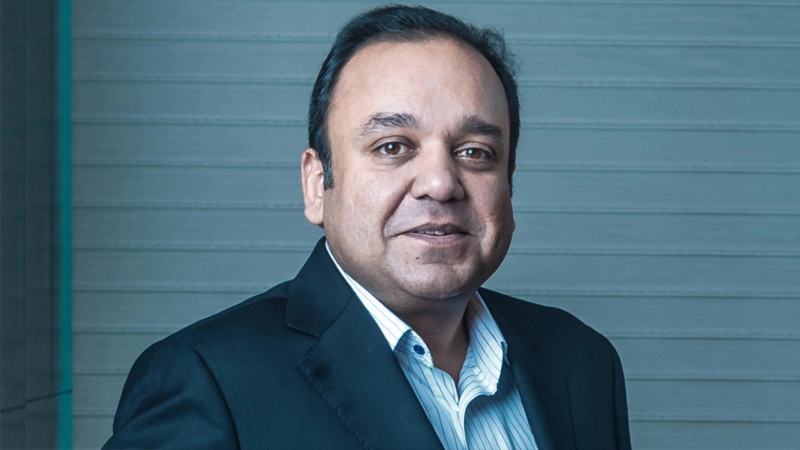
    MUMBAI: Abraham Lincoln once said, ‘Nearly all men can stand adversity, but if you want to test a man’s character, give him power.’ Embracing this ethos, Zee Entertainment Enterprises Limited (Zeel) reappointed Punit Goenka as MD & chief executive officer, reaffirming its commitment to leadership stability and growth. 

    With more than 25 years in the media industry, Goenka is set to lead the company for another five years, from 1 January 2025, to 31 December 2029, focusing on content quality and profitability. The board of directors’ approval on 18 October 2024, marks a strategic move to ensure continuity and enhance shareholder value.

    The announcement comes amidst Zeel’s ongoing transformation, with Goenka leading initiatives aimed at optimising operations and driving content excellence. Under his stewardship, the company achieved significant growth, expanding its footprint to over 1.3 billion viewers across 190+ countries. Zeel has become a diversified entertainment powerhouse, with strong positions in broadcasting, digital streaming, films, and music.

    “We are confident that Punit’s vision and leadership will continue to drive Zee forward,” stated a company spokesperson. “His ability to identify growth opportunities and strengthen Zee’s market presence has been instrumental in our success.”

    Goenka’s reappointment comes as ZeeL pursues a strategic growth plan focusing on frugality, optimisation, and content quality. In recent years, the company streamlined its operations into four main segments: broadcast, digital, movies, and music. By realigning its organisational structure, Goenka aims to boost productivity, promote cross-functional collaboration, and enhance profitability.

    His emphasis on efficiency extends to resource utilisation, with recent measures leading to a significant improvement in the company’s EBITDA margins. In the first half of FY25, Zeel, reported a year-over-year increase of 330 basis points in its EBITDA margin, highlighting the impact of effective cost management and strategic content investments.

    Goenka’s leadership has also guided the company through multiple industry accolades, including the broadcaster of the year award and recognition for treasury transformation initiatives. He has been a proactive figure in the entertainment ecosystem, contributing to regulatory and industry bodies such as the Indian Broadcasting & Digital Foundation (IBDF) and the Broadcast Audience Research Council (BARC).

    Looking ahead, Goenka plans to deepen Zeel’s content creation capabilities, focusing on delivering top-tier entertainment that resonates with diverse audiences. 

    “We are committed to creating stories that not only entertain but also drive positive societal change,” he said. Goenka’s strategy also includes furthering the company’s Environmental, Social, and Governance (ESG) efforts, which have recently centred on sustainable development and social impact projects.

    Zeel has made strides in mapping its ESG footprint, implementing programs for women empowerment, heritage preservation, and rural development. Under Goenka’s guidance, the company aims to reduce its environmental impact while enhancing governance practices through stakeholder collaboration.


  • HCL Technologies reports strong Q2FY25 with 8 per cent revenue growth

    HCL Technologies reports strong Q2FY25 with 8 per cent revenue growth

    Mumbai: HCL Technologies showcased a robust financial performance for the second quarter of FY25, ending 30 September 2024, with an 8 per cent year-over-year growth in revenue, driven by solid gains across its key business segments. The company’s board of directors, during a meeting on 14 October, approved the unaudited financial results and declared an interim dividend of Rs. 12 per share. This underscores HCL’s commitment to delivering consistent value to its shareholders amid the dynamic global tech landscape.

    The company recorded consolidated revenue from operations amounting to Rs. 28,862 crore, an increase from Rs. 26,672 crore during the same period last year. The growth was fueled by a rise in demand across IT & business services, which contributed Rs. 21,544 crore, and the engineering and R&D services segment, with revenues of Rs. 4,545 crore. HCL software also posted a healthy rise, achieving Rs. 2,773 crore in revenue.

    Profit before tax for the quarter stood at Rs. 5,687 crore, while the net profit reached Rs. 4,237 crore, showing an increase compared to Rs. 3,833 crore in Q2FY24. “Our strong financial performance in Q2FY25 is a testament to the resilience of our diversified business portfolio and our focus on delivering customer-centric innovations,” stated  HCL Technologies, CEO and MD, C. Vijayakumar.

    The approved interim dividend of Rs. 12 per share is set to be paid out on 30 October 2024, to shareholders on record as of 22 October 2024. The company’s ability to sustain dividend payouts reflects its solid financial health and cash flow management.

    HCL Technologies reported a total comprehensive income of Rs. 4,793 crore for Q2FY25. The company’s cash flow from operations reached Rs. 9,349 crore for the six months ending September 2024, underscoring its liquidity position. Total assets amounted to Rs. 99,763 crore, with an equity base of Rs. 68,887 crore.

    The balance sheet showed a slight increase in current liabilities to Rs. 21,626 crore, which aligns with seasonal trends in the technology sector. Non-current liabilities also rose marginally to Rs. 9,250 crore, reflecting increased lease obligations.

    Segment Performance:

    – IT and Business Services: This segment continued to be the primary revenue driver, witnessing a 8.2 per cent growth year-on-year, reaching Rs. 21,544 crore. The segment also recorded improved profitability due to efficiency enhancements.

    – Engineering and R&D Services: The segment saw an impressive 5.9 per cent rise in revenue to Rs. 4,545 crore, buoyed by increased investment in digital engineering initiatives.

    – HCL Software: Showing resilience, the software segment’s revenue increased to Rs. 2,773 crore, backed by strong licensing activity and cloud adoption trends.

    The quarter also marked the divestment of the company’s stake in a joint venture with State Street, generating a gain reflected in the Q1FY25 financials. This strategic move allows HCL to focus on core competencies while streamlining its portfolio.

    Looking forward, HCL Technologies remains optimistic about sustaining growth through digital transformation initiatives, with a particular focus on artificial intelligence and cloud services. While challenges such as global economic uncertainties and fluctuating exchange rates persist, the company’s diversified service offerings and strategic investments are expected to support stable growth.

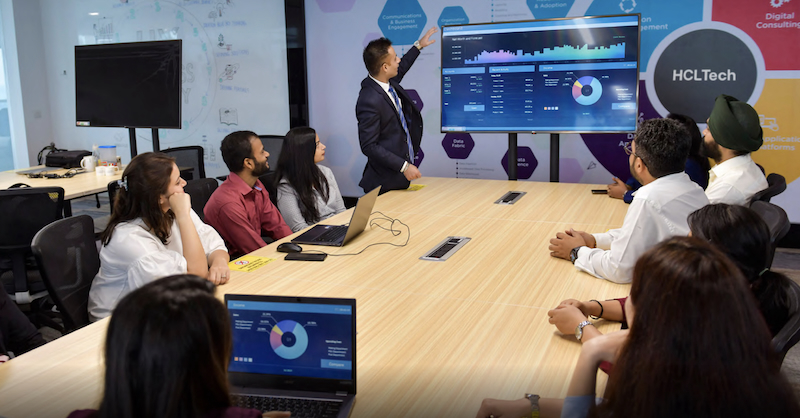
    Pix courtesy HCL Tech annual report

  • Global Standards Symposium 2024 concludes, paving way for digital progress

    Global Standards Symposium 2024 concludes, paving way for digital progress

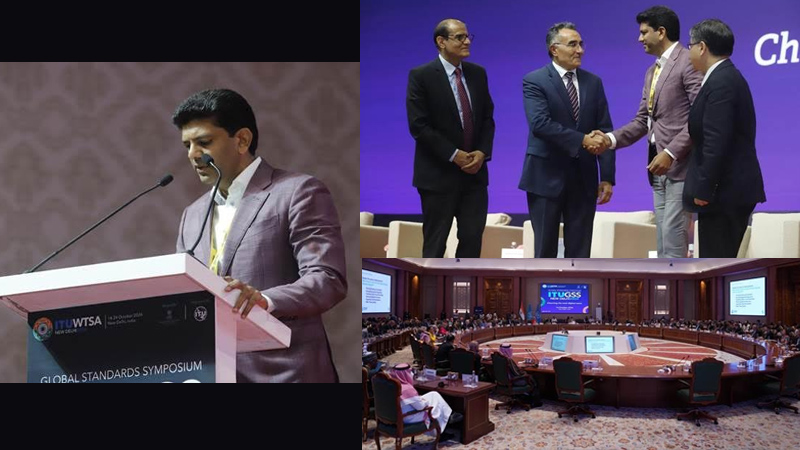
    Mumbai: The fifth Global Standards Symposium (GSS-24) wraps up in New Delhi, making history as the first time the event has been held in the Asia-Pacific region. Organised by the International Telecommunication Union (ITU) and hosted by the Department of Telecommunications, Government of India, GSS-24 gathers a record 1,500 policymakers, innovators, and experts to chart the future of digital transformation. The event emphasises the critical role of international standards in enabling emerging technologies to drive sustainable global development.  

    Minister of state for communications and rural development, Chandra Sekhar Pemmasani delivers a closing address lauding India’s transformation under prime minister Narendra Modi’s leadership. “The standards we establish are more than just technical standards, but they are moral compasses, guiding us towards a future of shared global progress. India is ready to take this journey not alone, but with all of you as partners,” Pemmasani states, advocating for an inclusive, democratic approach to international standards.  

    The symposium’s theme, “Charting the Next Digital Wave: Emerging Technologies, Innovation, and International Standards,” highlights the need for cohesive, forward-looking governance and standardisation in digital technologies. It serves as a platform for high-level dialogues on crucial issues like AI governance, open-source technologies, blockchain-based authentication, and the impact of AI and the Metaverse on public services.  

    Union minister Jyotiraditya M. Scindia underscores India’s role as a global telecommunications and digital innovation hub. He describes India as “a land of science, innovation, and rules aiding in the prosperity of the world.”  

    The key discussions focus on bridging the standards gap between developed and developing countries, emphasising equitable access to technology for all. The AI Standards Summit, held as part of GSS-24, illustrates how consensus-based standards can ignite innovation across multiple sectors, driving technological advancements.  

    Centre for Development of Telematics (C-DoT), CEO, Rajkumar Upadhyay chairs the symposium, marking India’s first time leading the event. The symposium’s outcome document lays the groundwork for discussions at the World Telecommunication Standardisation Assembly (WTSA-24), taking place from 15-24 October 2024, in New Delhi.  

  • Ericsson secures multi-billion dollar 5G deal with Bharti Airtel

    Ericsson secures multi-billion dollar 5G deal with Bharti Airtel

    In a significant boost to India’s telecom landscape, Ericsson has clinched a multi-billion dollar contract with Bharti Airtel to supply advanced 5G equipment. This partnership signals a pivotal moment in the rollout of next-generation mobile connectivity across the nation. As demand for high-speed internet and seamless connectivity skyrockets, this collaboration promises to enhance Airtel’s network capabilities, positioning it at the forefront of the telecom revolution.

    Ericsson’s latest deal with Bharti Airtel aims to strengthen the latter’s 5G infrastructure, enabling improved network performance and expanded coverage. The announcement comes at a crucial time as both companies gear up to meet the growing consumer demand for faster and more reliable mobile services.

    “Ericsson’s extensive experience and innovative technology will significantly enhance our 5G offerings,” said a spokesperson from Bharti Airtel. “This partnership not only reaffirms our commitment to delivering top-notch connectivity but also strengthens our position as a leading telecom provider in India.”

    Industry experts view this contract as a strategic move, further solidifying the collaboration between the two telecom giants. With Ericsson’s advanced network solutions, Airtel aims to offer enhanced user experiences and drive digital transformation in various sectors, including education, healthcare, and entertainment.

    This contract aligns with the Indian government’s vision of transforming the country into a global digital hub, boosting economic growth and innovation. As Airtel rolls out its 5G services powered by Ericsson’s technology, customers can expect a leap in internet speeds, latency reductions, and innovative applications tailored to meet their evolving needs.

    Ericsson’s success in securing this contract underscores its strong foothold in the Indian market, further solidifying its reputation as a leading provider of telecom infrastructure. With the ongoing rollout of 5G technology, both companies are poised to play a significant role in shaping India’s digital future.

  • UST unveils ‘Retail GenAI platform’ to transform retail operations with AI

    UST unveils ‘Retail GenAI platform’ to transform retail operations with AI

    Mumbai: UST launched its ‘UST Retail GenAI Platform’ at the London Innovation Lab. The platform, designed to revolutionise retail operations with generative AI-driven solutions, was inaugurated by Walgreens Boots Alliance, SVP & international CIO, Steve Rempel. Rempel shared insights on critical success factors for GenAI adoption, emphasising the importance of understanding the trust cycle when planning investments. Before the inauguration, UST’s CEO Krishna Sudheendra highlighted UST’s efforts in driving generative AI adoption, including the company’s initiative to train 25,000 employees in GenAI.

    The platform, developed in-house by UST’s technology and industry experts, combines established business models with cutting-edge GenAI capabilities, including search, summarisation, automation, and creation. It allows retailers to pilot AI-driven solutions, test outcomes, and accelerate innovation, ultimately optimising retail operations.

    “At UST, we’ve partnered with six of the world’s top ten retailers, transforming their businesses. While AI is already transforming retail operations, we still need to unlock its full potential. The UST Retail GenAI Platform offers a structured approach for exploring generative AI scenarios, marking a significant milestone in our mission to revolutionize retail operations through the power of generative AI. This is aligned to our focus on building platforms that can help scale the adoption of GenAI-led ways of working,” said Krishna Sudheendra.

    UST’s recent survey underscored the importance of digital transformation, citing resilience, profitability, and sustainability as key outcomes of technological advancements. The UST AlphaAI platform further consolidates AI offerings to enhance business agility and streamline operations.

  • TRAl extends last date to comments on Consultation Paper

    TRAl extends last date to comments on Consultation Paper

    Mumbai: In a recent notification release, The Telecom Regulatory Authority of India (TRAI) had sought comments / counter-comments of stakeholders on the Consultation Paper on “Digital Transformation through 5G Ecosystem” dated 29th September 2023. The last date for receiving written comments and counter-comments from the stakeholders was initially fixed as 30 October 2023 and 13 November 2023 respectively, which have been extended twice.

    The last date for submission of written comments was 26 December 2023 and that for counter-comments is now 8 January, 2024. Meanwhile TRAI has received requests from Industry Associations for further extension of timeline for submission of comments citing various reasons like difficulty in collecting the inputs from their members due to Christmas and New Year.

    They have also mentioned that the Indian Parliament has passed the new Telecom Bill-2023 very recently, so the comments need to be updated accordingly. Keeping in view the requests of stakeholders, TRAI decided to extend the last date for submission of written comments up to 22 January 2024 and for counter-comments up to 5 February 2024.

    For more information visit TRAI website