
Tag: Digital OOH

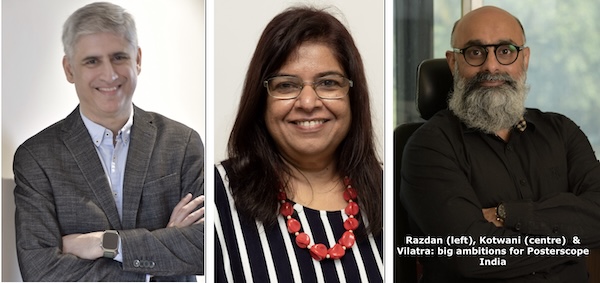
  • dentsu elevates Imtiyaz Vilatra to lead Postercope India

    dentsu elevates Imtiyaz Vilatra to lead Postercope India

    MUMBAI: He is going to be the new poster boy of dentsu’s OOH initiatives. The agency has promoted Imtiyaz Vilatra to chief executive officer of Posterscope India.

    In his new role, he aims to enhance Posterscope’s digital out-of-home (DOOH) and intelligent OOH (iOOH) offerings with a strong emphasis on data-backed, measurable outcomes for clients. He will report to dentsu media, south Asia, CEO Anita Kotwani.

    With more than  25 years’ experience, Imtiyaz is known for his focus on innovative and impactful OOH campaigns. He plans to further integrate advanced technologies like augmented reality, 4D experiences, and AI to strengthen Posterscope’s capabilities.

    By merging dentsu’s digital expertise with Posterscope’s established OOH foundation, his vision is to meet evolving client needs and expand the agency’s reach in both urban and rural sectors. This move aims to establish Posterscope as a leader in both traditional and digital OOH.

    Says dentsu south Asia CEO Harsha Razdan:  “Imtiyaz’s elevation is a timely and strategic move, enabling him to drive Posterscope’s expansion in experiential and below-the-line (BTL) divisions, strengthening our urban and rural reach. His leadership remains a vital link between strategy and execution, translating our goals into meaningful partnerships for our clients and communities. I am confident that under Imtiyaz’s continued guidance, we will not only meet but exceed the evolving needs of our clients, setting new benchmarks for excellence. His exceptional passion and deep industry insights will be pivotal as we navigate a path where innovation meets purpose, driving change that resonates far beyond the immediate.”

    Adds Kotwani: “Imtiyaz’s elevation is a testament to his visionary leadership and commitment to redefining the OOH landscape. Under his leadership, Posterscope will strengthen its position within the dentsu ecosystem, embodying our ‘Onedentsu’ vision of unified, cross-channel marketing solutions. By seamlessly integrating OOH with digital, media, and experiential campaigns, Posterscope is set to deliver transformative, multi-channel experiences powered by dentsu’s advanced audience insights, driving precision and impact that elevate client outcomes.”

     “The OOH industry stands at a transformative juncture, with technology and data insights reshaping how we connect with audiences,” points out Vilatra. “Posterscope’s future lies in harnessing AI, programmatic DOOH, and real-time analytics to deliver dynamic, measurable campaigns. Integrating dentsu’s digital intelligence into our OOH offerings enhances our capabilities and raises the value we deliver through deeper engagement, personalisation, and an integrated, ROI-focused approach.”

    That’s exactly what ad spend-focused marketers are increasingly demanding. If things work out as planned, the trio of Razdan, Kotwani and Vilatra could well be raising their champagne glasses in celebration soon. 

  • OOH on good recovery trajectory, to match pre-Covid levels soon: Experts

    OOH on good recovery trajectory, to match pre-Covid levels soon: Experts

    Mumbai: As the world accepts the ‘new normal’ and authorities uplift the Covid-19 restrictions, out-of-home (OOH) advertising has gained momentum once again and how. According to the industry experts, the OOH sector has matched the pre-Covid level by 75-80 per cent and it is expected to reach 100 per cent in the next four months.

    In this special report, IndianTelevision.com shed the spotlight on the most effective OOH medium and leading trends in the industry.

    OOH experiencing better recovery trajectory

    If we look at the initial days of the Covid-19 pandemic-induced lockdown and subsequent restrictions, OOH was one of the severely hit industries because the industry stands on the idea of being ‘out of home.’ 

    With the pandemic receding, the industry is witnessing significant growth now. JCDecaux Advertising India executive chairman Pramod Bhandula reveals that the industry has recorded 75-80 per cent business and will soon match the pre-Covid levels. “OTT, entertainment, and telecommunication brands are spending heaving on out-of-home advertising,” he tells.

    Explaining the reason behind this, Bhandula says the world has experienced a saturation point where there was no direct human communication, followed by a lack of new content too. “This turned out as an opportunity for OTT and entertainment industries as the blank period in between ignited the quest of viewers, increasing their interest in the new content,” he highlights.

    As a popular name in the OOH space, Bhandula also shares his analysis of the performance of the OOH industry since the first lockdown was imposed.  One thing which he emphasises is that the industry is on a good growth trajectory.

    “The first Covid wave followed by an indefinite lockdown brought a complete lull in the out-of-home advertising. Brands chopped down their marketing budgets and OOH was thrown at the back as the last priority in their budgets because the medium became insignificant during the lockdown,” he explains. “However, with the first unlock, the industry started registering momentum but was far from the regular business.”

    “The business started coming back by the end of 2020. Although the growth was slow, it was steady,” he further says.

    Bhandula feels that this steady growth helped the industry rise back carefully and if we do not experience another Covid wave, the industry will soon reach pre-Covid levels.

    OOH in metro gains momentum; OTT,  travel, and fintech top investors

    A Delhi Metro Rail Corp (DMRC) insider reveals that OOH advertising in Delhi Metro is experiencing growth like never before. However, most brands are more interested in digital out-of-home advertising but wrapping a train with advertisements still remains a favorite of many.

    “As the world has opened up almost completely, travel restrictions are removed by many countries and states. Interestingly, train wrap has become a favorite metro advertising trend among the tourism industry to woo the consumers with their eye-catching locations,” says the DMRC executive.

    On being asked what categories of brands are more interested in advertising in the metro, he reveals that 80 per cent of their overall OOH business is presently coming from OTT, travel, fintech, banking, and insurance brands.

    If we look back to 2021, when the world just experienced the deadly second wave of Covid, it was LIC, the largest Indian state-owned insurance company, who came forward with blunt advertising on Andheri metro station in Mumbai. In the same campaign, LIC took another bold move by acquiring digital screens spread across 12 metro stations and metro train wrap. Ever since we have experienced multiple short-term lockdowns, but the demand for metro advertising was stagnant among the brands to broaden the communication visibility.

    Digitisation remains a trend in OOH

    While the OOH industry is all set to grow even bigger, digitisation turns out to be the leading trend within the OOH space.

    A July 2021 report forecasts the value of the digital out-of-home (DOOH) market to nearly double in just seven years (from $18.8 billion to $35.1 billion, between 2020 and 2027). With the advantages digital OOH ads offer being opened up to a much wider audience thanks to new programmatic technology, this isn’t surprising.

    “When data is digitised, it plays a vital role in shaping the industry and with the implementation of new technologies like AI technology, it’s embracing the overall industry,” say OOH experts.

    OOH is experimenting with new technologies and trends too, from bright colors, to eye-catching animation and videos. With digitisation taking over in all industries, DOOH Media is rising as a notable trend in the OOH space.


