Tag: Digital India Week

  • “I am delighted that PM has given preference and priority to digitise India:” Ratan Tata

    “I am delighted that PM has given preference and priority to digitise India:” Ratan Tata

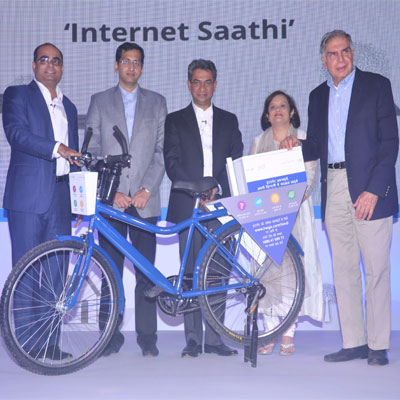
    MUMBAI: In a marquee philanthropic move, Tata Trusts has teamed up with Google India to take internet closer to women of rural India with its ‘Internet Saathi’ initiative. The move comes at a time when India is celebrating ‘Digital India Week’.


    The initiative has been built on the philosophy that it is important to digitise the entire country and not just a particular geography or gender.


    Tata Group chairman Ratan Tata at the time of launch of the initiative said, “It’s a privilege for us (Tata Trusts) to join hands with Google, a company I vastly admire because of the way it has digitised billions of people with its broad connectivity.”


    Tata further added, “It took 7 to 10 years for India to popularise telephone, but today, right from a pan wala to a rickshaw driver, there are millions using the mobile phone. They can buy a prepaid sim and use the device and that has helped in enhancing their self respect and has brought education and knowledge closer to them. Such is the power of internet. I am delighted that our Prime Minister (Narendra Modi) has given preference and priority to digitise India.”   


    India is a booming market when it comes to mobile phones and wireless internet. “It’s absolutely unbelievable. No one thought India would have so many mobile phone users who are now gradually transforming into smartphone consumers. It’s very essential for women in rural India to earn their livelihood and be self dependent. I hope this initiative takes internet closer to them and takes commerce closer to them. I wish luck to Google, Intel and my colleagues at Tata Trusts,” he concluded. 

  • Tata Trusts, Google India and Intel team up to launch Internet Saathi

    Tata Trusts, Google India and Intel team up to launch Internet Saathi

    MUMBAI: The definition of philanthropy is changing with time. In a philanthropic move and in keeping with the ‘Digital India’ campaign started by Prime Minister Narendra Modi, business giant Tata Trusts and digital ruler Google India have tied up to launch a special programme called ‘Internet Saathi’ to empower women and their communities in rural India by enabling them to use internet and benefit from it in their daily lives.


    The joint initiative is aimed at bridging the technology gender divide, which currently puts women in rural India at further risk of getting marginalized in the society as the world around them benefits from going online. The ‘Internet Saathi’ initiative adds on to the ‘Digital India’ vision of the country. The launch event was also attended by Tata Trusts chairman Ratan Tata.


    The initiative will provide basic training on the usage and benefits of internet for women through specially designed internet cycle carts which will be used to visit areas in villages which women can easily access and also learn more from the internet.


    Built on the back of a cycle, the cart is modeled on India’s traditional distribution system that is used to carry everything right from ice-creams to industrial supplies. The operator or the ‘Internet Saathi’ keen to train the women, would be akin to the village postman who was the single point contact for the village with the outside world both in terms of information as well as communication. Tata Trusts, with its vast field based ecosystem, will manage the on-ground rollout with its partners whereas Google will invest in providing the internet-enabled carts and the training content.


    Google South East Asia and India VP and managing director Rajan Anandan said, “While women are making rapid progress on adoption of internet in urban areas, women in rural India are being left behind. Today only 12 per cent of internet users in rural India are women. We need to come together to address this challenge and empower women in rural India through training and programmes that can truly transform their lives. We are delighted to partner with the most respected and well known Tata Trusts who have years of experience in managing programmes of this scale. By combining our strengths, I am confident that we can achieve great results and overcome the challenges of providing easy access and digital education to women in rural India.”


    “Tata Trusts strongly believes that innovative use of technology should be at the core of all its interventions that are undertaken for the benefit of the communities. Internet connectivity has become a fundamental need in any society and improves literacy and access to information that is instrumental for socio-economic development. We are glad that this joint initiative with Google will reach out to the rural communities, especially women in our country and we are confident that it will contribute towards their empowerment and also self-sustenance,” Tata Trusts executive trustee R Venkataramanan.


    Speaking to Indiantelevision.com, Google country marketing director India Sandeep Menon asserted, “With this initiative we will educate and empower women of rural India about internet and take them a step closer to entrepreneurship which will enable them to be self dependent. The next set of internet users will be totally different as majority of them will come from the rural part so it’s very important to make them aware about internet.”


    The initiative will also be supported by Intel who has been a long term partner of Google India’s Helping Women Get Online initiative. “We believe that the vision of Digital India will empower every Indian citizen with equal opportunities irrespective of cast, creed and gender. At Intel, we believe that skill development and innovation are imperative for realizing the Digital India vision and we are very proud to collaborate with Google and Tata Trusts on the ‘Helping Women Get Online’ initiative especially as we celebrate the Digital India Week,” said Intel vice president SMG, managing director- South Asia Debjani Ghosh.


    The initiative will kick off from Gujarat, Rajasthan and Jharkhand and will be rolled out across the country eventually reaching out to over 4500 villages and 5 lakh women and rural communities across rural India over the next eighteen months. The internet cart would be available in the village for a minimum of two days every week for over a period of four to six months. It will create awareness and also try to ensure that adequate training is provided to use the devices till women are confident of using them independently. Once the cart has completed the training in a cluster of three villages, it will be moved to the adjoining cluster for completion of a similar cycle. The training of women, and the community at large would be ensured by involving SHG federations / local NGO members as trainers.


    Google’s helping women get online is an initiative to create awareness about the benefits of internet amongst 50 million women in India. Under this initiative, Google conducts various outreach and educational programmes. The programme includes an awareness module, coupled with hands-on training modules aimed at teaching women how to use the internet, including via mobile devices. Since the launch of this initiative, Google has directly trained over 1.5 million women on the basics of the internet.

  • Mukesh Ambani to invest Rs 250,000 crore for ‘Digital India’

    Mukesh Ambani to invest Rs 250,000 crore for ‘Digital India’

    MUMBAI: The country’s telecom giants have committed to Prime Minister Narendra Modi’s ambitious plan to connect 2.5 lakh villages across India by 2019 at the launch of ‘Digital India Week’ in New Delhi.


    Reliance Industries chairman Mukesh Ambani began his address stating how, for the first time, the government, which usually lags behind industries, has taken a step ahead of them by conceiving ‘Digital India’. “Historically, the industry has moved faster than government in India, but with the ‘Digital India’ scheme, the government has overtaken the industry,” he said.


    “The youth today aspires for merit based opportunities and progress which ‘Digital India’ will ensure them and we at Reliance Industries commit to achieving that goal with an investment of Rs 250,000 crore,” Ambani announced.


    Addressing the infrastructure aspect, Ambani revealed his plans to create an all IP next generation wireless broadband infrastructure across all 29 states in India. Secondly, Reliance Jio will set up a nationwide distribution network that will enable 150,000 small electronic retailers to sell and service smartphones and internet devices.


    Not just that, Reliance Jio is in talks with leading device manufacturers to invite them to make smartphones and internet devices at an affordable rate in India. “We will give them assured off-take from our retail system,” said Ambani, who stressed that his company is committed to make necessary investment and strongly partner with central and state government on e-governance, and other services that ‘Digital India’ will provide.


    Though Mukesh Ambani set quite high standards for investors in their contribution to ‘Digital India,’ others who followed him didn’t fail to make their promises worth looking forward to.


    Take his brother Anil Ambani for example.  While most of the business leaders focused on manufacturing and infrastructure to penetrate in the remote areas, Anil Ambani addressed an important aspect of ‘Digital India’: a paper-free India powered by a gigantic database.


    “A crucial prerequisite to Digital India’s success is the availability of unlimited cloud computing power, whose building block is a digital database of the mission,” pointed out Anil Ambani.


    Reliance Group is the largest provider of data center facility, with its 11 data center connected by India’s largest terrestrial fiber network and world’s largest submarine cable structure, which Anil Ambani plans to double to 1.2 million sq ft in two years.


    The Reliance Group chairman also announced a first of its kind initiative — five fully operational cloud exchange points. “Each of these will give government departments 240 times the computing power currently available to their data centers and their efficiency  will scale up 100 per cent in every 90 days, as ‘Digital India’ will gather momentum,” he said, followed by an investment promise of Rs10,000 crore to the project.


    Bharati Airtel too assured a ‘meaningful contribution’. Bharati Enterprises chairman Sunil Bharati Mittal said, “We at Airtel are fully committed to stand by the government’s revolutionary initiative in the digital space. We plan to invest in excess of Rs 100, 000 crore or USD 16 billion in infrastructure in rural and urban regions alike. We also plan to make 4G available to the masses.”


    Mittal hailed Modi as a ‘digitally native man’ and the right person to lead India in this digital revolution. He also mentioned about Bharati Enterprises’ active involvement in promoting eHealth in villages and also collaborate with manufacturers to start making devices and services within India.
  • “I dream of digital India where 1.2 billion connected Indians drive innovation:”NaMo

    “I dream of digital India where 1.2 billion connected Indians drive innovation:”NaMo

    MUMBAI: Prime Minister Narendra Modi’s vision of ‘Digital India’ took a step forward on 1 July as the PM launched ‘Digital India Week’ in New Delhi. Modi, who foresees an impending “bloodless” cyber war as a global risk has called upon the nation’s IT community to become world leaders in providing credible cyber-security systems to the entire world. “Can’t India innovate in providing cyber security to the world and be a world leader in it?” he questioned.


    The Prime Minister encouraged the leaders in IT manufacturing to boost production of electronic services and goods in the country as part of the ‘Make in India’ initiative. “We need to manufacture qualitatively globally competitive electronic goods in India and reduce our enormous dependency on imports,” he added.


    Modi noted that there is a risk of digitization creating a barrier between the ‘haves’ and ‘have not’s and result in a digital divide. To avoid that, he outlined his vision of e-governance and mobile governance, where all important government services will be available on the mobile phone and digital platforms.


    “I dream of a digital India where high-speed digital highways unite the nation; 1.2 billion connected Indians drive innovation; technology ensures the citizen-government interface is incorruptible, where government proactively engages on social media platforms, quality education reaches inaccessible places of country, quality healthcare comes to remotest places through e health care,” he said.


    He stressed on making India as paperless as possible, especially in terms of government documentations, banking and other bureaucratic services. A key aspect of this is ‘Digital India’s’ eLocker initiative which enables citizens to store their important documents in an online database and access it using a digital signature that will be unique to every citizen and used with their AADHAAR number. “With eLocker, one doesn’t need to carry all their paperwork to government offices when they are applying for any government or other services. It makes official work easier, economic and secure,” said Modi, who is rightly addressed as a ‘digital native man’ by industry leaders.


    Apart from this, ‘Digital India’ aspires to spread its reach to the remotest parts of the country and enable citizens from all walks of society to enjoy its services like eHealth, eEducation, eScholarship, eSignature, ‘Digital India’ apps and weather reports for farmers among others.


    To achieve that, the mammoth-size challenge lies in infrastructure and availability of high speed broadband throughout the country. “There was a time when highways were in demand and were crucial to settlements and industries. Today a developed city can only be built where fiber optics pass through,” he opined, enlisting Broadband Highway as a top priority in his ‘Digital India’ plan.


    The Prime Minister cleverly tweaked his definition of IT and devised the formula ‘IT +IT =IT’ which breaks down to Indian Talent plus Information Technology which will give ‘India Tomorrow.’ He assured full support to young entrepreneurs who wished to launch start-ups and called upon the youth to innovate.


    “In a few years we will be second globally in startups after America, and the government is willing to invest in entrepreneurs. We need to make products and technology based on the target age group, its utility in our Indian society and thus ‘Design in India’ is as important as ‘Make in India’,” he concluded.