Tag: Digital Credit

  • Traditional Borrowing vs. Digital Credit: What Has Really Changed?

    Traditional Borrowing vs. Digital Credit: What Has Really Changed?

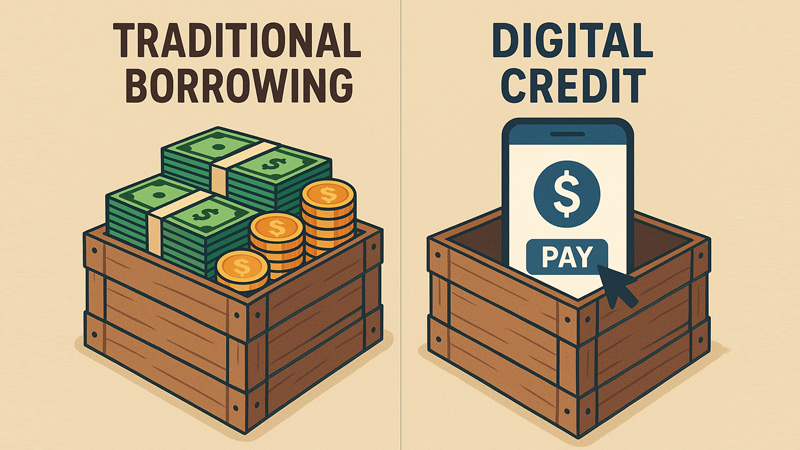
    In the bustling markets of India, where haggling is an art form and personal relationships often dictate financial decisions, the landscape of borrowing has significantly evolved. While the age-old tradition of approaching local moneylenders or visiting brick-and-mortar banks for loan persists, an exciting new player has entered the field: digital credit. In this fascinating clash of ‘Traditional Borrowing vs. Digital Credit’, we unravel the layers and explore what truly has changed.

    Understanding Traditional Borrowing

    For generations, Indians have navigated their financial needs by relying on traditional loan sources—local moneylenders, cooperative societies, and banks. These methods, deeply rooted in personal trust and community, have served as lifelines for many. However, the process, while familiar, often involves a cumbersome amount of paperwork and time-consuming procedures.

    The Process and Its Challenges

    Traditional borrowing usually requires individuals to physically visit a financial institution. This often includes filling out reams of paperwork, submitting tangible proofs of income and assets, and undergoing rigorous credit checks. The critical downside is the time taken—typically weeks—to process and approve a loan, leaving many in a temporary lurch during urgent needs.

    Moreover, the emotional labour involved in approaching a local moneylender, sometimes perceived as intimidating, cannot be ignored. These lenders might offer quicker loan disbursements but usually come with exorbitant interest rates or unfavourable terms.

    The Dawn of Digital Credit

    Enter the digital era. The advent of fintech and digital platforms has brought about an unprecedented transformation in how people access loans. With services like Online Personal Loan applications and digital lending platforms, credit is now more accessible than ever before. This paradigmic shift caters significantly to tech-savvy millennials and urban dwellers looking for quick, efficient financial solutions.

    Benefits of Online Personal Loans

    1. Speed and Efficiency: One of the greatest advantages of digital credit is its sheer swiftness. Applications for an Online Personal Loan can often be completed in minutes, with approvals following within hours. The use of advanced algorithms and AI-driven credit evaluations accelerates the process, making it ideal for emergencies. 2. Convenience: With everything online, gone are the days of sitting in long queues at banks. From application to disbursement, the entire process can be done from the comfort of one’s home via a smartphone or computer. 3. Transparency: Digital platforms offer clear, upfront information about interest rates, EMIs, and terms, empowering borrowers with the knowledge to make informed decisions. There are fewer hidden charges, and borrowers can easily compare loan products from multiple providers. 4. Inclusivity: These platforms often utilise innovative ways to assess creditworthiness, such as social media behaviour analysis or alternative credit scoring. This inclusivity has brought credit access to previously underserved segments.

    Comparing Traditional and Digital: A Statistical Insight

    To illustrate the shift, a recent report by the Reserve Bank of India showed a surge in digital transactions, with digital loans accounting for an increasing percentage of overall retail lending. In 2022 alone, the number of digital loan applications exceeded traditional bank loan applications by over 60%. 
    A survey on consumer preferences indicated that 70% of urban borrowers prefer Online Personal Loans over traditional methods, citing convenience and speed as primary factors. However, it’s noteworthy that traditional borrowing still holds sway in rural areas, where digital literacy and internet penetration remain challenges.

    What Has Really Changed?

    Trust vs Convenience

    While traditional borrowing heavily leans on trust and existing relationships, digital credit thrives on convenience and speed. Urbanisation, rising smartphone penetration, and government initiatives to improve digital infrastructure bolster this trend towards digital credit.

    Accessibility and Financial Inclusion

    One of the most significant changes is the enhanced financial inclusion brought about by digital credit. More individuals, especially younger generations and those residing in urban areas, now have ready access to loans. The digital nature has also paves the way for micro-loans, aiding small entrepreneurs in scaling their ventures.

    Innovation in Credit Assessment

    Digital lenders utilise big data analytics, AI, and machine learning to predict creditworthiness, which allows for a broader spectrum of borrowers to qualify for loans. Traditional banks, conversely, still rely heavily on CIBIL scores, often alienating those without conventional credit histories.

    The Human Element: Are We Losing It?

    An interesting dilemma observed in the shift towards digital credit is the loss of the ‘human touch.’ In traditional settings, the interaction with a bank manager or moneylender offered a personal rapport and understanding of individual circumstances, which digital interfaces lack. This personal connection can sometimes make a crucial difference, especially in renegotiating terms during financial hardships.

    Challenges in the Digital Space

    Despite its advantages, digital lending is not without challenges:

    1. Data Privacy Concerns: With personal data now being crucial to credit assessment, concerns around data privacy and security are at the forefront. There is always a risk of data misuse or breaches. 

    2. Digital Literacy and Access: While urban regions embrace digital credit swiftly, rural populations lag due to limited access to internet services and digital education. 

    3. Overborrowing Risks: The ease of obtaining an Online Personal Loan could lead some individuals to accumulate debt beyond manageable levels, highlighting the need for careful financial planning and education.

    The Future of Borrowing in India

    The future of borrowing in India is undeniably digital, but not without retaining the core values that traditional borrowing emphasised. The ideal scenario would perhaps be a seamless integration of the two—where digital platforms incorporate human elements, offering personalisation, flexibility, and compassionate customer service. 
    Digital lenders are beginning to take note, introducing AI-driven customer service bots that try to simulate human interaction, and offering hybrid models with physical outposts for those who prefer face-to-face interaction.

    Conclusion: Charting Your Financial Path

    In the grand scheme of things, whether one opts for a traditional loan or an Online Personal Loan depends largely on individual circumstances, preferences, and needs. It’s essential, however, to remain informed, aware, and prudent in any borrowing decision.

    The landscape of borrowing will continue to evolve as technological advancements propel us into newer dimensions of digital credit. As borrowers, staying adaptable and embracing change while safeguarding one’s financial interests will be key.

    Reflecting on this transformation invites us to ask: Are we poised to embrace a digital future, or should we hold on to the trusted traditions of the past? The choice ultimately lies in striking a balance that best suits our financial journeys.