Tag: digital cable TV

  • Hathway and Den bring Invidi Tech’s addressable ad tech to digital cable TV

    Hathway and Den bring Invidi Tech’s addressable ad tech to digital cable TV

    MUMBAI: Invidi Technologies, a pioneer in addressable advertising technology, has announced a ground-breaking partnership with Hathway Digital Ltd. (Hathway Digital), a wholly owned subsidiary of Hathway Cable & Datacom Limited (Hathway)  and Den Networks Ltd. (Den), India’s leading multi-system operators (MSOs). This collaboration marks a significant step in transforming the digital cable TV advertising landscape by introducing, for the first time, digital cable TV markets advanced targeted ad solutions to Hathway Digital  and Den’s extensive distribution network. This partnership will help in addressing the pressing need of the current day and age of reaching the right audience in the right markets in the most economical way. 

    Both Hathway Digital and Den will leverage Invidi Technologies’ cutting-edge ad tech through this strategic alliance to deliver highly targeted and personalised advertisements to diverse audiences. This solution will ensure anomalies of linear TV ads is addressed and they  are delivered with the required advertiser’s customer profile cohorts. This innovative approach will open new avenues, improve media buying efficiencies and allow brands to reach specific viewer segments with tailored messages, enhancing the relevance and effectiveness of their money spent on ad campaigns.

    Says Invidi Technologies chief operating officer Prasad Sanagavarapu: “Our collaboration with both Hathway and Den represents a major advancement for content owners, viewers, and advertisers alike. By deploying Invidi’s  addressable TV solutions, Hathway and Den will enable brands to optimise their marketing spend by delivering relevant ads directly to their target audiences. This partnership underscores our commitment to enhancing the Indian advertising ecosystem with state-of-the-art technology.”

    Adds a Den representative:  “We’re excited to integrate Invidi’s technology into our operations. This partnership is a game-changer for our advertising partners, giving them the ability to target their audiences with unprecedented precision. For our subscribers, it means receiving more relevant and engaging content, which enhances their overall viewing experience. By bringing Invidi’s  advanced solutions to the Indian market, we’re not just improving our ad offerings but also providing our subscribers with more relevant content and less ad clutter.”

    “We are delighted to bring first time in digital cable TV, targeted ad solutions and partnering with Invidi Technologies represents a major milestone in our commitment to delivering cutting-edge solutions to our advertisers,” points out a Hathway representative. “This partnership will redefine the ads on digital cable TV and enable us to offer a new level of precision in linear TV advertising. With this, brands can connect with their audiences more meaningfully.”

    Addressable TV advertising represents a departure from traditional broad-spectrum TV ads. Unlike conventional methods, which cast a wide net, addressable ads allow for precise targeting based on viewer demographics, interests, and behaviours. This tailored approach not only improves the relevance of the advertising content but also boosts engagement and maximises the return on investment for advertisers by minimising wasted impressions.

    Combining Hathway Digital and Den’s extensive distribution network and reach with Invidi’s advanced targeting capabilities, this partnership will deliver a robust ad solution that bridges the gap between linear digital cable TV’s wide audience and digital precision targeting, providing brands with a powerful tool to connect more effectively with their ideal customers.

    (Pix: courtesy Barc)


  • Consumers may get 60-day notice from unprofessional telcos

    Consumers may get 60-day notice from unprofessional telcos

    MUMBAI: The latest consultation paper of the Telecom Regulatory Authority of India (TRAI) is about issues related to closure of mobile phone services. TRAI seeks to extend the time mobile users get to change their service-provider if a particular company is shutting shop or selling its spectrum.

    The paper titled ‘Closure of Access Service” will seek feedback from telecom eco-system stakeholders to set up a framework to give an extended time and more options to users facing termination of services. A licence coming to fruition or failure of the service provider to bag spectrum or spectrum trading are normally the reasons behind an entity shutting shop.

    TRAI took note of three significant instances. Reliance Communications stopped CDMA services and migrated to LTE. Airtel acquired spectrum from Aircel and Videocon through trading deals. In some cases, operators do not renew the spectrum and stop offering services in a particular area. Tata Docomo has lost subscribers due to such non-renewal.

    The paper follows complaints from the subscribers who said they did not receive adequate notice or communication from their service-provider and their mobile number was disconnected. If TRAI has its way, cell-phone users will get more time to change their company in such a case.

    A mobile user currently gets 30 days to change its service-provider but this has been found to be far less than expected. The law requires the company to give the department of telecommunications (DoT) a 60-day notice in such a scenario.

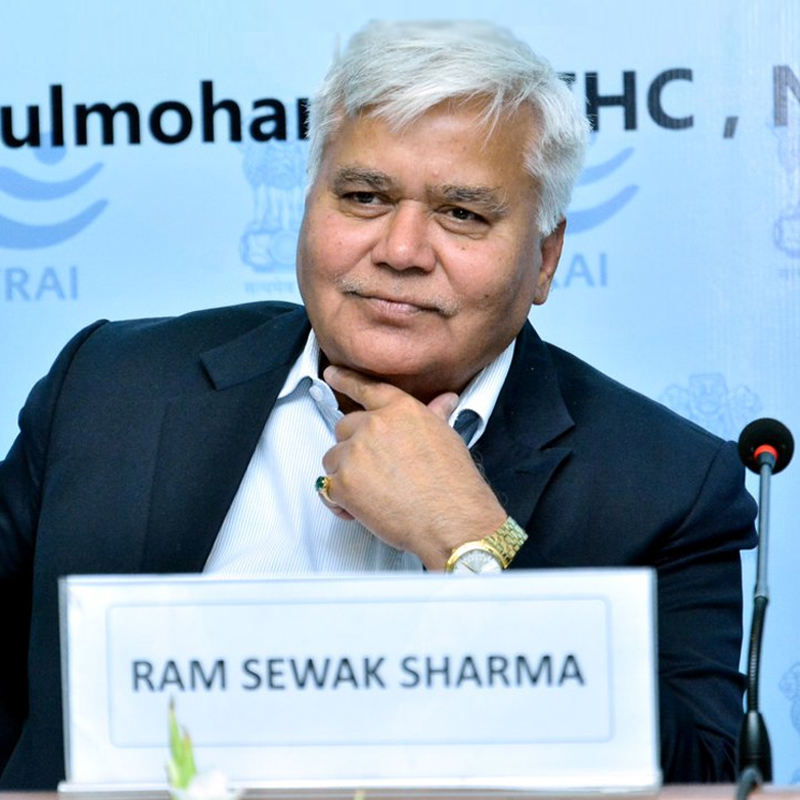
    India’s low broadband penetration is a matter of concern and the government needs to do a lot more work in the field to go up in the global ladder, TRAI chairperson RS Sharma said.

    Addressing Assocham summit, Sharma said that, according to an ITU paper, the penetration in India was only 7%. He said the report stated that India was even behind countries such as Singapore, Thailand and Malaysia.

    TRAI has recommended to the government on using cable television network for broadband delivery. In developed US and in Europe, around 50-60 per cent broadband comes from Digital Cable TV, he added.

    Foreign direct investment (FDI) attracted by the telecom sector in India meanwhile has jumped to more than US$10 billion in the first eight months of 2016-17 registering a 6-7 fold increase as compared to 2014-15 and 2015-16, telecom secretary JS Deepak said at the summit.

    Considering about 97% of population was covered by the 2G telecom network provided mostly by private telecom operators, there was a need to both popularise and simplify USSD (unstructured supplementary service data), he added. There was a need to work on a push USSD rather than a pull USSD, merchants should be able to push in a message to feature phone users where-in one just has to okay it for a transaction, he said.

  • Consumers may get 60-day notice from unprofessional telcos

    Consumers may get 60-day notice from unprofessional telcos

    MUMBAI: The latest consultation paper of the Telecom Regulatory Authority of India (TRAI) is about issues related to closure of mobile phone services. TRAI seeks to extend the time mobile users get to change their service-provider if a particular company is shutting shop or selling its spectrum.

    The paper titled ‘Closure of Access Service” will seek feedback from telecom eco-system stakeholders to set up a framework to give an extended time and more options to users facing termination of services. A licence coming to fruition or failure of the service provider to bag spectrum or spectrum trading are normally the reasons behind an entity shutting shop.

    TRAI took note of three significant instances. Reliance Communications stopped CDMA services and migrated to LTE. Airtel acquired spectrum from Aircel and Videocon through trading deals. In some cases, operators do not renew the spectrum and stop offering services in a particular area. Tata Docomo has lost subscribers due to such non-renewal.

    The paper follows complaints from the subscribers who said they did not receive adequate notice or communication from their service-provider and their mobile number was disconnected. If TRAI has its way, cell-phone users will get more time to change their company in such a case.

    A mobile user currently gets 30 days to change its service-provider but this has been found to be far less than expected. The law requires the company to give the department of telecommunications (DoT) a 60-day notice in such a scenario.

    India’s low broadband penetration is a matter of concern and the government needs to do a lot more work in the field to go up in the global ladder, TRAI chairperson RS Sharma said.

    Addressing Assocham summit, Sharma said that, according to an ITU paper, the penetration in India was only 7%. He said the report stated that India was even behind countries such as Singapore, Thailand and Malaysia.

    TRAI has recommended to the government on using cable television network for broadband delivery. In developed US and in Europe, around 50-60 per cent broadband comes from Digital Cable TV, he added.

    Foreign direct investment (FDI) attracted by the telecom sector in India meanwhile has jumped to more than US$10 billion in the first eight months of 2016-17 registering a 6-7 fold increase as compared to 2014-15 and 2015-16, telecom secretary JS Deepak said at the summit.

    Considering about 97% of population was covered by the 2G telecom network provided mostly by private telecom operators, there was a need to both popularise and simplify USSD (unstructured supplementary service data), he added. There was a need to work on a push USSD rather than a pull USSD, merchants should be able to push in a message to feature phone users where-in one just has to okay it for a transaction, he said.

  • TRAI explores methodology for QoS under DAS regime

    NEW DELHI: As the country moves towards the final phase of digital addressable systems, the Telecom Regulatory Authority of India wants to know if there should be a uniform regulatory framework for quality of service and consumer protection across all digital addressable platforms.

    TRAI has also sought opinion of stakeholders on the standards and essential technical parameters for ensuring good quality of service for digital cable TV, direct-to-home (DTH), head-end in the sky (HITS) and Internet Protocol Television (IPTV).

    The opinion has been sought in a detailed consultation paper on ‘Issues related to quality of services in Digital Addressable Systems and consumer protection’, and stakeholders have been asked to send in their comments by17 June and counter-comments if any by 1 July.

    In over fifty questions posed to stakeholders, it wants to know the broad contours for quality of rervice regulatory framework for digital addressable systems.

    The regulator has asked if timelines relating to various activities to get new connection should be left to the Distribution Platform Operators (DPOs) to be transparently declared to the subscribers.  What should be the time limits for various activities including consumer application form and installation and activation of service for new connections, it wants to know.  

    Referring to a query often asked by stakeholders, the Regulator wants to know if the minimum essential information to be included in the CAF should be mandated through regulations to maintain basic uniformity.  Should the use of e-CAF be facilitated, encouraged or mandated, it has asked.

    It wants to know whether the minimum essential information to be included in the Manual of Practice be mandated through regulations to maintain basic uniformity and to ensure that consumers get all relevant information about the services being subscribed.

    TRAI wants to know if an initial subscription period can be charged while providing a new connection to protect the interest of subscribers as well as DPOs, and the protections for subscribers and DPOs during initial subscription period.

    TRAI wants to know the methodology of reduction in subscription charges be calculated in case of discontinuation of channel from DPOs platform.

    Stakeholders have been asked to give their opinion on the maximum permissible time of disruption beyond  which subscriber must be compensated if there is disruption due to technical fault on the DPO network or at the subscriber’s end; disruption due to technical fault of Consumer Premises Equipment at the subscriber’s end.

    The stakeholders have been asked why the uptake of mandated schemes for set top box (Outright purchase, hire purchase, and on rent) is so low at present and whether this is due to lack of consumer awareness and what other methods should be used for this.

    Opinion has also been sought on the billing cycle both for pre-paid and post-paid and whether deduction of maintenance related charges for CPE from the pre-paid subscription account should be prohibited.

    Comments have been sought on call centre availability hours, multiple languages in Interactive Voice Response, response time for answering IVR and voice to voice calls and  d. Sub menu and accessibility of customer care executive.

    What should be the innovative ways to develop a speedy user friendly complaint registering and redressal framework using Mobile Apps, SMS, online system etc., the regulator has asked.


  • TRAI explores methodology for QoS under DAS regime

    NEW DELHI: As the country moves towards the final phase of digital addressable systems, the Telecom Regulatory Authority of India wants to know if there should be a uniform regulatory framework for quality of service and consumer protection across all digital addressable platforms.

    TRAI has also sought opinion of stakeholders on the standards and essential technical parameters for ensuring good quality of service for digital cable TV, direct-to-home (DTH), head-end in the sky (HITS) and Internet Protocol Television (IPTV).

    The opinion has been sought in a detailed consultation paper on ‘Issues related to quality of services in Digital Addressable Systems and consumer protection’, and stakeholders have been asked to send in their comments by17 June and counter-comments if any by 1 July.

    In over fifty questions posed to stakeholders, it wants to know the broad contours for quality of rervice regulatory framework for digital addressable systems.

    The regulator has asked if timelines relating to various activities to get new connection should be left to the Distribution Platform Operators (DPOs) to be transparently declared to the subscribers.  What should be the time limits for various activities including consumer application form and installation and activation of service for new connections, it wants to know.  

    Referring to a query often asked by stakeholders, the Regulator wants to know if the minimum essential information to be included in the CAF should be mandated through regulations to maintain basic uniformity.  Should the use of e-CAF be facilitated, encouraged or mandated, it has asked.

    It wants to know whether the minimum essential information to be included in the Manual of Practice be mandated through regulations to maintain basic uniformity and to ensure that consumers get all relevant information about the services being subscribed.

    TRAI wants to know if an initial subscription period can be charged while providing a new connection to protect the interest of subscribers as well as DPOs, and the protections for subscribers and DPOs during initial subscription period.

    TRAI wants to know the methodology of reduction in subscription charges be calculated in case of discontinuation of channel from DPOs platform.

    Stakeholders have been asked to give their opinion on the maximum permissible time of disruption beyond  which subscriber must be compensated if there is disruption due to technical fault on the DPO network or at the subscriber’s end; disruption due to technical fault of Consumer Premises Equipment at the subscriber’s end.

    The stakeholders have been asked why the uptake of mandated schemes for set top box (Outright purchase, hire purchase, and on rent) is so low at present and whether this is due to lack of consumer awareness and what other methods should be used for this.

    Opinion has also been sought on the billing cycle both for pre-paid and post-paid and whether deduction of maintenance related charges for CPE from the pre-paid subscription account should be prohibited.

    Comments have been sought on call centre availability hours, multiple languages in Interactive Voice Response, response time for answering IVR and voice to voice calls and  d. Sub menu and accessibility of customer care executive.

    What should be the innovative ways to develop a speedy user friendly complaint registering and redressal framework using Mobile Apps, SMS, online system etc., the regulator has asked.


  • Chrome Data: Mandela helps Infotainment channels gain OTS

    Chrome Data: Mandela helps Infotainment channels gain OTS

    MUMBAI: Last week, the world woke up to the news of the demise of Madiba aka Nelson Mandela. As the world came to terms with the loss of the man who changed and helped shape the history of South Africa, social media and media went berserk.

    Leave aside news channels, even the infotainment channels competed with each other to come up with more special segments on the revolutionary-turned-prisoner-turned-president-turned-legendary.


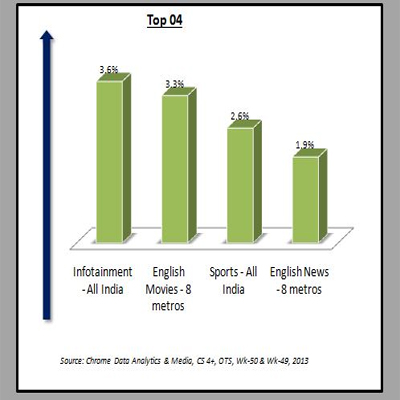
    And it shows in week 50’s  opportunity to see (OTS) data provided by Chrome Data Analytics & Media which keeps a tab on around 73 million TV homes nationally in analogue cable TV, digital cable TV and DTH. Infotainment channels were the biggest beneficiaries of the week with a gain of 3.6 per cent. Discovery Channel garnered the highest OTS among the players in the segment with its 89.1 per cent on an all India basis.


    Close behind was the English movies genre with a 3.3 per cent increase in the eight metros. As most channels gear up to air the biggest blockbusters to wrap up the year, movie buffs aren’t complaining. Sony Pix scored a 88.7 per cent in its OTS during week 50.


    Despite India losing to the Proteas in South Africa, sports buffs continued to tune into the action on the greens. The genre did appear in the top four categories with a  2.6 per cent gain. Ten Sports, the channel airing the matches, gained the most with 78.7 per cent OTS across India.


    The Delhi election aftermath did catch people’s attention with News channels in the eight metros seeing a jump of 1.9 per cent. Arnab Goswami’s Times Now topped the charts with 91.3 per cent OTS.  


    As for the bottom four categories, English entertainment channels saw a huge drop of 7.5 per cent in the eight metros. AXN registered 81.8 per cent OTS in the genre while others lagged behind.


    Religious channels saw a minor fall in the Hindi speaking market (HSM) at 0.6 per cent. Aastha channel continued to top the genre with a 97.9 per cent OTS.  Next in the line was the Hindi movie channel genre which sank 0.3 per cent with Star Gold continuing its golden run in the HSM with its 96.8 per cent OTS.


    Hindi News channels in the HSM region too saw a 0.3 per cent fall. Aaj Tak got the highest OTS at 93.6 per cent.

  • News channels record increase in OTS in metros

    News channels record increase in OTS in metros

    MUMBAI: Connectivity of a television channel is something that every executive is concerned about in the industry – whether in the media or broadcast sector or cable TV. And pioneering this data and analytics information is Delhi-based Chrome Data & Analytics which keeps a tab on around 73 million TV homes nationally in analogue cable TV, digital cable TV and DTH.

    We take a look at what the opportunity to see (OTS) was for various television genres and channels in week 48 of the year. It appears it was a week of the news channels, both business and general English news, as far as the eight metros are concerned.

    The reach of English news channels grew by 1.5 per cent and business news channels witnessed a 1.1 per cent gain. However, the English entertainment channels in the eight metros witnessed a drop of 0.3 per cent while the English movie channels saw a 0.6 per cent rise.

    Tarun Tejpal’s alleged misconduct with a journalist colleague in an elevator in a five star hotel in Goa, raised not only eyebrows of most urban Indians but also their interest as they tuned into news channels to catch up on the latest with the iconoclastic senior scribe.

    Hindi GECs in the Hindi speaking markets (HSM) saw a drop of 0.9 per cent, while Hindi movies and Hindi news dropped by 0.1 per cent and 0.8 per cent respectively. Only the religious channels saw a 1.4 per cent increase in HSM.

    The all India performance of sports and infotainment channels dipped in week 48. While sports recorded a one per cent drop, infotainment witnessed 2.6 per cent shaving respectively. Only the position of the kids’ channels in the all India market remained stable.


    The top Hindi GEC channel in HSM was Star Plus with a 97.8 per cent OTS. Zee TV and Colors were not too far behind with 97.4 per cent and 97.3 per cent OTS respectively. Life OK lagged behind in the race with 94.9 per cent OTS.

    Amongst the Hindi movie channels in HSM, Star Gold was the biggest gainer with 96.7 per cent OTS, while UTV Movies lagged at 88.8 per cent.

    ABP News was the leader in the Hindi News genre with an OTS of 93.2 per cent. And with 88.9 per cent, CNN-IBN was leading in the English news genre in eight metros, while CNBC Awaaz topped in the business news genre.

    Undoubtedly, it has been an interesting week for the channels. Let’s wait and watch how things unfold for the channels in the coming week.

    Click here for the full analysis

  • Cable TV DAS and the head end factor

    Cable TV DAS and the head end factor

    MUMBAI: Digitisation is meant to bring about transparency and order to what has for long been talked about as an unorganized business. The pressure of scaling up in order to deliver digital cable TV has also had an expected fallout: consolidation. Smaller cable ops, independent operators have been forced to join hands with existing national MSOs like Hathway or DEN or amongst themselves. And this fusing has resulted in the reduction of the number of headends in the major metros – especially in Delhi and Mumbai where there has been a shrinkage from 110 to 15 and from 50 to seven respectively.

    “Consolidation of headends is taking place in the transition from analogue to digital phase. Also the trend now is that the MSOs set up headends only in areas where they cannot get access to a fiber line or a digital line. Also they are looking for solutions like getting a line from say Delhi or Mumbai to the nearby areas,” informs an industry expert.

    Industry experts attribute this change to factors such as rising costs of digital headends, billing procedure and administrative control.

    Explains Hathway Cable & Datacom MD & CEO Jagdish Kumar: “With digitisation has come the convergence of technologies and features like high definition content, VAS and broadband accessibility. All this in turn requires large amount of investment to manage economies of scale, thus ushering consolidation.”

    While Hathway currently has 23 headends and seven backup headends, including GTPL, several independent operators, informs Kumar, have evinced a keen interest in aligning with its ongoing digital plans, largely due to its success in Phase I and II.

    “We’ve drawn up ambitious expansion plans for Phase III and IV. We will soon make announcements on a few strategic acquisitions,” he exults.

    IndiaCast Media Distribution executive vice president Amit Arora agrees that a number of Delhi and Mumbai-based independent operators have started taking their digital feeds from bigger MSOs.

    “This arrangement is gaining popularity since it isn’t easy for every independent operator to make the huge capital investment needed for digital headends. And consolidation of headends has led to central warehousing of data and SMS,” he says.
    According to Ortel Communications CEO BP Rath, with a 200 channel headend costing nearly Rs one crore, it is not worth investing that kind of money for an independent operator who caters to say 10,000 customers in a small town.

    “So, they are joining bigger players in order to take feeds from them. While smaller operators merged with bigger players even during the analogue phase, it is now happening on a larger scale. And one will see further consolidation during phase III of digitisation,” he says.

    Apart from independent operators joining forces with bigger MSOs, the other reason for consolidation is the advent of the conditional access system (CAS) and the subscriber management system (SMS), as well as the prerequisite for getting these systems audited and approved by broadcasters.

    “When the bigger MSOs are taking so long to adjust to the new system and maintain quality as per the regulation, how will the small players be able to do it?” questions InCable managing director Ravi Mansukhani. “With consolidation, the big MSOs will take care of all the back office problems and the on-ground activity will be done by the independent operators.”

    “All this has led to a whole lot of process issues, which the smaller MSOs find difficult to manage and that is why independent operators are joining bigger players,” adds Rath.

    Ortel, which has 31 analogue headends, two digital headends and four analogue plus digital headends, is waiting for phase III. “It is only after that, we will see consolidation happening in Orissa and Chhattisgarh. Though we have our own headends, we are also talking about intercity connectivity,” informs Rath.

    Kumar too feels that “the trend will continue even in phase III and IV. The demand for digitisation will impact local independent operators, who will find it difficult to manage independently. Hence, the independent operator would continue to look to aligning with the bigger MSOs.”

    However, Arora thinks otherwise. “The consolidation process has already come to a phase where I do not see any further consolidation happening in phase III. The big wave has already happened in phase II,” he says.

    So when a smaller operator takes digital feed from a bigger MSO, how do they share revenue? “The revenue share worked out between bigger MSOs and independent MSOs is purely on mutually beneficial terms based on investments and services being provided in the market,” says Kumar.

    Arora elaborates: “Everybody has worked a different revenue model. Someone has opted for a 49:51 split, some have a 50:50, while some will have a 51:49 split. The revenue share depends on the strength and the need for funds.”

    Coming to another metro, Kolkata, unlike Delhi and Mumbai, its five big players: GTPL, Hathway, Manthan, IMCL and Digicable Network have not seen an urge to merge.

    Meanwhile, Arora sounds a cautionary note. “A takeover of one MSO by the other in Kolkata would only be possible if there is a national degree of consolidation.”

    According to Mansukhani, the biggest consolidation will take place nationally. “Right now only the small and middle level players are going to the big players and then ultimately few major players will have control.”

    Mansukhani feels that even international players will show interest in India once they see healthy cash flows of the MSOs in DAS I and II areas. “This is when the maximum consolidation will take place and this will happen once the entire phase I and II is complete.”

    Talking about the evolution of cable TV on the ground in Kolkata Manthan Broadband Services director Sudip Ghosh says, “Players with a subscriber base of more than five lakh might not consolidate headends. But Kolkata can see the consolidation of players with others having a subscriber base of around three to four lakh.”

  • MSOs, LCOs could soon face anti-monopoly regulations

    MSOs, LCOs could soon face anti-monopoly regulations

    MUMBAI: There could soon be caps on market shares of multi-system operators (MSOs) and local cable operators (LCOs) in a city, district, state and the country.

    The Information and Broadcasting (I&B) Ministry is keen that competition emerges in some states where monopolies have got created in the absence of any market share regulations and such monopolies do not form in other states, through reasonable restrictions on MSOs and LCOs.

    The Information and Broadcasting (I&B) Ministry on Thursday asked the Telecom Regulatory Authority of India (Trai) for its views on imposing of restrictions to prevent monopolies and the measures to prevent monopolistic operations by MSOs and LCOs.

    The I&B Ministry said it has asked Trai to provide its recommendations based on the following: “In order to ensure fair competition, improved quality of service, and equity, should any restriction be imposed on MSOs/LCOs to prevent monopolies/accumulation of interest? If yes, what restrictions should be imposed and what should be the form, nature and scope of such restrictions?”

    The ministry has asked Trai to also suggest amendments required in the Cable Television Networks (Regulation) 1995 Act and Rules framed thereunder.
    The ministry said it has observed that cable TV distribution is virtually monopolised in some states as operation of the entire cable TV network is dominated by a single entity in those states. At present, there are no restrictions on the issue of accumulation of interest in terms of market share in a City, District, State or country by individual MSOs and LCOs in the cable sector.

    MSOs and LCOs are currently free to operate in any area or areas of their choice after obtaining registration from the ministry.

    The ministry feels such monopolies may not be in the interest of cable TV consumers and may have serious implications in terms of competition, pricing and healthy growth of cable TV sector in that market.

    MSOs and LCOs are required to be registered with local Post Offices to be able to operate in the permitted areas of registration. However, as per recent amendments in the Cable Television Networks (Regulation) Amendment Rules 2012, it has become mandatory for MSOs to get registration from the I&B Ministry to operate in areas which are notified for analogue switch off and transition to digital cable TV delivery.

  • ‘Trai has come up with the correct CAS economics’ : K Jayaraman – Hathway Cable & Datacom MD & CEO

    ‘Trai has come up with the correct CAS economics’ : K Jayaraman – Hathway Cable & Datacom MD & CEO

    The Telecom Regulatory Authority of India (Trai) has laid out a fertile ground for digital cable TV take off. The formula is simple: price everything low and large volumes will create a viable market dynamics.

    India has seen it in mobile phones. The lessons will repeat itself in the television industry. Despite the initial blip, the industry will correct itself and grow as at the centre of this pull of gravity rests the consumers.

    Broadcasters are not in tune with this logic. Their programming costs are rising. So why not let them have the freedom of pricing their products?

    The cable operators, along with the consumers, are in love with the a la carte pricing of pay chanels at a maximum of Rs 5. The multi-system operators (MSOs) feel that a new business model is being set.

    In an interview with indiantelevision.com‘s Sibabrata Das, Hathway Cable & Datacom managing director and CEO K Jayaraman argues how every stakeholder will eventually stand to gain. The a la carte pricing will make digital cable popular while the revenue share across the value chain has been “very accommodative.”

    Excerpts:

    Do you agree with what the Telecom Regulatory Authority of India (Trai) has fixed as the price and revenue share under conditional access system (Cas)?
    The regulator has come up with the correct economics. Consumers will have choice and at a real affordable cost. The a la carte pricing of channels at a maximum of Rs 5 in Cas areas will increase the penetration of set-top boxes (STBs) and drive in volumes. The revenue share allocation across the value chain is also very accommodative. Broadcasters will get 45 per cent share and have access to advertising revenues as well. While multi-system operators (MSOs) will have 30 per cent and carriage fee, local cable operators are also given a fair share with full revenue on the free-to-air (FTA) package and a 25 per cent share on pay channel revenues. Also, the government will get more tax revenues.

    Broadcasters complain that the maximum price of Rs 5 per channel is too low and doesn‘t take into account their high programming costs.
    When subscription becomes transparent, the rate has to be low. For digital technology to take off, we need such a price regulation. Let us face the reality: these are the consequences of a new environment and a change in business model. Besides, the price regulation is only for one year. Free market will prevail and price will be discovered eventually.

    With a la carte pricing, cable bills are expected to drop. How will falling ARPUs (average revenue per user) affect the cable companies?
    Nothing can be worse than the current model. But under Cas, we will, at least, have a legally sanctioned revenue, albeit lower. No doubt we will get a Hindu rate of return. But we will not have under-reporting of subscribers. We are happy that a proper business model is being set. Revenues Will grow once the business model settles. Everybody will be on the move. As consumers have choice, broadcasters will have to worry about pricing their channels correctly within a maximum of Rs 5. If they do that, then MSOs can also make money. We will have to focus on providing quality cable TV service. If we don‘t do that, we have competition from direct-to-home (DTH) service and will face threat of being wiped out.

    Cable companies will also have to subsidise the boxes. Do they have the resources to absorb subsidy costs and still scale up?
    All of us will have to be in investment mode because the business model is changing. The initial subsidy on each box will work out to Rs 1,500. This is the price we have to pay for a change in the business model. But this can be squared off once it settles down. The price of STBs will fall by 15-20 per cent with a surge in volumes. Cable companies will have to raise resources, either through debt or equity. For those who can‘t, survival will be tough. The telcos like Reliance Infocomm are waiting to step in. We should be prepared for a high volume, low margin game. Distribution, initially, is a volume business.

    Won‘t your traditional business from non CAS areas be a support?
    Yes, we will have other businesses to run: internet, non CAS placement fee, ad revenues from local cable channels. We will also have carriage fee from FTA channels in a CAS system. For cable companies to cover up their overhead and variable costs (STBs), they will have to do other related businesses.

    A la carte pricing will drive down our ARPUs. But we are happy that a proper business model is being set

    Like having a well-rounded revenue stream?
    If you are a composite cable company, you will survive. We will have to provide video, voice and data through a common pipe. Standalone players will have a tough time. We, for instance, are preparing to launch voice over internet protocol (VoIP) services by the last quarter of this year. Test runs are currently on. We are also be aggressively pushing digital cable TV in non CAS markets. We recently launched in Jalandhar, having rolled out our digital services earlier in New Delhi, Mumbai, Pune, Bangalore, and Hyderabad.

    Do you see DTH having a perceptional advantage over cable?
    DTH platform providers are well capitalised and have a more long term vision. Their ARPUs can also settle higher as they better their products. But they have a huge variable cost in occupying transponder space. Cable companies, in contrast, have already made the investments and have low operating costs. Of course, now they will have a variable cost towards procurement of boxes. But they have an existing relationship with customers and cable is two-way enabled. Digital cable can also offer more channels. Composite cable companies with focus on multiple revenue streams can effectively fight DTH.

    How are you planning to infuse capital to fund digitisation?
    We will raise Rs 1 billion as debt to fund the first phase of CAS The bulk of the investments will be towards subsidising the STBs. Funding will also be required in setting up VoIP and expanding broadband infrastructure.

    Is it a good time to acquire last mile operators?
    If cable companies have the resources, acquisition of last mile will make sense. In the CAS areas where you have an administered price regime for one year, the payback period will be longer. But once the price is market-based, then recovery will be faster as more channels come under the pay system and people start subscribing to them. Even in non CAS areas, acquisition will provide size upon which a digital platform can be built later. But in case of Hathway where we have limited resources, we would rather put the money in placing more STBs.

    Will Valuations of cable companies go up under CAS?
    CAS will bring some semblance of order into the business. But it is a long term roll out and needs cash flow. What is more important is that cable companies will attract capital, whether in the form of equity, debt or convertible bonds.

    Will there be a consolidation in the industry?
    Consolidation will happen wherever digitisation is required because of new technology and service requirements.

    Zee network‘s Wire & Wireless India Ltd (WWIL) is planning to launch a headend-in-the-sky (Hits) platform and has expressed intent to make inroads into south and western suburbs of Mumbai. Do you see territorial warfare among MSOs returning?
    Hits is right now viewed more as a fashion statement. We are delivering digital without having Hits. If it is necessary, then everybody will do it. As far as poaching of operators go, it is an open ground. Cable companies who focus on good service and have capital to create capacity will turn out winners. Competition is not a one-way street.