Tag: Digital Brand Fest 2022

  • Digital Brand Fest 2022: Tracking the post-pandemic shift to digital marketing

    Digital Brand Fest 2022: Tracking the post-pandemic shift to digital marketing

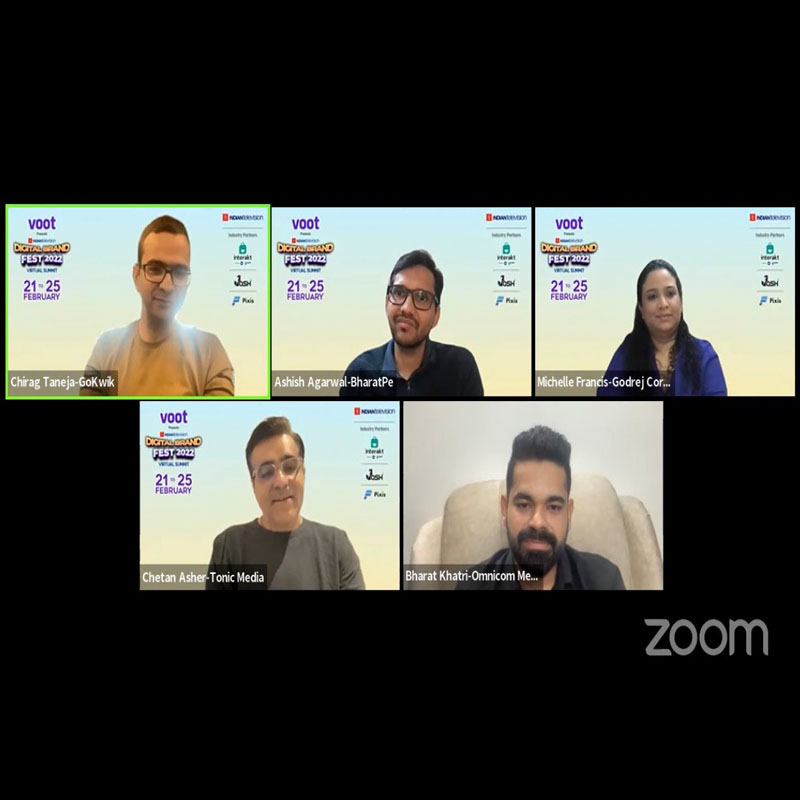
    Mumbai: The pandemic has brought a change in the marketer’s playbook over the last two years, challenging the existing guidelines on brand building and customer relationships. The second day of the ‘Digital Brand Fest 2022’ organised by Indiantelevision.com saw an interesting discussion centered on this new-found marketing reality in a session on ‘Digital Marketing – The New Dynamic Shift Post Pandemic.’

    The panelists included industry executives and marketers – BharatPe VP – Growth Ashish Agarwal, Omnicom Media Group Asia Specific chief digital officer Bharat Khatri, GoKwik co-founder & CEO Chirag Taneja, and Godrej Corporate brand and communications general manager Michelle Francis. The session was moderated by Tonic Worldwide Media CEO Chetan Asher.

    The week-long virtual summit is presented by Voot, and Interakt, Josh, and Pixis have joined as industry partners.

    Changing patterns of content consumption

    Today consumers are spending an increasing amount of time on their smart devices and connected TVs, compelling businesses to take a relook at their digital marketing goals. “There has been an increase in Digital spending by brands over the last two years,” said Omnicon media’s Bharat Khatri. “The Indian market is in the midst of the narrative where Linear Television is increasingly being replaced by Connected TV.”

    But, how have the large and legacy consumer brands dealt with this shift in the marketing paradigm? Are they still seen as a traditional marketing function?

    According to BharatPe’s Ashish Agarwal, earlier traditional marketers had a tendency to look at Digital marketing as just another channel, but now they have realised that it requires a different skillset. “You need to think of it as a product and a technology function when you are processing such a huge amount of data. It requires a ‘product manager approach’ and more technical expertise to handle it,” he added.

    Brands should consider digital marketing as a separate function that needs a specialised team, the panelists contended.

    “We also need to define the ROI and business metrics,” said Godrej Corporate brand and communications general manager Michelle Francis, adding that digital also played a critical role in reputation building, and building a connect with consumers. In the case of digital, ROI is performance-oriented and one that usually gives instant gratification, he added.

    The panelists also discussed the role of technology in marketing, on whether brands are building a marketing stack with MarTech, and if it is with a planned and sustained approach. They highlighted that most brands are open to the concept of additional tools to measure ROI, especially if a tool is able to decrease the brand’s cost per lead, and harvest a spike in sales and conversions by 10-15 per cent- which works as a good pointer for the brand. “You will see a lot of tools emerge which will cover up for talent gaps – or enablement products. Similarly, in the e-commerce space in India there are many companies trying to improve the funnel,” noted GoKwik’s Chirag Taneja.

    Omnicom Media Group Asia Specific chief digital officer Bharat Khatri said the investment is already happening from the agency’s point of view. “We have a separate division called analytic, which works mostly on the martech deployment tools, technology, etc. The new truth now is- marketing begins if you know your customer segment well, as opposed to ‘knowing your customer’ previously,” he added.

    With all the chatter going around on Web 3.0, NFTs, and the Metaverse, will brands be able to leverage the buzz?  It’s a “marketers’ paradise” and it’s here to stay – just like the new normal of the virtual world we have gotten used to, highlighted the panelists, adding that its scope goes beyond gaming. “Metaverse is going to be more powerful, when it comes to Web 3.0, digital economy, more so, creator economy,” said Michelle Francis. “Although I don’t see many brands integrating themselves as of now with it, it’s a great opportunity for the brands that are navigating it, for sure.”

    According to panelists, the challenge for brands now is to outdo themselves each time. They need to deliver better than what they delivered last time. “The ‘Test & learn’ kind of approach- that’s something that works better in a Digital world because you know what works and by how much. So keep testing, learn from it and incorporate it,” said BharatPe VP – growth Ashish Agarwal.

    There is also a need for stronger measurement metrics. To summarise what we need in this fast-paced, constantly evolving digital ecosystem is agility, flexibility, value-added customer experience, and constant iteration, the panelists concluded.
  • Digital Brand Fest 2022: How SMS and mobile marketing can accelerate brand growth

    Digital Brand Fest 2022: How SMS and mobile marketing can accelerate brand growth

    Mumbai: The digitally empowered consumers of today have more choices than ever before. As we enter into 2022 with new technologies propelling the digital transformation, several new age, as well as legacy brands, have jumped onto the digital bandwagon to up their marketing game, and retain connect with consumers.

    On day one of the Indian Digital Brand Fest 2022, IndianTelevision.com brought a host of industry experts together on one platform to discuss these trends shaping the future.  The week-long virtual summit is presented by Voot, and Interakt, Josh, and Pixis have joined as industry partners.

    The session on ‘Panel on SMS, Notifications & Whatsapp Marketing’ held virtually on Monday was moderated by Group M head of mobile and emerging tech Niraj Ruparel and the panelists included Soptle chief business & marketing officer Ritesh Ghosal, PhonePe corporate communications head  Priya Patankar, SUGAR chief business officer Suchit Sikaria, ex-WOW Skin Science VP of Marketing Madhur Acharya, Jio-Haptik’s SMB Solutions VP & business head Ahshad Jussawala, and Clever Tap SVP Marketing Jayant Kshirsagar.

    The industry executives discussed the latest trends driving the change in mobile marketing and how it has impacted the industry’s growth. SUGAR CBO Suchit Sikaria noted that the digital strategy has to revolve around mobile, and it starts right at the time of designing the asset and it has to be a mobile-first design.

    PhonePe corporate communications head Priya Patankar shared that PhonePe considers itself essentially as a utilitarian that begins with payments. “We have realised customers start with the most basic use cases for which they download an app. Once customers start trusting the app, they graduate to the more complex use cases,” she said about new consumer behaviour on the payment platform, while admitting that the pandemic has been a huge inflection point for digital payments.

    When it comes to mobile marketing, SMS and WhatsApp are very powerful media to build a connection with the customer, the marketers asserted. However, brand communication to the consumer has to be looked at through the lens of relevance, timing & value in the message, the panelists noted. According to WOW Skin Science VP of marketing Madhur Acharya, mobile marketing gives a better ROI & retention as there is more clarity on how one’s campaign is performing.

    The executives emphasised on leveraging WhatsApp for a mobile marketing strategy from the beginning. Jio-Haptik’s Ahshad Jussawala added, “For any small business or SME looking to grow their online sales and improve overall customer support, Whatsapp can be a game-changer.”

    On customer acquisition, Clever Tap SVP Marketing Jayant Kshirsagar said, “Retention is more important than acquisition and we help our customers retain their customers.”

    Also read: Digital Brand Fest 2022: Decoding digital transformation for tech-led future

    The industry executives were also unanimous in their views on the importance of hyper-personalisation in mobile marketing. Clever Tap’s Jayant Kshirsagar observed that the right kind of personalisation involves looking at customers as a ‘cohort’, and not as a ‘one size fits all’ with hyper-personalisation. Soptle’s Ritesh Ghosal agreed that personalisation on WhatsApp & SMS marketing allowed them to create a loyalty program, by crafting a value into the message. To which SUGAR’s Sikaria shared their experience of sending out personalised messages to their most loyal customers on Whatsapp, wherein the responses the brand received from its customers consisted of instant emotive acknowledgments.

    Group M’s Niraj Ruparel gave a huge thumbs up to Mondelez’s SRK campaign, citing it as one of the best instances of hyper-personalisation using AI & ML.  “Stop selling, start serving. Because if you serve your customers right they’ll refer to your brand and you’ll get new customers!,” said Clever Tap’s Kshirsagar concluding the discussion.

    Towards the end of the session, the marketers also addressed the concerns of Spamming in mobile marketing. Putting consumer fears to rest it was pointed out that WhatsApp has all the policies and measures in place to curtail Spamming activities by brands.

    For more details on the event, click here

  • Brands must tap into the emotional value of digital: Google’s Siddharth Shekhar

    Brands must tap into the emotional value of digital: Google’s Siddharth Shekhar

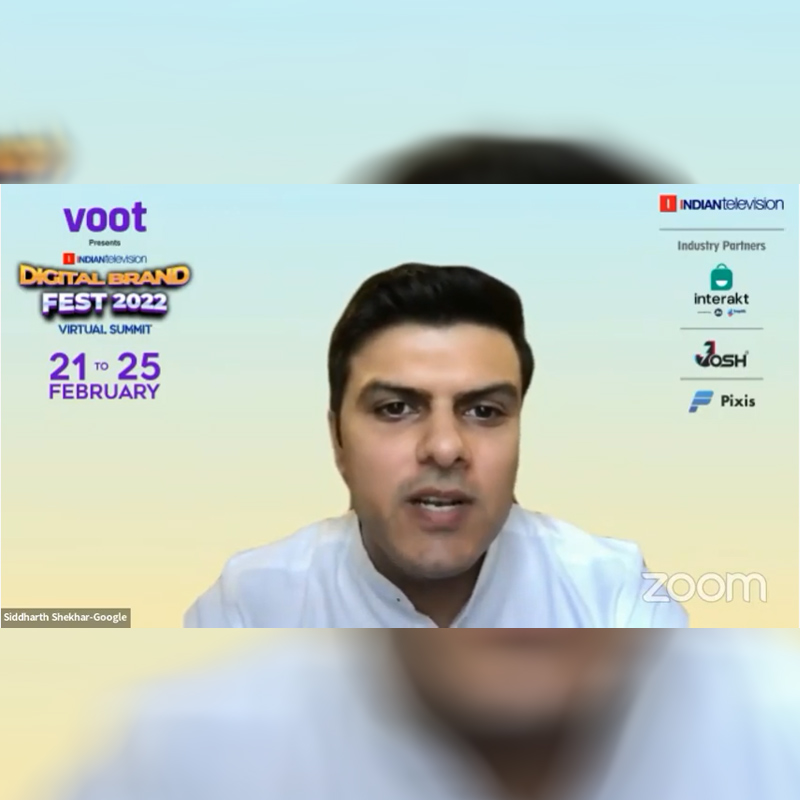
    Mumbai: Digital adoption is no longer a mere consequence of the pandemic. It has become an integral part of life for many who took to the internet because of the unprecedented situation. “Brands, therefore, need to be, not just Covid-proof, but also future proof,” said Google industry head – telecom, media, and entertainment Siddharth Shekhar.

    Shekhar was delivering the keynote address on ‘Decoding Current Digital Trends’ at the inaugural edition of the ‘Digital Brand Fest 2022’ being organised by Indiantelevision.com from 21 to 25 February 2022. The five-day virtual summit is presented by Voot. Interakt, Josh, and Pixis have joined as industry partners.

    Sharing the findings of the Google annual ‘Year in Search 2021’ report, Shekhar outlined five key trends under the broad themes – ‘Digital Mainstreamed’, ‘Lives Re-examined’, ‘Bridging Distances’, ‘Truth Seekers’, and ‘Growing Inequalities’.

    Digital Mainstreamed: Millions of consumers who migrated online in 2020 have demonstrated the staying power of digital from shopping to services to new users, who may have begun their online journeys due to necessity, now proactively deepening their usage. Speed, convenience, and price are some of the reasons why more consumers are now choosing a digital-first lifestyle, irrespective of offline mobility picking up.

    In 2021 India posted higher digital adoption than other regions like the US, EU, and China. The country has 600 million smartphone users and their number is increasing by 25 million every quarter. Users accessed more than four industries through digital channels in 2021. 65 per cent of Indians went online to buy a product they previously bought in-store. Search interest in online shopping and D2C brands grew by 32 and 533 per cent, respectively. Time and cost-saving, flexible payment options, diversity of offerings, improved delivery services as well as ease of tracking were their primary motivation.

    Search interest in virtual try-on increased by 55 per cent, while YouTube search interest in short video grew more than 100 per cent. “Among media consumption trends, streaming on CTV took off in a big way. Short-form videos became one of the largest sources of online entertainment. Even when people take a break from the screen, they are opting for formats like podcasts and audiobooks to stay informed and entertained. Live commerce is expanding its reach, with virtual try-ons becoming more common,” remarked Shekhar. 

    Lives Re-examined: As a result of introspection and revaluation of lifestyle choices and values, people are looking for more comfort in their personal and professional lives. They are placing more value on spending time with families which are echoed in their online searches.

    Search interest in the hybrid workplaces also grew by 350 per cent as people consider returning to offices in a hybrid set-up. “Even as restrictions ease, a blended way of living is likely to stay. Trends point towards a semi-remote future of work with 70 per cent of organisations in India looking at hybrid work models,” Shekhar observed.

    Holistic wellness with an emphasis on physical, emotional, and mental health is playing a bigger role in the decision-making process. There was an 80 per cent increase in search interest for online doctor consultation.

    Bridging Distances: Covid 19 still being a top concern in APAC, people in India feel more cautious about resuming normal activities, as compared to the global average. With one in two Indians saying they will not host events at home, festivals are now going virtual.

    “However, fears haven’t overtaken the need for personal connection and belonging. People are finding new ways to connect with each other,” shared Shekhar. “63 per cent users searched how to celebrate differently amid the pandemic, and some have also found new brands to help them do so.” This was also indicated by search interest in group orders growing by 85 per cent. Interest in virtual versions of offline activities also registered a 120 per cent increase.  

    Digital Brand Fest 2022: Decoding digital transformation for tech-led future

    Truth Seekers: People have become more aware of the spread of false information. 80 per cent of those surveyed say it is now more important for them to have trusted sources of information, as compared to pre-covid times. Searches about frauds and scams have grown by up to 35 per cent; trusted websites were searched +38 per cent.

    “Consumers want brands to be accountable and transparent at every step of the value chain. This is reflected in increased searches for delivery tracking and official stores (+80 per cent) of popular brands. They are doing extensive research prior to making a purchase. For as many as 31 per cent shoppers, authenticity is the key issue with online marketplaces.”

    Growing Inequalities: “Dubbed as ‘inequality virus’, the pandemic has exposed many societal fractures along the lines of wealth, race, language, gender, and more. Not everyone has equal access to the support systems they need,” observed Shekhar.

    Searches show the anxiety that consumers face when transacting in a foreign language. Up to 40 per cent say they won’t make a purchase unless they can access information in their local language. Search interest in songs and videos in local languages is also on the rise. Pandemic-induced unemployment in India has increased search interest in job security by 53 per cent. There was also a 38 per cent growth in searches for buy-now-pay-later financing options.

    Summarising the marketing implications of these trends for brands, Shekhar suggested that “brands must move forward with digital as an elementary strategy and not a complementary one. This will entail solutions such as bringing the storefront closer to shoppers, agile omnichannel strategies, owned or D2C channels that enable the building of bespoke brands presence and experience, and tapping into the emotional value of digital to build customer loyalty by delivering  at each touchpoint.”

    As consumers are becoming increasingly concerned about privacy, ‘building trust as brand equity’ is now more important than ever. “Brands will need to use first-party data more effectively to find the right balance between privacy and personalised interactions while preparing their own digital ecosystem without third-party cookies,” noted Shekhar.  He also advised businesses to “not let language be a barrier, and work towards closing technical, financial and accessibility gaps for consumers across the board.”

    For more details on the event, click here