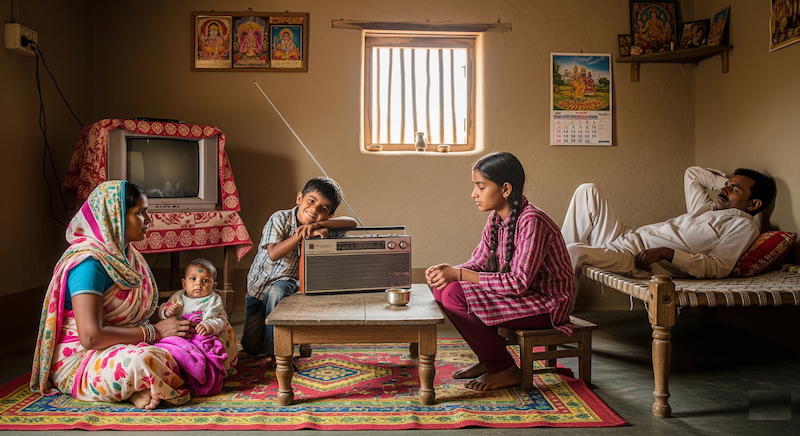
NEW DELHI: India’s telecom regulator has recommended sharp cuts in reserve prices for FM radio channel auctions, acknowledging the sector’s struggle against streaming services and stagnant revenues that have barely recovered from pre-pandemic levels.
The Telecom Regulatory Authority of India (TRAI) on 23 September proposed reserve prices 30 per cent below previous valuations for three cities seeking radio licenses. Bilaspur in Chhattisgarh would see its reserve price set at Rs 83 lakh, down from a calculated valuation of Rs 1.18 crore. Rourkela in Odisha faces a reserve floor of Rs 1.20 crore against a Rs 1.71 crore valuation, whilst Rudrapur in Uttarakhand gets a Rs 97 lakh reserve price from a Rs 1.39 crore assessment.
The cuts reflect harsh realities facing India’s private FM radio industry. Total advertising revenues peaked at Rs 2,382 crore in 2018-19 but crashed to Rs 941 crore during the pandemic’s first year. Recovery has been sluggish, reaching just Rs 1,819 crore in 2024-25—barely matching 2019-20 levels despite more channels operating.
“The sector is facing increased competition from digital audio platforms,” TRAI noted, warning of “substitutability effects” as younger listeners migrate to on-demand streaming services that offer playlist curation and skip functions unavailable on traditional FM.
The regulator’s move follows disappointing recent auctions. In July 2025, only 63 of 730 available channels across 234 cities found buyers, highlighting weak industry demand despite government efforts to expand FM coverage.
TRAI also introduced a new “category E” classification for 18 small cities in hilly regions of Himachal Pradesh, Uttarakhand and Jammu & Kashmir, setting their reserve prices at just Rs 3.75 lakh each. These locations would operate with lower transmission power than existing categories, reflecting challenging terrain and smaller populations.
The recommendations include several industry-friendly measures: allowing FM broadcasters to stream content online simultaneously, permitting news and current affairs programming for up to 10 minutes per hour, and offering instalment payment options similar to telecom spectrum auctions.
Most significantly, TRAI urged the government to delink annual licence fees from non-refundable entry fees for all operators—not just new entrants. Current rules tie existing broadcasters’ annual costs to auction prices set by later bidders, creating unpredictable expense burdens that “impinge on the business model for FM operators.”
The authority also recommended allowing voluntary infrastructure sharing and reducing mandatory co-location requirements with state broadcaster Prasar Bharati, whose rental charges some operators claim could be recovered through independent infrastructure within 2.5 years.
India currently operates 388 private FM radio channels across 113 cities. The sector employs thousands and serves as a crucial local information source, particularly during emergencies. However, its financial sustainability increasingly depends on adapting to digital competition whilst maintaining terrestrial broadcasting’s unique community connection advantages.