Tag: Diego Maradona

  • Brands pay tribute to ‘The God’ Diego Maradona on Twitter

    Brands pay tribute to ‘The God’ Diego Maradona on Twitter

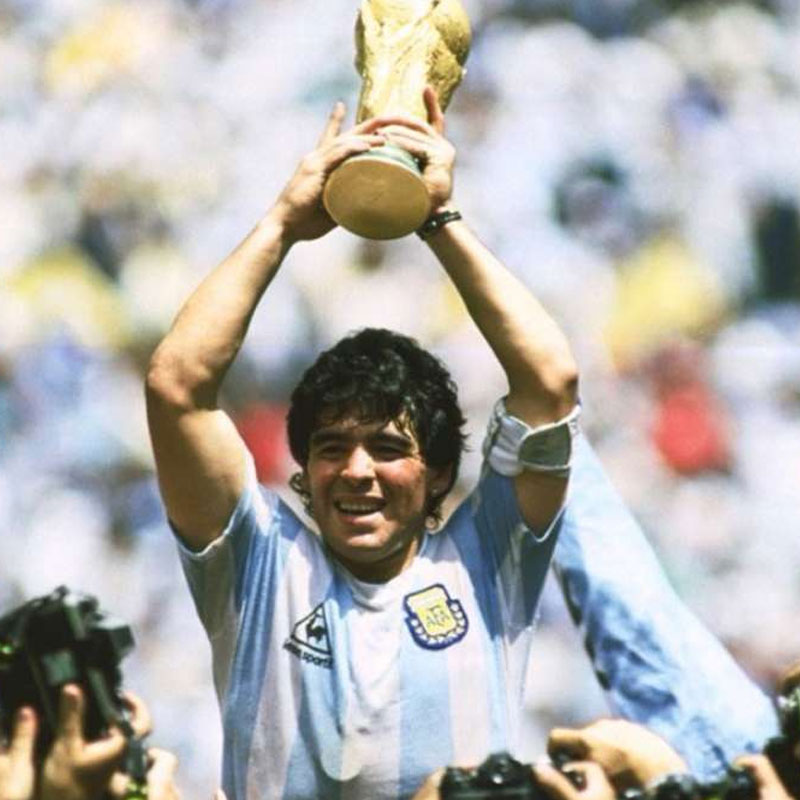
    NEW DELHI: The sad demise of legendary Argentina football player and manager Diego Maradona has left his fans heartbroken. Popularly known as 'El Dios' or 'The God', Maradona in his international career with Argentina earned 91 caps and scored 34 goals. He is best known for the ‘Hand of God’ goal, and leading his country to victory in the 1986 FIFA World Cup.

    At the peak of his career in the late ‘80s, Maradona also endorsed some of the top brands like Puma and Coca Cola. He breathed his last on Wednesday evening following a cardiac arrest. A number of brands, clubs, and celebs took to social media to pay their condolences on the passing of the maestro.

    Puma


    Greenply Plywood


    Mobile Premier League


    ATK Mohun Bagan FC


    Chennai Super Kings


    Chennaiyin FC

    Embed:


    Delhi Capitals


    Fox Football


    Sony Sports


    Sourav Ganguly


    Narendra Modi


    Robbie Fowler


    Virat Kohli


  • U-20 & U-17 FIFA ’19 bidding for host launched, Sony to telecast U-17 in seven countries

    MUMBAI: Broadcasters, OTT/VoD platforms and digital companies are looking forward to entertaining and engaging viewers by providing the best adrenalin. Sports lately is the genre which is in vogue. Leading broadcast and streaming companies are seeking out avenues and sporting event opportunities to keep their dedicated viewers glued to their respective screens.

    On the back of the success of the FIFA U-20 World Cup 2017 in Korea Republic, and with the FIFA U-17 World Cup India 2017 on the horizon, FIFA has launched the bidding process for the next editions of both of its men’s youth competitions – to be staged in 2019. 

    Telecast rights of U-17 FIFA World Cup 2017 to be held in India from 6–28 October are with Sony Pictures Network India. U-20 World Cup 2017 held in the Korea Republic was also telecast in India by Sony Pictures. Apart from India, Sony will air the matches in Bhutan, Sri Lanka, Nepal, Pakistan, Maldives and Bangladesh. 

    In 2014, Sony had won the media rights for the cyclic event till the next FIFA World Cup to be held in June 2018 in Russia, Sony Six business head Prasanna Krishnan told Indiantelevision.com.

    The FIFA 2019 bidding process for both tournaments recently got under way, with a deadline of 7 July 2017 having been set for FIFA member associations to declare an interest in staging either of the competitions. Member associations are being given the opportunity to bid for both events, however each event will be awarded to a different host.

    After that initial stage in the process, bidding and hosting documents will be sent by FIFA on 14 July to the relevant associations, who will have until 18 August to re-confirm their interest in becoming the tournament’s hosts. Definitive bids must then be submitted by 1 November, with the appointment of each host scheduled for Q4 2017 or Q1 2018 by the FIFA Council.

    The FIFA U-20 and U-17 World Cups are two of FIFA’s oldest competitions, dating back to 1977 and 1985, respectively. Since their inceptions, both competitions have grown in size and stature, adding lustre to the game by producing great attacking football and unveiling exciting players for the future.

    Players who have received the prestigious adidas Golden Ball for their performance at the FIFA U-20 World Cup include Diego Maradona, Robert Prosinecki, Lionel Messi, Sergio Agüero and Paul Pogba, whilst at the U-17 level they include Landon Donovan, Cesc Fabregas and Toni Kroos, to name a few.

  • CMG submits proposal to BFF for ISL-like football league in Bangladesh

    CMG submits proposal to BFF for ISL-like football league in Bangladesh

    KOLKATA: Sports event management company Celebrity Management Group (CMG) has put forth a proposal to the Bangladesh Football Federation (BFF) for organising a football league following the highly successful Indian Super League (ISL).

    Also, CMG has offered to purchase all sponsorship and marketing rights of the Bangladesh national team.

     
    CMG brought legendary Diego Maradona to Kolkata for a two-day promotional tour. CMG also helped BFF host the Argentina versus Nigeria FIFA Friendly in Dhaka in September 2011 besides organising a game between Argentina and Venezuela around the same time in Kolkata.

     
    It is further learnt that the events management company CMG has sought to host FIFA friendly matches for the Bangladesh national team for the next one-and-a-half years.

     
    CMG has reportedly suggested it will provide funds and arrange the opposition teams and venues for the games. The company will own the sponsoring, broadcasting and ticketing rights.

     
    CMG executive director Bhaswar Goswami said that they were in negotiations with the BFF and concrete developments could take place next month. “Yes, such a proposal has been made, but it is too early to say anything, further developments are likely to happen in around last week of January or the beginning of February,” Goswami said.


    “I have very good relations with (Diego) Maradona, who visited India twice at my request. I requested him to be involved with our initiative,” Goswami said.

     
    The BFF has decided to form a committee to look into the proposals.

  • ESPN announces new film series, 30 for 30: Soccer Stories

    ESPN announces new film series, 30 for 30: Soccer Stories

    WORLD: ESPN Films, creators of the critically-acclaimed 30 for 30 film series, will premiere a new series in April surrounding the 2014 FIFA World Cup on ESPN. 30 for 30: Soccer Stories will include a mix of standalone feature-length and 30-minute-long documentary films from an award winning group of filmmakers telling compelling narratives from around the international soccer landscape. In addition, a collection of 10 vignettes about Brazil’s rich culture will be featured throughout ESPN’s FIFA World Cup programming.


    “With ESPN being the home of the 2014 FIFA World Cup, we know that sports fans will be looking forward to high quality content focused on what is perhaps the world’s most revered sport,” said Connor Schell, VP of ESPN Films and Original Content. “We feel this is the perfect time to expand upon the success of our 30 for 30 series by focusing this collection on some of the incredible stories of soccer’s legendary past.”


    Two feature-length films:


    Hillsborough, Directed by Daniel Gordon


    25 years ago, on April 15, 1989, the worst disaster in British football history occurred in an overcrowded stadium in Sheffield, England, 150 miles north of London. 3,000 fans flocked through the turnstiles to head to the area reserved for standing, despite a capacity of less than half of that. The result was a “human crush” that killed 96 people and injured 766.  Initially the police blamed fans for the disaster, but a long investigation revealed that was not the truth. Prior to the disaster at Hillsborough, British football was known for the grime of its stadiums, hooligan fans and inadequate facilities, but great change came after the Hillsborough disaster. What emerged is now known as the most rich and powerful soccer league in the world, the English Premier League.


    White, Blue and White, Directed by Camilo Antolini; Produced by Juan José Campanella


    Although a large number of Argentinian players have found football success around the world, few have made a name for themselves in England’s top league. One notable exception is Ossie Ardiles. Fresh off Argentina’s victory in the 1978 World Cup, Ardiles and his compatriot, Ricky Villa, joined Tottenham Hotspur later that year, when the notion of overseas players was still new to the English league. Helping lead Spurs to victory in the 1981 FA Cup, the Argentinian stars became cult heroes in England. But on April 2, 1982, everything radically changed as Argentinian troops descended on the British-ruled Falkland Islands, asserting rightful sovereignty. A conflicted Ardiles returned to Buenos Aires two days later, his bright future with Spurs suddenly in question.


    Six 30-minute films:


    Garrincha: Crippled Angel, Directed by Marcos Horacio Azevedo


    In Brazil, Pelé is “The King.” But his teammate, Mané Garrincha, is also remembered as the one of the best soccer players of all time. In a country where the sport grants its protagonists such royal deference, Garrincha is the jester– an entertainer who amused crowds and turned soccer into an irresistible spectacle, all while helping Brazil capture two World Cups. This, despite his legs being so bent that early in his career doctors deemed him unfit to play professionally. Match after match, he proved them wrong. But his unpredictable moves were of little assistance after his playing career came to an end. Abandoned by the soccer establishment, Garrincha died a victim of alcoholism in 1983. But his fans did not forget him. His body was brought to a cemetery, in the outskirts of Rio de Janeiro. Garrincha’s relatives had to borrow a grave, which turned out to be too small for his coffin. Thousands of people flooded the tiny burial ground, much more than the place could accommodate. After 49 years of a brilliant career and tumultuous life, the man who turned soccer into a “Beautiful Game” was memorably laid to rest. His legend lives on.


    Barbosa – The Man Who Made All of Brazil Cry, Directed by Loch Phillipps; Executive Producers: Jonathan Hock & Roger Bennett


    In 1949, Goalkeeper Moacir Barbosa and his Brazilian national team are on top of the world, having just won the South American championship by a score of 7-0. Barbosa is one of the heroes, widely considered one of the world’s best goalkeepers. But everything changed during the 1950 World Cup, played for the first time in Brazil. Before the final game against neighbor and rival Uruguay, the Brazilian Football Confederation was so confident of victory it had made 22 gold medals with the names of their players imprinted on them. With 11 minutes left, Uruguay shocked the estimated crowd of 200,000 at Marcana and scored the winning goal – a goal that is still considered to be the greatest sporting tragedy to befall Brazil. The blame was mostly pinned on Barbosa for being out of position on his goal line, tantamount to Bill Buckner letting a baseball roll between his legs. The country went into a deep mourning, fans committed suicide, and Barbosa was nationally blacklisted. Barbosa was considered cursed and he never played in another World Cup. He rotted away, practically penniless and alone. On July 13th, the 2014 World Cup Final will again take place at the Maracana, giving the Brazilian team the chance to write a new ending into Brazilian folklore.


    Ceasefire Massacre, Directed by Alex Gibney and Trevor Birney


    New Jersey, June 18, 1994. Giants Stadium is awash with green as Irish soccer fans arrive to watch Ireland’s opening World Cup match against the mighty Italy. The sense of optimism is infectious. The Celtic Tiger is in its infancy, Bill Clinton’s decision to grant a visa to Irish Republican leader Gerry Adams has propelled the peace process forward and Jack Charlton’s team are walking onto the pitch before 75,000 fervent spectators made up of Irish, Italians and Americans of Irish and Italian decent. Amongst the fans is Irish Prime Minister Albert Reynolds who is sitting with members of an American group who’ve been working behind-the-scenes to end the conflict in Northern Ireland. The electrifying mood is shared by the supporters watching the match in the Heights Bar, a tiny pub in the Northern Irish village of Loughin Island, 24 miles south of Belfast. At the half, the Irish are remarkably ahead 1-0. Shortly after the second half begins, two masked gunmen belonging to a Protestant terror group burst into the Heights Bar. Thirty rounds are fired and six innocent men watching a soccer match were killed. Ceasefire Massacre will reveal how the juxtaposition of the jubilation felt inside Giants Stadium against the horrors of what happened in the Heights Bar, encapsulated the mood of the time. After 25-years of conflict, Ireland and her people longed for peace and prosperity but the brutalities of the violence in the North were never far from the surface. The gunning down of innocent men as they watched a soccer match marked both a low-point and a turning-point in the Northern Ireland conflict; one that would ultimately contribute to the paramilitaries on both sides calling ceasefires just weeks later.


    The Opposition, Directed by Ezra Edelman; Co-directed by Jeffrey Plunkett


    In the wake of the 1973 military coup in Chile, American-backed dictator Augusto Pinochet transformed Santiago’s National Stadium into a concentration camp where political opponents were tortured and assassinated. Only months later, that same stadium was scheduled to host a decisive World Cup qualifier between Chile and the Soviet Union. Despite protests, FIFA’s own investigation, and the Soviet’s eventual boycott, the Chilean team still played the game as planned, qualifying for the 1974 World Cup on a goal scored against no one.


    Mysteries of The Jules Rimet Trophy, Directed by Brett Ratner


    Inspired by Nike, the Greek goddess of victory, the Jules Rimet Trophy was awarded to the nation that won FIFA’s World Cup and was among the most coveted prizes in all of sports. It is also the sports prize shrouded in the most intrigue – with the whereabouts of the original trophy unknown to this day. This film focuses on the great prize’s first brush with crime – a Nazi plan to steal the Rimet Trophy from Italy during World War II. The story unfolds like a great caper film, where our hero, Ottorino Barassi, a mild-mannered Italian soccer official, attempts to protect a valued treasure.


    Maradona ’86, Directed by Sam Blair; Executive Produced by John Battsek


    In the 1986 World Cup, Maradona redefined what is possible for one man to accomplish on the soccer field. Already a figure of notoriety, but with one failed World Cup behind him, Maradona took possession of the international stage in Mexico, the spotlight rarely drifting from him as he wrote an indelible history with his feet and, of course, with a hand from God. Delivered with passion and intelligence, Maradona ‘86 is a fascinating, evocative and operatic portrait of Maradona, revealing his inner complexity and contradictions while basking in the joy and passion of his performance on the pitch as he wrote his name on soccer history forever.


    10 Vignettes:


    Coraçao, Directed by Jonathan Hock; Executive Produced by Roger Bennett


    Brazil’s soccer tradition does not compete with other countries’ teams: it exists on a different level. But aside from soccer success, and despite Brazil’s recent economic boom, most Americans know little about the country, its geographical richness, gripping culture, and complex recent history in which the nation has transformed from a military dictatorship to a thriving, if young, republic. This short vignette series will travel from the beaches and favelas of Rio, to Salvador – the former hub of the slave trade – on a journey of music, dance, and history, to discover the stories that lie behind Brazil’s legend and explore how Brazilian soccer is truly the expression of the soul of its people.

  • Time of the yore, once more

    Time of the yore, once more

    MUMBAI: She must have raised many eyebrows for her provocative choices. But nobody could match Madonna’s style at her vixen-esque best. She inspired almost all the young girls in the eighties and most of the guys were awestruck by her sheer screen presence. Now, the viewers have a chance to know all about Madonna and a lot more about the 80s with a new show on NGC.

    Retro never really goes out of fashion, and when one looks back on this era through the yellow window, amazing content is assured, says John Abraham

    Since the era has had its own glory with neon pop colours, Diego Maradona’s ‘Hand of God’ punching Argentina to footballing glory, the launch of the first personal computer, the rise of Bollywood’s very own “Disco Dancer” and Jennifer Beal’s “Flash” dance, the channel gives an opportunity to explore that.

    “National Geographic Channel provides factual entertainment that strives to give people something new and fascinating. The 80s is, at the very least – fascinating and quite trend setting. Trends that are still impacting our lives – in terms of fashion, gadgets, sports, music, etc. This not just makes for rich and interesting content, it is extremely refreshing for the whole genre as well,” says National Geographic and FOX International Channels, VP, marketing, Debarpita Banerjee.

    However, since the show would feature multiple domains – from fashion, gadgets and sports to media and politics, the channel has done a great deal of legwork. To recreate the entire decade across various arenas wasn’t easy. “Legitimacy and accuracy had to be ensured, since every story is told through a string of first-hand interviews and accounts,” remarks Bannerjee, further adding that the 80s icons and newsmakers like high-tech titan Steve Wozniak, media mogul Ted Turner, renowned director Oliver Stone as well as Jane Fonda, Calvin Klein, Michael J Fox, Joan Collins, David Hasselhoff and Bruce Weber have been brought on board to share their insights about the decade. “While on the Indian front, Piyush Pandey, Mahesh Bhatt, Vinod Dua, Mark Tully and Subhash Ghai are a few of the big-wigs that have been roped in,” she adds.

    “Retro” always interests people and that is what has got the channel interested in the concept. “Plus, this was the decade that witnessed the emergence of legends such as Sachin Tendulkar, rise of Rajiv Gandhi and the era that gave Madonna, in all her avatars, a manic fan-base and when the world was privy to a modern day fairytale – the wedding of Prince Charles and Princess Diana,” says Banerjee.

    The 80s, according to the channel, has the best of ‘infotainment’ to offer to the discerning viewer, in way of fashion, technology, sports and some of the biggest moments in history. “So, while the decade may not be top of mind now, and may have acquired some dust, there is definitely a lot of sheen beneath it. We are quite confident that it will make a great watch,” she adds.

    To promote the series well, it is being supported by an extensive online campaign which has been activated on social media and across websites. The channel is hosting a #Flashback80s week from 21 till 25 October on the Nat Geo Facebook page for the three million plus fans. “The week will also see an ‘80s Music Quiz’ contest hosted on Twitter, Facebook users can hashtag #Flashback80s and tell us any three things that made the 1980s a memorable decade for them, whether fun or emotional or plain nostalgic. Also, we will be sharing videos, pictures, faux pas, gadgets, sporting events from the decade for people to relive a slice of the 80s,” says Bannerjee.

    Besides, actor John Abraham, the face of the channel, has also been going gung-ho about the concept. “The cherry on the cake would definitely be the show’s overriding theme! ‘Retro’ never really goes out of fashion, and when one looks back on this era through the yellow window, amazing content is assured. It was the decade that throbbed to the sounds of the Boombox, witnessed the death of Indira Gandhi and rise of Rajiv Gandhi and also the decade that saw the world holding its breath as the Chernobyl nuclear reactor went up in flames. I have no doubt that the show would appeal to people across all age-groups and is just as relevant today, as it ever was.”

    The show will air on Thursday and Friday at 10 pm every week.

  • ‘Premier League Soccer will have $20 mn revenues in year 5’ : Celebrity Management Group executive Director Bhaswar

    ‘Premier League Soccer will have $20 mn revenues in year 5’ : Celebrity Management Group executive Director Bhaswar

    After hosting big names in football like Diego Maradona in 2008 and Lionel Messi last year when the star Argentinean footballer toured India for an international friendly game against Venezuela played in front of a record crowd in Kolkata, Kolkata-based sports management company Celebrity Management Group decided to kick-start a venture like the Premier League Soccer, modeled on the lines of America’s successful Major League Soccer.


    An initiative of Indian Football Association (West Bengal), the governing body of football in the state, and CMG, the league has turned world’s attention towards Indian football which has been slowly realising its true potential as a marketable sport.


    Testament of the league’s potential is the fact that leading sports media company, MP & Silva, has bought the international media rights excluding South Asia. The organisers are targeting total revenues of $5-6 million from the inaugural season of the league.


    In an interview with Indiantelevision.com’s Javed Farooqui, Celebrity Management Group executive Director Bhaswar Goswami, the brain behind the project, shares his vision behind launching the league and its commercial prospects.


    Excerpts:


    What was the thought process behind launching Premier League Soccer?

    The day we brought Diego Maradona to Kolkata, we realised that we wanted to do something for Indian football which be different. We started looking at different options; we organised exhibition matches, got coaches down for clinics. But these were one-off activities. We decided to do something that is a combination of all these activities but is held on a regular basis and is part of the Indian football system. That’s when this idea came to us and we shared it with IFA (Indian Football Association); they immediately accepted (the proposal) and asked us to start working on how it should happen and what are the modalities.


    We studied global football from different perspectives, looked at MLS (Major League Soccer), EPL (English Premier League), and were sure that the franchise model is what we are going to follow. During this time, IPL (Indian Premier League) also happened in India and the cricket league was a roaring success. The inspiration was the MLS.


    The I League was going nowhere; it had no vision. It is India’s premier domestic football but only in words; it did not had any effect on the football scenario of India. So we thought we should do something which would create buzz across the nation and catch the imagination of the fans, the sponsors and everybody who loves football. We decided that we should bring the biggest names in football to come and play for our teams. That is how it started.


    How difficult was it to get international players like Cannavaro and Crespo to come and play in the PLS?

    It took us seven-eight months to put together these six big names because the first time when we sounded them out, they thought we were crazy; they didn’t understand what we were talking about. They had a long and illustrious career and have been sold and transferred from one club to another. But we came up with a proposal that they would have to sign an MoU and would be put up for auction for a base price which is acceptable to both of us. We also told them that their participation in the league would go a long way to develop football in India. They bought into our vision and accepted our offer. We are happy that we will have some of the big names being part of Indian football for the first time.


    Why did you restrict yourself to West Bengal rather than launching a pan-India league?

    I definitely want it spread across the country. But you need to have the endorsement of the AIFF (All India Football Federation) to organise a pan-India league. As AIFF has taken IMG Reliance as its marketing partner, they couldn’t have agreed to our proposal. And in case we want to do something, we have to go through them


    The reality is that there are more fans of Manchester United in India than East Bengal and Mohun Bagan put together. So then why can’t our clubs from Siliguri or Barasat have fans across India and beyond? It’s not just the name of the club but also how you create content. We believe that in the era of television, if you have the right product, content and packaging, it’s only a matter of time that it will travel across the world. You will have a winning brand and a winning combination. It doesn’t matter where the matches are played. If the content is seen in North America, South America and Europe besides India, I think we are up for a great future ahead for PLS.


    What will drive this league?

    We have the best combination of legends in the world of football who will actually come together and play with our young boys in India. I think the quality of soccer played will be much better than what we see in India now. Each of the teams will be headed by a world-class coach. And in football, we all know coaches play a huge role.


    Imagine a young local footballer from one of the catchment areas passing the ball to Crespo for a goal. I mean, just the thought of it excites me! What it will do is bring our young footballers to the global scene. This will become an inspirational story for a number of talented footballers.


    Also for the first time in India, a league will be telecast across the globe in Europe, in Americas and Africa. You never know what will happen in five years time – perhaps, there will be an Indian footballer who may end up with a contract in Europe. So the marketing ability goes up.


    The market has already expanded. In the last few days, we have mopped up around Rs 1.05 billion that is being invested in teams and overseas players in the PLS. That money was always waiting to come into Indian football. The Indian football market will continue to grow.

    ‘The Indian football market has already expanded. In the last few days, we have mopped up around Rs 1.05 billion that is being invested in teams and overseas players in the PLS. That money was always waiting to come into Indian football’
    Don’t you think that the PLS will compete with I League?
    I League will continue to be the premier domestic competition in India. But I do believe that the PLS will be popular.


    Will it be more popular than I League?

    I hope so, that’s what my target is. A large number of television audiences watch EPL and I want them to watch our Indian league; that’s where my target audience is. If you look at Tam figures, in 2010 there were 155 million television viewers that watched football. I want most of them to watch the PLS.

    I also think that the PLS will complement the I League. It will be a talent supply source that the I League can tap.


    While the PLS will have big foreign names, will Indian players be able to participate?

    The I League players will not be eligible to participate in the PLS. We are talking about the other guys. The Kolkata Football League, which is one of the strongest leagues in India, has 16 teams in the premier division. Both Mohun Bagan and East Bengal have been beaten by four teams in the league. This proves that there are a lot of good footballers outside these I League clubs. Similarly, in Goa there are a lot of good footballers in the local league. So it’s actually these footballers who will get to showcase their talent in the PLS.


    A lot of I League clubs have been shut down in the recent past due to lack of returns. Many have blamed these clubs for not investing in talent development and marketing. Do you have commitment from the franchises that they will invest in talent development and help in marketing the league?

    One of the terms in the tender mandates each of the franchises to run U-13, U-16, and U-19 coaching camps. It is in the interest of the franchises to nurse talent. Because if you have a footballer who is worth being exported to one of the clubs in Europe, you might earn millions. The commercial opportunities in developing a footballer are enormous.


    What is your business model and how are revenues to be shared between PLS and the franchises?

    PLS has a central revenue pool which includes commercial rights. The broadcast and other media rights form part of this. Fifty per cent of that will be distributed among franchises. They also hold the marketing rights for their own teams; they have ticketing, merchandising and licensing rights. We are sure that the franchises will make profit.


    When do you expect the league to be profitable? What is the break-even period for the league as well the franchises?

    The league will be profitable in year one because of the model. In a franchise system, you cannot make loss because you are paid a fee. Then you will sell the commercial rights packages, out of which you share 50 per cent with franchises. So your earnin is the franchisee fee (which is Rs 75 million and is expected to reach Rs 85 million with the addition of the sixth franchise). And if you have $6 million from commercial rights in year one, you will make another $3 million from there (after sharing 50 per cent with franchises). We are also sure that each of the franchises will make profit in year two.


    What kind of investments you are making to organise the league?

    We will be investing around $3 million. A large part of that will go into developing infrastructure at all the venues. There will be floodlights in all the stadiums; upgradation will also be done.


    Do we have stadias in each of the franchise cities?

    The franchise cities itself were chosen on the basis of whether they have stadias and hotels.


    What do you think is the revenue potential of this league?

    I am expecting the league to reach $20 million in revenues during the fifth year. So far as the franchises go, if they do a consolidated P&L account they will earn a profit of at least $15-20 million.


    Why have fixed the expense cap for the franchises at $2.5 million?

    We don’t want them to over-spend. This cap will, however, change each year after discussing with the franchises.


    What about your broadcast partner for India?

    We are in talks with three of them. We are still evaluating what kind of deal we want to have. We are looking at a broadcaster who would help us in promoting the league. We want the matches to be shown live.


    Will you have a local broadcaster in West Bengal besides a South Asian rights holder?

    We are not looking at a local broadcaster at this point, but you never know what happens. We are looking to sell a South Asian package. I want my league to be a pan-Indian product.


    How many sponsors are you looking to sign in?

    We will have a title sponsor, six on-ground sponsors and one referee sponsor. We haven’t started looking out for sponsors yet, but we will sign them very soon.


    Will slowdown have an impact on PLS?

    I am not looking at billions of dollars, so I am not bothered about slowdown.


    What are your marketing plans for the league?

    We are in talks with leading agencies who will work with us on marketing the property. We are seeing presentations from a lot of them. We will have a 360-degree marketing strategy.

     
  • Avaya handles nine trillion bytes of data and voice transmission during the Fifa World Cup

    Avaya handles nine trillion bytes of data and voice transmission during the Fifa World Cup

    MUMBAI: Handling everything from players’ and journalists’ accreditations, to transmitting photos and match details around the world in real time, the converged network from Avaya, an official partner of the 2006 Fifa World Cup has managed a communication network that’s free of errors.

    Avaya, which provides business communications applications, systems and services. The converged network – which combines voice and data on the same infrastructure — connects the 12 host stadiums, the stadium media centers in Munich, Berlin and Dortmund and the Fifa headquarters in Berlin.

    Players, coaches, volunteers and fans alike benefit from the network that is being used to issue accreditations for players and journalists, report results, track materials and inventory, confirm accommodations at Fifa’s official hotels and maintain security systems.

    According to Avaya, at the halfway point in the tournament, the network has performed flawlessly and without any downtime, which is critical for a highly visible event such as the Fifa World Cup. For example, for the first 20 matches, the cumulative worldwide television viewing audience was almost 1.26 billion people. The total of voice and data bytes transferred over the network since it went ‘live’ on 1 June 2006 is 9.8 terabytes (or 9.8 trillion bytes of traffic). The average amount of traffic transmitted on Avaya network each day during the Fifa World Cup is 250,000 gigabytes.

    People have logged onto the converged communications network approximately 567,000 times, to date, and over 296,000 phone calls have been made on the network, which represents 632,297 minutes of calling time.

    Thousands of people have been using the high-speed Wireless Lan access from Avaya that have made connectivity easy and convenient for staff working temporarily in an area of the stadium or Fifa Headquarters Hotel.

    Journalists and photographers working in the stadiums can quickly connect to the Internet via an Avaya wireless Lan network and send photos and stories directly from the field.

    Avaya’s Fifa World Cup programme director Andrea Rinnerberger says, “Whether it’s our team of Avaya technical experts or the team of players on the field, the same rules apply: excellent preparation is critical to success. For months, the network Avaya built for the Fifa World Cup underwent rigorous testing in configuration, fail-over and resiliency.

    You might say we were in ‘intensive training’ for the tournament. Achieving 99.99 per cent network availability and reliability to date is the result of these high-powered IT ‘workouts’ that enable us to be fully ready for the expected and unexpected.”

    The unexpected arrived for the Avaya team of technicians working at a match at the Fifa World Cup stadium in Munich when Argentine football great Diego Maradona ducked into the stadium’s technical center to escape autograph seekers, and found himself surrounded by blinking monitors and racks of media servers and gateways that comprise the network Avaya built for Fifa. After his — and the Avaya team’s — initial surprise, the former football star was introduced to the world of high technology, with a tour of the network that Avaya deployed.

    Rinnerberger said, “It’s a ‘World Cup moment,’ but it illustrates Avaya’s dedication to being prepared for anything and everything. We bring the same dedication to the enterprise customers we serve around the world.”

  • Discovery Channel to premier series ‘More Than A Game’ on World Cup

    Discovery Channel to premier series ‘More Than A Game’ on World Cup

    MUMBAI:Starting 28 April, Discovery Channel is set to premiere six-part series More Than a Game, which will chronicle the emergence of international football’s greatest teams and players interwoven with the story of how the World Cup evolved as a tournament and shaped the nature of football worldwide.

    This series will air every Friday at 9 pm and each episode will be repeated on the following Saturday at 10 am.

    More Than A Game will feature the six giants of the game – Brazil, Germany, France, England, Argentina and Italy.

    The football World Cup has evolved into a cultural event that unites the entire world for one exhilarating and unforgettable month. More than just a sporting extravaganza, it has impacted the economy of countries and their presence on the global map, informs an official release.

    Made in collaboration with the Fédération Internationale de Football Association (FIFA) and featuring exclusive footage from FIFA’s film archive and recollections from some of the world’s greatest players including Beckham, Beckenbauer, Zidane, Platini and Zoff, the show will present the definitive account of the World Cup – its glorious goals, legendary players, fanatical fans and enduring appeal.

    The release also adds that with previously unseen footage from matches dating back over 40 years, viewers will get a fresh perspective on even the most familiar football legends. They will also witness how winning or losing a game can change the fortunes of a nation.

    Discovery Channel’s spokesperson said, “More Than A Game showcases how the World Cup has been a carnival of innovation, advancing both the game and the business of football. It presents the fascinating account of the extraordinary brilliance and the gallant failures of the superpowers of world football. Identifying and capturing the defining moments of the football World Cup is what makes More Than A Game so captivating.”

    The Ambassador of Brazil, His Excellency Jose Vicente Pimentel said “I am delighted to be part of this special programme by Discovery Channel which will provide the football enthusiasts in India an insight into the history of the World Cup. Each of the six nations covered in the programme represent football in its truest form. Each episode will give viewers an insight into the various manifestations of the sport and how single-handedly football can bind an entire nation.”

    MORE THAN A GAME programme schedule:
    • Brazil on 28 April at 9 pm
    The World Cup has defined Brazil as a nation. The five-time winners have given the world legends like Pele, Carlos Alberto, Tostao, Socrates and Ronaldo. In this episode, you can also watch 17-year-old Pele leading the Brazilian charge to their first World Cup win in 1958 and then taking it to the event to its greatest height: the superlative final of 1970.

    • Argentina on 5 May at 9 pm
    Argentina’s Diego Maradona became the biggest football star since Pele. Never has one man so dominated the World Cup. But after the bravura and brilliance of 1986, it has all been downhill for Maradona. His well-publicised descent into drug addiction and psychological deterioration mark a sad end to an incredible career. Also see the memorable celebrations in Buenos Aires in 1978 after Argentina won against a background of intimidation and corruption with a military junta governing the country.

    • England on 12 May at 9 pm
    The British boycotted the World Cup till 1950 and have won it only once – in 1966. They were the first nation to win as hosts. With a passionate (and infamous) fan base and the superstar status of their players, it has always shared a love-hate relationship with the sport they invented. Their story of the World Cup ranges from disaster to gallant failure.

    • Germany on 19 May at 9 pm
    It’s hard to imagine a time when Germany was not a footballing superpower. But in the 1954 final, they were definitely the underdogs against the talented Hungarians. An extraordinary comeback set the foundations for future dominance, and till now they remain one of the most difficult sides to overcome. Watch how the World Cup has helped Germany to emerge as one of the leading nations in world football.

    • Italy on 26 May at 9 pm
    Paolo Rossi’s hat-trick helped Italy beat Brazil 3-2 in one of the greatest World Cup games. Their World Cup victory in 1982 ended a fifty-two year wait for their demanding supporters. The famous Azzuri are characterised by their stubborn, defensive approach that has, according to their critics, overshadowed the beauty of their game. They have, however, won the World cup three times and those who underestimate them, do so at their own peril.

    • France on 2 June at 9 pm
    The 1998 World Champions had included 15 squad players from different ethnic backgrounds embodied by Zidane, Desailly and Lizarazu. As the most racially troubled country in Europe, France was divided by the question of immigration. The multiracial make up of the French national team was openly criticised till their stunning 3-0 victory over favourites Brazil, which led to four days of euphoric celebrations across the nation. The win also summed the international nature of a sport which is More Than A Game.