Tag: Deven Bhojani

  • TV’s beloved ‘urban’ family returns for Urban Company’s video series

    TV’s beloved ‘urban’ family returns for Urban Company’s video series

    Mumbai: What’s common between a Native RO Water Purifier and the most loved family of 2000’s television? It’s Urban Company’s latest video series, conceptualised and written by Bare Bones Collective.

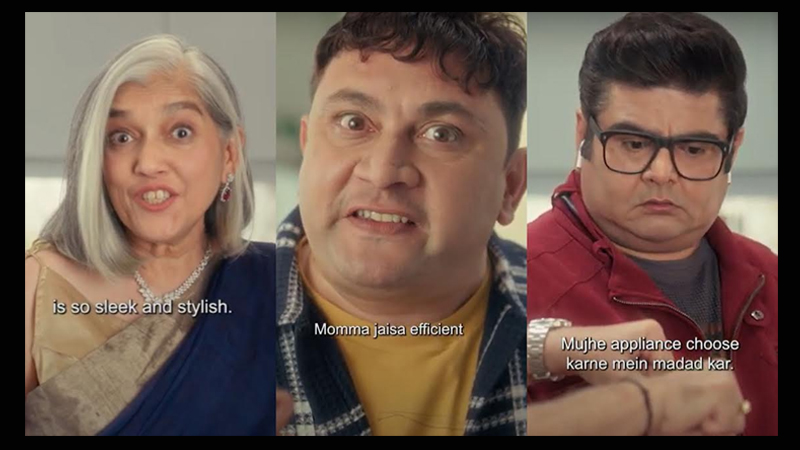
    Urban Company’s latest video series sees Ratna Pathak Shah, Satish Shah, Deven Bhojani, and Rajesh Sharma reunite to tickle your funny bone with an ‘Urban Company’ twist.

    The family that made us laugh out loud with their ‘upper class vs middle class’ antics is back to introduce Urban Company’s ‘Native RO Water Purifier’.

    A revolutionary product by Urban Company, the Native RO Water Purifier is a homegrown water purifier that requires servicing only once every two years! Tailor-made for Indian households, it promises a hassle-free experience along with unparalleled convenience.

    The writers Manaswi Mohata and Anuya Jakatdar, with the iconic cast, made The RO feel at home, just like all of us!

    The video series was released on Urban Company’s social media platforms, which include YouTube and Instagram.

    Talking about their latest project, Bare Bones Collective co-founder and chief creative officer Girish Narayandass said, “We’re excited to collaborate with Urban Company, and, who better to bring back for the launch of the Native RO Water Purifier than the beloved urban family? Hope it takes everyone on a nostalgic trip back to the 2000s.”

    Adding to the enthusiasm, Urban Company director of marketing Divya Jain shared, “With our latest campaign featuring the cast of a beloved sitcom, we’re tapping into the heart of Indian millennials who prioritize both convenience and cutting-edge technology. By partnering with Bare Bones Collective, we’ve embarked on a unique journey that intertwines humor, family dynamics, and smart living solutions such as Urban Company’s Native RO Water Purifier.”

    Twilight Entertainment is the production house on this project.

  • FTA audiences’ loyalty is more towards slots than programmes: Shemaroo’s Kranti Gada

    FTA audiences’ loyalty is more towards slots than programmes: Shemaroo’s Kranti Gada

    Mumbai: Shemaroo Entertainment forayed into the broadcast business in 2020 with Free-To-Air (FTA) channels Shemaroo MarathiBana and Shemaroo TV. The latter began its Originals journey in February 2021 with the crime show “Jurm Aur Jazbaat” hosted by one of television’s biggest stars, Ronit Roy. Around that time, the channel was enjoying a successful run with a cumulative reach of 43.89 million (as per Barc data) and an average of 71.18 million gross impressions per week.

    Despite taking off to a good start, the show had to be called off due to the onslaught of the Covid-19 second wave. But its short and successful run gave the company an insight into the popularity of the crime genre among its audience, and this became the motivation behind its second Original titled “Crime World,” launched earlier this month.

    In a freewheeling chat with IndianTelevision.com, Shemaroo Entertainment chief operating officer Kranti Gada shares more about the new show and its USP as well the nuances of the FTA audience. On the sidelines of the show launch, we also discuss ShemarooMe’s one-year journey of building the Gujarati entertainment ecosystem.

    Quasi-news or entertainment

    While “Jurm Aur Jazbaar” was instrumental in building Shemaroo TV’s viewership for the crime genre, the team realised that in order to have a loyal audience it had to offer something different. This led to the idea of dropping the anchor-led format for “Crime World.”

    “Channels across the board are doing anchor-led crime shows where the narration is highly sensationalised, and often quasi-news. But ultimately we are a GEC, not a news or infotainment channel. We have to entertain and engage the audience simultaneously. Today, the world over, a lot of crime is actually being done like drama. With this understanding of crime as another genre of entertainment we went ahead with the no-anchor format,” explains Gada.

    Shemaroo TV has two crime slots – afternoon and late night. To keep them running when “Jurm Aur Jazbaar” went off air, the channel had to get content from various sources. “We learnt a lot from the way those shows were crafted, and the way audiences responded to them, and that is how ‘Crime World’ happened,” Gada shares. 

    The show has been conceptualised by Shemaroo TV’s in-house team.

    The quirks and perks of FTA

    As a non-network player, Shemaroo took the FTA route to garner reach for the channel. Gada, however, maintains that consumers watch a channel not because it is free or pay, but depending on how compelling the content is. It was hence crucial for Shemaroo TV to offer at par content to its audience, and being a challenger brand helped. “We knew we had to innovate to grow. While it would have been very difficult for an established channel to take a punt at a new format or show, as a challenger brand we could experiment and afford to take a few risks. In this case it seems to have paid off,” she says.

    Both Shemaroo TV and Shemaroo MarathiBana have been experimenting to bring differentiated content to their viewers. Apart from crime, the brand has strengthened itself in the mythological genre which operates in the early morning slot.

    Gada shares that establishing clear programming slots has proven an effective strategy for the channel. “We observed that the FTA audience does a certain amount of binge viewing. Unlike the urban/pay audience their loyalty is towards particular slots, not programmes, and hence the restlessness on the remote is less. What this means is they are around for a significant chunk of time, during which if you feed them good content they will stick. This is why we operate in chunks of time instead of half-hour slots.” she elaborates.

    Growing the OTT-verse

    Starting out with ‘how many people can I get on my platform,’ the focus of the OTTs has shifted today to having more consumers sampling, liking, and eventually paying the brand for its content, points out Gada. Players acknowledge the need to reach out to as many people for building a base and to understand consumer behaviour, choices, and the ideal mix of content, product, and pricing.

    To this end, ShemarooMe has been leveraging its content-as-a-solution to build a partner ecosystem of brands across BFSI, telecom, e-commerce, hospitality, ISPs, FMCG, and travel industries.

    “Even though there has been an explosion in the consumption of digital services across categories, all these platforms have a common problem of the customer coming to them only for a certain need. Therefore, the frequency of engagement in many cases such as travel is as low as once or twice a month,” states Gada, adding, “The solution to this problem lies in servicing a recurring or daily need and entertainment is one of them. The partner platform grows its engagement, and by virtue of integrating with it, the consumer watches my content on my web platform. While these users may/will eventually subscribe to my content, in the meantime someone else who wants to engage them pays me for it.”

    The Gujarati content push

    In spite of its rich literary and cultural legacy, Gujarat remains a predominantly Hindi entertainment-consuming market, primarily due to a lack of Gujarati content. Having identified this opportunity, ShemarooMe began working on building the Gujarati entertainment ecosystem last year. 2021 marked the launch of the platform’s first Original in Gujarati. It hasn’t forayed into Hindi Originals yet. Right from Gujarati web series to day-and-date releases, to plays and bringing in old blockbusters whose digital rights were not getting monetised, the brand has been experimenting with it all.

    Gada is particularly proud of the Deven Bhojani starter “Yamraj Calling.” She describes the ‘heartwarming drama with a hint of comedy’ as a diversion from the usual crime and violence which forms a major chunk of OTT content. Hopeful of seeing more such family/mass content on OTT, she adds, “More than 10 per cent of our consumption of ShemarooMe happens on smart TV. The number is higher in the international markets. While OTT will be eventually going the TV/family viewing way, even if we’re not, we ought to be mindful of what we are feeding the audience.”

    She concludes the interaction by talking about ShemarooMe’s strategy of reaching out to the Gujarati diaspora in the US through humanitarian initiatives and local events, communities, influencers as well as local programming. The brand’s locally produced series “The Great American Gujju Show” is hugely popular in the community.

    “While Gujaratis in the US want to stay connected to their roots, they also want to hear about the local influencers and leaders who have played a big role in the upliftment of the community in the States. These are the kind of nuances we are trying to understand and tap into,” notes Gada.

  • Deven Bhojani to direct a Bollywood film

    Deven Bhojani to direct a Bollywood film

    MUMBAI: Who can forget the Kareema of Dekh bhai Dekh. The TV actor Deven Bhojani became to household name with his impeccable performaces in Baa Bahoo Aur Baby, Office Office etc. The actor who turned director with his serial Sarabhai vs Sarabhai is all set to enter Bollywood.

    According to reports, Vipul Shah has roped in Bhojani to direct his next, which is a romantic comedy. The makers of film are now looking out for actors as soon as the script is complete.

    Interestingly, it was Vipul who had given Bhojani his first big role in his serial Ek Mahal Ho Sapno Ka and since then the two have always been good friends.