Tag: Deutsche Telekom

  • XR Sports Alliance attracts new members

    XR Sports Alliance attracts new members

    MUMBAI: The XR Sports Alliance (XRSA) is beginning to gather momentum. Founded by video streaming solutions company Accedo  together with wireless tech company  Qualcomm Technologies and  sports host broadcaster HBS, in June 2024, it has announced its first batch of members. These include: sports rights owner E1 Series; telecom operator Deutsche Telekom; AR glasses and original equipment manufacturer (OEM) XReal and and technology service providers, Ateme, Skyrim.ai.

    The new members will  be contributing to the XRSA, which aims to accelerate knowledge gathering, technological advancement and time-to-market for XR sports services, as well as gather and share industry knowledge across the globe.

    Said Accedo CEO Michael Lantz: “The XRSA was born from a shared vision. Our ambition is to build a powerful collective of passionate leaders and experts from both the sports and XR industries, all committed to advancing the commercialisation of XR sports services. Every member is important for how we shape our end-to-end experimentation framework and how we lay the foundation for scalable technology and sustainable XR business models.”

    Qualcomm Technologies senior director business development Patrick Costello added: “Through the XRSA user testing framework, we  will gather valuable data from global deployments and share these lessons learned reports with our members, ensuring insights are drawn from diverse audiences to inform future developments.”

    HBS digital head Sylvain Lebreton  commented: “The planned experimentation deployments in early 2025 will involve extensive experimentation with both non-live and live spatial video formats and evaluating user interaction with various immersive fan features and spatial advertising. We will continue to grow the membership over the coming months and welcome interest from companies across the ecosystem, both those wishing to serve as contributing members, as well as observing members.”

    Accedo, HBS, and Qualcomm Technologies, will be at CES 2025 from 7-11 January 2025. 

  • India, China focus of report on ‘bundling interactive services with IPTV content delivery’ to accentuate market

    India, China focus of report on ‘bundling interactive services with IPTV content delivery’ to accentuate market

    MUMBAI: Interactive Services are being bundled with Internet Protocol Television (IPTV) content delivery to accentuate market. QYResearchReports.com has announced the addition of a new market intelligence report, titled “Global Internet Protocol Television (IPTV) Market Research Report 2021”.

    The research provides a granular analysis of major factors shaping the consumer demand and preference in various regions such as North America, Europe, and Southeast Asia, with a focus on India, Japan, and China.

    The intensifying demand for services to deliver standard or high-definition television signals over the internet in real time is a key factor driving the evolution of IPTV. The growing popularity of IPTV for streaming media to access TV channels is attributed to several distinct advantages it offers over traditional cable and satellite pay-TV services. Over the past few years, cable operators and satellite broadcasters in developing and developed channels are increasingly using IPTV to provide additional channels to their subscribers. This is a key factor accentuating the market.

    The rising demand for customizable TV content and the pressing need for improving quality of service (QoS) for content providers are key trends expected to stoke the demand for IPTV. The unique advantage of IPTV to subscribers to view programs that they want and at their convenient time is a key factor propelling the demand for IPTV in various parts of the world.

    The growing popularity of video-on-demand (VoD) and time-shifted TV is a prominent trend catalyzing the growth of the IPTV market. Recent advances made in broadband infrastructure in several developing and developed nations and the advent of robust video compression technology are key factors expected to accentuate the IPTV market.

    The ability to bundle a variety of hybrid services with IPTV services is a key factor bolstering their demand across various industries for creating targeted advertising-on-demand video (AVoD). The offering of interactive services has further boosted the IPTV market. In recent years, IPTV has offered exciting avenues for a number of telecommunication companies exploring new revenue streams to improve their profitability in developing and developed nations. The rising internet penetration in several developing economies and the rising adoption of wireless communication technologies are key trend expected to fortify the IPTV market in the foreseeable future.

    However, the lack of viable communication infrastructure in less developed regions is a key factor likely to hinder the growth of the IPTV market. Furthermore, the high cost of setting up dedicated network architecture and platforms for delivering high-quality TV over the internet is a vital factor likely to hamper the adoption in several countries.

    The need for high bandwidth requirement is also likely to hinder the demand in less developed regions. The growing popularity of OTT services in developed regions is also anticipated to negatively impact the market to an extent. Nevertheless, the prominence of wireless-based distribution networks in various developing and developed countries is a key trend expected to create lucrative avenues for market players in the coming years. In addition, the demand for premium content to be delivered over IPTV is gaining significance, thereby unlocking exciting opportunities in various regions.

    Prominent players operating in the OTT market, according to the report, include PCCW Limited, NTT Plala, Neuf Cegetel, Deutsche Telekom, BT Group plc., UTStarcom, Bharti Airtel, AT&T, Orange S.A., Verizon Communications, and China Telecommunications Corporation.

  • Huawei’s ‘NFV Solution’ awarded ‘Best Enabler’

    MUMBAI: At Mobile World Congress 2017 in Barcelona, Huawei’s NFV solution was awarded Best Technology Enabler. This award points to the recognition within the industry of Huawei’s leading capabilities and outstanding performance in NFV architecture, technology, commercial application, and the evolution toward Cloud Native. Organised by the GSMA, Mobile World Congress is the world’s most influential event in the mobile communications sector, and the GSMA Global Mobile Awards are considered the highest honor within the industry.

    Huawei hit the ground running by developing NFV solutions using the Cloud Native concept. Moving beyond basic virtualization, Cloud Native enables telecom networks to become fully distributed and automated, giving them greater elasticity, robustness and agility. This helps operators enhance network efficient and deliver inspired user experiences, and enable agile innovation in services for better digital transformation.

    Elastic: The Cloud Native network has a distributed architecture, so resources can be dynamically deployed wherever they are needed to support applications. It is a “sensing” network that recognizes the services deployed, and an elastic network that can adapt to support those services. There are two types of elasticity: capacity elasticity and topology elasticity. Capacity elasticity means that all network resources are pooled. Network software can orchestrate any part of the fabric across multiple data centers and capacity is no longer the bottleneck. Topology elasticity means the ability to deploy resources to any required geographical location, enabled by control/user plane separation and service orchestration.

    Robust: An intelligent network builds in robustness at the network and service levels. The network is decentralized, with stateless elements, N-way redundancy and inter-DC service provisioning. Active fault injection, monitoring and self-healing processes are combined with big data analysis and management of services, enabling fault prediction and automated controls. Ultimately, an intelligent network delivers carrier-class service reliability even over unreliable infrastructure.

    Agile: Agility means service orchestration + programmability + ISSU (in service software upgrade). Flexible service assembly, service autonomy, and distributed deployment are achieved by decomposing network functions into microservices, and applying a service governance framework, data model and a programmable user interface. Services and new functions can be delivered as needed, so the network can instantly respond to the needs of very different services required by different industries.

    Using key Cloud Native technologies, Huawei has already rolled out its Cloud Native VNF solution, which has been widely adopted on core networks. Huawei remarked at MWC 2017 that the company will continue to optimize solutions revolving around service needs and through such efforts will help to build 5G and better connected agile networks.

    As of January 2017, Huawei had won over 170 contracts for cloud core networks. In addition, Huawei is a strategic partner and co-innovator with Vodafone, Deutsche Telekom and other global leading operators on their Cloud Native strategies. At MWC 2017, Huawei presented a Cloud Native demonstration developed with Vodafone. Looking to the future, Huawei will continue to help operators build more open, more innovative, more sustainable ecosystems around their Cloud Native networks, with the aim of creating more new services and more value.

  • 5G TV may rival cable, satellite & IPTV: Report

    5G TV may rival cable, satellite & IPTV: Report

    MUMBAI: TV and video delivery is likely to become a core capability of next generation 5G wireless services, concludes a new report from Strategy Analytics. Recent demonstrations have suggested that 5G will support 1Gbps data throughput rates. Combining 5G with other networking enhancements and technologies would allow operators to support TV-equivalent services which could eat into the $500Bn global TV and video market currently served by cable, satellite, IPTV and terrestrial broadcast service providers.

    Strategy Analytics, Inc. provides the competitive edge with advisory services, consulting and actionable market intelligence for emerging technology, mobile and wireless, digital consumer and automotive electronics companies.

    “Data rates get the headlines, but other network technologies will also make or break the business case for 5G TV services,” says Service Provider Analysis director Sue Rudd. “The efficiency of the end-to-end network will determine whether 5G TV is possible, but we have seen enough from early demonstrations by operators like Verizon, Deutsche Telekom, SK Telecom, AT&T and BT to suggest that it will arrive sooner or later in many parts of the world.”

    The report points out that the number of households and devices supported by a 5G TV service within any cell will make or break the 5G TV business case. The number of termination locations can be increased by a factor of three or more by deploying several network enhancements that deliver ‘trunking’ efficiency in the Radio Access Network (RAN). These include MIMO and beamforming for optimal spectrum use, virtualization of cell sites, dynamic throughput over backhaul networks and network slicing to guarantee data rates to the household.

    “Television is already being transformed by new digital services like Netflix and Amazon,” notes Michael Goodman, Director, TV and Media Strategies. “The arrival of 5G TV wireless services could herald another wave of TV disruption through the 2020s and beyond.”

    “The emergence of 5G TV would represent a further stage in the convergence of media and communications, and wireless and fixed services,” says David Mercer, VP and Principal Analyst. “It would also raise important questions relating to the roles of different ecosystem players and the future structure of the media value chain.”

    Also Read:

    Verizon completes purchase of XO Comm fiber business

    Regulations 2016: Of DeMon challenges, changing goalposts & rampant litigation

    Sports TV 2016: Digital explosion, player consolidation & confusion

    Tata Elxsi to showcase latest innovations & solutions in BroadcastAsia 2016

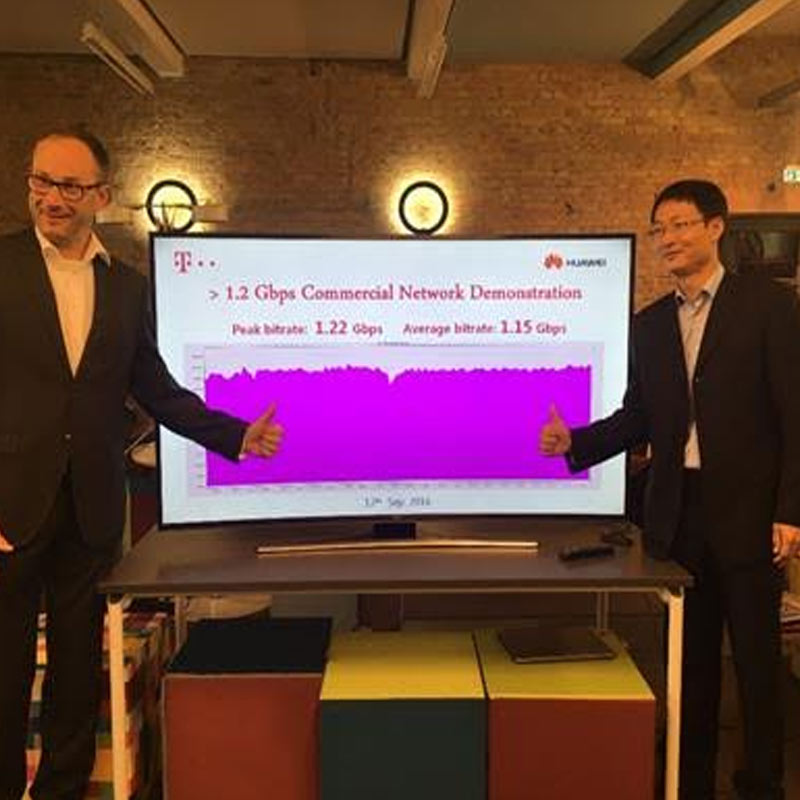
  • Deutsche Telekom pushes LTE speed to 1.2Gbps with Huawei

    Deutsche Telekom pushes LTE speed to 1.2Gbps with Huawei

    NEW DELHI: Deutsche Telekom and Huawei have accelerated mobile data transfer in Berlin’s LTE network to more than 1.2 Gigabits per second (Gbps), achieving a technology mix of four sending and receiving channels (4×4 MIMO) and five carrier frequencies deployed live for the first time and proving LTE Advanced Pro (4.5G) gives the highest data speeds.

    Deutsche Telekom and Huawei used the latest evolutionary step of this technology – LTE Advanced Pro (4.5G) – with a conventional mobile base station which was bundled with a small cell solution; the data traffic flowed over five carrier frequencies instead of just one. This required one thing above all from both the transmitter station and the receiving devices: they have to support 4×4 MIMO (multiple input – multiple output) technology. If all these components are used, individual users can enjoy peak speeds of more than 1 Gbps. Wireless capacities in the equipped cells are also improved greatly for all users.

    The current move by Deutsche Telekom and Huawei represents the next step in a long-term innovation collaboration in the development of mobile communications technologies and the roll-out of Germany’s fastest LTE network.

    “User behavior is evolving rapidly on the way to a gigabit society.
    That’s why fast Internet access can’t be limited to just fixed lines and fiber optics – our customers also want the highest possible speeds,” said Deutsche Telekom AG Board Member for Europe and Technology Claudia Nemat.

    Huawei Deutsche Telekom executive Lin Baifeng said, “Together, we innovate for the advanced wireless technology and Huawei is happy to support Deutsche Telekom to prove the benefits of LTE Advanced Pro (4.5G), in real field application.”

  • Deutsche Telekom pushes LTE speed to 1.2Gbps with Huawei

    Deutsche Telekom pushes LTE speed to 1.2Gbps with Huawei

    NEW DELHI: Deutsche Telekom and Huawei have accelerated mobile data transfer in Berlin’s LTE network to more than 1.2 Gigabits per second (Gbps), achieving a technology mix of four sending and receiving channels (4×4 MIMO) and five carrier frequencies deployed live for the first time and proving LTE Advanced Pro (4.5G) gives the highest data speeds.

    Deutsche Telekom and Huawei used the latest evolutionary step of this technology – LTE Advanced Pro (4.5G) – with a conventional mobile base station which was bundled with a small cell solution; the data traffic flowed over five carrier frequencies instead of just one. This required one thing above all from both the transmitter station and the receiving devices: they have to support 4×4 MIMO (multiple input – multiple output) technology. If all these components are used, individual users can enjoy peak speeds of more than 1 Gbps. Wireless capacities in the equipped cells are also improved greatly for all users.

    The current move by Deutsche Telekom and Huawei represents the next step in a long-term innovation collaboration in the development of mobile communications technologies and the roll-out of Germany’s fastest LTE network.

    “User behavior is evolving rapidly on the way to a gigabit society.
    That’s why fast Internet access can’t be limited to just fixed lines and fiber optics – our customers also want the highest possible speeds,” said Deutsche Telekom AG Board Member for Europe and Technology Claudia Nemat.

    Huawei Deutsche Telekom executive Lin Baifeng said, “Together, we innovate for the advanced wireless technology and Huawei is happy to support Deutsche Telekom to prove the benefits of LTE Advanced Pro (4.5G), in real field application.”

  • FY-2015: Subscription growth leads Sky revenue growth of 4.7%; EPS declines 2%

    FY-2015: Subscription growth leads Sky revenue growth of 4.7%; EPS declines 2%

    BENGALURU: London, UK headquartered pan-European satellite broadcasting, on-demand Internet streaming media, broadband and telephone services company Sky reported 4.7 per cent broad based total adjusted revenue growth for the year ended 30 June, 2015 (FY-2015) at ?11,2083 million as compared to the ?10,776 million in the previous year (FY-2014). Subscription is the biggest contributor to Sky’s revenue. The group’s revenue growth in the current year was led by a 4.6 per cent increment in adjusted subscription revenue at ?9697 million (85.9 per cent of total revenue) as compared to the ?9272 million (86 per cent of total revenue) in FY-2014.


    Across its five territories (UK, Ireland, Germany, Austria and Italy), the group reported 973,000 new customer additions in FY-2015, 45 per cent more than previous year, and 158,000 new customers in Q4-2015. Subscription revenue growth was underpinned by excellent customer growth across the group and strong product growth of 4.6 million (829,000 in Q4-2015), with the largest proportion of revenue growth continuing to be delivered through the UK where revenues were up over ?300 million. Alongside this, the group’s best year of customer growth in Germany drove a 10 per cent increase in subscription revenues, whilst Italy held total customers and revenue flat.


    Other segments


    Sky’s advertising revenue in FY-2015 grew 3.8 per cent to ?716 million (6.3 per cent of total revenue) as compared to the ?690 million (6.4 per cent of total revenue) in FY-2014. Sky attributes growth in advertising revenues with Germany delivering growth of 26 per cent through higher sellout rates and increased inventory around Bundesliga. Advertising revenues in the UK grew strongly, up five per cent, due to the benefit of incremental AdSmart revenues combined with Sky Media increasing their share of net advertising revenue by almost 170 basis points, whilst advertising revenue was down in Italy as we lapped the €27 million benefit of the FIFA World Cup revenues in Q4 last year.


    Transactional revenue increased 21.8 per cent to ?173 million (1.8 per cent of total revenue) in FY-2015 as compared to the ?142 million (1.3 per cent of total revenue) in the previous fiscal. Sky says that it benefited from the success of its Buy and Keep service, which surpassed weekly revenue of ?1 million in Q4-2015, and NOW TV transactions, which totaled almost 1.5 million over the past twelve months.


    Sky’s wholesale and syndication revenue in the current year increased 5 per cent to ?550 million (4.9 per cent of total revenue) as compared to the ?524 million (5 per cent of total revenue) in FY-2014. Sky says that growth was largely driven by continued growth in the UK where revenues were up 19 per cent as success on screen led to more favourable terms for our channels with wholesale partners. Alongside this, revenues were strong through the distribution of our programming internationally and the first time consolidation of Znak&Jones and Love Productions. In Italy, underlying wholesale revenues were broadly flat year on year (excluding the benefit in the prior year from Champions League resale revenues), whilst revenues in Germany were slightly down following the successful migration of former Deutsche Telekom wholesale customers to a retail relationship in the prior year.


    Other revenue was almost flat (declined fractionally) to ?147 million (1.3 per cent of total revenue) as compared to the ?148 million (1.37 per cent of total revenue) in the previous year.


    Adjusted profit before tax increased 5.9 per cent to ?1196 million as compared to ?1129 million in FY-2014. Adjusted EPS declined 1.9 per cent to 56p as compared to the 57.1p in the previous year

  • Satellite TV to overtake cable TV revenue by 2016: Study

    Satellite TV to overtake cable TV revenue by 2016: Study

    MUMBAI: By 2016 satellite TV revenue will overtake cable TV revenue for the first time.

    Market research firm Infonetics Research released excerpts from its November 2012 Pay TV Services and Subscribers report, which forecasts and analyzes the telco Internet protocol television (IPTV), cable video, and satellite video services markets.

    The global pay-TV market (cable, satellite, and telco IPTV) totaled $137 billion in the first half of 2012 (1H12), a 9.4 per cent increase over the same time last year. Global pay-TV service revenue is forecast by Infonetics to grow at a seven per cent CAGR from 2011 to 2016, spurred by emerging markets India, Brazil, Argentina, Mexico, Russia and China.

    Latin America, the smallest but fastest-growing pay-TV market, is on track to jump by 23 per cent this year to top $23 billion. The number of global pay-TV subscribers will reach 719 million in 2012, up by six per cent from 2011.
    While cable subscribers continue to make up the lion’s share (60 per cent in the first half of the year) of pay-TV subscribers, growth is strongest in the telco IPTV segment, up by 19 per cent in the first half of this year over the second half of last year.

    Verizon and AT&T are neck-and-neck for revenue share in the fast-growing telco IPTV market, followed by France Telecom and Deutsche Telekom in Europe and NTT and CTC in Asia Infonetics Research directing analyst for broadband access, pay TV Jeff Heynen said, “Ongoing challenging economic conditions in the key revenue-generating markets of North America and Western Europe have resulted in slowing subscriber and revenue growth in the cable TV market”.

    Subscribers are far less loyal than they used to be. The cable TV industry is characterised more by churn than cord cutting, as subscribers take advantage of introductory pricing on satellite and IPTV subscriptions that’s 30-50 per cent below their cable bills. “DirecTV, Verizon, AT&T, and Virgin Media have all set their sights on existing cable subscribers, and they’re seeing their subscriber bases increase as cable TV subscriptions shrink,” Heynen said.

  • Global revenue from online video will grow to nearly $1.5 billion by the end of 2007

    Global revenue from online video will grow to nearly $1.5 billion by the end of 2007

    MUMBAI: Global revenue from online video sales, rentals or subscriptions will total just $298 million this year, but will grow to nearly $1.5 billion by the end of 2007.

    A report from research firm Strategy Analytics states that With more than 100 million TV shows, movies and other programs downloaded, 2006 will be remembered as the year in which online sales of prerecorded video finally became a real business.

    Kicked off by a strong push from Apple Computer and other media companies, online video sales will be driven by a fast-growing broadband audience seeking new ways to find, watch and pay for video.

    TUsing demand elasticity analysis and feedback from 1,700 broadband users, Strategy Analytics projects that by 2010 global revenue will surge to $5.9 billion, accounting for eight percent of total home video industry revenues. Regions covered in this global forecast report include Asia Pacific, Central and Latin America, Europe, Middle East and Africa, and North America.

    Companies covered in this report include ABC, Amazon, AOL, Apple, BitTorrent, British Telecom, Channel 4, CinemaNow, Deutsche Telekom, Glowria, Google, Guba, LOVEFiLM, Microsoft, MovieLink, Telecom Italia, Telefonica, Starz Entertainment, Viacom, Wal-Mart, the Walt Disney and YouTube.

  • Fifa signs deal for official World Cup melody

    Fifa signs deal for official World Cup melody

    MUMBAI: Music publisher and online publishing administrator Kobalt Music Group has been signed up by footballs’ governing body Fifa to be the exclusive worldwide licensor and administrator for the Official Melody of the 2006 Fifa World Cup.

    Written by Nadir Khayat aka Red One and Bilal Hajji, the 30-second melody, a sample from the Red One song Bamboo will also be incorporated into several other songs.

    These include the official single of the event and other pieces of music to be used extensively throughout the championships, including the song Hips Don’t Lie – Bamboo which has been performed by Shakira.

    In addition, dance, hip-hop, house and Bamboo mixes will also be sold as ringtones. Kobalt founder and CEO Willard Ahdritz says, “Kobalt is exploiting the content on a global basis through digital distribution partners on five continents. With an audience of more than a billion people and extensive promotion, the potential exposure and consumer base for the Official Melody is extraordinary.

    “We are thrilled to be the administrator for Fifa to market, license and collect for both the publishing and master rights in what could be the biggest digital event ever.”

    The World Cup takes place from 9 June-9 July in Germany. The Official Melody of the event will receive extensive exposure during all World Cup events, including cross-promotion and in sponsor ad spots from such advertisers as Adidas, Avaya, Budweiser, Coke, Continental, Deutsche Telekom, Emirates, Fujifilm, Gillette, Hyundai, Mastercard, McDonald’s, Phillips, Toshiba and Yahoo.

    Through the deal, Kobalt is working with Fifa’s concept developer, Engine AB an MTG company, which is Fifa’s exclusive agent for the creation and supervision of the overall music program for the 2006 Fifa World Cup.

    Kobalt is a global, independent music publisher offering administrative and creative services to writers, publishers and other publishing rights holders. Kobalt’s technology enables clients to receive faster delivery of revenues and information in a transparent and efficient manner.