Tag: Department of Industrial Policy and Promotion

  • Viacom18 & govt announce anti-piracy partnership

    Viacom18 & govt announce anti-piracy partnership

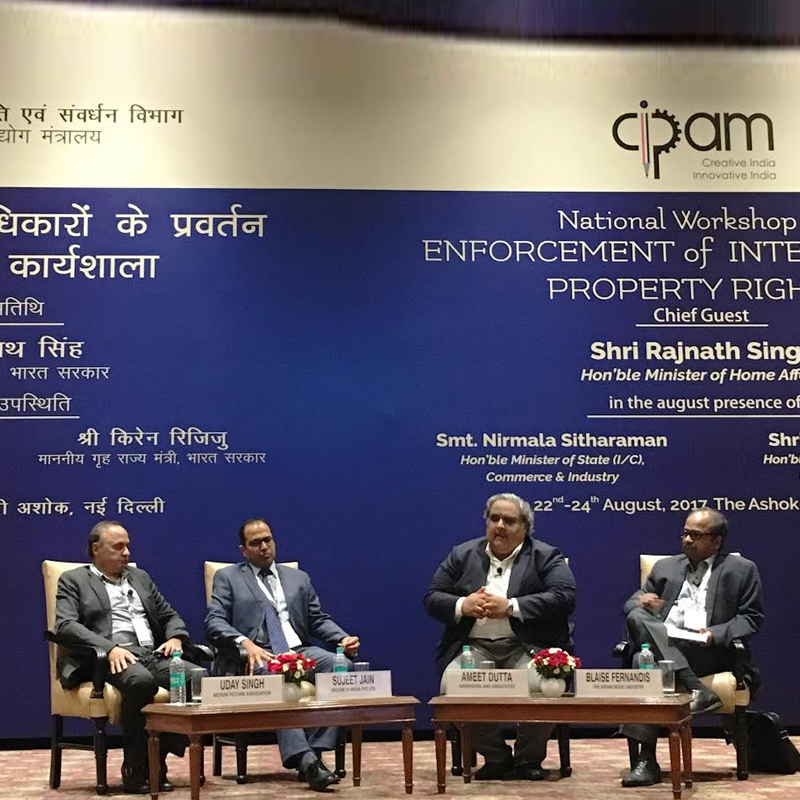
    NEW DELHI: In a step highlighting seriousness of stakeholders, Viacom18 has forged a partnership with the Cell for IPR Promotion and Management or CIPAM, a professional body under the Commerce Ministry, to launch an anti-piracy awareness campaign laying stress on the importance of IPRs.

    “A possible solution to the problem of piracy lies in creating awareness about intellectual property rights (IPRs) among the masses. It is pertinent that one of the main objectives enshrined in the national IPR policy is creating awareness about IPRs to build a healthy IP ecosystem in the country,” Commerce Ministry’s Department of Industrial Policy and Promotion (DIPP) joint secretary Rajiv Aggarwal said.

    Aggarwal, speaking on the partnership that was announced during an ongoing three-day national workshop on enforcement of IPRs, lauded the industry’s contribution in taking a lead to rally around the cause of IPR protection.

    According to Viacom 18 Media group general counsel and company secretary Sujeet Jain, “When it comes to consumption and circulation of pirated content, there is limited knowledge about its economic and social impact. Through this partnership with CIPAM, we hope to raise awareness amongst youth and children about the perils of piracy and the need for the protection of IPRs.”

    Content piracy, especially online, is a menace that has started to cause serious dent to revenues of content owners and also the Indian government in terms of taxes. And, it is high time that the industry and the government collaborated on a war-footing to create awareness about IPRs and anti-piracy measures being undertaken.

    As part of the association with CIPAM, Viacom18 has created a behavior change awareness videos, involving popular animated characters of its flagship kids’ channel Nickelodeon and Sonic (Motu-Patlu and Shiva, respectively), spreading the message that content piracy was equivalent to stealing.

    The campaign will see CIPAM and Viacom18 airing these videos across schools, colleges and various educational institutions, in addition to the network’s kids channels.

    Because IPRs are increasingly becoming crucial drivers of social and economic growth in the 21st century DIPP has organized a meet here, which was inaugurated by Home Minister Rajnath Singh in the presence of Minister of Commerce Nirmala Sitharaman and Minister of State for Home Kiren Rijiju. Sessions on various aspects of IPR, its protection, existing laws and anti-piracy measures are scheduled to be discussed by industry and government representatives.

    Singh said that counterfeiting and piracy activities give rise to serious organized crimes and police officials should be equipped with proper knowledge and training so as to curb and restrain IPR breaches.  

    The workshop is designed to help police officials and prosecutors to understand their role in effective enforcement of IPRs. It will also provide an opportunity to the officials to share their experiences, exchange best practices and coordinate effectively with each other.

    Sitharaman, while emphasizing that people need to understand  ways to create and protect their intellectual property for a secure future, said the World Intellectual Property Organization (WIPO), in collaboration with CIPAM, was setting up two technology and innovation support centres  in Punjab and Tamil Nadu.

    Meanwhile, a statement from Viacom18 added that it was not the first time that Viacom18 was championing the cause of IPR protection. Earlier this year, along with the Bombay High Court, the media group conducted a crack-down on counterfeit merchandise of their licensed character Dora the Explorer.

    This initiative was primarily targeted to protect children from hazards of using inferior quality products under the impression of them being original Viacom18 merchandise. The company, which also owns film production unit Viacom18 Motion Pictures, had previously led a campaign against film piracy too.

    ALSO READ:

    Comment: War on online video piracy, which matters, is here for India to fight

    Indian online video to grow to US 1.6 bn at 35 percent CAGR by 2022

    MPA forecasts Asia Pacific online video opportunity at US$35 billion by 2021
  • India to have a billion unique mobile subscribers by ’20; Delhi talent favourite

    India to have a billion unique mobile subscribers by ’20; Delhi talent favourite

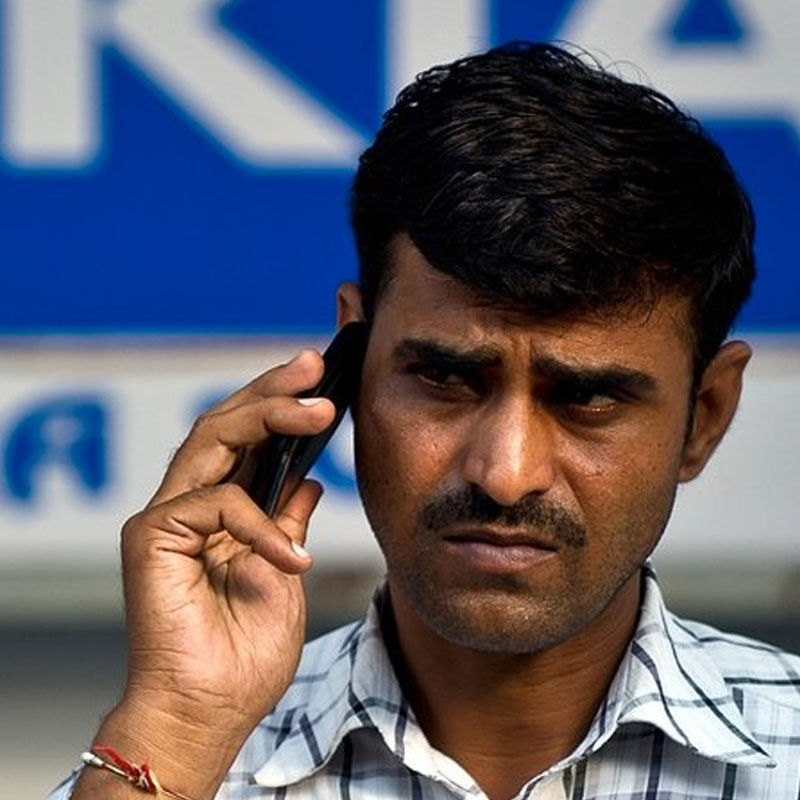
    MUMBAI: The contribution of mobile industry to the country’s gross domestic product (GDP) amounts to approximately US$140 billion (Rs 9,60,783 crore), the Department of Industrial Policy and Promotion and the Department of Telecom recently reported. India’s current GDP employs over four million people. At present, at 6.5 per cent, the government of India has stated that the mobile industry’s contribution is likely to rise to 8.2 per cent by 2020.

    According to the report, India is expected to cross the one billion unique mobile phone subscribers mark by 2020. India will also see an increase in adoption of 4G services with number of 4G connections estimated to grow to 280 million by 2020 from just three million in 2015. Further, the report claimed that the mobile industry is expected to add 800,000 more jobs.

    A survey by human resource (HR) solutions company PeopleStrong suggested that Delhi has emerged as the most preferred region for hiring in telecom and allied sectors. Hiring intent in this sector is expected to increase from 16% in 2016 to 20% in 2017.

    In 2011-12, telecom sector contributed about 2.1 per cent of GDP with revenue of Rs 1,85,930 crore while, due to the increase in revenue next year to Rs 2,07,498 crore, the net contribution came down to 2.07 per cent. The revenue generated by the telecom sector in 2014-15 was Rs 2,42,900 crore, making it a contribution of 1.94 per cent to GDP.

    Vodafone tops the list of investments with Rs 10,299 crore ($1,500.79 million) followed by Videocon International Electronics with Rs 4924 crore ($719.76 million). At third position stands Telenor at $573.15 million followed by Sistema Shyam Teleservices $451.83 million, Bharti Infratel $240.37 million, and Idea Cellular $123.22 million.

    PeopleStrong CEO Pankaj Bansal said Delhi’s emergence for hiring could be attributed to the availability of the engineering and general graduate talent pool in this area or to the fact that many telecom and allied industries are headquartered in Delhi NCR.

  • India to have a billion unique mobile subscribers by ’20; Delhi talent favourite

    India to have a billion unique mobile subscribers by ’20; Delhi talent favourite

    MUMBAI: The contribution of mobile industry to the country’s gross domestic product (GDP) amounts to approximately US$140 billion (Rs 9,60,783 crore), the Department of Industrial Policy and Promotion and the Department of Telecom recently reported. India’s current GDP employs over four million people. At present, at 6.5 per cent, the government of India has stated that the mobile industry’s contribution is likely to rise to 8.2 per cent by 2020.

    According to the report, India is expected to cross the one billion unique mobile phone subscribers mark by 2020. India will also see an increase in adoption of 4G services with number of 4G connections estimated to grow to 280 million by 2020 from just three million in 2015. Further, the report claimed that the mobile industry is expected to add 800,000 more jobs.

    A survey by human resource (HR) solutions company PeopleStrong suggested that Delhi has emerged as the most preferred region for hiring in telecom and allied sectors. Hiring intent in this sector is expected to increase from 16% in 2016 to 20% in 2017.

    In 2011-12, telecom sector contributed about 2.1 per cent of GDP with revenue of Rs 1,85,930 crore while, due to the increase in revenue next year to Rs 2,07,498 crore, the net contribution came down to 2.07 per cent. The revenue generated by the telecom sector in 2014-15 was Rs 2,42,900 crore, making it a contribution of 1.94 per cent to GDP.

    Vodafone tops the list of investments with Rs 10,299 crore ($1,500.79 million) followed by Videocon International Electronics with Rs 4924 crore ($719.76 million). At third position stands Telenor at $573.15 million followed by Sistema Shyam Teleservices $451.83 million, Bharti Infratel $240.37 million, and Idea Cellular $123.22 million.

    PeopleStrong CEO Pankaj Bansal said Delhi’s emergence for hiring could be attributed to the availability of the engineering and general graduate talent pool in this area or to the fact that many telecom and allied industries are headquartered in Delhi NCR.

  • Assembling imported parts not ‘Make in India’ says Broadband Forum

    Assembling imported parts not ‘Make in India’ says Broadband Forum

    NEW DELHI: Observing that assembling in India goes against the very principle of Make in India, the Broadband India Forum has criticized the decision to roll back import duties levied on mobile phone components and said this “is a step not in sync with encouraging manufacture of these items in India.”

    BIF, a dedicated Forum with representation from Telecom Service Providers, Technology Providers, R&D and Chip Design Companies, System Integrator, Project Management, Service & Solution Provide, MSO and DTH, Satellite & VSAT Service Providers, in its appeal to the Communication and Information Technology ministry has requested immediate withdrawal of the import duty rollback on populated PCBs and phone accessories in the interest of ‘Design in India’ as these equipments provide maximum opportunity for design and R&D.        

    In its recent Notification of 5 May 2016, the government decided to roll back import duties levied on components of mobile phones in the Union Budget 2016. The notification brought down the duty on chargers, batteries and headsets from 29 percent to 12.5 percent (at par with that of imported handsets) and lowered the duty on populated PCBs (printed circuit boards) to 0 percent from 2 percent (instead of raising it to 12.5 percent).

    In ia note to the Department of Industrial Policy and Promotion and the Department of Telecom,  the BIF has highlighted that no entity will design and invest in R&D in India if the PCB continues to be imported from China at 0 percent (zero) duty in fully-manufactured form. Though the increase in duty on imported handsets by 12.5 percent has increased manufacturing intensity of mobile phones in India from 5 million/year (50 lakh/year) to 100 million/year (10 crore/year), the local value addition is hardly 1 to 2 percent. Therefore, increasing duty on populated PCBs is the next logical step.

    BIF president T V Ramachandran remarked, “While the industry was hoping the government moved ahead with its 2015 initiative, this recent announcement has pushed the country back to the days of phone assembly, instead of progressing to a phased-manufacturing regime. This notification goes against the letter and spirit of the stated intent of the government, which is to gradually reduce the electronic imports and achieve ‘Net Zero Imports’ by 2020 under ‘Make in India’, as part of the Digital India action plan. Therefore, we request the government to withdraw this notification immediately.”

    The mere assembly of PCBs in India will immediately increase value addition to 10 percent from the current 1 percent, with scope of increasing it further with investment in ‘Design in India’ and R&D. It will also raise the quality of jobs and prevent these moving to other markets (in case they provide better economic conditions than India), and encourage component manufacturing in India by enabling components to be consumed in India (most components used in mobile phones are housed in PCBs).

    In its request, BIF also highlighted that India faces a unique challenge in terms of compulsion to encourage and initiate indigenous design and manufacturing or ‘Make in India’ with higher local value addition. Accordingly, it is imperative to work towards reduction of the exponentially increasing Import Bill for electronics/telecom equipment and services – an expense expected to surpass the oil import bill by 2020 (estimated at $ 400 billion).


  • Assembling imported parts not ‘Make in India’ says Broadband Forum

    Assembling imported parts not ‘Make in India’ says Broadband Forum

    NEW DELHI: Observing that assembling in India goes against the very principle of Make in India, the Broadband India Forum has criticized the decision to roll back import duties levied on mobile phone components and said this “is a step not in sync with encouraging manufacture of these items in India.”

    BIF, a dedicated Forum with representation from Telecom Service Providers, Technology Providers, R&D and Chip Design Companies, System Integrator, Project Management, Service & Solution Provide, MSO and DTH, Satellite & VSAT Service Providers, in its appeal to the Communication and Information Technology ministry has requested immediate withdrawal of the import duty rollback on populated PCBs and phone accessories in the interest of ‘Design in India’ as these equipments provide maximum opportunity for design and R&D.        

    In its recent Notification of 5 May 2016, the government decided to roll back import duties levied on components of mobile phones in the Union Budget 2016. The notification brought down the duty on chargers, batteries and headsets from 29 percent to 12.5 percent (at par with that of imported handsets) and lowered the duty on populated PCBs (printed circuit boards) to 0 percent from 2 percent (instead of raising it to 12.5 percent).

    In ia note to the Department of Industrial Policy and Promotion and the Department of Telecom,  the BIF has highlighted that no entity will design and invest in R&D in India if the PCB continues to be imported from China at 0 percent (zero) duty in fully-manufactured form. Though the increase in duty on imported handsets by 12.5 percent has increased manufacturing intensity of mobile phones in India from 5 million/year (50 lakh/year) to 100 million/year (10 crore/year), the local value addition is hardly 1 to 2 percent. Therefore, increasing duty on populated PCBs is the next logical step.

    BIF president T V Ramachandran remarked, “While the industry was hoping the government moved ahead with its 2015 initiative, this recent announcement has pushed the country back to the days of phone assembly, instead of progressing to a phased-manufacturing regime. This notification goes against the letter and spirit of the stated intent of the government, which is to gradually reduce the electronic imports and achieve ‘Net Zero Imports’ by 2020 under ‘Make in India’, as part of the Digital India action plan. Therefore, we request the government to withdraw this notification immediately.”

    The mere assembly of PCBs in India will immediately increase value addition to 10 percent from the current 1 percent, with scope of increasing it further with investment in ‘Design in India’ and R&D. It will also raise the quality of jobs and prevent these moving to other markets (in case they provide better economic conditions than India), and encourage component manufacturing in India by enabling components to be consumed in India (most components used in mobile phones are housed in PCBs).

    In its request, BIF also highlighted that India faces a unique challenge in terms of compulsion to encourage and initiate indigenous design and manufacturing or ‘Make in India’ with higher local value addition. Accordingly, it is imperative to work towards reduction of the exponentially increasing Import Bill for electronics/telecom equipment and services – an expense expected to surpass the oil import bill by 2020 (estimated at $ 400 billion).