Tag: Denstu

  • dentsu’s global ad spend report predicts 6.8 per cent growth for 2024

    dentsu’s global ad spend report predicts 6.8 per cent growth for 2024

    MUMBAI: Advertisers, marketers and media establishments around the globe can bring out the bubbly. dentsu’s latest Global Ad Spend Forecasts has revealed a projected buoyant 6.8 per cent growth in global advertising spend for 2024, reaching $772.4 billion. This growth projection has been revised upwards following the return to double-digit growth (+10.7 per cent) of digital ad spend, the impact of sporting, political events and improved outlooks across the US, UK, Brazil & France. 
     
    Ad spend growth is forecast to continue at 5.9 per cent in 2025. The American region is expected to lead in 2025 with 6.3 per cent growth, driven by rich US and Brazilian markets where digital and streaming see sustained investments. The Asia-Pacific market is forecast to increase by 5.8 per cent, with AI-driven ad placements contributing to the increase in digital ad spend in markets like India. Lastly EMEA (Europe, the Middle East and Africa) has projected growth of five per cent, with strong digital performance in key markets including the UK. As the industry enters what dentsu identifies as the algorithmic era, data-enabled advertising will increasingly shape media strategies, with algorithmically enabled ad spend forecast to reach 79 per cent of total ad spend by 2027. 

    Artificial intelligence (AI) is no longer confined to experimental phases. It has become an integral tool for creating personalised, one-to-one consumer experiences. Generative AI applications like OpenAI’s GPT models are embedding themselves in everyday services, from Duolingo’s AI-driven tutor to Spotify’s personalised AI DJ. These advancements mark a new era of micro-moments that enhance user engagement by delivering tailored interactions at scale.

    As algorithms increasingly gatekeep content visibility, brands are tapping into niche communities and fandoms to drive meaningful connections. Influencers, from content creators like Mr Beast to hyper-localised niche experts, are key to cutting through the digital noise. Additionally, connected television’s growing reach provides fertile ground for cross-platform storytelling, combining scale with intimacy. Paid social is forecast to grow by 8.7 per cent in 2025 (7.8 per cent three-year CAGR to 2027), supported by an integrated ecosystem that blends shopping, video, search, and gaming capabilities. This channel remains critical for engaging younger audiences, with 79.7 per cent of gen Z using Instagram monthly and 42 per cent of CMOs planning to boost influencer marketing investments. Paid search is expected to increase by 6.7 per cent (6.5 per cent three-year CAGR 2027), driven by continuous advancements in AI-powered features that sustain relevance amid the rise of social and retail search.

    Retailers are stepping beyond traditional advertising, transforming their platforms into data-rich media ecosystems. Amazon leads this charge with a $50 billion ad revenue engine, while others like Walmart and TikTok are innovating through acquisitions and self-serve advertising solutions. This convergence is reshaping how brands measure success and optimize campaigns, fostering a holistic view of the consumer journey. From a media channel standpoint, the report highlighted that digital is expected to remain the fastest-growing channel, with a projected increase of 9.2 per cent in 2025 (8.8 per cent three-year CAGR to 2027) to reach $513.0 billion and capture 62.7 per cent of global ad spend. Significant growth is anticipated across key digital segments, with retail media leading the way at +21.9 per cent year-over-year (19.7 per cent three-year CAGR to 2027) as advertisers capitalise on the high value of retailer consumer data and increasingly invest in offsite advertising, including connected TV. 

    In a world flooded with content, quality emerges as a non-negotiable factor. Advertisers are increasingly prioritising transparent, sustainable programmatic supply chains and investing in impactful creatives to capture attention in crowded digital environments. 

    Attention metrics, such as “attentive seconds,” are now as critical as traditional ROI measurements, signaling a shift towards more meaningful audience engagement. Online video advertising is projected to rise by 8.0 per cent as advertisers continue to seek out high attention and trusted environments. Programmatic advertising is set to grow by 11.1 per cent and will account for more than 70 per cent of digital ad spend, with sustained momentum (10.9 per cent three-year CAGR to 2027). 

    Television ad spend growth is forecast to show marginal growth of 0.6 per cent in 2025, with connected television rapidly increasing (+18.4 per cent) thanks to ad-supported streaming, and broadcast television declining (-2.5 per cent). Meanwhile, print media continues to contract, while cinema and out-of-home (OOH) advertising continue to grow by 3.2 per cent and 3.9 per cent, respectively. 
     
    Significant ad spend increases are anticipated in finance (+6.4 per cent), pharmaceutical (+5.8 per cent), and travel and transport (+5.5 per cent) as these sectors adapt to meet evolving consumer needs. 

    Says dentsu’s global practice president- media Will Swayne: “Our 2025 forecast underscores the pivotal role of media in today’s economy. Data-driven and digital-first media investment strategies continue to reshape how brands connect with consumers. The surge in algorithmic media capabilities will drive fresh opportunities for brands to engage meaningfully and effectively with existing and new customers.Media investment strategy is key to transformation and growth as brands keep pace with evolving consumer behaviors.

    “As digital channels continue to lead the way, the global advertising landscape is entering a new phase of growth and innovation. The projected 9.2 per cent increase in digital ad spend for 2025, driven by segments like retail media and connected TV, underscores the immense value of data-driven strategies. As algorithmic media capabilities take center stage, brands have an unprecedented opportunity to connect with consumers in more personalised and meaningful ways. The future of advertising is not just digital – it’s deeply connected, data-empowered, and poised for transformative growth,” added dentsu chief executive officer – media South Asia Anita Kotwani.

    Despite technology’s global proliferation, access remains uneven. From regulatory hurdles to the high costs of advanced AI features, digital divides are becoming more pronounced. Brands must adopt nuanced, locally informed strategies to ensure inclusivity while navigating fragmented markets.

    The algorithmic era promises opportunities for innovation in media and marketing. However, success will hinge on a brand’s ability to adapt to evolving consumer behaviors, leverage cutting-edge AI tools, and balance global aspirations with local sensitivities.

    This year of impact calls for brands to be bold, innovative, and deeply attuned to the digital zeitgeist. The possibilities are infinite, but the imperative is clear: in 2025, making an impact is not optional—it’s the only way forward.

    (Picture generated using Dall-E 3 generative AI tool)

  • Dentsu India launches Dentsu Intelligence Dashboard (DID)

    Dentsu India launches Dentsu Intelligence Dashboard (DID)

    Mumbai: Today, the media analysis setup used by planners is limited to API (application programming interface) integration, compelling them to manually seek data from multiple sources. To cater to this issue, the media services from dentsu India have unveiled Dentsu Intelligence Dashboard (DID) – an industry-first competitive media insight tool, to enable planners and clients to swiftly comprehend the latest competitor data and expedite the decision-making process. The tool provides integrated data analysis on online and offline media spends, gross rating points (GRP), and Impressions in an auto mode.

    The Dentsu Intelligence Dashboard has been created in association with the network’s existing partnerships with industry-syndicated sources and is equipped to aggregate & transform data from varied media channels on a single platform Through this tool, dentsu aims to ease the process by offering consolidated data, views with its digital data, and automated PPT functionality. Furthermore, it gives media planners the flexibility to customize their search across levels using its dynamic features of selecting sectors, categories, brands, advertisers, etc. Additionally, the tool also offers a holistic view of data analysis from across platforms like TV, Print, Digital, and Radio.

    Commenting on the tool launch denstu CEO Media, South Asia Anita Kotwani said, “At dentsu, we are on a journey that requires us to compete with ourselves. Our determination to break our records ensures that we invest in building one-of-its-kind cutting-edge solutions for our clients. The tool is certainly a game changer & one-stop go-to for our clients. Media pulls a massive chunk of financial budgets for every brand and the slightest deviation in seeking the true picture could ruin all their efforts. Dentsu Intelligence Dashboard simplistically offers data insights that are accurately curated in an easy-to-understand format and save resources. The launch of this tool is just the beginning of the many firsts that we are working towards.” It is pertinent to note here that the tool will further enhance dentsu India’s ability to enable clients with access to the latest GRPs information regardless of the category or brand.

    dentsu India chief operating officer, media Bhasker Jaiswal added, “We believe in upgrading our practices to best serve our clients and people. Dentsu Intelligence Dashboard is also proof of our commitment to contributing to the industry at large.  The first-ever tool in the market that integrates data from multiple data sources, alleviates the workload and enables better focus on strategizing. It goes way beyond a simple dashboard and gives planners/clients a readymade competitive overview for Digital as well as TV GRPs which will certainly make it a must-have for all brands.”

    dentsu India VP – media analytics, media Pankaj Bhatlawande commented, “Built on scalable architecture and powered by new-age technologies, the Dentsu Intelligence Dashboard will deliver unparalleled competitive intelligence to media planners. Using serverless technologies like BigQuery enabled data transformation of RLD data, and GRP calculations at scale and reliability. We are certain of this being a game-changer which will elevate marketing strategies to newer heights and redefine business approaches in this digital age.”

  • dentsuMB Group CEO Sidharth Rao moves on

    dentsuMB Group CEO Sidharth Rao moves on

    MUMBAI: After a career spanning over 22 years, dentsuMB Group CEO Sidharth Rao has moved on from the agency. Rao will be leaving the business in December 2022 to return to his entrepreneurial roots,the agency announced in a statement on Wednesday.

    dentsuMB India will then come under the additional charge of Isobar India group CEO Heeru Dingra, supported by business leaders Ajit Devraj, Indrajeet Mookerjee and Harsh Shah. The new dentsuMB India leadership team will work with Rao through the transition, and in close partnership with Amit Wadhwa, CEO for the entirety of dentsu’s Creative Service Line for India.

    Rao was given the additional responsibility of CEO of the dentsuMB Group in June 2021 as part of dentsu’s restructuring of creative, digital and PR services.

    He took over the role of chairman at dentsu’s creative agency Happy mcgarrybowen (HMB) India and Dentsu Webchutney in January 2020. Prior to that, Rao was CEO of dentsu Webchutney, a company he founded along with Sudesh Samaria in 1999, before it was acquired by dentsu in 2013.

    Confirming the development, dentsu India Creative Service Line CEO Amit Wadhwa said, “Sid is not just a colleague – he is, and will remain, a dear friend. He has played an instrumental role in dentsu India’s growth and creative journey, as well as in mentoring our talent, which gives me every confidence and much excitement for the next generation of dentsuMB India’s leaders who are already proving formidable.”

    “We truly wish Sid every luck as he returns to his entrepreneurial ambition and passion, for which we are sure he will find great success again,” he added.

    On his moving on, Sidharth Rao said, “Being acquired by dentsu was by far the most important milestone in Webchutney’s journey. It has been a great, great ride. Dentsu India is making such exciting strides and I am especially happy to see Dentsu Webchutney the strongest it’s ever been. There are absolutely no regrets. I have enjoyed this decade long journey enormously, and great credit goes to the network’s leadership team who I would like to thank dearly for making dentsu feel like home since day one.”

    “For my journey ahead, I am exploring new ideas in the exciting online space, with details of my plan ready to be announced in the coming months,” Rao further added.

    An integral part of dentsu India’s executive leadership team, Rao has helped build dentsu’s digital and creative capabilities in the market, the agency said in a statement. Under his leadership, dentsu India has been awarded at multiple local as well as major international award shows including Cannes Lions, Spikes Asia, The One Show and D&AD.

  • The future is about reinventing and recasting: Rohit Ohri

    The future is about reinventing and recasting: Rohit Ohri

    Dentsu created waves early this year when the Indian National Congress chose the agency to handle its creative mandate for the 16th Lok Sabha elections. The country’s oldest party might have lost in the elections but the communication was the talking point among industry as well as people.


    Rohit Ohri’s nearly twenty-four year journey in advertising communications, began with the Tata Son’s Marg Publications, but he soon moved to JWT, first Kolkata and then Delhi. Under his leadership and strategic direction, JWT Delhi’s top-line doubled, making it the largest branch office of any advertising agency in India, the largest and most profitable JWT office in Asia Pacific and the third largest JWT office in the world.


    In August 2011, Ohri, a golfer at heart with a seasoned sense of humour, joined Dentsu India Group as executive chairman. Today, he has additional responsibilities on his shoulders as its CEO in APAC (south).


    Indiantelevision.com’s Meghna Sharma caught up with the man to know more on how his term has been with the agency so far and what can be expected from it in the coming months.


    Excerpts…


    The year started with the great Indian political tamasha. How was the experience especially when the party blamed the agency for the debacle?


    The congress party had organised a pitch wherein 16 agencies were pitching, which included JWT and McCann and another six to seven top agencies. We won the business on the basis of our merit. We made over 16 pitches before we actually won the business, so everybody saw the quality of work and what we could deliver before being chosen.


    We had absolutely no problems with the congress party at all. None, whatsoever. And this blame game is a media created story. We have got letters from the party’s head of the communication cell that they are very happy with us especially for the quality of work that we delivered and the professionalism with which we worked. Congress party is not blaming us at all, it is an absolute lie.


    The first phase of campaign that we had created was really strong and worked really well. The fact is everybody we talked about the campaign, told us that it was strong and strategically correct.


    I think the issues are much larger and advertising campaigns are at best support but there has to be an overall positivity behind a candidate or the party. Unfortunately, it was a tough election.


    I would say the year started off pretty well for us. As an agency, and it was on the basis of merit and I am quite proud of it. Most of the bigwigs in politics believe that election campaigns are won on the ground. What a party does at the ground-level with the party workers makes a great primary for a win.


    We did not do the Delhi campaign; it was done by JWT and McCann. But see what happened to Sheila Dixit government.


    The real thing is what the need of the nation is.


    And then came the debate over the new Airtel ad?


    I think it is fantastic. The Airtel ad is about connectively and if the ad itself creates conservations then what more do you want?


    Everything generates two or more different point of views. So, if the ad shows new dynamics of relationships, it is bound to generate buzz. Change is not accepted easily. Today, we all are creating content that everyone wants to talk about and viralise. So, here it did the same. We had Barkha Dutt doing a show on it and people were logging on to just see the advertisement. So, which client will be unhappy with it?


    You will complete three years in the agency, soon, how has the journey been so far? What have been the high and the low points?


    I haven’t had any low points. When you look at cultural transformation in an organisation, I think when I look back and then see today’s Dentsu, it is in a much stronger place than when I had joined. I think that is an enormously gratifying feeling.


    So, I do feel that agency works very well in terms of where it wants to go in the future. Lot of things in terms of our acquisitions, not just of the company, the talent, and how we build within the Dentsu agencies and how we have integrated well with Taproot and WebChutney matters. And now on a larger level, with the entire Dentsu Aegies Network how we are leveraging the strength across the entire network. We have come a long way and I think we are very happy about that.


    It wasn’t very difficult for you to merge the cultural differences between the various Indian and international agencies?


    No not at all. If you fundamentally look at a few values of the network, it is about the focus on the quality of creative, integration and on collaborative model of working together. These are things that Dentsu Inc holds very close to its core in Japan.


    Example, today everybody talks about integration. It has really turned a new paradigm for advertising and communication agency. Almost 12 years back, Martin Sorrel started the whole thing of unbundling. It created individual interest versus brand interest dominations. In many ways what happened was that fragmentation was created between advertising and marketing and the agency structure was going somewhere else.


    That is the reason Dentsu never unbundled itself. It always stayed as an integrated agency firm from day one. The network saw this happening internationally and as the world’s largest advertising agency, could pretty well have gone the same way but decided not to do.


    Agencies within the Dentsu Aegis Network collaborate around a particular client saying that if a particular client needs x, then we will work around that particular client. So that the client’s interest is served before anything else. There is certain liquidity in the network and the network is dependent on the basis of client’s needs.


    With four creative agencies under the belt, how do you make sure that there isn’t any overlapping?


    The fact is that from a philosophy perspective it is one Dentsu; each one of the agency with the exception of Taproot. We have three Dentsu branded agencies and then Taproot which is our acquisition. There is one thinking around all of them. Physically three separate entities have been created so that there is absolutely 100 per cent confidentiality with each and every client.


    How has the partnership deal with Aegis Media helped Dentsu in escalating its position?


    The partnership with Aegis Media has been perfect for us. Primarily, because Denstu’s core vision, philosophy and point of view on advertising has been about innovation and integration. If you look at that, to deliver integration we need the best in class services across the whole wide number of platforms.


    We now have various offerings and all those capacities ready to take to the clients’ saying that ‘with all our entities, we can actually empower your brand.’


    In many ways Denstu has completed Aegis and Aegis has completed Dentsu. Now we are a full service integrated brand solution company.


    You have said that digital ad campaigns will drive Denstu’s next big initiatives. So, in the future, do you see brands being lead by chief marketing officer or chief technology officer?


    For Dentsu, the core of the brand is really about the intersection between creativity and technology. Technology is not just a lap over but technology is something we use as point of view. Technology is needed to reach out to new consumers and empowering them. Dentsu has a rich heritage of harnessing technology for brand communication in a creative and interesting manner.


    Going forward, it is a marriage of the two – creativity and technology. It’s not that human beings have become robots. Human beings will be human beings. There will be hearts; emotions and softer side that you need to connect with. It is important for us to say that technology is the enabler. So, how can we make it seamless to form connect with the consumers. It should be able to connect across multiple screens. Seamless connectivity is the idea and technology is letting it happen.


    Now that you are talking about seamless connectivity, there has been an increase in penetration of smartphones and tablets. But do you think brands know utilising that medium effectively especially in the rural India?


    As smartphones penetrate deeper and deeper into the socio-economic gratification, we will see a phenomenal rise of it.


    When mobile phones came, they changed the way we connected. Smartphones are the next level of it in the transformation. The power is in our hands it is only multiplying. One can watch videos, work, buy products etc all by a click on the device in my hand.


    However, one of the biggest challenge in front of the brands is that how to use that powerful device. Mobile is a great way to pole-vault over the lack of infrastructure. Where roads can’t reach, voice can reach. So, there is a huge opportunity for brands especially e-commerce because a large part of commerce comes from small towns where premium brands don’t have stores. The whole democratisation of luxury has happened so everyone has access to every brand. And this is what technology is doing.


    Also, there is a democratisation of creativity. Competitor of a creative agency is not another creative agency but it is the consumer. Today, individuals create content and upload it which sometimes become viral. As a brand/marketer, I will have to create something which people want to share and watch.


    One of your favourite digital campaign is…


    We saw many wonderfully crafted campaigns at Cannes Lion, this year. One campaign where Sweetie, a 3D CGI created child, from the Philippines working in the online sex industry was the perfect honey trap. It proves that how technology can be used to innovate for the betterment of the society.


    Dentsu has made a number of acquisitions in the country. So, will we see a lot more in the near future? Is that the way forward?


    India is a very important market for us and hence, we will look at more acquisitions here. We have a long-term strategic plan for the country and globally also. For us, it is all about a constant process of excellence, so we keep looking out for companies and opportunities. We want to build the Dentsu Aegis Network’s vision that is to build a complementary network – a network of complementary services rather than a network of competitive services. So, we want to have a collaborative culture within a network and it is very important to be complementary to each other. Because when two competing brands come together, brands don’t benefit from it but in a complementary set up clients benefit.


    Seeing that digital is the way forward, is acquiring digital agencies on priority list or creative?


    Currently, we have a very strong digital presence in India. We have iProspect, Isobar, Webchutney, which are complementary in the way they work but each has its own core competence. So when the three come together we have a powerful offering for the clients to leverage.


    We always look at bringing services – creative, digital, OOH, activation or any other – that are cutting-edge. That is how we look at organic and inorganic growth.


    How has the performance been on the financial and people front?


    Last year, for instance, our creative network grew at 65 per cent which made us the fastest growing Dentsu-branded agency anywhere in the world.


    It is a fantastic testimony of the fact that we have really come a long way and that Dentsu’s evolution and cultural changes bought in internally and externally have really worked for us. We may want to be anything but what you want to be, has that been bought by clients? That has been a very clear case for us.


    Touchwood, in the last three years the senior management lost nobody. Talent has always been my first and foremost agenda. We are a talent business so one has to bring in talent through collaborations, direct hiring or partnership.


    What can we expect from Denstu in the coming years?


    One of the things which we are really forward to bringing in for our clients is some of the technology platforms we have in Denstu Inc to India. We are already in a very advanced stage of conversation with one of our clients.


    We want to fundamentally change the paradigm of engagement with the consumer and when you interphase creativity with technology then you have a whole new paradigm of engaging with consumers at a deeper, meaningful and intimate communication. That’s what I’m excited about.


    As we go forward, it is about reinventing and recasting which advertising promised to do but has not really done for a long time.

  • Is it right of Congress to blame Denstu?

    Is it right of Congress to blame Denstu?

    MUMBAI: It was early this year that Congress started its Rs 600 crore blitz ad campaign. The campaign started with the slogan ‘Mein Nahi, Hum’ which caught itself amidst allegations from the Bharatiya Janta Party (BJP) which said that the slogan was first used by Narendra Modi at a rally.

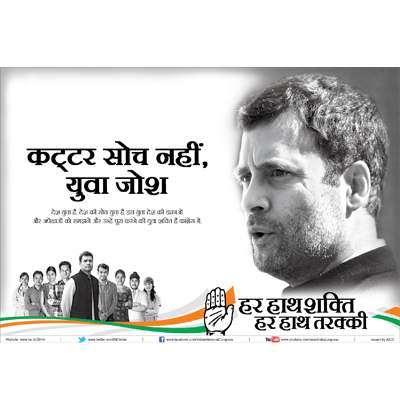
    Then came ‘Har Haath Shakti, Har Haath Tarakki.’ The campaign conceptualised by Dentsu was meant to position Congress vice president Rahul Gandhi as a young and dynamic leader who could empower the common man.

    BJP’s campaign, ‘Abki Baar, Modi Sarkar’, which went on floor a few months after Congress’ communication line, portrayed Modi as the saviour who could change the game of Indian politics.

    Both the campaigns created a stir not only amongst the experts but also amongst the common man as everyone had something to say about them – good, bad or ugly.

    The D-Day, 16 May, proved which ideology and promise voters believed in. BJP came out as a clear winner, while Congress’ performance was of sheer disappointment.

    Since then, the Congress has been ‘introspecting’ to find what went wrong. However, its latest reason for the debacle is the campaign, itself. The party is now blaming the creative agency by saying that its campaign was weak.

    When we contacted Dentsu India Group executive chairman Rohit Ohri, who is travelling abroad, sent an official statement of the agency through an email.

    The statement reads, “Dentsu India was hired by the Congress party for their 2014 Lok Sabha campaign, for advertising services, after a publicly announced request for proposal by the Indian National Congress. Dentsu India bagged the mandate after a rigorous pitching process involving several iterations among top Indian agencies. While Dentsu India worked rigorously on an ad campaign as per the client’s brief with approvals at every stage, the other aspects of the campaign eco system such as PR, media relations and online strategy were not within the ambit of Dentsu’s scope of work as mandated by the client briefing. Throughout the campaign, Dentsu India enjoyed a good working relationship with the Congress party.”

    “The agency maintains the highest standards of creativity and professionalism and adheres to global standards of ethics and compliance. The agency shares cordial relationship with all its clients, and shall endeavour to maintain the same.”

    We at Indiantelevision.com, ask creative fraternity if it is right to blame the agency for the dismal performance of the political party?

    Bang in the Middle managing partner and chief creative officer Prathap Suthan

    This is a bit of a deja vu for me. Considering that some leaders in the BJP did exactly the same thing when India Shining didn’t work as a political multiplier in 2004. That aside, elections are purely won on the basis of performance. On a limited scale, one could overcome inefficiency by hyperbole and exaggerating the potential of the future.

    But this was the national elections. On the back of a long winded story of scams, misgovernance, corruption, lack of leadership, slow economy and what have you. However the campaign, for all its advertising polish and gloss, did not address issues that people wanted answered. There were no admissions. No apologies. No responsibility for incompetence.

    Instead what we saw was campaign that was divorced from the need of the hour. They pushed a campaign that presented a hollow and shallow picture of supposed happiness. More importantly, Rahul Gandhi hardly came through as an honest, well meaning, and effective leader. His own media exposure wasn’t very kind to him.

    So when you have invested in a campaign that didn’t speak what was required, and projected a story that was far away from the truth, it is bound to fail, and has obviously failed. It is absurd to blame an agency. They only delivered what they were contracted for. I am sure they advised otherwise, but ultimately the client is always right.

    It is ridiculous to imagine that the party didn’t agree to the communication. Everyone saw it and everyone approved it surely, if they didn’t agree they wouldn’t have run the campaign. The agency doesn’t and will not create and release an unapproved campaign. There are a lot of signatures that need to approve media releases. And if they have spent all that money behind a donkey in a horse race, you really can’t turn around and blame the jockey.

    Lowe Lintas & Partners NCD Arun Iyer

    One shouldn’t take too much credit if a campaign goes viral or flak if it flops. Of course, at the end of the day if a campaign doesn’t work then the agency is to be held responsible, but everyone is kept in the loop. It is a well kitted effort and everybody involved is responsible for the outcome. I don’t think what Congress is doing is right. It shouldn’t have done what they did, especially publically.

    Infectious director Nisha Singhania

    It is not fair to blame an agency if the end product fails to deliver what it promises to the consumers. The purpose of an advertising campaign is to popularise a product but if consumers’ don’t have good experience rejection is obvious. The same thought applies in this situation too. 

    Curry-Nation director Priti Nair 

    How can they blame anyone or anything for this except themselves? This goes for each and every product; if your product is bad even Santa Claus cannot help you. Agencies build a brand and make people choose so as to go and use it, so agencies help to choose. A product has to deliver on the use bit. Unfortunately here people had already experienced the product, and it had failed so miserably that no amount of brand building could resurrect it. In fact if you ask me the outdoor, the films (if that is what Dentsu did) were pretty good and looked and seemed even nicer than the BJP campaign, which looked more like the usual political campaign. Except that the BJP campaign thought was far more powerful and true. You can fool some people all the time or you can fool all people sometime but you can’t fool all the people all the time.

    Origin Bean Stalk co-founder Upendra Thakur Singh

    I personally feel that the agency can be blamed only if it, for any reason, goes totally off the brief. Not if the client and agency have been hand-in-glove while developing the communication and approving the same before release. Today’s consumer is more aware and smart and doesn’t often buy into a bad product even if the campaign is good. 

    Having said that, fingers are always pointed when the campaign doesn’t give you the desired response or when you lose. Owning to that fact that your product offering is bad is a good thing but blaming the agency for sticking to the brief and executing such a high-cost visible campaign is very unfortunate.