Tag: demographic

  • India braces for a grey wave as elderly numbers set to hit 230m by 2036

    India braces for a grey wave as elderly numbers set to hit 230m by 2036

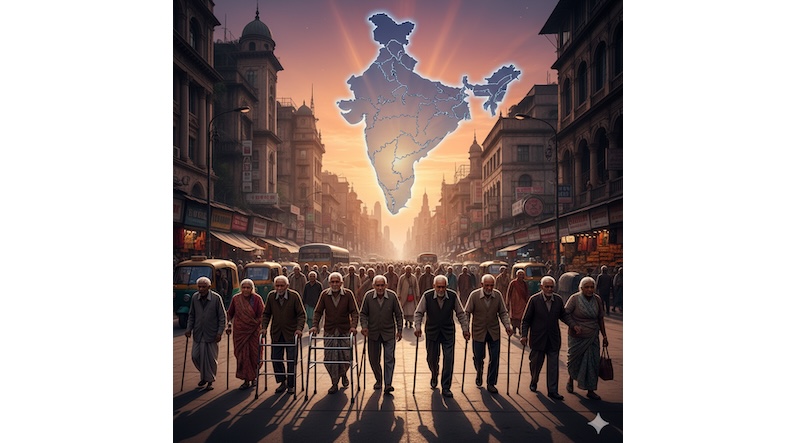
    MUMBAI India’s population is ageing fast. By 2036, roughly 230 million Indians—one in seven—will be 60 or older, more than double the 100 million recorded in 2011. It’s a demographic earthquake that will reshape everything from healthcare to housing, pensions to public transport.

    The south is greying fastest. Kerala, already home to 13 per cent elderly in 2011, will see that figure leap to 23 per cent by 2036, matching developed nations. Tamil Nadu and Himachal Pradesh aren’t far behind. 

    Meanwhile, northern states like Uttar Pradesh, though younger now, are catching up quickly—elderly numbers there will nearly double from 7 per cent to 12 per cent.

    Women dominate the demographic. They make up 58 per cent of India’s elderly, with a sex ratio of 1,065 females per 1,000 males. More than half are widows. The overall dependency ratio—62 dependents per 100 working-age people—signals mounting pressure on families and the state.

    The challenges are stacked high. Mental health stigma around dementia and Alzheimer’s persists. Geriatric infrastructure is patchy, especially in rural areas. Social security remains inadequate even as living costs climb. Traditional family support systems are fraying under the weight of urbanisation and nuclear households. And India’s infrastructure—from public transport to pavements—remains stubbornly unfriendly to the elderly.

    New Delhi is scrambling to respond. The ministry of social justice and empowerment has rolled out a raft of schemes. The Atal Pension Yojana, launched in 2015, has swelled from 15.4 million subscribers in 2019 to 82.7 million by October 2025, managing assets worth over Rs 49,000 crore. It promises monthly pensions of Rs 1,000 to Rs 5,000 after subscribers turn 60.

    The Integrated Programme for Senior Citizens runs 696 old-age homes across 29 states and union territories, with 84 more approved this year. The Rashtriya Vayoshri Yojana distributes walking sticks, hearing aids, wheelchairs and dentures to low-income seniors. A toll-free helpline—14567—offers support. The Sacred portal helps those over 60 find jobs. The SAGE portal encourages start-ups to develop elderly care solutions, offering equity support of up to Rs 1 crore per project.

    Legal muscle backs the effort. The Maintenance and Welfare of Parents and Senior Citizens Act, amended in 2019, compels children—including step-children and in-laws—to provide for parents. It scrapped the Rs 10,000 monthly maintenance cap and mandated special police units for seniors in every district. All hospitals, private included, must now provide dedicated queues, beds and geriatric care.

    Technology is pitching in too. Telemedicine platforms like e-Sanjeevani offer free home consultations. Wearable devices track vital signs. Online pharmacies deliver medicines to doorsteps. Smart home sensors let families monitor elderly relatives remotely.

    The silver economy—goods and services for those over 50—is booming. Valued at Rs 73,000 crore in 2024, it’s set for multi-fold growth. Globally, senior citizens and professionals aged 45 to 64 are the wealthiest cohort. India’s senior care market presents vast opportunities for health and wellness firms, both at home and abroad.
    Yet success hinges on more than schemes and start-ups. India needs specialised regulations for senior care, policy reforms anchored in evaluation frameworks, and better coordination across ministries. Panchayati raj institutions, urban local bodies, NGOs and private providers must work in concert. Public-private collaboration across healthcare is essential.

    The clock is ticking. By 2050, India’s elderly population will swell to 319 million, growing at three per cent annually. The country that once prided itself on youthful demographics now faces a greying future. Whether it becomes a burden or a boon depends on how swiftly India adapts. The grey wave is coming. Ready or not.

  • Gracenote says advertisers are botching connected TV with wrong targeting tactics

    Gracenote says advertisers are botching connected TV with wrong targeting tactics

    NEW YORK: Connected television was supposed to be the performance marketer’s dream: precision targeting on the biggest screen in the house. A decade in, it’s not delivering. American advertisers will spend $26.6 billion on CTV this year, up 12 per cent from 2024, according to the IAB. Yet 27 per cent cite lack of insight into whether ads reach their intended audience as their top challenge. Nearly a third rate CTV only “moderately effective” despite pouring money in.

    The problem is a mismatch between strategy and medium. Marketers are treating CTV like social media—chasing users with demographic and behavioural targeting—when they should be focusing on what people watch, not just who’s watching. A Gracenote survey of 600 American brand and agency executives found 30 per cent rank brand awareness as their top CTV objective, with customer retention a distant fourth. Yet 80 per cent still prioritise audience-based targeting over contextual approaches.

    “CTV has not delivered the scale and premium reach that marketers expect of the largest screen in the house largely based on the use of narrow targeting tactics,” said Gracenote VP of partnerships Jake Richardson. “By taking better advantage of contextual targeting capabilities with their CTV campaigns, they have new opportunities to drive both return on ads spend and the scale they’ve been looking for.”

    The irony is sharp. CTV now accounts for 48 per cent of American viewing time, overtaking live television’s 46 per cent in the first quarter of 2025. Ad-supported content makes up 45 per cent of streaming viewership. The audience is there, engaged and watching ads. But marketers haven’t adapted their playbook.

    Nearly 46 per cent of survey respondents have shifted at least 26 per cent of their budgets to CTV over the past three years. Among financial services, retail, technology and healthcare brands, that figure rises to 52 per cent. A quarter now allocate 40 per cent or more of total budgets to CTV. Yet confidence remains shaky. Only 28 per cent consider their CTV spending “extremely effective.”

    The culprit, according to Gracenote, is fragmentation and missing metadata. With 85 per cent of CTV buys purchased programmatically, incomplete or inconsistent content data leaves platforms blind. Nearly 70 per cent of respondents say lack of standardisation is at least a modest challenge when developing campaigns.

    Free ad-supported television (Fast) channels illustrate the problem. Gracenote tracked nearly 1,850 active Fast channels distributing more than 182,000 programmes as of July 2025. Pluto TV, Tubi and The Roku Channel accounted for 5.7 per cent of total American television usage in May 2025, up 36 per cent year-on-year. Yet the metadata is patchy. Before enrichment, 55 per cent of sports programmes on  Fast  channels lacked original air date information. A sample of 28 sports programmes shared by Rain the Growth Agency found only eight included proper content titles—three simply said “tv.”

    This matters because knowing whether a sports event is live, which teams are playing, or whether it’s a playoff game is crucial for advertisers. TV listing data can distinguish an MLB game between the Los Angeles Dodgers and San Francisco Giants from a Liga MX match between Santos Laguna and Pumas UNAM—both aired live on Fast channels on 12 July 2025.

    When asked if standardised content metadata would boost confidence in CTV planning, 62 per cent of respondents said yes. More than half said it would justify higher spending. When asked about TV schedule information, 72 per cent said it would help with planning and investing—rising to 78 per cent among financial services, retail, technology and healthcare advertisers.

    The solution, Gracenote argues, is contextual targeting at programme level. Only nine per cent of respondents currently prioritise this approach, compared with 29 per cent for demographic targeting. Yet contextual signals—knowing a programme has a TV-MA rating, includes adult language, has a gritty mood, or involves arms trafficking—provide the brand suitability insight that audience targeting can’t.

    The pitfalls of over-focusing on existing customers are well documented. Nike’s 2020 direct-to-consumer pivot, which neglected broader brand building, became a cautionary tale last year. Despite CTV’s addressable nature, excluding anyone outside the funnel inhibits future growth. Marketers want CTV for brand building, but to capitalise they’ll need to embrace a simple truth: what people watch matters as much as who’s watching.

    The survey was conducted online between 10 and 20 July 2025, polling brand and agency associates with director-level titles or above across media, entertainment, telecommunications, retail, financial services, automotive, consumer goods and healthcare.

  • Brands, youth mindsets & Samyak Chakrabarty

    Brands, youth mindsets & Samyak Chakrabarty

    MUMBAI: “Who can know the heart of youth but youth itself?” wrote punk rocker Patti Smith in her memoir, Just Kids.

    Indeed, global brands have made it their business to figure out what the youth wants, often ending up classifying them into categories which they think define them – cool, sexy, social media presence and so on.

    This is however their biggest mistake, opines DDB Mudra chief youth marketer Samyak Chakrabarty. “Youth can’t be classified or boxed into traditional or conventional SECs. A certain 21-year-old may appear to be the consumer for a brand but this doesn’t mean he/she will actually purchase it. For instance, a youngster living in Dharavi may own an iPhone while someone in SoBo may have a Nokia Asha,” he says.

    Samyak is speaking from a position of knowledge; he and his agency have spent six months with 40 youth unraveling the complexity of a youth generation in the Indian metros which is more connected and aware than any other in the history of mankind, thanks to the spread of the internet, mobiles and the power that both have showered on them. The output is Youth Report 2013 which aims to provide some insights into those between 18-25 years of age.

    While many question whether it is right to paint a very disparate and fickle demographic grouping with a broad sweep of a brush, Samyak has indeed taken a shot at it in his Youth Report 2013, which is drawing some attention amongst advertisers and marketers.

    The basic premise of his report is “that those born post 1988 are extremely moody people. At one level they are very sure of what they want to do in the long run, but on another there is immense amount of confusion and parallel thought flow. Again it is the number of options available and continuous bombardment of information through new media to blame. 9 out 10 decisions are made based on the prevailing environment and frame of mind.  5 mindsets (read: mood) existing every Young Indian born post 1988 living in metro cities. Each gets triggered based on the type of decision and plays a critical role in influencing choice.”

    The five according to Samyak are:

    * The Passionista: Someone who transforms into a Passionista while making decisions would base judgment purely on feelings often also defying strong logic.

    * The Racehorse: It’s always about being the first in everything he/she does. Such as state of mind is active in people who are generally very motivated, aggressive and competitive in nature.

    * The Label: All decisions are completely based on the badge value of a product. Unlike someone who thinks likes a racehorse, here it’s not about being the first but rather being the ‘coolest’.

    * The Shiny Disco Ball: If someone thinks like a Shiny Disco Ball, He / She is an optimist and will be open to try different things just for the experience.

    * The Kite: Those in this state of mind prefer to follow others when it comes to buying decisions.

    And how do these mindsets come into play. Samyak explains that if the youngster has a racehorse mind or competitive and aggressive mindset, he/she will buy a certain product to be in a position of leadership and create talk value among others.

    If a youth has a kite mind where say five friends get together in a bar with four of them ordering a certain brand of beer, the fifth friend will display a kite mind and order what his four friends ordered. At this point, his/her mindset is to simply go with the flow. However, if the same person is in a passionista mindset, he/she will take charge and order what he/she likes instead of blindly following the others.

    “Today, youngsters are driven a lot by mindsets rather than economics. I think they are more inclined towards their passion, following their desires and finding ways and means to achieve them,” says the young in years, but old in experience Samyak. Irrespective of their economic background, they strive to achieve what they want and it doesn’t have anything to do with their ability or inability to buy the product. It has got more to do with what they want.”

    However, diversity (economic, social, geographic or religious) does influence choice and so. Say, a like on a facebook page does not always translate into the youngster buying the brand and that’s where mathematics fails, explains Chakrabarty.

    For a brand to understand the youth, it is necessary to tap the thinking process. “Tap it because it remains constant. If a brand has been able to understand the ingredients that contribute towards building an opinion or brand preference, it has cracked the code,” says Chakrabarty.

    He cautions against the use of jargon and quick fixes like celebrity endorsement, popular lingo and bright colours to attract the youth. Asked how the Youth Report would help brands understand youngsters, he says: “One must remember that most statistics expire even before they are put to print. For instance, a report may say that seven out of 10 people think this way and so end up buying a certain product. However, what influenced a person today may not influence him/her tomorrow depending on the influence of his/her peer group and other such.”

    While the Youth Report helps brands by offering this kind of a classification, Chakrabarty also points out that brands would do well to stick to their core values even if they reinvent themselves with time. He cites the example of Red Bull which at its core continues to be about energy and adrenaline however much it may revamp itself. Ditto for Nike and Kingfisher.

    “It’s suicidal for a brand to reinvent its core because then you lose the long term relationship with the TG. Young people don’t wake up thinking about brands. They don’t care. If brands want to be in the youth’s priority list, they need to connect emotionally with the youth or have the youth looking up to them for example Apple,” he elaborates.

    The other thing he talks about is how a 22-year-old will always have options B and C if he/she doesn’t get option A but the same 22-year-old will turn 50 at some point in future. So, it is for brands to decide if they want a long-term relationship with such a customer. In the event they do, the message has to be sustainable and not fluctuating.

    Chakrabarty is candid about the fact that media – both print and television (even the likes of MTV and Bindass) – has failed to capture the mind of the youth.

     “MTV was MTV because of the music. It picked up on various popular trends and kept changing according to time. But now, shows have become bigger than the channel. Take Roadies, for instance – if we take the show away from the channel and put it on any other, it will still work. The same can be said about Emotional Atyachar. There has to be a balance between content and the brand. That is why we tell our clients to focus on 10 per cent of people and not the remaining 90 per cent because you can’t please everyone. When a brand tries to be overly youthful, it has lost the plot. MTV made a big blunder by changing their core.”

    “Having said that, I also think we give undue importance to the youth. Yes, it is true that those born after 1988 and those before 1988 will behave differently. The main reason is of course the social influences around them – internet was not an integral part of life before 1988, facebook wasn’t around, there was no ‘e’ before commerce. Plus, as a society too, we are changing, parents are giving more freedom to their children. The problem lies in the fact that people think that today’s youth is special, which it is not. Yes, it is different and it is quantitatively more but there is nothing starkly unique about it,” he adds.

    However, wouldn’t he agree that social media, which has become an integral part of youth today, has changed the youth’s psyche? He disagrees: “The time has changed but the thinking hasn’t in a way. Earlier our parents used to tell us to beehave in a certain manner because of what the society will think. And now youngsters behave in a certain manner because they want to be seen like that on social media. However, social media doesn’t influence when it comes to brands. It might surprise you to know that a brand so popular on social media may not have so many consumers. Also, there isn’t too much of branded content on social media that will engage young people.”

    Chakrabarty points out that the Youth Report clearly highlights the power of off-line communication (word of mouth).

    If someone were to buy a Rs 30K phone, he/she is going to show off in front of his/her friends. He/she may read a few reviews but will talk to his/her tech-savvy friends before making the purchase. In this case, it’s not peer pressure but peer influence. According to Chakrabarty, this can be artificially regulated and the agency is working toward it.

    And what is the youth’s attitude toward money? “There is no answer to it. We are still trying to figure it out. At one level, there are a lot of young people exploring the merits of economical products and savings. Currently, whatever the youth earns, 75 per cent of it is spent on satisfying desires while the rest is spent on survival. They do try to achieve a balance between the two. However, my prediction is that looking at our future and the way the economy is youngsters too will become cautious about their finances. So, all the financial product companies shouldn’t ignore them. They might form only five to seven per cent of the TG of these companies at present but it is going to amplify into something much bigger,” says Chakrabarty.

    Apart from what the youth think and how brands can decode that, Chakrabarty, who started young, is simultaneously running a Blackdot campaign to motivate youngsters to step out and vote in Maximum City. He feels that this year, a lot of youngsters are going to take charge because they want a better future and know that they need to take a stance rather than being passive observers. Maybe, he does know their mind better than most others….

  • ‘As content creators, we have to be more entrepreneurial in our approach’ : Castle creator and executive producer Andrew Marlowe

    ‘As content creators, we have to be more entrepreneurial in our approach’ : Castle creator and executive producer Andrew Marlowe

    With the television landscape having to work under a struggling global economy, it is becoming more of a challenge for content creators to stay creative under financial constraints.


    Fiscal responsibility has become a part of the creative process, says Castle creator and executive producer Andrew Marlowe.


    In an interview with Indiantelevision.com‘s Ashwin Pinto, Marlowe talks about the creation of Castle, its USP of focussing on characters, the relationship with ABC Studios, what is needed for a show to work, the importance of being in the digital space and the need for a collaborative relationship between broadcasters and content creators.


    Excerpts:

    How did the idea of Castle come about?
    I was watching a lot of procedurals on American television like CSI, Law and Order. I was missing the fun characters that I saw on TV growing up – like Moonlighting. On those shows, you really got a sense of who the people were and that is what you were following more than the case. I wanted to bring something like that back to television. It felt like there was room for it since the other shows were doing things that were different. They were not focusing on characters.


    When I was imagining the character of Richard Castle as a writer myself, I thought that it would be great if I could get up and do some of the things that I was writing about. That is where the idea came from. To create a character who is a mystery novelist who thinks of ways to kill people and get away with it. Then to have him go out with a detective in real life solving crime felt to me to be rich, fertile material for storytelling.


    We are at a time when there is a lot of competition among channels and shows for viewers attention. What sets Castle apart from other shows?
    The relationship between the two major characters sets it apart. You have to find what attracts your audience. Something like Law and Order was attractive at the time. CSI looks at forensics which was new. For us, it is about the character dynamic and the relationship. When we market the show, this is what we sell. We know that there has to be a procedural element as audiences expect it. However this is the strand on which we put the relationship pearls to make the necklace.


    Creating interesting characters for Castle was important. How did you approach this job?
    I looked at the dynamics between the two lead characters. I knew that I had to have characters that were in conflict but who also had a romantic interest in each other. For Castle, he thinks highly of himself. He is a bit of a narcissist but is also charming. Things have come easily for him. I wanted him to be in a relationship with a woman who is a bit of a mystery and who did not fall for him. She did not fall for his surface charm and surface wit but be a match for him. The characters approach storytelling from two different points of view.


    For detective Beckett, it is about what the evidence suggests. But Castle looks at it in terms of the story of the dead person like a frozen woman found at a construction site. He wonders how she got there. Though they approach things from different points of view, they help each other reach the solution. We capitalise on the spark and the great relationship that they have working together.

    You have to juggle different genres. Was this tricky?
    It is tricky while writing. We can go from comedy to drama quickly. It is important to treat the victim and the victim‘s family with respect. But we know that we allow viewers to have more fun with the murder mystery than they would with other procedurals. We walk the fine line of walking from a crime scene and have fun. The detective is on point carrying the torch for the victim.


    But Castle sometimes says inappropriate things and has more fun with it. Cops have come up and say how much they like our show. They have to find humour in their daily real life situations. Otherwise, it gets overbearing. On other shows where police officers are humourless, it feels less authentic to them. Even though our show exists in a fantasy setting, a lot of law enforcement officers seem to be relating to it.

    New technology has to be in the service of the storytelling rather than the other way around. We have seen big budget action affects movies that do not have a quality story at the heart of it. It is like watching fireworks. You watch something interesting but are not emotionally engaged

    Generally as a show gets more popular it gets more expensive to do. What is happening with Castle?
    Finances are a continuous challenge. We figure out which episodes we want to have which are bigger in scale and make a lot of noise. Then you have episodes that are smaller and more personal in scale. The production costs are smaller here and it becomes a more intensely focused drama in terms of the sets that we have. We shoot in Los Angeles but we want to give an authentic feel of New York. There is money that we have to spend on recreating New York.


    Fiscal responsibility has become a part of the creative process for us. I don‘t mind it that much as it seems to me that a lot of great creativity can come when you push against constraints. If you have all the time and money in the world, often TV shows are not as good as they should be. Facing constraints can challenge you as an artist to create something better and more interesting rather than opting for what is easy.


    How is the show perceived by viewers?
    They enjoy it as it is different from the other stuff on air. The other procedurals are sensationalistic and go to a darker place. Advertisers are excited due to our TG. Women watch us the most. We win the night every time in this demographic. In the US, we have Dancing With The Stars as the lead in. So it helps us build a strong female audience.


    We are also getting stronger with men. We have tried to craft an experience where they too can have fun when they come to the show. We are fortunate that our viewers are passionate and bring others into the experience. Advertisers are seeing the value of our show. But so much of the coveted 18-35 TG are seeking out content in non traditional forms on the net, portals. Everybody in the broadcast space is trying to figure out how to best monetise this.


    How is Castle faring in countries like India?
    From the conversations I have been having, people have been responding favourably. They like the relationships and the fact that Castle is a family man. They like the creativity of the storytelling. So far the feedback has been very good.


    How important is it for a show to be in the digital space?
    It is essential to create a community for viewers. Viewing habits are changing. Some people view content on the net, phone and not just on the TV. Creating a digital watercooler where people can have a conversation about your show is important to extend their experience. We launched a couple of initiatives to have better relationships with fans and deepen their entertainment value. Between the first two seasons in the US, our fiction character Richard Castle was tweeting.


    He went on vacation and got involved in a murder mystery. So in the break between seasons, he was keeping loyal viewers engaged and deepening their loyalty but having a story telling vehicle on twitter. Our audience was engaged between the seasons. These people became emissaries. It helped with viewership when we returned for the second season. Having a facebbok page helps get feedback. It helps extend the brand. This is what viewers expect from entertainment these days.


    We know what viewers respond to and like or do not like. In the past when you built an online community, it was the fanatics that visited. But now that twitter has gone mainstream, there are more viewers there. You can get more balanced information on what people feel about your show which helps in storytelling.


    Are you creating Castle content for the net and mobile?
    It is an on-going discussion. Is this being done to market the show or to try and create another revenue stream? People have not figured out the economic model. You have to have actors. They already work a lot on the television show. You need to figure out why you are doing it. Is it to attract a new audience, go to a new platform to bring people to the main show or is it to generate more revenue? It has a price tag.


    There is stuff we want to do, but we do not have the capability yet. The proven business model is not there and so it is always a risk. We might have a great idea but are we generating revenue or bringing more viewers to the table? These questions must be answered or you could have unnecessary capital expenditure.


    What are the key ingredients needed for a show to work and draw audiences regularly in an increasingly fragmented environment?
    You need something at the heart of a show for people to talk about. There has to be reason for them to leave the storytelling and go out to the community and talk about their experience. You can do it with a compelling premise like Lost. Or you can have a key relationship at the heart of it and characters that viewers fall in love with.


    If this happens, viewers will invite the characters into their homes week after week and live the adventures with them. It is either the premise that is very bold or characters that we fall in love with. Ideally, you should have both. The minute a premise loses its interest, then the characters keep you coming back for more.


    What trends are we seeing now in terms of the kinds of shows that work and do not?
    Comedy is making a bit of a comeback. There was a time when comedies were not working. But when things get bad economically, people want an escapist experience. People are attracted to really good content, characters. This is hard to do.


    Are dramas and realities tapering off a bit in terms of popularity?
    I think that they are both evolving. Some new reality shows are successful while others are not. What is specific premise? Is it resonating? Dramas had a tough year where few shows got traction or caught on. However, broadcasters are being more patient and seeing they can grow a show.


    Marketing is a challenge for everybody. There is a lot of product including online with YouTube. I think patience can help develop a show so that people can understand that this cultural experience will be something they would want to be a part of. Broadcasters will be more patient out of necessity to see if they can grow an audience. There is no hard and fast rule. If something goes strong out of the gate, people will be more generous and foster it over the next couple of years.

    What are the fresh challenges that you and the creative community in general face?
    We always think that our stories are worth telling and there is audience. We have to be entrepreneurial, be better partners for studios and networks. It means that we have to take chances. We have to take risks as the audience wants new and interesting material.


    They also want an experience that they are comfortable with. Sometime people spend a lot of money and at other times there is belt tightening. As a content creator, you have to roll with those punches and do the best that you can.

    Has the production process of making a show changed?
    Not really. The fundamental stuff is there. A lot of shows have switched to HD. People are doing more special effects work for less money. We can go to states where there are tax breaks. We still shoot on film. We don‘t feel that HD cameras are there yet in terms of how they capture light. They will catch up. There will be cost savings but also time issues.


    The new technology has to be in the service of the storytelling rather than the other way around. We have seen big budget action affects movies that do not have a quality story at the heart of it. It is like watching fireworks. You watch something interesting but you are not emotionally engaged. It is important for us that the cart does not lead the horse.

    Are you happy at the deal the WGA did with the AMPTP?
    That remains to be seen as to whether or not we are happy with what the settlement was. The issues that we had were in terms of new media. This landscape is changing rapidly. When we went on strike in terms of digital rights and payments, nobody understood the landscape. This brought the town‘s attention to the fact that this is an issue. It is an issue worldwide. What does it mean to have IP in a digital age when it is so easy to make a copy? How do you define and protect IP in the digital age?


    It goes to the heart of piracy. These issues have not been resolved by the marketplace. I know a lot of writers and studios who are still recovering from the strike. Nobody wants to see this labour strike again. But the issues that were raised across the board by the strike are the ones that we are going to be dealing with for a while.

    Will YouTube be the new TV five years down the road?
    No! There is too much content for people to sort through. People want to know that they will commit their time to something worthwhile. So the notion of a brand or a channel or community will not go away. I do think that the screen will change. This will create chaos but out of chaos comes opportunity.


    If there is too much product, people are not going to know where to look. They will ask their peers or stick to trusted brands. While there are hundreds of channels in the US, most people I know only watch five or six channels. They only talk about five or six shows. That is because it is hard to make great content that resonates. It will come down to making good shows and it will find an audience it is worthwhile. I don‘t have time to go to YouTube and sift through the noise and nonsense to find something worthwhile. I need a filtration system. This is why brand and channels will still be important in the new formulation.


    As a writer do you constantly learn from the work going on in other shows, especially those that have been going on for a while?
    We look at other shows to make sure that we are not doing the same thing. We also study older shows like Moonlighting to see how the relationship between the two lead characters was handled. On that show it was handled well for a while, and then it wasn‘t.


    I also look at shows like Bones. You never want to get too complacent and only look inside your own show. You would also want outside perspective to shape up your storytelling.


    What is the difference between writing for television and writing for film?
    In films, you have more leeway in terms of location and money that you can spend. You can paint on a much bigger canvas. In case of television, you need to be clever in terms of the storytelling – and overcome financial constraints.
     
    Are you looking at other concepts or is Castle your only focus?
    Right now it is my primary focus. I want to make sure that the series does well. But I have an appetite for creating shows.

    In films, I have a couple of projects that are actively moving forward. I have an alien invasion movie with Warner Bros. It will be directed by Pierre Morel who made Taken. He has just signed on.