Tag: Deloitte

  • What were the merger trends for marketing in 2018?

    What were the merger trends for marketing in 2018?

    MUMBAI: The year 2018 will be known for a lot of things. It has been one of the most imperative years for the advertising and media industry. This year broke shackles and ideologies of how people traditionally perceived the industry. I think it is safe to say that the marketing books hereon will have a dedicated page for everything that occurred in 2018.

    I am optimistic about 2018 being one of the best years for A&M industry (so far). Why, you ask? Because this has been one of the most momentous year for mergers and acquisitions. While news about mergers came in from all sectors of the media, the A&M world tasted its first big bite of consolidation this year.

    We’ve all read and heard about the four extensive types of mergers, but it was only in 2018 where we witnessed all of them! The traditional case of two big networks (agencies) coming together, big agencies merging their businesses with small agencies, two small agencies coming together to take on big network agencies, and the most recent trend: consultancy firms opening agencies or merging with one.

    Let’s start with the advertising giant WPP, where we saw a lot of action happen this year. One of the bigger mergers this year happened within the WPP group, where Wunderman and J. Walter Thompson were united to form Wunderman Thompson. The merger will help the group as Wunderman and J. Walter Thompson share many core clients, who will now have simpler access to the expertise of both agencies. Additionally, WPP’s GroupM, the leading global media investment group acquired an Indian digital agency, The Glitch. With this acquisition, The Glitch continues to work as an independently positioned brand, while taking advantage of GroupM’s larger infrastructure and ecosystem. 

    With a promise to simplify the business, WPP’s Chief Executive Officer merged one of its largest agencies, Y&R with VML, that left the ad industry gasping for breath. The disappearance of the 95-year-old Y&R brand, which had been part of the WPP empire since 2000, was a moment to pause and reflect on the pressures that the industry in general and ad agencies, in particular, are facing from changing client demands.

    Similarly, international advertising agency M&C Saatchi acquired Manish Bhatt-led Scarecrow Media, where the new entity is called M&C Saatchi Scarecrow. This is M&C Saatchi’s full-fledged attempt to get a stronger foothold in one of the most competitive ad markets in the world, India. Advertising agencies are finding ways to navigate through an increasingly volatile landscape. One of those ways is consolidating the hundreds of agency brands under their roofs and merging the entity with another agency. 

    After years of headlines about consultancy companies eating ad agencies’ lunches, the two groups are increasingly starting to look alike. The consultancies are rising fast by gaining a foothold in the marketing department and wooing chief marketing officers with their vast array of data analytics solutions and strategies to solve big business problems that traditional agencies can no longer solve. Increasingly, we are seeing a lot of consultancies merging their business and resources with agencies to deliver better solutions to clients. The trend of consultancies and agencies coming together is shaking up the marketing industry. In 2018, we saw the likes of Accenture Interactive, PwC Digital Services, IBM iX and Deloitte Digital emerge as winners for brands as they are looking for areas to cut costs and drive better performance.

    Right now, we’re at a point where the industry cares less about agency labels than ever before. This is an industry where so many people worry about whether something is an ad agency, a digital agency, a PR agency, or a consultancy. This may be the first time where the labels of agencies don’t really matter.

    If your merger translates to 1+1=2, the merger makes no sense because there is no added value to it. However, only if your merger translates to 1+1 >2 (greater than 2), the time, effort and money that you put into the merger will be beneficial for both parties involved.

    At the end of the day, I think consolidation is the way to go because it helps in playing on each other’s strength and delivering better results collectively. If agencies find the right partner to complement their existing skill set, it is only beneficial for both the parties. More importantly, the agencies and clients need to evolve with the changing time because their customers are evolving at a faster pace than them.

    (The author is chief executive officer and co-founder, White Rivers Media. The views expressed here are his own and Indiantelevision.com may not subscribe to them)


  • Global appeal of Indian sports high, says Deloitte report

    Global appeal of Indian sports high, says Deloitte report

    MUMBAI: The sports media market will continue to attract more global investments due to the high potential growth according to a report by consulting company Deloitte.

    There has been plenty of foreign capital flowing into the sector, which also brought in a wave of consolidation in the sports broadcasting space.

    The best examples are Sony Pictures Networks India acquiring Ten Sports from Zee Entertainment Enterprises for USD 385 million and Star India bagging the global media rights for the Indian Premier League (IPL) for 2018-22 for a whopping Rs 1,634.75 crore after a bidding that saw as many as 24 players in the fray.

    “The sports media landscape is evolving rapidly, especially in terms of who creates the content and who has the right to distribute them,” the report stated.

    “These entities who have made the bids are not primarily in the sports broadcast business but put value on the table to acquire digital broadcasting rights of IPL. This proves the global appeal of Indian sports which is now identified as a potential growth area by global sports giants,” it added.

    With the huge popularity of the IPL, there is a significant place for domestic sporting leagues in other sports and some like football and kabaddi have already generated interest, it said.

    Also Read :

    Star India gets IPL to change match timings for 11th edition

    The BCCI India rights conundrum

    578 players to go under the hammer for IPL auction

  • Vernacular content consumers to be 2.5 times English by 2021: Deloitte

    Vernacular content consumers to be 2.5 times English by 2021: Deloitte

    MUMBAI: Deloitte India has launched the eighth edition of its report on technology, media and telecommunications which predicts major advances in machine learning, voice over LTE (VoLTE) technology services and over-the-top (OTT) platforms, apart from other trends.

    According to the report, VoLTE is expected to be the most prevalent voice technology in the future. It is also estimated that more than 90 per cent of all mobile subscribers will comprise of broadband subscribers by 2023. OTT platforms are witnessing an explosion in original content due to increase in consumption and viewership, the report says, adding that they will gradually become a preferred medium over television, with the consumers of vernacular content likely to be over 2.5 times that of English language content by 2021.

    The publication highlights the fact that machine learning will intensify among medium and large-sized enterprises. Compared to 2017, the number of implementations and pilot projects using machine learning technology is likely to double in 2018 and then double again in 2020.

    As enterprises in India embrace technology to bring transparency and efficiency in business operations, data assumes centre stage in decision-making, setting the stage for tools such as advanced analytics and machine learning to usher value-chain efficiencies, a Deloitte India spokesperson said. Organisations will take steps to realise the potential of the internet of things (IoT) for their businesses, predictive analytics and intelligent data mining technologies are set to become mainstream in India.

    Deloitte India Partner PN Sudarshan, said, “India is one of the fastest growing technology markets in APAC, with the ongoing digital transformation of public sector and private sector enterprises enabled by changing market dynamics and policy interventions. Enterprises across industries are increasingly adopting technology driven solutions to improve customer experience, optimise business operations, and compete effectively in the market. Catalysed by the availability of cost effective computing infrastructure and flexible business models through cloud computing, and the adoption of exponential technologies such as AI, ML, AR, IoT etc., technology sector in India is truly at an inflection point.”

    He further added, “Trends such as IoT will catalyse the emergence of analytics at the edge. Digital revolution, also known as ‘The Internet Economy’ is creating a new market for digital-first services, which has the potential to optimise value chains, bring transparency, and improve overall productivity in the economy.”

    Newer technologies like LTE, LTE-A, LTE-A pro and 5G will make wireless internet commercially more viable for home internet users. The smartphone riding on new innovation will consolidate its position as the primary access to digital services and content, and live streaming and OTT video content are likely to gain popularity.

    IoT-driven point solutions will be adopted to solve a specific business issue. IoT-driven enterprise solutions would help organisations redefine their business models and provide innovative services for their customers; investments will not only be assessed on KPIs, but also will involve new product launches, new supply chains and a new operating model that enables organisations to monetise their services across value chains, leveraging IoT.

    Analytics will finally travel beyond the back office as enterprises will combine external perspectives, social inputs (surveys, social media comments, response to a feedback questionnaire) to the internal data sources to improve customer service. Device data will be integrated faster and on-demand to answer immediate field needs; information dissemination for decision-making will be faster and simpler using digital delivery; paying for results and provisioning on demand is the new normal (on cloud).

    Deloitte also predicts that more than 60 per cent of all broadband subscribers would be utilising VoLTE technology for voice services by 2023 surpassing five billion subscribers globally. IoT appliances can be enhanced with VoLTE improving the productivity and efficiency of applications and especially effectiveness in emergency situations. One example is a smartwatch with a feature to automatically dial an emergency contact in case of abnormal heart rate. Wi-Fi would be an essential part of service provider network strategy to enhance access and extend coverage. With VoLTE supporting VoWi-Fi (Wi-Fi calling), it would be an opportunity to monetise hot-spots especially relevant in the Asia-Pacific region which would constitute 45 per cent of global hotspots.

    Sports media in India is set to unlock new horizons as Indian sports business will continue to attract global investments. With broadcasters paying as much attention to rural segment, these geographies will continue to lead the way for sports sector in India, especially with tier II leagues beginning to receive widespread attention. Data analytics will increasingly play a significant role in managing all aspects of sports, especially on initiatives such as fan engagement and viewership on digital platforms. Governance-related matters will continue to be in focus in Indian sports ecosystem, and topics such as legalising betting will be discussed more than before.

    Wireless home internet is bigger than imagined but due to challenges in deployment of fixed broadband networks, current rural internet penetration stands at a negative 17 per cent. In future, demand for fixed broadband would be limited to consumers with higher bandwidth/QoS requirements, with majority of home internet requirements catered through wireless network.

    Augmented reality (AR) is on the cusp of reality as the Indian market is witnessing the emergence of AR service providers helping enterprises embrace it as part of their digital experience strategy. India’s $150 billion technology services industry has the potential to play a key role in increasing the adoption of AR for global businesses by building a robust supply of talent, business models, and frameworks to accelerate deployments. The public sector also has the opportunity to leverage the product and talent ecosystem in the country and adopt AR for improving the quality of experience in areas such as education and healthcare.

    Also Read :

    Media and marketing professionals most vacation deprived: Expedia Report 2017

    55% marketers make better decisions with machine learning: iProspect report

    India ad spend to grow by 12.5% in 2018: DAN report

    M&E industry to hit Rs8 trillion revenue by 2022: report


  • Pursuite.com forays into furniture

    Pursuite.com forays into furniture

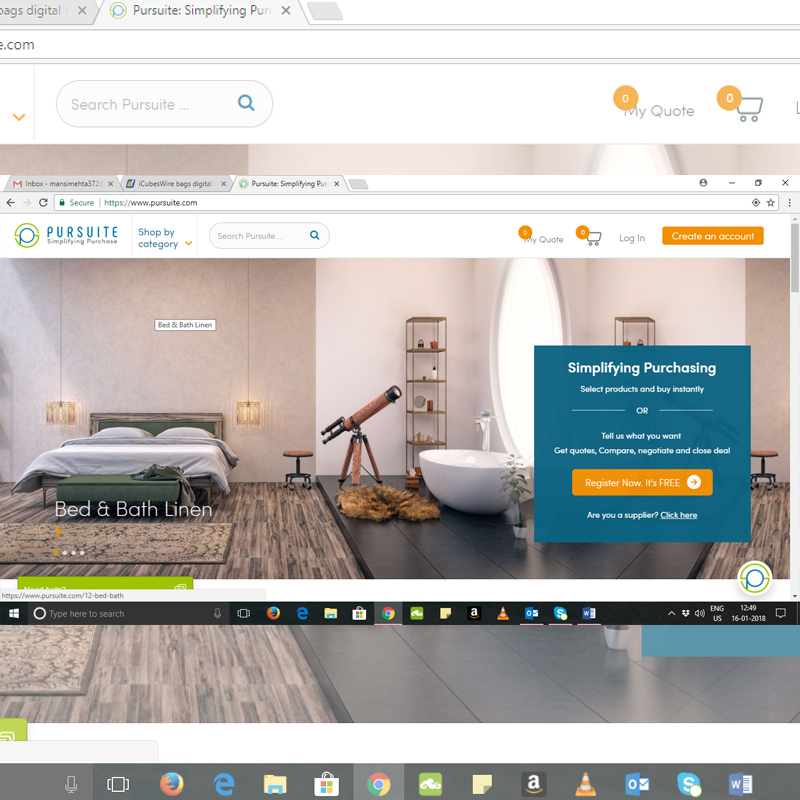
    MUMBAI: In a move to further expand its product categories, Pursuite.com, India’s first B2B e-commerce platform for hospitality procurements has announced its entry into furniture, fixture and equipment (FF&E) segment. 

    With over 50 brands and more than 5000 products from across the globe, Pursuite will now offer products across categories such as bathroom fixtures, fittings, doors & windows, finishes & coverings, furniture, hardware, lighting, furnishing & carpets and artworks & signages.

    According to a study by Assocham and Deloitte, the e-commerce market in the country is expected to cross $50 billion in value by the end of 2018 from the current level of $38.5 billion, on the back of a growing internet population and increased online shopping. 

    Pursuite has partnered with Roca, Parryware, Sio, Euronics, FCML, Vitofloor, Barlinek, Egger, Interex, Floorwalk, Wipro, Trend N Design, Stanley, Loomcraft, Renesola, Greyellow, The One Lighting, Nova and Havells   for FF&E product supply. 

    Pursuite CEO Amit Shukla says, “With our strategic and innovative solutions, we aim to enhance the brand connect and deliver the best value to our customers. Pursuite considers it crucial to enable its valued customers to get the best deals across the widest range of FF&E products. We already offer the widest range of choicest items in OS&E vertical. With this new category launch, Pursuite has reiterated its commitment to deliver best value to its customers.”

    The selection and product discovery of FF&E category will be simplified and optimised through smart technology that matches customer preferences with brand offerings and progressively fine-tunes this matching based on past product selections. This technology has already been deployed and tested in operating supplies & equipment category and has been well received by existing customers and participants of ecosystem.

    Also Read :

    PVR reports lower numbers for second quarter

    PVR acquires minority stake in US luxury theatre chain

  • Microsoft enables video calling on Android with Office 365 in 19 languages

    MUMBAI: Microsoft Corp. on Tuesday announced the general availability of Microsoft Teams, the company’s new chat-based workspace in Office 365. The new tool for team collaboration is now available to Office 365 business customers in 181 markets and 19 languages.

    Customers worldwide are choosing Microsoft Teams to enable collaboration within their organizations. Since announcing the preview in November, more than 50,000 organizations have started using Microsoft Teams, including Alaska Airlines, ConocoPhillips, Deloitte, Expedia, J.B. Hunt, J. Walter Thompson, Hendrick Motorsports, Sage, Trek Bicycle and Three UK.

    “In a world where information is abundant and human time and attention remain scarce, we aspire to help people and groups of people be more productive, wherever they are,” said Microsoft CEO Satya Nadella. “Office 365 is the broadest platform and universal toolkit for creation, collaboration and communication. Today we are adding a new tool to Office 365 with Microsoft Teams, a chat-based workspace designed to empower the art of teams.”

    Office 365 is designed to meet the unique workstyle of every group with purpose-built, integrated applications: Outlook for enterprise-grade email; SharePoint for intelligent content management; Yammer for networking across the organization; Skype for Business as the backbone for enterprise voice and video; and now, Microsoft Teams.

    According to Trek Bicycle vice president of global customer service Laurie Koch, “Microsoft Teams is already streamlining the company’s work by providing assets and tasks in context: “Across Trek’s global teams, the integrated collection of Office 365 apps serves up a common toolset to collaboratively drive the business forward. We see Microsoft Teams as the project hub of Office 365 where everybody knows where to find the latest documents, notes and tasks, all in line with team conversations for complete context. Teams is quickly becoming a key part of Trek’s get-things-done-fast culture.”

    Microsoft has introduced more than 100 new features to Teams since November, including: an enhanced meeting experience, with scheduling capabilities; mobile audio calling, with video calling on Android now and coming soon to iOS and Windows Phone; email integration; and new security and compliance capabilities. The company has also delivered new features to make Microsoft Teams accessible, such as support for screen readers, high contrast and keyboard-only navigation. Guest access capabilities and deeper integration with Outlook, and a richer developer platform are targeted for June of this year.

    Microsoft Teams brings together people, conversations and content, along with the tools that teams need. It’s integrated with familiar Office applications and is built from the ground up on Office 365 and Microsoft’s global, secured cloud. Microsoft Teams is built on four core promises:

    · Chat for today’s teams. Microsoft Teams provides a modern conversations experience, with threaded, persistent chat to keep everyone engaged. Team conversations can be either private or visible to the entire team, and users can access multiple teams, making it easy to switch between projects.

    · A hub for teamwork. The Office applications and services that teams use every day — Word, Excel, PowerPoint, SharePoint, OneNote and PowerBI— are all built-in, so people have the information and tools they need.

    ·Customization for every team. Microsoft Teams offers the ability to customize work spaces with tabs, connectors and bots from third-party partners as well as familiar Microsoft tools like Microsoft Planner and Visual Studio Team Services. Today, more than 150 integrations are available or coming soon, with companies like SAP, Trello, Hipmunk, Growbot and ModuleQ building on the platform.

    · Security teams trust. Microsoft Teams is built on the hyper-scale, enterprise-grade Office 365 cloud, delivering the advanced security and compliance capabilities our customers expect. Teams supports global standards including SOC 1, SOC 2, EU Model Clauses, ISO27001 and HIPAA.

  • Telestream to acquire IneoQuest

    MUMBAI: Telestream has announced its agreement to acquire IneoQuest, the global leader in video quality monitoring and analytics solutions for content distribution across managed and unmanaged networks.

    Founded in 2001, IneoQuest is headquartered in Mansfield, Massachusetts, with sales operations in North America, Europe, Asia, and Latin America. With this acquisition, Telestream will enable its customers to deliver the highest possible video quality to their viewers on any device. The terms of the deal were not disclosed as both companies are privately held.

    With video quality a critical part of the viewer experience, IneoQuest’s analytics solutions help hundreds of media companies and service providers around the world deliver the highest possible quality across any network, managed or unmanaged.

    Recognised as an industry leader and innovator by Deloitte, Red Herring, Inc., Frost & Sullivan, and others, IneoQuest’s patented solutions continue to set the standard for measuring video quality, quality of service, and viewer experience.

  • Deloitte: Indian film industry to touch Rs 23,800 crore by 2020

    Deloitte: Indian film industry to touch Rs 23,800 crore by 2020

    MUMBAI: Can the Indian film industry come up to scale and rival the US and Canadian box offices? Yes, it can. The potential is huge, says a new report on the Indian cinema industry released by Deloitte Touche Tohmatsu India at the Indywood Film Carnival taking place during 24-27 September in Ramoji Film City, Hyderabad.

    Both, the US and Canada, have a box office of $11 billion annually though they produce less films (700). India, with 1,500 to 2,000 films in more than 20 languages, is the world’s largest film producer and it also has the second highest footfalls at 2.1 billion, just behind China (2.2 billion).

    It is growing at a rapid clip of 10 per cent and its gross realisations are at Rs 13,800 crore ($2.1 billion). “This is mainly due to low ticket realizations and occupancy levels, lack of quality content, and rampant piracy,” says the report titled “IndyWood: The Indian Film Industry.”

    This growth is set to accelerate further to 11.5 per cent CAGR and by 2020 the Indian film industry will gross revenues of Rs 23,800 crore ($3.7 billion). Yes, that’s still not measuring up to the US and Canadian revenues, but given time, the Indian film industry will grow even further.

    Says the Deloitte report: “The key growth drivers are rising income levels and a swelling middle class, expansion of multiplexes in smaller cities, investments by foreign studios in domestic and regional productions, growing popularity of niche movies, and the emergence of digital and ancillary revenue streams.”

    The report points out that “By 2020, the Indian average household income is expected to reach $18,500 from $8,000 currently with a corresponding middle class of over 90 million people. This level of median household income will drive discretionary spending on leisure and entertainment. The proliferation of internet and smart phone usage has opened up a new platform for film distribution and viewing.”

    In all, 43 per cent of revenues for Indian cinema are accounted for by the Hindi film industry with regional and international cinema contributing 50 and seven per cent respectively. Tamil and Telugu movies account for 36 per cent, with other regional languages contributing 14 per cent. The south Indian film industry accounts for Rs 4200 crore, and is growing at 12 per cent CAGR. The Marathi film industry has ballooned to gross revenues of Rs 150 crore and it grew at 40-45 per cent in 2015, even as the Gujarati film business expanded to Rs 55 crore in 2015.

    The report says that “cable and satellite rights and online/ digital aggregation revenues are the fastest growing segments, and are expected to grow at a CAGR of about 15 per cent over the period FY6-FY20, driven by rising demand for movies on TV and increasing smartphone penetration across the country respectively. On the other hand, home videos have been shrinking due to increasing piracy and growing popularity of digital platforms. Home video has lost share to video on demand (VOD) through direct-to-home (DTH) operators and over-the-top (OTT) platforms.”

    What’s helping contribute to the Indian film industry’s revenues is in-cinema advertising which stood at Rs 630 crore in 2015 and is expected to grow 18-20 per cent annually over the next four years. Demand is expected to rise from Tier 2 and Tier 3 cities where retail malls and multiplexes are slated to come up — which obviously will lead to more screens.

    Says the report: “Multiplexes have shown a growth rate of 15 per cent in Indian cities, increasing from 925 in 2009 to 2,100 in 2015. Over 2,000 single screen cinemas have been shut down or converted to multiplexes in the last year mainly due to greater cost of operations (higher entertainment taxes, increase in distributors’ share, and lower ticket prices), non-viability of running on a standalone basis and low occupancy rate. Multiplexes currently account for approximately 26 per cent market share of the screens; however, they contribute more than 40 per cent of box office collections. Wider content and programming flexibility result in higher occupancy and hence profitability of multiplexes. With comparison to growing economies, India has a low penetration of multiplexes with a potential to have almost 7,500-10,000 multiplex screens across the nation.”

    Also, film studios will have to start looking at international markets for revenues. Only 15 per cent of Indian cinema makers revenues comes from outside India, while Hollywood earns two-thirds of its revenues outside the US. The report also states that the producers and distributors should start looking at the potential of merchandising, licensing for mobile and games, delivering movies directly to the consumers via the internet or on their smart phones.

    Piracy if controlled could also help the Indian film industry which loses nearly Rs 19,000 crore annually to pirate sites. “Over 150 sites thrive on piracy where content is stolen from Indian movies, quick copies are made and distributed globally. Nearly half of the 150 are from the US, followed by 11 from Canada, nine from Panama and six from Pakistan. The top 100 sites make Rs 35 billion ($510 million) highlighting the extent of the issue,” the report highlights.

  • Deloitte: Indian film industry to touch Rs 23,800 crore by 2020

    Deloitte: Indian film industry to touch Rs 23,800 crore by 2020

    MUMBAI: Can the Indian film industry come up to scale and rival the US and Canadian box offices? Yes, it can. The potential is huge, says a new report on the Indian cinema industry released by Deloitte Touche Tohmatsu India at the Indywood Film Carnival taking place during 24-27 September in Ramoji Film City, Hyderabad.

    Both, the US and Canada, have a box office of $11 billion annually though they produce less films (700). India, with 1,500 to 2,000 films in more than 20 languages, is the world’s largest film producer and it also has the second highest footfalls at 2.1 billion, just behind China (2.2 billion).

    It is growing at a rapid clip of 10 per cent and its gross realisations are at Rs 13,800 crore ($2.1 billion). “This is mainly due to low ticket realizations and occupancy levels, lack of quality content, and rampant piracy,” says the report titled “IndyWood: The Indian Film Industry.”

    This growth is set to accelerate further to 11.5 per cent CAGR and by 2020 the Indian film industry will gross revenues of Rs 23,800 crore ($3.7 billion). Yes, that’s still not measuring up to the US and Canadian revenues, but given time, the Indian film industry will grow even further.

    Says the Deloitte report: “The key growth drivers are rising income levels and a swelling middle class, expansion of multiplexes in smaller cities, investments by foreign studios in domestic and regional productions, growing popularity of niche movies, and the emergence of digital and ancillary revenue streams.”

    The report points out that “By 2020, the Indian average household income is expected to reach $18,500 from $8,000 currently with a corresponding middle class of over 90 million people. This level of median household income will drive discretionary spending on leisure and entertainment. The proliferation of internet and smart phone usage has opened up a new platform for film distribution and viewing.”

    In all, 43 per cent of revenues for Indian cinema are accounted for by the Hindi film industry with regional and international cinema contributing 50 and seven per cent respectively. Tamil and Telugu movies account for 36 per cent, with other regional languages contributing 14 per cent. The south Indian film industry accounts for Rs 4200 crore, and is growing at 12 per cent CAGR. The Marathi film industry has ballooned to gross revenues of Rs 150 crore and it grew at 40-45 per cent in 2015, even as the Gujarati film business expanded to Rs 55 crore in 2015.

    The report says that “cable and satellite rights and online/ digital aggregation revenues are the fastest growing segments, and are expected to grow at a CAGR of about 15 per cent over the period FY6-FY20, driven by rising demand for movies on TV and increasing smartphone penetration across the country respectively. On the other hand, home videos have been shrinking due to increasing piracy and growing popularity of digital platforms. Home video has lost share to video on demand (VOD) through direct-to-home (DTH) operators and over-the-top (OTT) platforms.”

    What’s helping contribute to the Indian film industry’s revenues is in-cinema advertising which stood at Rs 630 crore in 2015 and is expected to grow 18-20 per cent annually over the next four years. Demand is expected to rise from Tier 2 and Tier 3 cities where retail malls and multiplexes are slated to come up — which obviously will lead to more screens.

    Says the report: “Multiplexes have shown a growth rate of 15 per cent in Indian cities, increasing from 925 in 2009 to 2,100 in 2015. Over 2,000 single screen cinemas have been shut down or converted to multiplexes in the last year mainly due to greater cost of operations (higher entertainment taxes, increase in distributors’ share, and lower ticket prices), non-viability of running on a standalone basis and low occupancy rate. Multiplexes currently account for approximately 26 per cent market share of the screens; however, they contribute more than 40 per cent of box office collections. Wider content and programming flexibility result in higher occupancy and hence profitability of multiplexes. With comparison to growing economies, India has a low penetration of multiplexes with a potential to have almost 7,500-10,000 multiplex screens across the nation.”

    Also, film studios will have to start looking at international markets for revenues. Only 15 per cent of Indian cinema makers revenues comes from outside India, while Hollywood earns two-thirds of its revenues outside the US. The report also states that the producers and distributors should start looking at the potential of merchandising, licensing for mobile and games, delivering movies directly to the consumers via the internet or on their smart phones.

    Piracy if controlled could also help the Indian film industry which loses nearly Rs 19,000 crore annually to pirate sites. “Over 150 sites thrive on piracy where content is stolen from Indian movies, quick copies are made and distributed globally. Nearly half of the 150 are from the US, followed by 11 from Canada, nine from Panama and six from Pakistan. The top 100 sites make Rs 35 billion ($510 million) highlighting the extent of the issue,” the report highlights.

  • Animation companies upbeat on West Bengal

    Animation companies upbeat on West Bengal

    KOLKATA: The Indian animation and gaming industry in India is worth around $2,477 million with a growth rate of 35 per cent (2009-2013). West Bengal, which showed the least amount of growth some years ago with outsourcing as the main nature of work, is now attracting companies to set up their base here.


    The industry has potential for growth, both in terms of size and moving up the value chain, reveals a report on animation, broadcasting and gaming by Deloitte.


    Seeing good opportunities, players like Big Animation (an Anil Dhirubhai Ambani Group company), Arena Animation, NiDT and the Zee Institute of Creative Arts (ZICA) have set their sights on Kolkata. 


    According to NiDT director Chaitali Ghosh, the animation visual gaming sector, offering an opportunity never realized earlier, is now catching up in Kolkata.


    An expert said creativity from West Bengal is overflowing and a trinity should be created among government, industry and academia for the growth of the industry in eastern region.


    Webel DQE Animation Academy has placed more than 1100 students in various firms and is working on the animated version of Jungle Book apart from French and German movies. A production facility in Kolkata is also on the charts.


    ZICA director Shrey Agarwal informs that the company’s in-house studio in New Alipore is in the pipeline. Additionally, Arena Animation director Ramesh Kumar Ruia says that they has started a graduation course on animation. 


    Quoting Economic Survey 2014-15, an expert opined that Kolkata as a creative hub looked promising on the chart. “Seeing that digital advertising and gaming verticals are expected to drive growth on Indian media and entertainment industry in the next few years, West Bengal is likely to play a key role, firstly being a creative center of artists and secondly an important state in the eastern region. India is also emerging as the new favourite of international studios, with 100 per cent FDI permitted in the film sector,” he said.

  • Private sector should partner with the government to encourage sports

    Private sector should partner with the government to encourage sports

    NEW DELHI: Sports secretary Ajit M Sharan of the Youth Affairs and Sports Ministry has urged the private sector to participate and partner with the government and the apex chamber to promote sports in the country.

     
    The stakeholders need to actively engage at all levels to improve India’s ranking as a sporting nation.

     
    He said the government is launching a National Talent Search Scheme to scout for sports talent in various schools and institutions across the country. The National Institute of Sports Sciences and Medicine (NISSM), is already in place to support high performance of sports persons and integrate sciences and medicine into the training of elite sports persons and the curriculum of sport coaching in the country.

                                          
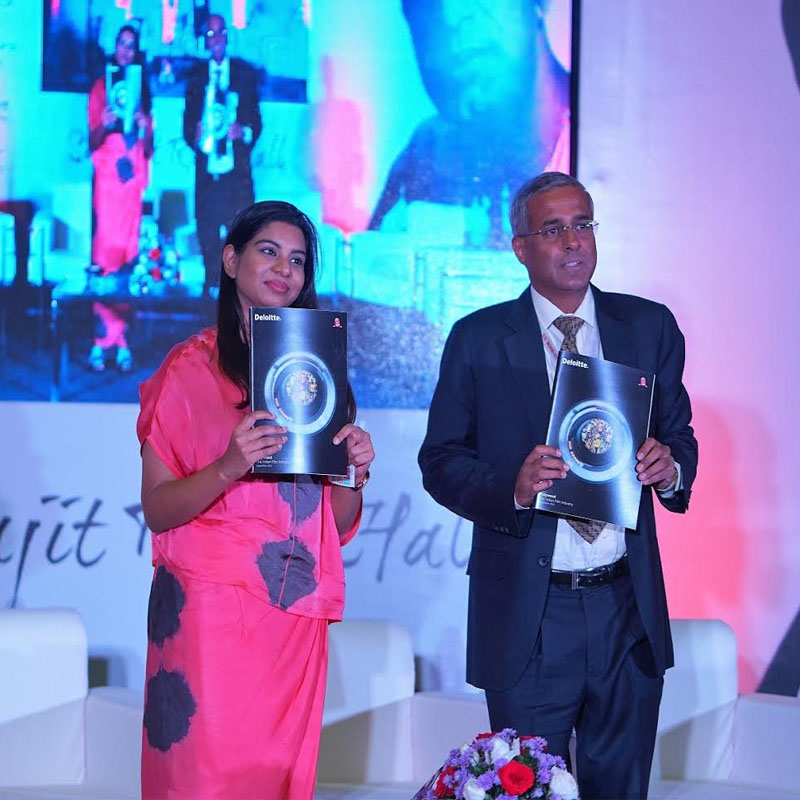
    Sharan was inaugurating ‘India Sports 2014’at Major Dhyan Chand National Stadium. He released a knowledge paper ‘Business of Sports – Aiming Higher….. Reaching Further!’ The paper looks at the sports industry and makes predictions for the upcoming decade. The paper provides information about the state of play and trends in the market for sports business in India.

     
    The three-day sports event on the theme ‘Making India as a Sporting Nation’ is organised by FICCI in association with Sports Authority of India. This focus is on strategic dialogues to bring together senior decision makers and renowned Indian and international sports industry players to deliberate on profitable promotion and grassroots development of sports in the country.

     
    Sharan also said that the setting up of Sector Skills Council in Sports is a big step towards making India a sporting nation in future. The council will devise ways to reduce skills gap and shortage improve productivity, hone the skills of the sector work force and improve learning.

     
    He said sports in India has witnessed stagnation in the last few decades. The challenges in the sector are numerous but some of which call for immediate attention such as development of a structured system at the grass root level to engage young boys and girls in the age group of 8-10 years in various sports; identifying and nurturing young talent based on their performance, talent and calibre; providing professional training, sporting equipment and wholesome nourishment to the identified sports persons; organizing regular competitions of international standard at the domestic level to measure the performance of local sports persons; setting up sports science and sports medicine centres to support the sports fraternity and providing alternative viable vocational career options to players to ensure their livelihood.

     
    FICCI Sports Committee chairman and Tata Metaliks MD Sanjiv Paul said with the support of MYAS, FICCI has finally received the approval for setting up Sector Skills Council in Sports, Physical Education, Fitness and Leisure sector. According to a latest study, this sector will require more than 4.3 million support personnel in various roles in sports in the coming 10 years.

     
    Paul thanked the Ministry for guiding FICCI on the issue of ‘demand of Industry Status to Sports Sector’. After FICCI’s representation on industry status to sports, there was a committee setup under the chairmanship of Director General, Sports Authority of India, where FICCI prepared a report on ‘granting infrastructure status to Sports Sector’.

     
    Deloitte LLP UK sports business group consultant Richard battle,said that there were numerous ways to promote sports. One of the most commercially successful models in India has been the Indian Premier League in cricket, which has phenomenally thrived. India now faces the challenge of replicating this model for other sports.

     
    Sahara India Pariwa publich affairs and communication VP Abhijit Sarka said that India has the talent to be amongst the top sporting countries in the world. It is also recognized that a lot more needs to be done, especially in the development of sports at the grassroots level where states have an important role to play if India has to reap the advantage of the positive momentum and claim its rightful place amongst the top sporting countries. The private sector should come forward and participate more proactively.

     
    FICCI Sports Committee co-chairman and Coca-Cola India public affair and corporate communication head Deepak Jolly said that there was both hope and optimism to make India a sporting nation. There is a long way to go but efforts are being made and India is moving in the right direction to achieve its goal. He added that India has done well in games and sports such as chess, which are primarily mind games. Sports requiring physical strength and stamina still need to be encouraged adequately for India to perform well at the international level.