Tag: Dell

  • Marketing maestro plugs into EV future at Astro Motors

    Marketing maestro plugs into EV future at Astro Motors

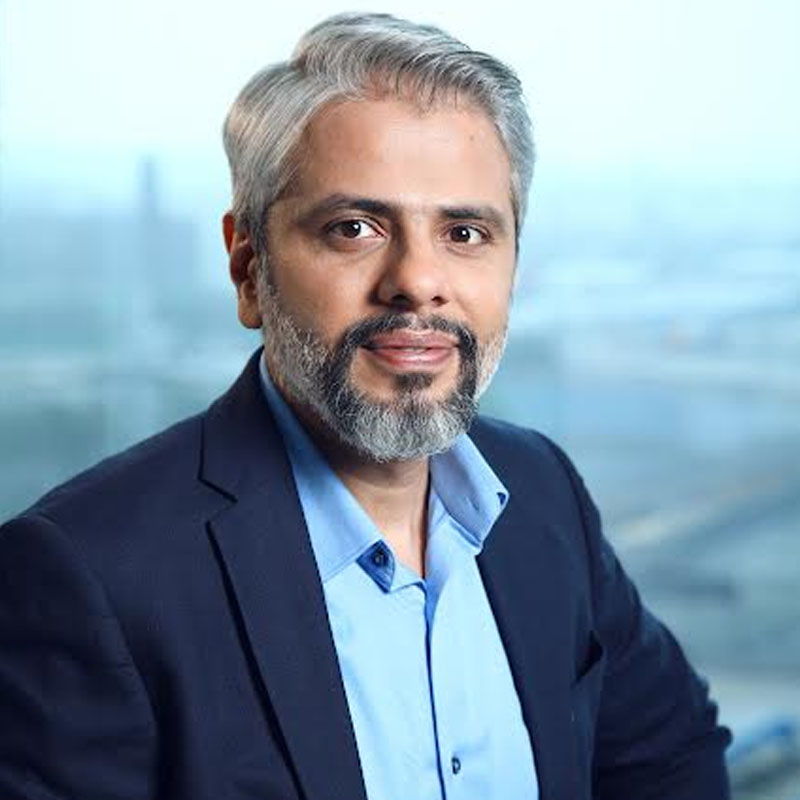
    MUMBAI: Aniruddha Khandekar, a true grand fromage in the marketing consultancy world, has just revved up his career with a cracking new gig. He’s been tapped as the fresh-faced marketing director at Astro Motors IN, an emerging electric vehicle manufacturer looking to absolutely revolutionise the industry. He’s only been on the job since March 2025, but one expects he’s already hitting the ground running in Pune, Maharashtra.

    Astro Motors isn’t just another tin box on wheels; it’s a disruption-focused outfit intent on combining sheer innovation with a dollop of education to cut through the noise in India’s bewildering EV marketplace. Its advanced vehicle design, superior performance, and integrated management systems are built to meet the demands of everyone from your individual punter to the largest fleet operators. It sounds like the folks there are not just selling cars, they’re selling a vision – and a very British one at that.

    Khandekar brings a truly impressive pedigree to the role, having clocked up over 20 years in the cut-throat advertising and media trenches. The strategy consultant and fractional CMO, formerly of G-S-D Consulting, has been a marketing gun-for-hire, delivering impact for a stellar roster of clients. He’s previously steered the strategic ship for heavy hitters like Marico, Colgate Palmolive, Dell, and Lenovo during his VMLY&R days. Before that, his brainy insights bolstered giants such as Bajaj Auto, P&G, Oreo, Asian Paints, and Tata Sky during stints at Leo Burnett and Ogilvy. He’s consulted for everyone from EdTech startups like Accreda to Web3 MarTech platforms such as Cultos, even dabbling in market entry strategy for an electric commuter motorcycle – quite the pre-nup for his current role, one might say!

    With a track record of shaping consumer insights and crafting go-to-market strategies, Khandekar’s arrival promises to inject a serious jolt of marketing wizardry into Astro Motors. The EV space just got a bit more exciting, and rather stylishly so.

  • “Data orchestration is the priority for many customers, but AI-driven pipelines are rapidly becoming a competitive advantage” – Dell Technologies’ Alex Timbs

    “Data orchestration is the priority for many customers, but AI-driven pipelines are rapidly becoming a competitive advantage” – Dell Technologies’ Alex Timbs

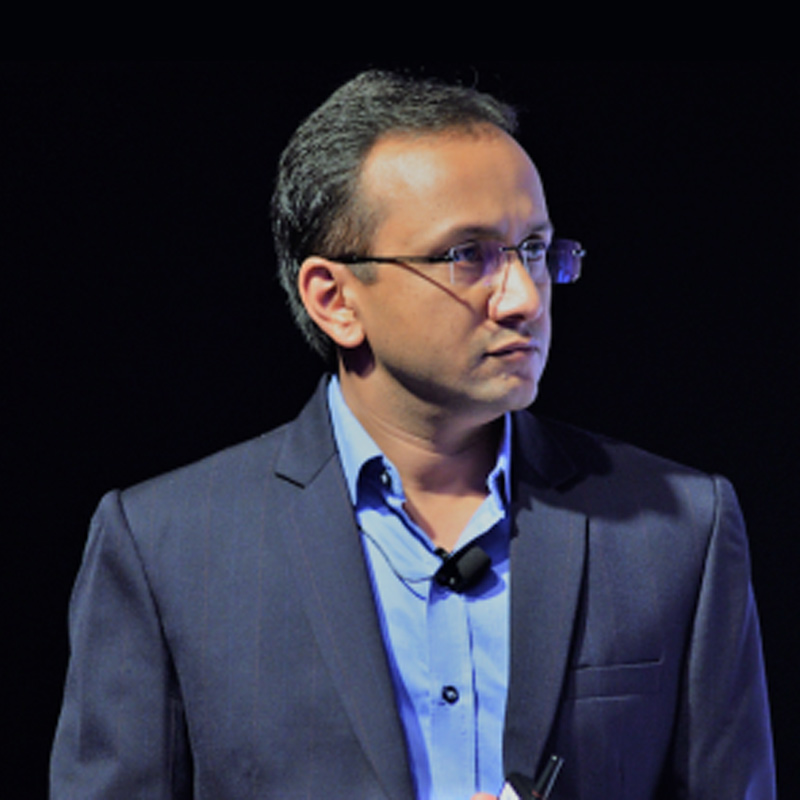
    Alex Timbs is not your regular business executive from Dell Technologies. The Ozzie Brisbane-based gent  takes a keen interest in everything right from sport to tech when he is not in his day job at Dell Technologies as a media industry expert.

    He likes to tinker around with almost every new tech that comes up, apart from having a creative bent of mind. He spent a good decade and a half at an animation studio working on some of the well-known animation and VFX franchises like Matrix and HappyFeet before switching to the vendor side at Dell. 

    Because of his understanding of both sides of the coin, Alex’s clients more often than not call on him to help him find some workflow solutions and not just about storage which he is an expert in. A courtesy he extends every time. And these are relationships which have seen emerge as amongst the top executives in the storage vertical at Dell.

    Indiantelevision.com’s founder, chairman and editor in chief Anil Wanvari got in touch with the affable gentlemen over several zoom calls to distil down whatever he had to say about the the transformative impact of AI on content creation and the evolving landscape of media storage solutions. Excerpts from the various conversations with Alex. This one is only part one of the interview; the second part will follow mid-this week.  

    On what were the workflows for animation and post-prod when he started out.

    I spent nearly 16 years at Animal Logic, and the transformation I witnessed was remarkable. . I vividly remember my early days at Animal Logic, where we were working on Matrix 2 using film scanners. The workflow seems almost archaic now – we’d send work out for overnight printing. Even during Happy Feet, our dailies process involved sending work out to be printed overnight. The next morning, everyone would gather in the theatre to review footage on actual film, Our technology backbone consisted of SGI boxes, with one particular suite costing around 1.5 million Australian dollars. Individual machines were running between 30,000 to 50,000 dollars each.
    Then came this revolutionary shift towards personal computers. It was transformative – suddenly we had access to incredibly powerful technology for just 5,000 to 10,000 dollars. This technological deflation has continued throughout my career and is accelerating with AI and generative technologies. Each year, we see the capability-to-cost ratio improving exponentially. What’s fascinating is how this democratisation of technology has fundamentally changed the way we approach content creation.

    This technological deflation has continued throughout my career and is accelerating with AI and generative AI. It’s been fascinating to watch this snowball effect, enabling us to do exponentially more with less.

    On his transition from a major animation studio to Dell Technologies

    I’ll be completely honest – I was incredibly skeptical about joining what I perceived as a sales company. I didn’t think I’d last more than 12 months, assuming I’d be bored out of my mind. But here I am, over five years later, and it’s been an extraordinary journey. Dell has a massive media and entertainment focus that many people don’t realize. We have a team of subject matter experts from various backgrounds – broadcasters, film studios, game studios – with over 100 years of combined industry experience.
    I actually had a relationship with Dell’s technology before joining them. Back in 2006-2007, I purchased an Isilon system (now PowerScale) to replace 14 individual storage silos. We went from needing two people working shifts to manage data movement to requiring just a quarter of one person’s time. That experience showed me the real impact technology could have on production workflows.

    On the major challenges media companies are facing today
    The biggest challenge we’re seeing is data management – and it’s not what people might expect. When we go to major trade shows, everyone assumes AI will dominate the conversation. But in reality, most customers want to discuss data orchestration. They’re grappling with questions like: How do I support globally distributed workflows? How do I enable freelance artists working from home? How do I manage this tsunami of data being created by automation and new tools?
    Many media companies are dealing with hundreds of millions, if not billions of files. They need help regaining control of their data. This includes automated solutions for deprecating or deleting data efficiently. It’s becoming a critical issue, especially as generative AI tools create even more data at an exponential rate.
    All of this is happening against a backdrop of global economic uncertainty. Companies are making more utilitarian decisions, seeking certainty in their investments. They want to know exactly what return they’ll get, whether that’s efficiency gains or cost control. Agility is also crucial – the ability to shift where data lives and how it’s accessed has become fundamental to modern workflows.

    Alex TimbsOn how  companies are  implementing AI in their production pipelines
    We’re seeing AI adoption across every scale of production. Whether it’s an individual working from home or a team of 1,000 artists, most customers are starting their AI journey. They’re gravitating towards validated solutions and partners who understand the unique infrastructure needs of this technology.
    The fascinating thing about generative AI in media production is its diverse application. While it doesn’t handle true 3D environments well yet – it’s more ‘2.5D’ with depth mapping – we’re seeing it used for face replacement, frame blending, character development, and environmental creation. But the implementation varies significantly, what we call the ‘T-shirt size’ approach.
    “A small ‘T-shirt size’ might be an individual or small workgroup doing exploratory work using local SSD storage. As projects evolve and more people start collaborating, you need shared flash storage – even for small teams of 30-40 people working with just 30 terabytes of data. The largest enterprises might invest in Nvidia superpods or specialized AI servers with large VRAM-capable GPUs for distributed AI use cases.”

    On his perspective on cloud storage in media production
    We’re seeing a significant shift in cloud strategy. The future is definitely hybrid, but cloud-first isn’t the right approach for many customers. In fact, we’re seeing considerable repatriation from the cloud. The reality is that sustained workloads in the cloud can be very expensive.
    That said, certain workflows make perfect sense in the cloud. Broadcasters who need to scale dynamically for specific events and then scale down – it would be foolish to buy infrastructure that sits idle most of the time. But there’s been a recent rationalization of strategy. Customers are becoming more sophisticated in their understanding of when cloud makes sense and when it doesn’t.

    On his perspective on the key trends in media technology that one should keep an eye on. 
    The industry is at a fascinating inflection point. We’re seeing the convergence of real-time workflows, often driven by game engines, with AI tools. This combination is radically speeding up the creation process. At the same time, there’s a growing focus on operational efficiency – automating repetitive tasks, improving asset management, and making more informed decisions about data lifecycle.
    The key is finding the right balance between innovation and practicality. Success isn’t about rushing to adopt every new technology; it’s about understanding your specific needs and implementing solutions that deliver measurable value while protecting your creative assets and IP.
     

  • Amazon veteran Minari Shah moves on

    Amazon veteran Minari Shah moves on

    MUMBAI: Amazon director – international (EU, Apac and Latam), owned content and channels Minari Shah has decided to move on from the multinational firm. She announced her departure today on Linkedin.

    Her post read as follows: “After eight years at Amazon, my longest stint anywhere in my work life, I called it a day here today. It’s been one hell of a ride – lots of learning, lots of adventure, working with some very smart people – both in my team(s) and other partner teams and business colleagues. It’s been a journey full of innovating and doing new things, with always the multiplier of complexity and scale and in the process, I carry so many memories of some most amazing campaigns. I leave Amazon as a sharper, better professional, more measurement and data-driven, with a deeper conviction for how communications can have a business impact and a stronger curiosity for new learning. I also leave with memories of fun and camaraderie, with loads of laughter along the way. I will miss Amazon and hopefully will stay in touch with all the people that I would like to stay in touch with. This has been an important chapter of my life but I am now ready to move on to new things. As many people know, there are key family issues that need my time and there are old dreams to follow regarding writing but I will continue to remain within the communications ambit one way or other!”

    Shah has had a long career in industry having worked with Hindu Business Line and Business India in the nineties. She then decided to shift to communications and had a stint with Sampark Public Relations as vice-president. Following that she worked with Mahindra & Mahindra, L&T Infotech, Dell, HSB,Tata Motors, and then finally Amazon.

  • FCB Ulka appoints Ajay Ravindran as national planning director

    FCB Ulka appoints Ajay Ravindran as national planning director

    Mumbai: – FCB Ulka, part of FCB Group India, has announced the appointment of Ajay Ravindran as national planning director.

    Ajay comes to FCB Ulka with remarkable breadth and depth of experience. He has a 360-degree view of brand strategy, having worked on the entire gamut from advertising to social media, content, media planning, and market research. He specializes in new-age planning, bringing together storytelling, social media culture, and technology.

    In his previous role as head of brand marketing for Razorpay, Ajay oversaw numerous campaigns that seamlessly integrated technology, creativity, and storytelling, demonstrating his ability to deliver successful and innovative strategies. Over his career, Ajay has worked on brands like Unilever, Britannia, Colgate, Vodafone-Idea, Dell, Titan, TVS, 3M and many others. He is a multi-time EFFIE award winner. He has led planning teams in agencies like Ogilvy, VML, MullenLowe Lintas Group & Grey with distinction.

    On the appointment, FCB Ulka CEO Kulvinder Ahluwalia said, “We are thrilled to have Ajay join us as our National Planning Director. His exceptional blend of creativity and strategic insight will play a pivotal role in enhancing our capabilities and driving impactful brand solutions for our clients. We believe his leadership will strengthen our strategic initiatives and inspire our teams to push the boundaries of creativity.”

    “I believe the true power of Brand Marketing lies not just in creating ‘buzz’ or some fuzzy ‘brand love’ but unlocking hidden growth opportunities for businesses. And the new-age we live in provides us with an array of avenues to do this – technology, digital, data, content, CX. FCB Ulka provides the finest playground to practice this craft. An enviable client roster, entrenched relationships, and a burning desire to do the very best for the businesses we work on. Just a few minutes into the conversation with Dheeraj, Nitin, Kulvinder and Hemant, I just had one question: “When can I start?” Ajay expressed on his appointment.

  • Amit Luthra joins Lenovo as MD for Infrastructure Solutions Group India

    Amit Luthra joins Lenovo as MD for Infrastructure Solutions Group India

    Mumbai: Lenovo has appointed Amit Luthra as MD for Infrastructure Solutions Group (ISG) India. In his new role, Luthra will be responsible for leading and building Lenovo ISG’s business in India.

    Based in Bengaluru, he will also play a key role in advocating Lenovo’s end-to-end offerings from the pocket to the data center to the cloud and in driving customer confidence in the data center business across the market.

    Luthra will also be responsible for growing the edge, hybrid cloud, High-Performance Computing (HPC), AI, Hyper-Converged Infrastructure (HCI), and storage solutions portfolio and strengthening ISG’s relationships with the partner ecosystem.

    Prior to joining Lenovo, Luthra was director and GM for Dell’s storage platform solutions. He is an expert in planning and leading strategic enterprise IT businesses and building efficient teams. With over 15 years of experience, he has held various positions at some really prominent companies including Sun Microsystems, and HCL.

    On joining Lenovo, Amit Luthra said, “I am thrilled to be joining Lenovo and taking charge of the ISG business in India. The industry is experiencing an exciting phase as businesses increasingly invest in long term infrastructure solutions to accelerate their digital transformation journeys. As I take the reins in this dynamic region, I hope to build on our successes and help deliver world-class cutting-edge solutions.”

    “Amit joins us at the right time as we expand the ISG portfolio and commence another powerful year to help organisations and businesses transform to transcend,” shared Lenovo ISG Asia Pacific president Sumir Bhatia. “India is a critical market for us; Amit’s expertise and intelligence will help us accelerate intelligent transformation for the data-centered.”

    “Amit’s appointment is an impetus to our data center and infrastructure solutions portfolio, as we continue to invest in India. Together, Lenovo is poised to become the leading everything-as-a-service partner for businesses of all sizes,” added Lenovo Group India managing director Shailendra Katyal.

  • Our future strategy is to be ‘media agnostic’: Wunderman Thompson’s Shams Jasani

    Our future strategy is to be ‘media agnostic’: Wunderman Thompson’s Shams Jasani

    Mumbai : After having spent over 13 years at Isobar, heading the group in South Asia and launching its India division in 2008, Shamsuddin Jasani moved to Wunderman Thompson as CEO South Asia business in November last year. He has also worked with agencies such as Hungama, Mediaturf, and Apnaloan in the past. In his new role as CEO of a creative agency, Jasani is all set to carry forward Wunderman Thompson’s legacy, while integrating it with Digital, Commerce, and Technology.

    In an in-depth conversation with IndianTelevision, the industry veteran talks about the shift from a new-age agency to a traditional agency as he completes three months in office. Jasani also shares his thoughts on steering the agency through a post-pandemic world and on the key innovations adopted by the company in the new year, and the trends that might dominate the advertising and marketing industry in 2022 and beyond…

    Edited excerpts…

    On his priority since taking over as CEO in 2021 and vision for the agency

    My first priority is just making sure that people understand and feel proud of the beautiful legacy that we have, and continue that as we go forward. Number two is how can I add a digital flavour to what’s already there? We’ve been at the forefront of advertising for nine decades. My objective is to get an add-on to that with a lot more digital in there. And number three is really making sure that we are working with clients on some great creative, brave, and innovative work, and making sure that we deliver to them. And of course, powered by technology and creativity. By technology I mean marketing technologies, and from our Commerce perspective.

    On the evolving landscape of the workplace and in the new post-pandemic normal

    I think people have had to work harder towards creativity during the pandemic. For a lot of people, the pandemic has not taken a physical toll but a mental toll. So it’s important to make sure that if any such point comes, one speaks out and seeks help.

    I believe going forward the future of the workplace is going to be a hybrid model of working because we have understood the advantages of working from home and remote working. But at the same time, the advantage of coming back to the office and making sure that we’re creating a great piece of work, the whole idea of an advertising community, people coming together and creating some good content, and solving things working together cannot be discounted. The human element is one of the most attractive parts of our industry, working together is such a big part of our industry. So even though digital has driven that a lot, I do feel the ideal is a mix of the two working environments. It also helps build the office culture & work culture of the organisation. It is slightly more difficult to build culture when we are not meeting people. And that’s where I think the hybrid model will work better.

    On new client wins or brand association or any major campaigns in 2021

    Tata Pravesh is one of the campaigns we did that need to be mentioned, especially because it was very relevant in 2021 due to the pandemic. The second one that we are really proud of is our PepsiCo India campaign, again because of the circumstances then. And then there was Tata steel. There are a lot more coming out in the next few months. Last year Vedanta was a big win for us that happened, Sun Pharma is another big one. There’s also Dell, Shell India, TataSky, L&T Realty, so the list goes on- all clients are important to us and it’s been a great year in 2021. And we continue that as we go into 2022, with a lot more focus on digital.

    On major trends that the advertising and media industry witnessed.

    Clearly the pickup in terms of digital and commerce during the pandemic has changed things like never before. A fundamental shift has happened in the way that people are transacting and communicating, using their devices more than ever before. What has primarily changed over the last two years, was the adoption of technology. Adoption of digital has happened across the board, across consumer demographics that were missing earlier. Also, the lines between what is physical and what is digital consumption is getting blurred. So the strategy for us is that we are going to be ‘media agnostic’. So digital is not going to be an afterthought- we need to think what’s the best strategy for the client and adapt it to the right kind of medium.

    And, commerce has driven a lot of that change. How can we help clients make sure that they are leveraging their communication? So every brand experience that I’m creating for clients’ needs to also have some element on getting them to buy, whether it’s in the physical environment or in the digital environment. That’s the other thing that’s very important for us.

    On digital vs TV ad spend in 2022

    The whole idea of ‘what is digital’ needs rethinking, because a lot of content consumption is happening through the digital pipe. Even TV consumption is happening through apps and not necessarily through Linear TV, and that’s increasing. The whole idea of linear TV and appointment viewership is going to change. When you consume television through a digital pipe, do you call that television or do you call that digital?

    And that is where a different approach needs to come in where you need to be agnostic about it and say, this is how I need to reach my customer. My consumers have already moved. Having said that, yes, digital has come of age. The overall pie of digital is going up and the speed at which digital is growing, will go further up and I think the biggest numbers will come when the IPL rights for digital come out. We are expecting a huge jump in digital rights, in terms of the money that’s going to come in. And that will clearly show how much digital has moved.

    And again, in the last two years, the OTT adoption has been phenomenal, with new-age players like Netflix coming out with India-specific packages, where they are reducing the rates. And then the other big driver is that over the last two years, the amount of original content that’s available on OTTs has spiked, not just English content, Hindi and regional content has really driven a lot of that too.

    But also I think content consumption is at that inflection point where I think TV is still growing in India today. And I still am coming back to the point that it will be very difficult to segregate between what is digital spend and what’s television spend. I think we need to aggregate it and say, this is “video spend” – what I’m going to spend on video. And I think that’s where the change needs to happen.

    On the rise of influencer marketing

    It’s taking the age-old KOLs (Key Opinion Leaders) and putting them online. What has changed is the medium, how can I use the KOLs to really talk about it and how can I use those influencers to take my content strategy, make the center of the strategy, and make sure that I am talking to as many people and influencing as many people as possible. So influencer marketing and content strategy need to be there in all clients and all agencies- big, small and medium- It’s a big part of what we are driving forward. A lot of brands are clearly wanting to do it. And we are working with brands to be able to bring that to life. So, yes, it’s very important.

    On the emergence of new brand categories during the pandemic

    Most of the new brand categories belong to the digital-first category. Whether you’re talking about food tech, or whether you’re talking about e-commerce or the FinTech and crypto brands – all of these are something that belongs to the newer generation of technology. I think in the last two years, and especially coming to what happened in the last IPL- 80 per cent of the advertising was pretty much cryptocurrencies that I could see. So although they are digital-first, from a reach and a brand-building perspective, they are still spending a lot on television, a lot on video and want to work with agencies like us because at the end of the day brands matter the most.

    Another shift that has happened is that Bangalore is coming up as a new place of “advertising destination”. The huge startup revolution that’s happened there is fuelling the growth. Because of the new-age companies sprouting there, a lot of brands are also coming from Bangalore, as opposed to Mumbai & Delhi which were always dominating the advertising space. So it’s not just the shift in categories, but it’s also a shift of where it’s coming from.

    On venturing into NFTs and the metaverse, and what opportunities it holds for brands and marketers

    NFT is growing, no doubt, but I think the real opportunity for brands lies in the Metaverse. That’s about creating an entire existence, a way of life, which is going to exist a lot more on digital.  There are a lot of transactions that are going to be only happening in that space without anything happening in the physical space. How are we going to drive digital commerce, which means how are we going to drive assets that are being only sold on digital and consumed on digital in the Metaverse? Also, how we connect it back to the physical space is going to be important, how does that relate to creating brands in people’s heads.

    It’s an opportunity for brands, and it’s going to be a first-mover basis – whoever goes in there first might be able to create a great experience. So, we are extremely gung-ho about it, we have been thought leaders globally in the metaverse, have got a lot of published articles, and have been doing a lot in that space. In India as well we are working very hard with how to bring it alive. It’s a new space and we are trying to work with brands. It’ll take a little time to take off, but once it does, I think the sky’s the limit.

    On the way forward for the agency and any key announcements in the new year

    A. From a growth perspective, we’ve clearly said in the next three years we are going to double our size (in terms of revenue). Now to fuel that objective, of course, parts of the business are going to play a bigger role. But at the end of the day, at the center of it, we are a creative agency. How do we make sure that when we are working with our clients, whether it’s in the digital space or traditional when you talk about creating great customer experiences, creativity is always going to be at the core of what we offer? So that’s never going to go away.

    Two parts of our business that are going to grow are the MarTech business and the commerce business. Something that’s coming up is an announcement in the healthcare space. Health is going to be a very critical and very important part of our growth ambitions in 2022 and 2023. You will hear about it hopefully in the next two to three weeks, in terms of our foray into that. So I think that’s going to be critical as well. At the end of the day, I think the big drivers are going to be Health, Technology, Commerce along with the Creative business, which is already its core part.

    And finally, to fuel the growth, we would also be looking at acquisitions, by scaling acquisitions in data, MarTech technology, UI UX and consumer experience, and in Commerce- these are the main areas of acquisitions that we’re looking at to fuel our growth ambitions that are going to come from both organic as well as from acquisitions.

  • Dell is India’s most trusted brand: TRA report

    Dell is India’s most trusted brand: TRA report

    NEW DELHI: Dell has achieved top spot as India’s most trusted brand, for the second year in a row, in TRA’s Brand Trust Report (BTR) 2020. In the second place is Mi Mobiles, which also led the mobile phone category for the first time this year. Samsung Mobiles secured the third place, followed by Apple iPhone and LG Televisions taking fourth and fifth ranks, respectively.

    Oppo took the sixth spot on the trust ranks this year. Hindi GEC Sony Entertainment Television came in seventh, featuring among the top ten for the first time in ten years. Maruti Suzuki was in eighth place, and also the leader in the automobile super-category. The ninth most trusted brand rank went to Samsung Televisions, with Vivo mobile phones finishing tenth. Five mobile phone brands made it to the top-ten list from among the twenty listed, making it the largest category in the report.

    TRA’s Brand Trust Report 2020 is the result of comprehensive primary research conducted on its proprietary 10-brand-behaviours which make up the brand trust matrix. This year’s study had 1,711 consumer-influencers across 16 cities as respondents and over 8,000 unique brands were analysed, from which the top 1,000 brands have been listed in this year’s report. The report lists 323 categories and 41 super-categories and F&B and FMCGs.

    The categories with the largest number of brands are F&B (151 brands) and FMCG (144 brands) contributing to 29.5 per cent of the total brands. LG secures a grand slam with leadership in televisions (all-India rank 5), refrigerators (All-India Rank 14), washing machines (all-India rank 26). Some other category leaders in TRA’s Brand Trust Report 2020 are Patanjali Dant Kanti (all-India rank 15) from toothpaste category which has broken the nine-year winning streak of Colgate, and Airtel (all-India rank 20) from mobile service providers.

    Other category leaders include, Tanishq (all-India rank 48) in jewellery, Euro Kids (all-India rank 52) in pre-school, American Express (all-India rank 59) in credit cards, Muthoot Finance (all-India rank 60) in financial services, Jeep (all-India rank 64) in SUV manufacturer, Zee5 (all-India rank 108) leads in OTT, Okaya (all-India rank 140) in inverter batteries, and Livpure (all-India rank 141) in water purifiers.

    TRA CEO N Chandramouli said “The Covid times have been harrowing for brands, and even consumers have been in an extended state of anxiety for multiple reasons. The impact of the pandemic is visible on the trust placed in brands, leading to a dethroning of many erstwhile category leaders.”

  • Star India appoints Nitin Bawankule as head of ad sales

    Star India appoints Nitin Bawankule as head of ad sales

    MUMBAI: Google country director – India Nitin Bawankule will be joining Star India as head of ad sales from October. Bawankule has around 25 years of experience combining digital, IT, telecom and consumer electronic space.

    A source has confirmed the appointment of Bawankule in Star India to Indiantelevision.com. Prior to his role as country director – India, he was the industry director leading the E-commerce (online retail) and online classifieds (local, real estate, jobs and matrimonial), technology, education and government verticals at Google India.

    Earlier, he has been the director in Dell for Asia Pacific Japan region managing software and peripherals portfolio. His earlier roles include regional sales manager at Motorola and sales manager at Whirlpool and Godrej-GE Appliances.

    He has done Post Graduate Diploma in Management from IIM Bangalore and has a Bachelor of Engineering (B.E) in Electronics from VNIT Nagpur.

  • Dell launches new campaign ahead of festive season

    Dell launches new campaign ahead of festive season

    MUMBAI: Dell India has launched its latest campaign, just as the festive season kicks off.
    The campaign extends across television, print and digital with prime associations and a high impact creative approach. Key to the launch, is Dell India’s television commercial that introduces ‘Dell Cinema’ – the 2018 innovation announced at CES earlier this year and which is available across a range of XPS and Inspiron PCs.
    Addressing the young and upcoming digital affluent individuals, the TVC will air across leading 42 English and Hindi entertainment, movie and music and sport channels and in regional media across Tamil Nadu, Karnataka and Andhra Pradesh.
    Dell’s association with the upcoming ‘Thugs of Hindostan’ across YouTube and Facebook as primary digital channels and a presence during the Asia Cup Cricket Tournament, is aimed to engage with consumers throughout the festive period. The estimated reach of the campaign is 71 million.

    Festivals in India exude a common sentiment across all corners of the country – be it the joy of colourful scenes everywhere, striking visuals and the drama of colours or celebratory songs sung in unison.
    The television commercial brings to life Dell’s commitment of redefining experiences that matter most to consumers. Be it films and their grandeur or memorable patriotism felt while watching a favourite sport together, Indians come together to celebrate, experiences. The film inspires consumers to enjoy a truly immersive cinematic experience, while transporting them to a completely new world, of extraordinary colour and sound.
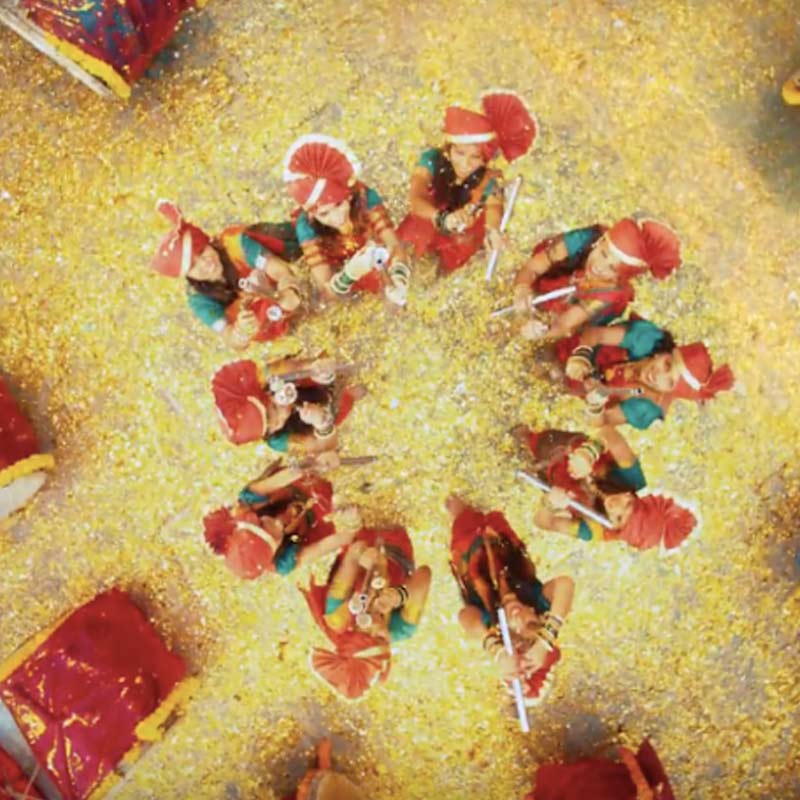
    Conceptualised and executed by Grey group, the film depicts features of Dell Cinema that collectively offer an immersive cinematic experience to the user who can enter a world of life-like colour, resonant sound and uninterrupted streaming. The film begins with the viewer visually entering a vibrant festive dance that comes alive on XPS 13’s screen, followed by losing oneself in watching a graphics intensive film with feature rich audio, the effect of which is evident on a glass of water kept next to the laptop. The film concludes with fans in a cricket stadium cheering for India, with every little detail coming to life without interruption, thanks to the unmatched streaming experience.
    Dell director of marketing India and ANZ for consumer and small business Ritu Gupta says, “Dell Cinema is an incredible innovation by Dell. It is the promise of entertainment being delivered in a way that it was designed to be by content creators – on your PC. We’re taking Dell Cinema closer to our consumers who look for immersive cinematic experiences, anytime and anywhere. The Indian festive season is as immersive as it can get and we are so excited to be a part of it with Dell Cinema.”
    Grey Bangalore senior VP and branch head Vishal Ahluwalia adds, “Dell and Grey as a team have been fortunate to have unique and insightful winning executions across all festivals in the past. While Dell as a brand is immersed in the Indian culture, this year we decided to project the grandeur of India celebrating through myriad of passion best experienced on Dell Cinema. The TVC captures a plethora of passion, which we are unable to experience live due to our busy everyday life.”
    The film went live on Dell’s social media channels on 12 September with the TV campaign going live from September 16 till November 7, 2018.

  • A.I.SHA | My Virtual Girlfriend to be dubbed in Tamil; S2 on cards

    A.I.SHA | My Virtual Girlfriend to be dubbed in Tamil; S2 on cards

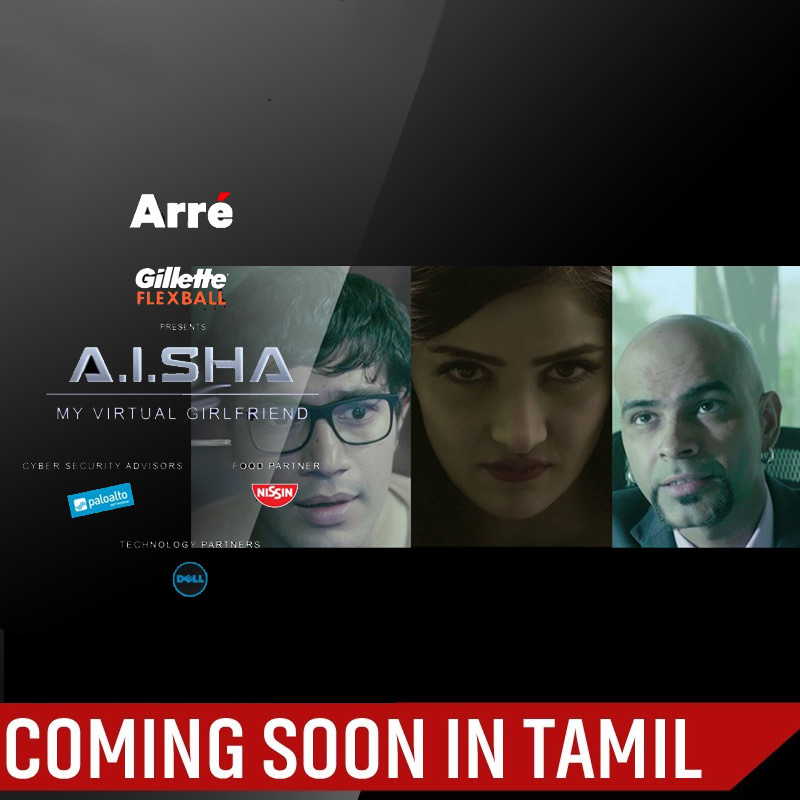
    MUMBAI: Following the successful run of the season 1 of A.I.SHA | My Virtual Girlfriend, Arre plans to release its Tamil version. With this category, it intends to reach out to a wider audience.

    This version is presented by Gillette Flexball in association with Palo Alto Networks, Indo Nissin Foods and Dell.

    In addition, the show is also syndicated to the digital platform of one of France’s television networks, TF1 Xtra, apart from various Indian digital platforms such as Sony LIV, Yupp TV, Vodafone Play, etc.

    “The southern regional markets are growing markets from a mobile internet consumption and advertiser interest point of view. They’re also interesting future forays for Arré considering that digital media in these markets is more secular as compared to broadcasting and cable and there isn’t enough original content available currently. A.I.SHA, our first show, is possibly the best show to begin our regional foray with, given its universal appeal and the overwhelming viewer response so far,” said Arre founder B. Saikumar.

    The series is produced by Raghu Ram and Rajiv Laxman’s production venture, Monozygotic.

    Ram added, “A.I.SHA is a special project for all of us at Monozygotic since it was our first fiction show and also the first show that Arré launched with.”

    A.I.SHA (Artificial Intelligence Simulated Humanoid Assistant) is India’s AI-based digital series. A fiction thriller, the story pivots around the widely debated and chilling premise of what happens when AI (Artificial intelligence) develops feelings and consciousness.

    Pre-production work for A.I.SHA season 2 is underway and is planned for launch later this year.