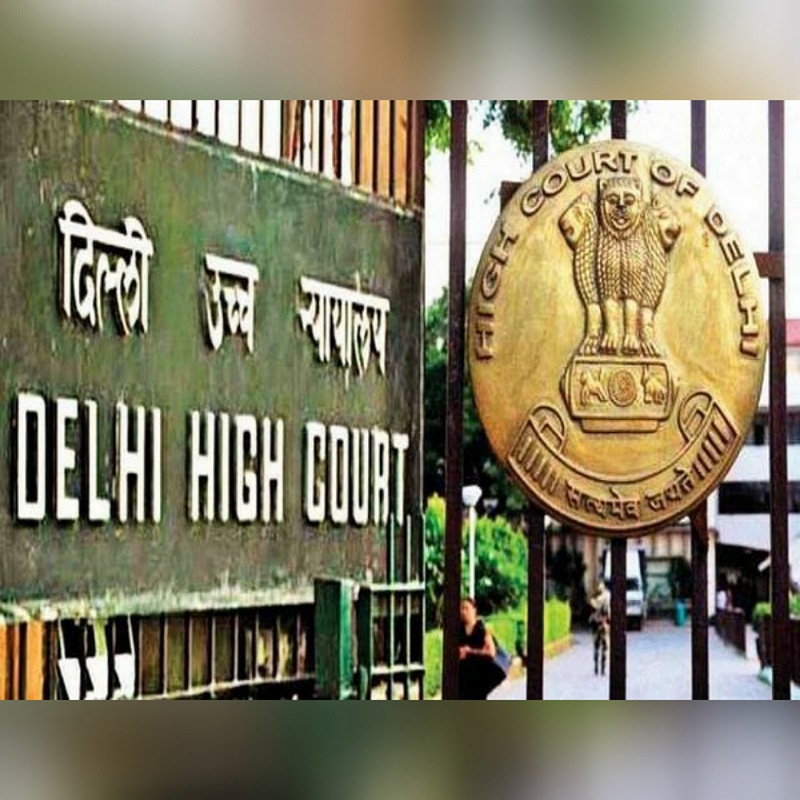
Tag: Delhi HC

  • Delhi HC issues notice to Centre on another plea challenging new IT rules

    Delhi HC issues notice to Centre on another plea challenging new IT rules

    NEW DELHI: The Delhi high court on Friday sought the Centre's response on another plea challenging the new Information Technology rules which seek to regulate digital news media.

    A bench of chief justice D N Patel and justice Jasmeet Singh issued notices to the ministry of electronics and information technology and the ministry of information and broadcasting and granted them time to file their responses, PTI reported.

    In its plea challenging the new IT rules, Quint Digital Media has argued that regulation of publishers of news and current affairs content, as provided under Part III, is in violation of Articles 14, 19(1)(a), 19(1)(g) and 21 of the Constitution of India, as reported by Bar and Bench. It stated that online news portals ought to be treated on par with print newspapers as they both contain written material on current affairs. It further argued that the rules attempt to proscribe content on digital media sites based on “vague and subjective grounds”.

    The case was adjourned for 16 April along with another similar petition filed by the Foundation for Independent Journalism and The Wire, which had submitted that the rules put an additional regulatory burden on digital news media. A plea was also filed in the Kerala high court by legal website LiveLaw. In both cases, the courts had issued notices to the Centre.

    The government had laid down the new rules for social media platforms, digital media and OTT platforms on 25 February. The Information Technology (Intermediaries Guidelines and Digital Media Ethics Code) Rules 2021 enable the setting up of a three-tier oversight mechanism for online content and a grievance redressal mechanism. Under the rules, social media and streaming companies will be required to take down contentious content quicker. It also makes these platforms more pliable in assisting government agencies in the investigation.

    Several media organisations have criticised the rules stating that the regulations could pose a threat to freedom of expression by laying the ground for tightening executive control over digital media. The Editors Guild of India too had demanded the repeal of these rules, highlighting that the laws are “deeply concerning”. 

  • Centre urges Delhi HC to restrain WhatsApp from implementing new privacy policy

    Centre urges Delhi HC to restrain WhatsApp from implementing new privacy policy

    KOLKATA: The Union government has urged the Delhi high court to restrain messaging app WhatsApp from implementing its controversial new privacy policy, stating that the terms are not in alignment with IT rules 2011.

    “WhatsApp may be restrained from implementing its new privacy policy and terms of service dated 4 January 2021 from 8 February 2021 or any subsequent date pending adjudication by this hon'ble' court," an affidavit by the ministry of electronics and information technology (MEITY) said.

    The ministry also said in the court that the policy does not specify what type of sensitive personal data is being collected. WhatsApp has also failed to notify user details of collection of sensitive personal information under new guidelines, MEITY noted. Moreover, the policy does not leave an option to review or amend information, or withdraw consent retrospectively. Further, it does not guarantee further non-disclosure by third parties.

    MEITY filed the affidavit in response to a petition filed by Dr Seema Singh, Meghan and Vikram Singh. The petition stated that the new WhatsApp privacy policy is violative of the fundamental right to privacy under Article 21. It does not even provide the users to have an option to protect their personal data by opting out of their policy, the petition contended.

    Earlier this week, minister of state for IT and communications Sanjay Dhotre informed the Lok Sabha that the government has asked WhatsApp to review the proposed changes.

    The next hearing in the matter has been posted for 20 April.

    Earlier this month, in response to another petition on the issue, the Centre had sought more time to examine WhatsApp's new privacy policy which is slated to come into effect from 15 May. It had informed the court that the government is already working on a data protection bill. It also suggested that the high court should take note of the differential treatment given to users in regards with the new privacy policy as compared to the instant messaging application's policy in the European Union countries.

    WhatsApp's new privacy policy was introduced on 4 January and was initially expected to come into effect on 8 February, but was later deferred to 15 May amid severe backlash from all corners. The app plans to make it mandatory for users to agree to its new data sharing norms, a key point of which is allegedly sharing data from WhatsApp business chats with Facebook. Since there was no opt-out option, there were apprehensions about privacy which led people to migrate to alternate messaging apps, like Signal and Telegram.

  • Delhi HC issues notice to Centre on plea challenging new IT rules

    Delhi HC issues notice to Centre on plea challenging new IT rules

    KOLKATA: The Delhi high court on Tuesday issued notice to the central government in a plea challenging the new rules framed under Information Technology (guidelines for intermediaries and digital media ethics code) Rules 2021.

    A division bench headed by chief justice DN Patel was hearing the petition which has been filed by the Foundation of Independent Journalism (the non-profit company that publishes The Wire). It has sought a response from the ministry of electronics and information technology in the matter and given them time to submit the same.

    The counsel for the petitioners, senior lawyer Nitya Ramakrishnan, stated that the rules have put an additional regulatory burden on news media and current affairs.

    “They cannot place a whole regulatory burden under Section 69A on news and current affairs agencies. 69A only provides for issuing directions to intermediaries,” she argued as quoted in media reports.

    The petition argued that the new IT Rules issued on February 25, 2021, were “palpably illegal” in seeking to control and regulate digital news media when the parent statute nowhere provided for such a remit.

    “The IT Rules, 2021, expand the scope of the Act even further by providing for a Code of Ethics and a three-tier regulatory system to administer a loose-ranging Code of Ethics, that contains wide and vague terms as ‘half-truths’, ‘good taste’, ‘decency’,” the petition said.

    The plea also contended that the oversight mechanism and the inter-departmental committee set up under the new rules would have the power to recommend "draconian measures such as ordering the deletion, modification of content or blocking the same."

    The matter will be heard next on 16 April.

    Several journalists, lawyers and activists have decried the rules as an attempt to muzzle freedom of press by laying the ground for tightening executive control over digital media. The Editors Guild of India last week demanded the repeal of these rules.

    The government laid down new guidelines for social media platforms on 25 February, making a distinction between social media intermediaries and significant social media intermediaries. In a gazette notification, it also specified five million registered users in India as the threshold for significant social media intermediaries.

  • Delhi HC seeks responses from Republic TV, Times Now in Bollywood producers’ lawsuit

    Delhi HC seeks responses from Republic TV, Times Now in Bollywood producers’ lawsuit

    NEW DELHI: The Delhi high court has sought responses from Republic TV and Times Now to a plea filed by major Bollywood production houses against the massive “smear campaign against the industry” run by the news organisations while covering the Sushant Singh Rajput death case. The court has also asked the media outlets to not run any defamatory content on their channels or social media handles. 

    The court was hearing the lawsuit filed by four Bollywood industry associations and 34 leading producers, which also sought to restrain the two outlets from interfering with the right to privacy of people working in the Bollywood industry. 

    The suit also sought orders against unnamed defendants and social media platforms to refrain from making or publishing allegedly irresponsible, derogatory and defamatory remarks against Bollywood.

    Senior advocate Akhil Sibal, appearing on behalf of the plaintiffs, submitted that a certain section of the news media seems to have abandoned journalistic principles. He asserted that yellow journalism is on the rise and judicial intervention is required in the matter.

    "…the idea is not to attack the Fourth Estate. What we called yellow journalism – that fringe has become mainstream. So a signal has to come from the court," Bar and Bench quoted him as saying.

    To this, justice Rajiv Shakdher responded: "Courts hesitate (in restraining media reports) because it is a constitutional right. But you are right, we expect fair reportage…"

    With reference to the orders passed by the News Broadcasting Standards Authority (NBSA) warning against media trials, the court went on to ask: "What is that should be put in place to change the way the reporting is carried out?…There needs to be some toning down. There are orders of NBSA. But it seems that news channels are not following that. As an officer of the court, what is the next step here if you do not follow self-regulation?"

    The case has further been adjourned to 14 December for hearing. 

  • TDSAT dismisses petition against BARC on landing page issue differing from Delhi HC view

    TDSAT dismisses petition against BARC on landing page issue differing from Delhi HC view

    KOLKATA: The Telecom Disputes Settlement and Appellate Tribunal (TDSAT) has dismissed the petition against TV audience measurement body BARC India on the ground of lack of jurisdiction. Bennett Coleman and Sun TV Network approached the tribunal on the legality, validity of a recent decision taken by BARC on the landing page issue.

    The petitioners claimed that BARC India had acted arbitrarily by adopting a formula which according to petitioners reduce the viewership data collected by measurement tools of BARC India. On September 3, the latter announced the introduction of algorithms into its data validation method to mitigate the impact of the landing page on viewership data across all genres of channels.

    While the tribunal gave out the final judgement on 4 November, it stated that it found out after both the parties that the main task was to find out whether BARC is a licensor of any ( specified) public telecommunication/broadcasting services; and (ii) whether it is providing a service that is made available to the public as users.

    Notably, the petitioners also approached Delhi High Court earlier. TDSAT has differed from the Delhi High Court’s opinion that BARC is a licensee or a service provider under the TRAI Act. “It is noted that in para 34 of its order dared 29.09.2020, the Hon’ble High court clarified that the finding that TDRSAT would have jurisdiction to entertain the petition was a prima facie one and in Para 45 it was further made clear that none of the observation shall bind TDSAT which shall hear the petition filed by the petitioners and any interim application filed therein without being influenced by any of the observations made in the order. Hence, the issue of jurisdiction has been raised afresh and parties have been heard in detail,” TDSAT noted.

    TDSAT also stated that since it has been found that BARC is neither a licensee nor a service provider as defined under the TRAI Act, the petitions under consideration are found to be beyond the jurisdiction of its Tribunal. Hence, the petitions have been dismissed on the ground of lack of jurisdiction.

    However, the petitioners would be at liberty to pursue their grievances in accordance with law before any court of competent jurisdiction.

  • PIL moves Delhi HC to prevent news channels from preaching communal disharmony

    PIL moves Delhi HC to prevent news channels from preaching communal disharmony

    NEW DELHI: A PIL has been filed in the Delhi high court in reference to the recent episode aired by Sudarshan TV on its programme Bindas Bol around the subject of the controversial Tanishq ad. The episode was aired on 12 October on the channel and talked about how the jewellery brand’s campaign was promoting ‘love jihad’ and attacking the psychology of the Hindu community.

    The petition, which has been filed by advocate Asghar Khan, sought directions to the central government to formulate guidelines to ensure that news channels do not preach communal disharmony and hate speech. It also sought a mechanism to check content and advertisements which are spreading hatred and are against the spirit of the Union of India.

    The plea said it can be clearly inferred from the Tanishq advertisement that its purpose was to showcase the spirit of unity and brotherhood amongst two religious groups.

    "However, Sudharsahan TV in its 8 pm show ‘Bindas Bol’ dated 12.10.2020 made their best attempts to incite hatred amongst above said religious groups…editor-in-chief of Sudarshan News and anchor of the show Suresh Chavhanke mentioned that love jihad is now being promoted by the way of advertisements and to quote him he said ‘advertisement jihad’.. an insidious attempt has been made to insinuate that the community is involved in a planned conspiracy to infiltrate the advertisement agency,” the petition reads.

    It stated that the central government and other authorities have, from time to time, issued directions and advisories to all private satellite TV channels, asking them to refrain from broadcasting content that may incite violence, threaten national integrity and violate the programme code.

    However, Sudarshan TV has not followed any of these advisories and has come up with broadcasts and printed blogs that target the sentiments of a particular community, the petitioner states. This isn’t the first instance of litigation against the channel. It is currently in the dock for its programme 'UPSC Jihad' over complaints that it violated the program code by communalising the entry of Muslims into the civil services.

    The plea further urged to ensure that the media houses report only true facts and not opinions and be responsible for what they are publishing.

    The plea sought direction to the authorities to form guidelines to include restrictions as envisaged under Article 19 of the Constitution and orders of the Supreme Court to ensure that media does not abuse the freedom of speech and expression.

    It has also prayed for imposition of "gag order" restraining the orators or authors of hate or derogatory speeches made on the lines of religion from addressing the public anywhere within the country till the disposal of the criminal proceeding initiated against them.

  • TRAI vs Tata Sky: Delhi High Court adjourns case to 11 March

    TRAI vs Tata Sky: Delhi High Court adjourns case to 11 March

    MUMBAI: The Delhi High Court on Thursday adjourned Tata Sky’s ongoing legal battle, in which Discovery,  Bharti Telemedia-owned Airtel Digital TV and Sun Direct are a part, with the Telecom Regulatory Authority of India(TRAI) and its new tariff regime to 11 March.

    Recently, the regulator extended the deadline for consumers to select television channels under its new tariff regime till 31 March. The subscribers that don’t opt for new channels would be moved to ‘Best Fit Plans’, which would be developed as per usage pattern, language and channel popularity, the sector regulator said in its statement.

    TRAI chairman RS Sharma addressed a press conference couple of weeks back in Delhi, rubbishing a Crisil report that claimed that cable and DTH bills were bound to increase after the implementation of the tariff order.

    Earlier, Indian Society of Advertisers' (ISA) executive council also advised its members to not use the BARC data for media buying, planning and evaluation perspective during the transition period, which it feels will stretch up to six weeks.

    On 4 February, after senior lawyer Kapil Sibal, representing Tata Sky, concluded his arguments including legal submissions, Discovery India Communication’s counsel Gopal Jain laid the foundation for his arguments.

    The regulator informed the court that the new tariff order has already been implemented from 1 February.

    Earlier TRAI had offered an extension till 31 January to distribution platform operators (DPOs) for implementation.

    On 24 January, the Harit Nagpal-led company finally unveiled the new pricing of channels and packs after it was served a show-cause notice by the TRAI.

    TRAI's show-cause notice said, "Tata Sky has failed to provide options to its 17.7 million subscribers in compliance with the new framework to exercise their choices for TV channels. Tata Sky has put its subscribers in a situation of great difficulty despite no fault of theirs by not complying with the provisions of the new regulations and the tariff order.”

    Despite the delay in announcing channel prices, Tata Sky MD and CEO Nagpal is confident that his team can complete the tricky task of implementing the new norms within a relatively short span of time.

    “Tata Sky has always been compliant to regulatory requirements. We have gone live with our modes of communication across the Tata Sky website, Tata Sky mobile app and also equipped the dealers that subscribers can reach out to. We were confident that we would be able to complete the task in 1 week’s time. Hence we used this time to a seamless and smooth transition for all our subscribers. We have ensured that choosing channels and packs is as easy as 1, 2, 3 for any subscriber,” the veteran executive said.

    On 29 January, the Calcutta High Court stayed the cable switchover till 18 February. The court’s directive was a result of 80 cable operators from the city filing a petition against the TRAI mandate. However, the high court later vacated the stay.

    The petitioners’ lawyer Debabrata Saha Roy argued that the revenue-sharing model under the new regime will significantly reduce the cable operators’ share to just nine per cent. With 80 per cent going into the broadcasters’ kitty, MSOs stand to get just 11 per cent, thus making it an unsustainable business proposition for operators.

    In 2017, Bharti Telemedia, Tata Sky and Discovery Communication India had filed petitions against TRAI, challenging its tariff order and the interconnect regulations.

    Unlike the position adopted by Star India wherein it questioned the regulatory powers of TRAI, the matter in the Delhi HC questions the regulator’s power to wipe out deals that operators enter into to fix commissions and rates for customers.

  • Delhi HC orders Zee Hindustan to stop using Rajat Sharma’s name in ads

    Delhi HC orders Zee Hindustan to stop using Rajat Sharma’s name in ads

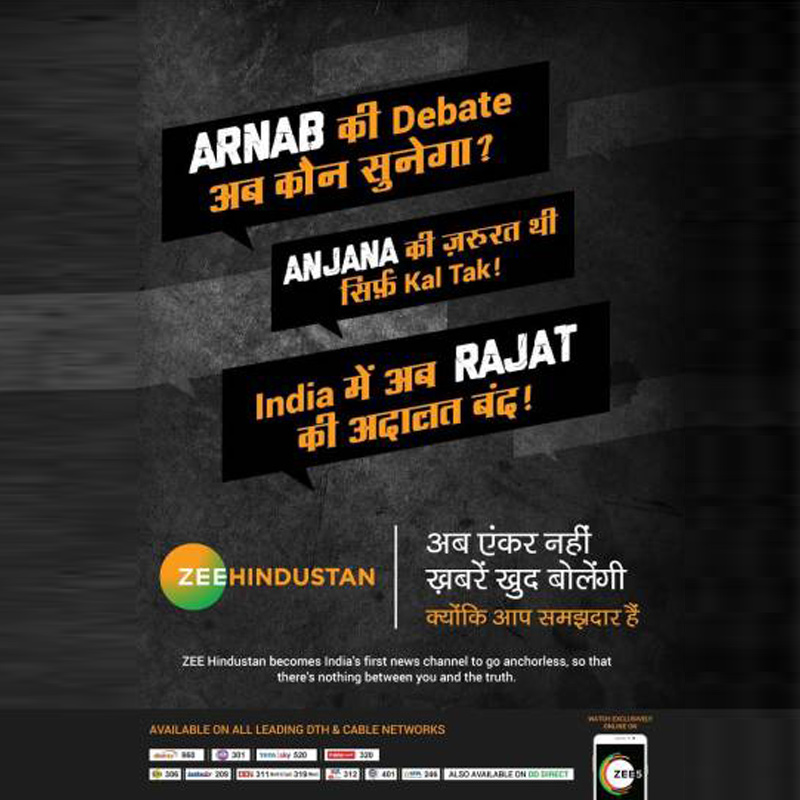
    MUMBAI: Delhi HC has restrained Zee Hindustan from using the name of India TV editor-in-chief Rajat Sharma in any of its advertisements, stating that its latest ad campaign is prima facie illegal. It has directed the channel to remove any hoardings or ads that use Rajat’s name.

    Zee Hindustan, to promote its anchorless news channel, had started an advertisement campaign that made reference to some of the popular news anchors including Sharma and Republic’s Arnab Goswami using slogans like “India mein ab Rajat ki Adalat band!” (Rajat’s Adalat is now shut in India!), and “Ab Anchor nahin khabarein khud bolengi, Kyunki aap samjhdaar hain” (Since you are intelligent, news would speak for itself, without any news anchor).

    Sharma and his channel India TV filed a suit for an injunction against Zee,  claiming that the advertisement is being used to deliberately and maliciously misrepresent and disparage the image of India TV and Rajat Sharma, who has been running the show Aap Ki Adalat on different channels since 1993.

    Justice Jayant Nath of Delhi High Court impugned the advertisement saying, “The Hon’ble Court while granting the injunction in favour of Sharma and India TV, refrained Zee from using Rajat Sharma’s name in their advertisements in the electronic and print media or in any other form. The Hon’ble Court has further directed Zee to take down all hoardings containing the impugned advertisements.”

  • Pepsico gets Delhi HC order to delete fake social media posts on Kurkure

    Pepsico gets Delhi HC order to delete fake social media posts on Kurkure

    MUMBAI: Kurkure, one of the favourite snacks of Indian kids, has gone through malign campaigns on social media questioning its food quality. Viral posts said that the snack can catch fire easily, implying it contains plastic. Now PepsiCo is fighting back legally to convince consumers that it isn’t true. Recently, the firm also spent Rs 20 million to curb the rumours, according to media reports.

    It has secured an interim order from the Delhi High Court (HC) which allows PepsiCo to ask to delete hundreds of such maligning posts on Facebook, Twitter, Instagram and YouTube. According to media reports, 20,000 Facebook posts, 3,412 Facebook links, 242 YouTube videos, 6 Instagram links, and 562 tweets about Kurkure have been ordered to be deleted. The order came following a petition moved by the company in May this year.

    “Fake news suggesting that Kurkure has plastic in it has adversely affected brand’s reputation. Due to such fake and defamatory content circulating on the social media, PepsiCo India was constrained to move the Delhi High Court…this step has been taken to protect brand equity, a matter that we take very seriously at PepsiCo,” the company said as quoted by Quartz.

    All the posts harmed brand reputation widely. PepsiCo India was forced to move the Delhi High Court and it issued an interim order on 1 June. The court will next hear the matter on 1 November.

    PepsiCo India claimed in a blog that the snack burns not because it contains plastic, but because one of its main ingredients happens to be starch. “Also the vegetable oil that is used as another primary ingredient, expedites the burning. This holds true for all regular snack items like papads, poppadoms, papdis, that contain carbohydrates, proteins and fat,” the blog said.