Tag: Dekho Magar Pyar Se

  • ‘Sohrabji’s Tips ‘

    The reason why ratings are consistently dropping for all the top GECs in markets like Delhi, UP and Punjab is because there’s a huge amount of viewership happening on the second TV set, which is not getting captured. The study showed that almost 30 per cent of homes in these markets have a second TV set and it was making an impact.

    “We did an analysis on who views them and what kinds of programmes are watched on the second TV set versus the first TV set. We found that on Sony, a lot of sampling happens on the second TV set on new shows like Indian Idol before the show becomes popular. Even on Star Plus, the shows like Kyunkii… and Kasauti… are largely viewed on the first TV set. On the other hand, the new shows like Dekho Magar Pyar Se were watched on the second TV set because maybe the younger women in the house were more interested in that. Then we also tracked programmes that males and kids watched on the second TV sets,” informs Sohrabji.

  • ‘Research paper on viewership with homes with a second TV set’

    The reason why ratings are consistently dropping for all the top GECs in markets like Delhi, UP and Punjab is because there’s a huge amount of viewership happening on the second TV set, which is not getting captured. The study showed that almost 30 per cent of homes in these markets have a second TV set and it was making an impact.

    “We did an analysis on who views them and what kinds of programmes are watched on the second TV set versus the first TV set. We found that on Sony, a lot of sampling happens on the second TV set on new shows like Indian Idol before the show becomes popular. Even on Star Plus, the shows like Kyunkii… and Kasauti… are largely viewed on the first TV set. On the other hand, the new shows like Dekho Magar Pyar Se were watched on the second TV set because maybe the younger women in the house were more interested in that. Then we also tracked programmes that males and kids watched on the second TV sets,” informs Sohrabji.

  • RCTV has slew of telenovelas on offer for Indian market

    RCTV has slew of telenovelas on offer for Indian market

    MUMBAI: Love, passion, revenge, ambition and intrigue! These are the tantalising themes that the telenovela genre deals with. Now RCTV International, which claims to be Venezuela’s largest media company, is looking to penetrate the Indian market with a slew of new telenovelas.

    Last year Coral Pictures, which is RCTV International’s distribution arm, sold the show My Sweet Fat Valentina to Star. This was adapted as Dekho Magar Pyar Se and was produced by Shrey Guleri. It has also sold Juanas Miracle to Sony. In the new show, medical advances combined with human error create a new life but in the wrong body.

    Now the company has announced that 11 more shows are available for purchase. RCTV Intl GM and VP Jose Escalante says, “RCTV realises that India is a market that has to be approached with a flexible product solution in order to better penetrate it. We have both scripts and audio-visual finished products which are available to premium partners interested in our concepts.

    However, he also explains that though flexibility is an important mind frame in the company’s core business there has to be a more solid penetration of the audio-visual finished product which can be achieved and will be executed by RCTV International.

    “The quality of our story lines and production standards are quite remarkable and one step at a time there can be a potential major enjoyment experienced by a different culture when watching a different one with identical life issues to observe and have emotions for.”

    The catalogue for India and Asia has been designed with Telenovelas having an average of 120 episodes and with a couple of them reaching close to 160 episodes each, of which runs for an hour. RCTV International director international sales Asia Gonzalo Redondo says, “RCTV is not only catering to traditional television audiences that have enjoyed classic Telenovela story concepts.”

    “The catalogue clearly reflects through more diversified telenovela story lines – the evolution of now contemporary life situations being experienced or at least very much familiar in knowledge to many groups of people and as a consequence creating much interest when observed by television viewers.

    “Humour has also found a more secured presence in some of RCTVs newly rolled out formats as there is no doubt of its positive and high general acceptance when entertaining and its positive impact in rating performance.”

    One of the shows in Brujas. this is a suspenseful drama involving a man who wants to be surrounded by women. Therefore he establishes a company that enables women to be trained so that they can be employed as household help. Later on he gets married but dies that same night. Five women are suspects in his death which may not be an accident after all though he has a happy smile planted on his face.

    Another show Love Of My Life deals with the relationship between a sales woman and her boss. Their love is as intense as it is persecuted. The man in question starts to face problems with his former girlfriend. As the saying goes ‘Hell hath no fury as a woman scorned’.

    Micel, meanwhile, brings in the theme of a career oriented business woman. The title character decides to take over the running of her father’s company as she suspects that a conspiracy is being hatched against it. She believes that she will be able to protect what her father built while staying true to her own principles.

    However, she keeps her identity a secret from the other workers as she wants to work her way to the top without being given special favours. The plot gets interesting when she is singled out for attention by three men.

  • Not all Spanish as Hindi entertainment takes a reality check

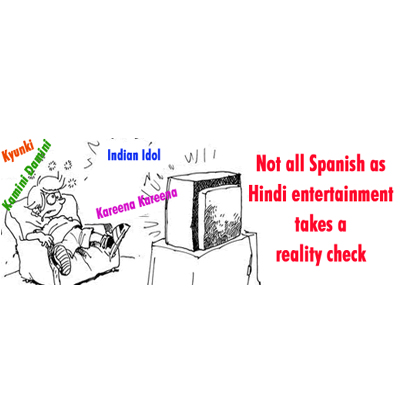
    Not all Spanish as Hindi entertainment takes a reality check

    The year certainly belonged to the sindoor-n-saga joint family opiates (four years and counting); but it also saw the competition hotting up and general entertainment channels going in for a slew of fresh programming initiatives. The tried and trusted three premiere ‘K’ shows on Star Plus, Kyunki, Kasauti and Kahaani continued their uninterrupted run at the top of the ratings charts for the fourth year running. These shows were the engineon the back of which Plus’ other shows merrily rode along.

    For the others in the Hindi entertainment sphere, it was a hard grind to try and make a dent into the dominance that Hindi entertainment television’s lead channel continued to enjoy. Rivals Sony Entertainment and Zee TV, as too the reprogrammed and reinvented Sahara Manoranjan as Sahara One, didn’t take this lying down however. With newer programmes and formats across various time bands, they took the fight to Plus.

    Banking on the fact that viewer ennui for the weepy sagas would at some point kick in; Sony, Zee and Sahara One all tried to fortify their programming for Generation X with a more youth oriented focus. So 2004 was an action packed year, when newer attempts were made to enthrall couch potatoes from all SEC’s and TG’s across metros and towns. The reality genre made a splash with channels going all out to woo starry eyed youth. Auditioning for talent, with behind the scene footage made for good programming; also with the small screen getting more interactive with more SMS’s and phone ins.

    The year was abuzz with activity with soaps, comedies, dramadies (read Kareena Kareena; as the channel calls it) and supernatural thrillers were launched at a rapid pace and competition in various time slots heated up. The Monday to Thursday format reigned supreme, and Spanish tele-novellas adaptations came into their own.

    In spite of the drop in its TRP’s as the year wore on, plain Jane Jassi remained the trendsetter and inspired newer initiatives from leader Star Plus. Star launched their own plain Jane with Hello Dollie, a queen of clumsiness with frumpy hair and social embarrassment. Then there was, the overweight bespectacled protagonist Nikki, from Dekho Magar Pyar Se, who many felt had an uncanny resemblance to the Jassi format – ugly ducking turning into a beautiful swan.

    As all good things come to an end, one also saw the end of serials like Kahiin Kissi Roz, Kittie party, Lipstick. Karishma- The Miracles of Destiny, Saheb Biwi Aur Ghulam amongst others.

    The Hot Bands

    The year saw a major rehaul in the 8 to 9 pm band. To compete with Star’s rock solid Kasauti Zindagi Kay, Sony launched Cinevistaas’ Aayushman (8:30 pm), the story of a 17-year-old prodigy, who becomes a practicing doctor. Almost during the same day, the channel rolled out Miditech produced Hum 2 Hain Na, journey of two identical twin sisters, separated at birth, one a rich lonely girl and the other a middle class girl

    Rising to the Kasauti so-to-speak, arch rival Star Plus brought in a major twist in the script of Ekta’s Kasauti Zindagi Kay, by killing the main protagonist Anurag Basu keeping the loyal viewership rolling. The channel also rolled out a new daily (Monday -Thursday) Shrey Guleri produced Dekho Magar Pyar Se (8 pm) an Indianised version of a Spanish show My Sweet Fat Valentina. Out went four shows — Krishna Arjun, Kyun Hota Hai Pyarr, Khichdi (which was shifted to StarOne in a new avatar) and Son Pari.

    Zee launched Tumhari Disha a daily at 8 pm, a family drama revolving around the story of disha a young firl and the twists and turns of life.

    In the 9 to 10 pm band the old serials continued to rock, except for Zee’s Kareena Kareena (9:30 pm), a socio comedy launched in the latter part of the year; leaving the Ajai Sinha produced serial Astitva-Ek Prem Kahani to work its magic at 9 pm band. As of now Kareena seems like a big ticket for the channel to ride on, though it remains to be seen how the serial shapes up in the coming year.

    Plus meanwhile, further consolidated its position with its old serials Des Mein Nikla Hoga Chand, Kehta Hai Dil, Sanjivni and Saara Akash. On Sony, Kkusum, after its 20 year leap continued to hold steady even as Jassi lost a lot of its sheen as viewers got weary of the endless stretching of the plain Jane tale into the realms of the ridiculous.

    The battle to shift eyeballs in the other bands continued with Sony’s new show Yeh Meri Life Hain, the story of a vivacious Gujju girl, wanting to carve out a niche as a film director took on the 10 pm slot. The story perhaps struck a chord for many aspiring youngster who want to break from the traditional moulds and get on with dreams to make it big. To take on competition, SaharaOne launched Ravi Chopra’s Kamini Damini, with Hema Malini in the lead.

    Giving the male protagonists their due share, Zee launched Teen deewane love se anjane (10:30 pm). A totally different format, the serial is a story of three young men and about their love life and relationships.

    The weekend programming saw the return of Sony’s popular suspense thriller Aahat as Aahat2 to grip the viewers with more spine chilling stories. One also saw the launch of Kaalchakra on Star; a socio-thriller revolving around the supernatural.

    Afternoon Band

    The afternoon band further consolidated with Ekta Kapoor produced Kesar (2 pm) being launched while BAG Films’ afternoon show Kumkum Pyaara Sa Bandhan completed its rocking 500 episodes. Zee, went on to experiment with the afternoon band and launched ‘The Zee Woman’. Apart from the regular repeat soaps the channel also brought in fresh non-ficton programming for the woman of today. So, in between the programmes apart from the agony aunts, viewers also got interesting tips on health, Beauty, career options etc. The channel also launched Reth, the story of a middle class bahu and her fight to win back her honor after being gang raped. A rather strongly scripted show, but remains to be seen how it fares in the coming months.

    Reality Shows

    The Reality genre made a huge comeback in 2004; as channels managed to draw in audiences who don’t regularly feed on general entertainment soaps. SET’s desi version of Fremantle Media’s Pop Idol, Indian Idol was definitely the high point for the year gone by. With its fresh approach, the show managed to rake in ratings with the youth brigade crooning away. Though the later part of the year saw Idol’s ratings dip, the numbers of the last Friday of 2004 saw a huge upswing as the show entered the crucial gala rounds. If that upswing is sustained, 2005 should begin on an interesting note for Hindi entertainment’s Number Two channel.

    Then there were other initiatives by other channels. Close on the heels of Sahara’s Mr & Miss Bollywood, Zee, launched its India’s Best – Cinestars ki Khoj, where the hunt traveled across 20 cities in a short span of less than a month to millions who auditioned. Millions choose their favorite contestants by watching the reality show and voting for them. Star, meanwhile, threw up its own rival to Idols with Channel [V]’s Super Singer.

    The reality band wagon is only expected to gather even more pace as 2005 rolls on.

    Sahara Manoranjan as SaharaOne

    The year saw Sahara General entertainment channel being changed from Sahara Manoranjan to SaharaOne. One saw the end of the Bollywood Star led shows, Karishma -The Miracle of Destiny, Raveena Tandon’s Sahib Biwi Aur Gulam. The channel tried had tried to use these programmes to differentiate themselves in the 9-10 pm band, as other channels were not dominating those slots at that point. Though not strictly 2004 entries, the early months saw these shows create enough buzz if not TRPs and the latter part of the year saw the channel dumping the star shows.

    Some of the shows across different genres which have created enough buzz in the market include Kuch Love Kuch Masti (Clapstem Productions) and a chat show with Shobaa De Power Trip (PPC). The later part of the year one saw the launch of KAmini Damini. Remains to be seen how the show fares.
    StarOne – Redifining Viewership

    The Dil Chahta Hai Generation couldn’t ask for more, with the launch of StarOne. An alternate viewing strategy adopted by Star Plus, the programming clearly defined for the upwardly mobile metro younger audience. So, the viewers still continued their saas-bahus but in a different setting. So, we have Sarabhai vs Sarabhai a sitcom set in a quintessential Malabar Hill dysfunctional family; a show for men Dil Kya Chahta Hai, a light hearted look at the story of four men living in a city, the dreams, aspirations, attitudes and quirks of the four men. DKCH is a series that reflects life in a big city and what it means to be a man, with all its faults, failures and successes. The channel also offers non-fiction lifestyle programme like Body & Soul anchored by Ruby Bhatia, and the immensely popular comedy in a new avatar called Instant Khichdi.

    All in all, 2004 offered the first glimpses that Hindi entertainment was ready to explore new concepts and ideas through a sustained effort. 2005 promises even more by way of choices for the couch potato whose staple diet is Hindi entertainment fare.