Tag: Defence

  • B4U supports 4 social causes4 it’s viewers through December 2018

    B4U supports 4 social causes4 it’s viewers through December 2018

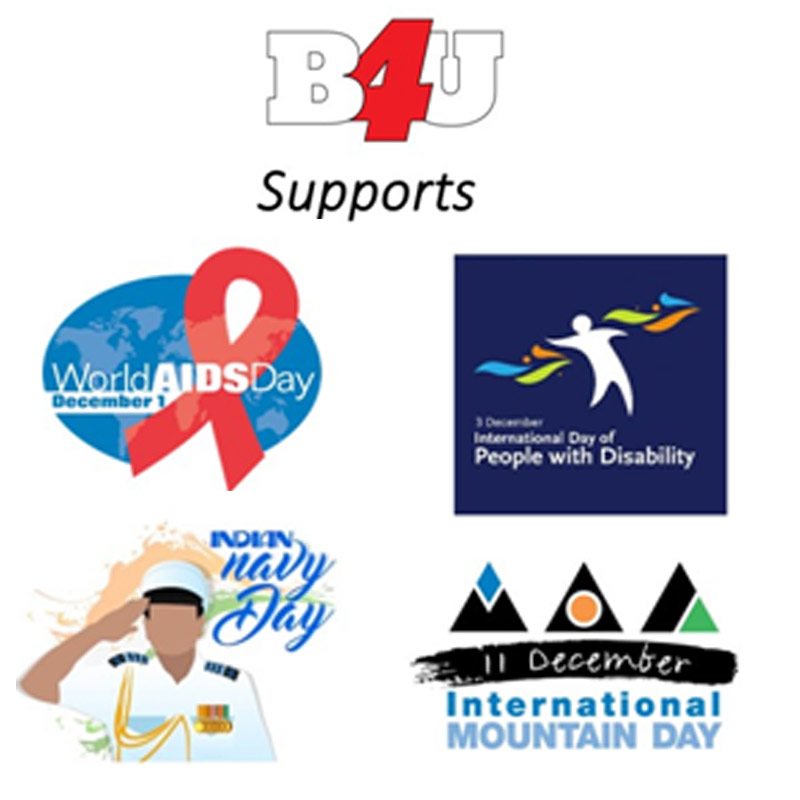
    MUMBAI: B4U Network supports 4 causes around Health, Disability, Defence& Culture in the month of December 2018. B4U Network with its 2 channels B4u Music & B4u Movies has always influenced its strong base of over 168 million viewers in urban & rural hindi speaking markets with entertaining bollywood music and movies content. Banking of its high reach and influence among viewers the networks channels have taken up four causes with the intent of spreading awareness, sensitizing, supporting and bringing change in the society at large through the medium of television starting from 1st December through this entire month.

    Causes around four diverse topics have been taken up in the same month directing viewer’s attention to different issues and causes around the below days:

    1st December, 2018 – World Aids Day

    B4U Music & Movies have launched promos on high frequency raising awareness for the AIDS pandemic caused by the spread of HIV infection, with focus on “SAFE SEX” through a series of quirky promos which are suggestive to use of condoms for the prevention of AIDS. With B4U’s reach, popularity and ardent fan following amongst the youth audience these promotions would drive awareness and reinforce the message of safe sex for all genders across India.

    3rd December, 2018 – International Day of Disabled Persons

    The observance of the Day aims to promote an understanding of disability issues and mobilize support for the dignity, rights and well-being of persons with disabilities.

    To get this message across the promo’s give tribute to disabled musical instrument players with intercuts of his remarkable journey of learning the musical instrument despite his disability. This is followed by the message: “B4U salutes the indomitable human spirit”.

    4th December, 2018 – Navy Day

    Supporting India’s defense forces and saluting them for their dedication in protecting the water bodies, Navy day would be celebrated on 4 December to celebrate the achievements and role of the naval force to the country and to give respect to our naval force.

    B4U would will create interesting promotional trivia about Indian Navy and Navy Day. The slate will have images of Indian navy warships, submarines, navy officers at duty, the Navy and national emblem etc.

    11th December, 2018 – International Mountains Day

    Celebrated to encourage the international community to organize events at all levels to highlight the importance of sustainable mountain development. Using graphic vignettes 45-60 seconds B4U would talk about different Bollywood movies and songs which have used mountains as a picturesque backdrop in their narrative which would help in promoting the importance of sustainable development through this entertaining medium. Interesting anecdotes from the shooting of the films and songs will also be shared in these vignettes

    to build alliances that will bring positive change to mountain peoples and environments around the world.

    The communication campaign & promos are scripted, directed and produced by B4U’s internal creative team. The promos are designed to be smart, quirky and minimalistic so that they break clutter at the same time trigger change in society during the last month of the year.

  • TV channels requested to telecast video “Azadi ke rang” by Defence and Textile Ministries

    TV channels requested to telecast video “Azadi ke rang” by Defence and Textile Ministries

    NEW DELHI: All television channels were today requested by the Information and Broadcasting Ministry to telecast the “Aazadi Ke Rang” video that has been prepared by the Ministries of Defence and Textiles.

    The video is available on the link https://we.tl/FxNz8EcuV4 free of cost.

    The note from the I and B Ministry said the video (in HD quality) in celebration of the Independence Day with a view to infuse the message of patriotism across the nation. The said video sends out a strong message of unity, strength, patriotism with a sense of discipline.

    The Ministry noted that electronic media has always been in the forefront to carry such message as it is a powerful tool to reach out to the millennia of people.

    It said: “Keeping in view the spirit of nationalism and patriotism, all TV channels are requested to carry the said video as part of celebration of the festival of Independence so as to spread the message to the farthest corner of the nation.”

  • TV channels requested to telecast video “Azadi ke rang” by Defence and Textile Ministries

    TV channels requested to telecast video “Azadi ke rang” by Defence and Textile Ministries

    NEW DELHI: All television channels were today requested by the Information and Broadcasting Ministry to telecast the “Aazadi Ke Rang” video that has been prepared by the Ministries of Defence and Textiles.

    The video is available on the link https://we.tl/FxNz8EcuV4 free of cost.

    The note from the I and B Ministry said the video (in HD quality) in celebration of the Independence Day with a view to infuse the message of patriotism across the nation. The said video sends out a strong message of unity, strength, patriotism with a sense of discipline.

    The Ministry noted that electronic media has always been in the forefront to carry such message as it is a powerful tool to reach out to the millennia of people.

    It said: “Keeping in view the spirit of nationalism and patriotism, all TV channels are requested to carry the said video as part of celebration of the festival of Independence so as to spread the message to the farthest corner of the nation.”

  • Radical changes in FDI regime; Most sectors on automatic FDI route

    Radical changes in FDI regime; Most sectors on automatic FDI route

    MUMBAI: The Union Government has radically liberalized the FDI regime today, with the objective of providing major impetus to employment and job creation in India. The decision was taken at a high-level meeting chaired by Prime Minister Narendra Modi today. This is the second major reform after the last radical changes announced in November 2015.  Now most of the sectors would be under automatic approval route, except a small negative list. With these changes, India is now the most open economy in the world for FDI.

    In last two years, Government has brought major FDI policy reforms in a number of sectors viz. Defence, Construction Development, Insurance, Pension Sector, Broadcasting Sector, Tea, Coffee, Rubber, Cardamom, Palm Oil Tree and Olive Oil Tree Plantations, Single Brand Retail Trading, Manufacturing Sector, Limited Liability Partnerships, Civil Aviation, Credit Information Companies, Satellites- establishment/operation and Asset Reconstruction Companies. Measures undertaken by the Government have resulted in increased FDI inflows at US$ 55.46 billion in financial year 2015-16, as against US$ 36.04 billion during the financial year 2013-14. This is the highest ever FDI inflow for a particular financial year. However, it is felt that the country has potential to attract far more foreign investment which can be achieved by further liberalizing and simplifying the FDI regime.  India today has been rated as Number 1 FDI Investment Destination by several International Agencies.

    Accordingly the Government has decided to introduce a number of amendments in the FDI Policy. Changes introduced in the policy include increase in sectoral caps, bringing more activities under automatic route and easing of conditionalities for foreign investment. These amendments seek to further simplify the regulations governing FDI in the country and make India an attractive destination for foreign investors.  Details of these changes are given in the following paragraphs:

    1. Radical Changes for promoting Food Products manufactured/produced in India

    It has now been decided to permit 100% FDI under government approval route for trading, including through e-commerce, in respect of food products manufactured or produced in India.

    2. Foreign Investment in Defence Sector up to 100%

    Present FDI regime permits 49% FDI participation in the equity of a company under automatic route.  FDI above 49% is permitted through Government approval on case to case basis, wherever it is likely to result in access to modern and ‘state-of-art’ technology in the country. In this regard, the following changes have inter-alia been brought in the FDI policy on this sector:

    i. Foreign investment beyond 49% has now been permitted through government approval route, in cases resulting in access to modern technology in the country or for other reasons to be recorded.  The condition of access to ‘state-of-art’ technology in the country has been done away with.

    ii. FDI limit for defence sector has also been made applicable to Manufacturing of Small Arms and Ammunitions covered under Arms Act 1959.

    3. Review of Entry Routes in Broadcasting Carriage Services

    FDI policy on Broadcasting carriage services has also been amended. New sectoral caps and entry routes are as under:


    http://www.indiantelevision.com/sites/drupal7.indiantelevision.co.in/files/styles/large/public/fdi.jpg?itok=yfNxkWYk


    4. Pharmaceutical

    The extant FDI policy on pharmaceutical sector provides for 100% FDI under automatic route in greenfield pharma and FDI up to 100% under government approval in brownfield pharma. With the objective of promoting the development of this sector, it has been decided to permit up to 74% FDI under automatic route in brownfield pharmaceuticals and government approval route beyond 74% will continue.
    5. Civil Aviation Sector

    (i) The extant FDI policy on Airports permits 100% FDI under automatic route in Greenfield Projects and 74% FDI in Brownfield Projects under automatic route. FDI beyond 74% for Brownfield Projects is under government route.

    (ii) With a view to aid in modernization of the existing airports to establish a high standard and help ease the pressure on the existing airports, it has been decided to permit 100% FDI under automatic route in Brownfield Airport projects.

    (iii) As per the present FDI policy, foreign investment up to 49% is allowed under automatic route in Scheduled Air Transport Service/ Domestic Scheduled Passenger Airline and regional Air Transport Service. It has now been decided to raise this limit to 100%, with FDI up to 49% permitted under automatic route and FDI beyond 49% through Government approval. For NRIs, 100% FDI will continue to be allowed under automatic route. However, foreign airlines would continue to be allowed to invest in capital of Indian companies operating scheduled and  non-scheduled air-transport services up to the limit of 49% of their paid up capital and subject to the laid down conditions in the existing policy.

    6. Private Security Agencies

    The extant policy permits 49% FDI under government approval route in Private Security Agencies. FDI up to 49% is now permitted under automatic route in this sector and FDI beyond 49% and up to 74% would be permitted with government approval route.

    7. Establishment of branch office, liaison office or project office

    For establishment of branch office, liaison office or project office or any other place of business in India if the principal business of the applicant is Defence, Telecom, Private Security or Information and Broadcasting, it has been decided that approval of Reserve Bank of India or separate security clearance would not be required in cases where FIPB approval or license/permission by the concerned Ministry/Regulator has already been granted.

    8. Animal Husbandry

    As per FDI Policy 2016, FDI in Animal Husbandry (including breeding of dogs), Pisciculture, Aquaculture and Apiculture is allowed 100% under Automatic Route under controlled conditions. It has been decided to do away with this requirement of ‘controlled conditions’ for FDI in these activities.

    9. Single Brand Retail Trading

    It has now been decided to relax local sourcing norms up to three years and a relaxed sourcing regime for another five years for entities undertaking Single Brand Retail Trading of products having ‘state-of-art’ and ‘cutting edge’ technology.

    Today’s amendments to the FDI Policy are meant to liberalise and simplify the FDI policy so as to provide ease of doing business in the country leading to larger FDI inflows contributing to growth of investment, incomes and employment.
  • Radical changes in FDI regime; Most sectors on automatic FDI route

    Radical changes in FDI regime; Most sectors on automatic FDI route

    MUMBAI: The Union Government has radically liberalized the FDI regime today, with the objective of providing major impetus to employment and job creation in India. The decision was taken at a high-level meeting chaired by Prime Minister Narendra Modi today. This is the second major reform after the last radical changes announced in November 2015.  Now most of the sectors would be under automatic approval route, except a small negative list. With these changes, India is now the most open economy in the world for FDI.

    In last two years, Government has brought major FDI policy reforms in a number of sectors viz. Defence, Construction Development, Insurance, Pension Sector, Broadcasting Sector, Tea, Coffee, Rubber, Cardamom, Palm Oil Tree and Olive Oil Tree Plantations, Single Brand Retail Trading, Manufacturing Sector, Limited Liability Partnerships, Civil Aviation, Credit Information Companies, Satellites- establishment/operation and Asset Reconstruction Companies. Measures undertaken by the Government have resulted in increased FDI inflows at US$ 55.46 billion in financial year 2015-16, as against US$ 36.04 billion during the financial year 2013-14. This is the highest ever FDI inflow for a particular financial year. However, it is felt that the country has potential to attract far more foreign investment which can be achieved by further liberalizing and simplifying the FDI regime.  India today has been rated as Number 1 FDI Investment Destination by several International Agencies.

    Accordingly the Government has decided to introduce a number of amendments in the FDI Policy. Changes introduced in the policy include increase in sectoral caps, bringing more activities under automatic route and easing of conditionalities for foreign investment. These amendments seek to further simplify the regulations governing FDI in the country and make India an attractive destination for foreign investors.  Details of these changes are given in the following paragraphs:

    1. Radical Changes for promoting Food Products manufactured/produced in India

    It has now been decided to permit 100% FDI under government approval route for trading, including through e-commerce, in respect of food products manufactured or produced in India.

    2. Foreign Investment in Defence Sector up to 100%

    Present FDI regime permits 49% FDI participation in the equity of a company under automatic route.  FDI above 49% is permitted through Government approval on case to case basis, wherever it is likely to result in access to modern and ‘state-of-art’ technology in the country. In this regard, the following changes have inter-alia been brought in the FDI policy on this sector:

    i. Foreign investment beyond 49% has now been permitted through government approval route, in cases resulting in access to modern technology in the country or for other reasons to be recorded.  The condition of access to ‘state-of-art’ technology in the country has been done away with.

    ii. FDI limit for defence sector has also been made applicable to Manufacturing of Small Arms and Ammunitions covered under Arms Act 1959.

    3. Review of Entry Routes in Broadcasting Carriage Services

    FDI policy on Broadcasting carriage services has also been amended. New sectoral caps and entry routes are as under:


    http://www.indiantelevision.com/sites/drupal7.indiantelevision.co.in/files/styles/large/public/fdi.jpg?itok=yfNxkWYk


    4. Pharmaceutical

    The extant FDI policy on pharmaceutical sector provides for 100% FDI under automatic route in greenfield pharma and FDI up to 100% under government approval in brownfield pharma. With the objective of promoting the development of this sector, it has been decided to permit up to 74% FDI under automatic route in brownfield pharmaceuticals and government approval route beyond 74% will continue.
    5. Civil Aviation Sector

    (i) The extant FDI policy on Airports permits 100% FDI under automatic route in Greenfield Projects and 74% FDI in Brownfield Projects under automatic route. FDI beyond 74% for Brownfield Projects is under government route.

    (ii) With a view to aid in modernization of the existing airports to establish a high standard and help ease the pressure on the existing airports, it has been decided to permit 100% FDI under automatic route in Brownfield Airport projects.

    (iii) As per the present FDI policy, foreign investment up to 49% is allowed under automatic route in Scheduled Air Transport Service/ Domestic Scheduled Passenger Airline and regional Air Transport Service. It has now been decided to raise this limit to 100%, with FDI up to 49% permitted under automatic route and FDI beyond 49% through Government approval. For NRIs, 100% FDI will continue to be allowed under automatic route. However, foreign airlines would continue to be allowed to invest in capital of Indian companies operating scheduled and  non-scheduled air-transport services up to the limit of 49% of their paid up capital and subject to the laid down conditions in the existing policy.

    6. Private Security Agencies

    The extant policy permits 49% FDI under government approval route in Private Security Agencies. FDI up to 49% is now permitted under automatic route in this sector and FDI beyond 49% and up to 74% would be permitted with government approval route.

    7. Establishment of branch office, liaison office or project office

    For establishment of branch office, liaison office or project office or any other place of business in India if the principal business of the applicant is Defence, Telecom, Private Security or Information and Broadcasting, it has been decided that approval of Reserve Bank of India or separate security clearance would not be required in cases where FIPB approval or license/permission by the concerned Ministry/Regulator has already been granted.

    8. Animal Husbandry

    As per FDI Policy 2016, FDI in Animal Husbandry (including breeding of dogs), Pisciculture, Aquaculture and Apiculture is allowed 100% under Automatic Route under controlled conditions. It has been decided to do away with this requirement of ‘controlled conditions’ for FDI in these activities.

    9. Single Brand Retail Trading

    It has now been decided to relax local sourcing norms up to three years and a relaxed sourcing regime for another five years for entities undertaking Single Brand Retail Trading of products having ‘state-of-art’ and ‘cutting edge’ technology.

    Today’s amendments to the FDI Policy are meant to liberalise and simplify the FDI policy so as to provide ease of doing business in the country leading to larger FDI inflows contributing to growth of investment, incomes and employment.
  • I&B Ministry took action on 91 complaints against TV channels since 2012

    I&B Ministry took action on 91 complaints against TV channels since 2012

    NEW DELHI: The Information and Broadcasting Ministry took action on 91 complaints between 2012 and August 2015 against various private television channels, the Parliament was told today.


    This included warnings, advisories, apology scrolls, and prohibiting transmissions of channels for a fixed period, Minister of State for Information and Broadcasting Rajyavardhan Rathore said.


    A budget of Rs 22.41 crore has been set aside in the budget estimates for the Electronic Media Monitoring Centre (EMMC), which is mandated to look at all private satellite television channels uplinked from and downlinked into India.


    The fund allocation for the same in 2014-15 was Rs 27.46 crore, while in 2013-14 was Rs 20.54 crore.


    The Inter Ministerial Committee (IMC) set up to look into the violations suo-motu or whenever violation of the Programme and Advertising Codes took action on 91 complaints against various TV channels since 2012.


    The IMC has representatives from the Ministry of Home Affairs, Defence, External Affairs, Law, Women and Child Development, Health and Family Welfare, Consumer Affairs and a representative from the industry in Advertising Standards Council of India (ASCI). IMC meets periodically and recommends action in respect of violations. 

  • TRAI says get spectrum from Defence, denies Govt. has no authority to ask BSNL to return unused spectrum

    TRAI says get spectrum from Defence, denies Govt. has no authority to ask BSNL to return unused spectrum

    NEW DELHI: Expressing concern that the constrained supply of spectrum poses a real threat to the continuity of services being provided to millions of subscribers by the expiry licensees, the Telecom Regulatory Authority of India (TRAI) has reiterated its earlier recommendation for a dialogue at the level of the Ministers for Finance, Communications, Defence to ensure the availability of additional spectrum for commercial use.
     
    In a letter to the Telecom Secretary, the Authority has said the non-availability of sufficient spectrum is the biggest impediment to the realisation of the stated goals in NTP- 2012 for broadband proliferation. The Authority re-emphasised the need to increase the supply of spectrum.
     
    The letter was in response to the DoT’s reference of 14 November seeking some clarifications on recommendations on Valuation and Reserve Price of Spectrum Licenses expiring in 2015-16 sent on 15 October.  
     
    There is no change in the reserve prices for spectrum in the 900 MHz and 1800 MHz bands from what were recommended earlier.
     
    The   Authority reiterated that steps should be  taken to  make available additional spectrum in  the  900, 1800 and 2100 MHz bands by  taking back 1.2  MHz of 900 MHz spectrum from BSNL,  utilising idle  1800 MHz spectrum in  the  Defence band and vacating spectrum held in excess of 20 MHz by Defence in the 1800 MHz ban.
     
    The Authority’s recommendation for the implementation of E-GSM band is one of the ways to enhance the supply of 900 MHz band spectrum which is considered by operators (the market) to be the most valuable spectrum. The option needs to be given serious consideration by the government.
     
    In the 2100 MHz band, an additional 3 blocks of 2×5 MHz of spectrum can be made available by swapping spectrum in this band with Defence which can be assigned spectrum in the 1900 MHz   band (1910-1920/1980-1990 MHz).
     
    The spectrum in the 800 MHz, 900 MHz, 1800 MHz and 2100 MHz bands should be auctioned together (simultaneously). Uncertainty would continue if auction of spectrum in the 2100 MHz is taken up later.
     
    The government should announce its decision on the adoption of APT700 band plan. It should also announce the roadmap for the auction of spectrum in 700 MHz band. This should be done before the conduct of the upcoming auctions in 900/1800 MHz band. These two decisions will help in the faster development of the device eco-system. It will also help TSPs to take an informed decision when bidding for the upcoming auction in 800/900/1800 MHz bands.
     
    The Authority had recommended that 1.2 MHz spectrum in 900 MHz band should be taken back from BSNL from all the LSAs where licences expire in 2015-16 except in Punjab. In lieu, BSNL should be assigned 1.2 MHz in the 1800 MHz band only in those LSAs where its spectrum holding in that band is less than 3.8 MHz in this band i.e. in Gujarat, Rajasthan and West Bengal. However, the DoT said it had no jurisdiction to take back spectrum from BSNL to which TRAI has said the PSUs (MTNL/BSNL) were awarded the spectrum in the 900 MHz band administratively and free of charge. Both the PSUs are government-owned companies and the government has every right to take the spectrum back from them if they are not using it optimally and efficiently. “It is inexplicable to take the stand that the government, being a sovereign and as owner of the PSU companies cannot resume spectrum given to the PSUs free of charge.” Besides, the DoT, being the licensor, has to ensure that spectrum is put to optimal use and an operator does not squat on invaluable spectrum.
     
    In this context, TRAI said it was worth recalling that being government companies, the government assigned 3G and BWA spectrum to them without their participation in the auctions. This spectrum was literally foisted on the PSUs. Later, when they just could not use the BWA spectrum, the government allowed them to surrender BWA spectrum and decided to refund the payment made by these PSUs.


  • TRAI  seeks clarifications with regard to spectrum allotted to Defence

    TRAI seeks clarifications with regard to spectrum allotted to Defence

    NEW DELHI: The Telecom Regulatory Authority of India (TRAI) has asked the Department of Telecom (DoT) to clarify whether discussions with Defence to release one block of 5 MHz is for the same block which has been already auctioned in five out of 22 LSAs or the discussion would result in release of one more block of spectrum, thus, making two blocks of spectrum available
    for auction.
     
    The letter from TRAI Secretary Sudhir Gupta follows a letter received from the WPC Wing asking TRAI to provide recommendations on: (a) Applicable reserve price for 2100 MHz, 2300 MHz and 2500 MHz bands for all the service areas in both the cases, that is, spectrum available in entire service area and spectrum partially available in any service area; (b) Auction of the right to use of spectrum in a band with varying validity periods (less than 20 years) so that expiry of validity period of right to use of spectrum in a band in a service area occurs at same time.
     
    TRAI has asked the DoT to provide information/ clarifications relating to the 2100 MHz band.
     
    The WPC has informed that at present no vacant spectrum is available with the DoT in 2100 MHz band and discussions with Defence are underway for release of one block of 5 MHz of spectrum. In its recommendations on ‘Valuation of Reserve Price of Spectrum: Licenses Expiring in 2015-16’ dated 15 October, TRAI had mentioned that the DoT has assigned the fifth block of 5 MHz in the 2100 MHz band in 5 LSAs and in the remaining 17 LSAs, the spectrum is available with the DoT.
     
    The Authority in its recommendations also recommended that entire 2X60 MHz in the 2100 MHz band should be made available for commercial use. If required, Defence may be assigned spectrum in the 1900 MHz band (1910-1920/1980-1990 MHz). It was further recommended
    that this matter is of utmost importance, therefore it must be taken up at the highest level and the vacant 3G slots should be put to auction along with the spectrum in 900 and 1800 MHz bands.
     
    In the letter, Gupta says TRAI will not be in a position to go ahead with the consultation process in the absence of full information with regard to total availability of the spectrum in the 2100 MHz band. Therefore, DoT is requested to indicate the decision regarding the above at the earliest.
     
    With regard to 2300 MHz band, the auction was conducted in June 2010 and two blocks across the 22 service areas were sold. However, even after four and half years of assignment of spectrum, no Telecom Service Provider has actually done any worthwhile rollout.
     
    Therefore, the Authority would like to know if in spite of such poor utilisation of earlier auctioned spectrum even after more than four years, the DoT believes that there will be takers for this spectrum at this point of time.
     
    TRAI had in a letter on 8 March 2013 informed DoT that in ten service areas, the guard band available between the spectrum assigned to different BWA spectrum holders is just 2.5 MHz, and this may result in severe interference in asynchronous TOO networks. TSPs have also suggested that the solution to the problem of interference in such a scenario can either be achieved by use of similar frame configuration (for uplinking and downlinking) or rearranging the assigned frequencies, so as to have a wider guard band.
     
    According to the present proposal of DoT, in 6 more LSAs, the guard band between different
    TSPs will reduce to 2.5 MHz.
     
    TRAI has also said that DoT may like to inform whether any study in this regard has been conducted to examine the concerns expressed by TSPs; and if so, DoT’s decision on this issue.
     
    Referring to the 2500 MHz band, TRAI says this band is very important and unique in the sense that it provides a substantial amount of spectrum (190 MHz) that has been allocated on a primary basis in all three International Telecommunications Union regions for terrestrial mobile communication. As per ITU-R recommendations there are three recommended frequency arrangements in this band. Most countries have followed an approach aligned with ITU Option I band plan (C1). The frequency spots in 2500 MHz band as shown in the annexure to the DoT letter are at variance with the Option I band plan of ITU which may result in the non-optimal use of the spectrum for all time to come. The decision on harmonisation of this band is pending for an inordinately long time.
     
    TRAI says there is urgent need to decide the issue so that this band can be used optimally for commercial as well as strategic purposes.
     
    According to current trends, the 700 MHz/800 MHz spectrum band known as the digital dividend frequencies and these bands are the ideal complement to 1800 MHz and 2600 MHz spectrum band using carrier aggregation techniques for LTE and LTE advanced technologies. The Authority in its recommendations of 15 October 2014 has recommended that the Government should announce the roadmap for auction of 700 MHz band before conduct of the upcoming auctions. The DoT may decide whether it wants to go ahead with the auction of spectrum in 2500 MHz band before conducting the auction in 700 MHz band.
     
    The letter says that DoT may also please confirm that it would like to go for auction without harmonising the band, in spite of the aforementioned implications.
     
    Referring to the validity period of right to use spectrum, TRAI has requested DoT to inform the ‘effective date’ of spectrum assignment for both administratively-assigned spectrum and auction-assigned spectrum for all TSPs in each of the service areas. It has also been noted that rollout obligation of TSPs is linked with the spectrum assignment that has been allocated for 20 years. Changes in the validity period will disturb the rollout obligations linked with the various spectrum auctions since 2010. DoT may indicate how rollout obligations are going to be ensured, going forward.