Tag: DD

  • Sri Adhikari Brothers’ ‘Galti Kiski,’ based on Kiran Bedi’s book, to air on DD

    Sri Adhikari Brothers’ ‘Galti Kiski,’ based on Kiran Bedi’s book, to air on DD

    MUMBAI: India’s leading media and entertainment conglomerate Sri Adhikari Brothers is bringing yet another classic hit show, ‘Galti Kiski,’  based on the book ‘What Went Wrong and Why?, written by super cop and lieutenant governor of Puducherry Kiran Bedi. The show will air on Doordarshan National from 19 May every day at 1 pm.

    ‘Galti Kiski’ is a real-life narrative based on the book ‘What Went Wrong And Why?, written by the super cop Kiran Bedi. It is a unique compendium of real-life first-hand experiences – candid, poignant, touching and thought-provoking – that will compel peopleto sit up and take notice. A true revelation of social and economic maladies that adversely affect the present-day society and the way one can handle such scenarios and a destination for those who sought help in similar matters. It places these realities for greater appreciation by all those who can play a role in preventing such happenings, and defines the duties to do and the responsibilities to accept

    SABGROUP patriarch Markand Adhikari said: “In lieu of our commitment to leverage our content library to Doordarshan, we are glad that ‘Galti Kiski’ which featured the super cop Kiran Bedi is going to air on Doordarshan National, We are willing to do whatever it takes to help our nation stay engaged and keep the momentum going during the lockdown."

    Kiran Bedi said: ‘’During my journey as an IPS officer and there on, I always observed the rift between people at different stages of life and most of them were due to simple lack of compassion.This book is all about making an attempt at being fair and human. My mission behind Galti Kiski was simply to save the next victim, it wasn’t to gain publicity or popularity but to forewarn people. I am so honoured to have created a televised version of this with Sri Adhikari Brothers and the fact that it is going to be aired again on Doordarshan National during these grim times. It gives people a chance to introspect and rethink life after lockdown and make this society a better place to live in as one.’’

    ‘What Went Wrong and Why?’ was adapted in a Hindi version for the book with the same title as the show Galti Kiski. 

    Follow Tellychakkar for the consumer facing news & entertainment

  • MIB asks MSOs to submit affidavit for DD channels carriage

    MIB asks MSOs to submit affidavit for DD channels carriage

    MUMBAI: The ministry of information & broadcasting (MIB) has asked MSOs to submit an affidavit that they will carry the additional channel launched by the pubcaster Doordarshan on their cable TV networks. While MIB notified another TV channel in the list of mandatory channels last year, MSOs need to extend their list including the channel filed through affidavit at the time of registration.

    “M/o information and Broadcasting vide Gazette Notification S.O. 4136 (E) dated 15.11.2019 had notified another TV channel in the list of mandatory TV channels to be carried on his network by MSO/cable operator making it a total of 27 channels (25 DD Channels, Lok Sabha channel and Rajya Sabha Channel). Accordingly, the list of mandatory TV channels to be carried by MSO duly undertaken vide their affidavit deemed to be extended to the extent including the additional TV channel notified on 15/11/2019 in their list filed through affidavit at the time of MSO registration,” MIB said in a notice.

    “As per Section 11 of the Cable TV Act, if any MSO does not carry mandatory channels on its network in violation of section 8 of the Act, then the authorised officer (DC/DM/SP/SDM/CP) is empowered to seize the equipment used for operation of cable TV network of the defaulters,” it added.

    In respect of a fresh application, the applicant MSOs are required to submit an affidavit to the effect that all mandatory channel will be carried on their networks. The affidavit would be on stamp paper of Rs 100 which will be sworn before a public notary appointed by central or state government.

  • Dabur proactive in the Covid-2019 crisis: Rajiv Dubey

    Dabur proactive in the Covid-2019 crisis: Rajiv Dubey

    NEW DELHI: The ongoing economic and social implications of the Covid2019 pandemic and lockdown induced by it have prompted every advertiser in the country to rework its strategies. The media mixes are being realigned and the ad spends are being controlled in a big way. In a recent virtual roundtable called “Survival At Its Best”, hosted by Indiantelevision.com with several big advertisers and agencies, Dabur India head of media Rajiv Dubey shed light on how his firm, which is one of the biggest advertisers in the country, is managing the situation.

    Dubey highlighted that Dabur was quite proactive in its approach to handle the situation from a marketing perspective and was ready with a roadmap by the mid of March. However, it did not foresee the rise of Doordarshan the way it has been.

    “We were pretty prepared with our strategies when it came to what media channels will work or not work by mid of March. But Doordarshan came out of the syllabus," he said.

    As per BARC-Nielsen data for week 15, advertiser count for Ramayana grew from three to 42, since it started airing.

    However, Dabur is now actively seeking partnership opportunities with the channel. It has already started advertising heavily on Mahabharat (which airs on DD Bharti) and is in talks with the public broadcaster to sponsor at least one of its show. The brand is also exploring opportunities on DD Retro. 

    Currently, Dabur is investing most of its media monies on news channels and digital platforms. Dubey further revealed that while TV still dominates the pie, Dabur has doubled its digital spends.

    When prodded if he would increase the digital spends further, given its meteoric rise in these times, Dubey showed reluctancy.

    “Television is still delivering. It grew by 40 per cent. The percentage increase in digital hasn’t been that much. We are there on digital news and some OTT platforms.  We have to be wherever the audience is.”

    He also added that he was not expecting the print industry to take such a big hit. The company had always had a strong print presence, which now has been impacted because of the difficulty in deliveries. “Online numbers can’t be accredited by any source right now. We can’t know how many people are getting digital copies of the papers,” he said.

    Apart from communication, Dubey is also relying on special product launches to sail through.

    “While regular new launches of our product portfolio have been a challenge like it has been for almost every major company, we are thinking of launching some special products in the coming weeks. For example, we studied the demand for sanitizers going up in the market and started production in a big way in the month of February. We are expecting to come back quickly and in a big way with launches," he added.

    Asked if it is the right time to come with new launches, he replied, “Relevant launches which can help people like disinfectants will surely work.”

  • Despite viewership growth, DD needs to overcome content, advertising challenges

    Despite viewership growth, DD needs to overcome content, advertising challenges

    MUMBAI: India’s public broadcaster, Prasar Bharati, is one of the largest public broadcasters in the world. It got a big boost with DD Free Dish that enabled it to reach into the interior parts of the country where pay channels didn’t have much headway. In 2019, Prasar Bharati added 11 regional channels on DD Free Dish to expand its reach, gaining 16 per cent more viewership over the previous year (2018). Half of its viewership comes from Hindi channels and the other half from regional language channels.

    Among the 24 DD channels measured by BARC India, the viewership of its English news channel DD India grew 63 per cent over the previous year, while that of DD Kisan gained 48 per cent. Notably, in the English news space, DD India contributes to 22 per cent of the entire genre viewership.

    Prasar Bharati CEO Shashi S Vempati says, “Doordarshan is not just a broadcaster; it is an institution that has helped germinate, build and popularise television in India. In the dynamic broadcast sector, Doordarshan, too, is transforming itself to keep in sync with its core mandate of public service broadcasting as well as meet audience expectations.”

    He further says, “Towards this, we rely on data and insights from BARC India to help target and deliver our content in a more effective manner. BARC India has done a great job in building the world’s largest TV viewership measurement system. As a key stakeholder of BARC India, we continue to engage and collaborate with the industry body as it consolidates and expands its services further.”

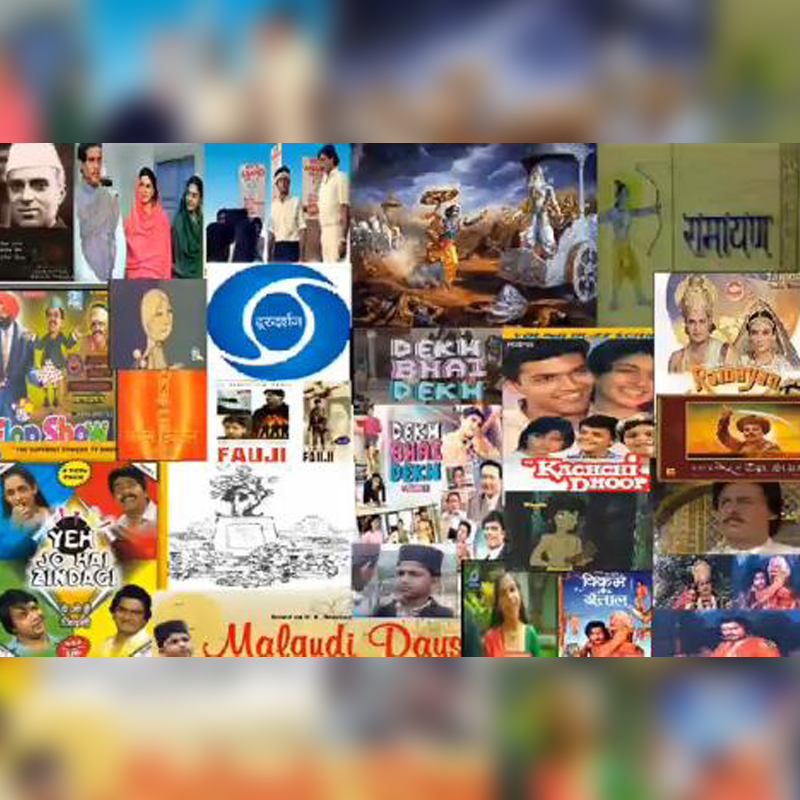
    Recently, the pubcaster revived two of its shows Ramayan and Mahabharat during the covid-19 crisis. Although it no longer enjoys a monopoly position, Doordarshan continues to have its dedicated audience and exercises its specific responsibility of public service and socially-relevant broadcasting.

    Joel Multimedia founder & CEO Varghese Thomas says, “India's public broadcaster was the one and only destination for television advertisers three decades ago. DD National, DD Metro and about 15 regional channels used to feature in all TV plans until the late 1990s. The public broadcaster has gifted a lot of good shows to the Indian television Industry such as Mahabharat, Ramayan, Surbhi, Rangoli, Chitrahaar, Superhit Muqabla, Shanti, Swabhiman etc. (Some of them were privately produced). The Friday and Saturday Hindi feature films were bumper hits among advertisers. Has anyone thought of creating a fantastic show out of a morning time band at 7 am on Sundays with a show like Rangoli? That was the power of Doordarshan during those days.”

    Thomas believes that after the entrance of satellite TV channels, pubcasters could not withstand the fast-changing trends and lost audience to private channels. He says, “Today, the HSM market has 57 per cent penetration of TV in the urban+rural markets. The proliferation of satellite channels with deep pockets and focus on innovative content has changed the way TV is consumed in India.  From fiction to sitcoms to reality shows, satellite channels have all that to entertain the ever-hungry TV audience. As the audience moved, advertisers have also moved to satellite channels as it was offering multi-dimensional opportunities for the brand rather than just buying a TV spot of 30 seconds.”

    Thomas, however, believes that though people in metros prefer satellite channels over public broadcasters only due to the programming, it would be a good idea to consider the public broadcaster for smaller towns and villages. “The terrestrial reach of the broadcaster is exclusive and no other broadcaster caters to that space which is very important. DD Free Dish is another superhit with 35 million connections and it's a great platform for even FTA satellite channels for distribution. Last year, the public broadcaster has generated revenue of Rs 500+ crore only by striking distribution deals with private channels.”

    According to the 2nd edition of BARC India- What India Watched 2019, the total viewership on DD grew to 573 billion viewing minutes in 2019 from 492 billion viewing minutes in 2018. The viewing minutes on DD's GEC channels grew by 19 per cent from 355 billion viewing minutes in 2018 to 424 billion viewing minutes in 2019.

    News genre witnessed five per cent growth in 2019 at 25 billion viewing minutes from 24 billion viewing minutes in 2018. Sports grew by four per cent at 101 billion viewing minutes in 2019 from 98 billion viewing minutes in 2018 and niche/others genre grew by 48 per cent at 23 billion viewing minutes in 2019 from 16 billion viewing minutes in 2018.

    “In spite of an increase in viewership, the number of advertisers in 2019 reduced by eight to10 per cent. In terms of spends there was growth in 2018 but in 2019 overall spends across DD network dropped by 30-35 per cent. Large CPG brands have also reduced spends on the DD channels in 2019,” informs Carat India executive VP Mayank Bhatnagar.

    He, too, agrees that the network has a vast untapped potential in the rural belt of the country. “The government has taken several steps to improve the quality of content and added new content to attract viewers. The viewership growth is exceptional, driven by the quality of the content and audience connect via increased presence on social media platforms. However, currently facing immense pressure from other FTA channels, DD needs to invest in the right content which is relatable and relevant to audiences,” he opines.

    Havas Media Group CEO India and South East Asia Anita Nayyar believe that if the public broadcaster is able to help advertisers with an attractive number of eyeballs and quality reach through innovative programming, it can get more investments.

    Nayyar says, “Depending upon the kind of audience and the markets it caters to and reaches, the investments follow. Advertisers are interested in reach and that too quality reach. With reach, the focus should be on quality of programming and that will get quality advertisers. As long as the same is delivered it should automatically attract advertisers and investments.”

    She further opines, “Unfortunately, the perception of public broadcasters in spite of the reach is not up to the mark and perceived to be low quality on both the audience and content fronts. With so many options available to view and great quality content available all across they have tough competition and will need to rise to the occasion.”

    There was some negative growth as well in some of the languages like Gujarati and Punjabi. Gujarati witnessed a fall of 5 per cent, the viewing minutes decreased to 9 billion in 2019 from 9.3 billion in 2018. Punjabi witnessed a 13 per cent fall in viewing minutes from 49 billion viewing minutes from 43 billion viewing minutes in 2018. 

  • MIB demands confirmation from MSOs regarding carriage of all DD channels

    MIB demands confirmation from MSOs regarding carriage of all DD channels

    MUMBAI: The Ministry of Information and Broadcasting (MIB) has sought affidavits from both existing MSOs as well as fresh applicants that they are carrying all 24 DD channels, besides Lok Sabha and Rajya Sabha TV channels, on their TV network.

    The ministry has mentioned in the notice that in view of the contribution of Doordarshan towards dissemination of accurate information about policies and programmes of government, acceleration of socio-economic change, promotion of national integration and stimulation of scientific temper, it is mandated that all cable TV networks should carry DD channels.

    The ministry has noticed that the mandate is not being followed by several cable operators in contravention of existing rules. The ministry has also asked to submit the affidavit within one month of the issue of notice.

    Section 8 of The Cable Television Networks (Regulation) Act, 1995 states that cable operators will have to compulsorily include Doordarshan channels notified by the central government in the Official Gazette. The MIB also listed DD Arunprabha as a mandatory DD channel recently.

  • Doordarshan’s future roadmap hinges on new tech, content development & monetisation

    Doordarshan’s future roadmap hinges on new tech, content development & monetisation

    MUMBAI: Public broadcaster Prasar Bharati is waking up from its slumber. With technology redesigning the media industry, the pubcaster has to quickly adapt to upgradations like ultra-high definition (UHD) along with focusing on over-the-top reach and tapping the huge digital base.

    Several recommendations to boost DD were discussed in the first ever India International Broadcast Conclave 2019 held at Hyderabad in March under the aegis of the Ministry of Information and Broadcasting (MIB). Experts across the media value chain shared their insights for further growth of DD and the industry.

    One of the important recommendations was the participation of DD and AIR in international forums like MIPCOM and other international festivals.  While PB has a huge repository of archival content, monetisation of this asset is the need of the hour. Along with helping in revenue augmentation, it would also ensure a wider reach of rich content to enthusiasts.

    DD also needs to quickly adopt HD and UHD technologies for better picture quality. It has also been suggested that DD should prepare a roadmap for moving towards HD completely. On the other hand, DD needs to tap the huge digital base of consumers nationally as well as globally and take necessary steps for digitising of content and infrastructure. While all the traditional broadcasters are taking the over-the-top (OTT) road, DD can either create its own platform or collaborate with third parties in a revenue sharing agreement.

    Technology is not only important for distribution but also needs to be implemented as a part of overall programming such as augmented reality and virtual reality (AR and VR) in order to innovate and present content tactically. The need to have a separate cell in DD for data analytics for better insights on content has been allowed.

    “DD needs to adopt a professional outsourcing model for content development and acquisition in view of a large number of vacancies of production staff and ageing manpower. DD needs to revamp its tariff rates, put in place a robust sales and marketing teams and monetisation of content to stay ahead in the competition,” the report read.

    To make the changes smoother, there should be a focus also on capacity-building initiatives. At the time of rapid changes, a well-designed skill upgradation programme is the need of the hour. Moreover, collaboration with private agencies to provide training on contemporary skills in areas covering the entire value chain has been suggested. 

    “Commercial activity of broadcast to be efficient to pay for the public service activity. Onus is to be self-sustaining so that it can sustain the organisation. DD Freedish is a good example of public service mandate and achieving commercial sustainability,” PB CEO Shashi Shekhar Vempati highlighted in his ‘Master Class’.

  • PILs filed against restriction of sharing sports feed of “national importance” with DD platforms

    PILs filed against restriction of sharing sports feed of “national importance” with DD platforms

    MUMBAI: Two separate petitions filed over a rule relating to the broadcasting of sports feeds by DD channels will be heard soon in the high courts of Delhi, and Punjab & Haryana. While the media rights holders of sporting events with “national importance” are bound to share the live feeds with public broadcaster Prasar Bharati, the rule restricts the telecast of such matches only on the terrestrial network and DTH operator of the pubcaster.

    According to a report from Economic Times, the petitioners are of the view that restricting the live telecast to the terrestrial and DTH networks of Prasar Bharati defeated the purpose of Section 3 (1) of the Sports Broadcasting Signals Act related to mandatory sharing with the pubcaster. Ahead of the ICC Cricket World Cup, the PILs have been filed seeking direction on allowing Prasar Bharati to live telecast the matches on its channels available on private cable and DTH platforms.

    Vaibhav Jain and Ramesh Kumar filed the PILs in the Delhi High Court and in the Punjab & Haryana HC respectively. Both high courts have posted the matter for hearing in late July while the World Cup will end before that on 14 July.

    The Supreme Court imposed restrictions on such retransmission back in August 2017. The report quoted a legal expert saying he doesn’t expect the high courts to give any interim relief to the petitioners in light of the Supreme Court judgement. But given that these are PILs, there are chances of spending some time to look for merits.

    Earlier, Supreme Court clarified in its order that sharing of signals with Prasar Bharati was aimed at giving access to consumers who otherwise did not have access rather than reaching consumers who have already subscribed to private cable and DTH networks.

  • Madison Group CEO Vikram Sakhuja on TRAI tariff order, Ekam & media landscape

    Madison Group CEO Vikram Sakhuja on TRAI tariff order, Ekam & media landscape

    In a highly VUCA media world, over I’m going to attempt to answer the question of what’s in store for media in the near future. Today 11000 TV and radio advertisers, over two lakh print advertisers, 1500 OOH advertisers and 300 large – 2 lakh long tail online advertisers think long and hard about how to spend their marketing budgets.

    On one hand, it costs 30-40 crore to do a significant national launch, advertising on IPL can exceed a 100cr for some advertisers. A YouTube masthead or a TOI jacket costs excess of a crore, a 10-day OOH plan in Mumbai can cost over a crore. Yet an average advertiser spends under five crore a year on TV, two crore on OOH and lakhs on other mediums. At the top, there are only 12 advertisers with spends more than 500 cr. At a brand level, an equal number (12) spend more than 100 crore.

    For all of them, budget management boils down to making trade-offs between mediums and media objectives. By mediums I mean TV, print, radio, OOH, digital, cinema, and media objectives: reach, frequency, SOV, weeks on air, advertising size and “impact vs regular” inventory.

    How media shapes in the future will depend on how advertisers, agencies and media owners use different mediums across these fundamental media objectives.

    Reach: When it comes to reach we have close to 200 mn TV homes but only a handful of advertisers – large FMCG, political parties and telecom that reach both urban and rural. Even within urban most aggressive plans reach about 70% of TV homes once/month and about 45% three times.

    Byron Sharp amongst other media pundits says that reach is most important, yet at an India level we are reaching less than half. Question to ask is whether that 60% reach overall urban better or 95% reach among a particular market.

    Frequency: At a campaign level, TV typically operates at a 3-5 frequency, online at 7-8, print at 1 or 2. Yet paradoxically as consumers we often see the same ad perhaps three times in an hour while watching a movie or a game. Question to ask here is do we truly understand the concept of media frequency?

    SOV: Most advertisers track SOV/SOM closely as they find that competitive spends have a bearing on their business. Best way to get a client to spend is to tell them that their competitor is spending. Fact is media salience does drive brand choice but do we need to do it over a campaign or a financial year.

    ACD: TV copy length is coming under a microscope even as print sizes are increasing. Digital has expanded the ad range from 6” to long-form video. Rather than approach copy length by the medium question is one of optimizing the effectiveness and efficiency of creative length (typically using analytics).

    Impact vs. regular: Impact unquestionably helps cut clutter and build awareness. Used well it builds equity. However, it comes at a premium. New advertisers hoping to make a quick mark in the Indian market opt for an impact heavy strategy, while legacy marketers approach impact more judiciously. Question to my mind is do brands have an impact strategy?

    WOA: Often the variable that is traded off most. It is felt that it is better to have a campaign that is noticed over an always-on one. Indeed, we have only a few brands who are always-on on TV, display, social, search, performance; but most TV and all print, OOH, radio, cinema activity is typically sporadic and behind specific marketing initiatives. Why is WOA not given more importance?

    Current thinking has carved the pie across TV – 38%, print – 32%, digital – 19% (search 6%, display/video 7% and social 6%) OOH – 5.5% and radio – 3.5%.

    How will this media scenario change in the near future? If the future follows the past we will see the following:

    TV will be the base medium for building awareness and consideration. More TV channels will continue to launch, rate/10” will not increase and may even fall. Fragmentation will lead to an increase in CPRP. CPRPs within a genre will be competitive. Reach will be precious. Overall it will cost more to reach less. There will be the occasional super Premium Impact program that becomes a “tribal moment”.

    The power of others seeing the same thing as you, in the same room and across India at the same moment, cannot be overstated. If I see a Dominos RCB spot during IPL, and I discuss it with a friend who I can safely assume has seen it, a certain legitimacy is created that is called Cultural Imprinting.

    Digital Video will grow on the back of OTT, YouTube, Jio, MX Player, ShareIt and other video consumption and sharing platforms. Digital video has two roles: on advertising, the TV vs. digital video debate will net out at one complementing/supplementing, rather than replacing the other. On content, video will have an amazing run limited only by a brand’s ability to embrace content assets.

    Social will grow on the back of great psychographic targeting and delivery of outcomes and again grow proportionate to brand’s ability to create content based assets.

    Search will grow but more modestly as CPC’s go up and the ROI on search reduces

    Print will have a bumpy ride. It will remain a medium for a call to action and announcement of new news unless it reinvents itself. Categories will put it more under the scrutiny of effectiveness than any other medium. Comparisons will inevitably be with digital. Newspapers will struggle to balance yield with outlays.

    Digital display will grow but less than video. Here the contextual, performance oriented, rich media, tech-enhanced nature will lead to banners winning the battle versus print. Voice will emerge as a display medium

    Radio and cinema will grow as outlays remain modest and local marketing importance grows. OOH will gain from traffic count measurement that is now available at least in Madison and also grows. Put this way, if nothing changes, one could see similar trends in the next t years as we have seen in PMAR 2018. In 2021 we could well see digital being the second most dominant medium.

    But I think an alternative more exciting scenario is possible. This, however, is predicated on the occurrence of three disruptor events and two changes in how advertisers market their brands.

    · Disruptor events are TRAI channel pricing, digital data measurement, and data privacy

    · Marketing changes are true integrated marketing and increased localisation

    Disruptor events

    TRAI channel tariff order

    When TRAI channel tariff order is enforced, channel availability per home will reduce from approx. 350 Channels to 100+50. So, today most GEC channels have 90%+ distribution and about 35% weekly reach. After TRAI these channels could land up having 30% distribution and 30% reach.

    Reality is that an average home watches 16 channels. It is just that with so many more available there is surfing and some snacking and reach extension. Once these extraneous channels go out we will see individual channel reach reduce, ATS go up, and overall fragmentation will reduce. More channels will also go FTA, but carriage fees will also increase. There will be moreexperimentation with consumers opting in and out of channels on a monthly basis.

    Today there is a high degree of substitution possible between channels. In a post TRAI world, we will need a combination of channels to build reach and no two channels will be completely substitutable. Life will also be more dynamic. Using past four week data to predict the next four weeks will become challenging. It is a good time for a media planner to make a difference.

    Digital measurement

    The most accountable medium does not have a measurement currency. We don’t have a currency on digital AdEx, no currency that tells us about viewability and viewership/listenership. Sure, we are fed data by publishers, and we also have our own tags that we track, but there is no industry currency. Ekam was supposed to be one and huge amounts were spent to keep the infrastructure going, but for completely manmade reasons this has not emerged. If it comes we will get a currency on digital viewership and an official read on integrated reach between at least TV and digital video.

    This can redefine the 27000 cr video+ (23500+3500) industry.

    I believe TV and OTT have the common lean back consumer habit to viewing which will lead to a lot of crossover advertising between the two platforms. I also think the OTT content ecosystem will allow advertisers the deal structuring that we used to do with private producers in the DD era.

    This will also allow a narrowcast of a broadcast medium. We can choose markets and genders or ages and cut some wastage.

    Data Privacy

    As a consumer who owns my data will have a profound bearing on how the digital marketing evolves.This is not a current issue in India but is a simmering one in more developed digital economies.

    The detractors say that global digital media giants have the power and ability to manipulate our behaviour as well as profile us if they control our data. The supporters say having consumer data has led to contextual marketing, psychographic marketing and programmatic marketing that has made messaging to consumers more relevant. Indeed, these are powerful tools for any marketer that goes a long way in improving targeting and explaining how media works.

    As a marketer it would be a shame to lose this tool. But with great power comes great responsibility. It is obvious that data needs to be anonymised. That is a given. The crux of the issue lies in internalising the difference between targeting and profiling. It is ok to target me, but please don’t profile me. The difference is subtle but significant. If we cross the line, there is a danger of the entire digital media juggernaut crashing.

    Two marketing practices will impact the way we spend

    Act truly integrated

    We have talked integrated marketing plans for decades but we still act in silos. Sometimes an idea binds the media together, but is this integrated?

    There is a term called consumer journey or path to purchase that tracks a consumer from the time the trigger for the category happens to when purchase and post purchase happens. In this journey the potential media touchpoints are when the consumer is engaged in the activity of listening, viewing, reading, searching, shopping, socialising, learning or gaming. What brands can do with media at these touch points is the opportunity to get consumers to see us, think about us, experience us, buy us and share their views about us.

    Today over 90% of a brand’s marketing budget is involved in getting ads to be seen. As they move to other aspects of the marketing funnel, how the money is spent will change dramatically.

    Biggest catalyst to that will be CPT (or CPM). Today we evaluate a TV plan in CPRP, print in rate/sqcm, radio in rate/10”, OOH in rate/site, digital in CPT or CPO, etc. This needs to move to an apple to apple CPT. Over this we can add outcomes and measure CPO.

    Increased localisation

    We need to factor India’s heterogeneity much more into our marketing plans than we do currently. We approach plans as urban vs rural, 8 metro vs rest of India urban, HSM, 4 southern states, Maharashtra and West Bengal, and on socio economic basis through an increasingly NCCS AB skewed classification. Way forward is for brands to fine tune their battlegrounds. From spray and pray to seek and prey. We have several examples over the years like Ghadi, Santoor, Thums Up, etc that have built dominant regional positions.

    So, what’s in store for media in the near future is essentially harder working outcome based marketing. Brand budget growth follows an arithmetic progression while demands from marketing forces increase at a geometric progression. The following six forces will shape the advertising spend market.

    1. Expansion of marketing funnel: We used to make trade-offs between Mediums and Media Objectives (R/F/SOV/WOA/ACD/Impact). This was largely about getting consumers to see an Ad. Now we will additionally make trade-offs between getting them to see, explore, experience, buy and share across the journey. If that happens TV will lose relatively and all others will gain.

    2.Integrated Reach will continue to be critical: More media touchpoints will be required to get reach. Marketers will seek it in an integrated manner. Campaigns will maximize reach and optimize frequency across media. CPT will become the common currency that equates the cost of an impression across media.

    3. Greater Localisation: it will become increasingly impractical and inefficient to market to one India. Additionally, the trade-offs between markets will become sharper than our current P1, P2 classification. Greater digitisation and channel selection will lead to more localisation. TV will be used as a local medium more than it ever has. Digital, OOH, radio, the cinema will work in combination better than they work in a silo. Print will need to redefine its value to a local marketer and will find a huge role.

    4. Integrated Reach:, CPT, and greater localisation will lead to more intelligent media selling. All Mediums will have a role. From selling Media like onions and potatoes, there will be a need to find brand building solutions. In the near though not immediate future, media in India will get truly integrated as smart devices get connected in what we know as IOT.

    5.Data and technology will revolutionise targeting: We will increasingly target geographically, psychographically, contextually and behaviourally. We will increasingly retarget sequentially with customised messaging. Any medium with digital backbone leverage this capability.

    6.We will decode how media works: Increasingly through a combination of marketing analytics and real-time attribution, we will understand what sequence of Media drives consumer behaviour for each category

    (The author is Madison Group CEO Vikram Sakhuja. The views expressed here are his own and Indiantelevision.com may not subscribe to them)

  • 38th DD Free Dish e-auction on 11 February: Key highlights of revised policy

    38th DD Free Dish e-auction on 11 February: Key highlights of revised policy

    MUMBAI: The 38th DD Free Dish e-auction for 54 vacant MPEG-2 slots will be held from 11 February. The Prasar Bharati Board on Tuesday gave a green signal to e-auctioning of DTH slots on DD Free Dish. The public broadcaster will resume the allocation of slots based on a revised policy, confirmed Prasar Bharati (PB) CEO Shashi Shekhar Vempati. He thanked the Board, MIB secretary Amit Khare and minister Rajyavardhan Singh Rathore for their support.

    The e-auctioning of slots on DD Free Dish was arbitrarily called off in October 2017. Earlier, DD Free Dish would conduct the e-auction every couple of months to award vacant channel slots to private broadcasters. The last e-auction was held In July 2017.

    With the pubcaster set to kick-start the much-awaited e-auctions, here are the key highlights of the revised policy:

    · The e-auctions will be based on a differential pricing to be determined by the genre (language) of channels. Private broadcasters desirous of carriage on DD Free Dish will have to declare the same to be eligible to bid in e-auctions.

    · To lower the entry barrier for genres (languages) that are currently under-represented on DD Free Dish the differential pricing for slots is split into five disparate buckets as opposed to the 2 buckets based on which e-auctions were previously held.

    · Different genres (languages) have been grouped within these five buckets with differential reserve pricing for slots in respective buckets.

    · To promote the new DD Free Dish authorized set top boxes, the new policy also envisages invitational pricing for channels to also take up MPEG4 slots in addition to the existing MPEG2 slots.

    · The new policy also makes it attractive for channels from a cash flow standpoint through better payment terms. This will ease the burden on channels while lowering the entry barrier for channels.

    According to the PB CEO, a key consideration factored in by the new policy was to increase the diversity of content available on DD Free Dish and to expand its reach across India especially within the non-Hindi speaking states.

    The government-owned DTH platform has had a good run since its launch and is now desired beyond rural areas as well. According to industry experts, the DTH platform now has close to 30 mn subscribers.

    While there are numerous advantages of Free Dish, some private broadcasters feel it offer a threat to distribution platform operators (DPOs).

  • DTDC joins Delhi Daredevils as official logistics partner for IPL 2018

    DTDC joins Delhi Daredevils as official logistics partner for IPL 2018

    MUMBAI: As the excitement and anticipation surrounding the eleventh season of the Indian Premier League (IPL) builds up, express parcel service provider DTDC has announced its association as the official logistics partner with Delhi Daredevils (DD) team.

    In its capacity, DTDC will deliver and oversee the entire back-end logistics operations for the team. The association leverages the brand with wider visibility in terms of its logo being visible on the lead trouser of the DD playing jersey.

    Led by the ever-competitive Gautam Gambhir, and coached by Australian legend Ricky Ponting, this year’s DD squad comprises stalwarts such as Chris Morris, Glenn Maxwell, Amit Mishra, Naman Ojha, Colin Munro, apart from youngsters like Shreyas Iyer, Rishabh Pant and India’s young U-19 World Cup winning captain Prithvi Shaw.

    DTDC executive director Abhishek Chakraborty says, “DTDC is looking forward to being a part of the Delhi Daredevils campaign as they look to end their silverware drought. The tournament is a celebration of the cricket-crazy spirit of Indians, and DTDC wanted to be a part of this celebration of the sport’s ultimate carnival. Furthermore, we aim to reach out to a wider customer base and strengthen our connection with the loyal fans of the team from the capital and its surrounding regions.”

    Delhi Daredevil team CEO Hemant Dua adds, “We are happy to welcome DTDC on board the DD family. To have a top notch logistics partner is a crucial part of a successful team. With DTDC on board, we will have great support for all our movements during the season.”