Tag: DD Freedish

  • DD FreeDish e-auction: MPEG4 slots saw highest bid of Rs 57.1 lakh

    DD FreeDish e-auction: MPEG4 slots saw highest bid of Rs 57.1 lakh

    MUMBAI: The first annual e-auction for MPEG4 slots on Doordarshan’s FTA DTH platform FreeDish witnessed an intense competition that was held from 27 to 29 March. According to reports, the highest bid during the e-auction was Rs 57.1 lakh, a premium of almost 1150 per cent over the reserve price of Rs 5 lakh and the average bid was at Rs 44.17 lakh per slot.

    A total of 15 MPEG4 slots were successfully sold to channels across genres that will be available on the platform with effect from 15 April 2019.

    The public broadcaster stated that the response to the 39th e-auction was overwhelming, as almost four times applications were received against the vacant MPEG-4 slots. Also, there was no genre based restrictions or reservations for participating in the e-auction.

    Among the 15 channels, five of them are Hindi devotional channels including Aastha Bhajan, Arihant, Satsang, Subh TV and Vedic TV. Apart from that, only three are non-Hindi channels while the rest are Hindi channels. Three MPEG-4 slots have been reserved for public broadcasting purposes.

    Home Shop18 and NT1 have won slots in the teleshopping genre. Enter 10 Bangla, Oscar Bhojpuri, Sky Star Bangla, Sky Star Telugu and WoW Cinema One have bought the slots in the movie genre. In the news genre, ABP Ganga, Chardikala Time TV and Aryan TV National have won the slots.

    Prasar Bharati CEO Shashi Shekhar had tweeted, “Happy to share that the first annual e-auction for MPEG-4 slots (39th e-auction) on DD Free Dish saw robust bidding with 15 successful slots sold to channels across genres and languages.”

    “The e-Auction saw slots being taken at an average price that was nearly 8 to 9 times the invitational price underscoring the high competition. With this overall projected annual revenue from DD Free Dish will cross 400 cr between MPEG2 and MPEG-4 slots,” he said.

  • DD Free Dish policy: New bucket created in MPEG2 slots for devotional genre

    DD Free Dish policy: New bucket created in MPEG2 slots for devotional genre

    MUMBAI: Public broadcaster Prasar Bharati has amended the DD Free Dish policy in a meeting held earlier this week. Under the amended policy, a new bucket has been created to reserve MPEG2 slots towards devotional channels. The reserve price of the bucket has been fixed at Rs 3 crore.

    “Consequently a new Bucket R1 has been created to reserve MPEG2 slots towards devotional/spiritual/AYUSH channels which may be placed through the open eAuction process as laid down in the policy,” Prasar Bharati CEO Shashi Shekhar Vempati said on Twitter.

    Spiritual channels including channels promoting Yoga, Ayurveda, Health & Wellness (AYUSH) based on traditional methods fall under the devotional category or bucket R1. Under amended policy, three slots have been reserved for genres deemed to be in public interest. The amended policy also says that placement of regional channels of Doordarshan that are currently not available on DTH/cable may be considered for placement on vacant MPEG2/MPEG4 slots reserved for the same.

    Vempati also revealed on Saturday the results of the first annual e-auction for MPEG4 slots on  FreeDish. After robust bidding, a total of 15 MPEG4 slots were successfully sold to channels across genres and languages.

  • DD Free Dish e-auction: 15 MPEG4 slots sold

    DD Free Dish e-auction: 15 MPEG4 slots sold

    MUMBAI: The first annual e-auction for MPEG4 slots on Doordarshan’s FTA DTH platform FreeDish, witnessed intense competition. After robust bidding, a total of 15 MPEG4 slots were successfully sold to channels across genres and languages.

    Prasar Bharati CEO Shashi Shekhar Vempati said on Twitter that the slots were being taken at an average price that was nearly eight to nine times the invitational price. “With this overall projected annual revenue from DD Free Dish will cross 400 cr between MPEG2 and MPEG4 slots,” he added.

    Vempati added that the new line up of 15 channels will be published on Monday, subject to completion of procedural formalities. He also mentioned that three slots have been reserved for public broadcasting purposes.

    Earlier in February, 40 MPEG2 slots were successfully sold under revised guidelines after recommencement of e-auction. Vempati said that the estimated revenue from the sold slots is Rs 395 crore and added that the new channels will be on air from 1 March 2019.

    The Prasar Bharati Board gave a green signal to e-auctioning of DTH slots on DD FreeDish in January. The e-auctioning was arbitrarily called off in October 2017. Earlier, FreeDish would conduct the e-auction every couple of months to award vacant channel slots to private broadcasters. The last e-auction was held In July 2017.

    While revealing the new policy guidelines, Vempati had said a key consideration factored in was to increase the diversity of content available on FreeDish and to expand its reach across India, especially within the non-Hindi speaking states.

  • TRAI tariff order’s impact on DD Free Dish’s growth

    TRAI tariff order’s impact on DD Free Dish’s growth

    MUMBAI: Prasar Bharati run direct-to-home (DTH) platform DD FreeDish’s success is evident from the estimated number of subscribers it boasts of. The free-to-air (FTA) DTH service, experts believe, commands close to 30 million subscribers, which could shoot up post TRAI tariff order’s implementation, the 2019 FICCI-EY report points out.

    According to the report, DD FreeDish has the potential to breach the 50 million subscriber mark if broadcasters continue to provide pay content on the platform.

    Another interesting point worth mentioning here is that the report suggests lower end consumers will increasingly shift to the free platform or even use it for their second television connection as a result of the new tariff regime.

    Last year at the Video and Broadband Summit, Doordarshan director general Supriya Sahu stated that FreeDish is not only used by a marginal section of the society but is also evolving as an alternative option for consumers. An older report of consulting firm EY predicted that the number of DD FreeDish subscribers is bound to cross 40 million by 2020.

    While the experts Indiantelevision.com spoke to were optimistic about the potential for robust growth, they seemed sceptical about the scale.

    Elara Capital vice president Karan Taurani did not agree with 2019 FICCI-EY report's observation about FreeDish, especially the figure of 50 million. Taurani rejected the possibility of a second home connectivity, adding that mobile is going to be the second screen for consumers. He said content consumption increment is happening on digital platforms.

    PricewaterhouseCoopers (PwC) partner and leader, media and entertainment Frank D’Souza, however, believes there is some merit to the argument.

    “Now the question is how many households who can get multiple connections will choose OTT rather than adding one more TV connection- that is little debatable. But the first argument has merit –lower-end consumers may shift to DD Free Dish. But the question is, will lower-end consumers be able to have multiple connections due to lack of physical space availability?” he asked.

    Travelxp CEO Prashant Chothani said the growth of FreeDish has so far been propelled by free content only. Now, however, major broadcasters have pulled off their content from the platform, he highlighted.

    The report also says that if large broadcasters continue to keep their content off the platform, television advertising revenues would be impacted and FreeDish’s future will be determined by the number of new channels that sign up on the platform.

    “FreeDish generated an estimated Rs 20 billion of advertising revenues. In February 2019, large broadcasters removed their channels from this medium and this could impact our ad revenue forecast by Rs 10-20 billion in 2019,” the report adds.

    Earlier this year, Prasar Bharati board gave a green signal to e-auctioning of DTH slots on DD FreeDish which was arbitrarily called off in October 2017. The first e-auction after recommencement witnessed intense competition. Under the revised guidelines, a total of 40 MPEG2 slots were successfully sold while the estimated revenue from the sold slots is Rs. 395 crore.

    The FICCI-EY report also adds that regional, news and niche channels, especially those impacted negatively by the TRAI tariff order, are bound to build their audience through FreeDish (subject to auction base prices).

    Industry experts, however, see things different in case of niche channels.

    “I don’t know how much they will try and do that because the market for niche channels is different and the people who are going to access DD Free Dish – the consumer is different. It may not fit the target segment of such channels,” D’Souza argued.

    According to Chothani, niche channels don’t see DD FreeDish as a viable option and are not going to jump on its bandwagon.

    In addition to that, he also pointed out that niche channels won’t be negatively impacted by the new tariff order. According to the 4k pioneer, niche channels will benefit from the new regime because consumers won’t shy away from paying for good content.

    “One of the fundamental premises of new tariff order is also to bring transparency in the system. Consumers’ habits build over time and also change. If they want to see the content which they were seeing earlier and now they are not getting because of NTO, in due course of time, they may subscribe. If the content is strong enough they will subscribe,” he opined.

    Taurani said niche channels opting for DD FreeDish remains a possibility mired in a couple of constraints. Apart from limited slots, what could also deter niche channels from staying off FreeDish is the high carriage fee.

  • DD Free Dish e-auction: Prasar Bharati nets Rs 395 cr from sale of 40 Free Dish DTH slots

    DD Free Dish e-auction: Prasar Bharati nets Rs 395 cr from sale of 40 Free Dish DTH slots

    MUMBAI: The first e-auction of Doordarshan’s FTA DTH platform, FreeDish, after recommencement witnessed intense competition. Under the revised guidelines, total of 40 MPEG2 slots were successfully sold.

    Prasar Bharati  CEO Shashi Shekhar Vempati said that that the estimated revenue from the sold slots is Rs. 395 crore and added that the new channels will be on air from 1 March 2019, subject to completion of formalities.

    After the e-auction Vempati asserted that the language diversity on DD FreeDish has also seen an expansion with Marathi channels taking up slots.He also added that nearly eight new channels have taken up space across various categories and genres in various languages.

    While revealing the new policy guidelines, Vempati had said a key consideration factored in was to increase the diversity of content available on FreeDish and to expand its reach across India, especially within the non-Hindi speaking states.

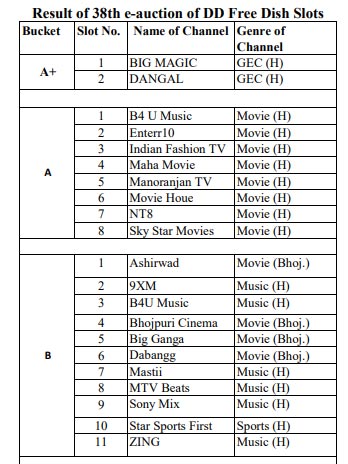
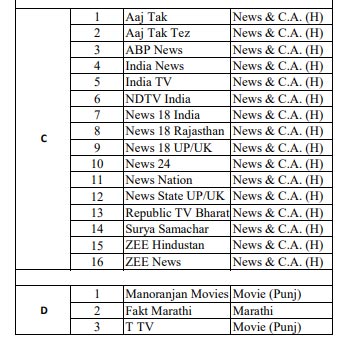
    As shared by Prasar Bharati, the highest bid price in Bucket A+ was Rs 15.05 crore, in Bucket A it was Rs 12.45 crore and in Bucket B was Rs 10.95 crore. In Bucket C, which saw the toughest competition, the highest bid was Rs 8.95 crore. Bucket D saw a high of Rs 6.1 crore.


    The new policy guideline has kept five buckets for e-auction of MPEG2 slots . Bucket A+ has been kept for Hindi GECs and teleshopping channels with a reserve price of Rs 15 crore, and Bucket A has been dedicated for Hindi movie channels with a reserve price of Rs 12 crore.

    Hindi music, sports, and Bhojpuri GEC and movie come under Bucket B, which has a reserve price of Rs 10 crore. All news and current affairs TV channels in various languages fall under the category of  Bucket C, which had a reserve price of Rs 7 crore. Bucket D with lowest reserve price of Rs 6 crore comprises all other remaining genres/language channels.

    Earlier on 15 February 2019, the Prasar Bharati Board on gave a green signal to e-auctioning of DTH slots on DD FreeDish. The e-auctioning was arbitrarily called off in October 2017. Earlier, FreeDish would conduct the e-auction every couple of months to award vacant channel slots to private broadcasters. The last e-auction was held In July 2017.

  • 9X Media, B4U & MASTiii challenge FreeDish e-auction in Delhi HC

    9X Media, B4U & MASTiii challenge FreeDish e-auction in Delhi HC

    MUMBAI: Within a few days of DD FreeDish e-auction recommencement notice, 9X Media, B4U and MASTiii have filed a writ petition before the Delhi High Court asking for a stay on the upcoming e-auction process as they feel the base prices are very high for small broadcasters.

    It wants the court to quash the guidelines issued by Prasar Bharati on 15 January 2019 as well as its directive to disconnect channels from 1 March 2019.

    9x Media has mentioned that it is a loss-making entity with losses of Rs 7.81 crore and negative earnings per share and such a decision could adversely impact its business. Its petition contends that FreeDish has shut the doors on small non-profit making companies from being available to the public at large and instead prefers deep-pocketed ones.

    After a long hiatus, Prasar Bharati board gave a green signal to e-auctioning of slots for DD FreeDish along with a revised policy with a change in pricing. The new policy guideline has kept five buckets for e-auction of MPEG2 slots. Bucket A+ has been kept for Hindi GECs and teleshopping channels with a reserve price of Rs 15 crore, and Bucket A has been dedicated to Hindi movie channels with a reserve price of Rs 12 crore.

    Hindi music, sports and Bhojpuri GEC and movie come under Bucket B which has a reserve price of Rs 10 crore. All news & current affairs (Hindi), All news & current affairs (English) and news & current affairs (Punjabi) channels fall under the category of Bucket C which with a reserve price of Rs 7 crore. The Bucket D with the lowest reserve price of Rs 6 crore will comprise all other remaining genres/language channels.

    9X Media contends that these categories of ‘high commercial potentiality’ and prices have not been justified by FreeDish. The petition also states that companies running news channels such as TV Today Network and Zee Media are profit-making companies and so keeping their base price lower than music channels is unjustified.

    “The channels can differ in content, viewership, class of customer, commercial potentiality, advertisement available, peak time of the channel, regions and other factors…Different music channels can have different uptake, viewership, potentiality, etc,” the document reads.

    The petitioners state that the entire process has been conducted arbitrarily without maintaining transparency. It even adds that Prasar Bharati is “misusing its status of the largest DTH operator, having largest number of subscriber base, as it claims to hold about 30 million subscribers.” Without consulting stakeholders, such decisions lead to creating monopoly in the hands of a few.

    Additionally, Prasar Bharati is seeking carriage fees which are way higher than private players even as the validity of FreeDish having 30 million subscribers is contended.

    The e-auctioning of slots onDD Free Dish were arbitrarily called off in 2017 while the last e-auction of DD FreeDish took place in July 2017. Earlier, DD FreeDish used to hold e-auction once every couple of months to award vacant channel slots to private broadcasters.

  • DTH subscriber growth see-saws in three quarters of 2018

    DTH subscriber growth see-saws in three quarters of 2018

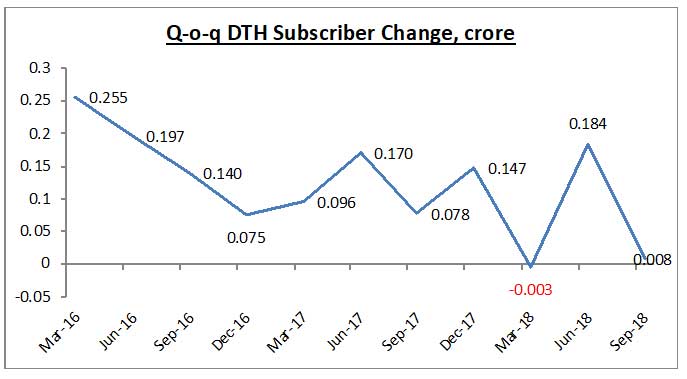
    BENGALURU: Growth of direct to home (DTH) subscriber base of private players in India was the slowest over the last five years for the nine month period ended 30 September 2018 (TQY 2018, TQY period, three quarters of the year under review) as per Telecom Regulatory Authority of India (TRAI). The good news was that the quarter ended 30 June 2108 (Jun-18, last or previous quarter) saw a reversal of fortunes. From a loss of about 30,000 (0.003 crore, 0.3 million, 0.3 lakh) subscribers in the quarter ended 31 March 2018 (Mar-18), DTH subscriber growth was positive 18.4 lakh (0.184 crore, 1.84 million) for the quarter ended 30 June 2018 (Jun-18). However, in the case of the quarter ended 30 September 2018 (Sep-18), subscriber growth has once again nose-dived to just 8,000 subscriber additions. As a matter of fact, the industry has faced one of the worst TQY periods – subscriber growth in TQY-18 was just 1,89,000 (0.0189 crore, 0.189 million) as compared to 3,44,000 (0.0344 crore, 0.344 million) in TQY-17 and 5,92,000 (0.0592 crore, 0.592 million) in TQY-16.

    The figure below shows a q-o-q growth of DTH subscribers between the period Mar-16 and Sep-18.It may be noted that Mar-16 growth of 25.5 lakh (0.255 crore, 2.55 million) is with respect to Dec-15.

    According to TRAI data, the overall private DTH active subscriber base grew by 0.419 crore or 4.19 million (7.8 percent) in calendar year (CY 2017) to 6.756 crore or 67.56 million from 6.256 crore or 62.65 million in CY 2016. Comparatively, in 2016, the overall private DTH active subscriber base grew by 6.67 million or 0.667 crore (11.9 percent) from 55.98 million or 5.598 crore in CY- 2015.

    Please refer to the figure below for the DTH subscriber numbers as per TRAI data:

    The merger between Dish TV and Videocon d2h that was effective since October 2018 has created the largest DTH services company in India and the second largest globally in terms of number of active subscribers. Please refer to the three figures below for approximate market share of the private DTH players in India in CY 2017, CY 2017 and CY 2018:

    It must also be mentioned that the government’s FreeDish DTH service is the largest DTH player by far in terms of subscribers with an estimated 22 million or 2.2 crore subscribers in 2016 as per the KPMG-FICCI Indian Media and Entertainment Industry Report 2017 (KPMG-FICCI M&E Report 2017) titled Media for the Masse: The Future Unfolds. It must however be noted that an exact number for registered or active subscribers is not available since this is a free DTH service. Also, the merger of Videocon d2h with Dish TV will create the largest private television carriage player in India and quite likely the second largest in the world, be it cable, internet television or DTH or any other.

  • Doordarshan now wants all matches of men’s hockey WC

    Doordarshan now wants all matches of men’s hockey WC

    NEW DELHI: Even as TV sports channels are wracking their brains as part of a public consultation to justify why proposed tweaking of rules relating to mandatory sharing of signals of sporting events is not a good idea, the Indian government has gone ahead to notify hockey World Cup for sharing with the pubcaster.

    Star India holds the broadcast rights of the men’s hockey World Cup 2018 to be held in the Indian state of Orissa from 28 November to 16 December 2018. The matches are scheduled to be aired on Star Sports channels and streamed live on the media company’s digital platform, Hotstar.

    In a notification dated 13 November 2018, Ministry of Information and Broadcasting has stated that all the matches of the men’s hockey WC were “sporting events of national importance”. Meaning? The matches would have to be shared by Star with pubcaster Doordarshan, which will telecast them on its terrestrial network and FTA DTH platform, DD FreeDish.

    If hockey is a notified sport, any rights holder in India would be compelled to share it with the national broadcaster. So, what’s new in the latest notification?

    As per the 2007-legislated sports rules, only the semi-final and final matches are to be shared with DD at a mutually decided financial arrangement. DD suddenly realised it needs all the matches for DD Sports as the tournament was being held in India and, hence, the fresh directive from the MIB that used a technicality in the official rules to include the whole hockey tournament.

    Industry watchers feel that such arbitrary actions by the government not only harm India’s image, but can also impact the business models of sports channels in the long run that acquire content at high prices. For example, Star bagged the broadcast rights for cricket IPL last year, beating original holders Sony and other tough bidders, at a mind-boggling price of $2.55 billion.

    Meanwhile, the public consultation that has been initiated by the MIB takes the mandatory sharing of sports signals of notified sports a step further. The amendments seek to make legal re-distribution of DD signals by other distribution platforms of TV signals (like LCOs, MSOs and may be OTT platforms) — something that’s unlawful presently.

  • DTH subscriber growth slow in first half of 2018

    DTH subscriber growth slow in first half of 2018

    BENGALURU: Growth of direct to home (DTH) subscriber base of private players in India was the slowest in five half-years for the half year ended 30 June 2018 (HY 2018, half year under review) as per Telecom Regulatory Authority of India (TRAI). The good news is that the quarter ended 30 June 2108 saw a reversal of fortunes. From a loss of about 30,000 (0.003 crore, 0.3 million, 0.3 lakh) subscribers in the quarter ended 31 March 2018 (Mar-18), DTH subscriber growth was positive 18.4 lakh (0.184 crore, 1.84 million) for the quarter ended 30 June 2018 (Jun-18, quarter under review).

    The figure below shows a q-o-q growth of DTH subscribers between the period Mar-16 and Jun-18.It may be noted that Mar-16 growth of 25.5 lakh (0.255 crore, 2.55 million) is with respect to Dec-15.

    According to TRAI data, the overall private DTH active subscriber base grew by 0.419 crore or 4.19 million (7.8 percent) in calendar year (CY 2017) to 4.19 million or 67.56 million from 6.256 crore or 62.65 million in CY 2016. Comparatively, in 2016, the overall private DTH active subscriber base grew by 6.67 million or 0.667 crore (11.9 percent) from 55.98 million or 5.598 crore in CY- 2015.

    Please refer to the figure below for the DTH subscriber numbers as per Trai data:

    The merger between Dish TV and Videocon d2h that was effective since October 2018 has created the largest DTH services company in India and the second largest globally in terms of number of active subscribers. Please refer to the three figures below for approximate market share of the private DTH players in India in CY 2017, CY 2017 and CY 2018:

    It must also be mentioned that the government’s FreeDish DTH service is the largest DTH player by far in terms of subscribers with an estimated 22 million or 2.2 crore subscribers in 2016 as per the KPMG-FICCI Indian Media and Entertainment Industry Report 2017 (KPMG-FICCI M&E Report 2017) titled Media for the Masse: The Future Unfolds. It must however be noted that an exact number for registered or active subscribers is not available since this is a free DTH service. Also, the merger of Videocon d2h with Dish TV will create the largest private television carriage player in India and quite likely the second largest in the world, be it cable, internet television or DTH or any other.
     

  • Launch of Ladakhi Regional Service on DD-Kashir Channel

    Launch of Ladakhi Regional Service on DD-Kashir Channel

    MUMBAI: Ladakhi News Bulletins are extremely popular among the people in Leh and Ladakh region as there are hardly any private channels telecasting programmes in Ladakhi.  Doordarshan is the only source of Ladakhi news for the people of the region.  DDK, Leh which started its telecast in the year 2000 has been producing and telecasting several programmes in Ladakhi.  As the world’s highest TV station, DDK, Leh has been fulfilling regional aspirations in spite of many challenges in the region.  The regional telecast, which takes place everyday between 6.00 p.m to 7.30 p.m. in Ladakhi is transmitted through  a network of 92 Terrestrial transmitters including 13 HPTs, 13  LPTs and 66  VLPTs.  

    Programmes of DDK Leh cover various aspects of local News and Current Affairs as well as local cuisine, life style, culture and heritage.  With increase in the popularity of  satellite transmission, it has become important to augment the terrestrial transmission services with the availability of Ladakhi programmes on satellite mode also so that programmes get a national foot print and are accessible to a large number of people not only in Ladakh but also elsewhere in India.

    It has been a long pending demand of people from the region that the Ladakhi regional service be made available on satellite platform.  Doordarshan, Prasar Bharati has decided to fulfil this regional aspiration by providing a Prime time slot to Ladakhi News and Current Affairs and other programmes initially through a half-an-hour slot on DD-Kashir, which is a satellite channel from 10th September, 2018 from 6.30 p.m. to 7.00 p.m.  This would enable accessibility of Ladakhi regional service on all DTH Platforms viz., DD Freedish, Tatasky, Dish TV, Videocon d2h, Airtel, Reliance Digtial TV, Sun Direct and Cable Services etc. as DD Kashir is mandatorily carried on all these platforms as per the direction of the Ministry of Information and Broadcasting.

    The Member of Parliament of the region Shri Thupstan Chhewang had met Smt. Supriya Sahu, Director General, Doordarshan during her visit to Leh and requested for providing a satellite platform to Ladakhi programmes for their wider dissemination.

    People of Leh and Ladakh can now tune in to watch their favourite Ladakhi regional service including Ladakhi News Bulletin from 6.30 p.m.  to 7.00 p.m. wherein 6.30 p.m. to 6.45 p.m. has been allocated for programmes of varied genres in Ladakhi and 6.45 p.m. to 7.00 p.m. has been earmarked for Ladakhi News Bulletin.