Tag: DAVP

  • Reliance Jio may be fined for using PM’s pic in ad sans permission

    Reliance Jio may be fined for using PM’s pic in ad sans permission

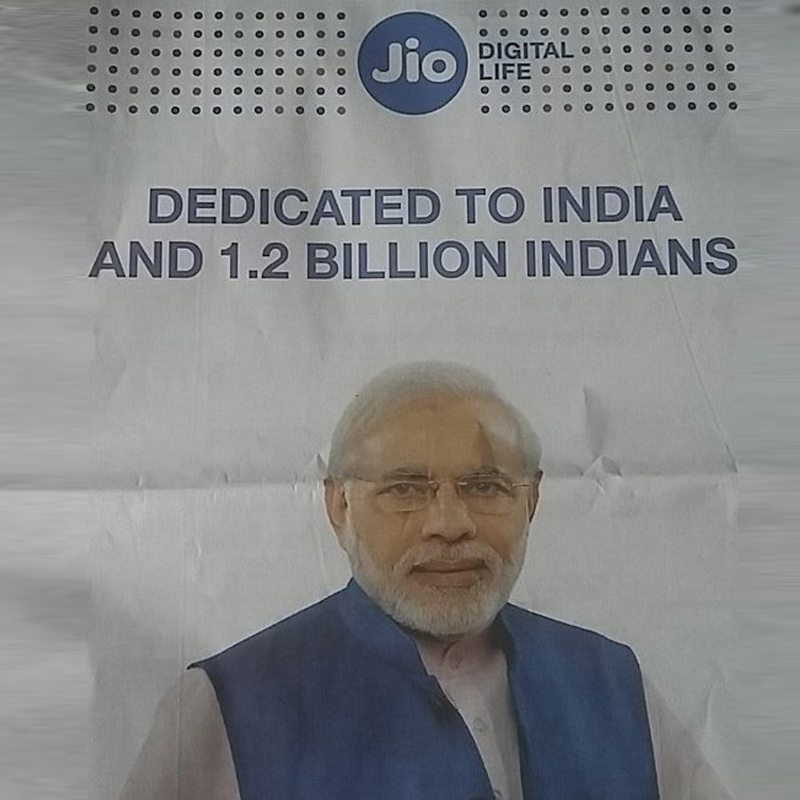
    NEW DELHI: The Government has denied that it gave permission for publication of a full-page photograph of the prime minister Narendra Modi in advertisements in newspapers about Reliance Jio.

    Minister of state for information and broadcasting Rajyavardhan Rathore said: “No permission was granted by the Prime Minister’s Office.”

    Rathore told the Parliament that the Act, ‘The Emblems and Names (Prevention of Improper Use) Act, 1950’ is administered by the Consumer Affairs, Food & Public Distribution Ministry.

    He also said that the directorate of advertising and visual publicity (DAVP) of his ministry releases Government advertisements only and does not release advertisements of any private body.

    Reliance Jio may have to pay only Rs 500 as fine for using Modi’s picture in advertisement, without permission from the government. Newspapers reported that the minor penalty could be charged from Jio.

    Rathore, in a written reply, admitted that it was aware that Reliance Jio used the PM’s photographs in the advertisement. About the actions that can be taken against Jio, he replied that the (DAVP) unit was responsible for it is the Emblems and Names (prevention of improper use) Act 1950.

    Section-3 of the Act states that no person shall use any “specified” name or emblem for the purpose of any trade, business or any such activities without the “previous permission of the central government” or officers authorised by the government. The list of names and emblems that cannot be used without prior permission from the government includes the president of India, the PM, governor of a state, the government of India or any state, Mahatma Gandhi, Indira Gandhi, Jawaharlal Nehru, United Nations Organisation, Ashok Chakra or Dharma Chakra.

  • Reliance Jio may be fined for using PM’s pic in ad sans permission

    Reliance Jio may be fined for using PM’s pic in ad sans permission

    NEW DELHI: The Government has denied that it gave permission for publication of a full-page photograph of the prime minister Narendra Modi in advertisements in newspapers about Reliance Jio.

    Minister of state for information and broadcasting Rajyavardhan Rathore said: “No permission was granted by the Prime Minister’s Office.”

    Rathore told the Parliament that the Act, ‘The Emblems and Names (Prevention of Improper Use) Act, 1950’ is administered by the Consumer Affairs, Food & Public Distribution Ministry.

    He also said that the directorate of advertising and visual publicity (DAVP) of his ministry releases Government advertisements only and does not release advertisements of any private body.

    Reliance Jio may have to pay only Rs 500 as fine for using Modi’s picture in advertisement, without permission from the government. Newspapers reported that the minor penalty could be charged from Jio.

    Rathore, in a written reply, admitted that it was aware that Reliance Jio used the PM’s photographs in the advertisement. About the actions that can be taken against Jio, he replied that the (DAVP) unit was responsible for it is the Emblems and Names (prevention of improper use) Act 1950.

    Section-3 of the Act states that no person shall use any “specified” name or emblem for the purpose of any trade, business or any such activities without the “previous permission of the central government” or officers authorised by the government. The list of names and emblems that cannot be used without prior permission from the government includes the president of India, the PM, governor of a state, the government of India or any state, Mahatma Gandhi, Indira Gandhi, Jawaharlal Nehru, United Nations Organisation, Ashok Chakra or Dharma Chakra.

  • Verified print publications to get higher rates for DAVP ads

    Verified print publications to get higher rates for DAVP ads

    NEW DELHI: A new marking system has been introduced for the first time in the government’s advertisement policy to incentivise newspapers which have better professional standing and get their circulation verified by the Audit Bureau of Circulation (ABC) or the Registrar of Newspapers in India (RNI). This will also ensure transparency and accountability in the release of advertisements by the Directorate of Advertising and Visual Publicity which is the nodal advertising agency of the government.

    The marking system is based on six objective criteria with different marks allotted to each criterion. The criterion includes circulation certified by ABC/RNI (25 marks), EPF subscription for employees (20 marks), number of pages (20 marks), subscription to wire services of UNI/PTI/Hindustan Samachar (15 marks), own printing press (10 marks), annual subscription payment to PCI (10 marks). Advertisements shall be released by DAVP to newspapers based on marks obtained by each newspaper.

    The innovation is part of the new advertisement policy for the print media issued by the Information & Broadcasting ministry with the objective to promote transparency and accountability in issuing of advertisements in print media.

    The policy focuses on streamlining release of government advertisements and to also promote equity and fairness among various categories of newspapers/periodicals. The key highlights of the policy are as follows:

    The policy framework includes circulation verification procedure for empanelment of newspapers/journals with DAVP. The procedure involves certification by RNI/ABC if circulation exceeds 45,000 copies per publishing day. A certificate from Cost/Chartered Accountant/ Statutory Auditor Certificate/ ABC is mandated for circulation up to 45,000 copies per publishing day. The policy states that RNI circulation certificate shall be valid for a period of two years from the date of issue and in case of ABC, the current certificate shall be used for circulation certificate.

    It is stated in the policy that the director general of DAVP reserves the right to have figures of circulation checked through RNI or its representative.

    The policy also stipulates the empanelment procedure for multi-editions of a newspaper. It states that according to the Press and Registration of Books Act whenever copies of one edition of a newspaper are printed from more than one centre, the newspapers would be treated as different editions if the content is different. Each edition of a newspaper is required to have a separate RNI registration number and RNI shall treat each edition as separate entity while verifying the circulation.

    However, the policy guidelines mention that if a newspaper is printing its copies of an edition in more than one printing press for sake of convenience without adding any additional content, DAVP may take the circulations of such printing centres into consideration for giving rate of that edition.

    The policy framework provides a premium for prominent placing of ads in newspapers and journals whose circulation is certified by ABC/RNI. The directorate would pay a premium of 50 percent above DAVP rates for colour/black and white for front page, 20 percent premium to third page, 10 percent premium to fifth page and 30 percent premium for back page to only those newspapers whose circulation is certified by ABC/RNI.

    The policy stipulates that the rate structure for payment against advertisements released by DAVP will be according to the recommendations of the Rate Structure Committee.

    The policy has classified newspaper/journals into three categories namely small ( less than 25,000 copies per publishing day), medium (25,001-75,000 copies per publishing day) and big ( greater than 75,000 copies per publishing day).

    Big category newspapers which are willing to publish the advertisements of educational Institutions at DAVP rates are being incentivised by giving additional business of 50 percent in volume terms as compared to those which are not willing to accept.

    DAVP will release payment of advertisement bills in the name of newspaper/company account directly through ECS or NEFT.

    A newspaper will publish DAVP advertisement only on receipt of the relevant release order by DAVP. All release orders issued can be accessed electronically at the DAVP website.

    The new policy has structured the empanelment procedure to ensure fairness among various categories of newspapers/journals. The policy also mentions relaxation in empanelment procedure to provide special encouragement for regional language/dialect small and medium newspapers, mass circulated newspapers (circulation above 100,000), newspapers in North Eastern states, Jammu & Kashmir and Andaman & Nicobar Islands.

    DAVP has been asked to make efforts to release more social messages and related advertisements which are not date specific to periodicals.

    To promote equity based regional outreach, the policy emphasizes that the budget for all India release of advertisements shall be divided among states based on total circulation of newspapers in each state /language.

    Public sector undertakings and autonomous bodies may issue the advertisements directly at DAVP rates to newspapers empaneled with DAVP. However, they all have to follow the criteria laid down by DAVP for release of all classified and display advertisements in different categories of newspapers viz. small, medium and big.

    To cut down on arrears, all clients of DAVP have been directed to issue Letter of Authority/cheque/ DD/NEFT/RTGS up to 80 percent of the actual expenditure in the previous year within the first month of the new financial year and clear all the remaining payments before 28 February of the financial year. Alternatively, the client ministries may provide 85 percent advance payments of the estimated expenditure of the advertisements.

  • Verified print publications to get higher rates for DAVP ads

    Verified print publications to get higher rates for DAVP ads

    NEW DELHI: A new marking system has been introduced for the first time in the government’s advertisement policy to incentivise newspapers which have better professional standing and get their circulation verified by the Audit Bureau of Circulation (ABC) or the Registrar of Newspapers in India (RNI). This will also ensure transparency and accountability in the release of advertisements by the Directorate of Advertising and Visual Publicity which is the nodal advertising agency of the government.

    The marking system is based on six objective criteria with different marks allotted to each criterion. The criterion includes circulation certified by ABC/RNI (25 marks), EPF subscription for employees (20 marks), number of pages (20 marks), subscription to wire services of UNI/PTI/Hindustan Samachar (15 marks), own printing press (10 marks), annual subscription payment to PCI (10 marks). Advertisements shall be released by DAVP to newspapers based on marks obtained by each newspaper.

    The innovation is part of the new advertisement policy for the print media issued by the Information & Broadcasting ministry with the objective to promote transparency and accountability in issuing of advertisements in print media.

    The policy focuses on streamlining release of government advertisements and to also promote equity and fairness among various categories of newspapers/periodicals. The key highlights of the policy are as follows:

    The policy framework includes circulation verification procedure for empanelment of newspapers/journals with DAVP. The procedure involves certification by RNI/ABC if circulation exceeds 45,000 copies per publishing day. A certificate from Cost/Chartered Accountant/ Statutory Auditor Certificate/ ABC is mandated for circulation up to 45,000 copies per publishing day. The policy states that RNI circulation certificate shall be valid for a period of two years from the date of issue and in case of ABC, the current certificate shall be used for circulation certificate.

    It is stated in the policy that the director general of DAVP reserves the right to have figures of circulation checked through RNI or its representative.

    The policy also stipulates the empanelment procedure for multi-editions of a newspaper. It states that according to the Press and Registration of Books Act whenever copies of one edition of a newspaper are printed from more than one centre, the newspapers would be treated as different editions if the content is different. Each edition of a newspaper is required to have a separate RNI registration number and RNI shall treat each edition as separate entity while verifying the circulation.

    However, the policy guidelines mention that if a newspaper is printing its copies of an edition in more than one printing press for sake of convenience without adding any additional content, DAVP may take the circulations of such printing centres into consideration for giving rate of that edition.

    The policy framework provides a premium for prominent placing of ads in newspapers and journals whose circulation is certified by ABC/RNI. The directorate would pay a premium of 50 percent above DAVP rates for colour/black and white for front page, 20 percent premium to third page, 10 percent premium to fifth page and 30 percent premium for back page to only those newspapers whose circulation is certified by ABC/RNI.

    The policy stipulates that the rate structure for payment against advertisements released by DAVP will be according to the recommendations of the Rate Structure Committee.

    The policy has classified newspaper/journals into three categories namely small ( less than 25,000 copies per publishing day), medium (25,001-75,000 copies per publishing day) and big ( greater than 75,000 copies per publishing day).

    Big category newspapers which are willing to publish the advertisements of educational Institutions at DAVP rates are being incentivised by giving additional business of 50 percent in volume terms as compared to those which are not willing to accept.

    DAVP will release payment of advertisement bills in the name of newspaper/company account directly through ECS or NEFT.

    A newspaper will publish DAVP advertisement only on receipt of the relevant release order by DAVP. All release orders issued can be accessed electronically at the DAVP website.

    The new policy has structured the empanelment procedure to ensure fairness among various categories of newspapers/journals. The policy also mentions relaxation in empanelment procedure to provide special encouragement for regional language/dialect small and medium newspapers, mass circulated newspapers (circulation above 100,000), newspapers in North Eastern states, Jammu & Kashmir and Andaman & Nicobar Islands.

    DAVP has been asked to make efforts to release more social messages and related advertisements which are not date specific to periodicals.

    To promote equity based regional outreach, the policy emphasizes that the budget for all India release of advertisements shall be divided among states based on total circulation of newspapers in each state /language.

    Public sector undertakings and autonomous bodies may issue the advertisements directly at DAVP rates to newspapers empaneled with DAVP. However, they all have to follow the criteria laid down by DAVP for release of all classified and display advertisements in different categories of newspapers viz. small, medium and big.

    To cut down on arrears, all clients of DAVP have been directed to issue Letter of Authority/cheque/ DD/NEFT/RTGS up to 80 percent of the actual expenditure in the previous year within the first month of the new financial year and clear all the remaining payments before 28 February of the financial year. Alternatively, the client ministries may provide 85 percent advance payments of the estimated expenditure of the advertisements.

  • Give more funds to DAVP for empowering people: Parliamentary Committee

    Give more funds to DAVP for empowering people: Parliamentary Committee

    NEW DELHI: Noting that the then Information and Broadcasting ministry secretary had admitted that the budget availability for publicity purpose was not adequate enough, a Parliamentary Committee has recommended that the budgetary allocation for the Directorate of Advertising and Visual Publicity should be enhanced.

    The Parliamentary Standing Committee for Information Technology which goes into issues relating to I and B said this will help DAVP to broadbase and increase the outreach of the multimedia campaigns being carried out by it through various means such as television, print, social media or other outreach programmes for the welfare of the society.

    Noting that a reduced allocation of Rs 125.60 crore had been made during 2016-17 at the Budget Estimate stage for the ‘People’s Empowerment through Development Communication’ (PEDC) scheme,  the Committee felt this amount was‘grossly inadequate to meet the requirement under this important scheme. As a matter of fact, the allocation was about 69 percent of the total outlay for the information sector. 

    The Committee was told that during the first year of 12th the Plan 2012-13, utilization of funds for PEDC was to the tune of Rs.103.18 crore which was increased to Rs.189 crore in the year 2013-14 and Rs.155.2 crore in the year 2014-15. For the year 2015-16, an allocation of Rs.151 crore had been made at the Revised Estimate stage out of which the actual expenditure as on 30 March 2016 had been Rs.146.34 crore.

    The Committee was given to understand that the line ministries and departments carry their ministry-specific campaign for which they have their own budgetary allocations. However, the DAVP’s budget allocation obtained through the Development Communication and Information Dissemination (DCID) programme of I&B ministry is used to run integrated campaigns on all the flagship programmes of the government.

    The Committee observed that the government had been launching several initiatives and direct benefit schemes for the welfare of the people, and information regarding these schemes have to be disseminated to the people and the target groups.

    To achieve this objective, the scheme of PEDC had an important role to play. In order to facilitate integrated campaign on various flagship programmes of the government, the DAVP needs a much larger budget with matching fund allocation which requires more allocation for the information sector.

    The DAVP is the nodal multimedia advertising agency of the government catering to the communication needs of the ministries/departments, autonomous bodies and PSUs. In order to strengthen the publicity of various peoples’ welfare and participation oriented programmes in a holistic manner, and to enable efficient discharge of its services, the DAVP had sought and obtained increased funding for two of its Plan Schemes – PEDC implemented through the DCID scheme and ‘Media Infrastructure Development Programme’.

  • Give more funds to DAVP for empowering people: Parliamentary Committee

    Give more funds to DAVP for empowering people: Parliamentary Committee

    NEW DELHI: Noting that the then Information and Broadcasting ministry secretary had admitted that the budget availability for publicity purpose was not adequate enough, a Parliamentary Committee has recommended that the budgetary allocation for the Directorate of Advertising and Visual Publicity should be enhanced.

    The Parliamentary Standing Committee for Information Technology which goes into issues relating to I and B said this will help DAVP to broadbase and increase the outreach of the multimedia campaigns being carried out by it through various means such as television, print, social media or other outreach programmes for the welfare of the society.

    Noting that a reduced allocation of Rs 125.60 crore had been made during 2016-17 at the Budget Estimate stage for the ‘People’s Empowerment through Development Communication’ (PEDC) scheme,  the Committee felt this amount was‘grossly inadequate to meet the requirement under this important scheme. As a matter of fact, the allocation was about 69 percent of the total outlay for the information sector. 

    The Committee was told that during the first year of 12th the Plan 2012-13, utilization of funds for PEDC was to the tune of Rs.103.18 crore which was increased to Rs.189 crore in the year 2013-14 and Rs.155.2 crore in the year 2014-15. For the year 2015-16, an allocation of Rs.151 crore had been made at the Revised Estimate stage out of which the actual expenditure as on 30 March 2016 had been Rs.146.34 crore.

    The Committee was given to understand that the line ministries and departments carry their ministry-specific campaign for which they have their own budgetary allocations. However, the DAVP’s budget allocation obtained through the Development Communication and Information Dissemination (DCID) programme of I&B ministry is used to run integrated campaigns on all the flagship programmes of the government.

    The Committee observed that the government had been launching several initiatives and direct benefit schemes for the welfare of the people, and information regarding these schemes have to be disseminated to the people and the target groups.

    To achieve this objective, the scheme of PEDC had an important role to play. In order to facilitate integrated campaign on various flagship programmes of the government, the DAVP needs a much larger budget with matching fund allocation which requires more allocation for the information sector.

    The DAVP is the nodal multimedia advertising agency of the government catering to the communication needs of the ministries/departments, autonomous bodies and PSUs. In order to strengthen the publicity of various peoples’ welfare and participation oriented programmes in a holistic manner, and to enable efficient discharge of its services, the DAVP had sought and obtained increased funding for two of its Plan Schemes – PEDC implemented through the DCID scheme and ‘Media Infrastructure Development Programme’.

  • India websites eligible for government advertisements

    India websites eligible for government advertisements

    NEW DELHI: Timing the move with its second anniversary of assumption of office, the government today announced that only websites which are owned and operated by companies that are incorporated in India will be considered for empanelment by Directorate of Advertising & Visual Publicity (DAVP) for government advertisements.

    However, websites owned by foreign companies/origin can still be empanelled if such companies have branch offices which are registered and operating in India for at least one year.

    In a move aimed at highlighting the government’s flagship programmes and achievements of the past two years, the Information & Broadcasting Ministry has framed guidelines and criteria for Empanelment of suitable agencies and Rate fixation for government advertisements on websites.

    The aim of the guidelines is to devise principles and instruments to streamline the release of Government advertisements on websites. The policy stipulates eligibility criteria for websites to get empanelled with DAVP which includes Unique Users (UU) per month data which shall be cross-checked and verified by internationally accepted and credible third party tool that monitors website traffic in India.

    The guidelines aim to ensure that the visibility of government advertisements online increased by strategically placing the ads on websites having higher Unique Users per month.

    The policy requires that the websites shall run the government ads through a Third Party Ad Server (3-PAS) engaged by DAVP for providing all relevant reports linked with online billing and will be used for verification of bills for payment. The Unique User Data of each empanelled websites will be reviewed in first week of April every year. The guidelines categorises the Unique User per month data of the websites into three categories:

    The key features of the policy guidelines include different rates for different ad properties like Standard Banners on Cost per Thousand Impressions (CPTI) basis and a minimum Click-Through Rate (CTR) of 0.30, Video ads per five second videos, Fixed Banner on home page with minimum display size of 300 X 250 pixels in a time frame on six-hour slots (6 am-12 noon, 12 noon to 6 pm, 6 pm to 12 midnight and 12 midnight to 6 am) and Fixed Video ads for 24 hour time slots on home page.

    The policy emphasizes that DAVP shall be the nodal agency for all central government ministries / departments for advertising through DAVP empanelled internet websites. However, autonomous bodies/PSUs can directly release advertisements but at DAVP rates and to agencies empanelled with DAVP.


  • India websites eligible for government advertisements

    India websites eligible for government advertisements

    NEW DELHI: Timing the move with its second anniversary of assumption of office, the government today announced that only websites which are owned and operated by companies that are incorporated in India will be considered for empanelment by Directorate of Advertising & Visual Publicity (DAVP) for government advertisements.

    However, websites owned by foreign companies/origin can still be empanelled if such companies have branch offices which are registered and operating in India for at least one year.

    In a move aimed at highlighting the government’s flagship programmes and achievements of the past two years, the Information & Broadcasting Ministry has framed guidelines and criteria for Empanelment of suitable agencies and Rate fixation for government advertisements on websites.

    The aim of the guidelines is to devise principles and instruments to streamline the release of Government advertisements on websites. The policy stipulates eligibility criteria for websites to get empanelled with DAVP which includes Unique Users (UU) per month data which shall be cross-checked and verified by internationally accepted and credible third party tool that monitors website traffic in India.

    The guidelines aim to ensure that the visibility of government advertisements online increased by strategically placing the ads on websites having higher Unique Users per month.

    The policy requires that the websites shall run the government ads through a Third Party Ad Server (3-PAS) engaged by DAVP for providing all relevant reports linked with online billing and will be used for verification of bills for payment. The Unique User Data of each empanelled websites will be reviewed in first week of April every year. The guidelines categorises the Unique User per month data of the websites into three categories:

    The key features of the policy guidelines include different rates for different ad properties like Standard Banners on Cost per Thousand Impressions (CPTI) basis and a minimum Click-Through Rate (CTR) of 0.30, Video ads per five second videos, Fixed Banner on home page with minimum display size of 300 X 250 pixels in a time frame on six-hour slots (6 am-12 noon, 12 noon to 6 pm, 6 pm to 12 midnight and 12 midnight to 6 am) and Fixed Video ads for 24 hour time slots on home page.

    The policy emphasizes that DAVP shall be the nodal agency for all central government ministries / departments for advertising through DAVP empanelled internet websites. However, autonomous bodies/PSUs can directly release advertisements but at DAVP rates and to agencies empanelled with DAVP.


  • DAVP owes electronic and print media Rs 148 crore for govt ads: Rathore

    DAVP owes electronic and print media Rs 148 crore for govt ads: Rathore

    NEW DELHI: A sum of around Rs 36 crore is owed to 271 television channels by the Directorate of Advertising and Visual Publicity. DAVP also owed about Rs 111.7 crore to the print media in 35 states and union territories as on 1 April. DAVP being the nodal advertising department for the government of India releases advertisements on behalf of different ministries/departments.

    While releasing this information, minister of state for Information and Broadcasting Rajyavardhan Rathore told parliament that this payment is due because ministries and departments of the central and state governments do not clear the bills of DAVP in time. In some cases, he said payments to media organizations are not cleared in time due to delayed availability of funds.

    “However, DAVP makes constant efforts to urge client ministries/ departments regarding their pendency”, he said.

    DAVP releases payments to newspapers and other media organizations, based on the funds released by the client ministries/departments.

  • DAVP owes electronic and print media Rs 148 crore for govt ads: Rathore

    DAVP owes electronic and print media Rs 148 crore for govt ads: Rathore

    NEW DELHI: A sum of around Rs 36 crore is owed to 271 television channels by the Directorate of Advertising and Visual Publicity. DAVP also owed about Rs 111.7 crore to the print media in 35 states and union territories as on 1 April. DAVP being the nodal advertising department for the government of India releases advertisements on behalf of different ministries/departments.

    While releasing this information, minister of state for Information and Broadcasting Rajyavardhan Rathore told parliament that this payment is due because ministries and departments of the central and state governments do not clear the bills of DAVP in time. In some cases, he said payments to media organizations are not cleared in time due to delayed availability of funds.

    “However, DAVP makes constant efforts to urge client ministries/ departments regarding their pendency”, he said.

    DAVP releases payments to newspapers and other media organizations, based on the funds released by the client ministries/departments.