Tag: data

  • TRAI data shows wireless data revenue, subscribers, ARPU shot up in 2018

    TRAI data shows wireless data revenue, subscribers, ARPU shot up in 2018

    MUMBAI: Wireless data usage in the country is spiking up. According to a report by the Telecom Regulatory Authority of India (TRAI), the total revenue that telecom operators collected through data usage last year was Rs 54,671.44 crore. In 2017, the revenue was Rs 38,882 crore.

    The amount of data consumption from every wireless data subscriber every month was up from 4.13GB in 2017 to 7.69GB in 2018. Simultaneously, the cost to subscriber has also reduced from Rs 19.35 per GB in 2017 to Rs 11.78 in 2018. This can be attributed to the presence of Reliance Jio as a dominant player in bringing down data rates. Additionally, the share of 4G data usage in total volume of wireless data usage has been 86.85 per cent during the year 2018.

    Average revenue per wireless data subscribers (data ARPU) per month increased from Rs 79.98 in the year 2017 to Rs 90.61 in the year 2018. It was recorded Rs 71.25 per wireless data subscriber per month in the year 2014.

    Total wireless data usage more than doubled from 20,092 GB in 2017 to 46,404 GB in 2018. The number of wireless subscribers went from 424.02 million in 2017 to 578.2 million in 2018. This shows an annual growth of 36.36 per cent.

    TRAI’s report states that though 4G adoption is on the rise in India, the world is witnessing even higher levels of data usage through the commercial deployment of 5G technology. Both the government of India and the telecom industry have announced that they have initiated preparatory steps for smooth and efficient rollout of 5G for the benefit of the consumers and the overall economic development of the country.

  • Flexi-timing, job hopping, social media feedback are key HR issues for media companies

    Flexi-timing, job hopping, social media feedback are key HR issues for media companies

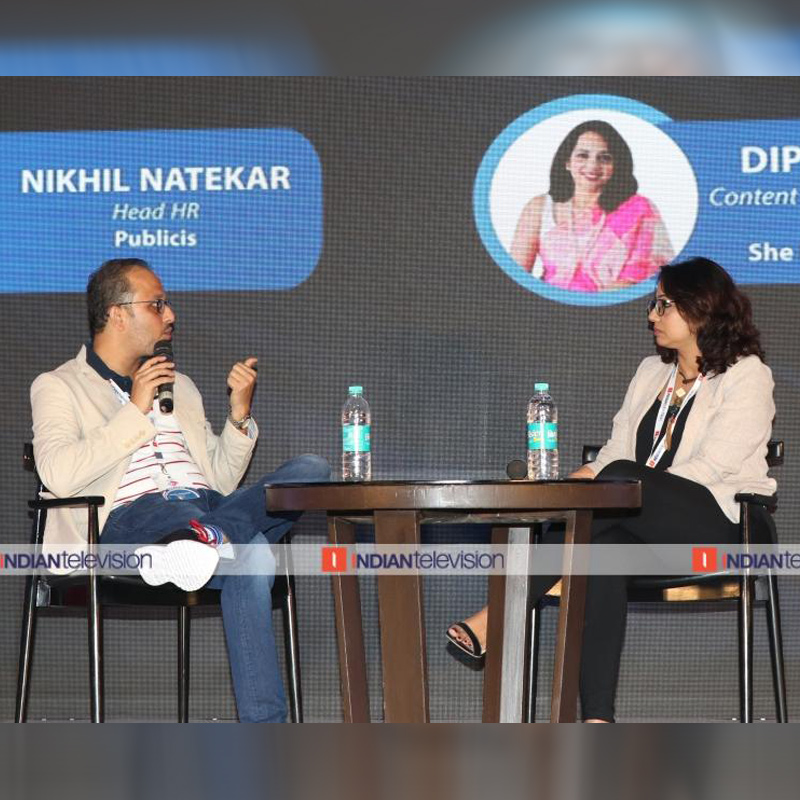
    MUMBAI: The challenges of human resources (HR) are constantly changing in any industry thanks to the emerging role of automation and social media along with a higher rate of attrition and scarcity of talent. Decoding the new age issues in the HR space, Publics head HR Nikhil Natekar spoke on a wide range of issues a freewheeling chat with She Means Business content creator and workshop facilitator Dipika Singh at the Indiantelevision.com Media HR Summit 2019.

    The first issue (and the most talked about one today) addressed the need for flexible timing. “It’s not only the responsibility of the HR to look into it. It depends on business to business; there are lots of challenges in terms of flexi-time. It should not impact your core business hours. You need to look at core business hours aligned with your organisation. Flexi-time cannot work in the hospitality sector but can work in the IT sector where the employees are playing an individual contributor’s role. So, you need to define where you want to apply flexi-time,” Natekar commented.

    With the power of social media in hand, employees and job aspirants can easily write good or bad feedback for companies and Natekar says that this is a reality that needs to be accepted and tackled. Companies need to perceive platforms like LinkedIn and Glassdoor as a mirror and start taking feedback positively.

    According to Natekar, accepting the flaws and responding to feedback is very important. Usually, organisations respond to consumer feedback on social media but not to employees. This is because they look at them as employees who are working for them but not as their internal customer who is generating revenue. Natekar voiced the need for a change in the thought process.

    “There are two ways to look at it. First, see your current stage and then map out where the organisation wants to be in three years. Identifying that gap is very important. That’s where HR plays an important role. You have to do your own streamlining. You have to align your business leader. If you want to move from this stage to version two, what are the required skill sets for that level and who in the current team have those skill sets and what skill sets do you need to hire. It is more of an understanding between your leadership and HR,” he commented on how business helps HR in pre-empting the requirement of future.

    He outlined that automation gives insights, data, and knowledge that was previously unknown but HR’s core responsibility ultimately lies in developing a relationship with an individual. Automation will give HR the background data but it will not be able to throw light on the feelings an employee has developed. Data can help understand focus areas but humans are needed to conduct personal level conversations.

    Job hopping has become a tendency among employees and Natekar’s approach would be to directly ask employees for the reasons. But he asks organisations to understand that in today’s age people don’t want to work at the same place for 10-15 years. The tenure has dropped drastically to three years.

    The HR’s focus should be on reducing attrition, not of average employees but for key performers who can aid the company’s goal for the next five years.

  • Brands, agencies to rewire approaches using data: CVL Srinivas, WPP

    Brands, agencies to rewire approaches using data: CVL Srinivas, WPP

    MUMBAI: Data. A four letter word that has even the senior most executives sweating and scratching their heads. While it is a small little word, understanding how to use it, is actually very complicated. That’s why  all we’ve been hearing about in the last year is how can brands and agencies leverage the most of data and more importantly, understanding the basics of data. 

    Data is not restricted to using it only in advertising (for data-driven advertising), it can essentially be a very function of every brand. With all the buzz around data and using it to reach the consumer effectively and efficiently, marketers and agencies must know how to make the most of data for better ROI and consumer engagement.

    Google Maps, Instagram, Facebook, Twitter, Snapchat, Google, YouTube, Netflix have all changed our world, and for good! Technology has changed the way we connect with brands and things around us. You like something, you hit a ‘heart’, something makes you furious, you reply via an angry emoji on Facebook. All this consumer behaviour is Data for marketers. And with a consumer’s likes, dislikes, hearts, tweets and browsing history available readily, a brand maps the consumer behaviour and reaches to them with targeted advertising and content. That’s why you only get a message or pop up to shop or buy your favourite pair of clothes, lipstick, car or mobile that you’ve been eyeing for long.

    However, with brands being able to map your behaviour by scrutinising you and using your data, it also violates a consumer right to privacy. To address this, the Government of India is currently considering sweeping a data privacy law –  Personal Data Protection Bill of 2018 , which states that privacy is a "fundamental right" under the Indian Constitution. 

    The bill is closely modelled after the European Union's General Data Protection Regulation (GDPR). It broadly applies to all personal data defined as any data of a person which allows direct or indirect identifiability; and envisions a regime where individual consent is the cornerstone of data-sharing. If the bill is passed, it may change the way on when, where and how much data can brands actually use. 

    Maybe eventually brands will have to pay their users in some form to be able to use their data in the new framework of guidelines. It could be in the form of money, virtual money, coupons or discounts.

    To understand the current scenario and future of data driven marketing, in a quick chat with Indiantelevision.com, WPP country manager CVL Srinivas gave us insights about creating the balance between using data and human insights, future of advertising with data, WPP’s plan for 2019 and more. Excerpts: 

    The importance of data in advertising today is more than ever. How do you see the future of advertising along with data?

    Data is a critical part of every business today. We have a lot more data available to us than we ever had before. Today, every business is looking at transforming itself – by smartly leveraging data, businesses can fast track their growth in numerous ways. Advertising is becoming a lot more data-led. Not just in targeting the right audience or deciding the best 

    medium, data is inspiring creative thinking on brands. We saw numerous examples of data-inspired creativity at our summit today. Going forward, we will see brands and agencies adapting to this new data world by rewiring their approaches. This is not to say that all the

    traditional methods will go out of the window. We need as much of the marketing gut as we need data.

    Having too much data can often become complex. What’s the way out?

    A data strategy needs to start with a purpose. The end uses of data need to be defined. Else there is a tendency to try and boil the ocean. Like we heard from a lot of our panellists that day, that the best approach is to start small, test a few hypotheses and then scale up. 

    Somewhere along the way one learns what kind of data is most valuable for a particular business/brand.

    While brands and agencies have a lot of rich data available today, we don’t know what to do with it. Do we still need time to get there where we understand the data and can leverage it to the best?

    Most businesses are on the journey to get better at harnessing the power of data. There is no one defined method. Some of them have made more progress while others are starting off from scratch. While there is an abundance of data, what we really need is a more 

    balanced approach to putting it to good use. By ‘balanced’, I mean combining data points across different sources to paint a broader picture. That’s where we need to see more progress generally speaking. 

    Focus point for agencies and brands in 2019?

    Data-centricity will be a key priority going forward, but it must go hand in hand with creativity. 

    Do you think brands and agencies need to take a step back, pause and say, “I think we are pushing it too much!” How can we as an industry skip being ad-blocked?

    I think we will soon get to a point where most, if not all advertisers will realise the need to move from a completely push-based advertising approach to a more balanced way of engaging with their consumers. Data and technology are making it easier to identify consumer tastes and preferences more sharply. This will reduce the bombardment. On top of that, if one knows what kind of content engages the consumer, it can result in more relevant messaging being served.
  • IT minister says won’t allow India to be centre of data pilferage

    IT minister says won’t allow India to be centre of data pilferage

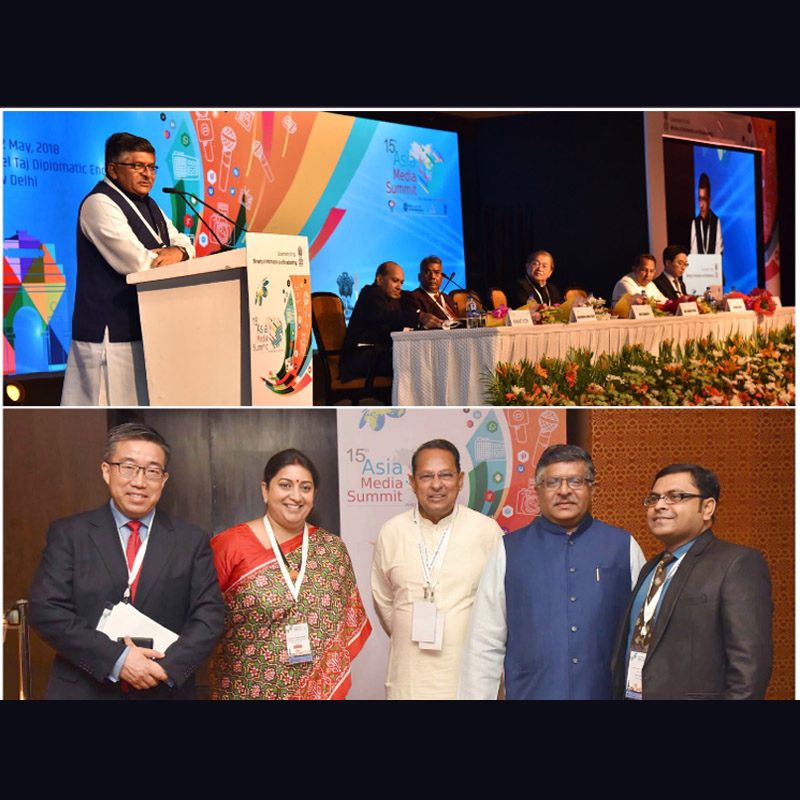
    MUMBAI: The country’s Electronics & IT and Law & Justice minster Ravi Shankar Prasad has come down sharply on data misuse. Speaking at the 15th Asia Media Summit, he said that the government would not allow the country to become a centre of data pilferage and data commerce that, through collusive methods, would be used to influence its electoral process.

    He added that all online companies, which were in the business of data commerce, must understand the nuances of accountability. When the recent controversy surrounding data privacy cropped up, with the Facebook-Cambridge Analytica scandal, the government took a firm stand. Since it is expected that India will be a big centre of data analytics, there is a need to have a proper coordination on data availability, data utility, data innovation, data anonymity and data privacy. Prasad also mentioned that a committee headed by a retired Supreme Court judge was looking into the issues and would soon come out with a data protection law.

    Though social media poses several challenges, Prasad said that the government was committed to the freedom of press but there was a need to segregate the real from the dangerous. The media, he said, had all the rights to inform, circulate, criticise, advice and counsel but the constitution allows for reasonable restrictions to be placed.

    He stated that he was in favour of self-regulation by media along with adherence to the IT Act, which says that content should not be dangerous, libellous or impinge upon the security and integrity of a country or encroach upon copyrights.

    Also Read :

    Efficient digital transition; MyGov.in pockets citizen engagement award

    FB reveals CA harvested data of up to 87 mn people

  • TRAI urges govt to set up public wi-fi systems

    TRAI urges govt to set up public wi-fi systems

    MUMBAI: The Telecom Regulatory Authority of India (TRAI) is of the opinion that the the government must encourage public wi-fi solutions from a public policy point of view. “The availability of broadband services at a very low cost and in every corner of the country is the basic requirement of digital India,” it said in a report.

    In the report on ‘Public Wi-Fi Open Pilot Project’, submitted to the Telecoms Ministry, TRAI  said, “Wi-fi is a technology that can easily meet this requirement [for digital India]. The recommendation envisages an architecture that supports one time authentication requirement, interoperability across different wi-fi networks, ease of payment through any instrument and above all inexpensive service.”

    According to TRAI,  global internet traffic is anticipated to increase three times to 3.3 ZB per year by 2021 from 1.2 ZB per year in 2016 and wi-fi will play an important role in driving that growth. Public wi-fi hotspots are crucial for broadband internet in international countries. As per a Cisco report, the number of public wi-fi hotspots is set to increase from 94 million in 2016 to 541.6 million in 2021. The density of WiFi hotspots will also increase from one hotspot for 150 people to one hotspot for 20 people.

    The authority noted that India significantly lags behind other countries in terms of providing access to broadband, especially to people in rural areas. Since there is a significant section of the population still to be connected, it feels there is a need to take some measures so as to provide broadband services to the unconnected. This calls for introduction of new set of small players in the wi-fi service provisioning space, who will be able to extend their resources through a process of incentivisation.

    The report shows that mobile network data usage in India remains dominant currently as compared to other forms of internet usage. This can be attributed to a number of factors, including the cost and affordability of different broadband services, lack of fixed line coverage and relatively small number of public wi-fi zones. “This situation highlights the need for better proliferation of public wi-fi networks that can offer a more affordable and flexible alternative for scaling up of internet access,” it says.

    The regulator has come prepared. In 2017, it conducted a pilot trial of the suggested framework in the recommendations. Several companies registered to be app providers, software and hardware service providers and public data offices with a vision to ‘establish an open architecture based on wi-fi access network interface (WANI)’ in such a way that smaller entities were easily able to setup systems and users were able to easily identify and connect to them. Its opinion is that the prices must be of lower denominations such as Rs 2.

    The pilot was conducted to demonstrate that unbundling of services reduces rework, speeds up development and hence is the most effective way to tackle this complex problem. It also highlighted that multi-provider, inter-operable, collaborative model increases the overall innovation in the system, dismantles monopolies and encourages passing of benefits to end user. The pilot allowed for real life testing and suggestion of improvements as well as fine tune technology.

    The public wi-fi pilot outcome aims to offer a seamless experience to end users. As an encouragement for small entrepreneurs such as tea shops, grocery shops to set up and maintain access points, it wants to uncomplicated issues like unbundling authentication, payment and accounting from hardware and software running on the access point.

    TRAI mentions the operating guidelines to include a speed of at least 2 Mbps and e-KYC linked to Aadhaar or m-KYC via OTP authentication. The providers must set up systems capable of withstanding cyber attacks such as malware, denial of service (DoS) and even customer data and privacy protection.

    It calls the pilot a success since 96.3 per cent of the persons found the system user friendly and just 3.7 per cent of the persons believed that there is still a scope for improvement. It now intends to expand the second phase in two large cities – Delhi and Bengaluru – at junctures like airports, railway/metro stations, bus stands and other public places. This will allow testing WANI framework at scale.

    As an encouragement, TRAI says that the success of the pilot addresses the issues of interoperability and payment options. The WANI architecture would unleash the power of wi-fi and provide an impetus to the number of public hotspots in the country thereby providing the user a good quality of service and also a foolproof payment system.

    Also Read:

    Industry hails doubling of digital allocation

    Wi-Fi: TRAI plans to set up ‘open’ WANI, seeks inter-operable, sachet-priced model

  • Video Lighting up Data and Smartphones, Says Hotstar

    Video Lighting up Data and Smartphones, Says Hotstar

    MUMBAI: Releasing the first India Watch Report 2018, Hotstar, India’s leading premium streaming platform, today shared insights on the dramatic transformation sweeping the Internet landscape in India. In a first of its kind report for any streaming platform in the world, the service has disclosed usage patterns on its platform.

    The big news? Nearly 5 times growth in video consumption in the last 12 months, with 96 percent of all usage being focused on long form video. This marks an inflexion point in India where the early years of online video were characterized by short form consumption from users deeply fearful of data charges. The last 12 months have also seen access to data and consumption of video go deeper into inner India. The report shared that growth in smaller cities, less than 10 lakh in population, outstripped that in the large metros. And, while the gender gap in access to data persists, affordability is opening up new opportunities for women, with women in smaller cities coming online faster than in the metros.

    Speaking about the report, Ajit Mohan, CEO, Hotstar said, “A new generation of users are emerging in India who take for granted round the clock access to the best stories; who know that they can watch the best shows from around the world at the same time as the world (and sometimes way ahead of most of the world); who do not worry about being forced to skip their team’s weekend football games because they are not at home in front of their television; and who have the implicit faith that all breaking news will reach them without any effort on their part.”

    Other highlights from the report:

    · Streaming video has hit critical momentum. The Champion’s Trophy Final 2017 on Hotstar hit 4.8 million simultaneous viewers, a record!

    ·Streaming habits have gone well beyond being ‘snacky’ time fillers. More and more users are treating the mobile as their first screen.

    · Streamers don’t follow stereotypes. Data reveals that consumption habits cut across stereotypes and traditional boundaries. 26% of Game of Thrones viewers also watched Hindi TV shows; 24% of Modern Family viewers watched cricket; and 50% of watch time of Star Plus’s show Yeh Rishta Kya Kehlata Hai, came from men.

    ·While cricket still rules the roost, other sports are sprouting well. VIVO IPL consumption grew nearly 7 times between 2016 and 2017. However, VIVO Pro Kabbadi and Premier League also grew nearly 10 times.

  • Zeotap launches new brand identity

    Zeotap launches new brand identity

    MUMBAI: Data insights are fast becoming the primary triggers for economic progress. In this new era, owners of valuable data assets need a trustworthy partner to utilise their data safely to establish exciting new businesses. At the same time, buyers are looking to activate the best possible combination of high-quality socio-demographic interest and purchase intent data to optimise their marketing efforts across millions of current and potential customers. Zeotap bridges this gap by providing an industry-leading platform for data sourcing, refinement and distribution, thereby enabling data owners and data buyers to achieve mutual success.

    Zeotap, a premium mobile data company providing high-quality customer insights, is all set to continue its strong growth in the Indian market in 2018 by unveiling its new brand identity, comprising a new logo, slogan and website. Its new identity is in tandem with the company’s vision and philosophy; it reinforces the company’s focus on ensuring value from pairing valuable data with intelligent technology.

    Founded in 2014, Zeotap is the global leader in sourcing data from telecom operators and other large enterprises and making it available for the mobile marketing industry. The platform aggregates refines and distributes deterministic user data, with a focus on data security and privacy.

    ‘Fuel for Growth’, the new slogan, indicates the company’s single-minded mission to supply only the most valuable datasets to its agency and brand clients for their continued success. Deterministic data, in particular, is the need of the hour and Zeotap aims to democratise data from large enterprises that have hitherto been unavailable in the market. To achieve this, the company has recently launched zeoCore, its proprietary platform that is compliant with prevailing privacy legislation, ISO 27001-certified for information security, recognised by CIO Review as one of the top 20 analytics platforms globally and has withstood a six-month hacking test conducted by a major US telecom operator.

    Zeotap founder and chief product officer Projjol Banerjean says, “Our brand identity is a visual expression of everything we do for our partners’ success. It reflects our simultaneous commitment to data owners to protect their assets while putting them to the best use, as well as to our agency and brand clients to ensure they exceed their targets.”

    The company’s client base in India includes brands from sectors like automotive, travel, CPG / FMCG and banking & financial services. To boost its sales efforts in India, Zeotap has recently set up an office in Mumbai headed by Neeraj Singhal, VP Business Development India, who previously had stints at Outbrain, Viacom 18 and Komli Media.  

    Founded in Berlin in September 2014, with Bengaluru as the global technology centre, Zeotap has grown in just over three years to 85 highly qualified professionals across additional offices in New York, London, Madrid, Milan and Mumbai, and works with all major media agencies as well as more than 30 of the top 100 global brands.

  • Guest Column: 5 Trends lending the Power to Believe in Indian TV industry

    Guest Column: 5 Trends lending the Power to Believe in Indian TV industry

    The four pillars influencing the M&E sector are: Infrastructure, Government policies, Devices and Digital Technologies. Growing consumer demand is inviting policy support driving innovation and resulting in increasing investments in the sector.

    There are 5 identifiable trends which lend television industry the power to dream and the analysts the power to believe.  These are:
    1. Positive Government Directives
    2. Surge in Digital consumption
    3. Consolidation the new buzzword
    4. Rural India beckons
    5. Data undergirds everything

    1. Positive Government Directives
    The M&E industry is expected to leap forward after a slow 2016. 2016 experienced two large government directives which affected the TV industry in negative ways for the short term. 

    Demonetisation came as a bolt from the blue and shaved off around 2% of ad revenues for the TV industry. 

    GST as another one to rationalise taxation across the M&E industry. While challenges abound initially, overall M&E industry is however a beneficiary for two reasons:
    • Availability of input credits across the board and inclusion of entertainment tax within the ambit of GST are both positive developments.
    • Formalisation of economy and widening of tax base will result in overall positive impact on GDP and thereby resultant positive impact on ad spends.

    public://guest.jpg

    Both Demonetisation and GST will however give a further boost to GDP in the long run. Over and above these, Cable digitisation is already creating a paradigm shift as a game changer with ARPU on an uptrend post digitisation.  Even as it is delayed, the same is expected to be completed in 2017.  

    2. Surge in Digital Consumption 
    The surge in digital consumption is compelling existing players to take a hard look at their business models.  OTT VOD is emerging as a parallel platform along with TV broadcast.   Entry of Netflix, Amazon Prime as global leaders; VOOT, OZEE, Hotstar and Sony Liv as broadcast network backed platforms; and Jio Apps and Airtel Wynk as telecom companies backed platforms joining the game with syndicated content offerings. 

    Development of a sustainable digital ecosystem will be required in the long run to address credible measurement and limited monetisation models.

    3. Consolidation the new buzzword
    Consolidation is gaining momentum across the value chain.  Even as there have been less number of transactions, the good news is that they are of higher value.  The three biggest ones are Dish TV and Videocon merger, Ten Sports acquisition by Sony and Reliance ADAG TV broadcast business takeover by Zee. 

    4. Rural India beckons
    Post commencement of rural measurement by BARC, the big story has bene that of the high levels of TV viewing habits of rural India. This has resulted in higher advertising spending in rural HSMs, introduction of new FTA channels and realignment of content focus for mass tastes.

    5. Data undergirds everything
    Along with the data dividends of digital becoming visible, BARC viewership data has led to consumer analytics becoming indispensable thereby leading to changes in content, distribution and ad strategies.

    Conclusion
    The long-term future for the television industry is very robust with CAGR projections above 14% for both segments of ad revenues and subscription revenues. The Indian Media & Entertainment industry is on the ball with Television leading the charge. 

    public://Untitled-3_17.jpg

    (Piyush Sharma, a global tech, media and entrepreneurial leader, created the successful foray of Zee Entertainment in India and globally under the ‘Living’ brand. The views expressed here are of the writer’s and Indiantelevision.com may not subscribe to them.)

  • BSNL offers cheaper data, free calls; Rs 1250 crore subsidy approved

    BSNL offers cheaper data, free calls; Rs 1250 crore subsidy approved

    NEW DELHI: State-run Bharat Sanchar Nigam Ltd. (BSNL) soon plans to reportedly bring a plan which will give neck and neck competition to Reliance Jio. BSNL chairman and managing director Anupam Shrivastava said that the was closely observing Jio’s performance and the market.

    Plans being considered by BSNL are — lifetime free-voice-tariff plans from January 2017 at Rs 2-4 cheaper than Jio’s offering. (Jio’s entry price is Rs 149) Free voice calls to all BSNL users including 3G and 2G. Mobile customers with broadband can also avail this offer. BSNL users can use home broadband to route outgoing mobile calls through the landline network.

    BSNL subsidy

    Meantime, the Indian cabinet has approved a compensation of Rs.1,250 crore for the deficit incurred in operating rural landline connections installed before April 1, 2002. The subsidy support to BSNL will be paid from the Universal Service Obligation Fund (USOF). The USOF, since inception in 2002, has provided subsidy to BSNL for the rural wireline connections installed prior to April 2002. A total of Rs.8,692 crore has been extended as USOF subsidy support till date.

  • BSNL offers cheaper data, free calls; Rs 1250 crore subsidy approved

    BSNL offers cheaper data, free calls; Rs 1250 crore subsidy approved

    NEW DELHI: State-run Bharat Sanchar Nigam Ltd. (BSNL) soon plans to reportedly bring a plan which will give neck and neck competition to Reliance Jio. BSNL chairman and managing director Anupam Shrivastava said that the was closely observing Jio’s performance and the market.

    Plans being considered by BSNL are — lifetime free-voice-tariff plans from January 2017 at Rs 2-4 cheaper than Jio’s offering. (Jio’s entry price is Rs 149) Free voice calls to all BSNL users including 3G and 2G. Mobile customers with broadband can also avail this offer. BSNL users can use home broadband to route outgoing mobile calls through the landline network.

    BSNL subsidy

    Meantime, the Indian cabinet has approved a compensation of Rs.1,250 crore for the deficit incurred in operating rural landline connections installed before April 1, 2002. The subsidy support to BSNL will be paid from the Universal Service Obligation Fund (USOF). The USOF, since inception in 2002, has provided subsidy to BSNL for the rural wireline connections installed prior to April 2002. A total of Rs.8,692 crore has been extended as USOF subsidy support till date.