Tag: data

  • Wavemaker India unveils earned equity report on IPL 2022

    Wavemaker India unveils earned equity report on IPL 2022

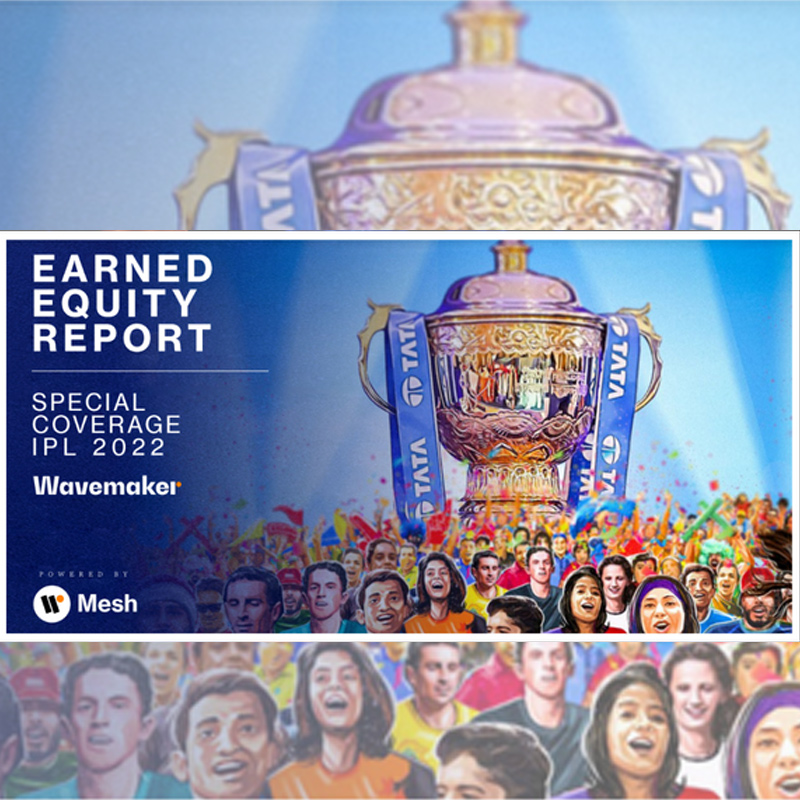
    Mumbai: The real-time data intelligence solution provider, Wavemaker MESH, has revealed an earned equity report on IPL 2022. The report captures the social conversations around IPL 2022 based on multiple data points collated to create meaningful and actionable insights. The report analyses how the audience perception of IPL has evolved over the years. It focuses on the digital audience and uses data points like consumption data around digital content and also social and search insights.

    The report has data sources from multiple consumer touch points across the digital ecosystem, ranging from social listening, video analytics in partnership with intuitive intelligence, and interaction data points collected from Facebook, Twitter, Instagram, and YouTube. The methodology behind measuring earned equity draws from social listening, content analytics, and audience measurement.

    Wavemaker plans to bring out an earned equity report on key properties, which will help brands add a qualitative layer to their decision-making process.

    Talking about the report, Wavemaker India chief content officer & GroupM India head of branded content Karthik Nagarajan said, “The perceived value of a property today is measured in a uni-dimensional way. ‘Earned Equity’ is Wavemaker’s way of quantifying the ‘digital perception’ and sentiment around it. Along with complementing the traditional media metrics, these earned equity reports will help brands decide their associations with premium events.”  

    Key highlights of the report:

    • When we talk about sporting events across the globe, the English Premier League emerges as the buzziest sporting event in the world. Just behind the EPL, we have the IPL, which has become the second-largest in the world and the buzziest sporting event in India. The popularity has been growing year on year and in 2022, with growth of over 300 per cent last year, the season garnered 334 million buzz, making it ahead of other global sporting events like the NBA, NFL, and Major League Baseball.
       
    • This season of IPL was unique in multiple ways, which is why the audience engagement was at its peak. After trailing in the number two spot for the past three consecutive seasons, RCB broke the jinx and emerged as the most popular team this season. The winner, ‘Gujarat Titans,’ was the sixth most popular team this season.  One more interesting fact is that RCB has only seven per cent of fans from Karnataka cheering for the team. This clearly shows that in this event, the loyalty is not with the city/state team but with the franchise.
       
    • IPL is growing as an opportunity for content creators and advertisers to engage with the audience. This season, the IPL received over 6.5 billion video views on digital platforms, representing a nearly 50 per cent increase over the previous year.
       
    • This rise in popularity corresponds to the media’s assessment. The popularity of this sporting extravaganza, along with potential growth rates of digital, is the reason why digital rights were sold more than TV for 2023–27.
       
    • For the third time in a row, Virat Kohli is the most popular player in the IPL 2022. The top three player spots have been the same for the last three years, with Virat, Dhoni, and Rohit on the leaderboard.
       
    • Amongst the advertisers, Vi continues to lead the advertiser leaderboard by being the buzziest brand around IPL 2022 for the fourth time in a row. The “Fan of the Match” campaign has become a critical engagement event for the audience. Tata, the title sponsor, garnered the second spot this season, followed by Vivo, Dream 11 and Unacademy.
       
    • IPL is synonymous with India’s Super Bowl and is the time of year when advertisers create engaging advertisements to make an impression on the audience. Creds had the top two most viral ads for “#Credbounty” this season, according to our technology partner Intuition Intelligence (Viral analytics and Insights provider). The nostalgia of the 90s content theme was the driving factor for the success. This was followed by the Cadbury 5 Star “#DoNothingLegend” ad, which incorporated humour around cricket’s third umpire.

  • TV Ad volumes of real estate sector rose by 68% in January-May’22: TAM AdEx report

    TV Ad volumes of real estate sector rose by 68% in January-May’22: TAM AdEx report

    Mumbai: Ad volumes of real estate category on television rose by 68 per cent during January-May’22 over January-May’20, while the growth was 42 per cent more than the corresponding period last year. According to a TAM AdEx cross media report on the real estates sector, advertising volumes for the category saw an increase of 2.8 times on radio during the period as compared to the same period in 2020, even as advertising space in print medium grew by two times during the same period. Ad insertions of the category on digital medium during the January-May’22 saw a rise of 5.5 times.  

    On television the top 10 advertisers accounted for over 40 per cent share of ad volumes during the half-yearly period in 2022 with the advertiser Subha Gruha Projects (India) having the greatest ad volumes in the category, with 9 per cent, as per the report. 300 exclusive brands advertised under the category as compared to 2021. 20-40 seconds and greater than 20 seconds ads together added 83 per cent share of the category’s ad volumes, the data indicated.

    News genre was the most preferred for the sector in the TV medium, with the genre alone hogging 82 per cent of the category’s ad volumes share followed by general entertainment category (GEC) in the second position. The best three channels got 97 per cent of advertisement volumes’ share for category in January-May ’22.

    News Bulletin was the foremost well-known program to advanced properties-real estate category brands on TV, with the top two program genres i.e. news bulletin and interviews/portraits/discussion together adding 66 per cent of the category’s ad volumes.

    In the print medium, Kedia Real Estate was the best promoter within the categories with two per cent share of ad space during January-May ’22. The top ten advertisers accounted for 15 per cent share of ad space. Over 6,000 brands were present in print during January-May’22 among which the top 10 brands had 9 per cent share of ad space. During the period, over 4,500 exclusive brands appeared under the properties-real estates category compared to Jan-May’ 21. English dialect was on top with 37 per cent share of ad space with Hindi following close behind with a 31 per cent share.

    Meanwhile, Kedia Real Estate was the top advertiser in radio too. The top ten promoters added 25 per cent share of ad volumes amid Jan-May ’22. The top ten brands added 18 per cent to the overall advertising space of the category on radio. Over 590 brands advertised exclusively during January-May’22 over January-May’21.

    In digital, the top ten advertisers had 42 per cent share of ad insertions during January-May’22 with Skandhanshi Infra Projects India being on top of the list adding 19 per cent share. Display Ads had more than 98 per cent share of category ad insertions during January-May’22.  Also, among the digital platforms, desktop display topped with 57 per cent share of ad insertions followed by mobile display with 39 per cent share, as per the report.

  • Reliance Jio adds 1.68 mn wireless subscribers in April: Trai

    Reliance Jio adds 1.68 mn wireless subscribers in April: Trai

    Mumbai: Reliance Jio added 1.68 million wireless subscribers at the end of April, as per subscription data by Telecom Regulatory Authority of India (Trai). Bharti Airtel added 0.81 million wireless subscribers during the same period. Vodafone Idea lost 1.56 million wireless subscribers in April.

    The total number of wireless subscribers increased from 1,142.09 million to 1,142.66 million in April. The wireless subscription in urban areas decreased from 624.23 million to 623.78 million. However, wireless subscription in rural areas increased from 517.86 million to 518.88 million.

    As per Trai data, there were 1013.81 million active wireless subscribers during the month. Reliance Jio had the highest number of active wireless subscribers at 378.85 million followed by Bharti Airtel at 352.68 million and Vodafone Idea at 222.33 million. BSNL had 59.31 million active wireless subscribers.

    As per information received from 657 operators in April, Trai found that total broadband subscribers increased from 788.30 million to 788.77 million. The broadband subscribers comprised 759.87 million mobile device users, 27.25 million wired subscribers and 1.18 million fixed wireless subscribers.  

    The top five broadband service providers were Reliance Jio Infocomm with 411.31 million subscribers, Bharti Airtel with 215.28 million subscribers, Vodafone Idea with 122.06 million subscribers, BSNL with 26.10 million subscribers and Atria Convergence with 2.08 million subscribers.

    The top five wired broadband service providers were Reliance Jio Infocomm with 5.63 million subscribers, Bharti Airtel with 4.85 million subscribers, BSNL with 3.80 million subscribers, Atria Convergence with 2.08 million subscribers and Hathway Cable and Datacom with 1.11 million subscribers.

    The top five wireless broadband service providers were Reliance Jio Infocomm, with 405.68 million subscribers, Bharti Airtel with 210.43 million subscribers, Vodafone Idea with 122.05 million subscribers, BSNL with 22.29 million subscribers and Intech Online with 0.21 million subscribers.

    The number of wireline subscribers increased from 24.84 million to 25.16 million in April.

    The number of telephone subscribers in India increased from 1,166.93 million to 1,167.82 million. Urban telephone subscription decreased from 647.11 million to 646.99 million. However, rural subscription increased from 519.82 million to 520.82 million.

  • Twitter to address Elon Musk’s demands by providing crucial tweet data

    Twitter to address Elon Musk’s demands by providing crucial tweet data

    MUMBAI: In a bid to end the standoff between the company and Elon Musk, Twitter will grant Tesla’s CEO unprecedented access to its “firehose” of public tweet data, The Washington Post reported. With this, the tech giant seeks to assuage Musk’s concerns over fake or automated accounts by yielding access to the firehose API, which contains ‘every tweet as it is posted.’

    Twitter’s firehose API, in its entirety, shows what a user would see if they followed every account on Twitter — although the sheer volume of data is impossible to obtain or analyse without automation. Due to its value for ad-targeting and platform surveillance, it is also one of the company’s most closely held resources.

    Firehose data could be immensely valuable as raw material for a study on automated activity. However, conducting a full study of automated activity would require significant time and resources, given the sheer scale of the data.

    Providing valuable data could help Twitter score political points over Musk, as the micro networking platform seeks to fend off Musk’s qualms over the number of bots or automated accounts on the platform, and ensure that he honours his part of the buyout deal.

    The news comes just days after the maverick billionaire once again threatened to back out of his deal to purchase Twitter, accusing it of failing to provide data on fake accounts.

    In his filing with the US Securities Exchange on Monday, Musk accused Twitter of breaching its April agreement by not providing him sufficient data on automated accounts, rejecting the company’s offer to provide more detail on its internal studies of the issue.

    Musk legally committed to purchasing Twitter in April this year, but since then has been increasingly vocal about growing bot activity on the platform, in what is seen by many as an attempt to renegotiate the deal on more favourable terms or cancel it altogether.

    ALSO READ |The Twitter-Elon Musk tussle: To be ‘bot’ or not to be

    “Twitter’s latest offer to simply provide additional details regarding the company’s testing methodologies is tantamount to refusing Musk’s data requests,” Musk’s representatives said in the filing. “At this point, Musk believes Twitter is transparently refusing to comply with its obligations under the merger agreement.”

    Despite all this, Twitter Inc. remains confident the deal will proceed as planned. In an internal meeting, a senior company executive assured employees that the deal was proceeding normally and set for a shareholder vote in late July or early August.

    Meanwhile, the networking giant’s stock continues to trade well below the $54.20 price set by Musk, reflecting market skepticism that the deal will go through as agreed.

    In response to Musk’s SEC filing, Twitter issued a statement earlier this week. “Twitter has and will continue to cooperatively share information with Musk to consummate the transaction by the terms of the merger agreement,” the statement reads. “We intend to close the transaction and enforce the merger agreement at the agreed price and terms.”

  • CAMM Summit 2022: Experts highlight the advantage of AI for marketers

    CAMM Summit 2022: Experts highlight the advantage of AI for marketers

    Mumbai: Artificial intelligence (AI)  has been a buzzword for a long time now! From content creation to customer support, AI is now everywhere. Interestingly, AI has also touched down the marketing industry. And to discuss the importance of AI and data in the marketing sector, the second day of IndianTelevision.com’s CAMM Summit and Exhibition 2022 witnessed an insightful panel discussion on the topic: ‘AI & Data – Your Tools for Better Efficiency.’

    Moderated by Pixis chief executive officer (Europe & APAC) Neel Pandya, the panel had marketing leaders including WATConsult managing partner Sahil Shah, Ferns N Petals chief technology officer Vasanth Kamatgi, Timex Group head of marketing & e-commerce Ajay Dhyani, and BFSI global technology leader Suresh A Shaan.

    Experts believe that AI can be very helpful in improving the data analysing speed and also to increase the efficiency of marketing campaigns. To begin with, Pandya explained his idea of AI. He feels AI is everywhere.

    How marketers look upto artificial intelligence?

    Taking the discussion further, he asked Dhyani if the Timex Group has ever integrated artificial intelligence approaches in their marketing campaigns?

    To which, Dhyani said that Timex Group has not used artificial intelligence in its marketing campaigns so far but they have come across various case studies and reports on how artificial intelligence is emerging and how companies across the sectors are using it.

    “We are excited to see the efficient use of artificial intelligence and are clearly looking to integrate it in our marketing campaigns,” he highlighted.

    Adding to it, Ferns N Petals’ Kamatgi said, “AI is a very powerful tool and it will change everything, from the way we live to the way we operate our business.”

    He further stated that Ferns N Petals started using AI back in 2018 for better product recommendation.

    Sharing the outcomes of using AI as a tool, he said, “we experienced mixed results, right now we need to work a lot to get better results because efficient use of AI requires smart applications and filtration of data and we are working in this direction.”

    He also told that Ferns N Petals recently concluded its annual business plan and artificial intelligence is going to be the biggest investment of the company. “We have a pipeline of 28 news cases that are supposed to go live in coming times. However, we have not decided the estimated time yet but we are working on it,” Kamatgi asserted.

    Explaining how they will integrate artificial intelligence in their marketing plan, he further said, “we will be applying AI for efficient product recommendations, classification of products, better search, product sequencing, multi-labeling and so on.”

    After listening from the marketers how they are using and planning to use artificial intelligence, Pandya highlighted how artificial intelligence has been helping the marketers. He said, “artificial intelligence is largely doing three simple things- automating the bidden budget which is currently planned manually, better customer targeting and creating more and more personalisation for the potential customers.”

    Metaverse – The next big thing in adtech world

    Shifting the conversation to the vision for the next step in the internet’s evolution – metaverse, Pandya asked WATConsult’s Shah, “Is metaverse or meta just a buzzword or are marketers really trying to do something which will help them and the industry?”

    “Metaverse is a fad to me,” Shah noted. “I am not sure if the metaverse is going to be there for a long time or not. We will get to know it with time.”

    He also said that after talking to a lot of gaming experts he realised that the term has suddenly become so popular after Facebook named its parent company as Meta. Otherwise the gaming industry has been operating in the metaverse for a long time.

    Furthermore, he shared how marketers are using metaverse. He said, “If we look from the marketing perspective, a lot of companies are now investing in metaverse. For example Nike opened a store which is just amazing. But the question is how many people are going to use it? And what is the return on investment in metaverse?”

    “The only concern here is the critical masses and consumers are not headed towards metaverse as of now,” he highlighted.

    How will marketers cope up with the cookie-less world?

    In the next part of the conversation, Pandya moved towards the most critical concern of marketers that is the removal of cookies. There’s been a lot of talk around how this announcement by Google will make it difficult for marketers to do audience profiling and reach out to the right audience at the right time.

    Throwing the next question to BFSI global technology leader Suresh A Shaan, Padnya asked, “how do you think a cookieless world is going to affect the ad and marketing world and how marketers will cope-up with the change?”

    Shaan answered, “now marketers need to switch to personalisation to a greater extent. People easily connect when the campaign is derived from an emotional perspective. Hence personalisation will emerge as a helpful tool for marketers.”

    Other panelists also agreed to him and shared how they are adopting personalisation. Sharing how marketers are going hyper personalised Shaan highlighted a few campaigns from Flipkart where the e-commerce company hired regional celebrities to go personalised for their consumers.

    Will artificial intelligence lead to job cuts?

    Concluding the session, Pandya asked one quick question to panelists, “Will artificial intelligence take away human jobs in the coming time..?”

    While Shah and Dhyani think that artificial intelligence will not take away jobs, Kamatgi thinks that it will definitely take away a few jobs. “I think in urban areas it will lead to a job cut but in rural areas it will not,” Shaan opined.

    “Well! I also think that artificial intelligence will not take away human jobs; rather it will add more power and liberty to manpower,” Pandya commented.

  • Reliance net profit jumps 41 % YoY to reach Rs 18,549 crores in Q3

    Reliance net profit jumps 41 % YoY to reach Rs 18,549 crores in Q3

    Mumbai: Mukesh Ambani-led conglomerate Reliance Industries Ltd (RIL) continued its golden run, and posted a net profit of Rs 18,549 crores for the third quarter ended 31 December 2021. This is an increase of 41 per cent from ₹13,101 crore reported a year ago during the same period.

    The company had posted a profit of Rs 13,680 crore in the September 2021 quarter.

    “I am happy to announce that Reliance has posted best-ever quarterly performance in 3Q FY22 with a strong contribution from all our businesses. Both our consumer businesses, Retail, and Digital services have recorded the highest ever revenues and EBITDA,” said RIL chairman and MD Mukesh Ambani on Friday.

    Ambani said the company continued to focus on strategic investments and partnerships across its businesses to drive future growth in the last quarter. “Retail business activity has normalised with strong growth in key consumption baskets on the back of festive season and as lockdowns eased across the country. Our digital services business has delivered broad-based, sustainable, and profitable growth through improved customer engagement and subscriber mix,” he added.

    The consolidated revenue for the company by market-capitalisation grew to Rs 1,91,271 crore, up by 62 percent for the quarter from Rs 1,17,860 crore in the year-ago period. Revenues in the previous quarter stood at Rs 1,67,611 crore.

    Reliance Jio’s revenue rise five per cent at Rs 19,347 crore

    The net profit of Reliance Jio, the telecom arm of the company rose 10 per cent YoY to Rs 3,615 crore for Q3. It was Rs 3,291 crore in the last year period. The revenue rose five per cent at ₹19,347 crore as against ₹18,492 crore in the last year period. “Jio now has over five million connected wireline customers and has been consistently enhancing its FTTH product with new apps on STB, Society Centrex, 4K content on JioTV+, Home Secure, Home Automation, LiveTV and Gaming solutions,” the conglomerate said.

    Jio also undertook ~20 per cent hike across prepaid plans effective 1 December 2021 in line with other industry operators. According to the company, while the ARPU is set to improve to Rs 151.6 led by a better subscriber mix and recent tariff hike, the full impact of tariff hike will be reflected in ARPU and financials over the next few quarters. During 3Q FY22, average data and voice consumption per user per month increased to 18.4 GB and 901 minutes, respectively.

    Meanwhile, Jio continues to maintain its top position in the 4G speed chart with a 22.0 Mbps average download speed in December 2021, according to the latest Telecom Authority of India (Trai) report.

    Ambani also highlighted that the recovery in global oil and energy markets supported strong fuel margins and helped its O2C business deliver robust earnings. “Our Oil & Gas segment delivered strong growth in EBITDA with volume growth and improved realisation. We are making steady progress towards achieving our vision of Net Carbon Zero by 2035. Our recent partnerships and investments in technology leaders in the solar and green energy space is illustrative of our commitment to partner India and the World in the transition to clean and green energy. We continue to pursue growth initiatives and collaborate with global leaders who share our vision of a sustainable future for our planet,” he added.

  • Discovery Inc invests in advanced TV ad company OpenAP

    Discovery Inc invests in advanced TV ad company OpenAP

    Mumbai: Discovery Inc has joined FOX, NBCUniversal, and ViacomCBS to buy a minority stake in OpenAP, the advanced advertising company which is working on a goal to “bring simplicity and scale to audience-based campaigns in television. The decision comes as media companies worldwide look for improved ways of audience measurement.

    The joint venture created by several media industry giants, centralises data activation on behalf of premium national TV publishers, bringing efficiency and scale to audience-based campaigns.

    The recent announcement furthers Discovery’s strategy of building a technical framework that enables cross-platform audience-based buying and creating collaborative support for alternative currency standards, it said in a statement. The factual-life entertainment giant will join OpenAP’s board of directors with chief US Advertising sales officer Jon Steinlauf, and executive VP digital ad sales and advanced advertising Jim Keller, both representing the company.

    “Discovery is excited to take an active role shaping the future of advanced audience buying,” said Discovery’s executive VP digital ad sales and advanced advertising Jim Keller. “Given our current momentum, influence, and growth of audience-based sales, we believe Discovery can help further the work OpenAP has been doing to initiate meaningful change in the market.”

    The investment signals an expansion of Discovery’s existing relationship with OpenAP, having integrated with the central TV identity spine, OpenID in April last year, and more recently partnering with OpenAP on the launch of XPm, the publisher-backed cross-platform measurement framework. For OpenAP, it will help further its ability to grow the overall market for audience-based advertising and expand the breadth and scale of its services across cross-platform identity, measurement, and planning.

    “Discovery has long been a pioneer of TV entertainment with its iconic portfolio of content and direct-to-consumer experiences people love. The last two years have demonstrated the force of change that can happen when we take an audience-first approach to reimagining TV advertising for media owners, advertisers, and consumers alike,” said OpenAP CEO David Levy.

    In a joint statement, FOX senior VP, data strategy and sales innovation Dan Callahan, NBCUniversal president, and chief business officer Krishan Bhatia, and ViacomCBS COO – advertising revenue John Halley at ViacomCBS, stated that Discovery’s commitment further validates OpenAP’s mission and builds on the success and scale of our collective organisations work to build a more advanced model for TV advertising that focuses on audiences.  “OpenAP has been a catalyst for bringing programmers and marketers together to change the model, and we’re proud to now have Discovery join us to accelerate these efforts,” they added.

  • HUL top advertiser in week 50: Barc

    HUL top advertiser in week 50: Barc

    Mumbai: Hindustan Lever (HUL) has emerged as the top advertiser in week 50 (11 December to 17 December) in the recently released weekly Barc data. The FMCG giant delivered ad volumes of 3466.83 (‘000s), slightly less than last week’s 3975.65. Reckitt Benckiser (India) was second with 3439.56 (‘000s). At 1100.13 Ponds India finished third.

    The top three firms were followed by Cadbury’s India, Godrej Consumer Products, and Marico. Facebook Inc – the only digital brand in the FMCG-dominated list which was at the tenth position last week was at number seven in week 50. The remaining three spots were grabbed by Brooke Bond Lipton India Glaxo SmithKline and Procter & Gamble.

    Harpic Power Plus 10X Max Clean led the brands’ list with ad volumes of 593.78. Lizol and Ultratech Cement jumped to the second and third slots from their last week’s positions at number four and five respectively.

    They were followed by Dettol Antiseptic Liquid, Harpic Bathroom Cleaner, Instagram Reels (No.10 in week 49), Clinic Plus Shampoo, Veet Men Hair Removal Cream, and Dettol Disinfectant Spray. The consistent top-performer Horlicks finished last this week.

  • GUEST COLUMN: Top marketing trends brands may need to adopt in 2022

    GUEST COLUMN: Top marketing trends brands may need to adopt in 2022

    Mumbai: With the rising internet and smartphone penetration and social media usage, especially in tier-II and tier-III cities, the way brands engage with their clients has irrevocably changed. Digital adoption has been the primary focus for marketers in 2021, with a myriad of trends appearing in the marketing industry, including growing online shopping, technology-integrated operations, and so on. With this backdrop in mind, here are some of the most essential marketing trends to watch in 2022.

    Influencer marketing

    Once known as an additional leg to a brand campaign to gain social media visibility, influencers have expanded their audiences and now are driving the communication strategy for many brands. Millennials and Gen Z customers religiously follow influencers on social media, considering them to be highly relatable in terms of content they share. Various brands are already banking on this trend, collaborating with influencers to promote their products and services. The coming months will see more marketers and advertisers follow suit increase brand exposure and garner fans from the influencer’s audience. In fact, several businesses are developing technologies that will enable influencers to create their D2C brands, resulting in creating a micro-entrepreneur ecosystem.

    First-party data will become relevant

    Until recently, most marketing platforms have relied on third-party cookies to collect consumer data. These insights help them understand the evolving shopping patterns of customers and accordingly modify their ongoing marketing activities. However, with rising privacy concerns, the new legislation has initiated restricting the use of third-party consumer data sources. Given this, first-party data will become more relevant than ever. As a result, organisations should enhance their existing data practices and partner with platforms that have extensive first-party data. Doing so will not only give them access to quantitative insights but also help them craft innovative marketing campaigns that are tailored to the intent of consumers.

    AI-powered conversational marketing

    As technological advancements continue to evolve, consumer behavior, interests, and expectations will keep changing at an accelerated pace. Today’s consumers aren’t satisfied with simply appealing websites or products. They are always looking for something new, desiring more personalised, engaging, and immersive shopping experiences. Brands must therefore modify their customer interaction strategies to generate interest, engage buyers, and convert demand to flow in sync with the new customer journey.

    Many brands are implementing conversational AI technologies such as chatbots and voice assistants that can understand and speak vernacular to provide an enhanced experience and strengthen brand-customer relationships.

    Short-form content

    Long-form videos make consumers reluctant to watch and consume content about the brand and its products, pushing them away rather than attracting and retaining them. But fitting well with the fast-paced attention spans of Millennials and Gen Z consumers across several demographics, short videos have gained substantial traction, contributing to an overall increase in e-commerce. As a result, major e-commerce platforms are shifting their focus to short-form content to create more engaging purchasing experiences.

    Mobile-friendly digital experiences

    With over 600 million internet users in India, it’s no wonder that people are spending more time on their smartphones and tablets. And, as millennials and Gen Z audiences, who like to explore and buy across a range of devices, increase their purchasing power, the problem of providing a & seamless experience across all devices — particularly on mobile — will get more complicated. So, it is pivotal for marketers to recognize that mobile-friendly digital experiences are more important to consider, and accordingly create meaningful user experiences to drive brand awareness.

    Conclusion

    The Covid-induced quarantine and consequent isolation have redefined the consumer expectations and how they interact with brands. Improving customer satisfaction is the most accessible approach to distinguish yourself from the increasing e-commerce crowd. And catalysed by the pandemic, the aforementioned trends will continue to thrive in 2022, which is why you should start experimenting with different advertising strategies to keep customers happy and delighted at every point possible.

    (Vijay Kumar Mikkilineni is TCL India marketing head. The views expressed in the column are personal, and Indiantelevision.com may not subscribe to them.)

  • GUEST COLUMN: SEO trends that can be game-changers for the business

    GUEST COLUMN: SEO trends that can be game-changers for the business

    Mumbai: Search engine optimisation (SEO) is the practice of improving your site’s data to increase its traction when people are looking for products or services that are related to your business in search engines such as Google, Firefox, Bing. Yahoo, etc. This is facilitated by the result pages that pop up when a person types a particular keyword in relation to their search. The better visibility your pages have in search results, the more likely you are to garner attention and attract prospective and existing customers to your business.

    How does it work?

    Major search engines such as Google and Yahoo use virtual bots to crawl through different web pages, collecting and analysing data that is then refined into an index. This index acts as a bank of information that possesses data collated from web pages. The algorithms within this index then categorise the collected data by filtering the information that is requested by the user. The final results page is a result of hundreds of ranking factors or signals, determining the order of the pages that should appear in the search results for a given query. This intensive process is carried out in helping the user find an exact match to their keyword search. The success of your SEO depends on how user/keyword-friendly your website data is.

    How important it is from a marketing perspective

    SEO plays a critical role within digital marketing because people search for a trillion things in a day, often with a commercial interest in a certain product/service. ‘Search’ is a primary way of generating digital traffic towards your website, making it an essential part of your digital marketing strategy. Greater visibility and higher search rankings than your potential competitor can have a material impact on your ultimate goal. To summarise, SEO lays the foundation of a holistic marketing ecosystem.

    Changing Trends

    Since the internet culture is so dynamic, its tools and practices are constantly evolving. SEO is no exception as the concept is subject to so many technological advancements on a daily basis. The algorithms change frequently, keeping the businesses and digital marketers on their toes. This is why being aware of what’s coming down the pipeline is extremely important. It can help a business plan prevent possible penalties or a massive drop in its site’s ranking.

    Mobile SEO: With an uncontrollable smartphone penetration, more and more people are getting their hands on a smarter cellular device. The one that allows them to do more than just calling, texting people. Billions of people conduct searches via their phones, making it a key target area for digital marketers. It has now proven to become one of the more influential SEO areas than a desktop. If you’re doing SEO for desktops and not for mobile, it might have a better impact on your desktop rankings however, your mobile rankings could be abysmal. Moving forward, marketers will have to focus on both desktop and mobile SEO to maintain their positions in the search pages.

    Voice Search: With virtual assistants such as Siri and Alexa getting smarter by the day, voice-search interaction is definitely going to be the next big thing within the SEO market. It is going to revolutionise the way you interact with search engines. Virtual assistants and AI are on their way to making the search process more user-efficient by providing answers to questions prior to users asking them. This path-breaking technology is expected to transpose the SEO landscape for many businesses.

    Intentional Content: This SEO trend/technique is evergreen. It creates the basis of your search results ranking. Unless you have content that is meaningful and relevant to the consumer, no level of optimisation could help you attract traffic to your website. A digital marketer needs to curate best-in-class intent content by keeping the user in mind. This can only be achieved after a comprehensive study of current keyword trends, followed by rigorous competitor analysis.

    Video Content: YouTube has been increasingly impacting the SEO rankings of many businesses. This makes one realise the importance of effective video content within a digital marketing strategy. Analysts and marketers highly suggest that these videos should promote the target keywords and be optimized for search. Embedding a video on your landing page that targets the same keyword could also prove beneficial in this regard.

    (Anoushka Adya is founder of Di-mention Studios, a digital marketing agency. The views expressed in the column are personal and Indiantelevision.com may not subscribe to them.)