Tag: DAS

  • Howrah’s DAS travails

    Howrah’s DAS travails

    KOLKATA: To DAS or not to DAS? That is the question in West Bengal’s Howrah.
    Howrah, which is among those regions that are under phase II of DAS, has seen the implementation of DAS in only around 40 per cent of the million or so cable TV connections that dot the district.

    The remaining 60 per cent continues to be stuck watching analogue cable TV services. Subscribers have been loathe to pick up a set top box (STB) as local cable TV operators have clearly assured them that they fall under Howrah district and not Howrah city.

    A Howrah resident Rohan Das when contacted says: “I don’t mind buying the set top box (STB) but my operator has informed that it is not necessary to buy now.”

    Sources further add that not enough is being done to monitor or police how cable TV is making the transition to digital in Howrah. Cable Operators Digitisation Committee of the Association of Cable Operators convener Swapan Chowdhury confirmed that there is slackness in the DAS rollout.

    Manthan director Sudip Ghosh pointed out that things are doing well in “Howrah city which has around five lakh cable TV connections; most of these have been digitized. More over the CAF collection has also been completed by many, while some are doing it now.”

    Manthan has installed 20-25 per cent STBs in the region out of the four to five lakh STBs. Ghosh clarified that “Howrah district and Howrah city are different.”

    SitiCable Kolkata director Suresh Sethia also confirmed that the company has completed the work as mandated by TRAI. He however added, “TRAI has to define whether the border of Howrah falls under phase II or not. The regulator has to clarify the DAS area.”

    SitiCable controls a sizeable chunk of cable TV viewers in the region. It should be noted that broadcast regulator TRAI has extended the deadline for collection of Consumer Application Forms (CAF) in phase II cities including Howrah by MSOs to 15 November from its previous deadline of 30 September. MSOs operating in Howrah vicinity confirm that they will meet the deadline.

    While cable TV analysts say that CAF forms have not been received by many cable subscribers due to festive holidays – firstly, Durga Puja, and now Kali Puja followed by Diwali. “LCOs and MSOs will be back to work only after these are over.” 

  • Decks cleared for JAINHITS to get TV signals of MSM Discovery, ESPN and SUN channels

    Decks cleared for JAINHITS to get TV signals of MSM Discovery, ESPN and SUN channels

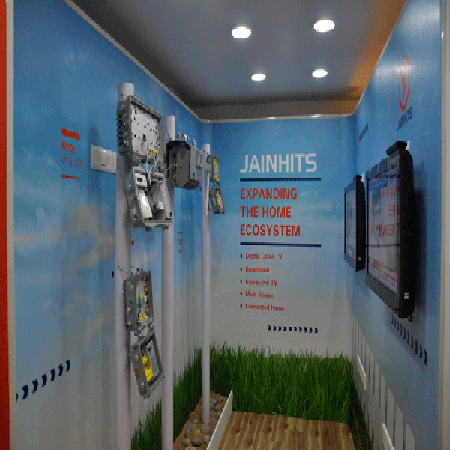
    NEW DELHI: In less than two months since Media Pro Enterprises India was given directions to supply the channels it distributes to JAINHITS, the country’s only headend-in-the-sky (HITS) platform, the Telecom Disputes Settlement and Appellate Tribunal (TDSAT) today directed Sun, Sony (MSMD) and ESPN to provide their television channel signals to the platform by this evening.

    The three channel aggregators between them provide more than fifty prominent channels, but had been delaying giving their channels to Noida Software Technology Park Ltd (NSTPL) – which manages JAINHITS – which had approached the authorised content aggregator for these channels owned by Sony, Sun and ESPN.

    TDSAT Chairman Justice Aftab Alam and member Kuldip Singh were not impressed by the argument that all operators had created fresh Reference Interconnect Offer for HITS which was yet to get the clearance of the Telecom Regulatory Authority of India (TRAI). They asked the counsel for respondents whether this did not amount to breach of violation of section 3.2 of the Digital Access System (DAS) regulations of the cable interconnect agreement.

    With this, JAINHITS will now be able to transmit over 250 channels to consumers all over the country. The 12 September order relating to Media Pro had brought a total of around 75 channels into the JAINHITS fold.

    The only satellite-based platform for the distribution of digital TV channels, NSTPL is currently the only distribution platform of TV channels that is providing advanced HITS services to consumers through local cable operators.

    NSTPL founder and chairman of Jain TV Group Dr. J.K. Jain said, “The mission of JAINHITS is to build and operate digital highways in collaboration with cable network owners. We thank TDSAT for the ruling as this is an important announcement not only for the 60,000 cable operators across the country but also to the consumers. Without proper digitisation, government is losing huge revenue.”

    Senior counsel for NSTPL Vivek Chib told indiantelevision.com that this order would not only be in the larger interest of the government’s digitisation policy, but would ultimately benefit the end-user with greater choice and better quality.

    NSTPL had filed the petition under sections 14 and 14A of the TRAI Act 1997 seeking directions to enter into the Interconnect Agreement on mutually agreed terms or in case the two sides are unable to come to any mutually agreed terms, as per the respondent’s Reference Interconnect Offer (RIO) and to provide to it the content/TV channels under the latter’s control.

    NSTPL obtained from the Information and Broadcasting Ministry in 2003 the licence to establish, install, operate and maintain “headends in the sky” system to provide digital cable services in India. Apparently, the licence was granted even before provisions were made for accommodation of the HITS operator in the regulatory framework. Suitable provisions were made in the regulations to accommodate the HITS operators.

    NSTPL claimed that it had even got its system checked by the Broadcast Engineering Consultants (India) Ltd.  

  • TDSAT admits petition by LCOs wanting right of billing under DAS

    TDSAT admits petition by LCOs wanting right of billing under DAS

    NEW DELHI: Cable operators in the state of Maharashtra have got a head start regarding the billing system for cable television under DAS that MSOs are planning to put into effect. The Telecom Disputes Settlement and Appellate Tribunal (TDSAT) has accepted its petition and the case filed by the Nasik District Cable Operators Association of Maharashtra will come up for hearing on 22 November.


    Counsel Vikram Singh submitted that while the services were being provided by the local cable operators, the billing was meant to be done by the multi-system operators under the Standards of Quality of Service (Digital Addressable Cable TV Systems) Regulations 2012 of the Telecom Regulatory Authority of India.


    TRAI counsel Saket Singh sought to argue that LCOs cannot approach TDSAT as they are not service providers. However, the Bench of Member Kuldip Singh admitted the case for hearing and asked TRAI to file its counter-affidavit.


    It has also been stated in the petition that cable TV operations cannot be equated with telecom services since there was only one service provider for mobiles while there were the MSOs and the LCOs in television.


    Regulation 14 of the Regulations issued on 14 May 2012 says ‘Every multi-system operator shall offer cable TV services on both pre-paid and post-paid payment options to the subscriber and shall be responsible for generation of bills for the subscribers.’


    Regulation 15 says ‘Every multi-system operator either directly or through its linked local cable operator, as the case may be, shall give to every subscriber the bill for charges due and payable by such subscriber for each month or for such other period as agreed between the parties, for which such charges become payable by the subscriber.


    The LMOs in Maharashtra have been fighting against the alleged dominance shown by MSOs by imposing restrictions on them as well as dictating terms relating to billing practice. A cable TV blackout was also held in various parts of the state from 6pm to 9pm on 2 October as a sign of protest.

  • Channel UFX signs on Aidem Ventures for its ad sales

    Channel UFX signs on Aidem Ventures for its ad sales

    MUMBAI: Channel UFX, the youth entertainment and music channel catering to the South market with its edgy, across-the-board programming mix, has commissioned its ad sales duties to Aidem Ventures.

    Usman Faheed feels with a large team of people who are media as well as genre specialists Aidem Ventures will help them become a stronger brand

    Channel UFX offers a mélange of meticulously crafted programming from international to Bollywood and South Indian music. It maintains competitive standards with a dash of Indian flavour. VJ Paloma, Sherif, Rochelle and Craig hosting talk shows, reality shows, game shows, celebrity interviews, gossip segments, automobile, technology, food and fitness features, exciting contests, trivia, laugh out loud segments and voyages into the lives of the rich and famous, is what Channel UFX is all about. It is a whole new world of boundless entertainment and spectacular visual extravaganza. It is a one-stop-channel for all things Youth.

    The 2013 line-up consists of four fresh, new shows over and above the regular line-up. There’s a show called Tech In. Mobiles, gaming consoles, software, mp3 players, notebooks is what this show is all about. It features new arrivals; tips on how to care for gadgets and an exclusive gaming segment featuring a variety of games that are currently in vogue.

    Vikas Khanchandani believes the channel is going to reconstruct market boundaries to create and capture an enormous new segment

    Another new show Voices allows people to record their video requests, ask questions to celebrities using the cameras on their cell phones or computers. The channel then plays these videos along with the names of those participating, followed by video clips of the celebrities responding to those questions. On Ground features different colleges, their structure and geography, moves onto student achievers and talents and lastly identifies the current celebrities and personalities who passed out of the same college. The Boss is another exciting new show about successful businessmen, entrepreneurs and professionals discussing their vision, obstacles faced, future plans etc.

    As of today, the channel reaches out to 95 per cent of Tamil Nadu. It is available on four out of the six key DAS operators in Chennai. Outside of Chennai, Channel UFX is available on Arasu Cable. In Kerala, it is available on KCCL which covers 60 per cent of the market. In Karnataka, the channel is available to two major networks i.e. DEN Network & All Digital. As for Andhra Pradesh, the channel is currently available in Vishakhapatnam and will soon be distributed across the state.

    Internationally, Channel UFX has been made available on E-Vision starting today. E-Vision covers all of the Middle East. Our channel has been recording a good amount of online viewership by viewers in US and UK as well.

    Channel UFX is an exciting and vibrant option for brands looking at targeting the 15-34 age groups says Nikhil Sheth

    Announcing the association, Channel UFX MD Usman Faheed said, “The Aidem team possesses a great amount of expertise in every business facet be it developing the right positioning & pricing strategies for the media, developing sponsorship packages, identifying all possible revenue streams to going out and generating revenues. From news and infotainment to movies, general entertainment and music, they are a large team of people who are media as well as genre specialists. We are glad to be associated with them.”

    Aidem Ventures director Vikas Khanchandani added, “Channel UFX is a very interesting channel that not just entertains the youth but also encourages them to be informed, global citizens. Its broad appeal taps into the tastes and interests of every young adult.This channel is going to reconstruct market boundaries to create and capture an enormous new segment.The team is very excited about the channel.”

    “UFX is unparalleled youth destination that is all set to disrupt the status quo of marketing to the youth in South India. There isn’t a similar option available in South India. Considering South India is the most literate zone in the country, Channel UFX is an exciting and vibrant option for brands looking at targeting the 15-34 age groups,” said Aidem Ventures business head Hindi Entertainment & Niche channels Nikhil Sheth.

  • TRAI notifies draft DAS tariff & interconnect rules

    TRAI notifies draft DAS tariff & interconnect rules

    NEW DELHI: The Telecom Regulatory Authority of India (TRAI) has made life a little simpler for MSOs. Last weekend (20 September 2013) it notified the amendments to interconnection regulations applicable for Digital Addressable Systems (DAS) and also to the tariff order for DAS the drafts of which it had released for industry consultation on 4 June 2013. 

    It has some further changes following industry feedback. Amongst these include: 

    * The removal of the minimum channel carrying capacity of 500 channels for MSOs.

    * It has clarified that subscribers can either opt for channels on a-la-carte basis or bouquet or combination of both, as per their choice. 

    * It has disallowed MSOs from seeking a channel from a broadcaster while at the same time seeking carriage fees from it. 

    * It has forbidden MSOs from charging placement fees. 

     The amendments in the Telecommunications (Broadcasting and Cable) Services (Fourth) (Addressable) Systems) Tariff (Second Amendment) Order 2013 modify the ‘twin conditions‘ that regulate the a-la-carte rate of channels vis-a-vis the bouquet rates at retail level protecting subscribers’ interests. It also clarifies the position that subscribers can either opt for channels on a-la-carte basis or a bouquet or a combination of both, as per their choice. 

    Considering the fact that the operators would be required to make appropriate changes, both in pricing and packaging, the Authority has decided to make the ‘twin conditions’, prescribed through this tariff order mandatory with effect from 1 January 2014. However, during the period from the notification of this tariff order till 31 December 2013, operators would be required to offer channels, complying to either of the two conditions, specified in the ‘twin conditions’. 

    The operators are, however, free to make their offering, complying to the ‘twin conditions’, if they wish to do so before 1 January 2014. 

    Further, in case a channel forms part of more than one bouquet then the above conditions will have to be satisfied for all such bouquets. Further, if the operator offers discounts to its subscribers on bouquet rates, the above said ‘twin conditions’ should also be satisfied with such discounted bouquet rates. 

    Therefore, the Authority felt it appropriate to extend the a-la-carte provisioning of channels to cover both the FTA and pay channels carried over the network of an operator.

    Accordingly, vide the tariff amendment order dated 30 April 2012, it was mandated that every operator providing services to its subscribers using an addressable system shall offer or cause to offer all channels, whether pay or FTA, offered by it to its subscribers on a-la-carte basis. In sync with this provision, the word “pay” has been deleted from the heading of clause 6 and also from the clause 6(2) of the principle Tariff order dated 27 July 2010. With the removal of word ‘pay’, an operator can specify a minimum commitment period, not exceeding three months for both ‘pay’ and ‘FTA” channels, subscribed on a-la-carte basis. 

    The TRAI has noted that “it has been observed that, some of the DTH service providers have been imposing pre-condition for subscribing to a particular bouquet before add-on-bouquets and/or a-la-carte channel(s) can be subscribed. The Authority is of the view that such conditions are unreasonable and the consumer should be free to choose any combination of the channel(s) or bouquet(s) offered by the operator. In the tariff amendment order dated 30 April 2012, a provision was made which allowed the DAS subscriber to subscribe to basic service tier or basic service tier and one or more pay channel or only free to air channels or only pay channels or pay channels and free to air channels at his option i.e. consumer is free to choose any combination of the channel(s) or bouquet(s) offered by the operator. 

    Accordingly, sub-clause (4) of clause 6, applicable for addressable platforms other than DAS, has been suitably amended and a proviso has been added to bring in parity amongst various addressable platforms as well as to ensure that consumers of these platforms are on equal footing. 

    The Interconnection Regulation applicable for DAS has the following safeguards with regard to charging of carriage fee: carriage fee to be transparently declared in the RIO of the MSO; the carriage fee is to be uniformly charged; the carriage fee not to be revised upwardly for a minimum period of 2 years, and the details of the carriage fee are to be filed with the Authority and the Authority has a right to intervene in cases it deems fit. 

    The Authority has decided that the phrase “having the prescribed channel capacity” appearing in sub-regulation 3(2) of the Telecommunication (Broadcasting and Cable Services) Interconnection (Digital Addressable Cable Systems) Regulations 2013  should be deleted as the same will have no relevance with the deletion of the minimum channel carrying capacity criteria from the regulations.

    For the time being, the Authority has decided not to specify the capacity to carry a minimum number of channels by the MSOs, on the expectation that market dynamics will take care of the emerging situation. However, in the event the Authority notices that the market dynamics are not allowed to function freely by the service providers, resulting in creation of an artificial capacity constraint, it will intervene appropriately. 

    Analysing the issue of placement fee, TRAI has noted that the DAS technology provides for an Electronic Programme Guide wherein the channels being carried on an MSO’s network can be arranged in a simple, easy to understand, manner so that the subscriber can easily go through this guide and select the channel of his choice instead of flipping through all the channels.

    The genre-wise display of channels in the EPG, where all the channels of a particular genre are listed under relevant genre, has been mandated through regulations. Moreover, in digital systems, signal quality of the channels is independent of the placement of the channel. 

    Further, the Interconnection Regulation already has a provision (sub-regulation 3 (11)) that if an MSO, before providing access to its network, insists on placement of the channel in a particular slot or bouquet, such precondition amounts to imposition of unreasonable terms. Thus, adequate provisions already exist in the regulations. Accordingly, sub-regulation 11A of regulation 3 of the interconnection regulation has been deleted. 

    The amendments follow a judgment of the Telecom Disputes Settlement and Arbitration Tribunal and a consequent fresh consultation paper by TRAI and reactions on it from stakeholders. 


  • Bengal’s broadcasters battle ad slowdown

    Bengal’s broadcasters battle ad slowdown

    KOLKATA: Last week, if one followed the rupee-dollar crisis anything close to a heart attack was inevitable. Thanks to the economic upheaval and slowdown thereafter, the media industry is going through a rough patch.

    Bengali general entertainment channels (GECs), news and other TV channels are seeing a downward trend in ad spends. The urge to splurge is giving way to an urge to curb spends and the Bengali TV ad market is expected to remain flat at last year‘s Rs 700 crore, according to media analysts.

    The largest chunk of this revenue, which is anything between 35-40 per cent, comes from non-banking financial institutions (NBFCs). However, that has melted down, because of a loss of investor confidence in NBFCs. The experts say that the change has come in after the Saradha Group’s chit fund scam that occurred in the beginning of the current financial year.

    “Many other companies which are engaged in money marketing have reduced their ad spends too. Firstly, to stay away from the authorities’ menacing eyes and secondly, they seem to think even after spending a huge amount on advertising, investors are not gullible enough to put in their hard earned money into the chit fund schemes,” says a media buying professional who didn’t want to be named.

    A slowing economy hits smaller companies first as they don‘t have enough resources to get through the downturn. And hence, the first steps taken by them is pulling the noose on marketing and ad spends.

    “The main spenders for ads in the electronic media are the chit fund companies. With these companies now lying low or some even going bust, the regional channels are bleeding badly. And even channels as big as 24 Ghanta and ABP Ananda aren’t spared. If one looks at the current situation in the news genre, the two popular vernacular channels – 24 Ghanta and ABP Ananda – do a monthly business of around Rs 2 crore as compared to Rs 2.5 crore garnered earlier. Hence, they are coming up with several attractive advertising packages to lure clients,” informs a media analyst.

    Some of the main advertisers on these channels are Japani Oil, Chayya Prakashini, Rice Group??? . However, their spends have not managed to compensate for the loss of chit fund advertising and are not adequate enough for the news channels to meet their operational expenses. “These channels must devise their strategies to remain afloat in the market,” media managers added.

    George Telegraph Group, engaged in education, earmarks around Rs 2 crore as its annual ad budget. “We allocate 75 per cent to the print media and in the electronic media, we advertise on mainly news channels and some music channels,” says George Telegraph Group director Atin Dutta. He goes on to add that the group doesn’t advertise much in the month of October because the admission season is over and there is too much clutter during the Puja.

    Kolkata TV editor-in-chief Biswa Majumdar says: “Most of the TV channels whether big or small are in trouble as their ad revenues have gone down by at least 30 per cent due to the slowdown and clients not spending much on regional media.”

    “Within the Kolkata market wherein city-based advertisers contribute almost 25 per cent of the total revenue (Rs 700 crore), the advertising rate is Rs 1,000 per 10 seconds .It is likely to remain the same this year as well. Soon, we all would have to come out with packages. Also, there is a need for national advertising to spread out to regional channels as well,” says Akash business editor Amitabava Banerjee.

    Kolkata TV‘s Majumdar says that the financial scene is so bad that till now nobody has started booking for the festive season (Durga Puja) as well. “The scene is dire with no signs of recovery,” he says.

    Pipalmajik CEO and founder CM Mitra says: “When sales of the companies go down due to downturn, promotion related ads are adopted by companies to increase the topline. Retail and FMGCs are likely to spend on such promotions to liquidate their stocks.”

    Also, with Digital Addressable System (DAS) in place, customers are going to opt for their preferred channels. Therefore, smaller and not-so-popular players will perish.

    GECs gain as others lose

     “In the current year, around Rs 550 crore would be bagged by the GECs while the rest will be split between news, movies and other channels,” asserts media analyst Mrinal Chatterjee.

    “The GECs continue to dominate the canvas of Kolkata television ad  market, with high production values and a robust content bank based on local programming,” he adds.

    BPN India executive VP Mahesh Motwani too feels that considering the viewership trends in Kolkata, GECs will continue to attract more ads than any other TV genre.

    The trend of the maha episode was started by the Late Jishu Dasgupta in his serials likeKuhasha Jhokon and Tithir Athithi on ETV Bangla in the late 90s and has been copied by other GECs like Star Jhalsa and Zee Bangla now. “Clients can spend crores to catch the attention of the TV viewers who are glued to their screens to know what would happen next!” adds Motwani.

    “We Bongs don’t allow ourselves to be deprived of fish in our daily meal, so how could any fast-moving consumer goods brand manufacturing mustard paste let an opportunity go past an audience who are big time foodies?” feels consultant Sayan Chatterjee. He adds that FMCG companies would and should spend on marketing and advertising no matter how bad the economy is.

    Talking about cable TV advertising, Chatterjee, who is also the convener of the Cable Shilpa Bachao Committee, said it has been on the up.

    For GECs, the clients’ aim is to place spots between 7:30 pm and 11:00 pm and for news channels the preferred slot is between 7:00 pm and 9:00 pm, inform media managers.

    Furthermore, with just 40 days to go for Durga Puja, undoubtedly, it is the time for local and national conglomerates to reach out to the hearts, sentiments and pockets of every Bengali family via the Bengali media.

    However, this time, from all indications, it appears as if most of the players in Bengal‘s broadcast space will be in not as celebratory a mood as in previous years. Is the goddess listening?

  • Kolkata based MSOs, LCOs receive summons from service tax department

    Kolkata based MSOs, LCOs receive summons from service tax department

    KOLKATA: The Kolkata based Multi System Operators (MSOs) and local cable TV operators (LCOs) had uninvited guests last week. They were taken by surprise when the service tax officials conducted two raids to probe into their alleged financial irregularities. And, this in a digital addressable system (DAS) cable TV ecosystem which reveals the business and operations of these players at length.

    Apart from service tax, the income tax department also searched the premises of one of the big MSOs. And if sources are to be believed, the MSO made an upfront payment of around Rs 50 lakh – Rs 75 lakh to the income tax authorities.

    More than 350 cable operators have been issued summons for evading service tax payments for the past five years, sources said. “As per market reports two MSOs were raided last week, who then had to cough up huge amounts to the service tax authorities. The officials questioned the accountant of the MSOs on the financial details,” said a cable TV industry insider.

    It is also learnt that another MSO who had evaded service tax amounting to Rs 15 crore – Rs 20 crore spanning over four years, had to cover up the case by paying a huge amount to the authorities. “It is learnt that the company deposited a huge amount, though I am unsure of the exact amount,” the source added.

    Though the second MSO, whose office was raided on Thursday paid Rs 2.5 crore (approximately) to the service tax department officials. “Another Rs 50 lakh – Rs 75 lakh was given to the income tax department,” he informed.

    “The raid was part of a probe into financial transactions for suspected alleged tax evasion by the cable TV operators in Kolkata,” he said.

    A cable operator under Gujarat Telelink, an MSO, informed that as per the summons, the operator has to furnish details of the number of set top boxes installed and also the account details for the past five years. “If we don’t furnish it, we might be in trouble,” he said.

    Cable industry sources inform that cable TV operators are liable to pay 12.36 per cent as service tax to the authorities from the subscription amount collected every month from the customers.

    Kolkata based operators are treading in troubled waters. First it was the Telecom Regulatory Authority of India (TRAI) which planned to take strict action against the MSOs and LCOs for not collecting and feeding the CAF details into the system for DAS implementation and now they face the wrath of tax inspectors.

    Seems like it is time for operators to buck up and clear all past payments to avert any embarrassing situation in the DAS environment.

  • “We are hoping for a fair share of revenue in a digitised ecosystem” :The One Alliance president Rajesh Kaul

    “We are hoping for a fair share of revenue in a digitised ecosystem” :The One Alliance president Rajesh Kaul

    Cable TV digitisation has forced the entire television ecosystem to come face to face with some gut-wrenching changes. Each one of the players has come under the scathing gaze of either the ministry of information and broadcasting or the telecom regulator, the Telecom Regulatory Authority of India (TRAI). Some have even got a rap on their knuckles as the powers that be continue to work overtime on evolving a rickety old cable TV landscape into one capable of delivering top of the line world class digital services.

    Earlier this month, it was the aggregators that came under the scanner of TRAI which sent out a consultation paper which tries to reduce their importance in a digitised cable TV India. TRAI has said that aggregators tend to misuse the clout they have and need to have their wings clipped.

    The One Alliance, a  Discovery India-MSM joint venture which distributes 28 channels to the 30,000 or so cable operators nationally is one of the aggregators whose future and existence many are questioning.  But its president Rajesh Kaul, a scarred veteran of many a cable TV battle,  is hopeful things will get sorted out and work out well for him and others of his ilk such as MediaPro and IndiaCast.

    Even as The One Alliance has been celebrating the completion of 11 years of being in business, Kaul was busy preparing his responses to be presented to the regulator before the scheduled 27 August deadline. He still found some time to speak to Indiantelevision.com’s Seema Singh on trends in carriage and placement fees, the TRAI consultation paper and all things cable TV. 

    Excerpts:

    Do you see the aggregators become more relevant or less in the coming years? Why or why not?

    We will be as relevant as we are right now. We are a very important link in the chain of the entire television ecosystem. We just hope that with digitisation we will get a fair share of revenue which we haven’t got for so many years.

    What is your take on the TRAI consultation paper, which if implemented will cut down on the aggregator’s clout?

    We are evaluating the entire paper for which we need to file replies.

    TRAI in all its open houses and interaction with stakeholders has maintained that the era of regulation should go now and that they want to deregulate. So the consultation paper came as a surprise. On one hand they talk of deregulation, while on the other they put us under more regulations.

    May be the regulators need some clarification on the same and we are working on it. I am unsure of the intensity of the complaints put by the MSOs. 

    All through we have been following the TRAI and Information & Broadcasting Ministry (MIB) guidelines, with not a single case of deviation.

    There are close to 700 channels today and this has led to huge competition. The situation is such that no one channel can behave unreasonably with an MSO or with consumers. We all need eyeballs from our consumers. The competition ensures that the channels’ content and rate is good. We have to ensure that everything is as per market dynamics so that they are more liked and watched. This is the age we should be talking of forbearance rather than regulation.

    As per the TRAI regulation we are supposed to offer our channels on a la carte rate as well and this is available to the MSOs. In this country, there is a ‘must provide’ for all broadcasters, according to which not a single channel can say “No”  to an MSO for providing the channel to them.  But the MSO has the option to not subscribe to our channels. Since all the channels are on a la carte rate as well, there is no question of forcing them to subscribe to our bouquet.

    Another point that needs mentioning is that the broadcasters have not been getting a fair share of revenue in subscription. We thought with digitisation things will change. We have been a very good stakeholder in this entire process and done all that the regulator wanted us to do, be it doing quick deals to help MSOs sell the set top boxes or curbing our ambitions to make profits.  We hope that we will bear the fruit of being responsible stakeholders in this entire stretch one day.

    TRAI had even in the past come up with such consultation papers, but always heard us and I am hopeful they will listen to us even in this case. We are going to them to present our thought process. May be some wrong impression and feedback has gone to them, our duty is to explain to the regulator.

    The second phase of DAS will conclude soon. Any problems that you faced in this switch? What is the percentage growth in revenue in phase two as compared to phase one?

    We are still waiting for a transparent system. With digitisation the consumer can chose what they want, and pay for it. This transparency has not come out so far. We are still not getting reports from the MSOs and do not know who is watching what. These are the bottlenecks that we face.

    We were looking at ambitious numbers when digitisation kicked off. We didn’t get that in the first phase. Also as responsible stakeholders we curbed our ambitions then because we knew it would be difficult to expect a huge jump in the beginning. We supported the MSOs, which is what the regulator wanted us to do.

    But with the completion of phase II, we should be inching towards that fair share, which should be around 35 to 40 per cent of the on-ground subscription revenue collected. This should happen by April 2014. Channels cannot survive only on ad sales, subscription money is a very important revenue stream for broadcasters, but unfortunately it hasn’t so far happened in India.

    Another problem that the broadcasters face is the high carriage fees. In an analogue system, due to capacity constraint, broadcasters had to pay huge carriage fees. But now with digitisation there is no question of any capacity constraint, so why have carriage fees?

    How are you playing out the carriage fee market? Will the carriage fees come down? How much has this come down, pre- and post-DAS?

     In the next three years there should be no carriage fees. Though carriage fees  have come down post DAS, we still have been paying some placement fees to support the MSOs as they make their transition. But, with the completion of digitisation, even this should go down.  I expect carriage and placement fees to disappear over the next two to three years. While these were expected to go down further by phase II of digitisation, it has only been to the extent of about 25 per cent.

    Earlier the subscription revenue share we (read: broadcasters) were getting from the cable TV ecosystem was about 10-15 per cent. Now it has gone up to maybe to 20 per cent on the overall. Some broadcasters may have got 25 per cent but others may have got lower amounts of the digital dividend.  Many of the channels don’t get any subscription revenues because in the analogue environment they could not afford to have that as a part of their business model. With digitisation all this could change.

    Do you plan to add more channels in the bouquet? What was your strategy to ensure that you had Times Network in your bouquet, when other news channels were walking out of the bouquet?

    We are not market shopping for channels and we are not desperate. Only if tomorrow we come across something good, we will think of adding it to our bouquet.

    We added Times Television Network to our bouquet this year. It was a mutual decision between the two of us. They fitted in our profile and also they wanted to be a part of our network. They are a premium channel and they deserve suitable revenues considering their performance and we at The One Alliance are working to get them those revenues.

    We are in the process of concluding deals for Times with other MSOs. We have finished with Hathway, GTPL, and some other MSOs. And more are coming.

    You had a dispute with Hathway going on for some time? How is that progressing?

    There were many issues like are bound to happen in the cable TV business and yes one of these issues was the one we had with Hathway. And one of the issues – amongst the many issues – we had with Hathway was The Times network, which we have been distributing. But we amicably resolved all the issues with Hathway this evening. And the One Alliance bouquet of channels should have come back on all of Hathway networks by this evening. (26 August).

    It’s been 11 years in the business, how has the journey been so far?

    The journey has been fantastic. While we started with three or four channels now we have a bouquet of 28 channels, with extremely powerful and premium channels. We have various genres, we have a solid name and repututation. It has a journey which has had  more ups than downs.


    Unfortunately, even with the IPL being the biggest sporting property in this country, we have not been able to monetise it well due to under declaration. But, now we have aggressive plans to monetise it for the next season..

    What are the key pointers that set The One Alliance apart from other aggregators? As compared to others aggregators you have less channels, is that a limitation. How do you see things going ahead?

    We are the most stable joint venture (JV) in the industry. All the other aggregators are just a couple of years old. Our partners are very much involved and keen to ensure that the stability continues. For us the quality of the channel is important. We have never been in the race of having 50-60 channels in our bouquet. 

    We have channels from different genres in our bouquet and most of them are amongst the top two or three ranking in their respective genres. There are many more who want to be a part of One Alliance, because they trust the JV. Also our dealings are very transparent. We can add two to three channels at any given time, but our policy doesn’t allow us to do that. We have always believed in quality and so want to have premium channels in our bouquet.

    Today we are the strongest, despite having 28 channels. Also we are the only one having a sports channel in our bouquet unlike the others. Considering we have most genres covered in the bouquet, I don’t see any limitation. Our revenue is far higher than the others.

    Are you selective about the channels you take in the bouquet? What are the criteria that a channel needs to fulfill to be a part of The One Alliance bouquet?

    The channel and the company backing the channel should have similar kind of values and ambitions like ours. We also look at the channels’ performance, which we understand on the basis of the weekly television viewership ratings.

    What is the reach of the bouquet and which is the largest channel in the bouquet?  

    We currently have 28 channels from different genres in our bouquet. Sony Entertainment has the largest reach and, during IPL, Sony Max gets the largest reach.
    IPL is the biggest sporting property that we have. What is interesting is that though most sporting properties are a simulcast with Doordarshan, IPL is the one property which is exclusive on Max. This makes it the most important property in the sporting channel world and we have it.

    We are present almost across the country. We would be there in around 90 per cent of the towns, which have cable and satellite, but through DTH our reach is 100 per cent. Close to some 6,000 cable networks across the country carry our channels. 

    What is the current strength of the organisation?

    One Alliance employs 125 people with offices in Delhi, Bengaluru, Kolkata, Indore and Mumbai. Apart from this, we also have a strong distribution network with distributors in Rajkot,  Pune, Ahmedabad, Guwahati, Patna, Ranchi and Lucknow among others. Like this we have offices in 60 cities. The distributors have their own employees. So, if we take a cumulative strength, we have around 350 people working for us.

    The major revenue for The One Alliance is dependent on IPL. So till how long will IPL be with Sony Max? How do you maintain subscription post IPL and also with so many controversies surrounding IPL, how will you deal with it?

     Unfortunately, even with IPL being the biggest sporting property in this country, we have not been able to monetise it well due to under declaration. But, now we have aggressive plans to monetise it for the next season.

    What are the future plans for The One Alliance?

    We have to lead the change and ensure that everybody gets their fair share.
  • TRAI adamant on 23 August deadline in Kolkata, blackout to follow

    TRAI adamant on 23 August deadline in Kolkata, blackout to follow

    KOLKATA: With the Telecom Regulatory Authority of India (TRAI) strictly adhering to the 23 August deadline for collection of the customer application forms (CAFs) to help in the implementation of Digital Addressable Cable TV Systems (DAS), 50 per cent of the 30 lakh cable television consumers of the Kolkata metropolis area, might see their television sets going blank.

    Till 3:00 pm on Friday, CAFs for around 45 per cent of the cable consumers had been completed, a TRAI official told indiantelevisioin.com. “By midnight we expect the details of around 50 per cent consumers,” the official added.

    However top placed industry sources said that a 14 member team from the TRAI office is likely to come to Kolkata on 26 August (Monday), to decide the fate of the customers who have not yet filled the forms with required details. “This simply proves that MSOs will not be asked to disconnect the TV subscribers,” he said.

    It should be noted that the broadcasting regulator had set a deadline of 23 August for cable TV viewers here for filling up the CAFs including choice of channels in the subscriber management system some 40 days ago and failing which services would be stopped, it notified not once but many a times, added the TRAI official. “In fact we had two meetings with MSOs in the last one month,” he further stated.

    “In this weekend the MSOs and operators will work harder and try to feed in as much details as they can,” said people associated with the cable industry.

    Manthan Broadband Services which has more than 6.5 lakh to seven lakh subscribers has managed to collect around 35 per cent of its CAFs. “We will abide by the law. South Kolkata has done well as compared to North and Central Kolkata in terms of form submission,” said Manthan Broadband Services director Sudip Ghosh.

    “However, we expect to receive more such details on coming Saturday and Sunday,” added Ghosh.
    While SitiCable which has set up around 11.5 lakh digital addressable systems here has achived 60 per cent collection of forms and is optimistic of reaching the 70 per cent mark by midnight.

    SitiCable director (Kolkata) Suresh Sethia informed that the MSOs have received a new format from TRAI and the MSOs have been asked to send the details to the regulator on an everyday basis. “Details like number of boxes switched off, number of boxes reactivated and CAFs received,” should be filed everyday said Sethia.

    While a Hathway Cable and Datacom official stated till 3:00 pm, they had received details of more than 57 per cent customers and will be looking at 80 per cent by tonight. “We will act as per the instruction of TRAI,” he said.

    TRAI member R K Arnold who was in Kolkata recently said: “We are not going to extend the deadline beyond 23 August. In this if subscriber details including channel preference is not done, his connection is liable to be disconnected.”

    Kolkata remains to be the last metro where DAS is yet to be implemented.

    Will TRAI ask the MSOs in Kolkata to disconnect the non complying subscribers from 24 August, if the subscriber data is not updated?

    If TRAI wanted the MSOs to switch off the TV connections, it would have informed the players by now but it seems that people will get some breathing space for some hours to complete the mandate, said an analyst.

    Even if the TV screens go blank, it can be connected in two hours to three hours, after the customers send all the details via their cable operators, concluded a MSO.

  • Hinduja Ventures investments PAT up for Q1-2014

    Hinduja Ventures investments PAT up for Q1-2014

    BENGALURU: IndusInd Media & Communications Limited’s (IMCL) holding company Hinduja Ventures Limited (HVL) reported Rs 18.74 crore profit for Q1-2014, 10.41 per cent higher as compared to the Rs 16.97 crore for Q1-2013 and 16.43 per cent more as compared to the PAT for Q4-2013. Profit from HVL’s investments and treasury segment was eroded by losses from its media and communications segment, real estate segment and the others segment.


    Let us look at HVL’s results for Q1-2014


    HVL reported a net income from operations for Q1-2014 of Rs 26.62 crore for Q1-2014 which was 25.98 per cent higher than the Rs 21.13 crore for Q1-2013 and 32.72 per cent more than the Rs 20.05 crore for Q4-2013.


    HVL’s total expense for Q1-2014 at Rs 6.92 crore was almost triple (more by 189 per cent) the Rs 2.39 crore for Q1-2013 and 72.09 per cent higher than the Rs 40.22 crore for Q4-2013.


    Revenue from media and communications segment fell by 25 per cent from Rs 1.46 crore in Q1-2013 Rs 1.09 crore. Loss from this segment more than quadrupled (went up by 308.01 per cent) from Rs (-1.08) crore in Q1-2013 to Rs (-4.40) crore in Q1-2014. This segment had reported a profit of Rs 0.6952 crore in Q4-2013.


    Capital employed by this segment increased 1.1 per cent in Q1-2014 to Rs 97.44 crore from Rs 96.36 crore in Q1-2013 and was 1.8 per cent more than the Rs 95.75 crore for Q4-2013.


    Revenue from investment and treasury segment recorded an increase of 29.75 per cent to Rs 25.52 crore in Q-2014 as compared to the Rs 19.67 crore for Q1-2013 and was 27.3 per cent more than the Rs 20.05 crore for Q4-2013.


    HVL’s investment and treasury segment posted a profit of Rs 24.43 crore which was 32.92 per cent more than the Rs 18.38 crore for Q1-2013 and 36.36 per cent more than the Rs 17.92 crore for Q4-2013.


    As mentioned above HVL’s real estate and ‘Others’ segment posted small numbers to erode the profits from the investment and treasury segment as mentioned above.


    HVL estimates that it has 8.5 million subscribers across 36 major cities. The company offers over 350 channels in the digital mode. It claims to have a backbone of over 10,000 kms of hybrid fiber optic network through which it also offers broadband services with its national ISP license. IMCL has gone ahead with the first two phases of the digital revolution being ushered in by government mandated policy of digitising the cable networks. The Digital Addressable System (DAS) was introduced by the government on 1 November, 2012 in phases and offers a unique opportunity to IMCL to make all its subscribers addressable and monetise its subscription revenues manifold. HVL says that IMCL has planned new services for the digital cable foray, apart from the broadband services like HD services, hybrid STBs for cable and internet value added services for digital cable.


    HVL says that its real estate projects are taking off in Bangalore. Its subsidiary M/s IDL Specialty Chemicals has land in Hyderabad.