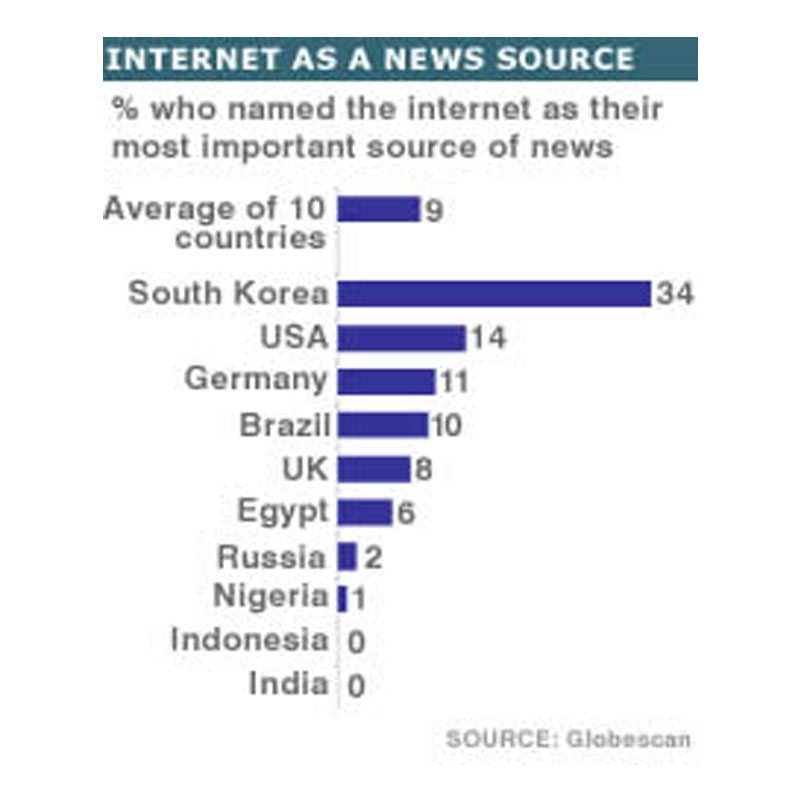
MUMBAI: In India, television and newspapers are engaged in a neck and neck fight for prominence in the news media space, while internet lags far behind. The country also has more people trusting the media than its government when it comes to news.
The findings were derived from a global survey conducted by BBC, Reuters and Media Center Poll in association with research firm Globescan. A total of 10,230 adults were questioned by GlobeScan in the UK, USA, Brazil, Egypt, Germany, India, Indonesia, Nigeria, Russia, and South Korea in March and April.
As per the survey, the most important news sources for Indians in a typical week are television (mentioned first by 37 per cent), newspapers (36 per cent), radio (7 per cent), and news magazines (4 per cent). There is no significant gender imbalance in India regarding where people get their news.
When asked which news sources they trust the most, Indians give the highest rating to national/regional newspapers and national television (85 per cent give each a lot or some trust). Also strongly trusted are local newspapers (76 per cent), friends and family (70 per cent), and public broadcast radio (69 per cent). Very low levels of awareness mean that blogs and news websites are each trusted by only 1 per cent (Zero per cent named internet as their most important source of news), while 10 per cent trust international newspapers.
The most trusted specific news sources mentioned spontaneously by Indians include Aaj Tak (mentioned by 11 per cent), DD television (10per cent), Dainik Jagran (7 per cent), Sun TV (5 per cent), Star News (4 per cent), NDTV (4 per cent), AIR (3 per cent), the Times of India (3 per cent), Zee News (2 per cent), Rajasthan Patrika (2 per cent), and BBC World Service radio (2 per cent).
There is broad satisfaction with standards in India’s media with 76 per cent agreeing that news is reported accurately, and 69 per cent that the media report all sides of a story. A solid majority of 64 per cent also agree that the media strikes the right balance between freedom of speech and respect for culture. Nonetheless 58 per cent say that there is too much foreign influence in their media and 60 per cent that the media is too focused on Western values and concerns.
MEDIA Vs GOVERNMENT
Media is trusted by an average of 61 percent compared to 52 percent for governments across the countries polled. But the US bucked the trend – with government ahead of media on trust (67 per cent vs 59 per cent) along with Britain (51 per cent vs 47 per cent).
Trust in media was highest in Nigeria (88 per cent vs 34 per cent govt.) followed by Indonesia (86 per cent vs 71 per cent), India (82 per cent vs 66 per cent), Egypt (74 per cent, govt. not asked), and Russia (58 per cent vs 54 per cent).
Comparing these current trust findings with 2002 results to the same question shows media is trusted the same or more today in 7 of the 8 countries for which comparative results are available (that is, all countries except Germany, where trust has fallen from 49 percent to 43 percent; and Egypt and Brazil where no tracking is available). Trust has increased over the last four years in Nigeria (from 61 per cent to 88 per cent), India (76 per cent to 82 per cent), USA (52 per cent to 59 per cent), Russia (48 per cent to 58 per cent), and the UK (29 per cent to 47 per cent).
GlobeScan President Doug Miller comments, “With public trust levels in general eroding over the last four years, it is noteworthy that the media has retained or increased its trust in most of the 10 countries in the same period.”
Over one in four people (28 per cent) across the 10 countries surveyed either strongly agrees (13 per cent) or somewhat agrees (15 per cent) with the statement, “In the past year I have stopped using a specific media source because it lost my trust.”
This is particularly the case in Brazil (44 per cent), Egypt (40 per cent), South Korea (39 per cent), and the US (32 per cent). Russians (10 per cent) are least likely to say this, as are Germans (15 per cent), and Indonesians (17 per cent). Citizens of the UK (29 per cent), India (28 per cent), and Nigeria (27 per cent) define the average position across the 10 countries.
GLOBAL NEWS BRANDS
The most trusted global news brands among those tested include the BBC (with 48 per cent across the 10 countries saying they have a lot or some trust) and CNN (44 per cent). Even though Internet web sites in general do not receive particularly high trust ratings, three Internet portals received the next highest prompted trust ratings across the 10 countries; namely, Google (30 per cent, a lot or some trust), Yahoo (28 per cent), and Microsoft/MSN (27 per cent).
Newsweek (25 per cent) and Time (24 per cent) are next most trusted among the 16 global news brands tested in all countries. Al Jazeera (23 per cent) came next but it also had the highest percentage of people (19 per cent) expressing no trust or not much trust in providing the information they want.