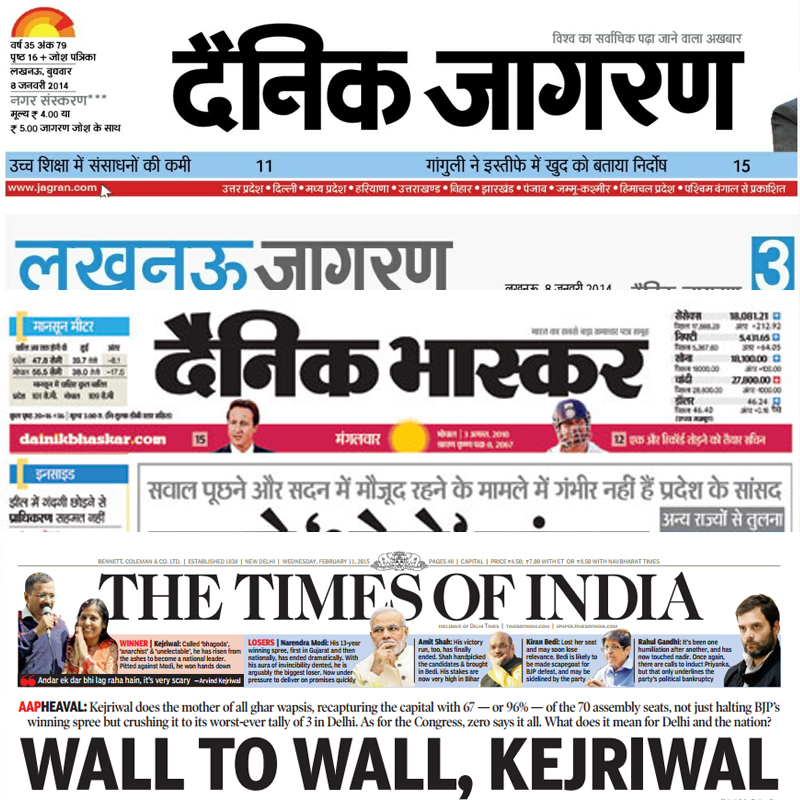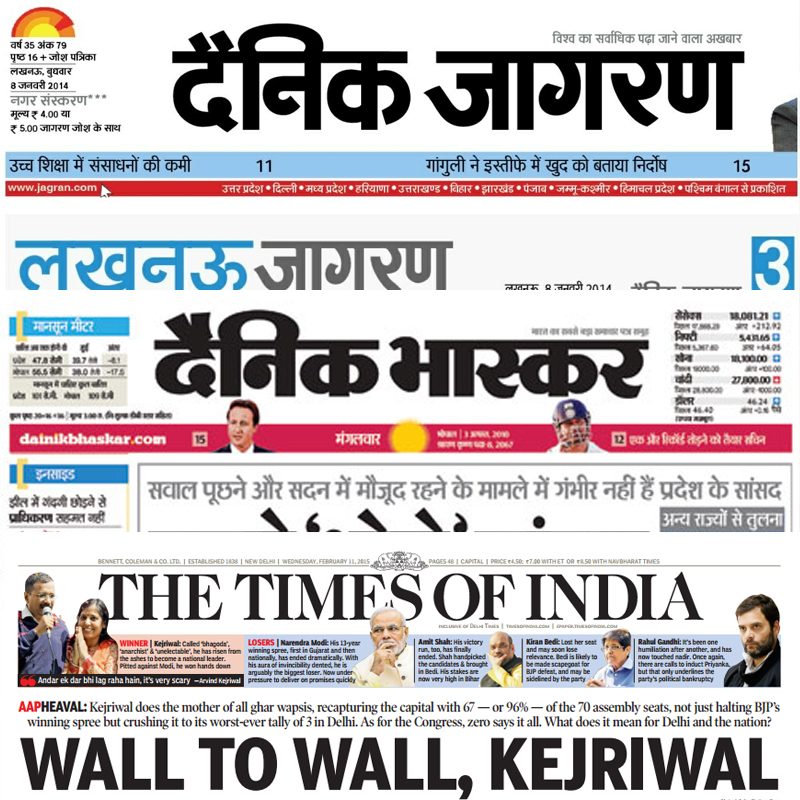
Tag: Dainik Jagran

  • Q3-2014: Higher Ad & circulation revenue, forex gain ramp up Jagran Prakashan’s profit numbers

    Q3-2014: Higher Ad & circulation revenue, forex gain ramp up Jagran Prakashan’s profit numbers

    BENGALURU: Indian media and communications group Jagran Prakashan (JPL) reported growth in all numbers, including the bottom line, which propped/ramped up in advertising and circulation revenue during Q3-2014.


    JPL reported a 12.71 per cent jump in standalone operating revenue during Q3-2014 to Rs 427.44 crore as compared to the Rs 379.24 crore during the corresponding quarter of last year and 10.92 per cent higher than the Rs 385.35 crore during Q2-2014. The company reported a 6.81 per cent growth in PAT during Q3-2014 to Rs 68.57 crore from Rs 64.2 crore y-o-y.


    The company reported growth in standalone advertisement revenue by 14.71 per cent during Q3-2014 to Rs 300.04 crore from Rs 261.56 crore in Q3-2013. Circulation revenue rose by 13.91 per cent y-o-y to Rs 86.11 crore during Q3-2014 from Rs 75.94 crore.


    Higher cost of raw materials consumed dampened the bottom line of JPL. During Q3-2014, JPL reported a consolidated foreign exchange gain of Rs 2.41 crore as compared to a loss of Rs 5.85 crore during Q3-2013.


    Let us look at the other figures for Q3-2014 reported by JPL


    JPL has three revenue streams: the flagship publication Dainik Jagran, other publications such as Naidunia, Midday, etc., and also outdoor, events, mobile solutions, online, etc., with Dainik Jagran being the major contributor on all fronts.


    On a consolidated basis, JPL’s operating revenue at Rs 455.20 crore grew 11.05 per cent in Q3-2014 from Rs 409.09 crore in Q3-2013. Consolidated advertising revenue during Q3-2014 grew by 12.18 per cent to Rs 320.42 crore from Rs 285.64 crore in Q3-2013. Consolidated circulation revenue grew by 13.72 per cent to Rs 93.68 crore in Q3-2014 from Rs 82.38 crore in Q3-2013.


    Consolidated PAT in Q3-2014 grew 7.76 per cent to Rs 67.67 crore in Q3-2014 from Rs 62.8 crore in Q3-2013.


    JPL reported a growth of 11.29 per cent of operating revenue from Dainik Jagran in Q3-2014 to Rs 332.53 crore from Rs 298.79 crore in Q3-2013 and a 9.96 per cent growth from the immediate trailing quarter’s revenue of Rs 302.42 crore. Dainik Jagran’s operating profit in Q3-2014 grew 13.89 per cent to Rs 108.62 crore from Rs 95.37 crore in Q3-2013 and improved by 9.03 per cent from the Rs 99.62 crore reported in Q2-2014.


    Operating revenue from other publications grew by 15.15 per cent to Rs 90.23 crore in Q3-2014 from Rs 78.36 crore in Q3-2013 and grew by 9.56 per cent from Rs 80.67 crore in the preceding quarter. Operating profit from this stream was a positive Rs 1.17 crore as compared to the operating loss of Rs (-3.58) crore in Q3-2013 and the loss of Rs (-6.83) crore in Q2-2014.


    Outdoor and events operating revenue at Rs 32.89 crore during Q3-2014 showed a growth of 3.85 per cent as compared to the Rs 31.67 per cent in Q3-2013 and a growth of 10.04 per cent as compared to the Rs 29.89 crore in Q2-2014. This stream reported 27.19 per cent fall in operating profit to Rs 0.83 crore in Q3-2014 as compared to the Rs 1.14 crore in Q3-2013, but was almost quadruple (3.95 times) the Rs 0.21 crores during Q2-2014.


    JPL reported a 22.76 per cent increase in total expense to Rs 336.83 crore in Q3-2014 as compared to the Rs 274.37 crore in Q3-2013 and 8.4 per cent more than the Rs 311.76 crore in 2-2014. Cost of raw materials consumed went up a whopping 29.73 per cent in Q3-2014 to Rs 152.88 crore as compared to the Rs 117.84 crore in Q3-2013 and was higher by 10.49 per cent as compared to the Rs 138.36 crore in Q2-2014. As mentioned above, the higher cost of raw materials consumed dampened the profits reported by the company.


    Depreciation and amortisation increased in Q2-2014 by 10.88 per cent to Rs 18.38 crore from Rs 16.57 crore in Q3-2013 and increased by 5.10 per cent as compared to the 17.49 crore for Q2-2014. The company reported 16.36 per cent higher ‘Other Expense’ for Q3-2014 at Rs 112.56 crore as compared to the Rs 96.74 crore in Q3-2013 and 8.47 per cent more than the Rs 103.79 crore in Q2-2014.


    JPL Chairman and Managing Director Mahendra Mohan Gupta said, “The highlights of the quarter are the growth of advertising revenue and further improvement in per copy realisation. This has made it possible for the company to report the highest ever operating profit in spite of the steep hike in the cost of newsprint cost. The increase in cover price has not impacted the planned growth of circulation and all the publications including Naidunia registered a healthy growth.”

     

    Click here for financial

    Click here for release

  • IRS Q4 2012: Press continues to lose

    MUMBAI: According to the Indian Readership Survey for Q4 2012 conducted by Media Research Users Council (MRUC) and Hansa Research, seven out of the top ten dailies (across languages) have lost readership. These include Dainik Jagran, Dainik Bhaskar, Amar Ujala, The Times of India, Daily Thanthi, Lokmat and Matrubhumi.

    The pecking order of the top ten dailies remains unchanged with Hindi daily Dainik Jagran continuing its reign at the number one spot. The publication saw a reduction in its readership as compared to the third quarter from average issue readership (AIR) number falling from 164.74 million in Q3 to 163.70 million in Q4. Second spot holder Dainik Bhaskar saw a similar fate as its AIR decreased from 144.91 million in Q3 to 144.16 million in Q4.

    English dailies seem to be holding ground. In their case, just five of the Top 10 dailies lost readership. The Times of India, The Hindu, Deccan Chronicle, The Economic Times and The New Indian Express. While The Times of India continued to take the top spot, its readership fell from 7.653 million in Q3 to 7.615 million in Q4. The only change in the pecking order of English dailies happened with The Tribune taking ninth place (previously tenth; AIR 671000 for Q4) to replace The New Indian Express (previously ninth; AIR 652000 for Q4).

    For the language dailies, the pecking order remained unchanged with Malayalam Manorama retaining the top position and saw an increase in readership from 9.752 million in Q3 to 9.76 million in Q4. Six of the top ten language dailies lost readership with the biggest loser being Dinakaran that lost 96000 AIR (4.912 million in Q3; 4.816 million in Q4).

  • ‘Ad pie shifting towards Indian language newspapers’ : Dainik Jagran Shailesh Gupta

    ‘Ad pie shifting towards Indian language newspapers’ : Dainik Jagran Shailesh Gupta

    Shailesh Gupta, director of Dainik Jagran, has been in the print media industry for more than 18 years. He was recently elected chairman of the Audit Bureau of Circulations (ABC), which provides audited newspaper sales figures every six months, replacing Madison World CEO Sam Balsara. Gupta is also a member of The Indian Newspaper Society (INS).


    Gupta has been a director at Jagran since 1994 driving the newspaper group‘s advertisement and marketing functions.


    In conversation with Indiantelevision.com, Gupta says Tier 2 and 3 towns are now the new volume drivers for newspapers and we now see the advertising pie shift in proportionate terms in favour of Indian language newspapers.

    Excerpts:


    As there is a shift from newspapers to online, the reading habits are changing. What does this mean for the newspapers?
    As a group, we already have a presence in Mumbai with MidDay, MidDay Gujarati,Inquilab and City Plus. There‘s a sizeable presence that we have in the city, and all these brands are growing and doing well. The decision on Dainik Jagran entering Mumbai in the future would depend upon the market forces and many other considerations.


    Any plan of expanding in southern market through an acquisition?
    We currently have a presence in South through City Plus in Bangalore and Hyderabad. Once again the question of acquisition would depend upon the opportunity in question and the prevalent market environment. It would not be fair to conjecture on that as of now.


    The difficult economic conditions have continued in 2012-2013. How do you see the next six months?
    Yes, it‘s been a difficult year in terms of advertising revenue growth. The market sentiment is muted, but there is growth. With the policy level changes taking place, and the festive season coming up, the outlook is more positive for the rest of the year.


    Last year competition drove cover prices down. Do you see the pressure continuing?
    In our markets, we‘ve steadied and increased cover prices instead of reducing. Circulation growth too has happened.


    ‘Our digital portfolio consists of over 12 sites across genres and with over 8.5 million unique visitors, it‘s one of the leaders in the space. And this is just the beginning‘


    The advertisers in Hindi and other Indian language newspapers have still not fully recognised the improved demography of their readership and are not prepared to give advertisement rates that English newspapers command. Why?
    The fact that the market is rapidly shifting to the Tier 2 and Tier 3 towns is a reality. Marketers have increasingly started looking at these markets very seriously for both volumes and growth. From a marketer‘s point of view, it‘s a market that‘s most important, and if the market is sizeable enough, investment flow is commensurate. Historically, the metros provided small geographies with a high concentration of target audiences and the resultant sales volumes. English dailies dominated these metro geographies and at times earned a premium versus the other languages. However, with Tier 2 and 3 towns now being the new volume drivers, the situation has changed completely and we now see the advertising pie shift in proportionate terms.
     

    Is it possible that Hindi language newspaper publishers will agree not to lower their cover price till ad rates are on par with English newspapers?
    The business environment for English in metros and Hindi papers differ significantly as far as the cost structures are concerned. An English paper sells for example at a price of Rs 4 in the metro markets with an average pagination of 40 pages, and the cost structures of the metro notwithstanding. Contrast that with a Hindi newspaper, with an average pagination of 22-24 pages and priced at Rs 3, with a very different cost structure. The differences are all too apparent. The factors behind cover price determination are very different from the factors behind ad rate pricing. Having said that, the model of the Indian newspaper industry is based fundamentally on lower cover prices, high circulation and a higher dependence on ad revenues – and this is true across the board for all languages including English. At the same time, Indian language newspapers have a sizeable part of the revenue coming in from the local markets, which normally are not greatly impacted by macro-economic changes – either positive or negative. Ad rates are a function of position in the market, importance of the market, the prevailing competitive environment and the individual cost structures apart from a lot of other factors.


    What helped Jagran to beat the industry trend and grow at a faster pace?
    We‘ve always believed in realistic planning and extremely focused implementation – these probably are the two central pillars of our work ethic which have yielded results. Other key factors are quick response times, empowered teams, the ability to provide customised solutions, and above all transparency in our working. Innovation is another key driving factor. We study ongoing trends in the market, anticipate a scenario and are able to innovate accordingly.


    What are the plans for Dainik Jagran‘s digital platform? What kind of investments are you planning to make in the digital space?
    We‘ve been very serious about our digital delivery platforms and had taken a lead in investing in this platform as early as year 2000. We have a dedicated digital team that‘s working to distribute the Jagran content across multiple digital platforms and devices. Our digital portfolio consists of over 12 sites across genres and with over 8.5 million unique visitors, it‘s one of the leaders in the space. And this is just the beginning.


    Last year Mid Day and Mid Day Gujarati did well. What is the trend in the current year?
    MidDay is on a growth path – both on the circulation and readership level as well as at the product level. Over the last 3 years, MidDay has seen a good growth – this has come on the back of an improved product. Same goes for MidDay Gujarati – it‘s now the No.2 Gujarati paper in Mumbai and has grown on all counts.


    Last year you were not able to meet the ad revenue target, how do you see things this year?
    We‘ve been realistic with our planning and our expectations. We have a plan for the ongoing year, and we‘re progressing as per the plan.


    Which medium are you banking upon to promote Jagran?
    The biggest platform that we use to promote Jagran is our own existing platform – there‘s no bigger platform that reaches out to almost 70 mn readers and an 8.5mn+ unique digital audience. Add to this our OOH reach pan India. Additionally, we use Radio, TV and some targeted trade and business mediums.


    What is your agenda as the head of Audit Bureau of Circulation?
    The priority at ABC is to bring about a more transparent system, evolve the ABC as a currency and make it a powerful decision making tool for the industry.


    What are the drawbacks that ABC faces?
    There are no drawbacks as such. But clearly we will need to march ahead, look at the changes in the environment, and be able to evolve the currency to reflect the changes. For this, we will need to have all publishers on the same page. It will be important to consider suggestions and opinions of all stakeholders to create a robust and transparent currency – one that truly reflects what‘s happening in the marketplace.


    Will you increase the frequency of audit of circulation figures from six months to quarterly?
    This again is a decision that needs to be taken by the body in consensus with all the stakeholders. As I said, the first priority above all else is to evolve the ABC as a currency and make it a powerful decision making tool for the industry.

  • IRS Q2 2012: Publications see drop in readership

    MUMBAI: Daily publications continued to occupy all the spots in the top ten publications list, according to the Indian Readership Survey conducted by the MRUC. In fact, there is no change in the pecking order of the top ten publications.

    Hindi daily Dainik Jagran continued to rule the charts with an All India Readership (AIR) of 16.43 million in the second quarter of 2012 (AIR Q1 2012: 16.41 million). Dainik Bhaskar saw a drop in AIR from 14.55 million in Q1 2012 to 14.45 in Q2 2012 while third place occupier Hindustan Times increased its Air to 12.21 million in Q2 2012 from 12.16 million in Q1 2012. Seven out of the top ten publications saw a drop in AIR.

    The only change in the ranking of the Hindi dailies is the swapping of places by Navbharat Times and Prabhat Patrika. The former slipped from the No. 7 spot to be replaced by the latter. Navbharat Times’ AIR decreased from 2.588 million in Q1 2012 to 2.584 million in Q2 2012 while Prabhat Khabar’s AIR rose to 2.621 million in Q2 2012 from 2.437 in Q1 2012. Six out the top ten Hindi dailies lost out on readers in the second quarter of 2012.

    In case of the English dailies, the Times of India (AIR: 7.643 million) maintained its position at the top of the list followed by Hindustan Times (AIR: 3.767 million) and the Hindu (AIR 2.208 million). The only change in the rankings was Mumbai Mirror (AIR: 795000) replacing Economic Times (AIR: 789000) at number seven and ET slipping to number eight.

    Among the language dailies, Malayala Manorama held onto the top position with an AIR of 9.71 million followed by Marathi daily Lokmat at AIR of 7.507 million. In third place is Tamil publication Daily Thanthi with AIR measuring 7.431 million. Malayalam daily Matrubhumi (AIR:6.493 million) displaced Tamil daily Eenadu (AIR: 5.925 million) to take the number six spot.

  • ABC names Dainik Jagran’s Shailesh Gupta as chairman

    MUMBAI: Dainik Jagran’s director marketing Shailesh Gupta has taken over as Audit Bureau of Circulations (ABC) chairman, replacing Madison World chairman and MD Sam Balsara.

    Gupta will occupy the new position from 2012-2013.
    Meanwhile, ITC EVP-marketing Syed Mahmood has been unanimously elected as the deputy chairman of the Bureau.

    The other members of ABC‘s Council of Management for 2012-2013 include eight publishers. They are M Venkatesh (Hindustan Media Ventures), Amit Mathew (Malayala Manorama), Aritra Sarkar (ABP), I Venkat (Ushodaya Enterprises), Hormusji N Cama (The Bombay Samachar), Devendra V Darda (Lokmat Media) and Sanjeev Vohra (Bennett, Coleman & Company (BCCL)).

    On the part of advertisers, Ravi Pisharody (Tata Motors), Debabrata Mukherjee (Coca Cola India) and Anil Dua (Hero MotoCorp) have been appointed.

    The four members appointed from the advertising agencies are Madhukar Kamath (DBB Mudra Group), Shashi Sinha (Lodestar UM), Srinivasan K Swamy (RK Swamy BBDO and Vikram Sakhuja (GroupM).

  • Asci upholds 25 out of 38 complaints

    MUMBAI: The Consumer Complaints Council (CCC) of the Advertising Standard Council of India (Asci) upheld complaints made against 25 advertisements from various sectors like education, healthcare, FMCG and F&B sectors, ads of which are being tracked on TV and newspapers nationally by NAMS in June 2012.

    During the same period, the CCC did not uphold complaints against 13 ads while decision on one ad was kept pending.

    In the healthcare sector, Leonardo Olive Pomace Oil ad, which claimed that the oil “fights cholesterol and heart disease” and “lowers blood pressure”, was upheld. The CCC concluded that the claims mentioned in the ad and cited in the complaint were not substantiated. The advertisement contravened Chapter I.1 of the Code.

    Another ad that was upheld was of Kwality Walls Selection. According to the complainant, the advertorial makes a clear mention of the Kwality Walls Strawberry and Cheesecake as being an ice cream, when in reality it is a frozen dessert. The CCC concluded that the “mention of Kwality Walls as an ice cream”, is misleading and the advertorial contravened Chapter I.4 of the Code.

    According to the complainant, the communication in the Amul Ice cream‘s leaflet shows a “Kwality Walls” cup to depict Frozen Desserts as the words “feel it say it” can clearly be noticed from the picture of the cup on the leaflet. The communication tantamounts to generic disparagement of the Frozen Dessert as a category in general and Kwality Walls Frozen Dessert in particular.

    The communication further tries to pass off ice creams as a complete food which is easy to digest and full of energy. It is categorically stated no food can be termed a complete food, much less an ice cream. The CCC noted the contents of the advertisement and checked the advertiser‘s response and concluded that the advertisement did not denigrate the complainant‘s product. However, the portrayal of ice cream as a “complete food” was misleading and contravened Chapter I.4 of the Code. This complaint was upheld.

    Also, the complainant noted that Cadbury Chocolates‘ ad is clearly in breach of the Maharashtra Prohibition of Ragging Act, 1999 as it directly/indirectly propagates ragging. The CCC concluded that the ad is in breach of the law and contravened Chapter III.4 of the Code. The complaint was upheld.

    The other ads that were upheld in the healthcare sector were of Lotus Mustard Oil, TV 24 Shopee India, Om Healthcare Centre‘s Good Health, Slim Life, Sesa Hair Oil, Perma Healthcare‘s Seatone and Natural Medicine.

    Dainik Bhaskar‘s ad was also pulled up by the CCC. According to the complainant, the print advertisement on the hoarding claims that Dainik Bhaskar “is 3 times of Dainik Jagran” and quoted false circulation figures both for themselves and for Dainik Jagran and also did not mention any source in their advertisement. The advertisement contravened Chapter I.4 of the Code.

    According to the complainant, the print advertisement of Parachute Advanced Coconut Hair Oil claims that, “I have the World‘s Best Hair and so do you”, “International hair research has found that Parachute Advanced users have the World‘s Best Hair”. Claiming that Parachute Advanced users have the world‘s best hair is a superlative claim. The quality of hair does not depend only on hair oil. The CCC considered the technical data and concluded that the claim that its users have the “World‘s Best Hair”, is misleading. The advertisement contravened Chapter I.4 of the Code. The complaint was upheld.

    Luminous Battery/Inverter as was also upheld because the CCC concluded that the claims mentioned in the advertisement like “Luminous Batteries give more backup when compared with other batteries” and cited in the complaint were not substantiated. The ad contravened Chapter I.1 of the Code.

    Leads Bariatrics‘ TVC, which claimed “give a scar less weight loss surgery”, was upheld as the CCC concluded that the promotion of weight loss surgery is an oversimplification of the remedy to reduce weight. The claim is misleading.

    Pure Roots Gold Cream Bleach‘s TVC claimed that the bleach has pure gold added in it. It also claims to remove dead cells and opens pores and gives instant glow in just ten minutes. According to the complainant, the advertiser needs to provide scientific proof to substantiate this claim. In the absence of supporting clinical information from the advertiser, the CCC concluded that the claims mentioned in the advertisement and cited in the complaint, were not substantiated. The advertisement contravened Chapter I.1 of the Code. The complaint was upheld. As per the advertiser‘s response, their company believes in fair and proper competition. On receiving a complaint from ASCI, the advertiser has already modified the said advertisement immediately.

    The CCC concluded that the TVC for Third Eye of Nirmal Baba is likely to encourage superstition as well as it is likely to lead to grave or widespread disappointment in the minds of the consumers. The advertisement contravened Chapter I.5 of the Code. The complaint was upheld.

    Videocon Air Conditioner‘s ad with claims like “Your daily dose of good health from Videocon air conditioners” and “Vita Air technology releases Vitamin C into the air” was pulled up by the CCC. The complaint said that the advertiser needs to substantiate these claims with technical comparative data. In the absence of comments from the advertiser, the CCC concluded that the claims mentioned in the advertisement and cited in the complaint, were not substantiated. The advertisement contravened Chapter I.1 of the Code.

    In education sector, the CCC upheld the complaint against ads of Career Launcher‘s Powerful Prep Program, T.I.M.E. BBS/BCA/HM/LAW, Institute of Apparel Management, NIPS School of Hotel Management and Nalanda Institute of Advanced Studies Lovely Professional University.

    Smartprep Education Smart Prep‘s Guidance and Expert Training was also upheld. As per the complaint, Smart Prep claims that its faculty has “delivered 5 out of top 10 Ranks and 46 out of top 100 ranks in BBS‘11”. Smart Prep should submit detailed evidence/ independent substantiation to validate its claim and is kept pending. The CCC considered the data submitted by the advertiser. The claim can be considered substantiated subject to a spot check by the ASCI Secretariat.

    The CCC also received complaints against two print advertisement and 10 television commercials during the month of June 2012. The complaints were received against the ads of “Smart Prep Education Pvt Ltd.‘s Unique Training System‘‘, “Kamal Toordal”,” Uninor”, “Airtel”,” Indica 10 minutes Herbal Hair Colour”, “Fiat Punto Sport”, “Ayur Sunscreen Lotion”, “Nasivion “, “Fiama Di Wills‘s bathing bar “, “Sanofi Seacod “, “New Extra Strong Axe” and “Mahindra Duro 125 DZ”. However, as these advertisements did not contravene Asci‘s codes or guidelines, the complaints were not upheld.

  • Asci pulls up Dainik Jagran’s & Vodafone’s ads

    Asci pulls up Dainik Jagran’s & Vodafone’s ads

    MUMBAI: Asci, the watchdog of the Indian ad industry, has received 24 complaints for the period of March and April, out of which it has upheld half of them.

    Most of these ads are part of the healthcare and personal hygiene sector.

    The Consumer Complaints Council (CCC) of Asci has come down heavily on two of media house Dainik Jagran‘s advertisements in April for being false and misleading. The news papers through ads made claims like “Haryana mein Dainik Jagran 2 guna Dainik Bhaskar se” when in fact it had used the data of readership for the city of Faridabad.

    The CCC noted that Dainik Jagran‘s claim was not made on the basis of Average Issue Readership (AIR) and thus was misleading.
    On another occasion, Dainik Jagran‘s advertisement which stated that Dainik Jagran is “Haryana‘s No.1 newspaper,” was also pulled up for misleading the readers by using visual aids to create the illusion of its leadership and gap between the newspaper brands. Complaints against both these print advertisements were upheld for being false and misleading.

    Telecom service provider Vodafone was under the radar in April, for its TVC which depicted school going kids getting attracted towards each other and falling in love. The CCC concluded that the ad was upheld since the sexualised subtext of young teens being attracted to one another was likely to cause grave and widespread offence.

    Euro Fashion Inners‘ print advertisement showing ‘naked men holding cockerels against their pelvic region while asking ‘what‘s your size‘?‘ received complaints saying it was obscene and seriously offensive to public decency. The ad was upheld and the advertiser was asked to stop the campaign.

    Sareen Hair Clinic was reprimanded for its advertisement wherein it made unsubstantiated claims of helping get hair back naturally in just one day procedure.

    The claims were made in the absence of any proof or supporting clinical information and reports of tests/trails conducted from an independent recognised testing institution. Considering the lack of information and proof, the CCC concluded that the advertisement is likely to mislead consumers and upheld the complaint.

    Carrying the lines ‘Reduce upto 5 kg, Lose up to 15 inches with Ultra Lypolysis Program, Advanced treatment free,‘ Fit and Fine Slimming Centre and Beauty Clinic was under the scanner for its advertisement.

    Here too the advertiser failed to provide data or supporting technical information with details of reports of tests/ trails conducted by an independent recognised testing institution to substantiate the claims. The CCC concluded that all claims mentioned in the advertisement were not substantiated and upheld the complaint.

    Fair Pharma was pulled up for its advertisement that states “Cancer – We open for you the door back to life.” The treatment given by the centre for curing Cancer is not provided and the claim implies assuring consumers of curing cancer, which is a false claim. Since the advertiser failed to respond to Asci‘s letter and in the absence of supporting clinical information, it was concluded that the advertisement could be misleading and could cause widespread grievance and the complaint was upheld.

    The advertisement of Smart Careers (BBS/BBA) claiming ‘Guaranteed College Admission‘ was not backed or substantiated with data or evidence. Also, there was no validation provided by an independent agency to confirm the claim. In the absence of any proof, it was concluded that the advertisement contravened Clause 3 of the Asci Guidelines for Advertising of Educational Institutions and Programs and hence was upheld.

    Along the same lines Career Launcher‘s (IIM Calls) advertisement was pulled up for its claim “24 YLP admits in ISB.” The CCC concluded that the claims are unsubstantiated in the absence of any verification and, thus, the advertisement contravened chapter 1.1 of the code and upheld the complaint.

    Similarly, Stoss Welle Healthcare came under the scanner for its advertisement stating ‘Many suffer from erection related problems/ pre-mature ejaculation/ leakage of urine/ difficulty in urination. Are you one of them? Obtain desired results with the help of latest proven state-of-the-art non surgical Swiss Technology‘.

    An advertiser is required to provide proof, supporting clinical information, with a detailed report of tests and trials conducted by independent recognised testing institutions. Since these were not supplemented, the CCC upheld the complaint.

    Shree Baidyanath Ayurved Bhavan‘s advertisement on Rheumartho Gold Capsules that states ‘Enriched with most effective swarna bhasma and salal guggul; Offers lasting relief from backache, joint pain, muscular pain etc; Helps to treat the root cause of pain and Helps to regain the flexibility of joints‘ was also upheld as there was no proof provided to substantiate the claims.

    Pernod Ricard‘s print advertisement on Absolut Kher, shows the visual depiction of a ‘bottle‘ which is suggestive of a well known brand of liquor product – Absolut. The CCC concluded that the depiction of the bottle with the titles ‘Absolut‘ was in violation of the Asci Code as it propagated a product, the use of which is banned under the law. The complaint was upheld.

    During the month of March, the CCC also received complaints against two advertisements of Perfetti Van Melle, and one each against Gulf Oil India, HUL‘s VIM Detergent Bar, and Cadbury India‘s Perk Chocolate, Johnson‘s Baby Top-To-Toe Wash, HUL‘s Close Up toothpaste, Parle Mango Bite, Uninor, HUL‘s Axe Shower Gel, and Tata Chemical Ltd‘s Tata Swach Water Purifier. As these advertisements did not contravene ASCI‘s codes or guidelines, the complaints were not upheld.

  • IRS Q4: Dainik Jagran, TOI continue to dominate

    IRS Q4: Dainik Jagran, TOI continue to dominate

    MUMBAI: Dainik Jagran and The Times of India continue to be the most read Hindi and English dailies, according to the Indian Readership Survey (IRS) Q4 report, released by the Media Research Users Council (MRUC) and Hansa Research.

    However, breaking the trend from Q3, Dainik Jagran recorded a decrease in its average issue readership (AIR) from 16.46 million in Q3 to 16.41 million in Q4. It saw a negative of 0.3 per cent.

    Dainik Bhaskar, meanwhile, continued to be second and recorded an AIR of 14.60 million, down 1.84 per cent, compared to 14.88 million in Q3.

    While the top five places did not see any major changes, the top two recorded decrease in AIR while Hindustan, Malayala Manorama and Amar Ujala (third, fourth and fifth position respectively) gained readership.

    Maharashtrian daily Lokmat and Tamil publication Daily Thanthi swapped places to land up at No. 7 and 8 respectively. The Tamil daily’s AIR was recorded at 7.5 million while the Marathi publication’s AIR was 7.5 million

    Among the English dailies, The Times of India leads with a readership of 7.62 million, an increase of 2 per cent over previous quarter’s AIR of 7.47 million.

    While the top six dailies maintain the pecking order from the last quarter, the last four positions have seen some shuffle with The Economic times (AIR 790,000) slipping to No. 8 and Mumbai Mirror (AIR 803,000) climbing to No. 7.

    The ninth and tenth positions also saw a change as The Tribune (AIR 585,000) slipped to No. 10 while The New Indian Express (AIR 637,000) settled at No. 9.

    The regional dailies also experienced changes in the top ten order. While Lokmat went up a notch to No. 2 with AIR of 7.56 million, Daily Thanthi replaced it at the No. 3 spot with a readership of 7.5 million. Eenadu slipped down the ladder to sixth position with AIR of 5.99 million, propelling Anand Bazar Patrika to fifth spot with a readership of 6.05 million. Tamil daily Dinakaran dropped down to No. 8 at an AIR of 5.22 million while Telugu daily Sakshi bumped up to No. 7 with AIR of 5.3 million.

  • IRS Q3: Dainik Jagran and Times of India maintain lead

    IRS Q3: Dainik Jagran and Times of India maintain lead

    MUMBAI: According to the Q3 IRS (Indian Readership Survey) second-quarter report released by the Media Research Users Council (MRUC) and Hansa Research the Q2 leader in the Hindi and English dailies sectors continues to be Dainik Jagran and Times of India respectively.

    Dainik Jagran recorded an increase in its average issue readership, continuing the trend from Q2.

    While the top five places did not see any major changes, the top three recorded increase in AIR (average issue readership) while Malayala Manorama and Amar Ujala (fourth and fifth position respectively) lost out on readers.

    Dainik Jagran’s AIR has risen in Q3 to 16.46 million, from 16.39 million in the preceding quarter. Dainik Bhaskar (14.88 million) and Hindustan (12.03 million) follow.


    Hari Bhoomi which entered the top ten in Q1 at 10th place and maintained the position in Q2 survey was nudged out by Malayalam daily Matrubhumi.

    Among the English dailies Times of India continues to lead with a readership of 7.47 million, though it has seen a slight loss in AIR.

     
    Maintaining last year’s pecking order in the English dailies’ segment, Hindustan Times recorded an AIR of 3.73 million, the Hindu 2.17 million and the Telegraph an AIR of 1.27 million.

    The regional dailies experienced a ruffling in the top-ten order. While Lokmat shifted down a notch to number three with AIR of 7.44 million, the Daily Thanthi replaced it at the number two spot with a readership of 7.45 million.

    Eenadu moved up the ladder to fifth position with AIR of 6.10 million pushing the Anand Bazar Patrika to sixth spot with readership of 6.09 million. Gujarat Samachar slid down to number nine from previous quarter’s number seven with an AIR of 5.19 million.

  • IRS Q2: Top newspapers post growth

    IRS Q2: Top newspapers post growth

    MUMBAI: Dainik Jagran and The Times of India are holding on to their top spots as the most read publications in the Hindi and English language dailies respectively, according to the IRS (Indian Readership Survey) second-quarter report released by the Media Research Users Council (MRUC) and Hansa Research.

    Among the Hindi dailies, Dainik Jagran’s average issue readership (AIR), which had seen a drop in the previous survey, has gone up.

    The top four players have seen surge in AIR, while Rajasthan Patrika and Punjab Kesari have seen marginal fall.

    Dainik Jagran’s AIR has risen in Q2 to 16.39 million, from 15.91 million in the trailing quarter. Dainik Bhaskar (AIR of 14.17 million), Hindustan (11.98 million) and Amar Ujala (8.89 million) follow.

    Navbharat, which was pushed out of the top 10 Hindi dailies by Hari Bhoomi in previous report, has still not managed to get back.

    Among the English dailies, the Times of India continues to hold its numero uno position.

    TOI has garnered a total AIR of 7.47 million, slightly higher than the trailing quarter report (7.44 million). It is followed by Hindustan Times (AIR of 3.74 million) which also saw a marginal growth as compared to Q1. The Hindu (AIR of 2.28 million), saw a dip from AIR of 2.09 million in the Q1.

    Interestingly, The Economic Times, which was pushed to eighth place behind DNA and Mumbai Mirror in Q1, managed to outnumber Mumbai Mirror. However, it is still behind DNA.

    Meanwhile, the pecking order of the regional dailies has remained same as of Q1. Malayalam Manorama has once again topped the chart with 9.96 million AIR, up from 9.94 million in Q1.

    The list includes Lokmat (Marathi) (AIR of 7.59 million) and Daily Thanthi (Tamil) with an AIR of 7.29 million.