Tag: Dabur

  • TV Brand Fest 2021: GEC space remains unchallenged in building mass reach, say marketers

    TV Brand Fest 2021: GEC space remains unchallenged in building mass reach, say marketers

    Mumbai: On day three of the TV Brand Fest 2021, media and marketing heads of prominent organisations discussed the merits and challenges of fiction and nonfiction content as a vehicle for brand messaging. The five-day event being organised by Indiantelevision.com is co-powered by Star India.

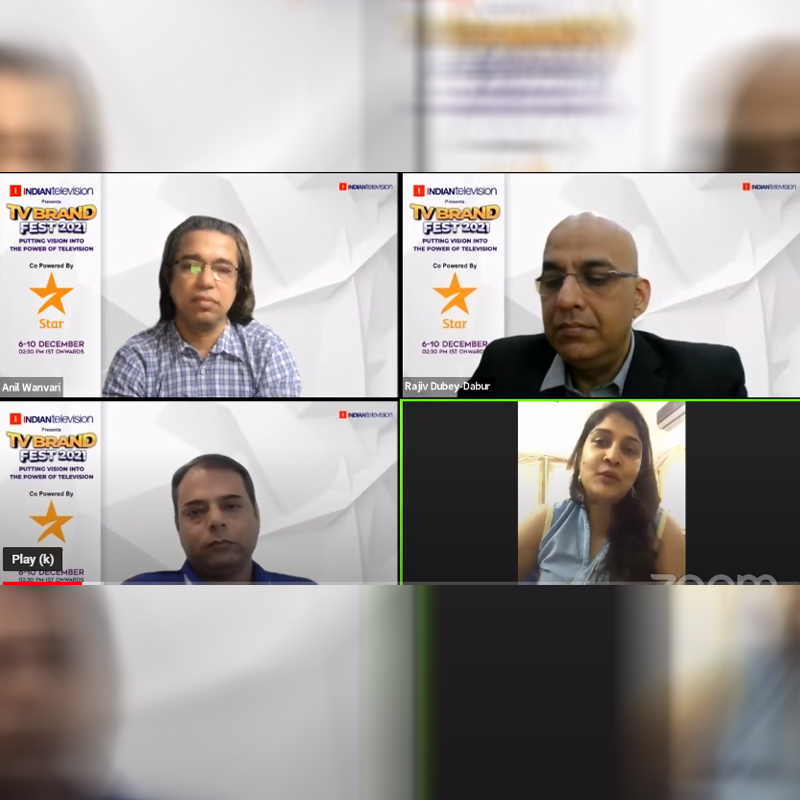
    The panel consisted of Dabur head of media Rajiv Dubey, Yamaha Motor India head – marketing Vijay Kaul, and Dr Reddy’s Laboratories marketing head – OTC, emerging markets Prachi Mohapatra. The session was moderated by Indiantelevision.com Group founder CEO and editor-in-chief Anil Wanvari.

    The discussion began with trying to understand the relevance of GECs which remain unchallenged despite the existence of a plethora of niches. Last year they had almost 50 per cent genre share as far as weekly viewing minutes were concerned, and therefore, any brand looking for a mass reach cannot afford to miss out on them.

    “GECs are cost effective, and they give high reach for businesses like us who want to communicate to the masses repeatedly. Niche channels, on the other hand, are not consistent performers,” said Dabur’s Dubey.

    EMBED: Panel image

    Sharing her experience of using GECs, Mohapatra added, “They are a great way to build trust for your brand. GECs work extremely well when you have to change the brand imagery and also with tactical campaigns where the objective is to reach out to the right kind of consumers in a time-bound manner.”

    Even though the auto category uses quite a balanced mix of fiction and non-fiction content, GECs are a staple in the media plan for mass or unisex products such as scooters. Elaborating further, Kaul stated, “GECs are the right choice for mature brands with a country-wide footprint. That’s where we expect a lot of sales volumes. When the idea is to launch a new brand, the media plan depends on the sales target being huge as in case of unisex or mass commuter brands.”

    Mohapatra shared a similar opinion on the kind of products (based on the life cycle stage) that are best-suited for fiction content. “GEC are trust builders with a huge reach, and hence apt for mature brands as well as brand extensions. Taking a new brand/product directly to GECs is not feasible due to the high costs involved,” she observed.

    For Dabur though fiction/GECs is the medium of choice for all kinds of brands barring a few like a men’s hair removal crème. This is because of the female-centric nature of content.

    This insight from Dubey steered the conversation towards the importance of the content (message) and brand ethos being in sync with each other. While ratings and minimisation of duplication are Dabur’s primary concerns, Yamaha’s Kaul asserted that “in the automobile segment it becomes necessary to evaluate the nature of content because one is looking at a long association with a brand/product whose ticket value is huge.”

    Non-fiction content on niche channels has thus been integral to Yamaha’s media plans. Sharing the example of Yamaha YZF R15, the brand that was built on one niche sport brand – MotoGP – alone, Kaul added, “MotoGP complemented the (high) price (Rs. 1.8Lakh) and the DNA of the brand perfectly. We went for live programming as well as repeats with bundled deals on EuroSports, never using any GEC for it.”

    He cited another example, that of Yamaha Fascino Miss Diva Universe where the “fashionable scooter was embedded in the fashion property one year before its launch.” “Longevity is key here; one can’t have big-ticket integrations for six months, it needs at least four-five years for the association to build.”

    Concurring with Kaul, Mohapatra noted, “With such high-decibel programs consistency is extremely important, otherwise even as you work on creating the brand image, recall fades out very quickly.”

    As regards non-fiction on GECs such as ‘KBC’, and ‘Bigg Boss’. the panel believes that it brings in a fresh set of viewers, and a large number of eyeballs at the same time. It also offers more scope and solutions in terms of brand integrations and product placements.  “Used in combination with fiction, weekend non-fiction properties are a great source of incremental reach,” stated Dubey.

  • Content Hub 2021: Growing relevance of language personalisation in OTT advertising

    Content Hub 2021: Growing relevance of language personalisation in OTT advertising

    Mumbai: The last one and a half years have escalated the pervasiveness of the OTTs and streaming platforms in our lives like never before. Not wanting to lose out on their share of the OTT marketing pie, brands have begun exploring promotions and advertisements on these channels.

    With regional content being a major chunk of the consumer viewership on the OTT platforms, there is a growing conversation around advertising too being tuned towards regional to resonate more with their audiences. Representatives from some leading brands came together to discuss the growing relevance of this regional targeting in OTT advertising at the fifth edition of the Content Hub 2021- ‘TV, Film, Digital Video, and Beyond’ which was organised virtually by IndianTelevision.com from 28-30 July.

    The panel consisted of representatives from Lenskart, Myntra, DABUR, ESSENCE and Zee Entertainment Enterprises Ltd (ZEEL). The discussion was moderated by IndianTelevision’s founder, CEO & editor-in-chief Anil Wanvari, who began the session by seeking the panellists’ views on how brands are looking at the OTT ecosystem as a communication tool with their customers.

    “The platform (OTT) represents the best of both worlds,” remarked ESSENCE India, managing director, Sonali Malaviya, “It provides the ‘comfort & love of Television’ and the possibility of ‘an ad-free background’, which is what consumers have been wanting to have, since time immemorial. As an advertiser, it gives you the flexibility, the dynamism and the targeting dexterity which we have always wished for in TV. So definitely OTT platforms are here to stay.”

    As the OTT boom revolutionised the media industry, it also opened new avenues for advertisers who had otherwise been reviewing their ad spends on certain genres. One such example has been Lenkskart, which moved out of advertising on English genre, along with the premium audience which gradually moved to OTT.

    However, the lack of data measurability remains a concern, pointed out Lenskart, brand media head, Anupam Tripathi. “The only worrying factor is that little black-box of information about viewership, targets in terms of absolute numbers that doesn’t pass on via the OTT to the marketers. Especially during the streaming of live sports,” said Tripathi.

    While the OTTs have evolved in terms of content and consumer reach, the lack of adequate data measurement and the ability to compare that data with other platforms has proved to be an obstacle for advertisers looking to invest in OTT, according to the panellists. But they also contended that, since these are early days for digital platforms, it may take some time before the new technologies and data measurement systems are devised and made available for advertisers and brands.

    One of the many things that may be challenging for OTT is the high level of expectations that advertisers may have from it. Nevertheless, there’s one area that sets the OTTs apart as a marketing medium, is the regional reach, and the ability to target specific audiences through vernacular content.

    “From an OTT stand point, that’s where the next level of growth is going to come from,” highlighted Malaviya. “And, this is also what makes ‘measurability’ all the more critical- for brands to be able to figure out the scope of the language content, and for marketers to know where they are putting their money is the most optimal use of it.”

    Regional content is drawing advertisers’ interest across all segments. A major portion of the ad-spends of FMCG brands is also shifting towards regional, highlighted Dabur, head of media, Rajiv Dubey. The brand has also been creating regional marketing teams, producing local content & ads, getting local influencers, getting closer to the ground by creating custom made campaigns for that market.

    “This goes hand in hand with regional content on OTTs,” he added. “But, OTTs have to give people options to watch original content in their language. Then it becomes a level playing field. Right now the content is only skewed towards English & Hindi content. So there’s a huge place to grow over there. Though, reaching people behind the paywall will be a challenge.”

    Myntra vice president & head of marketing, Achint Setia concurred. “The next big growth for OTT will come from regional content and advertisers would want to be part of this journey. However, the expectations from OTTs are higher. Almost one-third of our money is deployed in sharp regional campaigns today, so I think it’s just going to get bigger as we see success in this. It’s bound to happen- if anybody has to scale in this country you just cannot not go regional,” said Setia. “It’s an industry which we all have to support because in the future, it will provide solutions which do not exist today.”

    While it took television several decades to understand the power of regional, digital platforms are plunging into vernacular content within a few years of their debut. “Regional is a dominant force in OTT content because of the sheer numbers of people consuming it. It’s just that the expectations from OTTs are also higher, in terms of addressability. The responsibility is higher,” said Zee Entertainment Enterprises Ltd (ZEEL), Revenue, COO, Rajiv Bakshi.

    The OTT platform launched three years ago has already expanded into 11 languages, including Hindi, Bhojpuri, Tamil and Telugu. It has been leading the way in regional content with the release of several original series in local languages, including Nanna Koochi (Telugu), Utsaha Ithihasam (Malayalam), Date with Saie (Marathi) and What’s up Velakkari (Tamil).

    “I don’t think any medium can invest or prepare for the future, as best as OTT,” added Bakshi, giving a sneak peek into the platform’s latest solution for brands and advertisers, which he said will differentiate why OTT is an important medium for tomorrow’s media planning. “So, when you are watching any piece of content, you can pause and see the jhumkas (or any other item), and when you press on it, you can see the price, colors, details etc and if interested, you can go to the platform and buy it. This is the new solution we are offering to our advertisers. So, at any point viewers can pause and visit the platform to purchase an item. We have the solution, now rest depends on our partnership with the client as to how to develop it so as to ensure it doesn’t affect the overall consumer experience. These are the kind of solutions we are investing in.”

    Summing up the discussion, Wanvari also drew attention towards the lower cost of advertising on digital and OTT, compared to TV. “Digital and OTT channels are offering reach at a fraction of the cost that print and TV offer, and that makes a case for allowing this new medium to develop and grow similarly too with adequate support. At the end of the day, for anyone using regional languages to target specific audiences, first movers would always stand to benefit from the platform as the medium grows because one builds a relationship early on,” he added.

    The three-day summit organised from 28-30 July, 2021 concluded on Friday. It was co-presented by IN10 Media Network and ZEE5, and co-powered by Applause Entertainment and Tipping Point, the digital content unit of Viacom18 Studios. PTC Network was the supporting partner.

    Centred on the theme – ‘The New Dynamic’, the three-day event witnessed insightful sessions with industry stakeholders deliberating on how the new forces are transforming the way content is created and stories are told. It also delved into the impact of these changes on the business models for the world of films, TV and OTT.

    For more details, visit: https://www.thecontenthub.in/

  • Parineeti Chopra signs as Dabur brand ambassador

    Parineeti Chopra signs as Dabur brand ambassador

    NEW DELHI: Dabur India has roped in Bollywood actor Parineeti Chopra as the new brand ambassador for Dabur Pudin Hara. The brand has also unveiled a new TVC with Chopra.

    The TVC is a slice-of-life relatable story of a young couple where the husband has a mild stomach problem after having a heavy meal. He thinks that an ambulance or doctor might have to be called during the night and he would not be able to sleep. That is when Chopra, his wife, offers him Pudin Hara Pearls which relieves his distress.

    Dabur India marketing head- OTC healthcare Ajay Singh Parihar shared that the new campaign aims to highlight the importance of Pudin Hara during different stomach problems, in an endearing manner. “We are excited to have Parineeti Chopra as the new face of Dabur Pudin Hara. She fits well with the brand persona of being modern, trustworthy, and progressive apart from connecting well with different sets of consumers. A new TVC featuring Parineeti Chopra has also been unveiled with an interesting consumer insight Isse Pehle Ki Baat Badh Jaaye, Lein Pudin Hara,” he added.

    “I always believe in natural ways of taking care of oneself and the new campaign of Dabur Pudin hara is exactly that. Hence, I would want to communicate to the consumers that they can take care of their stomach with 100 per cent natural and safe Pudin Hara, which also has a strong heritage and is the most trusted brand of Dabur,” said Chopra.

  • Dabur Red Pulling Oil is the brand’s first ayurvedic mouthwash

    Dabur Red Pulling Oil is the brand’s first ayurvedic mouthwash

    NEW DELHI: Dabur India Ltd has entered the mouthwash category with the launch of Dabur Red Pulling Oil, an Ayurvedic mouthwash, creating a whole new segment in the oral care market. The launch of this ayurvedic detox for teeth and gums marks another first for Dabur and for the ayurvedic products industry in India.

    Dabur India Ltd marketing head-oral care Harkawal Singh said, “Dabur Red Pulling Oil is an Ayurvedic mouthwash which contains natural oils and herbs with no alcohol. The product is based on a process defined in Ayurvedic scriptures and introduces to the world the Kavala-Gandusha Therapy, an oil-based oral detox regimen. Besides its oral care benefits, the therapy is also known to provide relief from health problems with improved health of sinuses, improved hormonal balance and detoxification. Dabur Red Pulling Oil helps strengthen teeth and gums, and kills 99.9 per cent germs, thus providing complete oral care.”

    The product contains coconut oil, which prevents gingivitis and plaque; sesame oil, which strengthens teeth and gums; tulsi to prevent bad breath; clove, which helps in reducing toothache; cinnamon oil that gives relief to a sore throat; and thyme mint for preventing tooth decay.

    “Backed by our 136-year heritage and knowledge of Ayurveda, Dabur has launched this breakthrough innovation for improvement of people’s overall oral health. Developed after extensive research, it is a known daily therapy for both oral and overall wellness of teeth and gums. Dabur Red Pulling Oil is made with pure and natural ingredients and is a complete solution for all dental problems,” Singh added.

    Priced at Rs 275 for a 195 ml pack, Dabur Red Pulling Oil is initially available across all leading e-commerce platforms and will soon be rolled out through regular retail channels too.

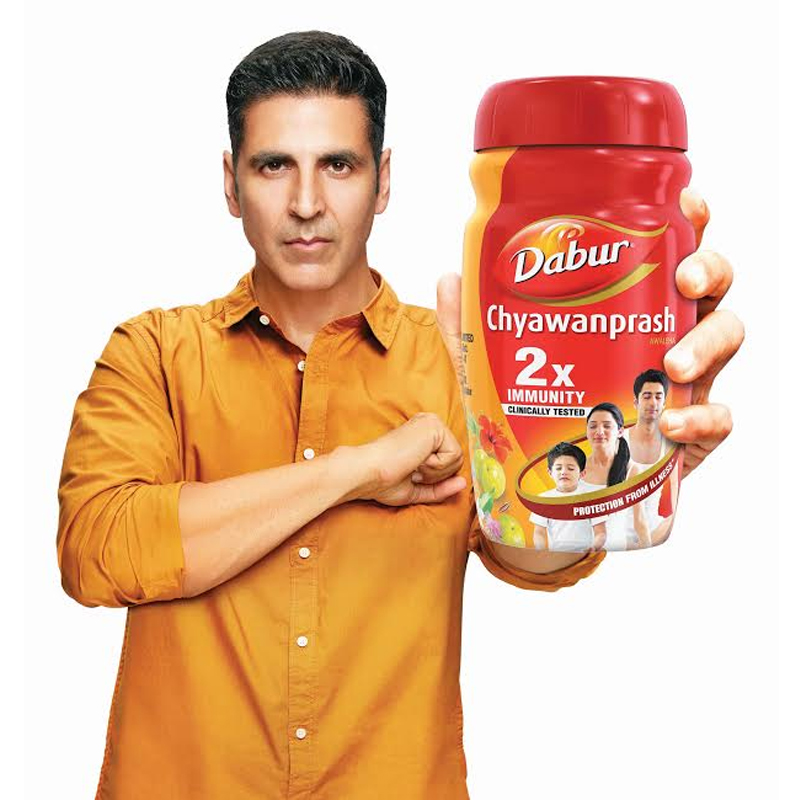
  • Akshay Kumar takes the immunity pledge with Dabur Chyawanprash

    Akshay Kumar takes the immunity pledge with Dabur Chyawanprash

    NEW DELHI: Embattled FMCG Dabur India, whose flagship product Dabur Honey was at the centre of a controversy after failing the NMR purity test, is now relying on star power to turn around its dented fortunes. The company has signed on A-list actor and fitness icon Akshay Kumar as the new face of its health supplements brand Dabur Chyawanprash.

    A new campaign featuring Kumar, a paragon of what it means to live healthy, calls on the nation to come together and pledge to build “inner strength and fighting spirit” in these uncertain times.

    “Strong immunity is the need of the hour with the threat of illnesses looming around us,” said Dabur India Ltd CEO Mohit Malhotra. “Dabur Chyawanprash, with the power of more than 40 herbs like Ashwagandha, Giloy  and Amla, has always stood for boosting immunity to fight illnesses. Dabur Chyawanprash has always celebrated and championed the cause of building the health of the nation. Akshay Kumar is emblematic of health, fitness and inner strength, the properties of Dabur Chyawanprash. We are happy to welcome him to the Dabur family.”

    The new campaign serves as a rallying cry, inviting Indians to keep their immunity strong for themselves and for the nation.

    “With this communication, Dabur Chyawanprash, along with the charismatic Akshay Kumar, are also establishing our strong sense of pride about ‘Made in India, by Indians, for Indians’, and caring for every Indian household’s immunity and well-being,” added Malhotra.

    Conceptualised by McCann Worldgroup India, the film attaches a deeper purpose to why each one of us needs to keep our immunity high. It takes the idea of immunity from safety for an individual to the strength for an entire nation. And it does that by inviting Indians to take a pledge for becoming strong from within so that we can support each other in this journey and emerge stronger.

    “Har ghar me, har kisi ko, leni he ek shapat khud ko strong banane ki, kyuki hum strong rahenge tabhi toh har mushkil se ladenge. Bharat kare vishwas, har din Dabur Chyawanprash.” Leading this pledge is Akshay Kumar, who helps galvanise the masses in joining this movement.

    Prasoon Joshi, chairman, McCann Worldgroup, Asia Pacific CEO & CCO McCann Worldgroup India, said: “Akshay is a fitness icon in our country and so is the brand Dabur Chyawanprash. I have always believed that there should be an inherent resonance between the brand and its endorser, which is absolutely so in this case. I have been part of Dabur’s communication for more than two decades and seen the journey to the top. This will be another great chapter in the brand’s journey and would strengthen the relationship with the consumers.”

    Akshay Kumar said: “I am immensely proud and happy to be a part of the Dabur family. Dabur has relentlessly nurtured the country’s health and fitness through the science of authentic Ayurveda. I really believe that together, Dabur and I, will take Dabur Chyawanprash to every household, every person – so that collectively our nation’s immunity becomes stronger and we can conquer every challenge.”

    The film’s essence is in activating and tapping into the power of immunity and collective action. It portrays Indians from different walks of life who are doing their bit to keep the nation going. And at the heart of it is their inner strength driven by the core of benefit of Dabur Chyawanprash – 2X immunity. 

  • Honeygate: A sweet tale turns bitter for brands

    Honeygate: A sweet tale turns bitter for brands

    KOLKATA: Honey is one of the most loved home remedies or immunity booster in Indian households. With the onset of Covid2019, the sweet miracle has attracted more Indian consumers, even global buyers. But a plot-twist has changed the narrative, as top brands in the category are allegedly adulterating the product with the addition of sugar syrup.

    An investigation by the Centre for Science and Environment (CSE) has found that leading brands sell honey which doesn’t meet purity standards. Dabur, Patanjali, Apis Himalaya, Baidyanath, Zandu failed to clear the Nuclear Magnetic Resonance Spectroscopy (NMR) test. What’s more concerning is the fact that the business of adulteration has evolved to hoodwink stipulated Indian tests.

    “The honey category stands stirred and shaken. Sugar syrup is sure an adulterant. The next time a consumer reaches out for a jar of honey, there is going to be suspicion around. And rightly so. The brand equity of the category is stirred,” Harish Bijoor Consults Inc. brand guru and founder Harish Bijoor said.

    Will brand reputation and business suffer?

    As the brand reputation of honey is based on health benefits, the controversy is not going to bode well for manufacturers. Brand consultant Shubho Sengupta stated that the category is very close to Indian families, unlike new age brands. Certainly, the consumers will be disappointed, thereby impacting the brand equity. Consumers might look at it as “tampering with Indian tradition,” remarked Sengupta adding that there are many emotions at play. However, it is hard to make out what would be the impact on sales.

    Business strategist Lloyd Mathias echoed the sentiment, and noted that the addition of sugar syrup is damning, because consumers buy honey for its health benefits and some of the prominent brands like Dabur, Jandu, Patanjali being on the list is disheartening.

    “Honey, as an overarching category, promises purity. If that purity comes under question, then it is a huge blow on the brands that are failing the test. Today, a lot of consumers must be thinking about what they are buying. It impacts large brands very badly. Last time when something like this happened, brands like Pepsi, Maggie had a tough time coming back,” pointed out Naresh Gupta, co-founder & chief strategy officer at Bang In The Middle. He added that food is a very high involvement category and consumers will not be quiet if they found anything wrong with what they consume.

    Will this cause a long-term impact?

    However, Alchemist Brand Solutions founder and managing partner Samit Sinha differed slightly. He went on to explain that many of these brands have a wide portfolio and honey is not their flagship product and not even the biggest contributor to their revenues. Moreover, the brands in the rejected list are very large, established, and riding on strong momentum. Hence, they have the ability to ride out the storm.

    Moreover, a lot of developments happen but they are restricted to the intellectual community, and it is not certain if this one will actually reach the target consumer – the middle-class Indian housewives, he noted.

    “Our expectations on substantiating claims and superior products have been historically far-fetched and the attitude on the ground has been more like 'adjust karlenge'.  Also, the impact on the category will be short-term as the consumer mindset is like 'aisa toh sab karte hain' (everyone does this), so it is a possibility that people will get over it,” Sinha added.

    Mathias, too, held the view that while the report may cause a bit of a hub-bub now, public memory is short-lived. But if these brands don’t go and correct themselves, they will continue to lose in terms of consumers’ faith.

    “The only good thing is the brands will hopefully address the issue and will make sure they are not adulterating natural honey,” he said. Sinha’s also optimistic that one good thing that will emerge from the incident is that the brands will no longer sell fabricated products but superior products.

    However, after a huge face loss, the brands have started defending themselves. According to Gupta, these companies cannot debunk the claim just by releasing an ad saying “I am pure,” because the whole report has been covered widely across media. They will have to put their money where their mouth is to win back the consumers’ trust.

    While the experts agree that CSE is a reputed organisation which has carried similar movements in the past, Sengupta mentioned that consumers will, unfortunately, believe the brands’ claims because brands like Dabur will spend huge to kind of own the narrative. Very few consumers will care about an NGO report unless the competitors promote it.

    Will it help the brands that passed the test?

    You can count on one hand the number of brands that passed the quality test, among them being – Marico’s Saffola Honey, Markfed Sohna and Nature's Nectar. These products will jump in to maximise the impact, acknowledged Sengupta. Mathias concurred, adding that it is a positive endorsement for those brands. “Those two-three brands will be preferred hugely and they might come up with campaigns. That will bring a systematic change in the category. It’s a category dominated by heritage players for a very long period but suddenly the category will change,” Gupta commented.

    Saffola lost no time in tooting its horn and advertising the fact that it “has launched the best quality honey in its purest form” in India.

    “Every batch of Saffola Honey is tested using NMR (Nuclear Magnetic Resonance) technology, which is one of the most advanced tests in the world, in the best in class laboratories to ensure that it is 100 per cent pure, free from added sugars and free from any form of adulteration. Saffola Honey is produced at a USFDA registered plant with state-of-the-art technology ensuring robust quality checks and controls. Saffola Honey is also compliant with each of the quality parameters mandated by FSSAI,” a Marico spokesperson said.

    Right now, the biggest brands producing honey are like the magician whose best trick has been suddenly exposed for what it is – a sleight of hand. It will be interesting to see how the magic syrup makes its comeback.

  • Top honey brands fail international quality test

    Top honey brands fail international quality test

    KOLKATA: Among top honey brands in India, majority have failed to make it through a stringent quality test. According to the Centre for Science and Environment (CSE), brands including Dabur, Patanjali, Emami have flunked the Nuclear Magnetic Resonance (NMR) test that was carried out at a lab in Germany, bringing focus on the adulteration of packaged honey in Indian markets.

    Food researchers at CSE selected 13 top brands and some smaller brands that sell processed and raw honey in India to check their purity. The researchers found that 77 per cent of the samples were adulterated with sugar syrup. Out of the 22 samples that were checked, only five passed all the tests.  

    Marico’s Saffola Honey has cleared the litmus along with two other brands – Markfed Sohna and Nature's Nectar. However, Dabur has already countered saying its honey has passed NMR test. For the record, the NMR test is required only for exporting honey, and not for local marketing in India.

    After the report was released, Dabur has categorically stated that its honey is not adulterated with sugar syrup. “Dabur is the only company in India to have an NMR testing equipment in our own laboratory, and the same is used to regularly test our honey being sold in the Indian market. This is to ensure that Dabur Honey is 100 per cent pure without any adulteration,” it said in a statement.

    On the other hand, Patanjali Ayurved MD Acharya Balkrishna claimed that the CSE report is an attempt to downplay Indian honey and promote German technology. An Emami spokesperson also said that its Zandu Pure Honey conforms to all the protocols during production and adheres to quality norms and standards.

    “It is a food fraud more nefarious and sophisticated than what we found in our 2003 and 2006 investigations into soft drinks; more damaging to our health than perhaps anything that we have found till now – keeping in mind the fact that we are still fighting against a killer Covid2019 pandemic with our backs to the wall. This overuse of sugar in our diet will make it worse," Centre for Science and Environment (CSE) director general Sunita Narain said.

  • Bigg Boss 14:  The brand countdown has begun

    Bigg Boss 14: The brand countdown has begun

    MUMBAI: A century. That’s what Viacom18 head of network sales Mahesh Shetty is hoping to hit with the fourteenth edition of celebrity reality show Bigg Boss. “It will be great if we manage to hit last year’s 100 advertiser landmark we did with the show,” says Shetty.

    Recently, the sales team once again signed on Capital Foods Ching’s Secret as an associate sponsor for the show. It already has e-sports and mobile gaming league platform MPL as presenting sponsor, while Dabur Dant Rakshak Ayurvedic Paste and HUL’s Tresseme have come on as co-powered by sponsors.

    It looks like Shetty has his work cut out for him with only around a fortnight to go before the show starts filming in Mumbai’s Film City on 3 October. However, he is confident that the sponsorship and advertising contracts will start rolling in faster now.

    Says he: “It’s not that this is the first time the team that is selling Bigg Boss is facing environmental pressure. At some point of time there was demonetization followed by GST, which created huge pressure on the economy. The feedback that we got from brands who wanted to associate with us has been phenomenal. I’ll give the credit to the equity of Bigg Boss and to my team also.. I am very optimistic about this season as well. We are expecting the same traction this year itself.”

    Read more coverage on Bigg Boss

    He further explains why he is not worried. Says Shetty: “There are certain brands who come on board for the entire season while others come only for half-season. Some of our key brands have been associated with us since the last season. We have 106 episodes, so there are many brands who wish to come in the later part of the show. Apart from that a lot of revenue comes from the Free Commercial Times (FCT).”

    He has no regrets that he has pegged the advertising and sponsorship rates at least year’s levels when Star Sports has managed to command higher pricing for its IPL inventory than last year. Explains Shetty: “It is not a short-term relationship as some brands also come back. We have kept similar rates as last year because Bigg Boss is a 106-day property. At the end of the day, it is a demand-supply game.“

    He is hopeful that Bigg Boss this year will be able to command higher sticker prices than the Rs 300,000-350,000 per 10 second spot that it did last year. “Depending on how the property performs and demand-supply it creates, we will look at increasing the prices. When the show starts and if the demand is very good, we will definitely hike the prices,” he says.

    Shetty’s opinion is that very platforms can offer the brand integration that Bigg Boss does.”I don’t think there is any property like Bigg Boss when it comes to brand integration and brand engagement. The show not only gives them a wide visibility and reach, but helps them connect with the end consumer,” says he. “We engage very deeply with brand owners, and not just with the agency. Every integration of ours is something that we kind of take them through, also at the same time our programming team, people who run the show are very well equipped and experienced.

    Shetty points out to how last year presenting sponsor Vivo used the platform to showcase the video features of its brand new phone the V17 Pro. For Dabur, the programming team innovated by enrolling contestants of season 13 – Shehnaz Gill, Madhurima Tuli, Rashmi Desai, Mahira Sharma, and Shefali Bagga to promote Dabur Amla Hair Oil while walking the ramp after they were tasked by Salman Khan to do so. Shefali Zairwala and Aarti Singh became the hair stylists for the ramp walkers. Siddharth Shukla, the ultimate winner of the season, and Asim were the judges and chose Shehnaz Gill as the winner. “Again, it was very entertaining and brands’ core values got communicated. It is something you will see again this year,” says Shetty.

    He is quite emphatic that advertisers will hitch themselves to the Bigg Boss bandwagon. “Today, if there is so much traction for IPL, it is because there isn’t anything like IPL. In the same way, I would say there is nothing really like Bigg Boss. It’s not just another property,” he says. “It starts on 3 October goes on all the way till January 2021. It covers all the key festivals from Dussehra to Diwali, Christmas, New Year, and Sankranti. In terms of consumer spending, this entire period is a big chunk as far as consumer spending goes. So brands would want to latch upon the properties like Bigg Boss.

  • Dabur files case against Marico for copying its packaging

    Dabur files case against Marico for copying its packaging

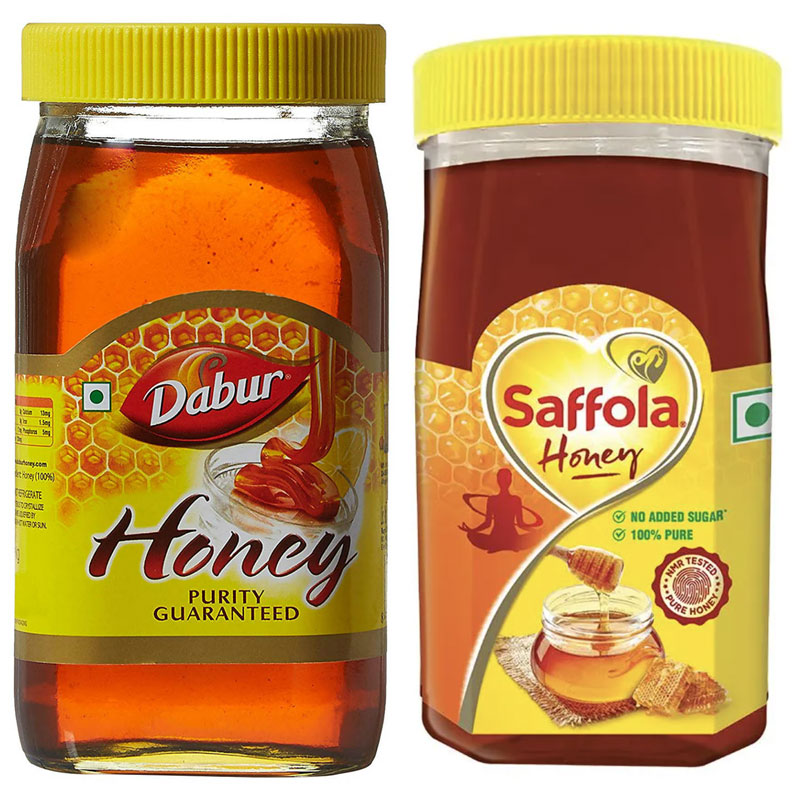
    NEW DELHI: FMCG brand Dabur has filed a case against its competitor Marico alleging that the brand has copied the packaging of its honey product. Marico launched its honey product last month and Dabur claimed it copied the entire packaging i.e., the shape of the bottle, its yellow cap, dome-shaped label, usage of honey combs on the label and other similarities, according to court documents.

    The Delhi high court in its observation mentioned that both the products prime facie show a similarity, which can cause confusion in the mind of the buyer even though the brand name Saffola is mentioned on the product.

    “An overall comparison of the two products would prima-facie show a similarity causing confusion in the minds of the buyer, even though the trade name Saffola is prominently noted on the bottle,” the court said in its interim order last week. “It is clarified that this interim injunction would not apply to the products already sold by the defendant in the market and the defendant will maintain the accounts thereof, which will be submitted to this court,” the order further said while setting the next date in August.

    Meanwhile, in a subsequent appeal by Marico both the parties agreed that the “order be kept in abeyance since the interim application preferred by the plaintiff/respondent herein is still pending consideration and has not been disposed of," according to a court order of 17 July.

    In the court documents, Dabur mentioned that the company has been selling the honey products since many decades, and revamped the new packaging and shape of the current bottle in 2013. The brand also said it generated sales of Rs 482 crore in 2019-20 from its honey business.

    Follow Tellychakkar for the consumer facing news & entertainment

  • How Dabur realigned itself to manage Covid2019

    How Dabur realigned itself to manage Covid2019

    NEW DELHI: Covid2019 came as a big disruptor for the marketing and advertising industry. All the brands, big or small, had to rework their strategies for the year, realign their spends, and work with a different approach to reach to the consumers. In a live webinar with Indiantelevision.com, Dabur India head of media Rajiv Dubey had revealed that the brand was quite proactive in its approach to handle the situation and now in its financial review, the company has detailed the many measures it took to manage Covid2019.

    As per the report, the company worked on a multi-pronged strategy to handle the situation, keeping a tight focus on employee well-being, consumer marketing reorientation, GTM approach, streamlining manufacturing, cost and cash flow management, and community welfare.

    Elaborating more on the facet of consumer marketing reorientation, the company shared in the report that all its communications were repurposed in the Covid2019 context and a higher focus was put on healthcare and hygiene. The company also entered into newer categories and launched relevant NPDs.

    The media mix was retooled with an increased digital presence and clocking higher engagement on social media. It also decreased its presence on GECs, stopped advertising on print and outdoor, and invested highly in news channels, kids’ channels and movie channels on TV.

    To reach the consumers, a go-to-market (GTM) strategy was adopted under which incentive schemes for the salesmen and delivery personnel were announced in the early-Covid period. Automation was made a key factor in taking orders by enabling SSMs to telecall and take order on SFA, directly from home at start of Covid, piloted order taking through WhatsApp & centralized tele-agents was also introduced. It also launched a retailer app, which is now reaching to close to 40,000 retailers for self-service.

    To motivate and support the retailers, the company rolled out one lakh ‘Suraksha Stores’ with the ministry of consumer affairs, provided health insurance of one lakh to 1500+ SSM of Dabur stockists and gave digital certificates for exceptional service by sales team members.

    It also ventured out to reach the consumers directly via partnering with platforms like Swiggy and Dunzo, starting the ‘Immunity to Doorstep’ initiative, and placing Dabur's Immunity booster products in dairy and kirana stores.

    Dabur also initiated several community welfare programmes, earmarking Rs 21 crores towards support and relief activities. It also contributed Rs 11 crore to PM care fund by Dabur and other group entities.

    However, the company did not stay immune to the ripple effects of the pandemic. The month of April and part of May 2020 saw complete lockdown which led to a significant impact on the company’s revenue but with the easing of restrictions, we are seeing sequential improvement in the revenue trajectory of the company.

    While the impact on revenue from operations has been partially mitigated by higher focus on health and hygiene categories, the launch of new products, driving sales through new channels such as delivery platforms and e-commerce and aggressive monitoring of sales in GT channel, yet the impact of Covid-19 on Q1 FY21 revenue from operations (based on best judgment and normal growth scenario) is likely to be in the range of Rs 400-450 crore. Impact on PAT of Q1 FY21 is likely to be in the range of Rs 60-80 crore.  

    It revealed in its performance summary for FY’20 that it was on track to deliver six per cent revenue growth if the pandemic had not happened. With an impact of Rs 360 crore on sales, its revenue grew by only two per cent in FY’20. Even the growth in PAT before exceptional items dipped to 5.8 per cent from 14 per cent.

    The Q4 was massively hit by the ripple effects of the lockdown. Dabur’s revenue dipped by 12.3 per cent in the final quarter and the PAT before exceptional items witnessed a dip of 18.9 per cent.