Tag: cyber space

  • India takes significant initiative to secure cyber space

    MUMBAI: Extending the ‘Swachh Bharat’ campaign to the cyber world, the minister of electronics and information technology Ravi Shankar Prasad has launched the Cyber Swachhta Kendra–Botnet Cleaning and Malware Analysis Centre for analysis of malware and botnets that affect networks and systems. 

    This is a part of MeitY’s Digital India initiative aimed at creating a secure cyber space by detecting botnet infections in India and to notify, enable cleaning and securing systems of end-users to prevent further infections. The centre is operated by the Indian Computer Emergency Response Team (CERT-In).The Centre aims to enhance coordination between the Government and industry in order to encourage cyber hygiene among all end-users and to create a secure and safe internet ecosystem in India.

    Speaking on the occasion, Prasad said, “India is going to take a lead in the digitization process of the world. India today joined the distinguished club of countries that have malware cleaning systems for the use of its citizens. As of now, we have 13 Banks & internet service providers using this facility. With the expanding digital footprint in the country, I see a surge in start-ups in the area of cyber security by the end of the year.”

    “With the expanding role of Information and Communication technology across sectors and growth in volume of transactions and data exchange via internet, Cyber Security as reiterated by the prime minister, has emerged as the most critical factor when we move towards Digital India. Combating cyber threats is not something that can be done just by the government or an organisation or an individual alone. It requires a partnership approach. This centre being launched today will work in coordination with the Internet Service Providers and Industry. This Kendra will also enhance awareness among citizens regarding botnet and malware infection along with measures to be taken to secure their devices”, added Prasad.

    The minister made the following announcement at the launch of Cyber Swachhta Kendra:

    · The National Cyber Coordination Centre to be operational by June 2017
    · Sectoral CERTs to be created, that would operate under CERT-In
    · CERTs are to be set up in the state level as well
    · 10 more STQC (Standardisation Testing and Quality Certification) Testing Facilities to be set up
    · Testing fee for any star-up that comes up with a digital technology in the quest of cyber security, to be reduced by 50%
    · Empower designated Forensic Labs to work as the certified authority to establish cyber crime

    The Centre will operate in close co-ordination and collaboration with Internet Service Providers (ISP) and Anti-Virus companies. Whenever an infection is detected, the Centre will send alerts on the infected IP addresses to the Internet Service Providers, who in turn will inform the end-user about the malware and botnet infections on their system. The Centre will also work in close collaboration with the Banks to detect malware infections in their banking network and enable remedial actions. The launch of the Centre will help the Internet service providers and the banks to keep their networks clean and prevent cases of cyber fraud and theft.

    Ministry of electronics and information technology Aruna Sundararajan said, “With the increased penetration of ICT infrastructure in our country, the threat of cyber security has become more serious and visible. Today, the common man is confronted with hacking, spamming, malware and loss of data, yet public awareness about these issues and how to protect themselves is extremely low. There is a need to collaborate and come forth with solutions like the Cyber Swachhta Kendra in order to ensure a safe and secure cyber world for the citizens of India.”

    With the growth in digitalization and proliferation of broadband and mobile internet, security of end users’ systems is vital for enhancing their trust in ICT and online transactions. User information from the computer and the mobile devices can be compromised if systems get affected with Bots. Users therefore need to practice a rigid cyber hygiene regimen to prevent malware infections on their systems and to ensure security of their systems through suitable anti-malware tools. The Cyber Swachhta Kendra will provide free tools for detection and removal of malicious programmes. More than 3500 users have currently downloaded and tried the free bot removal tools till date. The end-user can log on to the Cyber Swachhta Kendra Portal (www.cyberswachhtakendra.gov.in) and clean their systems using the free cleaning tools. Users can also educate themselves about the various cyber threats and get information on the security tips in order to secure their computers, mobiles and prevent infections in their systems.

    Given below are details of some of the tools released for citizens:

    · USB Pratirodh -A desktop security solution, which protects from USB mass storage device threats.
    · AppSamvid – A desktop solution which protects systems by allowing installation of genuine applications through white listing. This helps in preventing threats from malicious applications. 
    · M-Kavach – An indigenously developed solution to address the security threats in mobiles.

    Also Read:

    Rs 12 billion budgeted for ‘Digital India’ ’17-18

    Cyberbullying may lead to depression in Asian kids

    India, US renew commitment to work on cyber security

  • Govt. bows to votaries of free social media, withdraws controversial draft on Encryption Policy

    Govt. bows to votaries of free social media, withdraws controversial draft on Encryption Policy

    NEW DELHI: Following protests by votaries of a free social media, the government today withdrew a draft of an encryption policy, thus exempting mass use encryption products, which are currently being used in web applications, social media sites, and social media applications such as Whatsapp, Facebook, Twitter, etc


    In a statement, the Department of Electronics and Information Technology said that it had “noted public sentiments viz-a-viz this draft. It is clarified that the above mentioned draft is not the final view of the Government on the matter.”


    The draft had been prepared by a High-level Committee as part of an attempt to ensure secure transactions in Cyber Space for individuals, businesses and Government and prepare a National Encryption Policy. 


    The statement said the Department had also taken note of the ambiguity in some portions of the draft that may have led to misgivings. “Hence, the draft has been withdrawn and will be put up for consultation after appropriate revision.” 


    The removal of the draft also amounts to exemptions to SSL/TLS (Secure Sockets Layer/ Transport Layer Security) encryption products being used in Internet-banking and payment gateways as directed by the Reserve Bank of India and SSL/TLS encryption products being used for e-commerce and password-based transactions.


    Communications and IT Minister Ravi Shankar Prasad told newspersons that the draft was not the final view of the government. “The policy will consider the views of the public,” he said.


    Under the draft, which has now been withdrawn, every message that is sent through e-mail, Whatsapp or SMS was required to be stored in plain text format for 90 days from the date of transaction and made available to the law enforcement agencies on demand.


    The draft was to help introduce a New Encryption Policy under Section 84A of the Information Technology Act, 2000, and had called for public comments by 16 October.


    The stated mission of the policy is to provide confidentiality of information in cyber space for individuals, protect sensitive or proprietary information, ensure reliability and integrity of nationally-critical information systems and networks.


    “Users or organisations within B2B group may use encryption for storage and communication. Encryption algorithms and key sizes shall be prescribed by the government through notifications from time to time… On demand, the user shall be able to reproduce the same plain text and encrypted text pairs using the software or hardware used to produce the encrypted text from the given plain text,” the draft said.

  • Google, Bing join hands to eliminate illicit searches

    Google, Bing join hands to eliminate illicit searches

    MUMABI: While the availability of information online has turned out to be a blessing for almost everybody, it is also disturbing for parents who fear their kids getting exposed to unwanted data. Coming to their rescue are two of the world’s leading search engines — Google and Bing, who will jointly handle the menace of illicit searches made by under age kids on the cyber space.


    Now about 100,000 search keywords are going to be listed as illegal words. Moreover, someone searching for those keywords will not only be prohibited from viewing the search results but also be informed that his or her search is illegal. Soon, the strategy will be extended to 150 languages on global scale to make a huge difference.


    According to Google CEO Eric Schmidt, child sexual exploitation can be eliminated by terminating such keyword searches.


    The parent company of Bing, Microsoft has also stated that they have had zero-tolerance policy for any such material but now they are going to make it stricter.


    UK’s National Crime Agency and Internet Watch Foundation will help the internet giants in this initiative.   

  • 2.7 billion will be using internet by the end of 2013: UN

    2.7 billion will be using internet by the end of 2013: UN

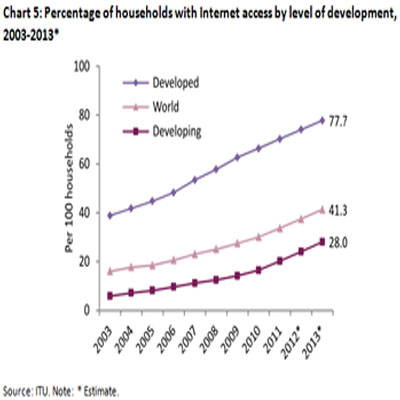
    NEW DELHI: The United Nations has said that 2.7 billion people will be connected on cyber space by the end of the year, making about 40 per cent of the total population of the world.


    The International Telegraphic Union also said 90 per cent of the people who are deprived of a presence on cyber space belong to the developing world.


    Mobile subscription was estimated to reach 6.8 billion equating the amount of people that live on planet earth.


    The report also said mobile broadband is now more affordable than fixed broadband.


    The report ranks 157 countries for their efforts to improve ICT access, use and skills in their countries.