Tag: Crisil

  • Business Today unveils jury for 13 edition of India’s Best CEOs Awards

    Business Today unveils jury for 13 edition of India’s Best CEOs Awards

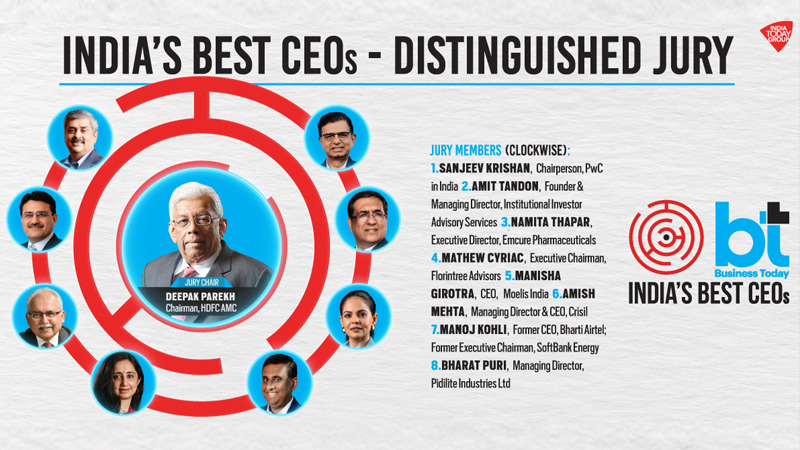
    MUMBAI: When it comes to celebrating corporate brilliance, Business Today leads the way. The 13 edition of BT India’s Best CEOs Awards is set to recognise the extraordinary leadership shaping India Inc., with the winners being adjudicated by a distinguished jury on 27 January 2025 in Mumbai.

    The prestigious annual awards, designed to honour excellence across industries, will be chaired by HDFC AMC chairman Deepak Parekh. A luminary in India’s financial sector, Parekh is celebrated for his visionary leadership and transformative contributions.

    Joining Parekh is a panel of ten eminent business leaders, bringing unmatched expertise and insight to the table:

    1. Bharat Puri, Managing Director, Pidilite Industries Ltd

    2. Sanjeev Krishan, Chairperson, PwC in India

    3. Manoj Kohli, Former CEO, Bharti Airtel; Former Executive Chairman, SoftBank Energy

    4. Amit Tandon, Founder & Managing Director, Institutional Investor Advisory Services

    5. Amish Mehta, Managing Director & CEO, Crisil

    6. Namita Thapar, Executive Director, Emcure Pharmaceuticals

    7. Manisha Girotra, CEO, Moelis India

    8. Mathew Cyriac, Executive Chairman, Florintree Advisors

    This stellar panel will evaluate CEOs on key performance parameters such as financial performance, strategic direction, successful M&A deals, shareholder returns, global expansion, and turnaround achievements.

    The awards programme selects its nominees from the BT 500 list, which ranks India’s largest firms by market capitalisation. In addition to its main categories, the awards feature special honours like Business Icon of the Year, Lifetime Achievement, and Impact Leader of the Year.

    For over a decade, PwC in India has served as a trusted knowledge partner, ensuring the evaluation process remains credible and rigorous. Their continued association underscores the legacy of integrity and excellence that defines these awards.

    The winners of the 13 BT India’s Best CEOs Awards will be revealed during a grand event on 21 March 2025 in Mumbai. This highly anticipated ceremony will celebrate the achievements of leaders whose contributions continue to inspire and transform Indian business.

    The BT India’s Best CEOs Awards are more than just accolades—they are a testament to the vision, resilience, and innovation that drive India’s economy. The 13 edition promises to once again spotlight those who have led with distinction and paved the way for a brighter, more prosperous corporate landscape.

  • Ramkumar Uppara  roped in as Crisil communications director

    Ramkumar Uppara roped in as Crisil communications director

    MUMBAI:  Ramkumar Uppara, a seasoned public relations strategist with over 20 years of experience, has taken on the role of director of communications and public relations at Crisil. Uppara brings with him a wealth of expertise in corporate communications, crisis management, and stakeholder engagement.

    Most recently, as senior vice president of PR and communications at Ujjivan Small Finance Bank, he played a pivotal role in transforming the bank into a leading retail institution, aligning communication strategies with the bank’s business objectives. His initiatives enhanced stakeholder relationships and reinforced the bank’s commitment to financial inclusion.

    Uppara has also held significant positions at renowned organisations including Ketchum Sampark and Glenmark Pharmaceuticals, where he honed his skills in reputation management and brand advocacy. Throughout his career, he has earned recognition for crafting strategic PR campaigns that elevate brand visibility and drive significant business growth.

    With a diverse background spanning sectors such as banking, healthcare, and real estate, Uppara is poised to bring innovative PR strategies to Crisil,  enhancing the firm’s communication framework and overall market presence.

  • Blockchain technology is a game-changer for protecting brands against counterfeit goods: Padmakumar Nair

    Blockchain technology is a game-changer for protecting brands against counterfeit goods: Padmakumar Nair

    Mumbai: Ennoventure Inc. has unveiled an advanced brand protection technology which has been designed to bolster legal defenses against brand abuse. We would like to propose a fascinating and topical narrative that explores the intricate and ever-changing landscape of trademark protection: “The Tech-Counterfeiter Tango: How Innovation Fuels the Game of Cat and Mouse.”

    In today’s era of rapid technical progress, the conflict between brands and counterfeiters has taken on a new dimension, resembling an intricate dance where each move is met with a strategic countermove. As per a report by ASPA and CRISIL, in India alone, 25-30 per cent of products sold are spurious with counterfeiting. This increases the need for anti-counterfeit solutions to battle the grappling issue, ensuring brand protection and product authencity. To address this, Ennoventure’s latest technological innovation named ‘Enncrypto’ will help brands respond to the relentless pursuit of cutting-edge technologies by counterfeiters, employing equally creative methods to preserve their reputation and ensure customer safety and satisfaction.

    Indiantelevision.com caught up with Ennoventure, Inc CEO & co-founder Padmakumar Nair where he shed light on numerous topics regarding the evolution of counterfeiting techniques

    Edited excerpts

    On the sophisticated methods currently employed by counterfeiters to bypass brand protections

    Counterfeiters are increasingly using advanced technology to evade brand restrictions. They are able to replicate products in almost all industries using these techniques.

    1   Advanced Printing Technology: Counterfeiters use high-resolution printers and specialized inks to reproduce packaging, labels, and even security features such as holograms and barcodes with remarkable precision.

    2   Chemical and Material Mimicry: Advanced chemical processes enable counterfeiters to mimic the physical properties and materials used in authentic products for instance in the pharmaceutical industry, making it difficult to distinguish between genuine and fake items.

    3   Supply Chain Infiltration: Counterfeit goods are introduced into legitimate supply chains through various means, including unauthorized production at subcontractors, smuggling, and diversion of genuine products.

    4   Digital Counterfeiting: Online platforms are exploited through the creation of counterfeit websites and listings on e-commerce marketplaces, using sophisticated digital imagery and deceptive marketing to deceive consumers.

    5   Global Smuggling Networks: Illicit networks utilize complex logistical routes and falsified documentation to transport counterfeit products across international borders, evading customs inspections and legal scrutiny.

    6   Technological Adaptation: 3D printing, digital scanning, and artificial intelligence replicate complex designs, especially in the luxury goods industry.

    On invisible signatures offering more over traditional anti-counterfeit measures

    Invisible signatures offer significant advantages over traditional anti-counterfeiting measures, making them a powerful tool in combating counterfeiters. Primarily, they enhance security by making it difficult for counterfeiters to detect and replicate, providing an additional layer of protection. Their non-intrusive nature ensures that the appearance of products or packaging remains unaltered, thereby preserving brand integrity.

    Moreover, invisible signatures are easily verifiable using mobile devices, streamlining the authentication process. This quick and efficient verification is particularly beneficial in high-volume environments. The ability to customize these signatures for each product batch further complicates counterfeiters’ efforts, as mass-producing fake items becomes substantially more challenging.

    Additionally, invisible signatures can be seamlessly integrated with existing processes and other security features, such as QR codes or blockchain technology, for enhanced protection. This combination of features creates a robust anti-counterfeiting system that is difficult to breach.

    Overall, the security, non-intrusiveness, ease of verification, and customizable nature of invisible signatures make them an invaluable asset in safeguarding brands against counterfeiting.

    On utilisation of blockchain technology to protect brands from counterfeit goods

    Blockchain technology is a game-changer for protecting brands against counterfeit goods, offering several robust solutions. Firstly, blockchain provides unparalleled supply chain transparency by creating a transparent and immutable record of a product’s journey from manufacturer to consumer, making it significantly easier to track and verify authenticity. The tamper-proof nature of blockchain ensures that once data is recorded, it cannot be altered, guaranteeing the accuracy of product information. This technology also empowers consumers, who can access blockchain records via QR codes or NFC tags on products to confirm authenticity before making a purchase. Besides, blockchain can be seamlessly integrated with other anti-counterfeit technologies, such as invisible signatures and AI-powered authentication, creating a comprehensive security solution. Utilizing blockchain technology can dramatically enhance the effectiveness of our anti-counterfeiting strategies.

    On consumers becoming more empowered in the fight against counterfeit goods

    Consumers are increasingly empowered in the fight against counterfeit goods through a variety of innovative means:

    1   Access to Information: Consumers have greater access to product information and supply chain details through digital platforms and mobile apps, enabling informed purchasing decisions.

    2   Verification Tools: QR code scanners and NFC technology in mobile apps allow consumers to authenticate products easily, helping them identify counterfeit items at the point of purchase.

    3   Consumer Education: Brands conduct awareness campaigns to educate consumers about counterfeit risks and how to distinguish genuine products from fakes, empowering them to make informed choices and report suspicious products.

    4   Social Media Impact: Social media provide a platform for consumers to share experiences and warnings about counterfeit goods, promoting community awareness and vigilance.

    5   Reporting Mechanisms: Improved reporting channels, including official websites and consumer hotlines, enable consumers to report suspected counterfeit products promptly, aiding in enforcement efforts against counterfeiters.

    6   Legal Support: Strengthened regulatory frameworks and laws support consumers in seeking redress and combating counterfeit trade, enhancing consumer protection and market integrity.

    On discussing the dynamic cat-and-mouse game between counterfeiters and brands

    The battle between counterfeiters and brands is a dynamic cat-and-mouse game, where both sides are in a constant state of adaptation. Whenever brands introduce new anti-counterfeit technologies like invisible signatures or blockchain verification, counterfeiters respond with agility and resourcefulness. They reverse engineer products to replicate security features, invest in advanced printing technologies to mimic packaging and labels with high accuracy, and exploit vulnerabilities in supply chains through social engineering or insider threats. Technological advancements such as 3D printing and digital scanning further empower counterfeiters to replicate complex designs and security elements. Global smuggling networks enable them to distribute counterfeit goods across borders, exploiting regulatory gaps and leveraging online platforms to reach consumers directly.

    To stay ahead, brands must remain vigilant and continuously adapt and innovate their anti-counterfeit strategies, collaborate closely with technology experts and law enforcement agencies, and maintain rigorous oversight of global supply chains to effectively protect consumers and uphold brand integrity.

    On the future of anti-counterfeit solutions evolving in the next five to ten years

    The future of anti-counterfeit solutions is set for significant evolution over the next five to ten years. We can expect huge advancements in AI, machine learning, and blockchain to greatly enhance the accuracy and reliability of our anti-counterfeiting efforts. Integrated solutions that combine various technologies—such as invisible signatures, blockchain, and the Internet of Things (IoT)—will offer more robust protection. Real-time tracking and monitoring of products throughout the supply chain will become more sophisticated, helping to detect and prevent counterfeiting more effectively. Stronger regulatory frameworks and international cooperation will also play a crucial role in creating a more robust legal environment against counterfeiters. Moreover, increased consumer education and engagement will empower individuals to recognize and report counterfeit products, promoting a collective effort to safeguard authenticity. Ultimately, these advancements will lead to a more secure marketplace that ensures the integrity of products and enhances consumer trust worldwide.

  • BARC India revenues at Rs 251 crore in FY21: Crisil

    BARC India revenues at Rs 251 crore in FY21: Crisil

    Mumbai: The Broadcast Audience Research Council (BARC) India revenues stand at Rs 251 crore for FY 2021, according to a Crisil report. Its profit after tax stands at Rs 44 crore. 

    The TV rating agency’s financials for FY 2020 stood at Rs 317 crore in revenues and net loss of Rs five crore. The agency also has a debt obligation of around Rs 38 crore for FY 2022. Crisil reaffirmed its rating of ‘Crisil A/Stable’ for the agency.

    “TV advertisements, the major factor driving revenue for the company, have a high correlation with economic activity. The lockdown imposed to contain the Covid-19 pandemic and weak economic activity in the first half of fiscal 2021 led to a significant drop in ad revenue for television broadcasters, which led to decline in revenue for BARC. However, with an uptick in economic activity in the latter half of the fiscal, revenues have been gradually recovering. Furthermore, the cost-rationalisation measures undertaken by the company ensured better operating profit in fiscal 2021,” said the report.

    Crisil’s report indicates that downward factors such as weakening support from member entities of promoter bodies, change in status as the sole provider of TV viewership measurement in India, and larger than expected debt may impact ratings for the company in the future.  

    80 per cent of BARC India’s revenue comes from broadcasters. It levies a fixed percentage of the ad revenue of broadcasters (0.8 per cent for fiscals 2017 to 2021). As the sole provider of independent TV viewership estimates, BARC India is highly strategic to broadcasters which ensures stickiness and good visibility.

    The agency is promoted by three industry associations, the Indian Broadcasting Foundation (IBF), the Indian Society of Advertisers (ISA), and the Advertising Agencies Association of India (AAAI) with a shareholding of 60:20:20. BARC uses audio watermarking technology and deploys around 46,000 BAR-O-meters. “The company is venturing into viewership estimation for digital platforms, and is increasing the number of BAR-O-meters deployed,” said the report.

  • Print media will reach only 75 % of its pre-pandemic revenue this fiscal, says report

    Print media will reach only 75 % of its pre-pandemic revenue this fiscal, says report

    New Delhi: Despite 35 per cent on-year growth this fiscal on a low base, the country’s print media sector will reach only three-fourths of its fiscal 2020 revenue, according to a new CRISIL report.

    While the cost of newsprint continues to remain high, there is a good probability that profitability will revive to 9-10 per cent driven by sharp cost rationalisation measures and digitalisation of content, shows the report. The analysis assumes the impact of the second wave to continue to subside, as is seen currently.

    According to CRISIL, the credit profiles of large print media companies will be resilient, cushioned by healthy liquidity and strong balance sheets, while for the remaining ones, liquidity management will be crucial, shows an analysis of CRISIL-rated companies that account for roughly 40 per cent of the sector’s revenue.

    The sector’s revenue of Rs 31,000 crore in fiscal 2020, split 70:30 between advertisement (ad) and subscription revenue, had declined 40 per cent last fiscal amid the first wave. However, it is expected to reach to Rs 24,000-25,000 crore this fiscal, notwithstanding the second wave.

    “The second wave has impacted ad revenues in the last quarter, as it correlates strongly with economic activity,” CRISIL Ratings, director Nitesh Jain said, “We expect ad revenues to recover from the current quarter as economic activity revives. But it would still reach only 75 per cent of the pre-pandemic level this fiscal, as seen during January-March 2021, before the second wave took hold.

    As for subscription revenue, the sector is witnessing a structural change with a shift in consumer preference towards digital news, from physical newspapers. This is more prominent for English newspapers, which have a higher share in metros and Tier-1 cities, where digital adoption is also higher. These companies are, therefore, focusing on monetisation of content by putting premium news behind paywalls and pushing digital subscription along with print subscription. Non-English newspapers, on the other hand, had relatively resilient subscription revenue even in the first wave because of their strong roots in the hinterland.

    “We believe, unlike western countries, print media will remain popular in India. Besides low cover price and the convenience of home delivery, it benefits from the ability to provide original and credible content, and people’s habit of reading physical newspapers,” stated the report, according to which, the overall sector’s subscription revenue loss this fiscal should be restricted to 12-15 per cent of the pre-pandemic level.

    That said, printing physical copies of a newspaper requires newsprint – a key raw material that accounts for 30-35 per cent of the total cost for print media companies. Over the past six months, newsprint prices have risen 20-30 per cent

    The run-up in cost notwithstanding, the operating margin is expected to reach 9-10 per cent this fiscal, or 100-200 basis points lower than the pre-pandemic low of fiscal 2020. This is because of sharp cost rationalisation measures undertaken by the companies, such as reduction in pagination, employee cost and other expenses.

    Last fiscal, retailers strengthened their balance sheets through equity infusions of Rs 2,000 crore, which reduced overall debt for CRISIL-rated apparel retailers by 30 per cent.

    CRISIL Ratings associate director, Rakshit Kachhal said, “Credit profiles of large print media companies will continue to be supported by ample liquidity and sustained strong balance sheets, with most being net-debt free. However, for the smaller ones, whose interest cover has declined to 1.6 times as on 31 March from 2.1 times a year ago, ability to manage liquidity amid the second wave and rising newsprint prices will still be crucial.”

  • New DTH guidelines to have potential effect on top operators

    New DTH guidelines to have potential effect on top operators

    KOLKATA: The new DTH guidelines issued by the ministry of information and broadcasting (MIB) can have far-reaching impact on the sector, such as increasing the potential liabilities of incumbents when renewing their licenses. The top four DTH operators are liable to pay Rs 7,700-8,000 crore, credit rating agency Crisil said. Their Ebitda for the current fiscal is estimated at Rs 7,000-7,500 crore.

    Few days after releasing the amended guidelines, the ministry said that the issue of fresh license to the existing licensees will be subject to their clearing all dues. “New licensing guidelines issued by the MIB on 30 December 2020, for providing direct-to-home (DTH) broadcasting service could significantly increase the potential liabilities of incumbents when renewing their licenses,” Crisil said.

    It also added the matter has been discussed at various legal fora over the past decade and continues to be sub judice. Clarity with respect to the final dues, timelines for payment and the debt-equity funding mix to pay up the liability will be crucial to ascertain the cash-flow impact on the DTH operators.

    “DTH operators supported by strong sponsors will be able to sustain their credit profiles notwithstanding the expected potential liability. Their credit profiles are also supported by healthy cash accrual, strong balance sheets and high financial flexibility,” the credit rating agency added.

    Crisil said it would continue to monitor the developments on this and take appropriate action as and when required.

  • CRISIL assigns A-/Stable credit rating to Shemaroo Entertainment

    CRISIL assigns A-/Stable credit rating to Shemaroo Entertainment

    MUMBAI: Shemaroo Entertainment (Shemaroo), one of the largest independent content aggregators in Bollywood, today announced that CRISIL has assigned its CRISIL A-/ Stable’ rating to the long term bank facilities of Shemaroo. Post this, the existing credit rating enjoyed by the Company on its long term banking facilities stands upgraded by 3 notches.


    Rating Rationale by CRISIL:


    The rating reflects the benefits that Shemaroo derives from its established market position as a distributor of film content in the re-issue cycle, supported by a large library of content rights and its strong financial risk profile. The rating also reflects CRISIL’s belief that the company’s capital structure will remain below 0.5 times over the medium term. These rating strengths are partially offset by the company’s long working capital cycle marked by long inventory holding period leading to price volatility risks along with high debtor days and its exposure to intense competition in the new media segment.


    CRISIL believes that Shemaroo will maintain its credit risk profile supported by its strong market position and financial risk profile. The outlook may be revised to ‘Positive’ if the company’s enhances its business risk profile, backed by sustainable improvement in its sales to inventory ratio and its receivables management, while maintaining its healthy profitability levels and strong financial risk profile. Conversely, the outlook may be revised to ‘Negative’ if the company’s cash accruals declines significantly or of its working capital cycle lengthens, leading to deterioration in the company’s financial risk profile.


  • Zee Entertainment Enterprises to be a Nifty 50 stock soon

    Zee Entertainment Enterprises to be a Nifty 50 stock soon

    MUMBAI: The Subhash Chandra-owned Zee Entertainment Enteprises Ltd (Zeel) is getting blue blooded once again. The Zeel stock is all set to get included in the 50-share CNX Nifty index, come 19 September 2014. It will be stepping into the spot left vacant by the eviction of the Diageo-controlled United Spirits Ltd (USL).  The latter enjoyed just a six month stay in the CNX Nifty 50 as it had been placed in it in April 2014.


    India Index Services & Products Ltd, a NSE-Crisil joint venture that maintains the Nifty index, on 20 August, after market hours released a statement stating the same.


    Zeel  jumped to a high of Rs 300 during the early trade on 21 August. It opened 1.7 per cent higher than the previous close of Rs 293, while the stock of USL  was trading under pressure, following news of its being dumped from the Nifty. The stock opened 3 per cent lower at Rs 2,390 and ended 2.1 per cent lower than the close on 20 August 2014.


    This is not Zeel’s debut on the CNX Nifty 50 Index. It had an earlier stint which ended in March 2009 when  Axis Bank replaced it.  Another notable point is that while USL  has fallen more than 20 per cent since its inclusion in the Nifty 50 in April 2014, Zeel has risen around 35 per cent in the past one year.


    NSE also announced other inclusions and exclusions in the index; Aurobindo Pharma and Motherson Sumi Systems will be included in CNX Nifty 100 replacing Mphasis and Zeel.


    There have been changes in the CNX Nifty 200 as well. Companies such as CARE, Castrol India, Muthoot Finance, Edelweiss Financial Services, Kaveri Seeds, Marico among others will replace the likes of Adani Power, CRISIL, Bhushan Steel and Vijaya Bank etc.


    A total of 15 companies in the CNX 500 index, two from the FMCG and LIX 15 indices and one each from the CNX Consumption and NI15 indices have been replaced. All the changes will be effective from 19 September 2014.


    The CNX Nifty 50 index is reviewed every six months and a six week notice is given to the market before any changes are made to the index set.  As per the guidelines, only 10 per cent of the Nifty stocks (five stocks) can be reshuffled in a calendar year. Two stocks (USL and Tech Mahindra) were already included in the Nifty 50 in April 2014.


    In 2010 and 2012, four stocks from the Nifty were replaced while in 2011, two stocks and 2013, three stocks were substituted.


    Zeel also has been included in the recently launched CNX Media Index on the NSE and carried the maximum weight of 45.45 per cent in the index that comprises 15 media and entertainment stocks. The methodology for selection of the stock was based on free float market capitalisation.


    Click here for details of NSE’s CNX Nifty Index methodology

    Click here for CNX Media Index details

  • Tata Sky to make equity infusion of Rs 5 bn every year over medium term

    Tata Sky to make equity infusion of Rs 5 bn every year over medium term

    MUMBAI: Direct-to-home (DTH) television service provider Tata Sky has planned equity infusion of over Rs 5 billion every year over the medium term to meet its capital expenditure and for serving its debt.

    The additional equity will be raised from investors other than the promoters and will result in dilution of Tata Sons‘ shareholding from the current 60 per cent but is expected to be gradual.

    Tata Sons would remain the single largest shareholder in Tata Sky after the equity infusions over the next few years. Tata Sons holds 60 per cent stake in Tata Sky while News Corp. has an effective stake of 29.8 per cent.
    CRISIL, which has rated its bank facilities and debentures, believes that management control will remain with Tata Sons and Tata Sky‘s association with the Tata brand will continue even after its stake gets diluted.

    Tata Sky has Rs 17.01 billion of bank facilities and recently raised Rs 1.6 billion through a debenture issue.

    The Indian DTH industry is characterised by the presence of few dominant players, leading to intense competition. The competitive intensity is reflected in frequent launches of special offers and discounts and high marketing spends by these players, whose primary goal is to increase their market share. While the industry has witnessed healthy subscriber additions, the overall profitability remains low. CRISIL believes that Tata Sky’s operating performance will improve over the medium term. It also believes that the company’s financial risk profile will remain weak over the same period, marked by negative net worth and stretched debt protection metrics.

    Tata Sky narrowed its net loss in the year ended 31 March 2012 from a year earlier, on increasing subscriber numbers.

    Tata Sky’s net loss in 2011-12 was Rs 2.98 billion, 36 per cent less than Rs 4.7 billion a year earlier. The company‘s net loss in 2009-10 was Rs 6.26 billion on total income of Rs 11.10 billion. The company‘s net sales were up 18 per cent to Rs 15.9 billion from Rs 13.5 billion a year earlier.

    The continuing losses have resulted in piling up of accumulated losses. Tata Sky‘s accumulated losses as on 31 March 2012 would amount to Rs 43.03 billion with the addition of loss in 2011-12 to the accumulated losses of Rs 40.05 billion as on 31 March 2011.

  • SBI Mutual Fund is the Mutual Fund of the year at CNBC-TV18 – CRISIL Mutual Fund Awards

    MUMBAI: In a glittering ceremony, CNBC-TV18, India’s leading Business Medium and CRISIL, India’s premier ratings agency announced the most sought after and valued Mutual Fund Award in the country – ‘CNBC-TV18 – CRISIL Mutual Fund of the Year Award’.


    Mark Tucker, Chief Executive of Prudential & Ajay Srinivasan, Chief Executive, Fund Management, Prudential Corporation Asia spoke on the performance of mutual funds across the world, emerging trends, investor reactions and expectations setting the tone for the evening. This was followed by a p anel discussion with Mr Ramesh Damani, Mr Jaikumar, Mr Kela and Mr Naganathan moderated by Udayan Mukherjee.


    As the most powerful radar to prosperity, the CNBC TV18 and CRISIL Mutual Fund of the Year awards performance and consistency in wealth creation of enterprising fund houses for the year 2006. These Awards, based on CRISIL’s objective and analytically rigorous CRISIL~CPR methodology, are the ultimate test in performance and consistency on one of the most distinguished platform.


    These awards are the Investors most definite guide to the best managed fund house in the country. It brings together the world’s most renowned investment experts and shares their ideas, philosophies and predictions.

    The winners in the various categories at the Mutual Fund of the Year were:

    Category
    Winner
    Large Cap Oriented Equity Funds DSP Merrill Lynch Opportunities Fund Sundaram BNP Paribas Select Focus
    Diversified Equity Funds SBI Magnum Global Fund
    SBI Magnum Sector Umbrella – Contra Fund
    Sundaram BNP Paribas Select Midcap
    ELSS SBI Magnum Tax Gain Scheme 1993
    Income Funds Principal Income Fund
    UTI Bond Fund
    Income Short Reliance Short Term Fund
    Balanced Funds HDFC Prudence Fund
    SBI Magnum Balanced Fund
    Liquid Funds HDFC Cash Management Fund – Savings Plan
    UTI Liquid cash plan
    Liquid Funds Institutional Tata Liquid Fund – SHIP
    Liquid Funds Super Institutional UTI Liquid Cash Plan – Institutional Plan
    Gilt Funds Long Reliance Gilt Securities Fund – Long Term Plan
    Templeton India G-Sec Fund – Long Term Plan
    MIP Aggressive HDFC Monthly Income Plan – LTP
    MIP Conservative Prudential ICICI MIP Plan – Cumulative
    Floating Rate Funds (Long term) Principal Floating Rate Fund – Flexible Maturity Plan
    Floating Rate Funds (Short term) HDFC Floating Rate Income Fund – Short Term Plan
    Sectoral –IT SBI Magnum Sector Umbrella – Infotech Fund
    Emerging Fund of the Year (diversified equity) Prudential ICICI Infrastructure Fund
    Mutual Fund of the Year SBI Mutual Fund

    In addition to leaders from various fund houses, luminaries from India’s financial services sector including senior regulators, leading economists and analysts witnessed a host of awards being presented to various mutual funds for their consistent performance over time on the CRISIL~CPR performance rankings framework.


    Commenting on the methodology Rupa Kudva, ED & Chief Rating Officer,CRISIL, said “The fund house of the year award is given to the mutual fund which performs well in CRISIL’s CPR framework, has a good presence across categories, and wins at least 2 category level awards”


    Speaking at the occasion, Mr. Haresh Chawla, CEO, TV18 Group said, “The size of the Mutual fund industry is a burgeoning Rs 3,39,662 crore indicating the popularity enjoyed by Mutual funds amongst investors who want to participate in India’s growth story. Increased popularity in Mutual funds as an investment avenue and a spurt in the number of innovative mutual funds calls for a robust, unbiased and objective evaluation of the annual performances of funds. Since its inception, ‘The CNBC-TV18 – CRISIL Mutual Fund of the Year Award’ has established a benchmark for excellence in the Mutual Fund industry and has over the years, assisted investors to make the right choices in their mutual fund investments.”


    Speaking on the initiative, Mr. Ashvin Arora, Director, OptiMix, said, “CNBC Mutual Fund awards is a landmark event in the Indian Mutual Fund Industry, which recognizes and rewards the best managed fund houses on the basis of objective performance criteria laid down by Crisil. As India’s first multi-manager, Optimix identifies best of breed mutual funds and blends them together into separate products, so that optimal combinations of expertise and style are available to the investor. The Optimix process helps the investor with superior, consistent wealth creation. All in all, this is a great fit and we are proud to be associated with the CNBC TV-18-Crisil Mutual Fund Awards 2007. My heartiest congratulations to the winners of this prestigious award.”