Tag: Cricket

  • Times Internet acquires Willow TV International to live broadcast ICC World Twenty20 in the US

    Times Internet acquires Willow TV International to live broadcast ICC World Twenty20 in the US

    MUMBAI: Times Internet, the digital arm of The Times of India Group, has acquired Willow TV International. Expanding the ICC tournament’s reach beyond the traditional and expensive pay-per-view distribution method, Willow will provide an exclusive live US television broadcast and live stream of the ICC World Twenty20.

    This will be the first time an ICC tournament will be available on a US television broadcast channel.Willow TV is one of the leading cricket broadcasters in the US.

    Willow is the only channel that is dedicated to cricket in the US, with an aligned direct-to-consumer digital service.

    Times Internet director Satyan Gajwani says, “We are extremely pleased to welcome Willow to The Times Group. Cricket is one of the most popular sports in the world, and has the potential to become a major sport in the US. We are excited to expand and strengthen our offerings for South Asians living in the US and to grow interest in cricket across the US, both with loyal fans and new consumers”.

    The channel and its associated TV Everywhere service is widely distributed by the largest satellite, cable, IPTV and OTT platforms in a variety of subscription packages, including sports packs and South Asian targeted packages. 

    On the other hand, Cricbuzz will exclusively deliver pre-match, in-match, and post-match highlights and coverage of the entire tournament to its US based digital audiences.

    “As a bootstrapped company, we launched the Willow cricket channel just over 5 years ago, and we are extremely proud of where it has reached. With the backing of The Times of India Group and its assets, I am confident that we can jointly build one of the premier sports businesses in the US”, adds Willow TV founder and CEO Vijay Srinivasan.

    For Times Internet, Willow is complementary with its recent acquisition of Cricbuzz, the world’s largest online cricket destination. During the ICC World Cup 2015, Cricbuzz claims to have 1 billion visits in a span of 40 days with 96 percent available on mobile.

    Between Willow, Cricbuzz, and Times of India’s digital assets, the group estimates to reach about 15 million Americans with an interest in cricket. Willow is the first international acquisition by Times Internet, and the first US acquisition for The Times of India Group.

    The channel is available on 7 of the top 10 pay television platforms in the US, and also plans many more launches currently in the pipeline.

  • Times Internet acquires Willow TV International to live broadcast ICC World Twenty20 in the US

    Times Internet acquires Willow TV International to live broadcast ICC World Twenty20 in the US

    MUMBAI: Times Internet, the digital arm of The Times of India Group, has acquired Willow TV International. Expanding the ICC tournament’s reach beyond the traditional and expensive pay-per-view distribution method, Willow will provide an exclusive live US television broadcast and live stream of the ICC World Twenty20.

    This will be the first time an ICC tournament will be available on a US television broadcast channel.Willow TV is one of the leading cricket broadcasters in the US.

    Willow is the only channel that is dedicated to cricket in the US, with an aligned direct-to-consumer digital service.

    Times Internet director Satyan Gajwani says, “We are extremely pleased to welcome Willow to The Times Group. Cricket is one of the most popular sports in the world, and has the potential to become a major sport in the US. We are excited to expand and strengthen our offerings for South Asians living in the US and to grow interest in cricket across the US, both with loyal fans and new consumers”.

    The channel and its associated TV Everywhere service is widely distributed by the largest satellite, cable, IPTV and OTT platforms in a variety of subscription packages, including sports packs and South Asian targeted packages. 

    On the other hand, Cricbuzz will exclusively deliver pre-match, in-match, and post-match highlights and coverage of the entire tournament to its US based digital audiences.

    “As a bootstrapped company, we launched the Willow cricket channel just over 5 years ago, and we are extremely proud of where it has reached. With the backing of The Times of India Group and its assets, I am confident that we can jointly build one of the premier sports businesses in the US”, adds Willow TV founder and CEO Vijay Srinivasan.

    For Times Internet, Willow is complementary with its recent acquisition of Cricbuzz, the world’s largest online cricket destination. During the ICC World Cup 2015, Cricbuzz claims to have 1 billion visits in a span of 40 days with 96 percent available on mobile.

    Between Willow, Cricbuzz, and Times of India’s digital assets, the group estimates to reach about 15 million Americans with an interest in cricket. Willow is the first international acquisition by Times Internet, and the first US acquisition for The Times of India Group.

    The channel is available on 7 of the top 10 pay television platforms in the US, and also plans many more launches currently in the pipeline.

  • Red Chillies taps into young audience for ‘Dilwale’ via Hotstar tie-up

    Red Chillies taps into young audience for ‘Dilwale’ via Hotstar tie-up

    MUMBAI: Red Chillies Entertainment’s Shah Rukh Khan – Kajol starrer Dilwale in association with Rohit Shetty Productions has drawn up a comprehensive plan to reach young digital audiences by inking a strategic marketing alliance with Star India’s over the top (OTT) platform Hotstar.

    Dilwale’s promotions on Hotstar kid-started almost five weeks before its scheduled release.

    The production house has employed a start-to-end approach, which is showcasing all the great video elements released – starting from the trailer to two song videos and entertaining behind-the-scenes videos. Additionally, a one-hour video with Shah Rukh Khan and Kajol for Hotstar’s original show M Bole Toh has also been specially shot. The content momentum will be sustained right through the release weekend from Friday – Sunday.

    Dilwale content will also reach Hotstar’s film-lovers worldwide through Hotstar.com, with cross promotions across the Star network’s international TV channels. The TV cross-promotions of the Dilwale content on Hotstar will also roll out in India across Star Network channels.

    The Dilwale content will also be cross promoted across tentpole hotstar properties like On Air with AIB, Cricket, ISL and EPL amongst others.

    Dilwale marks the return of Khan and Kajol on screen. The movie, directed by Shetty, also stars Varun Dhawan and Kriti Sanon.

    Red Chillies Entertainment CEO Venky Mysore said, “Dilwale is the biggest film we have made and therefore we decided to promote it across all platforms, especially via Hotstar. Hotstar is a unique platform for a large, fast-growing and important young digitally active audience, which is an important segment for any film marketer today. We have taken a pure content-driven approach with several Dilwale video elements. We are delighted with the great response and the reception it is receiving through Hotstar – both in India and, through its website, across the world.”

    Hotstar head Ajit Mohan added, “We are delighted to partner with Dilwale to introduce an exciting movie to our audiences in India and across the world through hotstar. Hotstar is introducing a whole new way of promoting and marketing a movie premiere, and I must compliment Red Chillies Entertainment for their strategic, and brave new approach to reach a large and young digital audience in India and worldwide.”

  • Neo Sports’ Mautik Tolia opens up on the Impact of DAS

    Neo Sports’ Mautik Tolia opens up on the Impact of DAS

    DAS (digital addressable system) is here to stay. Despite the shortcomings, the hiccups in the implementation of the first two phases, the government has announced that it will not extend the deadlines of December 31, 2015 for phase III areas and December 31, 2016 for phase IV, when the entire country is expected to be digitised. After complete switchover, cable TV services will be available only through set top boxes in India.

     
    We, at the Indiantelevision.com are starting a new section – ‘The Impact of DAS’ through which thought leaders, experts from the television ecosystem will share their thoughts, ideas, and say their piece on the subject. We are beginning with the impact of DAS on the sports broadcasting ecosystem. 

     
    Our expert for the section is Neo Sports EVP programming Mautik Tolia.


    Excerpts:


    How big an impact has phase I and II digitization made when it comes to subscription revenue?


    Digitization has been a big step forward not just in terms of revenue but in providing secular access to viewers to more sports events, apart from just cricket. As India moves more and more to a multi-sport fan universe, digitization will continue to play in important role in increasing the popularity of all sports. Combined with the increasing market share of DTH platforms, which in turn enhances the reach of sports networks without whimsical interruptions (which were a constant feature in the analog domain) we at neo sports see other sports climbing to a 40 per cent share of revenue universe in 3 years time.


    From sports broadcaster’s point of view are you happy with the two phases of digitization?


    Doubtless there have been roll out issues and delays in implementation but on balance digitization has been a positive. It will be some time before more sophistication is achieved in packages and tiers, which will steadily take us to a CPS billing norm. Transparency in billing remains a challenge but we believe that too will be resolved in the next 2-3 years.


    Is the sports broadcasting industry in a subscription positive scenario? Or we are still ad dependent?


    From a 90:10 ad: subscription ratio 10 years back, the sports broadcast industry has probably moved to a 70:30 maybe even 65:35 ratio. This may even be 60:40 or 55:45 in the case of some networks. Due to significant ad spend on cricket, especially IPL this ratio will inch its way to maybe 50:50 in 3 years for the industry as a whole.


    Are sports like Football, Badminton which are hugely popular but have very little room for advertisement profitable assets for broadcasters?


    Aside of Cricket, the dominant sports are football, tennis, golf, hockey, badminton and motor sport. Except for Football and Badmnton, others have adequate ad break potential. At Neo Sports we believe that it is more a question of focus, ability and experience when it comes to monetizing sports other than cricket.


    With phase III and IV scheduled do you see a substantial inclination in subscription revenue?


    We see further momentum in subscription revenues, reach and secular access for all sports in phase 3 and 4.


    How can a non cricket sport or a sport with least ad room turn profitable for broadcasters in India?


    The profitability conundrum is more a function of irrational acquisition prices and lack of focus on monetizing all sports. We have seen at least one sports broadcaster recently pay over the top for rights that were being jettisoned by another and for which there may well have been no other takers. Ill informed and panic buying has resulted in lack of profitability for some. At Neo Sports we believe that intense discipline is required both with acquisitions as well as in monetizing assets. Wise spending may not make a sports broadcaster no 1 but there are plenty of sports rights constantly available, the universe of sports fans is rapidly expanding, advertisers are increasingly willing to spend on sports other than cricket and affiliate platforms understand that tens of millions of viewers are tuning into other sports – hence there is room for multiple sports networks and increasing opportunity for revenue and viewership expansion.

  • Star India snaps up broadcast rights to Sachin-Warne’s Cricket All-Stars

    Star India snaps up broadcast rights to Sachin-Warne’s Cricket All-Stars

    MUMBAI: Star India has snapped up the broadcast rights of the much awaited venture of Sachin Tendulkar and Shane Warne namely The Cricket All-Stars T20 tournament, featuring cricket legends from across the globe.


    Confirming the development to Indiantelevision.com a source close to the development said, “The rights are with Star and we all are looking forward to the tournament.”


    While Master Card has been roped in as the title sponsor of the tournament, negotiations are on with a few more brand. The source adds, “We are in the last phase of proceedings and will soon reveal many more developments.”


    The Cricket All-Stars T20 tournament is set to unfold on 7 November, 2015 in New York. The tourney will then move to Houston on 11 November and to Los Angeles on 14 November.


    Virender Sehwag, who recently retired, has also joined the roster, which has former Indian greats like Sourav Ganguly, VVS Laxman and Ajit Agarkar. While Warne confirmed his participation in the tournament a few days back, the master blaster Tendulkar was also spotted sweating it out in the nets yet again. Some of the others former cricketers who are a part of the league are Kumar Sangakkara, Jonthy Rhodes, Wasim Akram, Glen Mcgrath and Ricky Ponting.


    His recent tweets read : 


    Had fun at the nets today. #ComingToAmerica, see you in New York in 10 days.. #CricketAllStars2015 @T20AllStars


    Welcoming Sehwag and beginning the countdown, Telndulkar tweeted: Welcome my friend and a batsman with distinct style …………………. #10daystogo


    Senior cricket expert Hemant Kenkre said, “It’s a delightful opportunity for the average American cricket fans to see the legends playing in front of them. The initiative is nice. I remember something similar was done in Brabourne Stadium long back. From cricket’s perspective, it remains to be seen how fit the players are, it’s been long since many of them retired and no one knows how much cricket they have been playing. But overall Wasim Akram bowling to Lara or Sachin facing Warne again would be a worthy sight for cricket lovers.”


    A sports media planning veteran added, “Sachin, Sourav, Sehwag, Warne in one pitch again can take viewership to a different level, recently we saw in Wankhede how the entire stadium was chanting Sachinnnnn! Sachinnnnnn! Having said that, the matches are to be played in America so the timing will be an issue for the Indian audience. Moreover, how competitive the matches are, will be another factor to look at. Overall the first three matches will be an experiment and the quality of those will determine the future.”


  • ColorPlus launches maiden TVC

    ColorPlus launches maiden TVC

    MUMBAI: Casual clothing brand ColorPlus has launched its maiden television commercial.

    Conceptualised by Alok Nanda and Company, the TVCs will highlight the brand’s core parameters – color, comfort and craftsmanship in every Color Plus garment. While the first TVC communicates about ‘Comfort’ through best quality fabrics, the second TVC focuses on ‘Craftsmanship’ showcasing the brand’s eye for detail. The third TVC is about ‘Color’, that brings out the wide range of colour palette the brand works with.

    Speaking on the launch of the company’s first ever television commercial, ColorPlus brand director Hetal Kotak said, “Standing true to our commitment of being ‘Crafted for Comfort’, the brand has come a long way from its inception in 1993 by offering the Indian male with an array of options with refreshing colours. We are confident that we will continue to offer the best smart casual wardrobe solutions for the Indian man in the country going forward.”

    The TVCs will be visible across select genre that attract male audiences namely cricket, news, movies & English entertainment. Select regional language channels have been picked to reach audiences in Tamil Nadu, West Bengal and Punjab.

  • Sky Sports bags England – Bangladesh 2016 cricket telecast rights

    Sky Sports bags England – Bangladesh 2016 cricket telecast rights

    MUMBAI: Strengthening its position as the home of cricket, Sky Sports has secured the rights to England’s 2016 tour of Bangladesh.


    The deal for two Tests and three One-Day Internationals (ODIs) means that all of England’s matches for the next two years will be exclusively live on Sky Sports, following the recent agreement to show England’s tour against Pakistan in the UAE next month. 


    Sky Sports viewers can enjoy over 50 England Tests and more than 360 days of scheduled live England cricket over the next five years, as well as every ICC competition until 2023. 


    A packed upcoming England schedule features a winter tour to South Africa, the ICC World Twenty20 in India, and two home series against Sri Lanka and Pakistan.


    England’s Bangladesh tour is immediately followed by a five Test series in India, and England host the West Indies and South Africa in 2017, as well as the ICC Champions Trophy.  


    This is the latest in a series of rights deals announced by Sky Sports over the last 18 months. Major additions have included the Barclays Premier League for another four years, Open Championship golf from 2017, Matchroom boxing until 2021, La Liga, Major League Soccer, and most recently the Heavyweight World title clash between Wladimir Klitschko and Tyson Fury next month.  


    Sky Sports MD Barney Francis said, “Sky Sports will offer the complete England story – home and away – over the next two years. It’s exciting times for English cricket and thanks to this agreement our viewers can follow the team’s progress in all formats of the game, including ICC events. There’s a real sense of excitement building around English cricket after a thrilling Ashes summer and Sky will be with the team every step of the way.”

  • What spells success for Indian sports leagues?

    What spells success for Indian sports leagues?

    MUMBAI: The sports industry in emerging markets is changing rapidly today. Amongst the various changes that is impacting sports and its allied businesses, is the emergence of sports leagues.


    According to a white paper released in collaboration between GroupM ESP and IIM –Ahmedabad, the success of the league is dependent on factors such as the sport and its fan base, the performance of the national team for the sport, design of the league, initiatives to build the fan experience, relationship of the league with relevant sports associations and the involvement of celebrities in the league.


    By studying what worked and what didn’t, the report brings to light best practices in the formation and running of sports leagues in a manner that will make them successful.


    Sports – The game is changing


    Over the past 10 years, the sports firmament has changed fundamentally. There has been an increase in the marketing of sports as well as a rise in the use of sports marketing purposes.


    Research indicates that there has been a sharp increase in the governmental support to sports as it is believed to increase societal and economic welfare of the country as well as promote the nation on the global front.


    Increased economic activity has also contributed to the growth of sports and its following. Today, sports serves two purposes: One, to be a platform to create marketing opportunities for brands and secondly, to actually create value for sports fans.


    These twin purposes go hand in hand, and serve the business and industry as well as the sports fans. For brands and advertisers, it is a win-win situation, in so much as when they pay to sponsor or promote a sport; the sporting event offers them a platform to reach their audience.


    As per an industry study report, sports industry in both mature and emerging economies has been growing at a rate faster than the GDP. As of 2011, the size of the industry was estimated at $620 million, growing at a rate of 6 per cent. While the sports economy has always been strong in North America and Europe; in the recent past, it is experiencing a major push in emerging markets.


    The report further states that all the BRIC nations have shown impressive growth in sports (India – 17 per cent, China – 20 per cent, Brazil – 7 per cent and Russia – 53 per cent).The growth of sporting events in emerging markets has been accompanied with the rise of several sports leagues.


    Professional sports leagues like the Major League Baseball (MLB), National Basketball Association (NBA), National Football League (NFL), English Premier League (EPL) etc have achieved great success in North America (US and Canada) and Europe.


    The report states that these leagues have gained worldwide popularity and fan following and in turn has inspired the setting up of similar sport leagues in emerging countries such as India, South Africa, and Sri Lanka.


    With a number of new sports leagues being formed in the recent past, the report highlights interesting set of differences.  Some of these leagues are in infancy, a few others are already defunct, and there are a few which seem to have attained some degree of maturity.


    As per an industry study, it is estimated that in India, the proportion of spending by average household on education and recreation will rise from 5 per cent in 2005 to 9 per cent in 2025. This, coupled with the rise in middle-class segment (from 4 per cent to 41 per cent from 2005 to 2025) will present a huge opportunity for business of sports to cater to recreational needs of such a large population.


    Interest in sports has increased with economic, educational and social advancement of the society. These trends underlie the development and popularity of sports leagues. A brief overview of the various leagues operating within sports in India was analysed as follows:


    Hockey – Federation rivalry stymies the initial leagues


    There have been several attempts to set up Hockey Leagues in India. The first such attempt was with The Premier Hockey League which started in 2005, but folded up by 2008. Then came the World Series Hockey in 2012. These leagues have been able to attract fans as they presented a more exciting format of the game through minor modification of the rules. However, they failed to sustain interest in the game. Reason: existence of two rival national hockey federations which were involved in disputes. This impacted the participation of players in the leagues.


    The country currently has Hockey India, a national federation, which has started the Hockey India League (HIL) that has run two seasons and has performed better than the two earlier avatars.


    Cricket – Success after a false start


    The professional league trend in cricket began with the launch of the Indian Cricket League (ICL), which was started by Zee Group, a television broadcast company. The BCCI in its wisdom did not endorse ICL and banned players contracted with BCCI from playing in ICL matches. It also exerted pressure on the International Cricket Council, the international cricket federation to stop other national federations from supporting ICL.  With this concerted denial of support, ICL folded up in 2008, three years after it opened shop.


    BCCI then launched Indian Premier League (IPL) in 2008, which forever changed the face of professional leagues in the country. IPL has attracted the best of the international players from across the globe.


    Kabaddi – The Indian contact sport that has touched the heart of millions


    The Pro Kabaddi League (PKL) was started in 2014 with eight teams from different cities. The league is supported by the national and international Kabaddi federations. The teams follow the system of salary caps and its owners are personages from the industry, movies, and sports business. The first season of PKL enjoyed unprecedented viewership and fan following. Another league – The World Kabaddi League which began at around the same time as PKL could not duplicate the success of the latter, even though it had a number of film stars as owners of teams in their league.


    Badminton – Shuttling towards increased popularity


    Badminton started becoming increasingly popular in India and attracted huge following with the emergence of some world-class players. The Indian Badminton League (IBL) is managed commercially by a sports management firm and has the backing and support of the Badminton Association of India. It started the competitive games in 2013, and was fairly popular as it was able to attract some foreign players, including the world’s number one. It failed though to get some of the best Chinese players. Indian Badminton League has recently been facing issues related to scheduling due to other international tournaments.


    Findings

    • Fan acceptability of Leagues – Rather than financial viability, fan acceptability seems to be a better measure of predicting future success of leagues.  To sports leagues and businesses, sportsmen and others who are investing their time, effort and money in sports leagues, this is an important parameter to track and follow-up with concerted action to improve the chances of success.
    • Choice of Sports – The choice of sports can impact the success of a league. Higher the fan base of a sport, the more the fan base of the leagues in that sport. Also, better the performance of the national team, in a particular sport, the higher is the acceptability of the league in that sport. Managers, sports persons and sponsors investing in a league will benefit from analysing the two factors mentioned above, even as they analyse the probable future of the sporting league. Starting a league for a sport that has a large fan following and a national team that is performing at par may be a way to ensure its early survival and growth.
    • Design of the League – The design of the league, more specifically the salary structure can impact the success of the league. Salary caps tend to distribute talent across teams, and lead to more intense competition which has a positive effect on the success.
    • Team Location – Regional teams can help in building team character. Thus, regional team locations enable association with fans of that particular region resulting in a captive fan base, while providing a competitive spark with respect to other regional teams.
    • Game Format and Scheduling – Fans respond positively to minor changes in the game format, but are alienated by major changes. The timing and scheduling of games can impact the success of the league.
    • Fan Experience – The more the social media initiatives by the league, the more the fan acceptability.  Improve the TV viewing experience through engaging broadcast and improve fan acceptability. Employ greater in-stadia engagement for higher fan acceptability of the league.
    • Players – When top regional players, famous foreign players and world class sportsmen participate in the league games, what happens is a cascading of their respective following into the league following. So each of these people are stakeholders in enhancing fan engagement and acceptance.
    • League – Federation Leadership -The relationship between the league and the federation can impact the success of the league. Starting a league in harmony and full cooperation with the federation that controls the game is almost a hygiene factor for the success of the league.
    •  

    Celebrity involvement


    Celebrity involvement is a key factor in increasing acceptability and marketability of the league. Stars in the game and stars outside the game are a good combination for league success.


  • IPL is the largest reached sports event in 2014: FICCI KPMG Report

    IPL is the largest reached sports event in 2014: FICCI KPMG Report

    The global sports industry is estimated be worth of $600 – $700 billion. Revenue generated from the industry is estimated at $80 billion globally and is growing at Compound Annual Growth Rate (CAGR) of 6.5 per cent over 2009 to 2014, which includes revenues from media rights, sponsorships and ticketing.

    The market for advertising in sports in India was estimated at Rs 41 billion in 2013 growing at a CAGR of 14 per cent from Rs 21 billion in 2008. It consists of on ground advertising, team sponsorship, athlete sponsorship and media ad spends on sports. Licensing and merchandising contribute Rs 2 billion to the industry in India. Gate revenues make up another revenue stream but its contribution to the sports market in India is relatively low compared to media ad spends and sponsorship.

    Sporting events have been popular throughout history, and have gained greater viewership with bigger stadiums and TV broadcasting of domestic and global events. Annual sports viewership in India reached 276 million in 2014. But the sports genre accounts for only 2.4 per cent of total TV viewership and 4.3 per cent of AdEx (Advertisement Expenditure) revenue in the Indian TV industry, much smaller than the general entertainment genre.

    The median age in India is around 27 years and around 64 per cent of the population is expected to be in the working age group by 2020. This provides a large and growing target segment for sports in India. Moreover, an increase in percentage of middle class and rich households (households with annual income greater than Rs 2,00,000) from 6.1 per cent in 2001-02 to 14.5 per cent in 2009 -10 has increased the number of people with an appetite for sports consumption. The middle class alone is expected to increase to 41 per cent of the population by 2025. There has also been an increase in the average share of educational and recreational activities in the annual household consumption and it is estimated to increase from five per cent in 2005 to nine per cent by 2025.

    A good start to non cricket sports is one interesting to look at the growth of sports other than cricket in India. Many sports have grown well over the last half decade. A survey on the popularity of sports in the Indian online community reports that while 85 per cent of respondents followed cricket in some manner, an estimated 44 per cent followed tennis, 41 per cent followed football (soccer) and 32 per cent followed badminton. With economic development, sports viewership in a country usually moves from single sport to multi sport. Africa and the Indian subcontinent have been traditionally dominated by football and cricket respectively. However, with greater economic development, India is seeing a growth in other sports as well. 

    League formats have helped in increasing popularity of sports Globally

    The leagues system has served as an important way for companies to enter the sports sector. A sports league creates several opportunities for private companies in domains such as league management, franchisee, broadcasting and sports videos production houses, advertising, sports infrastructure such as multipurpose venues, player management, licensing and merchandising. One of India’s most successful leagues in terms of viewership and revenues has been the Indian Premier League (IPL), which is based on the English Premier League (EPL) format. The league was launched in 2008 by the Board of Control for Cricket in India (BCCI) with eight city franchisees. Though it is still small in comparison to some of the biggest leagues of the world, it has been able to achieve success in a short span of time, which other mature leagues could not manage to do. The evolution of IPL as a brand is an example of successful product innovation, which effectively combined entertainment and sports. The Twenty20 (T20) format of IPL has made the sport more popular and convenient to watch for cricket enthusiasts. The success of the IPL, which is estimated to have had a viewership of 191 million people and ad revenue of Rs 8 billion in 2014 has led to the creation of several other league-format sporting events, such as the Indian Badminton League, Hockey India League and the recently launched Pro-Kabaddi League. The inaugural season of football’s Indian Super League has been fairly successful as well. Cumulative reach of Pro Kabaddi League was 435 million compared to 560 million for IPL in 2014. Football’s Indian Super League was close with 410 million cumulative reach. The new domestic sports leagues however require significant management efforts over a period of time to get established and be successful. 

    Viewership refers to sum of weekly GVTs, which is a factor of number of viewers and frequency.

    IPL leads the cumulative reach chart amongst sporting events held in 2014
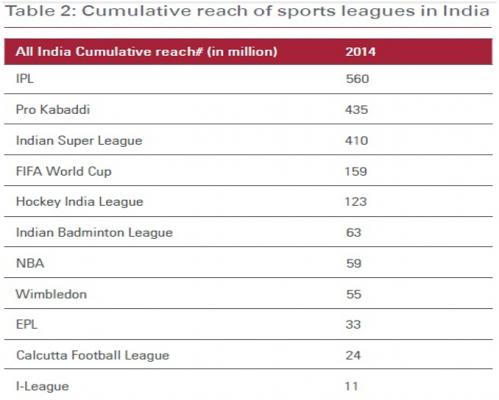
    Cumulative reach refers to the number of individuals within the target group who viewed the tournament over a certain period of time, including duplication.

    Ecosystem to support sports development in India

    However, in order to sustain the growth in sports and sports-related businesses, a flexible regulatory and policy framework that is able to realise synergies between various segments of sports needs to be developed. This in turn requires the sports ecosystem and its stakeholders to be recognised under the purview of a dedicated industry of sports which can provide impetus to an organised and professional business environment for sports in India.

    Sports Broadcasting in India

    There has been a surge in the number of sporting events broadcast in the past few years. These events include tournaments and leagues played at state, national and international levels. Several international tournaments and leagues played at the regional or global level are now telecast in India bringing in a larger and much diverse audience. Males form around 60 to 65 per cent of viewers and are expected to continue to be the main target segment. However, the number of female viewers has been increasing. About 57 per cent of the viewership of ISL and 53 per cent of the viewership of Pro – Kabaddi League was made up of women and children. Broadcasters are supplementing the sports with other entertaining and informative pieces to make the program more inclusive.

    Getting to the right content mix

    With the rise in number of sporting events, sports channels are covering several sporting events in their annual calendar. It consists of a mix of marquee events from domestic and international leagues, major tournaments along with minor domestic leagues and tournaments.

    Star Sports has revamped itself with uniformly branded eight channels to showcase a variety of domestic and international sports both cricket and non – cricket and in English as well as Hindi. While international cricket matches featuring India will make up 65 per cent of Star Sports 1, Ranji matches, university and women’s cricket and international cricket matches not featuring India will form 50 to 60 per cent of content on Star Sports 2. This will enable Star to nearly double its cricket content, which is the major revenue driver for sports channels in India. Star Sports 4 will feature other sports, which include international football (soccer), European soccer leagues, badminton, tennis and Formula-1 racing.

    The new Indian leagues, which include hockey, badminton and soccer, will be telecast on Star Sports 1 to 3 to reach a larger audience. Such a strategy enables Star Sports to increase its cricket content as well as broadcast non – cricket sports, which are seeing increasing traction. There is also an increasing trend towards multi-sports channels, as the viewership of different sports are increasing and sports channels are vying for TV rights across sports. Star has seen a shift from having a cricket specific channel in its cluster to multi-sports channels. It enables Star to broadcast both international and domestic cricket content simultaneously as well as gives it flexibility to show different sports across different channels. This can be attributed to the large investments made by Star to purchase rights for domestic and international cricket, football, tennis, badminton etc.

    On the other hand, Neo has rebranded its cricket specific Neo Cricket to Neo Prime on account of reduced live cricket properties and surge in volume of several sports.

    Ten however, has sports specific channels with Ten Cricket for cricket, Ten Action for football and Ten Golf for Golf broadcasting. Availability of sufficient single sport media rights and a definite viewership base for that particular sport drives the presence of sports specific channels. This helps advertisers to target a specific audience, for example luxury products have tied up with Ten Golf. Although, digitization and lower costs of distribution make single – sport channels more viable than before, it can take some time to evolve in India and reach the popularity of golf and tennis channels in some developed countries.

    Regional language boost to broadcasting

    Another strategy to target a specific audience is the language of telecast. Hindi and other regional languages increase the audience reach for sports as English has a limited audience. Star Sports 3 replicates Star Sports 1 in Hindi. In 2014, it telecast the domestic football league – Indian Super League in five languages. Its regional TV channels were used to telecast the league in Bengali, Kannada and Malayalam apart from English and Hindi broadcasts. During FIFA World Cup 2014, Bengal accounted for half the country’s viewership mainly because of regional language feed by Multi Screen Media (MSM) on its Bengali general entertainment and film channel Sony Aath. Hindi broadcast of the Pro Kabaddi League on Star Gold also helped take the cumulative reach to 435 million for the event. Other than using regional sister channels for feed in local languages, sports channels may spin off separate regional language sports channels if the demand picks up.

    Revenue and Profitability model

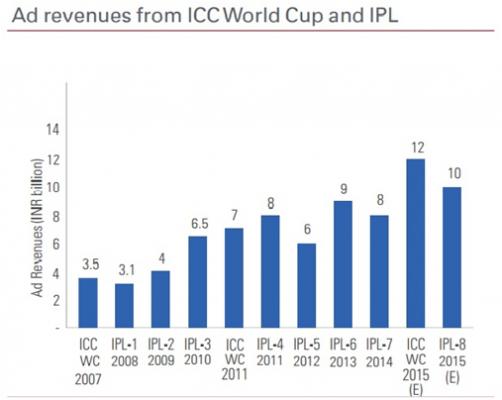
    Sports industry is still an ad driven revenue model. Media spends on sports, most of which is on TV, increased from Rs 11.5 billion to Rs 22.5 billion over 2008 to 2013 at a CAGR of 14 per cent. In mature markets, subscription is the main revenue driver for sports channels, contributing nearly 60 to 90 per cent of the revenues. However in India, advertisements still account for nearly 60 per cent of the revenues of sports channels, mainly driven by cricket, which is the largest revenue spinner and accounts for nearly 80 to 85 per cent of the total television sports media revenue. Non-cricket sports provide live sports content around the year, which gives advertisers a regular touch-point to their target segments. Revenues from advertisements in any year vary depending on the tournaments and series held during the year. Cricket mostly forms the peaks whereas the troughs are being evened out with non–cricket sports and non-live cricket content. In 2011, ad spends on TV for cricket was estimated to have crossed Rs 20 billion. In 2015, ad spends from the ICC World Cup and IPL 8 alone are expected to be around Rs 22 – 25 billion. Ad revenues for non-cricket sports are only a small fraction of cricket revenues. In 2013, ad revenues from Indian Badminton League and Hockey India League were Rs 0.9 billion and Rs 0.7 billion respectively.
    Key challenges facing the spurt of non-cricket leagues in India includes:

    • Poor investor confidence

    For instance the Indian Badminton League (IBL) suffered a loss of Rs 25 crore in the opening season in 2013 owing to investors pulling out casting doubt on the return of IBL with its second season. However, despite no play in 2014, the IBL is set to return in 2015.

    • Lack of industry status

    Provision of industry status could lead to an organized sports industry leading to higher available capital, newer sports businesses, additional revenue streams for stakeholders making leagues commercially viable ventures.

    • Lack of a culture for sports

    Sporting leagues in India are designed to last just a couple months every year. However, many major sporting league seasons in the world last for longer durations every year. Sporting leagues need to become year round (or at least three – four months a year) ventures. Apart from the benefit of a longer engagement with viewers (allowing the building of a larger fan base and culture for the game), this also touts the idea of sport becoming a year round profession furthering the advent of sports businesses.

    Revenue model in leagues

    Major sources of revenue for any league come from media rights, sponsorships and revenue from franchisees. Share of franchisee consideration in IPL has increased from 30 per cent in 2010 -11 to 37 per cent in 2012- 13 with a corresponding decrease in the revenues from sponsorship rights. Income from media rights and other sources have nearly the same share in 2012-13 as in 2010- 11.

    Major Sources of revenue for a League Franchisee

    Major sources of revenue for any league franchisee are share of the central revenues, local revenue and performance revenue.

    • Share of central revenue

    This includes a percentage of the revenue to the league from media rights and central sponsors like Pepsi in the IPL. In India, media rights are a major revenue sources both for the league and the franchisees. Channels are expected to further increase the subscription revenue for sports channels.

    • Local revenue

    Local revenue for a franchise entails revenue from match day ticket sales (gate revenue) and commercial revenue that includes funds from franchise sponsors, merchandise sales and revenue generated from membership with the franchise club if any. However, revenue from franchise sponsors makes for a majority of the commercial revenue. Sports merchandise sales is a fast growing segment with Rs 2 billion in retail sales in 2013. Moreover, contribution of gate revenue to overall revenue of franchises is low due to inexpensive ticket pricing, especially in non-cricket leagues. This is in contrast to leagues abroad where gate revenues are a significant contributor to a franchisee’s revenue.

    How can leagues be further popularised/ monetized?

    Some of the critical success factors of a league in India are identified below:

    • Players

    Involvement of top players of the world creates interest in the viewers and increases the quality of the game. The IPL is a successful example of the same. On the other hand, I-League is struggling to attract top players resulting in poor viewership.

    • Marketing

    An effective marketing campaign is another critical factor in making the league popular. Again, the involvement of various celebrities as brand ambassadors or owners in the IPL contributed to generating larger viewer interest in the league. In fact, the marriage of the Indian entertainment industry and cricket has aided in making IPL a commercial success.

    • Governance framework

     It is seen that leagues, which are run with the support of the approved federation have been able to sustain. The ICL failed due to lack of support from BCCI and World Series Hockey (WSH) is facing similar troubles due to non-recognition of the founding federation as the official national sports federation of hockey itself.

    • Stadium Infrastructure

    Quality of stadium infrastructure improves the viewing experience, hence increases the level of interest in the sport. It is important to create supporting infrastructure like restaurants, bars, fast-food chains, merchandise, stores, books and music stores, etc. to develop stadiums into popular entertainment spots for the family. Hike in ticket prices subsequent to rise in viewership, organizing multiple sporting events and entertainment shows wherever possible can help monetise stadium infrastructure.

    • Fan base

    An effective strategy to increase a franchisee fan base is engagement of respective franchises with local community. This helps generate greater TV viewership, increase attendance of matches and sale of merchandise. Performance of national team or players at international level increases the interest in the game, hence the league.

    League timing

    The tournament should be held at a time when there is no clash with international tournaments that could divert a significant section of the viewers, many players are available and weather is suitable for holding matches. The length of games and timing of matches (conducive for family viewing) are also important factors to consider, both having further helped significant viewership of the IPL. Other factors may include spectator friendly broadcasting such as better viewing angles and broadcasting in Hindi and English.


  • Sporty Solutionz signs multi-year media rights deal with New Zealand Cricket

    Sporty Solutionz signs multi-year media rights deal with New Zealand Cricket

    MUMBAI: Sporty Solutionz has signed a multi-year media rights deal with New Zealand Cricket. The deal enables Sporty Solutionz to sub-license New Zealand Cricket rights until 2016 and 2017 in Pakistan, Sri Lanka, Bangladesh and other parts of the sub-continent outside India. This will involve all cricket hosted by New Zealand Cricket during the 2014-15, 2015-16 and 2016-17 seasons.

    During the period of the contract, New Zealand Cricket will play host to eight international series, including three visits from Pakistan, two from Sri Lanka, and a visit each from Bangladesh, Australia and the West Indies.

    Sporty Solutionz’s chief executive officer Ashish Chadha rates the new relationship as extremely valuable. “We are proud to be associated with New Zealand Cricket,” said Chadha and added, “We are confident of broadcasting the action to previously unexplored territories to ensure the best reach for cricket played in New Zealand.”

    “Of the eight series NZC will host during the period of our contract, six will involve teams from the sub-continent: Pakistan, Sri Lanka and Bangladesh – all of which play exciting cricket. On average, one of these teams will be playing every six months in New Zealand over the next three years – and I’m sure cricket lovers in the sub-continent are going to witness some exciting encounters,” he highlighted.

    NZC chief executive officer David White welcomed the agreement and said he was looking forward to working with Sporty Solutionz over the term of the contract period.

    “The next three seasons are shaping up as an exciting time for New Zealand Cricket and the Blackcaps, and we’re delighted to have Sporty Solutionz as a media rights partner,” said White.


    “At a time when the Blackcaps are making excellent progress as an international team, this new partnership will ensure their exposure to an ever-increasing media audience,” added White.