Tag: covid2019

  • ITV virtual roundtable on seamless video experience today

    ITV virtual roundtable on seamless video experience today

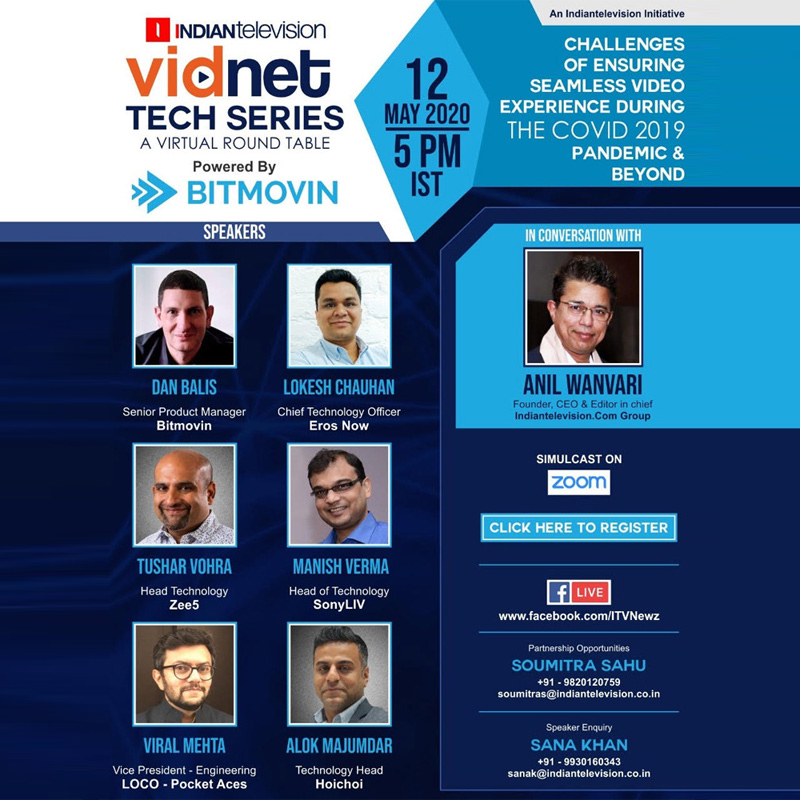
    MUMBAI: The latest roundtable in the Vidnet tech series being organised by Indiantelevision.com will be held today, 12 May, at 5 pm. Powered by Bitmovin, the webinar will discuss the “challenges of ensuing seamless video experience during the Covid2019 pandemic & beyond.”

    The pandemic meant many more people were at home, consuming content, delivered on streaming platforms and television. Data consumption rose to levels not seen before. In India, most of the streamers started delivering videos in the standard definition format as against HD because of the stress on bandwidth. What other lessons has the current crisis and pandemic taught streamers? What else did they do to deliver a better seamless experience to consumers? And going forward what else can be done? The webinar seeks to find answers to these questions, and many more. 

    The virtual roundtable will feature Dan Balis, senior product manager at Bitmovin, and will be moderated by Indiantelevision.com founder, CEO & editor in chief Anil Wanvari. 

    Bitmovin is built for technical professionals in the OTT video market with software solutions to help optimize customer operations and reduce time-to-market. Dan's work at Bitmovin focuses on the Bitmovin Player. He has over 15 years experience launching streaming video products and platforms at scale for media and technology companies that include Viacom, Bright cove, and AOL. His specialties include video platforms, cloud, analytics, SAAS, and ad tech.

    The roundtable will have technology heads of some of the prominent OTTs as delegates. They include: Hoichoi technology head Alok Majumdar, Eros Now CTO Lokesh Chauhan, Zee5 technology head Tushar Vohra, SonyLIV head of technology Manish Verma, LOCO – Pocket Aces VP engineering Viral Mehta, Lionsgate India director of product Mohit Khatwani, and ScoopWhoop Media CTO Vinay Gupta,  

    The event will be simulcast on zoom and Facebook. 

  • Star India, Disney+Hotstar join hands with Project Mumbai in Covid2019 battle

    Star India, Disney+Hotstar join hands with Project Mumbai in Covid2019 battle

    MUMBAI: When the entire world is hobbled by a never-before-seen pandemic of this scale, what the world wants is an unwavering sense of camaraderie that is rooted in humanity. In such a crisis, people and organisations, transcending all man-made restrictions, help each other so as to put up a collective fight against the Covid2019 pandemic.

    The country has already seen how the entertainment industry has come out to help those in need of succour.    

    Now, media organisations are coming to the forefront in this hour of crisis to do their bit for the health and safety of individuals who are at the forefront in their battle against the pandemic.

    Star India and Disney+Hotstar have joined hands with the NGO Project Mumbai by donating 200,000 personal protection equipment (PPE) kits to the health workers at BMC and an additional 10,000 khakhi-coloured kits for the Mumbai police.

    Mumbai, which is seeing a spike in cases with each passing day, needs the consistent support and help of non-governmental organisations in dealing with a massive crisis like this one. This is where Star India and Disney’s contribution matters. The support will help the ongoing efforts in meeting the demand for PPE kits for almost four weeks. Showcasing solidarity with the numerous medical, health, and protection warriors, the initiative seeks to equip the selfless warriors who are at the frontline, battling the pandemic.

    Project Mumbai CEO-founder Shishir Joshi told Indiantelevision.com that Uday Shankar, president of The Walt Disney Company Asia Pacific, and chairman of Star India, was very keen to extend a helping hand to help Mumbai tide over the crisis.

    “Uday Shankar was very keen to do something for Mumbai. Star has its base prominently in Mumbai. He himself has lived in Mumbai for a longer period of time. He asked us what needs to be done. We told him that doctors need to be helped out. They need PPE,” he said.   

    According to him, this is biggest contribution of its kind by a media company in India after Covid2019 has broken out. People need to come to help the city, especially given the fact that Mumbai has been seeing spike in cases.

    Project Mumbai has been at the forefront of helping the needy in these times. “We are feeding over 2,000 doctors every day. We are also feeding 70,000 homeless people,” said Shishir Joshi.

  • Is television viewership petering out as India adjusts to lockdown?

    Is television viewership petering out as India adjusts to lockdown?

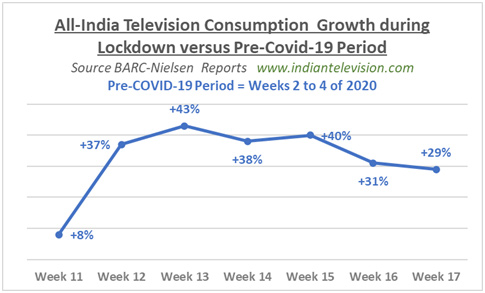
    BENGALURU: Television consumption in India seems to be petering out, according to Broadcast Audience Research Council of India (BARC)-Nielsen Reports. Of course, even in the sixth week and the second extension of the national lockdown to lockdown 3.0, television consumption is 29 per cent higher than during pre-Covid2019 periods. BARC and Nielsen have compared data for the pre-Covid2019 period with average numbers for Weeks 2 to 4 of 2020. Television consumption had peaked in Week 13 of 2020, the first full week since the lockdown commenced in the middle of Week 12 of 2020, on 25 March 2020 in India. Television consumption grew 43 per cent in Week 13 of 2020 as compared to the pre-Covid2019 period. BARC-Nielsen reports are available for the period starting Week 11 of 2020 until Week 17 at the time of writing of this paper.

    Please refer to the figure below for All-India television consumption trends.

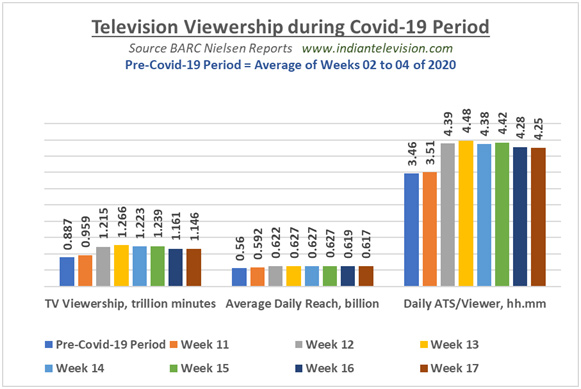
    The basic currency for total television consumption is trillion minutes. Average television viewership during the pre-Covid2019 weeks considered in the BARC-Nielsen Reports (Average of Weeks 2 to 4 of 2020) was 887 billion minutes with an average daily reach of 560 million. This worked out to a daily average time spent (ATS) watching television of 3 hours 46 minutes. In Week 13 of 2020, this peaked to 1,266 billion minutes with a reach of 627 million and ATS of 4 hours and 48 minutes.  These numbers have been sliding down since then. Please refer to the figure below.

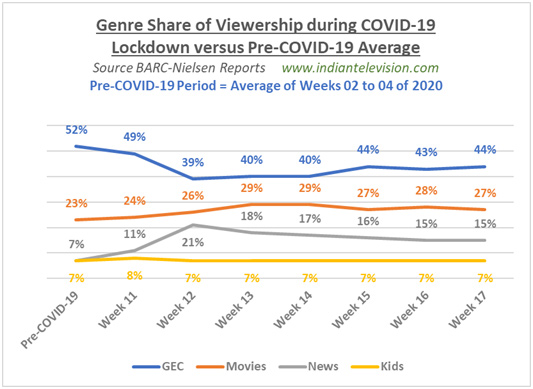
    In the pre-Covid2019 weeks, four genres had 89 per cent of viewership share – in terms of size, they are GEC, Movies, News and the Kids genres.  During the 7 weeks for which BARC-Nielsen Reports are available (Weeks 11 to 17 of 2020) at the time of writing this report, their combined share grew to 93 per cent. During the pre-Covid2019 weeks considered in the BARC-Nielsen Report (Weeks 2 to 4 of 2020) GEC had the largest viewership share of 52 per cent, followed by Movies with 23 per cent, the news and the kids’ genres with 7 per cent each. During Week 13 of 2020, this had changed to 40 per cent for GEC, 29 per cent for Movies, 18 per cent for news and 7 per cent for Kids. It must be noted that though share of the Kids channels was has generally been steady, overall television viewership has gone up during the lockdown period, and hence the number of viewers and ATS on the Kids was much higher than earlier times. It must further be noted that News had a share of 21 per cent in Week 13 of 2020.

    GECs, which had been experiencing a decline in viewership share during the Covid2019 lockdown due to the lack of fresh programming, got a breath of fresh air by way of re-runs of mythology and old classics on pubcaster network DD’s DD National and DD Bharati.  GECs’ viewership share has climbed to 44 per cent in weeks 16 and 17 from a low of 39 per cent in Week 12. The Movies genre seems to have stabilized at abut 27 per cent share as compared to the 23 per cent share during the pre-Covid2019 weeks considered in the BARC-Nielsen Reports.

    Please refer to the figure below:

    Overall, television consumption seems to be petering out slowly across the other major genres also.  Besides the four genres mentioned above, business news, youth, infotainment and lifestyle have witnessed changes in consumption growth. Relatively, the lifestyle genre seems to have had stabilized with about 32 per cent growth since week 13 of 2020 as compared to the average of the pre-Covid2019 weeks considered by BARC-Nielsen. The news genre, which had seen consumption triple in week 12, has stabilized consumption at around 165% growth in Weeks 16 and 17 of 2020 as compared to the average of the pre- Covid2019 weeks. Please refer to the figure below:

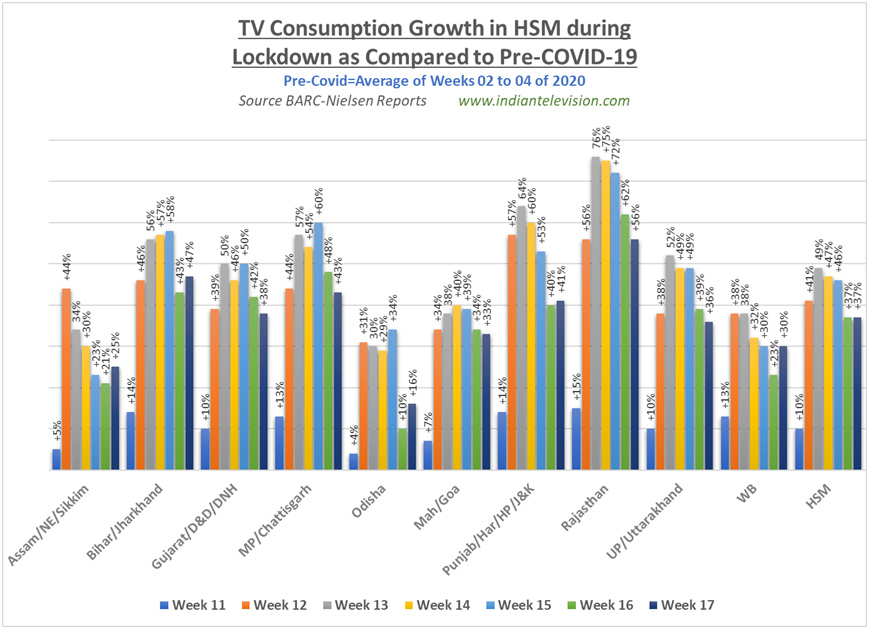
    BARC considers the Hindi Speaking Market or HSM as All India minus the four Southern Languages: Kannada, Malayalam, Tamil and Telugu. The South is a mature market with a higher penetration of television as compared to the HSM. Television consumption is also higher in the South. Hence, growth in the South market has been more muted as compared to the HSM during the lockdown weeks to date as compared to the average of the BARC-Nielsen Covid2019 weeks. The North Eastern states saw television consumption peak in week 12 itself – this was the week when the Janata Curfew and a couple of days later the first series of Lockdown or Lockdown 1.0 were announced by Indian Prime Minister Narendra Modi.  Most of the states saw viewership peak in Week 13. The exceptions were a few states where more of local ‘Covid2019’ and or/or events such as the lynching of the Sadhus in Maharashtra or the swearing in of ministers in Madhya Pradesh. There has been a general decline in television consumption since then, as mentioned before. Please refer to the figure below:

    Further, as mentioned above, South India has seen lower growth in viewership during the lockdown weeks because of its higher base and longer ATS spent even before the Covid2019 lockdown weeks. Hence the decline in television viewership since the peak has been lower in the South markets as compared to HSM. Please refer to the figure below:

    Is this the way forward?

    Television networks have tried to bring in viewership and maintain viewer stickiness. News by itself has grown as a genre because of the playout of events around the lockdown. Taking a cue from the movies genre, many networks have started beaming film-based content, but this has not been enough. The South GECs have witnessed growth on the back of comedy films over the last few days. Channels have brought back mythology and classics. Reruns of the Ramanand Sagar Ramayan and the B R Chopra Mahabharat, through daily episodes as opposed to the weekend episodes that were experienced when these magnum opuses were first aired, have brought in viewers and ensured their loyalty in the case of DD National and DD Bharati. Since mythology seems to have worked for DD, private networks have decided to include them in their programming mix. This seems to have worked to an extent in the case of Star Plus which launched of Ramayan in Week 17, and that slot for the channel has seen viewership grow by 65 per cent according to a preview of data by BARC for Week 18. Viacom18’s flagship Hindi GEC Colors has seen viewership growth of 24 per cent in Week 18 for the time slot when it commenced airing Mahabharat.

    It is still early days for a cure or vaccine for the pandemic to make things easier for humans, to bring back some form of normalcy. A lot more people will continue to stay at home. As the world and India slowly limp back in a phased manner to a ‘new normal’ from the Covid2019 lockdown, fresh content will surely be produced. However, given the circumstances globally, the ‘new normal’ has yet to take on a definite shape. If study, work, exercise, etc. from the home becomes the ‘new normal’, then ‘entertainment consumption at home’ is definitely set to be a big part of daily life. Content viewership from home, be it on the OTT platform, or the idiot box, or on the smart phone or a computing device, is definitely set to be much larger than during the pre-Covid2019 weeks. The question is“Will it be higher than during lockdown weeks?”

  • Agency recovery to take at least 6 months: Havas Group CEO Rana Barua

    Agency recovery to take at least 6 months: Havas Group CEO Rana Barua

    NEW DELHI: Human beings are a creature of habit and it won’t take them long to get back to the routine once the lockdown is lifted, believes Havas Group CEO Rana Barua. In an exclusive interaction with Indiantelevision.com, he, however, notes that the number of brands that a person usually relies on will drop drastically.

    “From a consumer perspective, people have somehow understood that a brand has to have some relevance in their life. In the past weeks, they have realised that they can manage their lives without certain brands. For example, a person who used to own 150 brands prior to the lockdown will use only 70 now,” Barua says.

    He adds that only those brands that have a purpose and the ability to indulge people in meaningful conversations through stories will survive. “I am very sure that the coming months will see great stories from advertisers.”

    Barua also sees a lot of positivity around the growth of businesses across categories in the coming months. “People are willing to buy stuff. You witnessed what happened with the liquor shops opening up. Even with governments adding Covid2019 special taxes in disproportionate percentages, record sales happened. Several brands like Amul and Reckitt Benckiser performed exceptionally well even during the lockdown. I see things coming on track for green and orange zones by the end of June and red zones following it by the middle of July, provided the lockdown is lifted.”

    "Our client Hyundai opened 225 showrooms across the country and it recorded 500 bookings in just two days. All of this shows that the consumer is willing to spend,” he says.

    Barua emphasises that the overall impact on categories and brands will be “mixed-matched” depending on the role a product plays in a consumer’s life. Businesses like events and experiences will not see any positivity in this year.

    While most of the client-side will pick up pace in the next 30-40 days, the agencies will take at least six months to get back to the pre-lockdown form, Barua observes.

    “I think the agencies will follow the trail in a slow manner. Large and scalable companies like ours will take at least six months to get back in some form. Obviously, a brand that had been missing from a consumer’s life for three months won’t start advertising suddenly.”

    However things are going to be challenging for small scale businesses while bigger networks have cash reserves  “They could possibly take a year to recuperate, due to issues like cash flow, rents, salaries, payment to vendors, collections and more, taking a bit longer to recover."

    He concludes that he is hoping that the economy opens up soon so businesses can start functioning. He also remains quite positive about new launches.

    “I think that the launches will go on as planned once the lockdown is lifted. They (brands) might have to rework on their numbers and the return they were expecting from the calendar year, but launches will happen. Summer brands are obviously at a bigger loss, but if the monsoon is delayed and summer continues for two weeks extra, they too might come out with their new ranges.”

    Follow Tellychakkar for the consumer facing news & entertainment

  • Need to use Covid2019 situation to create 21st century content delivery biz: Uday Shankar

    Need to use Covid2019 situation to create 21st century content delivery biz: Uday Shankar

    MUMBAI: “We are in for a long, dark and scary winter,” says Uday Shankar, president, The Walt Disney Company, APAC and chairman, Star & Disney India, regarding the current situation, in an interview with ET Now. He dwelt at length on the Covid2019 crisis, its impact on the media, especially the TV business, and the road ahead.

    Regarding advertising revenue, he said, April and May are the months when advertising climaxes. “This is the time of IPL. In the seven weeks of the IPL matches, it generates six to seven thousand crores of economic value just around the IPL. And all of that has become zero this year. A larger number of advertisers wait for IPL to launch special campaigns and products. All of them have stopped."

    Regarding post-covid2019 world, he feels that life has changed a lot. “But the basics are remaining the same. We are still alive and still looking positively about priorities. We are running our businesses. We have to run our businesses very differently. We can't travel or go to the office. My portfolio stretches across the Asia Pacific region. So the level of my challenges is even higher. But one I think I realize is that people are extremely adaptable and they are trying to make it work."

    According to him, the new ways of working and adaptability to them are pretty exciting, he states. The biggest challenge, he says, is that the economy has taken a massive hit, especially in India which is going through a lockdown.

    Regarding the impact on advertising revenue, he said: "Leave aside sports, even entertainment too has come down: from the normal to down to 20-25 per cent. That's the aggregate level. The news business is holding up there."

    Programming has stopped due to lockdown, but even when they restart it will be difficult.   

    According to him, all broadcasters will have to aggressively revisit their programming costs. So those who are doing ten shows will start with four. The financial pressure will pose even bigger challenges. And there is only going to be so much advertising available.

    “We make our money in this country disproportionately from advertising; the distribution income is still small. People advertise only because they realize that there is a market for their goods to be bought and sold. If nobody is going to buy a car, why would a car manufacturer advertise? So we are in it for a long and dreaded winter. Newspapers are going to face even bigger problems. And everybody thinks that it is a great time for digital, but I don’t think so. Digital advertising has taken a hit and it will continue to be like that for a while.”

    Regarding sporting activity for which his company has invested heavily, he said: “Sports has taken a hit globally. There is nothing you can do. People’s health and safety come before everything else. It would be naturally selfish or immature on our part to even think that regardless of everything, sports should happen.”

    He feels that once the situation is back to normal, live sports events will happen with massive restrictions on spectators’ presence. You can’t have a plan-B for live sports, he said.

    Regarding cost-cutting across the media sector, he said that his organisation has also taken some measures. “We urged our senior executives to take a voluntary reduction in salaries. People have responded very positively to that.”

    But some organisations, he said, have been forced to take measures as a last resort. Job losses will happen, he said.

    According to him, the way the media works in this country is “very antiquated.”  Do you need so many people to shoot a show? Does everybody have to sit in one place? If supply chains are distributed globally, why is the entire media chain different?”

    On what he is trying at this moment of crisis, he said: “I am trying three things. First of all, we don’t treat this as new normal. I believe this is a passage into a new world. Within the discipline of my company I won’t really put pressure on people to come to work every day even if everything becomes normal. Star has already taken some lead in that direction. We don’t have mandatory attendance. We don’t ask people to sign in at a time. Or we don’t have fixed leave. I think we were pretty liberal. We should actively encourage people to work from wherever they are. We should look at lighter ways of creating content, which is less resource-intensive, less human power-intensive, but very heavy on creativity and technology.”

    “And I think we should revisit the whole concept of gigantic headquarters where everybody sits together. For our business television has always been under pressure, partly because of the shift that has been happening in the environment and also because of the fact that television in this country is unfortunate to have a regulator who has no understanding of the business and who is out to destroy the business. So the television business has been under pressure. And its odds for regaining its health are much less than I would like to think.”

    So how can we make it lighter, nimbler, direct to consumer and use this Covid2019 situation to make a 21st century content delivery business in this country is the question.

    According to him, regulation means that there should be an even-playing field and transparency. If businesses are not able to succeed, then nobody is going to invest, he says. “That’s the real risk of the TV sector in India. Advertising income was strong and the regulatory fees pressure that was value-destructive in the distribution side was sort of mitigated to some extent. Now it is a twin shock on the advertising and distribution fronts. It is going to be really tough for the television business. And it is very challenging for fresh investments. I don’t think people will come and pour money,” he explained.

    As to why his company wants to invest in India, he said: “Star India is the number one media company in India. Everyone knows in the power of India. When I took over Star India the entire television business was much smaller, but today it is one of the biggest media and entertainment markets in the world despite all the challenges. We remain optimistic about the power of 1.3 billion people, the big market, and the creativity in this country. So those who have already invested, they will continue to be committed. But new people who have to start from scratch many of them will rethink before investing.”

    Regarding the kind of content consumers will consume in the times to come, he said: “We give too much credit to ourselves and too less to consumer. Consumers may not be able to articulate it, but they are usually far ahead of the business. Our innovation usually catches up with where the consumers’ mind is. When we started Hotstar, people said I was being delusional and that we were going to lose money. And with the data revolution that happened we have seen the explosive change. In the next three year or so there will be 700-750 million people who will watch content on their mobile devices. And 250 million on TV. That’s where Covid crisis has taken us to. People are home, working but also catching up entertainment.” 

    Follow Tellychakkar for the consumer facing news & entertainment

  • Hotstar brings some cheer to Disney numbers

    Hotstar brings some cheer to Disney numbers

    BENGALURU: Covid2019 has hit most businesses and hard! Events, including all the sporting ones, have been cancelled globally. Ad and other revenues have been impacted for media companies. The Walt Disney Company (Disney) had a steep fall in diluted earnings per share (EPS) in the quarter ended 28 March 2020 (Q2 2020, quarter under review) as compared to the corresponding year ago quarter. The company reported a 63 percent fall in diluted adjusted EPS to $0.60 in Q2 2020 versus $1.61 in the corresponding year ago quarter. Diluted EPS from continuing operations for the quarter under review decreased 93 percent to $0.26 from $3.53 in the prior-year quarter.

    Disney has four segments: Media Networks, parks, experiences and products (Parks), studio entertainment and direct-to-consumer (DTC) and international.

    Disney said in an earnings press release for Q2 2020, “The impact of Covid2019 and measures to prevent its spread are affecting our segments in a number of ways, most significantly at parks, experiences and products where we have closed our theme parks and retail stores, suspended cruise ship sailings and guided tours and experienced supply chain disruptions. In addition, we have delayed, or in some cases, shortened or cancelled theatrical releases and suspended stage play performances at studio entertainment and have seen advertising sales impacts at media networks and direct-to-consumer and International. We have experienced disruptions in the production and availability of content, including the cancellation or deferral of certain sports events and suspension of production of most film and television content. Many of these businesses have been closed consistent with government mandates or guidance. We estimate the Covid2019 impact on operating income at our parks, experiences and products segment was approximately $1 billion primarily due to revenue lost as a result of the closures. In total, we estimate that the Covid2019 impacts on our current quarter income from continuing operations before income taxes across all of our businesses was as much as $1.4 billion, inclusive of the impact at the parks, experiences and products segment. Impacts at our other segments include lower advertising revenue at media networks and direct-to-consumer and international driven by a decrease in viewership in the current quarter reflecting Covid2019’s impact on live sports events and higher bad debt expense and a loss of revenue at studio entertainment due to theater and stage play closures.”

    Total revenues for Q2 2020 increased 21 percent Y-o-Y to $18,009 million from $14,922 million in Q2 2019. Total segment operating income declined 37 percent Y-o-Y in the quarter to $2,416 million from $3,816 million. Disney’s OTT Platform Disney+ includes Indian OTT platform Hotstar. Disney+ Hotstar is a part of Disney’s direct-to consumer and international segment and Disney+ Hotstar helped alleviate a bit of the drop in numbers according to the company. Disney+ average monthly revenue per user at $5.63 was higher than ESPN’s $4.24 and about 47 percent of Hulu SVOD only at $12.06  in Q2 2020, The company estimates that it had 54.5 million Disney+ subscribers as of 4 May 2020.

    “Disney+ launched in a number of European markets during the quarter, which contributed to a total paid subscriber base of $33.5 million at the end of the quarter. And we are very pleased with the success of our rollout in Western Europe and India, including the execution of previously announced deals with some European platforms to distribute the service to all paid subscribers on certain of the widely distributed tiers and in India to convert our pre-existing subscription based Hotstar service to Disney+ Hotstar, revealed senior executive vice president and chief financial officer Christine M McCarth during an investor call.

    Parks, experiences and products

    The largest drop in absolute numbers was from Disney’s Parks segment, followed by a steep increase in operating loss from Disney’s DTC and international segment. Parks' segment operating revenue and segment income declined 10 percent and 58 percent respectively. Disney reported revenue of $5,543 million for Q2 2020 and $6,171 million for Q2 2019 from the Parks segment. Income from the segment was $639 million in Q2 2020 and $1,506 million in Q2 2019.

    “As you know, Disney, like many other companies, has experienced widespread disruption. In mid-March, we closed our domestic parks and hotels indefinitely, suspended our cruise line, halted film and TV productions and shuttered our retail stores. And while these were necessary steps to ensure the safety and well-being of our guests and employees, our businesses have been hugely impacted,” said Disney CEO Bob Chapek.

    “While it's too early to predict when we'll be able to begin resuming all of our operations, we are evaluating a number of different scenarios to ensure a cautious, sensible and deliberate approach to the eventual reopening of our parks. We will take a phased approach with limits on attendance using an advanced reservation and entry system, controlled guest density using social distancing and strict government required health and prevention procedures. These include the use of masks, temperature screenings and other contact tracing and early detection systems," revealed Chapek.

    Disney’s direct-to consumer and international

    Disney’s DTC and International segment operating revenue increased more than threefold (increased 260 percent) y-o-y in Q2 2020 to $4,123 million from $1,145 million in Q 2019. However, loss from the segment more than doubled (increased 111 percent) in Q2 2020 to $812 million from $385 million. Average monthly revenue per user (AMRPU) from Disney+ in Q2 2020 was $5.63. AMRPU for other contributors to Disney’s direct-to consumer and international segment numbers are:

    ESPN ARMPU $4.24 in Q2 2020 versus $5.13 in Q2 2019, a drop of 17 percent; Hulu SVOD only ARMPU $12.06 in Q2 2020, which was 5 percent lower than $12.73 in Q2 2020 and Hulu Live TV + SVOD ARMPU which increased 29 percent in Q2 2020 to $67.75 from $52.58 in Q2 2019.

    The company says that the increase in operating loss from its DTC and International segment was due to costs associated with the launch of Disney+ and the consolidation of Hulu. Results for the quarter under review also reflected a benefit from the inclusion of the TFCF businesses due to income at the international channels, including Star.

    “Results at our DTC businesses had an adverse impact on the year-over-year change in segment operating income of about $500 million which came in a little better than the guidance we provided last quarter. We expect our DTC and International segment to generate about $1.1 billion in operating losses for the third quarter and we expect the continued investment in our DTC services, in particular, Disney+ to drive an adverse impact on the year-over-year change in operating income of our DTC businesses of approximately $420 million, revealed McCarth to investors.

    Media Networks

    Disney’s largest segment is media networks which comprises of 2 sub-segments – cable networks and broadcasting.

    Media networks segment saw revenue increase 28 percent Y-o-Y in Q2 2020 to $7,257 million from $5,683 million in Q2 2019. Operating Income increased 7 percent Y-o-Y to $2,375 million from $2,230 million. Cable networks sub-segment revenue increased 17 percent Y-o-Y to $ 4,445 million from $3,793 million in Q2 2019. Cable networks operating income increased 1 percent to $1,799 million from $1,789 million. Disney says that the increase in cable networks operating income was due to the consolidation of TFCF businesses (primarily the FX and National Geographic networks), partially offset by a decrease at ESPN, and to a lesser extent, the Domestic Disney Channels and Freeform. The decrease at ESPN was due to higher programming and production costs and lower advertising revenue, partially offset by higher affiliate revenue

    Broadcasting revenue increased 49 percent Y-o-Y to $2,812 million from $1,890 million. Broadcasting operating income increased 53 percent in Q2 2020 to $397 million from $259 million. Disney says that the increase in operating income was due to the consolidation of TFCF, largely reflecting program sales, and to a lesser extent, an increase at its legacy operations

    Studio entertainment

    Studio entertainment segment revenue increased 18 percent in Q2 2020 to $2,539 million from $2,137 million in the corresponding year ago quarter. Studio entertainment operating income declined 8 percent in the quarter to $466 million from $506 million. Disney says the decrease in operating income was due to lower results at its legacy operations, partially offset by the consolidation of the TFCF businesses. The decrease at Disney’s legacy operations was due to higher film impairments and decreases in theatrical distribution and stage play results, partially offset by an increase from TV/SVOD distribution

    Confident about the future

    “While the Covid2019 pandemic has had an appreciable financial impact on a number of our businesses, we are confident in our ability to withstand this disruption and emerge from it in a strong position,” said Chapek. “Disney has repeatedly shown that it is exceptionally resilient, bolstered by the quality of our storytelling and the strong affinity consumers have for our brands, which is evident in the extraordinary response to Disney+ since its launch last November.”
  • Curtains for in-hotel conferences and events sector?

    Curtains for in-hotel conferences and events sector?

    MUMBAI: For long, the hospitality industry has played hard to get with those in the knowledge and entertainment event business. Banquet sales managers of five star hotels, venues were so used to charging a premium for almost any additional request that was put to them. And they refused to budge.  We are referring to the Tajs, the Oberois, the Marriots, the Hyatts, the ITCs, the Lalits et al.

    Rentals for banquet halls, mediocre buffet meals at atrociously high price, additional monopoly penalty fees for suppliers (who have a monopoly in the hotel, promising it minimum obscene revenues) of almost everything from cranes, to generators, to even sets in the hall – the charges piled on. And the organizer of the event (mainly the client, which could be a brand or parents of a to-be-wedded couple) had to cough up.  No amount of cajoling or negotiation worked. ‘Take it or leave’ was the attitude.

    The challenge is there are very few good banquet halls to organize conferences for 300 people or more. The venues are a scarcity and most of them are taken up much in advance. Hence, with it being a sellers’ market, the buyers had no choice but to grit their teeth and agree.

    An evening gig for 300 people could set you back by Rs 16-17 lakh, including meals, alcohol, and some décor and stage setups. A majority of that would be accounted for by banquet fees.

    Now with the Covid2019 virus raging like a tempest across the world and slaying hundreds of thousands of people and strict lockdown procedures in place – disallowing gatherings of people – these very same hotels are vacant or are being used to house policemen or other government officials. Banquet managers, who used to grinning ear to ear thanks to the fat revenues they earned from overcharging for average spaces, are scratching their heads on how and when they will go back to what was their normal.

    The news for them is that their days are numbered. The normal is gone. There’s a new gig in town. The online one. Over the past few weeks, new options have emerged: that of the online webinar, and of web performances. Tools like Zoom, Microsoft Teams, Google Meet – are being used more than ever. At any given moment at least hundred webinars or meetings are being held somewhere in India. And they are working out well.

    Prices are affordable: a good webinar with 500 participants can be put together for less than $200 each, including hosting, audience generation, marketing, video recording, packaging and the bells and whistles. The best part is that you have very limited check boxes to tick as compared to real live events. The main ones being: bandwidth, and speaker generation and a background image.  There is no question of food, or arrangements, sound or lights, or stage.

    As compared to that, the amount of effort that goes into organizing a live event is draining. Sessions are delayed, some run overtime, speakers arrive late courtesy traffic, thus sending schedules haywire and irritating other punctual ones and the audience.  Speakers are irritated, the audience gets annoyed. Of course, there is the additional worry of raising sponsorships and selling seats to help defray these exorbitant costs, negotiations with the hotel on every issue, sounds, lights, projectors et al.

    It’s quite likely that corporate India will take the digital virtual conference route even after the Covid2019 menace goes away, because of all the conveniences it offers.

    Will this force five star hotels and conference venues to become more reasonable?

    The top ends ones might go even more premium and charge even more, willing as they are to forego business volumes and focusing on high profitability. The wise ones will choose the price competitive path, and, may be, attract some real-world conferences back.

    My understanding is that while the real-world-touch-and-feel effect for events is so much better, the challenges outweigh the benefits.  Hence, the digital/virtual pathway seems more appealing. Of course, some may argue that zoom bombing can throw a spanner in the online conference business. But that can be curtailed by verifying ever participant.

    Clearly, the events industry has seen a shift. Those in the hospitality industry who react rightly will benefit in the long run. Those who do not: well, it will be ta-ta to them.

    (The author is a leader in the events business. He chooses to remain unidentified as he fears a backlash from the already hurting hospitality and venue sectors.)

  • Covid2019 a disruptor for digital content delivery

    Covid2019 a disruptor for digital content delivery

    MUMBAI: It's not easy to cope with the rising anxiety and uncertainty while sheltering-in-place. Fortunately, there is a huge amount of content available online that keeps everyone entertained and informed. With the exponential rise in content consumption, the tech teams of over-the-top (OTT) platforms and publishers have taken up important roles to serve consumer needs along with the help of content distribution networks (CDNs). However, the challenges of delivering content have risen during the Covid2019 crisis due to the overwhelming surge in consumption, a panel comprising industry experts during a virtual discussion agreed.

    The panelists included Viacom18 Digital Ventures technology and engineering head Mohit Srivastava, EPIC ON COO Sourjya Mohanty, The Indian Express CTO Amardeep Vishwakarma, Asianet News Media and Entertainment assistant director of technology Anoop Mohan, Quintype head of engineering Rashmi Mittal, Snapdeal CTO Prashant Parashar, Simsim CTO Gaurav Kalra, Limelight Networks product management senior director Michael Milligan, VideoTap founder and CEO N Dilip Venkatraman, Limelight Networks India sales director Ashwin Rao and Kavasam Konnect chief information and technology officer Koushik Ramani.

    The panel discussion, on the importance of CDN for data and video explosion in the post-Covid2019 world, was organised by Indiantelevision.com and moderated by its founder, CEO and editor-in-chief Anil Wanvari. 

    Srivastava said that consumption has gone up exponentially both for AVOD and SVOD models on VOOT; the latter has seen really skyrocketing growth.

    Mohanty also mentioned that its two OTT platforms have been doing really well. It has witnessed consumption going up 3-4x many days. He also added that along with more consumers, they have received more consumer insights too during this period.  

    Vishwakarma also added that traffic has increased 2x across its platforms. Although it's not inclined too much to video, people are consuming available static content on websites. 

    Mohan also spoke about a 2-2.5x growth across Asianet platforms. While it serves in seven languages, growth is occurring in each. It has also started producing Covid2019-related content to avoid fake news. 

    Mittal also added that the number of page views has doubled for its client publishers. On the other hand, Ramani said that it's leveraging social media platforms more as its OTT platform is not fully launched yet. 

    Snapdeal recently entered the video content space. Parashar said that during the lockdown, when non-essentials were not being shipped, it wanted to engage customers and started using video for that. Kalra, too, acknowledged that there has been an impact on the business as commerce is not happening. Hence, its focus has deviated more towards content.

    Parashar said that they have to put more efforts to deliver similar quality content at a lesser speed of data used by consumers. He brought up an important aspect that CDNs have not focused highly on mobile devices while Indian consumers mostly consume content on smartphones. According to him, it is the right time for CDN players to innovate on the mobile side of videos and images and optimise for the newer economy in the post Covid2019 world. 

    “A lot of time we experience that video delivery is not as optimised as you would expect for mobile platforms. As new content is not being created, content consumption has spread out quite a bit. As a result, it is putting pressure on CDNs in terms of efficiency. Hence, it has become tough managing traffic,” Srivastava added. Mohanty also agreed that this has been a key challenge: reduction of latency and better response time.

    Limelight Networks' Milligan noted that although smartphones are heavily dominating the Indian market, the Indian audience is also watching content on connected devices. “It's not only about the mobile experience, but content providers also have to think of connected devices. So, as a content distributor you have to find out how you can give the best experience on both,” he added.

    Mohan also revealed that as Asianet users are in tier-III cities and rural areas, where consumers use a lower version of Android, it created a multi-CDN strategy. It reached out to different CDNs to see how it can optimise them and deliver content faster.

    However, publishers in the panel said that CDNs have been very helpful to deliver static content during this crisis taking up a lot of load. Their challenge was another: the decline in ad revenue despite growing consumption.

  • Dubbing comes to a standstill; subtitling goes on

    Dubbing comes to a standstill; subtitling goes on

    MUMBAI: The outbreak of Covid2019 has not only brought the film and TV production industry to a halt, but even the associated sectors. The dubbing industry is one.

    However, the pandemic hasn't stopped people from consuming content. In fact, people are consuming content more than ever. According to a recent study conducted by KPMG, there has been a perceptible increase in media consumption during the last few weeks as people have remained homebound.

    With no new content in the making, most dubbing and subtitling companies are suffering huge losses.

    Business Of Languages (BOL) founder and CEO Rahul Bhatia says, “Currently, the dubbing industry has completely shut down. In this case, working from home is also not possible. We, in fact, tried doing it with artists with setups available at home but the outcome was not that great. So, technically everything is shut down as far as dubbing is concerned.”Prime Focus Technologies AVP Dubbing Bipin Doshi said, "Creating fresh viewing content requires lot of personal interaction which in the current scenario is neither permitted nor advisable. This means localizing existing or older content is the only option to ensure that audience currently ensconced at home gets entertained. Traditional method of dubbing currently is on a halt due to the restrictions in place but PFT is working on couple of approaches to start the dubbing process without endangering health of team or talent."

    Bhatia says that though dubbing is not happening,  other kinds of works like e-learning content where video reference is not required are going on. It can be recorded on the phone and shared with the client. Apart from that, IVR and audiobox projects are also being conducted from the confines of people's homes.

    Even for dubbing content in the regional language, Bhatia says it is not possible without studios and proper artists.

    Mega Media Studio MD John Joseph says that nobody is approaching for dubbing work right now. Most of the films are halfway through and those which are lined up do not have a release date.

    "Covid2019 has immensely affected our studio. Nothing is happening right now on the production side but post-production work is slowly happening. We are just continuing with films which were happening in the studio before lockdown."

    According to Joseph, unless films are completed, they cannot go ahead with the dubbing work.

    Doshi begun taking tentative steps for remote dubbing last year and managed to do a couple of tests just before the lockdown came into place. According to him voice quality is something that will take a while in addressing. The output will get homogenised to a certain extent and better quality can be achieved if talent can acoustically treat their rooms, mics are used etc so that voice quality can be monitored. It is important to solve for change in room tonality which is inherently found when audio is recorded in different setups.

    He adds, "Although we have begun using remote dubbing solutions it has lot of technical and user end challenges as this industry has never tried it before."

    Fakt Marathi Enterr10 MD Shirish Pattanshetty, however, says that the dubbing industry is making use of some other sectors to survive.

    "As far as industry norm goes people have been deferred from operating dubbing studios but some large corporates are using dubbing to their benefit to tap various content for different languages to ensure there is freshness in the content to cater to the audiences so that the retention level is high," he says.

    As the lockdown continues, no new episodes are being made. So, Pattanshetty thinks that the second-best option would be to dub the existing projects into native languages that are demanded by the audiences. He also believes that dubbing content is a beter option that showing OTT shows on TV.

    On the contrary, subtitling is happening with the help of cloud-based platforms where artists are translating the content and sharing on the platform. The cloud-based solutions enable them to download and transfer easily and quality issues do not come into play like they do for audio in dubbing.

    Cloud-based solutions enable editors also to work from home as long as they have stable broadband connectivity. Prime Focus Technologies has a cloud-based solution on its flagship product called CLEAR for content sharing, viewing and reviewing of the same at the other end. For localization, the options of reviewing multi-language audio tracks without creation of additional video screeners is a lifesaving facility. "Ability to give access through independent user IDs with watermarking of the content ensures online viewing of the files without having to send them to any one separately," Doshi adds.

    While different states are mulling over various lockdown-lifting strategies, Bhatia says, “We have to wait till the government grants permission to resume work. We work with a lot of professional dubbing artists but due to the lockdown most of them are in their hometown. So, we are waiting for permission so that people could travel. As of now we are completely clueless what is going to happen next.”

    Pattanshetty thinks that even if Mumbai  remains shut there would be dubbing studios based out of Pune, Kolhapur or Sangli who could ensure work is delivered to other connecting places. If Delhi becomes fully functional, Hindi content can take help from Delhi studios.

    Bhatia also points out that even after the lockdown is lifted clients will cut down the numbers of hours of dubbing. As cost-cutting measures, they might want to have only 20 hours of dubbed content rather than 50 hours.

    Joseph says, "We are currently suffering as there is no payment coming in. Initially, we would be finishing three to four movies a month and now we are restricted to just one."

    In a recent announcement, Kerala cultural affairs minister AK Balan  said that the Malayalam film industry will soon resume the post-production work of pending films. Meanwhile, FEFSI association president RK Selvamani has requested the Tamil Nadu government to grant them the permission to resume post-production works such as dubbing, re-recording and editing for films and TV soaps. Additionally, the Karnataka government has also granted indoor shoot permission with minimal 18 to 20 people. While there were rumours that the Maharashtra government was likely to give some leeway, the sudden spurt in the number of cases has closed that door.

    ZEEL executive vice president and cluster head South business Siju Prabhakaran says, “We are waiting for the Maharashtra government to grant permission to resume post-production work. In the meantime it is a good opportunity for people to use footages of short-form content which is pending for a long time.”

    Although new shows are not in production, ZEEL says it has certain shows as backup which will be used in the content pipeline for future. Prabhakaran adds that audiences know short-form content are sometimes shot on the phone and there is a possibility that it will have a technical snag. As far as a proper TV serial or a film is concerned, it requires a dubbing studio.

    For now, the dubbing industry doesn't have a way out and industry players are waiting for a revival strategy.

  • Instagram businesses witness demand dip by 80% during lockdown

    Instagram businesses witness demand dip by 80% during lockdown

    NEW DELHI: Since its inception, Instagram Business has been creating a pool of myriad opportunities for local and home-grown businesses to flourish. With its impactful visual presence, availability to micro-tag, and easy discoverability, the platform has led many businesses to set a unique benchmark. However, the ongoing lockdown necessitated by the Covid2019 crisis has impacted these businesses massively. 

    According to insiders, there has been a dip of around 70-80 per cent in sales queries in the past two months given consumer sentiments and unavailability of raw materials plus proper distribution channels. 

    Kriti Chaudhary who runs online clothing and accessories platform @sanskritikvastrashala tells Indiantelevision.com, “We have witnessed an 80 per cent dip in queries online. Another major crisis is with artisans as there no supply of raw materials because of restrictions on movement. Even if there are a few clients who are still interested in buying our stuff, we are not taking any new orders.” 

    Niharika Chaudhary, who owns and manages @peeli.dori selling sustainable Indian handloom online and has got actresses like Shweta Tripathi and Sumona Chakravarti wearing her pieces, also shares, “There are 70 per cent lesser orders and we have stopped dispatching stuff completely. The dip in revenues is massive as people are very apprehensive about ordering online.”

    Shivani Singh of @theartbox.in reveals that she used to register a sale of Rs 3-4 lakh monthly before the lockdown and has been able to deliver only two to three orders in the past two months. She is using this time to keep her followers engaged by posting tutorials and making new stuff and designs with available resources like resin. 

    Tanya Jain, who recently left her job to start her home-bakery, which she promotes on Instagram by the name of @kitschyn, adds that there is a lot of uncertainty about the business now. “I order Belgian chocolates for my cooking, which is impossible to import now. Also, even if someone orders, I can’t be delivering the food as I relied mostly on pickups or my driver going out. Now, we are in a containment zone and it is impossible to get people coming and picking stuff.” 

    Sakshi Uppal and Samarth Anand, who manage online clothing store @titli, said that they were in the process of launching a website to extend the business by the end of April, which has been halted now. 

    Anand, who also manages the finance and photography for the page, notes that sourcing of raw materials has been a major problem and they haven’t been able to create new designs, which was a USP for them. 

    Uppal, who also attends a lot of fairs and exhibitions like The Little Flea to extend her sales, adds that she is expecting that part of the business to be further hit. She used to get around 70 per cent of her orders online and relied on pop-up shops at exhibitions for the rest 30 per cent. 

    @MousseStruck partner Sahil Vora, who sells mousse and other desserts online shared that sales from Instagram, which used to be at least 15-20 every day, have dipped to zero. The platform also uses food aggregator platforms of Zomato and Swiggy for ordering and delivery, which, too, have noticed a sizeable dip because of the lockdown. 

    “Out of our 13 outlets across Mumbai, we are running only one now with limited manpower. The sales are just 20 per cent of what we used to manage to do before the lockdown,” he shares.

    Vora adds that food businesses particularly are facing a lot of problem because of the contagious nature of the virus and people being very cautious about what they are purchasing. 

    “Another big factor that is troubling us is the uncertainty around it. It would have been better if the government had given us a set time frame, say everything will start moving in the next three months. Then, we would have planned better, created leaner operations, paid staff accordingly. But now because there is no clarity, most of the businesses are forced to take harsh unprecedented decisions without any warning,” he says.

    Apart from dipping sales, the lack of access to raw materials and no support in end-point deliveries, another thing that is bothering these small business owners is how to keep paying their artisans and other team members. 

    Chaudhary says that many of her artisans are from poor backgrounds and live in remote areas. Right now, she is making sure that she pays them on time understanding that they live on a hand-to-mouth basis. “But if it (revenue problems) continue, I might not be able to keep the business afloat for more than three to four months.”

    Singh says that while she paid the team for the month of March, she hasn’t been able to pay for the last month. “They haven’t even asked because there was no work to do in April. My operating account is out of cash and it will take us some time to get back.”

    To keep paying their staff, Vora and his partner have started controlling additional expenditures like marketing and CRM. They also launched gift cards for their customers who are not able to avail their services now, where they purchase a gift card now and redeem after the lockdown is lifted.

    While Uppal has already announced some discounts, even on her top-selling pieces to keep the sales going, Kriti Chaudhary believes she won’t be able to do that. In fact, she assumes that the prices will likely go up as the raw material is going to be costly after the lockdown and so will be the artisan fee. 

    All of them showed mixed sentiments towards the post-lockdown world though. While most of them believe that sales will improve, they agree that the consumer is going to be more apprehensive about what to buy.