Tag: covid2019

  • Lockdown impact on cable operators: Drop in STB sale and collection from connections

    Lockdown impact on cable operators: Drop in STB sale and collection from connections

    MUMBAI: Despite higher viewership of linear television during the lockdown, the cable operators’ business in India has felt the heat of the Covid2019 pandemic. While sales of new set-top boxes and collection for existing connections witnessed a drop, customers down-traded packs. Due to these factors, especially in view of customers opting for cheaper packs, the multi-system operators (MSOs) expect a high double-digit decline in FY21 revenues.

    According to a survey done by INTIN on 92 MSOs (six per cent of overall base) across India, 63 per cent of cable operators maintained or improved their performance during the lockdown, overcoming several circumstantial challenges. Consumers also seem to be more satisfied as the number of received complaints increased for only 26 per cent operators.

    While many MSOs have stated during the period that they could not provide new connections due to restrictions, the survey points to their concerns. Sales of the new box dropped for 75 per cent of the operators. Moreover, the collection also dropped for 84 per cent of cable operators which could be attributed to the unwillingness for digital payment and the lack of infrastructure, coupled with the social distancing norms.

    Consumer sentiment is not high across industries due to the current economic scenario. It has reflected in the TV distribution business also as 41 per cent of operators experienced consumers down-trading to cheaper packs. Only nine per cent of the operators have witnessed addition of channels. There was an increase in demand for news channels and movie channels along with cable TV channels, but sports, GECs and infotainment reported a drop in demand.

    Owing to all the factors, 77 per cent of MSOs expect their revenues in 2020-21 to drop whereas 32 per cent expect this drop to be more than 25 per cent. However, 66 per cent also do not plan any drop in the pack prices. 

    OTT threat

    While Covid2019 has posed an unprecedented challenge for the MSOs, a larger – and long-term – challenge that is looming over them is the increasing consumer shift to over-the-top (OTT) platforms. Majority of cable operators (54 per cent) anticipate a negative impact of OTT on the cable TV business. However, some of the operators are already bringing change to their business model. For example, 25 per cent of cable operators have already launched their own OTTs. Fifty-seven per cent of operators are selling broadband service also with the hunger for data and higher bandwidth increasing across the country. But the statistics clearly indicate that a large number of MSOs are yet to upgrade their business models.

    Amid this difficult scenario, the report also suggests some healthy practices, such as 100 per cent online payment, launch of targeted consumers offers, easy instalment payment methods, focusing on own content, including launch of OTT and pure cable channels to prevent the de-growth. 

  • Latasha Jadhav leaves Sri Adhikari Brothers TV

    Latasha Jadhav leaves Sri Adhikari Brothers TV

    Mumbai: Latasha Jadhav has resigned from the post of chief financial officer from Sri Adhikari Brothers Television Network Ltd with effect from 26 May, 2020 on personal grounds, informed the company in filing to SEBI.

    The board of the network appointed Latasha Jadhav as CFO of the company from 23 April 2019. Jadhav is also on the board of several other companies.

    The filing also informed that it is submitting the disclosure in “SD mode” pursuant to the guidelines issued by BSE and National Stock Exchange of India Limited for submissions of documents on respective portals in the wake of Covid2019 virus and following the WFH policy.

    Sri Adhikari Brothers produces television programmes such as sitcoms, music shows, game shows, entertainment news and current affairs, soap operas, etc. 

  • News ratings on the decline as lockdown eases

    News ratings on the decline as lockdown eases

    BENGALURU: News is event-driven. Events drive up viewership of news channels. Elections, disasters, pandemics send news channels into a frenzy.  Coverage, debates, breaking news …., the rapid staccato oratory, hyperbole, events dissected from different angles often leaving messy dregs of the matter, all these antics drive viewership up. Now to the cliché. No other event in television history has affected humanity as the advent of Covid2019 or COVID-19 as most call it. 

    The pandemic that this virus has caused has resulted in the largest lockdown in human memory. People stayed at home, worked from there, for there and at there. Commutes to anywhere were suddenly recent memory. Movie halls closed, business, sporting and other entertainment events were canceled as humanity sought shelter in the precincts of home. World economy, economy of countries and states and cities and places took a nosedive as manufacturing, all business, all economic activitiesalmost completely halted. The stock markets, of course, did function and they too went into steep falls, and then recovered with each bit of ‘positive’ news, but they are nowhere near the highs’ of just a few months ago.

    The time saved from commuting and the spare time culminated into television, media and entertainment consumption binges like never before. And the shortage of surrealism that soaps created, because fresh content was not being produced, led to viewership increases of channels and genres that had never ever experienced the kinds of viewership peaks that they did during the COVID2019 weeks. News, movies, mythology, classics were tried and tested as the media and entertainment industry tried to offer apprehensive audiences some solace, some time away from reality. Television viewership, reach, average time spent (ATS) rose probably like never before. GECs’ lost viewership share to News and Movies channels, but quickly regained some of the lost eyeballs by airing movies, mythology and classics. Pubcaster network Doordarshan or DD made a viewership coup, a killing of sorts, by airing the original Ramanand Sagar made Ramayanand the B R Chopra made Mahabharat as well as classics from the late eighties and nineties of the previous century. 

    Many celebrities including heads and leaders of a few nations contracted the virus. A few succumbed to it. People wanted to know what was happening. Am I safe? Are my family, my parents, my elders, my siblings, my siblings, my pals safe? Could humanity survive the pandemic? Was there a cure, was there a vaccine? News consumption on the ‘idiot box’, on the smart phone, on the laptop or a digital computing device exploded. News on newspapers was often a no-no as some people feared contracting the virus by touching the surface of the newspaper that has to go through so many hands before it is delivered for the reading over a breakfast or a ‘cuppa’. 

    Overall news consumption on television trebled to 21 per cent of total television consumption in Week 13 of 2020 as compared to the average consumption between weeks 2 and 4 of 2020 according to Broadcast Audience Research Council of India and Nielsen (BARC-Nielsen) Reports. This was the first full week of the All India Lockdown, or Lockdown 1.0 as it is now called, that commenced on 25 March 2020, which by the way, was just after midway into Week 12 of 2020. BARC-Nielsen have standardized the average data for weeks 2 and 4 of 2020 as the Pre-COVID-19 reference point in their reports.

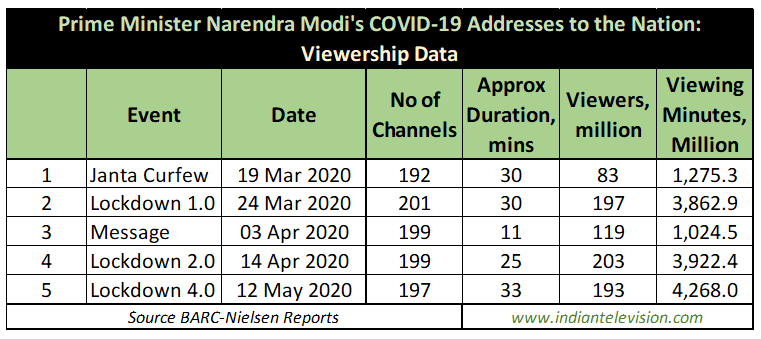
    Week 12 by itself saw Television News viewership surge past the normal – this was the week in which India had the Janata Curfew first and then the announcement of the first All India lockdown by prime minister Narendra Modi. Now a digression – Modi has been one of the biggest viewership draws for News Television, and every time he appeared on television during the lockdown weeks, television consumption lineswent completely off even the new charts!

    Please refer to the chart below for Viewership data of the 5 Addresses that Prime Minister Modi has made to the Nation pertaining to COVID-19 (COVID2019) until the time of writing of this paper.
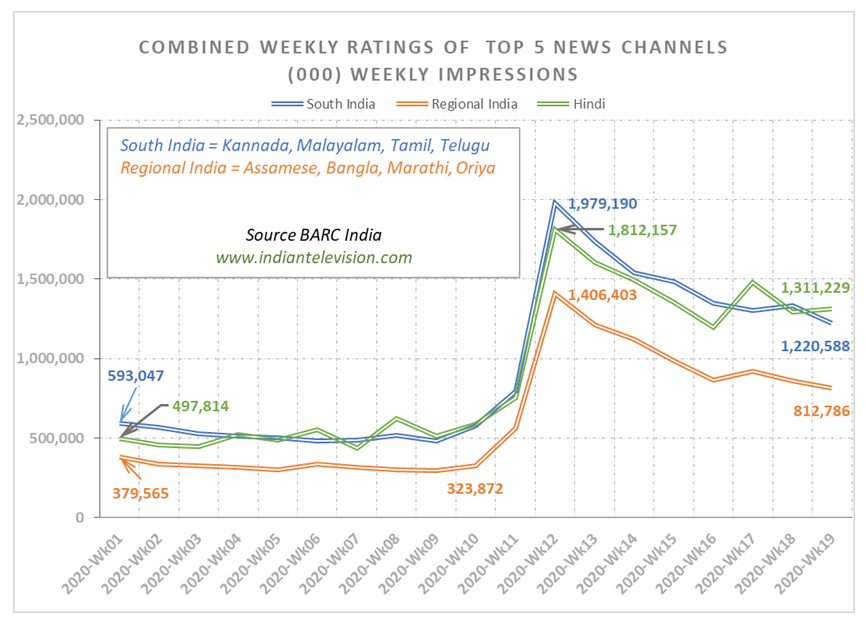
    News Television ratings rose phenomenally in the week leading to and during the lockdown period. Overtime, as Indians got used to the idea that staying at home was the one option that would keep them safe from the disease, television viewership started petering down. Events that were out of normal resulted in small spikes in the already ballooned viewership. The chart below shows viewership data of Top 5 News channels for nine of the ten languages for which BARC provides on a weekly basis for Week 1 to 19 of 2020. To make things easier, the author has combined viewership of top 5 News channels in Kannada, Malayalam, Tamil and Telugu News channels into South India, and the combined viewership of Top 5 News channels in Assamese, Bangla, Marathi and Oriya into Regional India. 

    Per capita news consumption in South India and other regional markets is higher than in the overall Hindi Speaking Market or HSM. BARC defines HRM as All India excluding the South Indian states of Karnataka (Kannada); Kerala (Malayalam); Tamil Nadu and Puducherry (Tamil); and Andhra Pradesh and Telangana (Telugu). TV penetration in South India is also higher than the rest of the country. 

    As is obvious from the viewership trends of the Top 5 Channels from the chart below, News consumption in the country in the weeks after Week 13 of 2020 is lower. 

    Using the BARC-Nielsen base of average data for Week 2 to 4 of 2020, the All India average for the combined weekly impressions of Top 5 channels for 10 languages (nine mentioned above and English) works out to 1,338.614 billion weekly impressions. As is obvious from the viewership trends of the Top 5 Channels from the chart below, News consumption in the country in the weeks after Week 13 of 2020 is lower. 

    Week 12 of 2020 saw the highest consumption of television news across India until the writing of this paper at 5,203.690 million weekly impressions or 388 per cent of the pre-COVID-19 weeks average. This was followed by Week 13 of 2020 with 4,558.658 combined weekly impressions of the top five channels in 10 languages, or about 341 per cent of the pre-COVID-19 week’s average.

    Week 18 saw All India News viewership of top 5 channels of the 10 languages drop to 3,499.652 million weekly impressions or 261 per cent of the pre-COVID-19 weeks average. Week 19 of 2020 has seen a further drop to 3,357.073 million weekly impressions or 251 per cent of the pre-COVID-19 weeks average.
    Economic stagnations and declines have forced governments across the world to slowly recommence trade, businesses, at least within their own boundaries in a limited way with a number of restrictions. As humans slowly restart work and start and learn to adapt, there will be less and less time for television consumption. At present, a lot of people across the globe, including Indians, are still continuing to work from home. And as a matter of fact, the so called ‘new normal’ which has yet to take a definite shape, may enclose work at home for many businesses and services. The world is likely to work quite differently at least until the pandemic dies out, or there is a cure for it or there is a vaccine or maybe all the three or some other combination of these options and or new ones. Media and Entertainment consumption, which includes news is likely to be quite high, higher anyway that during the pre-COVID-19 period.
     

  • TV producers haunted by rental costs

    TV producers haunted by rental costs

    MUMBAI: The pandemic may have halted production activities, but the costs are mounting, especially the rent, according to ANM Global managing partner Nidhish Mehrotra.

    He was speaking at a virtual round table conference organised by indiantelevision.com that included some of the television eminent producers who came together to discuss the challenges faced by TV producers during the Covid2019 pandemic.

    "I possibly see that currently and post Covid2019, the major concern is of rentals. We are commissioned by the channel and then we produce the show and bring the artists and crew together. We have the privity of contract with broadcasters and artists and crew have the privity of contract with producers. Most of the producers hire studios on rental; very few producers own their intellectual properties (IPs). Rentals are expensive at Rs 15 to 25 lakh per month,” he said.

    He added that nobody had thought of adding pandemic as force majeure clause in the contract globally. If your insurance talks about a pandemic in your contract then you're covered, but if it doesn't mention it, then you are not eligible for the same. And to include force majeure in your insurance cover, one needs to pay a premium price. 

    He mentioned that a couple of lawyers have filed a petition in the supreme court saying that their earning has gone for a toss and that they are unable to pay rentals. But the apex court has denied any intervention in this matter. The supreme court in the hearing clarified that it cannot give any favours to the lawyers as every organisation would come to them. There are people in India whose livelihood is completely dependent on real estate and rentals. 

    The order, passed on 30 April 2020, stated that it depends on the understanding between the licensor and the licensee.

    Mehrotra suggested that if the licensee feels that the licensor can terminate the contract or may reduce the rental fee by 50 per cent, it is essential to immediately make the contract. 

    “Producers are left with no option, either they can pay the rent or they cannot. You can suspend or waive off only when it is written in your contract otherwise you will have to pay the rent,” he concluded.

  • Dangal continues on top across genres as TV consumption drops

    Dangal continues on top across genres as TV consumption drops

    BENGALURU: Television consumption continued to drop in week 19 of 2020 (Saturday, 9 May 2020 to Friday, 15 May 2020, week or period under review), according to Broadcast Audience Research Council of India (BARC) data for Top 10 channels on all platforms across genres. However, overall television consumption in terms of impressions was still 24.1 percent more in Week 19 of 2020 as compared to week 4 of 2020. Viewership in terms of billion impressions in week 19 of 2020 was 18 as compared to 14.5 in week 4 of 2020.

    BARC and Nielsen have set the average viewership data between weeks 2 and 4 of 2020 as the yardstick to measure television consumption trends during COVID-19 (Covid2019) weeks. While the lockdown in India commenced on 25 March 2020, which was midweek of Week 12 of 2020, BARC-Nielsen COVID-19 reports are available for weeks between Weeks 11 and 18 of 2020 at the time of writing of this paper. The author has considered week 4 of 2020 as the reference week here.

    As is obvious from the chart below, viewership has been dropping over the past few weeks.

    Top 10 Channels on All Platforms Across Genres

    The combined weekly impressions of the Top 10 Channels on All Platforms Across Genres declined by 4.5 percent in week 19 of 2020 as compared to the previous week. Nine of the ten channels in the list were the same as in the previous week. pubcaster network’s flagship Hindi GEC DD National exited the list to be replaced by Zee Entertainment Enterprises Limited (Zeel) Hindi Movies channel Zee Cinema.

    BARC’s weekly list of Top 10 Channels on All Platforms Across Genrescomprised of five Hindi GECs’, two Hindi Movies channels and one channel each from the Kids, Tamil and Telugu genres. From the networks’ perspective, there were two channels each from Sony Pictures Network India (SPN), Star India and Zeeland one channel each from DD, Enterr 10 Television, the Sun Tv Network, Viacom18.  While DD Bharti and Dangal are available on both the pay TV and FTA platforms, Zeel’s acquired Hindi GEC Big Magic is FTA. The other seven channels were Pay TV. It must be noted that Dangal, Star Plus, Big Magic, Star Maa and Sony Max had higher impressions in Week 19 of 2020 than in week 18, despite the lower combined ratings of the Top 10 channels in the list.

    Please refer to the figure below:

    Top 10 Pay Channels Across Genres

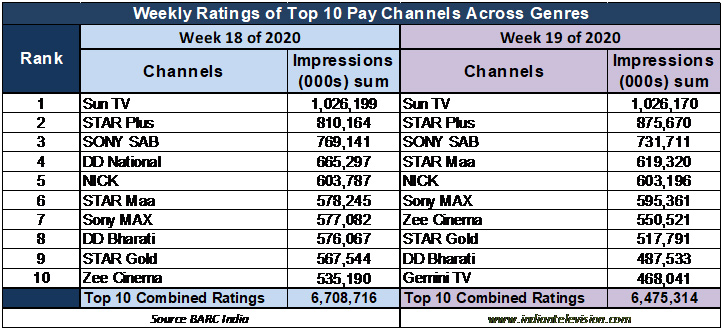
    The combined weekly impressions of the Top 10 Pay Channels Across Genres declined 3.5 percent in Week 19 of 2020 as compared to the previous week. Nine of the channels in the list in the week under review were the same as in Week 19 of 2020. Here also, DD National exited the list and was replaced by the Sun Tv Network’s Telugu GEC Gemini.

    There were three channels each from the Hindi GECs’ and Hindi movies genre, two Telugu channels and one channel each from the kids and Tamil genres in BARC’s weekly list of Top 10 Pay Channels Across Genres in week 19 of 2020.  There were three channels from Star India, two channels each from SPN and the Sun TV Network one channel each from the DD, Viacom18 and Zeel in the list.

    Please refer to the chart below:

    Top 10 Free Channels on Across Genres

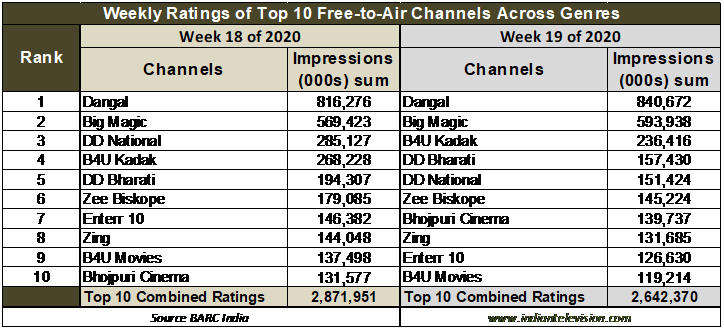
    BARC’s weekly list of Top 10 Free Channels Across Genres shows that the combined weekly impressions of the top 10 channels in Week 19 of 2020 was 8 per cent lower than in Week 19. All the channels in the list in Week 19 were the same as in week 18 with some shuffling in the ranks.

    Four of the channels were Hindi GEC; there were three Hindi movies channels, two were Bhojpuri channels and there was one youth channel in BARC’s weekly list of Top 10 Free Channels Across Genres for Week 18 of 2020, There were three channels each from Enterr 10 Television and Zeel and two channels each from DD and B4U Network during the period under review.

    Please refer to the chart below:


  • When others fire, Dream Sports hires

    When others fire, Dream Sports hires

    MUMBAI: Sports tech company Dream Sports will hire over 250 employees this year at a time when job losses and pay cuts are part of the new normal due to the Covid2019 pandemic. Out of this 180 would be for Dream11. The company’s other brands include FanCode and DreamX.

    The company has already hired 80 sportans since January 2020, and continues to look for talents across various levels.

    Dream Sports chief human resources officer Kevin Freitas told Indiantelevision.com that the company is looking for hiring tech-savvy and sports-loving engineers, designers and product managers for all its brands: Dream11, FanCode, and DreamX. “We will be hiring in departments of technology, design and product teams for roles such as SDEs, data scientists, business analysts, product managers and designers, and other functions include finance, legal, HR, and customer service.”

    “We are looking for applicants who are data-obsessed, who will take ownership, and are dedicated to high performance. We want an employee who can put the user first and believe in transparency,” says Freitas.

    Though the vacancies are technology-related, the company seeks candidates who understand and have an interest in sports, but not as requisite eligibility. Currently, Dream Sports has over 350 employees across Dream11, FanCode, and DreamX.

    Dream11, the primary product of Dream Sports, is a fantasy sports platform based in India that allows users to play fantasy cricket, hockey, football, American football, kabaddi, basketball, volleyball, baseball, handball. FanCode is a multi-sport aggregator platform for every sports fan, focusing on long-tail sports content and contextual commerce which offers a personalised, curated sports experience across live streaming, news, live match scores, in-depth game analysis and fantasy sports statistics & tips.

    The company has recently hired Dev Bajaj as chief corporate development officer, who will lead investments and drive global strategic partnerships in Fantasy Sports, SportsTech, Gaming and other opportunistic sectors

    Dream11 is an official partner of the IPL till 2022. It's also an associate sponsor on Star Sports and co-presenting sponsor on Disney + Hotstar.

  • Advertising agencies should recalibrate around Covid2019

    Advertising agencies should recalibrate around Covid2019

    As Covid2019 continues to sweep through the world, global ad spending is also sliding southwards. With major events being cancelled and slowdown in demands for lifestyle and consumer brands, marketing budgets are being slashed and advertisers are trying to find a silver lining among the gloomy clouds over the urban skyscrapers. USD 4.5 billion a day! That is how much the pandemic is costing the Indian economy! This has trickled down to every sector. With consumption dropping, manufacturing is seeing a halt. This would have been the wedding season in India, with increased spending on jewellery, etc. Sunscreen and myriad skincare-related television commercials would have by now been urging us to fill the online carts. But Covid2019 has impacted marketing and sales negatively. This variable can be fatal to creative agencies who fail to adapt to what we expect will come next.

    Given the current scenario, we have to wait until September when things start to ease up. Being nimble is the key to the game. In fact, we the advertising people are a race of humans who are no strangers to disruption and turmoil. We have overcome all kinds of pressures – economic, financial, political, natural, and many more. As the Covid2019 is no longer viewed as a short-lived outbreak and the world is calibrating itself to settle around it and with it, advertising agencies will also have to recalibrate. In fact, many mainline or legacy agencies will have to brace themselves for the slump that is yet to come. With businesses being conducted online now, creative pitches, client meetings, brainstorming and such have all moved online, and remote terminals are our new offices now.  Agencies that cater to tech innovations, digital and internal B2B can expect some sort of sustainability.

    While agencies understand the need to change, the same is required from clients’ side too. At Hotstuff, we mobilized our resources in March, even before the actual lockdown, setting up new systems and work management protocols that ensured business continuity. We helped our clients to do so too and adapt. During the lockdown we even created TVCs from home that set a precedence and a trend for other marketers to follow suit. Innovation is the key and as Indians, we are known to innovate the best during crises. This has helped us churn out campaigns and create communication pieces in full swing. As an agency we did not stop at that but kept our clients engaged through our huge network of experts who could add value to its world of clients. Our Tattva Knowledge Series of webinars are a huge success and only growing in its reach.

    Advertisements are nothing but human stories and one of the key factors that make them touch our hearts is how we interpret and imagine our interaction with each other. In pandemic times, this significant emotion itself is of high risk. Though our social interactions have lessened and are almost at a standstill, we are still humans, capable of managing all that and much more through our subtle perceptions.

    Physical expressions have evolved and are evolving to subtle expressions. Creative people are catching that and messages of hope and beauty and a world of subtle emotions will play a pivotal role. Strong ideas will matter more than exuberant productions. The power of storytelling will need to be honed better. We humans have the agility and the tensile strength to overcome anything and as dream merchants we are like the frontline workers who would keep the sanity alive. The templates would need to change – hope, beauty, gratitude, calmness, stoic, prayer, positivity, sombre and empathetic along with technological innovations would be the new norm in the brand new world.  

    (The author is Hotstuff CEO. The views expressed are his own and Indiantelevision.com may not subscribe to them)

  • Producers’ guild issues safety guidelines for shooting

    Producers’ guild issues safety guidelines for shooting

    MUMBAI: Producers’ Guild of India has issued a list of protective measures to be adopted during filming. According to the producer's handbook, prior training and daily briefing about sanitization will be given to members present at the set. The association has urged crew members and people present at the set to follow the social distancing rules and have minimal human contact. There will be properly demarcated floor markings in all relevant areas and zones.

    Information boards will be placed at all shooting locations. They will set up secure lock-up to prevent any unauthorised personnel from entering the premises.

    The guild is also ensuring that they are doing everything in its capacity to maintain strict hygiene levels. As per the hygiene mandate, the entire studio will be sanitized daily before the shoot. In order to keep shooting location disinfected and clean, a government-authorised agency will carry out the sanitization process. This will include studio, cafeteria, washroom and vanity vans. Only the use of disposable items – plates, cutlery, food boxes, etc. will be allowed on the set. A designated disposable area for food waste will be provided.

    Hand sanitisers and portable wash basins will be installed at multiple locations. Each crew member will be provided with a triple-layer medical mask. Isolation rooms will be designated in case of emergency. Ambulance and a doctor must be present at the set. Designated seating areas will be arranged with chairs spaced at a distance of minimum six feet. Meal timing will have to be staggered to avoid crowding.

    While maintaining social distancing and safety measures, the association has advised to check the body temperature of each person with infrared scanners. According to the guideline, anyone with body temperature of 99°F / 38°C or higher must not be allowed to enter.

    Besides other safety measures, a detailed form should be filled by all crew members mentioning information such as:

     • Mode of travel

    • Medical history

    • Age

    • Contact tracing details Daily

     • Temperature

    • Pulse rate (pulse oximeter)

    As per association’s guidelines every personnel will be on set under the premise of ‘informed consent’ and self-assess symptoms of Covid2019 and or exposure to Covid2019. Before the commencement of shoot, it is mandatory for them to inform the production team about their health status and exposure to Covid2019 at the time of booking / signing up for a project and again on arrival at the shoot location.

    Filming protocols for the technical crew will include disinfecting hair and makeup items before and after each use. Use of single-use/disposable items are recommended. All garments and racks should be disinfected before and after each use.

    The association explains that equipment and props must be disinfected before and after each shot. Remote viewing should be made available. Lapel mics should be duly disinfected after each shot. Before beginning the shoot, it is important to check with the local ward admin which zone the location comes under to avoid any risk. Authorized personnel will have the responsibility to sanitize location pre-shoot.

    Protocols that will be followed if a crew member is infected include:

    ·   Request the employee to immediately isolate in the designated isolation room on set

    ·     Have the set doctor monitor for symptoms and inform the necessary authorities

    ·   Collect details of all close contacts and have them self-quarantined

    ·    Clean and disinfect the place

    ·   Notify all employees

    ·    Check up employees.

    It is also important for members present on the set to download the Aarogya Setu app.

    On Friday, a 12-member delegation of television producers and broadcasters interacted with Maharashtra chief minister Uddhav Thackeray who asked them to find safe and secluded places for resuming shoots.

    Follow Tellychakkar for the consumer facing news & entertainment

  • Covid2019 is a financial earthquake: Faye D’Souza

    Covid2019 is a financial earthquake: Faye D’Souza

    MUMBAI: For former Mirror Now executive editor Faye D’Souza, Covid2019 is not just a pandemic but also a financial earthquake with no clear end time. Speaking to former Viacom18 COO Raj Nayak on his recently-launched digital chat show, D’Souza, who turned independent journalist last year, revealed details on the kind of journalism manufactured on TV today.

    D’Souza believes that we’re entering a phase where our relationship with money is going to change. Her advice to young professionals who own money is to not feel anxious as many in the society don’t even have that luxury. As far as investment is concerned, she urges people to wait and watch.

    According to D’Souza, in the news business, the audience is not a consumer but a commodity and the real consumer of news channels is advertisers. “News broadcasters are least bothered about what’s good for the viewers or the society and are playing with their emotions,” she said.

    In a scathing attack on the advertising-dependent journalism, she said, “Advertisers don’t care about the quality of journalism and give money to the channels with the highest TRPs. The majority of the money is going to the top two news channels with the highest TRPs, and both are doing extremely poor journalism, and everybody is getting crushed by them. The news channel’s sheer existence depends on whether or not it is able to please its biggest advertisers and if you can’t then you’re an impediment in the chicken assembly line.”

    Knowing the intricacies of how it works, she said that honest journalism or asking hard questions to the government can lead to repercussions. The government is the biggest advertiser on news channels and such channels would then be barred from getting PSAs and elections ads, she observed.

    Her main aim in launching her own platform is to give a place for journalists, who believe in the core value of this profession, to participate. Freelance journalists, who want to do good journalism, can contribute to the platform and earn on the story or photo they cover through hits. She wants to show that a journalist doesn’t have to be a part of media conglomerates to do good journalism and serve society. According to her, the biggest responsibility of a news presenter or journalist is to inform the audience in an even-tone manner.

    D’Souza confirmed that she is ready to launch her website soon and it would be linked to all social media platforms. She is in the process of logo designing and some animation for the website. The platform would be a freemium subscriber-model and it would be completely based on news.

    Faye started her career as a news presenter and jockey with All India Radio (AIR). A business journalist by choice, she worked a couple of years with Network18’s CNBC-TV18 as producer and reporter and then moving to Times Network’s ET Now business news channel as an anchor and producer in 2008. But it was her three-year stint at Mirror Now that shot her to fame as she asked compelling questions during her debate show.

    A Mangalorean by heart, D’Souza said that if she wasn’t a journalist, she, being a hardcore foodie, would have been a teacher or doing something in the food industry.  

  • Lionsgate reports $944 million revenue in Q4

    Lionsgate reports $944 million revenue in Q4

    MUMBAI: Global content leader Lionsgate has reported fourth quarter (ending 31 March, 2020) revenue of $944 million, operating loss of $12 million and net loss attributable to Lionsgate shareholders of $45 million or $0.20 diluted net loss per share on 219.9 million diluted weighted average common shares outstanding.  

    Adjusted net income attributable to Lionsgate shareholders in the quarter was $47 million or adjusted diluted EPS of $0.21, with adjusted OIBDA of $126 million. Fourth quarter cash flow provided by operating activities was $180 million and adjusted free cash flow was $175 million.

    "We reported a strong quarter to end a solid fiscal year despite the disruption posed by the Covid2019 global pandemic," said Lionsgate CEO Jon Feltheimer.  "Our Lionsgate family has risen to the challenge of these unprecedented times with resilience, dedication and collaboration.  Thanks to their efforts, Starz is continuing to deliver great entertainment to our audiences in the current at-home environment; and we're working closely with all of our content partners to ensure that when production resumes and theatres re-open, we will be ready."

    Full year fiscal 2020 (fiscal year ended March 31, 2020) revenue was $3.89 billion, operating income was $2.8 million, and net loss attributable to Lionsgate shareholders was $188 million, or $0.86 diluted net loss per share on 217.9 million diluted weighted average common shares outstanding.  Adjusted net income attributable to Lionsgate shareholders was $124.3 million or adjusted diluted EPS of $0.56 and adjusted OIBDA was $462 million for fiscal 2020.  Full year adjusted free cash flow was $349 million.

    Driven by robust sales at home environment in the quarter, library revenues for the fiscal year reached a record $600 million.

    The company reported a charge of $50.5 million in the quarter due to the Covid2019 global pandemic and related economic disruption.  This charge included, among other things, certain motion picture and television impairments and development charges associated with changes in performance expectations and the feasibility of project completions, along with costs associated with pausing film and television production.

    Fourth quarter results

    Media networks segment revenue of $358 million was essentially unchanged from the prior year quarter while segment profit of $26 million was impacted by the continued investment in STARZPLAY's international expansion.  STARZPLAY has launched in 50 countries and exceeded subscriber targets for the fiscal year.  Domestically, STARZ grew its OTT subscribers to 6.8 million in the quarter.

    Motion picture segment revenue increased by 10 per cent to $393 million compared to the prior year quarter due to the strong home entertainment performance of Knives Out and other titles.  The only new theatrical release in the quarter, I Still Believe, was in theatres for only four days before they closed, but the studio pivoted quickly to launch the title in an exclusive premium video-on-demand window to mitigate lost theatrical revenue.  Segment profit was $101 million.

    Television production segment revenue was $258 million and segment profit was $22 million driven in part by strong library sales.

    Covid2019 Impact

    The impact of the ongoing Covid2019 global pandemic and measures to prevent its spread, and the resulting unprecedented economic uncertainty, are affecting the company’s business in a number of ways. To date, it has experienced early termination of the theatrical run of one of its  films domestically and one of its films in the UK, delayed theatrical distribution of several films domestically and internationally, and delayed production of film and television content resulting in changes in future release dates for some titles and series. Its partners have also closed several location-based entertainment attractions based on its film and television properties. It won’t be possible to accurately predict when theatres re-open, production resumes or if and when certain of our content will be released. The full extent of the impact of the Covid2019 global pandemic on its business, operations and financial results will depend on numerous evolving factors.

    Increase in TV consumption

    Conversely, television and streaming consumption around the globe has increased as well as home entertainment demand. STARZ has experienced an increase in viewership of its content across all platforms as well as an increase in subscribers to its OTT services, both domestically and internationally. This increase, however, may not be indicative of future results and growth may slow as governmental and other restrictions are relaxed, and as a result of the current and possible longer term negative economic impact of the pandemic.

    “In a number of instances, we have also been able to adapt to these new circumstances by releasing one of our theatrical films earlier on streaming platforms, completing post-production of one of our television series remotely and continuing the development of a number of our television series utilizing virtual writers' rooms. These changes in the way we operate may be helpful to partially offset some of the negative impacts from the pandemic.  However, the impact of these changes and the Covid2019 global pandemic are uncertain and cannot be predicted,” said the company release.

    As a direct result of the Covid2019 global pandemic and the related economic disruption, including the worldwide closure of most theatres, international travel restrictions and the pausing of motion picture and television productions, during the fourth quarter of fiscal 2020 the company incurred $50.5 million in incremental costs which were expensed in the period. These costs include $46.0 million reflected in direct operating expense, which include certain motion picture and television impairments and development charges associated with changes in performance expectations or the feasibility of completing the project, costs associated with the pausing of productions, including certain cast and crew costs and incremental costs associated with bad debt reserves. In addition, these costs include $4.2 million reflected in distribution and marketing expense, which primarily consists of early marketing spends for film releases and events that have been cancelled or delayed and will provide no economic benefit, and $0.3 million in restructuring and other costs primarily due to transitioning the company to a remote-work environment and other incremental costs associated with the Covid2019 global pandemic during this period.