Tag: covid2019

  • Hindi GEC shows highlight Covid2019 precautionary measures

    Hindi GEC shows highlight Covid2019 precautionary measures

    MUMBAI: Turn on your TV sets and you will see that most shows have resumed shooting. But what’s different now? Unlike before, leading characters in shows are seen wearing masks, face shields, gloves and using sanitisers. As a responsible community, GEC shows are also passing on information to viewers about Covid2019 precautions. 

    While speaking to Indiantelevision.com, TV producers shared because the shows are watched by millions of people, channels had requested them to include safety measures being promoted within shows.

    Shoonya Square Productions founder Ved Raj, who is the maker of the show Guddan Tumse Na Ho Payega, highlights that the production house will continue to have episodes where safety protocols will be showcased. However, it will not be so frequent and informative but will reflect in the story. He also points out that the studio will not be shooting from the pandemic point of view, but will try to incorporate the current situation in their stories.

    He said, “From the Covid2019 lens we are showing characters wearing masks and gloves when they are going outside their homes. They are sanitising their hands after entering the house. But the plotline of the story remains the same.”

    However, upcoming episode scripts that were written before the pandemic had to be re-written considering the Covid2019 situation. In this show’s case, the protagonist will not give birth at the hospital but will do so at home. The production house can’t shoot in a different studio with more junior artists.

    Raj also shares, “Earlier our shows included a lot of party scenes and festivals but now I am avoiding that. It is challenging but still, it is better than nothing.”

    A video clip from Star Plus’ popular show Yeh Rishta Kya Kehlata Hai is already going viral on social media where the main characters, Shivangi Joshi and Alka Kaushal, are interacting while wearing masks. In the same Mohsin Khan was seen asking Shivangi Joshi to use the sanitiser before helping her wear gloves and face shield.

    Full House Media Production director Sonali Jaffer, who is the producer of the show Tujhse Hai Raabta, thinks that it is the responsibility of the channel and the production houses to showcase the importance of taking precautions. “We are doing this positive messaging through our shows because it is the reality. Until and unless the government tells us to stop wearing masks, we will continue to show safety protocols in our episodes,” she says.

    Sonali adds that even when the pandemic is over, the studio will incorporate positive things that had happened during this timeframe in their shows such as the people who bravely fought with the disease, donated their plasma to help other Covid2019 patients etc.

    As far as challenges are concerned while shooting the episode, Sonali points out that no producer or a writer likes to do a cheat shot. But now, no extra scenes are filmed, important conversations are happening from the point of view of one character only. Double shots of different locations are avoided.

    Shakti Astitva Ke Ehsaas Ki writer Sharad Tripathi says that to a certain extent the makers of the show will introduce pandemic scenes and protocol measures in their show. He also adds that they will be using different footages and cuts of actors wearing masks and gloves wherever possible to create awareness.

    “There is a mass following of the show, so I think it is important for us to tell people about what should be done. In the coming days also, what the government will say, we will try to portray it through our scenes and dialogues,” he further added.
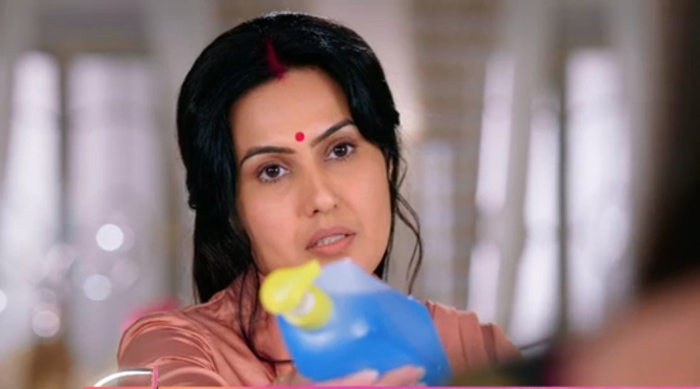
    Ekta Kapoor’s show Yeh Hai Chahatein shows the characters discussing how house-helps should go on leaves. Then the entire family was seen contributing to the household chores. In one of the latest episodes, the main lead played by Aishwarya Sakhuja was seen talking about online classes, and how it would help students to continue their studies with the help of technology.

    SAB TV’s show Tera Kya Hoga Alia started the episode with showing Alia, played by Anusha Arora, and Rabiya, played by Namrata Pathak, on an early morning jog. The two were seen talking about the importance of maintaining social distancing and wearing a mask when outdoors.

    In Sony Entertainment Television’s show Mere Dad Ki Dulhan in its new promo showcased the main leads Shweta Tiwari and Varun Badola wearing masks while they were outdoors.

    Since all producers and writers are facing similar challenges, audiences will get to see reality reflected in all the shows.

  • NDTV to end pay cuts for employees

    NDTV to end pay cuts for employees

    KOLKATA: To fight the uncertainty caused by Covid2019 pandemic, many organisations resorted to pay cuts to take forward the business. While NDTV announced a salary cut in April, it will end pay cuts for all employees who took a 10-20 per cent cut, effective 1 August.

    It announced the salary cut from 1 April for a period of three months, "subject to detailed review at the end of the period." It also mentioned that there would be no cuts for employees earning less than Rs 50,000 a month.

    At the time of announcing pay cut, NDTV said that it was "forced to undertake certain cost-cutting measures" as a result of the "impact of decreasing advertisement revenue accelerated by the onset of the Covid2019 pandemic, together with the uncertainty surrounding the recovery of the global and Indian economy."

    “Upon review, it has been decided that through 1 July, the existing pay cuts shall continue but effective 1 August 2020, NDTV Group will end pay cuts for all employees who took a pay cut between 10-20 per cent,” it informed stock exchanges on Monday evening.

  • Madison OOH launches OTS measurement updates for Covid2019 unlock periods

    Madison OOH launches OTS measurement updates for Covid2019 unlock periods

    NEW DELHI: The Covid2019 lockdown has significantly changed the user mobility (traffic flow patterns). The current traffic movements are very different when compared to the pre-Covid2019 lockdown movements, and are quite unpredictable. Realising this unpredictable outdoor scenario, Madison decided to launch an extension to its Traffic Count Tool. This tool will provide clients with legitimate data to help them note the actual changes in OOH mobility in the post-Covid2019 lockdown era. 

    Madison’s technology partner for this is  AdMAVIN – a Geo-spatial marketing solutions company, founded by alumni from IIT Madras. 

    The extension of Traffic Count Tool utilised the Google mobility reports. These reports are available for various countries and contain state-wise summaries for each touchpoint. The algorithm of Traffic Count Tool is updated to provide OTS based on the current OOH Mobility with a location level detailing. 

    Mobility of a particular location is estimated based on the latitude and longitude of 25,000+ sites which have been tagged in the Madison OOH system across all major markets. A 1km vicinity to a particular location is mapped and the dispersion of touchpoints studied. A change % is determined and applied on the base line OTS to provide present day OTS numbers. The dataset provides the change compared to a baseline value for any given day of the week. The baseline defined by the Google Mobility report, is the median value corresponding to the respective day of the week, during the 5-week period Jan 3 – Feb 6

    To further advance and enhance the Madison Traffic count tool, further granularity will be provided based on the market Population and Live Traffic flow data. The OTS COVID-19 update will help in providing current and realistic OOH estimations to clients and will be updated on a weekly basis. This will help in providing clients with real time OTS which are the best possible impression numbers that can be shared for OOH roadside media. The Traffic Count Tool can help provide OOH mobility data at key touchpoints and key markets. From the consumer in their work, live & play arenas like retail and recreation, groceries, and pharmacies, parks, transit stations, workplaces, and residential points of interest respectively. 

    Considering the dispersion of traffic, we see a difference in recovery basis the touchpoint spread and market. For e.g. Mumbai has seen an average recovery of 57 per cent of traffic across key junctions while cities like Bengaluru and Delhi have recovery of movement to the range of 65-70 per cent. Although few locations have shown encouraging signs of traffic movement compared to Pre-COVID conditions, the majority of the locations range in the 57-60 per cent recovery. Smaller cities like Lucknow, Patna and Vijayawada have seen a 10-15 per cent point better recovery of traffic movement than the larger cities.

    Madison Media & OOH Partner & Group CEO- Vikram Sakhuja says, "Thanks to traffic count data that we have built data tech partnerships in, it is now possible to track the post lockdown recovery of traffic on our metro roads. This should help build confidence amongst OOH advertisers.” 

    Traffic at some key Junctions in Metro

  • SBI Life launches ‘Apno ki #PoornaSuraksha’ campaign

    SBI Life launches ‘Apno ki #PoornaSuraksha’ campaign

    MUMBAI: SBI Life Insurance, today, unveiled its new product campaign ‘Apno Ki #PoornaSuraksha’, highlighting the product’s (SBI Life’s Poorna Suraksha) dual protection feature which offers complete financial immunity by providing both Life cover and protection against 36 critical illnesses in a single plan with an auto-rebalancing aspect which is much needed to navigate through the current uncertain times.

    The ad film features popular playback singer, Shaan alongside his son Shubh, emphasising the need to maintain immunity. The film opens with a charming father-son role reversal conversation, where Shaan is being interrupted by Shubh at various instances while performing daily activities, only to be reminded of ways to boost and keep the health immunity in check at all times. Shaan, expresses how kids these days have become immunity specialists to their parents. Similarly, he continues to highlight the importance of building a healthy financial immunity for choppy times that will enable in creating a financial cushion to safeguard oneself and the loved ones from any monetary stress led by lifestyle diseases or other unforeseen consequences.

    Today, critical illnesses account for 60 per cent of deaths in India, according to the Global Burden of Disease Study. Treatments to cure critical illnesses are usually lengthy and expensive, making it very difficult for the family to afford the costs. Therefore, it is paramount to focus on building one’s financial immunity for tough times so that mental immunity stays guarded, in case of a lifestyle disease or any other unforeseen event. 

    SBI Life, chief of brand and corporate communication Ravindra Sharma said, “A newfound immunity regime has become second nature for most of us, today the larger populace is consciously making smart choices around health, wellness and life in general. Delving deeper into this intrinsically protective behaviour, that is consuming everyone across sections of the society, we realised that as an Insurance player our role to provide immunity to the consumer has never been more accentuated. With an approach of keeping a simple communication for an insurance category, we have drawn a parallel for financial immunity via the concept of health immunity which is understood by all. We hope to educate the consumer on the importance of building one's financial immunity like they have towards their health. SBI Life’s Poorna Suraksha being a unique product combining both life cover and protection against 36 critical illness in a single package, this dual protection can enable individuals to build a holistic financial immunity, as a safety net for themselves and their family to battle against any odds.”

    Mullen Lintas CCO Garima Khandelwal said, “Health Immunity is of a priority today, with everyone aware and abreast like never before. We have all realised the importance of being proactive about immunity when it comes to good health, and made changes to our routines, self-care is undoubtedly the no. 1 learning today. This being the context, we wanted to introduce a parallel need for one’s family’s financial immunity, being as proactive about the same. And it’s relevance in this landscape. Drawing a simple parallel between health and financial immunity and stressing on the need for both, borrowing from the current and changed awareness in the behaviour.”

  • Kannada news channels clocked 10% hike in ad revenues during Covid2019 period

    Kannada news channels clocked 10% hike in ad revenues during Covid2019 period

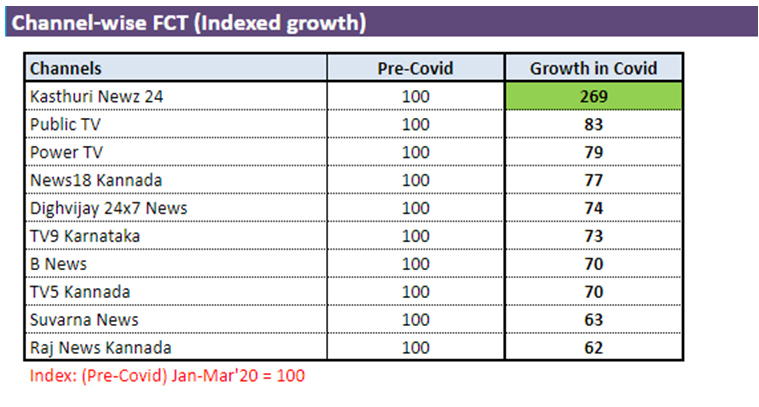
    NEW DELHI: While most of the markets witnessed a slump in ad revenues across genres on television, Kannada news market was surprisingly on an upward spree during the past three months. While the overall Kannada market witnessed a dip of close to 72 per cent, compared to April-June 2019, when the overall ad spends were Rs 145 crore, news genre maintained a steady hold on advertising revenues, data in the possession of Indiantelevision.com reveals. 

    The Media Ant co-founder Sameer Choudhry tells Indiantelevision.com that the news genre witnessed an increase of about 10 per cent during the lockdown period. 

    Sharing an in-depth data, Vizeum Chennai associate general manager R Kumaran revealed that as compared to the same period in 2019, the ad revenues for Kannada news channels grew 18 per cent in April’20, 20 per cent in May’20, and 15 per cent in June’20. 

    mPlan CEO Parag Masteh attributes this growth to the increased news consumption in the state during the lockdown. He shares with us, “The audience in the state of Karnataka is more educated and even before Covid2019, the viewership on news channels used to give tough competition to other genres including the GEC. The number accelerated more in the Covid2019 times as the need for information grew more.”

    As per BARC+Nielsen weekly report on consumption trend during the lockdown, in week 20 (starting May 16), the growth in viewing minutes for Kannada news channels was a whopping 148 per cent. 

    While the ad revenues were scaling up for news channels during the past three months, as per TAM AdEx data, apart from Kasthuri News 24, which recorded a 15 per cent increase in the count of advertisers too, none of the other news channels witnessed positive growth. Overall, there was a 33 per cent drop in the tally of advertisers. 

    However, during the Covid2019 period, the numbers kept growing month-on-month. While comparing the count of advertisers in June’20 and April’20, TAM AdEx witnessed a 19 per cent growth, reveals the TAM AdEx data. 

    Masteh states that these numbers will continue to grow if the Covid2019 numbers stay on the lower margin in the state during the coming months. “However, with GECs slowly claiming their stake back, we can witness slight dips in the ad revenues on news channels, but the growth will remain upward if the pandemic remains contained.” 

    Kumaran adds, “In Karnataka, retail clients have started spending from June onwards compared to pre-Covid2019 on TV (across genre) followed slowly by other regional/national clients. If continues in July–Aug, Karnataka market will see more ad spend if relaxation continues. The upcoming festive season of Dussehra and Diwali will expectedly revive the overall industry.” 
     

  • Regional markets to fuel English entertainment channels’ growth: ZEEL’s Kartik Mahadev

    Regional markets to fuel English entertainment channels’ growth: ZEEL’s Kartik Mahadev

    MUMBAI: The Covid2019 pandemic has given a boost to indoor activities such as TV viewing but specific genres such as English GECs, lifestyle and infotainment channels have been immensely impacted as their limited audience switched to streaming platforms. ZEEL premium channels business head Kartik Mahadev says that television came across as a trusted medium during the lockdown and the audience finds content on television compelling and comforting.

    Mahadev says that the channel saw significant growth in TV viewership, led by more walk-ins as well as more time spent on television. Data shared by the network show that Zee English cluster of channels grew by 93 per cent (Week 12 – week 22 vs week 1 to week 11 as per BARC data). &flix had 56 mins (week 12 – week 22 as per BARC data) average weekly time spent on the channel.

    For English GECs, the similarity of content on OTT platforms is a concern. Mahadev says, “There is no doubt that digital video platforms are here to stay. However, today we live in an AND world, not an OR world. Studies reveal that consumption of overlapped content between TV and OTT grew on television from 59 per cent pre-NTO to 82 per cent contribution post-NTO for sitcom, drama, reality genres. It naturally follows that navigation between screens is seamless and consumption on TV and digital is complementary in nature.”

    According to Madison Media Sigma CEO Vanita Keswani, English GECs losing their audiences to OTT platforms is not a recent phenomenon. “They have been largely impacted due to the disruptions caused by Covid2019. Apart from that there is profitability pressure. Covid2019 is putting a lot of pressure on broadcasters and English niche is the first under scrutiny for survival,” she says.

    Mahadev believes that regional markets will continue to fuel new user growth for English entertainment channels. This also includes a whole set of audience moving from regional to English content as they become more comfortable with English as a professional, conversational language.

    He adds, “We have designed unique offerings such as multi-language block on &flix and locally nuanced content on Zee Café, that will stand out as enablers of bringing an aspirational, English-comfortable audience onboard. Recently, for the premiere of Jumanji: The Next Level on &flix and a simulcast in Hindi on Zee Cinema, we successfully reached a wider audience by providing access through language.”

    Post lockdown, Zee Café has added 256 hours of content to cater to the growth in walk-ins within the genre, including latest dramas such as Nancy Drew and Evil, popular sitcoms such as Seinfeld and I Dream of Jeannie along with the original airings of the celebrity chat show Starry Nights GEN Y.

    “Television provides youth-focused brands and premium brands the opportunity to associate with a premium subscriber base that is defined on the basis of their content choice. This sort of content and platform synergy for brands to associate with is not available on OTT platforms where English content is behind a paywall,” he points out.

    Some of the brands that came on board as a partner for the property on &flix were Kia Motors, Ariel, Amazon, Airtel 4G, Xiaomi, Protinex and ITC along with Bingo Potato chips, Hyundai Creta, Behrouz Biryani, Bharat Matrimony and Cinthol. These brands were on board for the Hindi simulcast also. The channel has a new slate of premieres like Bad Boys For Life and Fantasy Island to entertain audiences.

    Mahedev finds that while marquee international shows bring the best of the world to Indian viewers, locally-produced content allows adding a new dimension from the Indian point of view. “With India’s first-ever English fiction show Bombay Talking, Zee Café brought in relevance with content that is locally nuanced for the Indian viewer. What followed was the introduction of successful properties such as Look Who’s Talking with Niranjan, Not Just Supper Stars and Starry Nights that truly added a unique flavour to Zee Café’s wide repertoire of content,” he shares.

    According to Samsika Marketing Consultants founder chairman and MD Jagdeep Kapoor, family viewing pushes down the priority of English GEC. “English GEC channels will now have to work on their programming. The nature of the show and specialisation will help them to stay in the business. The channels that are currently in the business will not only have to look at original content but also relevant content and solid programming. The ones who were not able to do that have lagged behind.”

    In the coming months, Mahadev expects the trend in audience preferences towards light-hearted content, superhero flicks and adventure to pick up. With out-of-home entertainment options being limited in the new normal, he feels television will continue to be the entertainment destination for individuals and families. This immediate context is an opportunity for growth.

  • Hindi GECs see 8% growth in non-prime slots: BARC-Nielsen

    Hindi GECs see 8% growth in non-prime slots: BARC-Nielsen

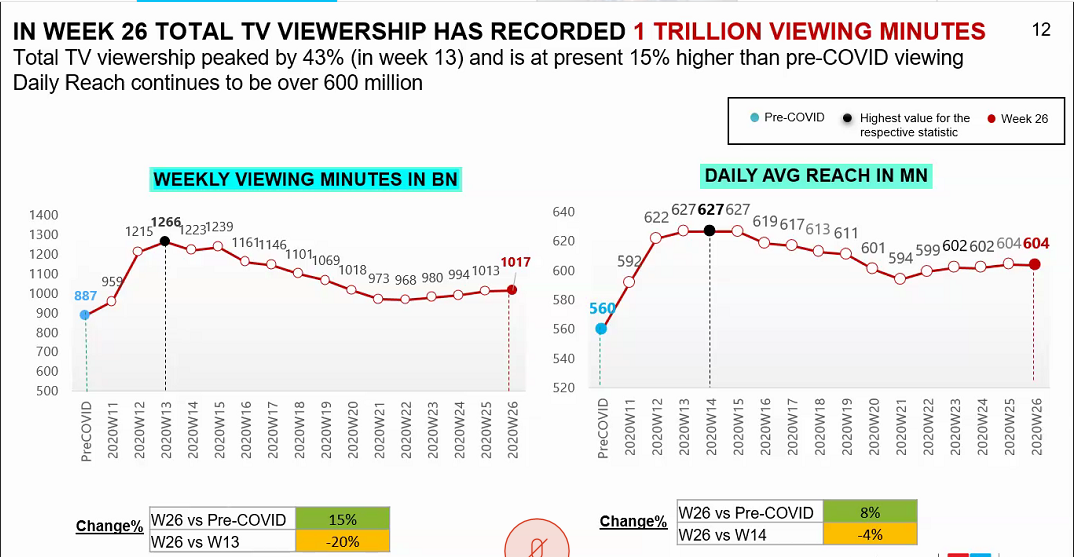
    MUMBAI: Hindi GEC saw eight percent growth in non-prime time slots in 2020 as compared to 2019, revealed the tenth edition of BARC-Nielsen data. However, there is a dip of two per cent in prime time shows. Kids non-prime time shows saw a growth of 32 per cent and in prime time shows it is 28 per cent.

    In week 26, TV viewership is 15 per cent higher than pre-Covid2019 times. Apart from that, TV viewership peaked by 43 percent in week 13. In week 26, daily viewing reach continues to be over 600 million.

    Average daily time spent on television is higher than pre-Covid2019 times but it is lower than usual peak time. The data also reveals that the total number of channels watched per viewer has decreased from the peak. In week 13 it was 23 channels which has now declined to 19 channels in week 26. 

    GEC channels have dominated the television market. The data highlights that TV consumption is higher than pre-Covid2019 time across all markets. The Hindi speaking market has seen a growth of 49 per cent.

    The data also reveals that the share of GECs has consistently increased in the past five weeks. From being at 52 percent in the pre-Covid2019 times it has seen a decline in week 22, but it picked from there and now it is at 48 per cent in week 26. 

    Apart from Hindi GEC, kids and English GECs are also performing better in non-prime time slots as compared to prime time. GECs that recently chose to  be on free platforms have seen growth.

  • India Gate Basmati Rice to focus on expanding portfolio, product availability & quality checks

    India Gate Basmati Rice to focus on expanding portfolio, product availability & quality checks

    NEW DELHI: As the nation is dealing with Covid2019, the problem of hunger still prevails amongst millions of under-privileged humans. India Gate Basmati Rice, being one of the oldest brands in India has started #UmeedHainHum – an initiative to feed families during these tough times. The brand has been providing more than 20,000 meals every day across the country.

    KRBL Limited business head, sales and marketing Ayush Gupta shares, “When we first started this activity, it was about helping an orphanage which was struggling for their daily meals somewhere in Bhopal, but as we moved along the journey became larger and more vivid in terms of the people and sections of the society we could serve.”

    According to Gupta, the brand has observed that people are buying via online channels, “We are observing a heavy surge in online purchases, which is becoming beneficial for top brands who have a really high recall. FMCG as a consumer segment is going to be the most sustained and will provide a backbone for customers returning to the market. Groceries will remain key to the last mile shopping with strong positive sentiment towards supporting them.”

    He also points out that local brands, which are providing quality products, will be the most benefited in the coming months as well.

    “During the ongoing crisis of Covid2019, we want to make sure that we are available in appropriate quantities to all our customers across the globe. As rice is one of the most consumed essential grains in most countries, we are taking special measures to make sure that each and every packet is passed through stringent quality checks and is hygienically packed,” he says.

    When asked about what kind of shift the brand has seen in the marketing strategies and on what mediums the brand is experimenting to connect with the consumers, Gupta says, “Right now, in times of uncertainties, brand communication should be able to educate, assure and be empathetic to the needs of customers. Being omni-channel, ensuring the availability of stocks everywhere with a 'value for money' proposition is how we are approaching the current scenario.”

    He shares that the remaining financial year looks promising as the food and beverage industry will become the forming grounds of people coming out again shopping for their staple requirements. “This will, in turn, provide opportunities to various other categories to get picked up and provide better balance to the overall market,” he adds.

    Gupta reveals that the brand is planning to extend its existing health portfolio which has brown rice and quinoa in it, with flax seeds, chia seeds and black rice. These products, which are already available under the brand India Gate in international markets, will now be available in India as well.

    He further added, “Currently, KRBL intends to expand further into various regional rice varieties which are generally available as loose rice only. In our category particularly, customers are fast moving towards packaged products as it gives assurance of safety, hygiene, cleanliness and quality consistency month on month. Along with this, after the successful launch of Idli Rava, we are planning to launch similar rice- and grain-based products which can be used for making a multitude of dishes.”

  • Digital is pushing other mediums towards accountability

    Digital is pushing other mediums towards accountability

    NEW DELHI: In the post-Covid2019 world, measuring the efficacy of advertising spends will become even more critical for companies as they navigate their recovery given the significant pressure of their cash flows and liquidity positions. How can the various M&E segments respond to these enhanced requirements on attribution? How can measurement become timelier and more precise for brands? Addressing these questions at the 21st edition of FICCI Frames, industry members discussed the ‘Attribution at the forefront of the conversation.’

    GroupM South Asia president growth and transformation Tushar Vyas asserted, “We always say that half of the advertising is wasted but we don’t know which half, it’s a problem which keeps resurfacing in a new avatar even in the digital area. One of the reasons is because of the complexities associated with this area. There are issues like brand safety, ad frauds and many markets don’t have a set of common measurement across the various channel of mediums, even tonnes of data are making it more complex."

    This year’s FICCI report released in March stated that in 2019, advertising grew by Rs 4000 crore but Rs 3700 crore were spent on digital and new media while the growth in traditional media was only Rs 300 crore.

    BARC CEO Sunil Lulla shared that the pandemic has shifted the consumption pattern of content across mediums. He said, “I don’t think ROI has always been less important perhaps but what we have today is better measurability than ten years ago. We are still not there where a market has a unified independent measure, like on TV there is an independent measure, on digital, there are many digital providers.”

    “There used to be conversation on digital vs television but the consumer is shifting from one screen to another. In the pandemic, we have seen a steep rise in TV consumption in certain categories such as kids, news and movies. As there was no original content, people started watching repeated content and Doordarshan became the no.1 channel after 1986, and digital was moving in parallel. TV is equally important that’s why July has the same volume as in January. TV is good for building brands, it’s good for targetting an entire family and digital is good for sharp targetting,” he added.

    Due to Covid2019 print and radio took a much bigger hit. “I believe when the economy opens up fully, we could see all these mediums working in a better partnership that can be a big outcome from this period,” Lulla opined.

    The panellists echoed that due to Covid2019 there are higher chances of brands shifting their spends to the digital landscape.

    Vyas said, “Advertisers are going to follow where the consumers are going. It’s all about building an entire connected environment where you’re linking the consumer to commerce.  The focus is shifted more from output to outcome now. Earlier the conversation was about reach and frequency which is now moving to a different level. The conversation today is more about what it is going to do to my business or brand. That’s the change which digital is bringing, which is resulting in that kind of accountability from other mediums as well.”

    Vyas stressed that it’s important to build a first-party data ecosystem and knowing the consumer in-depth from their perspective.

    “As an industry, we need to work together on how we report and agree on the metrics. We need some common practices to build these measurements, and then agree to the standardisation of data, and as time goes by, AI and MI can supplement these data,” he said.

    He also said that agencies will always require the TV medium. Said Vyas: “Parties can’t do without TV because it’s the entertainment and information medium of the household and digital is for the individual.”

  • Brooke Bond Taj Mahal extends classical music association with e-concerts

    Brooke Bond Taj Mahal extends classical music association with e-concerts

    NEW DELHI: Due to the current nationwide lockdown, Indian classical musicians were looking for opportunities to continue performing for their audiences. Brooke Bond Taj Mahal recently launched the concept of live online Indian classical music concerts featuring gifted Indian classical musicians serenading audiences with specially-curated compositions from the confines of their homes.

    Their limitless passion to deliver symphonies to the living rooms of their audiences prompted Brooke Bond Taj Mahal to extend its 30-year old association with Classical Musicians to create ‘Sur Ke Saath’, a line-up of 24 artists performing live for over two months.

    Tea & Foods (HUL) vice president- Shiva Krishnamurthy, in a conversation with Indiantelevision.com, spoke about the insight behind its latest campaign, 'Sur Ke Saath' where it is bringing classical musicians together. “Brooke Bond Taj Mahal’s purpose is to champion Indian classical music," Krishnamurthy said. "Taj Mahal tea has always been associated with Indian classical music and has promoted it through some memorable and iconic advertising for over three decades. During the lockdown, classical musicians and classical music aficionados are not being able to experience the joy of live classical music performances. Brooke Bond Taj Mahal Tea believes that “the show must go on” and is proud to present “Sur ke Saath”, a series of live Indian Classical Music content on digital platforms of Facebook. Our endeavour is to urge people to support Indian classical music by coming to Taj Mahal Tea’s Facebook page every Sunday morning at 10 am. We hope that Brooke Bond Taj Mahal’s Sur ke Saath will make people say “Wah Taj!”"

    Krishnamurthy also shed light on the future of e-concerts in India. He says that for the foreseeable future, there is likely to be an increase in the number of e-concerts. “For the sake of Indian classical music, I hope this turns out to be true. Virtual streaming and virtual gigs were a part of our life even in the pre-Covid2019 era. With physical distancing being the new norm, e-concerts have gained in popularity. It gives you a chance of attending sessions in any form, from the comfort of your home. And I see a lot of scope for e-concerts to grow as it gives budding musicians a platform to showcase themselves.”

    This unique initiative is also being supported by Nirali Kartik who came on-board and helped in curating the weekly performances. Kartik is one of India’s popular Hindustani classical vocalists and the brand ambassador for Brooke Bond Taj Mahal Tea.

    Krishnamurthy shares that the campaign has received an overwhelmingly positive response. “We have reached over 82 lakh people so far with this initiative. The most gratifying part is the love that we have received from the wonderfully talented musicians who have performed for us. Conceptualised by Ogilvy India, Sur Ke Saath has seen classical musical lovers join us every Sunday on the Facebook page of Taj Mahal Tea for two months, and this really motivates our upcoming artists to put up a great show.”

    To spread the word about the campaign, the brand has a digital marketing plan to urge people to watch the e-concert. “We created a campaign video (https://www.facebook.com/watch/?v=565165081028169 ) with Nirali Kartik. Week-on-week, we create chatter around the artists performing for the week through different social media channels."

    Due to the ongoing pandemic, people are spending more time at home, there is an increased consumption of tea. Brooke Bond Taj Mahal sees this as an opportunity to serve consumers with the finest of Indian tea and raga-themed virtual concerts performed by classical musicians.

    Follow Tellychakkar for the consumer facing news & entertainment