Tag: covid

  • Covid surge: Kerala government orders suspension of movie, TV filming

    Covid surge: Kerala government orders suspension of movie, TV filming

    KERALA: Earlier this month, the Maharashtra government enforced a state-wide halt on film and TV shooting, and given the second wave of Covid is spreading like wildfire in the nation, it was only a matter of time before other states followed suit. Now, the Kerala government has issued guidelines to suspend filming in the state. 

    Kerala chief minister Pinarayi Vijayan, during his routine press conference at 5.30pm, informed media outlets that directions have been given to stop serial and film shooting in the state until further notice. Earlier, TV serial and film shoots in Ernakulam were suspended following the rise in Covid cases, and now the government has decided to suspend it in the entire state. 

    Last year, in March, LDF-led dispensation had shut down film and serial shooting in the state, and the industry was silent for more than two months. Later, in May, the government allowed resumption of shooting under strict Covid restrictions. 

    Due to the suspension of filming TV series, several top Malayalam channels including Asianet, Surya TV, Flowers, Zee Malayalam, and Mazhavil Manorama had tided over the content crunch by re-telecasting old shows and already-aired episodes of television serials. 

    On 29 April, Kerala’s Covid graph hit another high with 38,607 cases. The average test positivity rate in the state is 24.5 per cent as of Thursday. 

    Meanwhile, the Kerala Government Medical Officers Association (KGMOA) has urged the government to lock down the state. However, Pinarayi Vijayan stated that a complete lockdown is not possible, but stricter restrictions will be put in place. He also advised the public to go into “self-lockdown”, underscoring the gravity of the situation and appealing to citizens to help contain the surge in caseloads.

  • E-comms step forward to help tide over Covid second wave

    E-comms step forward to help tide over Covid second wave

    MUMBAI: With India battling a deadly second wave of the pandemic, night curfews and partial-to-near-complete lockdowns seem to be the norm in many parts of the country. The last couple of weeks in particular have been more devastating with the nation witnessing an unprecedented pan-India surge in Covid cases. India Inc is stepping on the gas to ensure that employees and their families get vaccinated as soon as possible. MNC consumer goods company Procter & Gamble, on Monday pledged Rs 50 crores towards ten lakh vaccine doses covering five lakh Indians.

    E-comms are also going the extra mile to ensure protection of their associates, including delivery staff, while guaranteeing safe delivery of orders to customers. With movement restrictions being introduced in additional parts of the country, buyers are taking the safety route of shopping from home. This has resulted in driving bigger orders for e-commerce companies across India.

    Here are some of the efforts undertaken by online platforms in the fight against Covid2019:

    Food delivery app Swiggy last month took the initiative of supporting the vaccination cost for its entire delivery fleet. The company announced on its Twitter handle: “From essentials to food, delivery partners have always been our lifelines. We’re happy to announce that we’re supporting 100 per cent of the vaccination cost for our entire delivery fleet, and that this entire drive will be facilitated by us to keep them and you safe. #DeliveringHope”

    Food & Grocery app Grofers took the initiative of using its platform to set up a real-time data of all Covid2019 resources, including city-wise databases and helpline numbers. It shared on its blog, “A lot of people are currently overwhelmed and struggling to find relevant information on what to do and what measures to take if they or someone they know is currently affected by the virus. We thought we could use our platform to help a bit here. To help make this a slightly less cumbersome process we have aggregated some of the publicly available information for your convenience, so you do not have to go looking for it in different places.”

    Grofers has also partnered with UNICEF to encourage people across the country to get vaccinated. It tweeted :“When you get vaccinated, you potentially safeguard yourself and your family from Covid2019. Here is our little way of expressing our appreciation for those who have taken this important step.”

    E-commerce giant Flipkart went all-out in its measures to ensure a safe working environment for all its employees and stakeholders across the board. The company took to its twitter handle to share a video on the same. “We stand strong in our commitment to safety. Our priority remains the well-being of our employees, customers, sellers, and our entire ecosystem. Watch for the various measures we continue to implement to ensure  #SafeCommerce for all.”

    The firm has also been lending its helping hand to deliver Covid care medical kits. Official Twitter handle of infrastructure & industrial development department of the Uttar Pradesh government tweeted lauding the company’s efforts, which included delivering over 3,000 covidcare medical kits free of charge.

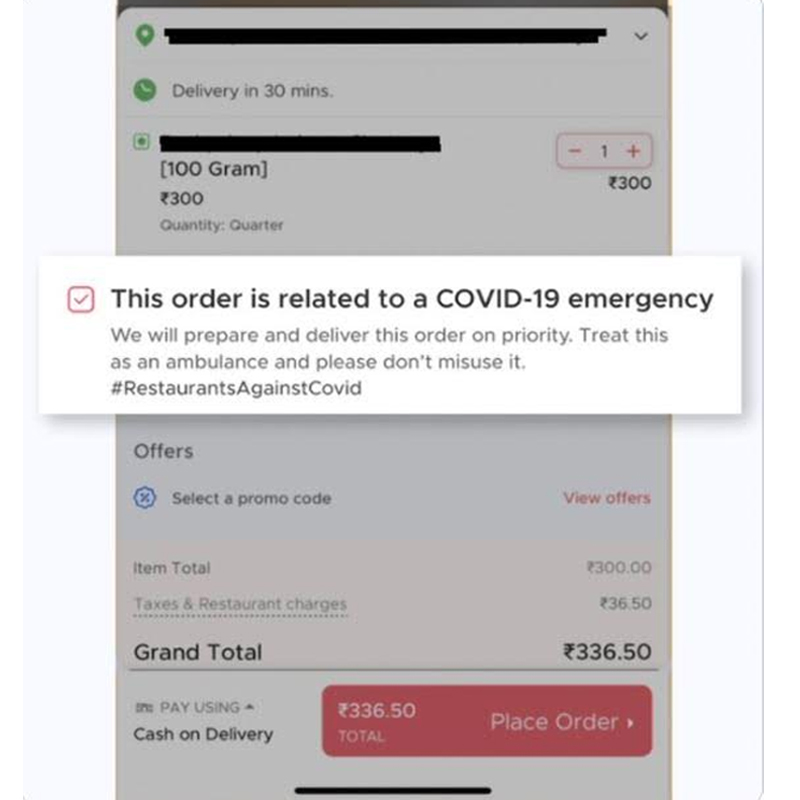
    Food delivery app Zomato had in 2020 taken steps to educate the riders and restaurants on safety and hygiene practices, provided them with COVID insurance, masks, and facilitated hand sanitisation stations at restaurants across the country. This time the Food delivery app has rolled out a feature for “Covid emergencies”. Zomato Founder Deepinder Goyal tweeted, “Today, along with thousands of our restaurant partners, we just rolled out a “priority delivery for covid emergencies” feature on the Zomato app. This feature will allow our customers to mark *This order is related to a Covid2019 emergency* option during checkout.

    These orders will be prioritised by providing fastest rider assignment, and dedicated customer support in case of queries. Thousands of restaurants have pledged to prioritise these orders in their kitchen above all others.

    In addition, the firm’s not-for-profit arm Zomato Feeding India has kickstarted a Help Save My India endeavour in association with @delhivery to source oxygen concentrators and related supplies to help hospitals and families in need.

    Early this month, Urban Company (formerly UrbanClap) – a managed marketplace for home services, committed towards getting 100 per cent of their fleet vaccinated, free of cost in the coming weeks. “We have already initiated phase 1 of this effort for service partners aged 45+, and are working closely with local govts and healthcare providers.

    With the government now allowing vaccination for all above 18 starting 1 May, @urbancompany_UC further reiterated its commitment. “ @urbancompany_UC is committed to getting all our front lines service professionals and employees vaccinated at the earliest possible availability,” tweeted Urban Company co-founder Abhiraj Singh Bhal  @abhirajbhal .

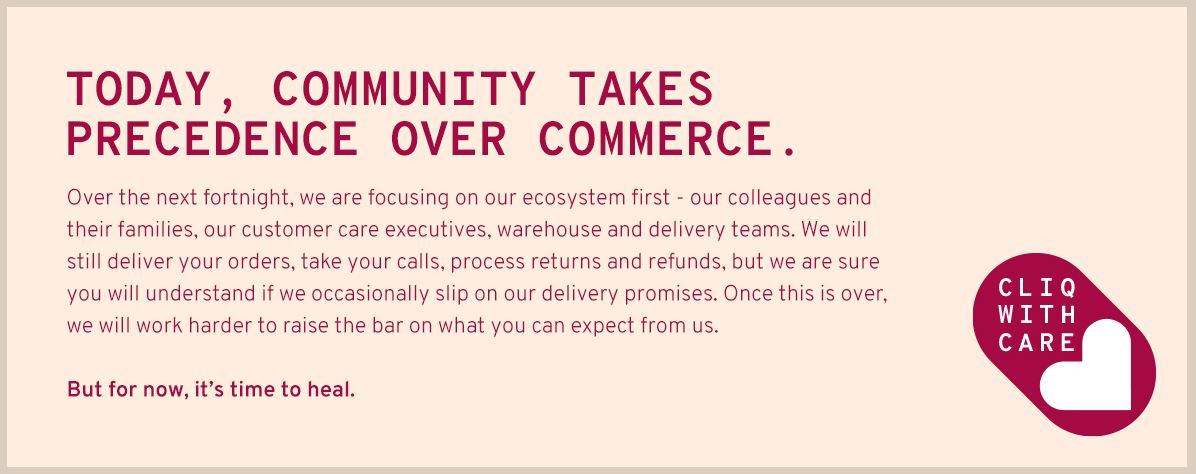
    Tata Group’s Online apparel brand TATA CLIQ chose to take a step back by reminding everyone that ‘It’s Time To Pause’. It urged its customers to think again before making a purchase on the app. Declaring that ‘Today Community takes precedence over Commerce’ the brand sent out communication to its subscribers and on its webpage saying “Sometimes it takes courage to pause, to listen to what the heart already knows. We encourage you to pause and ask yourself – do you really need to buy this now? Just because someone else carries it well doesn’t mean it isn’t heavy.”

    It added “Out of respect for our stakeholders, we are open for commerce – so we will still deliver your orders, take your calls, process returns and refunds – but we will not penalise our delivery team on road for a day of delayed delivery, we will not focus on the number of calls made in an hour by our customer care executives, we will not allow colleagues at our warehouse to travel via public transport and expose themselves and their families to risk.” 

  • Centre asks Twitter & other SNS to delete posts critical of India’s Covid response

    Centre asks Twitter & other SNS to delete posts critical of India’s Covid response

    NEW DELHI: Twitter and other social media platforms have removed about 100 posts and URLs after the Indian government asked them to remove content that was critical of its handling of the current Covid2019 crisis or spreading fake news around the pandemic.

    Twitter said it has notified the impacted account holders of its action taken in response to a legal request from the Centre, while Facebook did not comment on the issue. According to media reports, the microblogging site censored tweets from a member of parliament, an actor, a former journalist, and West Bengal’s minister of labour and law on the government’s behest. It wasn’t immediately known what the removed posts were.

    The action comes after the ministry of information and technology, on the recommendation of the ministry of home affairs, asked social media platforms to remove the posts and URLs to “prevent obstructions in the fight against the pandemic” and disruption of public order due to the said posts.

    They added that the order was issued in view of the misuse of social media platforms by certain users to spread fake or misleading information and create panic about the pandemic in the society “by using unrelated, old and out of the context images or visuals, communally sensitive posts and misinformation about Covid protocols”.      

    Twitter removed or restricted access to more than 50 posts in the past one month at the behest of the government, including tweets that criticised its handling of the pandemic. Other posts removed showed pictures and videos of a recent Maoist attack in Chhattisgarh.       

    A Twitter spokesperson said when it receives a valid legal request, it reviews it under both Twitter Rules and local law.

    “If the content violates Twitter’s Rules, the content will be removed from the service. If it is determined to be illegal in a particular jurisdiction, but not in violation of the Twitter Rules, we may withhold access to the content in India only. The legal requests that we receive are detailed in the biannual Twitter Transparency Report, and requests to withhold content are published on Lumen,” the spokesperson said.

    Earlier this year, more than 500 accounts were suspended and access to hundreds of others in India blocked after the government ordered the microblogging platform to restrain the spread of misinformation and inflammatory content related to farmers’ protests.

    India is currently dealing with one of the worst Covid2019 outbreaks globally. On Sunday, the number of new Covid infections touched 3,49,691 cases and 2,767 fatalities, according to the Union health ministry data. 

  • Declare journalists frontline workers: Editors Guild urges govt

    Declare journalists frontline workers: Editors Guild urges govt

    NEW DELHI: As the nation weathers the second wave of the Covid2019 outbreak, the news media community is working round the clock to keep the general public informed and apprised of the latest developments. Scribes in the country are also working closely with the government to drive awareness about the deadly virus and vaccine roll-out. However, until now, they have not been classified as frontline workers by the Centre.  

    As newspersons are also at the forefront of the battle against the novel Coronavirus, the Editors Guild of India has requested the government to declare journalists as frontline workers and be allowed priority Covid vaccination.  

    "News organisations have been relentlessly covering the pandemic, elections, and other current affairs in an effort to ensure that the flow of news and information to readers continues unabated. News media is included in essential services. Therefore it will only be fair that journalists be given this cover of protection, especially in the face of the number of infected rising to astronomical levels," the Editors Guild of India said in a statement.  

    The letter has been signed by Guild president Seema Musthafa, general secretary Sanjay Kapoor, and treasurer Anant Nath. 

    "Without the protection of a vaccination, media persons are finding it very difficult to discharge their professional responsibilities,” the Guild pointed out. “Therefore the EGI calls on the Union government to immediately get all journalists, regardless of age, vaccinated so that there is no disruption in their work during this critical time." 

    India saw its highest single-day rise of 2,17,353 Covid2019 infections, pushing the country's tally of cases to 1,42,91,917, according to official data released on Friday.

  • Ad volumes on music genre see steep rise in Q4: TAM

    Ad volumes on music genre see steep rise in Q4: TAM

    NEW DELHI: Covid2019 impacted nearly every genre on television. People were forced to stay indoors and as a result they spent a lot of time watching news, movies, music and shows on TV, resulting in a massive viewership spike.

    Films / shows, news and music were the key source of entertainment for the audiences. The music genre platforms created curated lists to offer respite to audiences from news of the pandemic. However, the genre was hit in terms of advertising, like many others.  

    TAM recently released data that showed ad volumes per day fell sharply in Q2 but witnessed a sharp rise in Q4. In Q2 it fell to just 56 hours per day, whereas it surged to 157 hours per day in Q4. This is in line with the fact that 90 per cent advertisers paused advertising in the early days of the pandemic and only started resuming their spends during the early Unlock phase.

    The monthly share of ad volumes for the genre is as follows. It depicts the growth in the genre barring December 2020, when it registered a slight decline.

    The data clearly reflects that the genre clocked the lowest ad volumes in the last five years.

    The top five sub genres in 2019 were – Hindi, Tamil, Telugu, Kannada and Punjabi, while in 2020 the top sub genres were Hindi, Tamil, Punjabi, Telugu, and Kannada.

    Personal care and food & beverages sectors were the leading advertisers in this genre, however, toilet soaps, toilet/floor cleaners and e-comm/entertainment/social media were the leading advertising categories in the genre in 2020.

    HUL and Reckitt Benckiser India were the leading advertisers, while Dettol Antiseptic, Dettol Toilet Soaps and Lizol were the leading brands in the genre.

    The report also highlighted that ad volumes had a split of 63:37 between national and regional. In 2019, this split was nearly the same.

    During the Unlock phase, the movie genre saw nearly 120 hours of average ad volumes per day, which was 93 per cent more than the lockdown period.

    Ad volumes were maximum on primetime band and the 20-40 seconder ad format still ruled the segment.

  • Personal care brands dominate movies genre in 2020: TAM

    Personal care brands dominate movies genre in 2020: TAM

    NEW DELHI: Covid2019 impacted nearly every genre on television. People were forced to stay indoors and as a result they spent a lot of time watching news, movies, music and shows on TV, resulting in a massive viewership spike.

    The movie channels leveraged this period and showcased the best titles from their library to ensure that they are able to attract audiences. A BARC report stated that there was a 14 per cent increase in impressions and 10 per cent spike in daily average reach.  

    However, during several webinars, meetings and discussions, industry observers clearly mentioned that the surge in viewership did not translate into advertising.

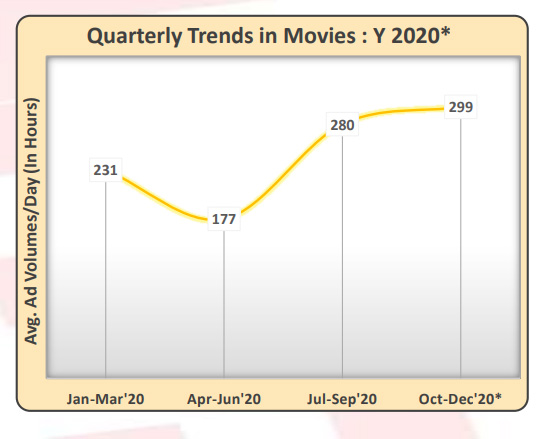
    TAM recently released data that showed ad volumes on movie genre grew by 60 per cent in 2020, compared to ad volumes in 2016. Interestingly, the quarter ended 31 December saw the highest number of hours in ad volumes per day.

    If we look closely at the data, we will notice an obvious trend where the average ad volumes per day steeply fell in the initial stages of lockdown, and then started picking up early May-June onwards. The trend was obvious because marketing teams at brands were still unable to gauge the depth of the crisis and not ready to bet money on advertising in that quarter.

    Movies have consistently maintained a 20 per cent average in overall television advertising across the years. (since 2016). In 2020, it was at 23 per cent.

    The top five sub genres in 2019 were – Hindi, English, Telugu, Tamil, and Bengali, while in 2020 the top sub genres were Hindi, Bhojpuri, Bengali, Telugu, and Kannada.

    Personal care and food & beverages sectors were the leading advertisers on this genre, however, toilet soaps, shampoos and washing powders continued their dominance in terms of ad volumes in this category.

    HUL and Reckitt Benckiser India were the leading advertisers, while Dettol Toilet Soaps and Clinic Plus Shampoo were the leading brands in the genre.

    The report also highlighted that ad volumes had a split of 51:49 between national and regional. In 2019, this split was at 56:44.  

    During the Unlock phase, the movie genre saw nearly 280 hours of average ad volumes per day, which was 93 per cent more than the lockdown period.

    Ad volumes were maximum on primetime band and the 20-40 seconder ad format still ruled the segment.

  • Lifestyle retailers ride on festive cheer, but will it last?

    Lifestyle retailers ride on festive cheer, but will it last?

    NEW DELHI: Businesses across varied sectors are trying their best to beat the lockdown blues altogether after months of economic slowdown. Apparel and lifestyle retailers have some cause for cheer as the sector is showing signs of revival. The players are banking on the festive season to revive their sales further.

    In August, lifestyle retailers reported almost 20 per cent growth, the best since outlets reopened in June after months of lockdown.

    Retailers say that the business has started picking up over the past few weeks, and now with Diwali and the wedding season around the corner, it will help brands to perform better as compared to the lockdown period. However, companies believe that it will take around six months at least for the business to be back on the actual sales and revenue figures.

    Consumer demand registered an uptick on the occasion of Navratri and Durga Puja but so far, the average ticket size is small.

    Cantabil Retail India Ltd director Deepak Bansal said the brand is expecting around 40 per cent growth compared to the previous months. “We anticipate achieving 75 per cent of what we achieved vis-à-vis last year. With the new merchandise and festive offers, we are hopeful it will act as a pull factor for the customers and the season will prove to be good for the whole industry.”

    He shared that to achieve the same growth figures as last year will take time, and not to expect the market to function at pre-pandemic levels before the next financial year.

    TCNS Clothing Co Ltd head – marketing Aarti Ahuja agreed that there has been a revival of demand for festive products such as ethnic dresses, accessories, and attires. Consumer trends may not match the demand created by festivals in normal times but the growing sale of festive products is reviving the sector and displaying high inclination of buying festive products, she added.

    Havas Media managing partner- North & West India Uday Mohan was of the view that the lockdown has resulted in pent-up demand. A lot of discretionary spends on travel/holidays/eating out have been cut down, so all these savings should be pumped towards retail spends especially with a plethora of deals available.

    By contrast, Spykar CEO Sanjay Vakharia doesn’t perceive the current situation to be sustainable. “Festive period would be comparatively good, and that will lead us into the end of season months. Post that will be the real test and what turns the business will depend on a lot of variables.”

    It was an unprecedented crisis for the retail sector when stores were shut for months during the lockdown, but the unlock phase has its share of challenges too. Now, customers are preferring to shop online instead of stepping out. The situation has driven companies to focus on the e-commerce model.

    Bansal explained while offline sales have bounced back in the second quarter and look stable for Tier 2 and 3 cities, the customer in Tier 1 cities are still more comfortable ordering online. “We have been working towards strengthening our digital channel. We have forayed into the online market space recently, so this would be the first festive season we would be available online and are expecting good traction in the number of sales".

    Ahuja also chimed that the brand is witnessing a rise in footfall as the year progresses, however, there is a growing trend of people leveraging both online and offline channels to purchase products.

    In order to boost sales, retailers have been offering heavy discounts of up to 60 per cent. Future Group, for example, is running discount offers of up to 60 per cent on apparels through third-party online sales, including Amazon India, and also offline via its own retail chains such as Big Bazaar and fbb.

    Considering most of the sales take place in this period, brands do extensive promotion and stress a lot on the marketing channels to leverage it. All the major brands have started launching campaigns, promoting products through the ATL and BTL modes.

    Ahuja shared that over the years, TCNS clothing has been exploring all mediums of advertising including print, outdoor, TV as well as OTT to reach the TG. However, the outbreak of the pandemic has disrupted the way media and content is being consumed. “We are evolving with the TG and focusing on changing trends in the ‘new normal’ by creating personalised communication for both online and offline consumers while bridging the gap. All costs are being challenged from a zero-based budgeting principle.”

    She further mentioned that various initiatives like hyper-local pop-up stores and virtual store visits are being experimented with. "The brand is exploring influencer marketing in a more structured and sustained manner. In terms of leveraging other media channels, it would depend largely on how the current situation evolves soon".

    Cantabil this year is focusing more on personalized communications for both offline and online consumers channels through SMS campaigns, influencer engagements, or strategic digital campaigns, in order to maintain connect with the target audience

    Biba MD Siddharth Bindra said that brands are planning innovative and creative ideas in terms of marketing to cope up with the current situation, with the maximum spend being on digital. “We, too, have changed our strategy and are adapting to the new. We are engaging with our existing consumers through our CRM tool and are very active online to keep our audiences abreast with what is new at Biba.”

    “From an overall perspective, TV and digital are the two lead mediums. For retail, specifically print (newspapers) continues to be the focus option. IPL and news are the key genres on TV where the bulk of advertising has been focused on,” Mohan concluded.
  • 50% cap on seating to continue for cinema halls till November 30

    50% cap on seating to continue for cinema halls till November 30

    KOLKATA: As the number of Covid2019 cases is inching towards the 80 lakh mark, preventive measures continue to remain in force. While the ministry of home affairs (MHA) allowed the reopening of cinema halls with limited capacity from 15 October, the 50 per cent cap will be applicable till 30 November.

    At the time of announcing unlock 5.0 guidelines, the ministry stated that the movie theatres outside containment zones can open with 50 per cent of their seating capacity. The announcement brought smiles to the faces of stakeholders across the film exhibition industry, who welcomed the decision despite persisting challenges.

    Later, the ministry of information and broadcasting (MIB) shared an extensive list of SOPs for the exhibition industry to abide by to check the spread of Covid2019. The ministry has clearly stated that no exhibition of films shall be allowed in containment zones; film exhibition activities through cinemas/theatres/multiplexes shall be governed as per the prevalent guidelines of ministry of home affairs and ministry of health & family welfare, and further states/UTs may consider proposing additional measures as per their field assessment.

    However, not all states have permitted the functioning of theatres and multiplexes. Cinema halls remain closed in states like Maharashtra, Telangana, Tamil Nadu, Kerala and Chhattisgarh. On the other hand, Delhi, Haryana, Uttar Pradesh, West Bengal, Madhya Pradesh are some of the states where theatres have reopened.

  • Unlock 5.0: Maharashtra to not go national way

    Unlock 5.0: Maharashtra to not go national way

    MUMBAI: Denizens of Maharashtra will have to wait a while before they start tasting the freedom of unlock 5.0 guidelines from 15 October announced by the ministry of home affairs (MHA) yesterday.  The MHA gave the go-ahead to organisers of B2B exhibitions, cinema halls, entertainment complexes, schools, and swimming pools to open outside containment zones. Additionally, cultural, religious and  other gatherings of 100 plus persons could also be allowed in certain areas.


    Even as the experiential and event sector was celebrating, the Maharashtra government announced its own set of guidelines which put a dampener on everyone’s spirits. According to these, exhibitions, theatres, swimming pools, large gatherings, schools,  are a no-no in the state until 31 October. The lockdown will continue in Maharashtra  until 31 October. However, the Udhav Thackeray led government has allowed tiffin delivery services to travel by local trains, permitted the opening up of hotels, restaurants and bars at 50 per cent of seating capacity.


    Mumbai, which probably contributes a large chunk of the movie box office, has a very active B2B exhibition schedule, will not be able get going in full swing. For that, we will have to wait for another day.


  • News consumption, ad volumes on a high in the first half of 2020: BARC+Nielsen

    News consumption, ad volumes on a high in the first half of 2020: BARC+Nielsen

    NEW DELHI: As India enters in unlock 2.0, news channels look at the brighter side, both in the terms of viewership and advertisements, reveals the tenth edition of BARC+Nielsen weekly report on media consumption habits in the covid period. 

    News viewership in the first half of 2020 stands 3 per cent above that in the first half of 2019, taking 12 per cent of the overall media consumption pie, operating at 43 per cent higher viewership than the previous year. Primetime viewership is even higher at 48 per cent more. Business news viewership in the first half of 2020 is 44 per cent higher than the previous year, reveals the data. 

    For the covid period, news consumption has started stabilising at 11 per cent of the overall TV viewership in week 26’20 (starting 27 June). 

    The viewing impressions for Hindi News are also operating at a much higher level compared to pre-covid period (11 Jan – 31 Jan), at 71 per cent more. The number is 45 per cent more for English news, 19 per cent more for Hindi Regional News, and 13 per cent more for English Business News. 

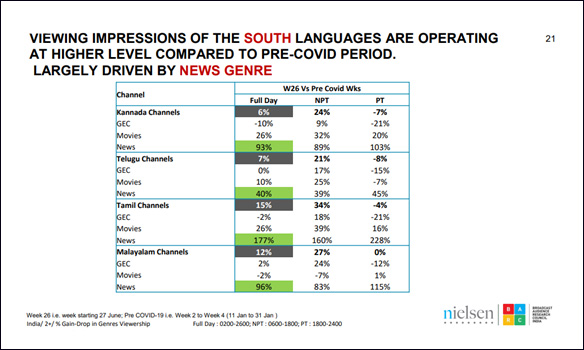
    The viewing impressions for Southern India are even higher across genre, especially news, with Tamil News channels recording 177 per cent higher viewing impressions than pre-covid period, Malayalam channels at 96 per cent higher, Kannada channels at 93 per cent higher, and Telugu channels at 40 per cent higher. 

    Ad volumes are also increasing on news genre, clocking 39 million in June 2020, higher than 35 million during the same period last year. However, the overall ad volumes in the first half of 2020 (225 million) are lower than that in the same period the previous year (259 million). Albeit, for some of the languages, the numbers are higher than that of the previous year.