Tag: covid

  • PayTM pledges 100 oxygen concentrators, one oxygen plant for Covid relief

    PayTM pledges 100 oxygen concentrators, one oxygen plant for Covid relief

    KERALA: Indian e-wallet and fintech company PayTM has pledged to donate 100 concentrators and one oxygen plant for Covid relief efforts in Gujarat. The donations were made to the Corona Sewa Yagna initiative spearheaded by Gujarat governor Acharya Devvrat. 

    PayTM has donated oxygen concentrators to combat the shortage in the supply of medical oxygen and stabilise the healthcare infrastructure. The oxygen concentrators will be sent to public hospitals, Covid-19 clinics, primary health centres, dedicated Covid-19 hospitals and health centres. 

    “We feel proud to extend our efforts to support Gujarat governor Shri Acharya Devvrat’s noble ‘Corona Sewa Yagna’ initiative. It’s crucial in the time of crisis to provide a pillar of support to our fellow citizens as pandemic waves hit the shores. We aim to converge our resources along with the state government’s initiatives to save as many lives of the people of Gujarat. These oxygen concentrators are our humble contribution to help overcome the oxygen shortage by the Gujarat citizens struggling with Covid-19,” said PayTM founder & CEO Vijay Shekhar Sharma.

    Non-profit organisation Yuva Unstoppable is supporting this campaign under the mentorship of the governor of Gujarat. Other corporates like HDFC Bank, Finolex, JITO, and more have supported ‘Corona Sewa Yagna’ initiative. 

    PayTM’s helping hand to its employees

    While interacting with the Indiantelevision.com, Sharma talked about various initiatives PayTM has taken to assure the wellbeing of its employees. 

    “Unfortunately, we have lost eight members of our PayTM family due to the Covid pandemic. We, at PayTM, are trying our best to fulfil the needs of the employees at these pandemic times. We are providing jobs to the dependents of the deceased employees, and we are meeting their family expenses for one year. We have introduced work from home option to our employees. We have given health insurance to our employees, and have never compelled them to work if they face any Covid-related issues,” he added. 

  • Filmmakers’ hopes dashed again as second Covid wave runs rampant

    Filmmakers’ hopes dashed again as second Covid wave runs rampant

    KERALA: The Indian film industry was beginning to show signs of a feeble revival early this year. As restrictions eased and Covid cases declined, people began returning to the theatres to relive the cinematic experience. The relief, however, did not last long. Now, with the second wave of Covid2019 showing no signs of abating, the industry’s future is in jeopardy yet again.

    India has recorded a record 4.01 lakh new cases of Covid in the last 24 hours and lost over 4,194 people who were battling with its complications. The deteriorating situation has compelled filmmakers to reconsider the release of their projects. Some have taken the streaming route, but even that faced hurdles, as the situation continued to worsen, impacting viewership across all mediums.

    Filmmakers put brakes on new releases

    The makers of Farhan Akhtar-starred Toofan have postponed the release of the movie due to the surge in Covid cases. The film was slated to release on Amazon Prime Video on 21 May. In a statement shared on social media, Akhtar said the current focus is only on the pandemic.

    “The situation in India is truly heart-breaking… In light of the severity of the situation, our focus is completely on the pandemic and on supporting our employees, their families, and helping the wider community. Therefore, we have decided to postpone the release of our film Toofan until the situation improves,” he tweeted. 


    Makers of Telugu flick Khiladi, which stars Mass Maharaja Ravi Teja in the lead role, have also decided to defer its theatrical outing. The movie was initially scheduled to come to cinemas on 28 May; a new date of release is yet to be announced.


    Wait for theatrical releases gets longer

    According to the latest updates, Marakkar: Arabikkadalinte Simham (which bagged the Best Feature Film honour at the 67th National Film Awards) is scheduled to hit the screens on 12 August 2021. The film was slated for a 23 March release but was postponed to 13 May due to the first phase of the Covid outbreak. As the marauding virus showed no signs of slowing down, the makers again pushed back the release to 12 August. With a third wave imminent, the August release could also get impacted. If the situation persists, producers may look for other options like direct OTT releases or hybrid releases as the content will get outdated. 

    “Even though it is too early to comment, current developments indicate that theatres in the country will not open in June or July, especially because vaccination is progressing slowly, and the number of fresh cases is rising phenomenally. Not just Maharashtra, most of the states are witnessing a sudden surge in cases,” said Elara Capital vice president and research analyst (media and consumer discretionary) Karan Taurani. 

    A potential third wave?

    As India struggles to combat the second wave, the government has issued warnings for a potential third wave that could hit the country later this year. According to principal scientific advisor to the PM Dr KV Vijay Raghavan, the third wave of Covid is inevitable. “The next outbreak could turn deadlier and it is not clear on what timescale this phase 3 will occur,” he added. “Hopefully, incrementally, but we should prepare for new waves. New variants will arise all over the world and in India too.”

    The dire warning comes at a time when the pandemic has already taken a toll on the Indian film industry. Following the Coronavirus outbreak, several production houses postponed the releases of their films, while some of them opted for OTT premieres. Although some Bollywood movies like Mumbai Saga and Roohi got a theatrical showing earlier this year, they failed to make an impact at the box office. 

    Will Radhe light the way ahead?

    Radhe is the first Indian movie that is set to get a hybrid release this May. The Salman Khan-starrer will hit theatres on 13 May and simultaneously premiere on Zee5 and Zee Plex as a pay-per-view. If the Covid situation persists in the country for long, several big-budget movies are likely to follow in Radhe’s footsteps. 

    “Considering the current trend, makers of big-budget movies like Sooryavanshi may not hold the movies for a long time. They may prefer an OTT release or hybrid release. The second wave might go quickly, we do not know,” opined Karan. 

    Given this uncertainty, most big-ticket, mass market films, both Bollywood and regional, have vanished from the upcoming release slate. Depending on how Radhe performs at the box office despite strict restrictions in several states and the success of the pay-per-view showing, which is yet to take off in India, hybrid release may be a ray of hope to industry stakeholders.

  • Covid relief: India Inc shows it cares, puts employees’ wellbeing before profits

    Covid relief: India Inc shows it cares, puts employees’ wellbeing before profits

    MUMBAI: As the second wave of Covid2019 batters the Indian subcontinent, there is little doubt that we are staring at a humanitarian disaster of humongous proportions. Even as the country struggles to cope with what is possibly a deadly new variant of the Coronavirus, organisations are going out of their way to show solidarity with their workforce.

    Recently, Reliance Industries announced that it has decided to give employees their entire bonus for 2020-21, acknowledging their commitment to the company in a challenging year. It also launched an inoculation drive for all its employees, their family members, and stakeholders from Friday.

    Earlier, FMCG major HUL announced it will cover for the vaccination of around three lakh people, which include not only its employees and their families but also those in its extended ecosystem.

    Across India, as cases surge and precious lives are being snuffed out, companies are pressing the pause button on chasing quarterly targets and are instead going the extra mile to help afflicted employees and their loved ones.

    Showing empathy  through enhanced employee benefits

    Many companies have become generous with employee benefits and leaves, granting special wellness leaves, vaccination leaves, and reduced work-day weeks for their employees, along with providing staff access to mental and health care services.

    Online food delivery platform Swiggy has rolled out a four-day work week for employees for the month of May, keeping in mind the mental and physical well-being of its employees. Workers have also been given the flexibility to choose the four days they want to work in a week.

    Companies like Tata Steel, Google, Amazon, Schneider Electric, Deloitte and more have provided their employees with 14 special sick leaves for them to recuperate and recover.

    Some companies like ITC, Optum and Phillips have provided their employees with unlimited leave policies. These companies have allowed the affected ones to rest with a clear-cut mandate of not to resume work until they recover.

    According to Human capital solutions and services provider GI Group India VP & head HR Upasana Raina, “The mental well-being of everyone in the organisation is key to each person’s individual success that finally ties up into the success of the collective.” She added that apart from ensuring that 100 per cent of their workforce has WFH facility, the agency also “encourages employees to take time for themselves to strike a healthy balance between work and family.”  

    Personal finance app Branch has also implemented the “unlimited paid time off for dealing with the physical and emotional trauma”. Branch India MD Sucheta Mahapatra says, “With the second wave, we understand that most employees are physically and mentally affected either personally or in their social circles. The health coverage will now cover Covid Related hospitalisation. We have internally formed a Covid employee taskforce to evaluate and work on various work streams to support employees during these times.” 

    Telecom and IoT services provider Teliolabs CEO Amit Singh says, “We have formed a Covid response team with a doctor, finance, HR and system admin teams to ensure proper help to the team members in case of any Covid related query, hospital admissions etc. We are also extending our medical insurance and term insurance policies for better coverage in these difficult times.” This is in addition to giving paid leave to employees falling sick owing to Covid.

    Insurance tech provider SE2 Digital Service LLP head HR Sumit Bhatia shares some of the initiatives the company has put in place to ensure their employees are safe and reassured during the pandemic situation: “Reimbursement of RTPCR tests and vaccination costs, health insurance that includes Covid related hospitalisation, 24×7 free doctor access, stress management (EAP) support, 14 days of special Covid leaves in case any associate is detected positive, and in the unfortunate scenario of an associate’s demise due to Covid – monetary coverage for family (beyond Term Life Insurance)- SE2 will pay the associates’ full one-year salary (including 100 per cent of the variable pay) or Rs 10 lakh (whichever is higher) to the family.”

    AI-driven online automobile marketplace Droom has announced a Rs 1 crore budget to combat Covid for its employees and dealers’ community. It has launched programs for its 20,500+ dealers to assist in pharmaceuticals, vaccination, medical assistance and provide isolation wards with basic medical facilities. It has also increased its medical insurance coverage by five times this year, providing medical coverage group insurance for employees’ parents, and has even launched a telemedicine consultation for mental and physical health free of cost.

    Converting office spaces into Covid isolation & vaccination centres

    Besides providing benefits, some companies have taken a step further and converted office spaces into isolation centres and hospitals for employees and their kin.

    HDFC Bank has converted three of its training centres in Gurugram, Bhubaneswar and Pune into isolation facilities for its Covid-affected employees. These facilities have been equipped with first-line assistance and will have round the clock nurses and visiting doctors. The facilities include setting up vaccination camps. In addition, it has also tied up with many hotels across the country to provide isolation facilities, basic amenities and basic medical checks.

    Similarly, TCS has set up Covid Care Centers across 11 cities in India and entered into arrangements with hotels that have hospital tie-ups. Employees and their families can avail emergency medical financial assistance, apart from the health insurance facilities offered. In fact, many IT firms are setting up hospital beds in their campuses with oxygen and ventilator support to support employees and their families to deal with the acute shortage the country is facing.

    Droom has also converted its Sector 15 office into an emergency response center with telemedicine services, nurses, and all basic healthcare facilities.

    Further, Amazon, ITC, Capgemini, RPG Group, and Cognizant have also set up Covid-care centres either on their own, or through tie-ups with hotels or hospitals at this critical time when the country’s healthcare system is getting overburdened.

    Bry-Air, DRI and Artemis have organised vaccination camps for their employees, while Fortis recently arranged drive-thrus for Panasonic, Jindal Steel, Coforge, Honda Motorcycles and Scooters.

    IT majors like TCS, HCL Tech, Tech Mahindra, Infosys have introduced Covid201919 test centres to help their staff avoid exposure by visiting crowded test centres and waiting in long queues.

    Assuring monetary aid

    Companies are also taking measures to ensure the long-term financial stability of their staff and their families. Zomato announced that it would provide 100 per cent of the deceased employee’s income for two years to the family. Paytm’s Vijay Shekhar Sharma said the company will continue to pay salaries to the families of deceased employees throughout the current financial year

    Cars24 CEO Vikram Chopra recently won a lot of love on social networking site LinkedIn for an internal mail he sent out to all his employees urging them to buy whatever it was that they needed for the treatment of themselves or a family member, without worrying about its price.

    He wrote, “Need oxygen or medicines but only available in black at a very high price and without any proof? Please just buy whatever you need, from whatever source you get it. Don’t worry about a proof to be produced to the company or how it costs,” adding “Send us an email and we will transfer money asap.” He further wrote that the company will also try to arrange medicines, or oxygen and whatever else is required, while stressing that “We will pay you advance or reimburse all costs, whichever is faster. I repeat, no proofs required.”

    Setting up Covid helpline & resource access  

    Software giant, TCS has set up a Covid help desk for employees to seek any assistance required, along with a 24×7 TCS Medical Hotline to reach doctors and TCS Cares services for counselling.

    HDFC Bank too is providing e-consultation with doctors through apps including Apollo 24/7, MediBuddy, PharmEasy Apps, with PharmEasy helping with delivery of medicines as well. Additionally, the bank has also provided access to e-consultation with empanelled psychologists through these apps.

    Several companies, including PricewaterhouseCoopers, Accenture, Grofers, Cars24, Deloitte have announced that they will sponsor the cost of vaccines for their employees and some for their families as well.  
  • Post-pandemic, 50% commuters anticipate continued remote working

    Post-pandemic, 50% commuters anticipate continued remote working

    Mumbai: More than half of commuters around the world plan to continue working remotely, at least in part, after the pandemic. This, together with a growing preference for healthier modes of transport, but also a resurgence in commuting by car, means the next year will be pivotal in shaping the transport infrastructure and the future of mobility. New research from Kantar’s Mobility Futures study, based on deep analysis conducted across almost 10,000 city dwellers ahead of June’s Movin’ On World Summit on Sustainable Mobility revealed that the pandemic resulted in a 30 per cent drop in travel volume to work, places of education and leisure activities.

    Of those surveyed, 50 per cent respondents who commute to their workplaces anticipate continuing to remotely to some extent post-pandemic. Furthermore, public transport has experienced a 5.6 per cent loss of share as hygiene concerns became a factor with the outbreak of Covid.

    Car usage has experienced a 3.8 per cent increase in share of journeys during the pandemic and looks set to stick as preference for post-pandemic travel. A five per cent shift in share of journeys across Western Europe to healthy modes of transport, walking, cycling and scooting, during the pandemic, with an increase in those saying it will be their preferred mode of transport.

    In the newest research, conducted as the world starts to think about life after the pandemic, city planners and transport infrastructure professionals adapt to the new travel patterns. Kantar predicts that remote working will play a significant part in the ‘New Normal’ after pandemic restrictions lift. Currently, around two in three residents of major urban areas are working from home globally and the study shows that on average half plan to keep working remotely in the future. 

    Healthier modes of transport have seen a noticeable increase in this period especially in Europe. With limited transport sharing options, Europeans have favoured walks and bike rides for their daily journeys. Kantar has observed a 4.8 per cent rise in the use of healthy modes of transport in Europe, with walking being the most preferred of these means and scoring a 78 out of 100 on the satisfaction chart. US cities however have seen only a slight increase in use of healthy transport means (0.6 per cent year-on-year), mainly due to large distances and car-centric infrastructures.

    The pandemic has created an increased focus on localism and shorter trips. This trend could positively impact the ‘15-minute city’ concept – moving away from being car-centric and offering all the amenities for people’s essential and daily needs within a 15-minute walk or bike ride. Kantar data supports this by revealing that walking and biking are currently the highest scoring means of transport in terms of satisfaction.

    Despite the health-kick, there has also been an increase in car usage. Social distancing measures and health concerns led to more people choosing to drive alone during the pandemic to reduce exposure to the Coronavirus. Driving remains one of the preferred ways to travel, despite the negative environmental impact of petrol-powered cars, with usage growing 3.6 per cent and preference +1.9 per cent – making driving the second most popular mode of transport after walking. 

    In contrast, public transport has taken a serious hit during the pandemic, dropping by 5.6 per cent YoY in usage and scoring only 37 out of 100 for satisfaction, as a result of restrictions on its use, social distancing and people choosing individual means of transport (i.e. walking or biking). The challenge for cities will be how to entice members of the public back onto these services in order to reduce traffic congestion and limit environmental damage in cities.

    Kantar executive VP & practice lead – automotive & mobility, South Asia, Anang Jena said, “The pandemic in India has fundamentally changed the way people process and consume mobility, especially with more serious manifestation in the current wave. There will be an inherent psychological restriction towards public transportation which is likely to be fairly long term, especially amongst those who had opted for public transportation even if they could afford personal mobility solutions such as personal vehicles. The large part of India’s migrant population will continue to rely on public mobility solutions with a lot of caution and sensitivity. Public mobility suppliers need to gear up to address these sensitivities going forward. The last mile connectivity will continue to thrive as social distancing practice can be applied effectively – this could create a clear and significant opportunity for e-mobility.”

  • L’oréal stands in solidarity with India’s fight against Covid

    L’oréal stands in solidarity with India’s fight against Covid

    Mumbai: To address the acute shortage of oxygen being faced by India in combating the Covid2019 pandemic, L’Oréal has lent its financial support to the French government’s initiative to provide oxygen generators, liquid oxygen containers and specialised respirators to the country. In addition, the global cosmetic brand is working with a network of NGOs across India, including GiveIndia, United Way Mumbai, Hemkunt Foundation, ActionAid Association, the Akshay Patra Foundation etc to supply critical oxygen equipment, medical supplies, food, education and hygiene kits across the country.

    L’Oréal will provide oxygen concentrators and cylinders to hospitals in Maharashtra, Karnataka, Delhi, Himachal Pradesh and Punjab and distribute over 100,000 units of sanitisers to government hospitals, police forces, municipal corporations, and those on the frontline of the pandemic across the country. The company said it will also give care packages to approximately 2000 nurses who have become the primary caregiver and family to many.

    With schools closed indefinitely, underprivileged children have not had access to education or food provided by schools. To aid their requirements, L’Oréal has partnered the Akshay Patra Foundation to provide 4,000 food and education kits for children. As women have been amongst the most severely impacted by the pandemic, L’Oréal is working with Action Aid India to provide livelihood training and infrastructure support, there by empowering them to restart their livelihoods.

    L’Oréal India managing director Amit Jain said, “We are deeply concerned with the severity of the second wave of the pandemic and committed to working closely with the government and our NGO partners to support the country’s collective efforts to fight the crisis.”

    L’Oréal employees will also be contributing toward Covid relief to an NGO of their choice via the fundraising platform GiveIndia.

  • Covid care: Borosil extends helping hand to kin of deceased employees

    Covid care: Borosil extends helping hand to kin of deceased employees

    MUMBAI: With the country battling an upsurge of Covid2019 cases, several companies have been rolling out aid and compensation for employees and their families impacted by the pandemic.

    Borosil Ltd and Borosil Renewables have said that in the event of an employee losing their life due to Covid2019, his or her family will continue to receive the salary for the next two years. The company will also take care of the education of the deceased employee’s children “till their graduation in India” the glassware company said. The family members will also be eligible to receive other additional benefits the employee is entitled to, said the brand.

    A statement to the effect from Borosil Ltd’s managing director Shreevar Kheruka was shared on the company’s social media handle.

    The statement read, “We have lost four employees to this dreadful pandemic. Their names are Santosh Chalke, Vijay Shirsath, Tushar Panchal and Shiv Shankar Bisht. The sadness for these losses is indescribable.

    In order to reassure our employees, we have announced that the family of any employee of Borosil Ltd and Borosil Renewable Ltd and their subsidiaries will be given two years of salary in the event of an unfortunate demise owing to Covid2019. In addition to this, the education of the children of the employee will be paid till graduation in India.

    The above is no comparison to the scale of the loss, but hopefully will allow the family enough time to process the bereavement and reorient.

    I strongly believe that the real assets of Borosil are not reflected on our Balance Sheet at all. We need to protect these assets in whatever way we can. I hope this move is a step in that direction.

    This too shall pass and we will emerge into a better tomorrow!”

    Last week, gig services marketplace Urban Company also announced it had set up the Mohit Agrawal Covid Relief Fund in memory of the company’s director of engineering who passed away due to Covid2019. The company has partnered with Srinidhi Foundation to set up the relief fund that will provide medical assistance and bereavement support to Urban Company’s gig workforce and their families. The company’s co-founder Abhiraj Singh Bhal took to Twitter to share the news.

  • From Maharashtra to Punjab, how TV industry is navigating Covid’s second wave

    From Maharashtra to Punjab, how TV industry is navigating Covid’s second wave

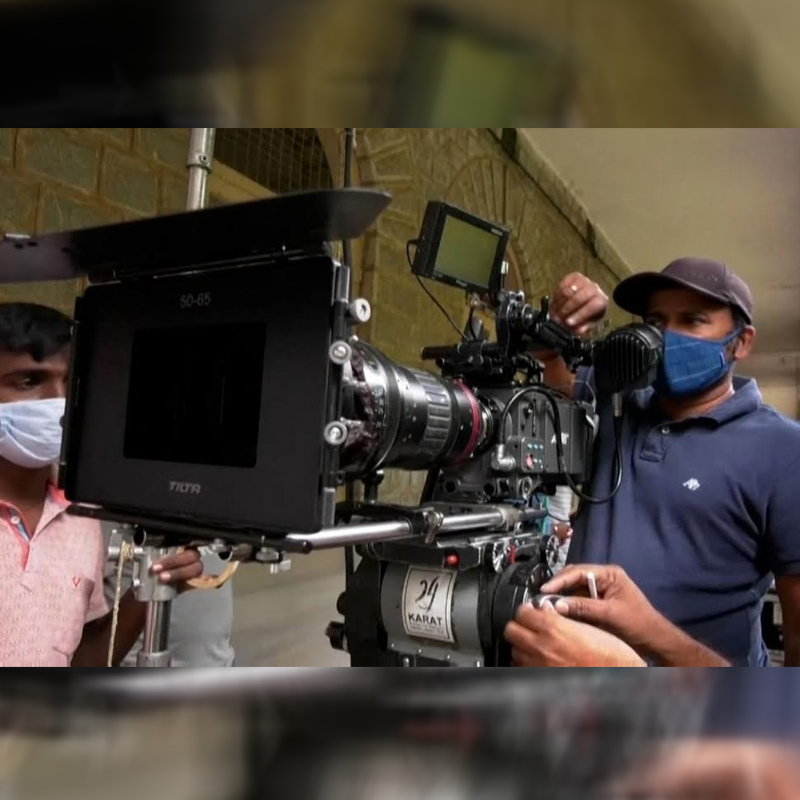
    KERALA: The second wave of Covid2019 that is wreaking havoc in India has reshaped the way in which television shows are made and broadcasted. As several states including Maharashtra have suspended the shooting of TV shows due to the surge in Covid cases, producers are now choosing states like Punjab to complete the filming of ongoing projects. 

    Producers compelled to shift shoots to other states

    During the initial days of shooting suspension, most showrunners shifted to states like Goa and Karnataka to complete their pending shoots. And now, as several states have started imposing strict restrictions, producers are going further afield – moving to Punjab, Gujarat, and Rajasthan to quickly film the pending episodes. 

    For television producers, this inter-state expedition is a costly proposition, especially because the shooting in these states has to be carried out in adherence to all Covid protocols. 

    “Shooting in other states outside Maharashtra is undoubtedly a very expensive deal, and producers are struggling financially. We are quickly trying to complete the filming of pending episodes in states like Goa, Gujarat, Karnataka, Rajasthan, and Punjab. We are facing huge loss, but the show must go on,” said Indian Films and Television Producers Council chairman JD Majethia. 

    Filming of non-fiction shows impacted

    According to Majethia, production of non-fiction shows has been largely impacted due to Covid restrictions, especially due to the huge funds and infrastructure involved in the filming process. 

    “Even in normal scenarios, running a non-fiction show is very challenging, and now, during the time of the pandemic, it has become more challenging than ever before. Contestants who participate in these shows come from different cities, and producers should take care of various things including their accommodation. We have to be very careful to ensure that no person in the sets is infected. It is a financial and moral responsibility, and it is stressful too,” added Majethia. 

    The actor-director also noted that it is really difficult to replicate everything on the new sets that are being erected to ensure continuity of shows. 

    Artists and technicians stranded in various states

    IFTPC revealed that several artists from Maharashtra are currently stranded in other states. To avoid this situation, producers have urged the government to permit the shooting of television shows within Maharashtra, and assured that filming will take place by maintaining all Covid protocols. Majethia also added that producers in Maharashtra are ready to work together with the government to curb the spread of the pandemic. 

    “There are several technicians and artists who are now in other states for shooting activities. To enter Maharashtra and to go back to other states for filming is not an easy task, as RT-PCR tests are mandatory to enter other regions. We also love to be a part of the government’s initiative to curb the spread of the pandemic,” added IFTPC. 

    Majethia went on to mention that the lockdown imposed in Goa has negatively affected the filming of many shows that had switched production bases to the smallest state in the country. 

    However, Goa Line Producers Association president Sandeep Korecha revealed that the lockdown has not affected indoor shooting. 

    “We are allowed to shoot at indoor venues, until May 30, even during the lockdown. Outdoor shoots aren’t permitted. We have also been asked to shoot with minimum crew members. We put an indicator on our vehicles so that they’re allowed to pass during the lockdown,” said Korecha during a recent interview with The Times of India.

    Television shows essential during Covid times

    Following the spate of restrictions in several states including Maharashtra, Karnataka, Goa, and Kerala, people are now confined to their homes, and for them, the primary means of entertainment is the television. Citing this point, Majethia claimed that makers of TV programs also come under essential services. 

    “People are depressed and frustrated due to the Covid pandemic. Entertainment is very much necessary at this time. Getting ample doses of entertainment will act as a medicine for depressed people,” he asserted. 

    Meanwhile, several television personalities have also succumbed to the deadly virus in recent days. On 30 April, actor and anchor Kanupriya died days after contracting Covid. She was known for her roles in Bhanwar, Ananro, Kahi Aek Gaon, Kartavya, Meri Kahani, Tesu Ke Phool and Tumhara Intezar Hai.  

    On 10 April, veteran Punjabi actor Satish Kaul, who had featured in BR Chopra’s Mahabharat, passed away due to Covid-related complications. 

    Television actor Divya Bhatnagar, best known for her role in Yeh Rishta Kya Kehlata Hai, died due to Covid2019 in December last year. She was just 34. 

  • Madison Media’s K Suresh Kumar succumbs to Covid2019

    Madison Media’s K Suresh Kumar succumbs to Covid2019

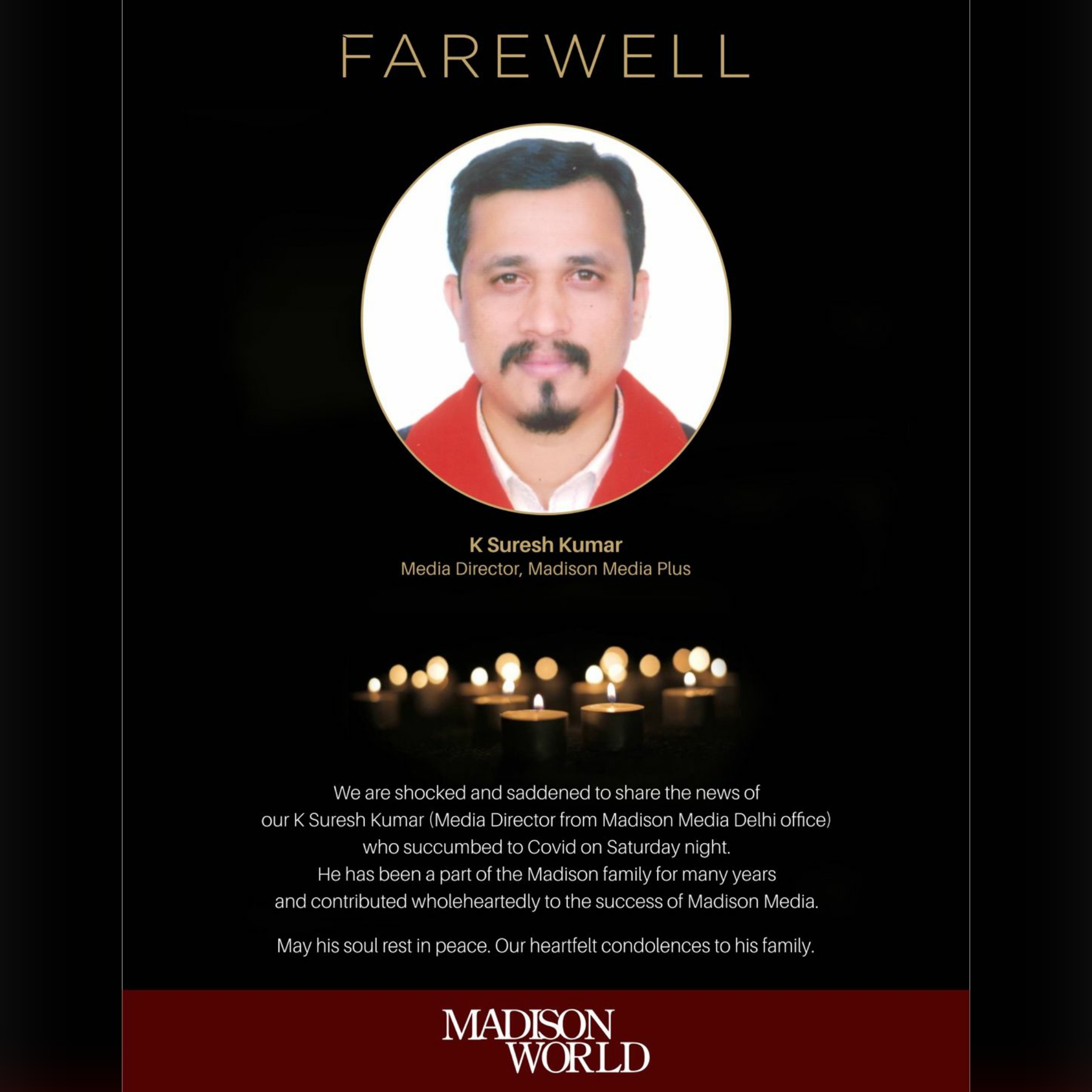
    MUMBAI: Madison Media Plus media director K Suresh Kumar passed away due to Covid2019 on Saturday, the media agency said in a statement. Kumar, who operated out of Madison Media’s Delhi office, had been with the company since November 2018.  

    The agency expressed condolences in a post on professional networking site LinkedIn:

    “We are shocked and saddened to share the news of our K Suresh Kumar (media director from Madison Media Delhi office) who succumbed to Covid on Saturday night.

    He has been a part of the Madison family for many years and contributed wholeheartedly to the success of Madison Media.

    May his soul rest in peace. Our heartfelt condolences to his family.”

  • TIMES NOW suspends its election results coverage on 2 May

    TIMES NOW suspends its election results coverage on 2 May

    MUMBAI: In an unprecedented move, English news channel Times Now on Saturday announced that it will suspend its coverage of Assembly elections results for four States and one union territory on 2 May, citing “the biggest health emergency” that the country is facing.

    The Times Group-owned channel said that it will track the “biggest national story”- keep COVID news as its main priority and suspend its usual special election coverage ‘on 2 May and beyond.’ 

    “As part of the coverage, viewers can expect COVID-related news reports, the latest on the status of the vaccination drive, information on helplines, and can interact with healthcare and mental wellness experts on the channel,” it stated in a social media post. However, it will still carry flash news updates on the counting and results, but refrain from covering poll-related celebrations.


    “The second wave would have been better controlled had we avoided two of the mega risk events – Kumbh Mela and elections in five states in normal campaigning mode. But, as the wave keeps climbing, with it claiming more innocent lives, it is clear that there has been a serious lapse in leadership at all levels- across the political spectrum,” the channel averred expressing concerns over the deteriorating situation and said that it has been vocal against these lapses.


    After the final phase of polling for West Bengal, Tamil Nadu, Kerala, Assam, and Puducherry assembly elections got over, all eyes are now set on 2 May when the counting of votes will take place for the four states and one UT. As many as 822 seats out of 824 scheduled for election went to poll between March 27 and April 29.

    However, the results have been overshadowed by the massive surge in Covid2019 cases and the resultant oxygen shortage at hospitals which has put the lives of millions of Indians at risk. The country is facing one of the biggest health crises, as daily cases crossed an unprecedented 4 lakh on Saturday. As many as 3,523 more people succumbed to the infections during the last 24 hours, taking the total death toll to 2.11 lakh.

    A staggering 69 lakh new infections were detected in the country during April when campaigning for the Assembly elections was on in several states. This was the highest tally for any month in any country so far- another dismal global record, raising a question mark on conducting regular elections during the crisis.

  • HUL Q4: Net profit up 41%; health, hygiene & nutrition portfolios drive growth

    HUL Q4: Net profit up 41%; health, hygiene & nutrition portfolios drive growth

    NEW DELHI: FMCG major Hindustan Unilever (HUL) reported a good set of numbers on all fronts for the quarter ending 31 March 2021. Beating market estimates by a significant margin, net profit surged 41 per cent to Rs 2,143 crore on the back of a solid 16 per cent volume growth.

    Revenue grew by 34.6 per cent year-on-year to Rs 12,132 crore during Q4. Domestic consumer growth was at 21 per cent.

    For the fiscal 2020-21, the consumer goods company said its consolidated net profit was at Rs 7,999 crore, as compared to Rs 6,756 crore in 2019-20, a growth of 18 per cent. Consolidated total income for FY21 was at Rs 47,438 crore, as against Rs 40,415 crore in FY20.

    Health, hygiene and nutrition, which makes up 80 per cent of business, grew in double-digits for the third consecutive quarter, while discretionary and out-of-home categories improved sequentially, the company said.

    Home care growth at 15 per cent was enabled by a strong recovery in fabric wash. Household care continued its strong performance delivering double-digit growth. Liquids and fabric sensations continued to outperform, benefitting from robust market development initiatives, stated HUL.

    “Our in-quarter performance was strong on both the top-line and bottom-line. Despite challenging times, in FY21 our business ecosystem has withstood the disruption and demonstrated agility and resilience across the value chain,” said HUL chairman & MD Sanjiv Mehta. “We have delivered on our multi stakeholder business model. Our purpose-led brands and capabilities were further strengthened during the year and this positions us well to serve our consumers during this turbulent period.”

    The company’s focus will firmly remain behind delivering volume led competitive growth, he added.

    Mehta went on to say that the recent surge in Covid cases is of serious concern and “ensuring safety and well-being of people remains our top priority”.