Tag: covid-19

  • Advertising Club Bangalore spells out how to deal with COVID2019 and after

    Advertising Club Bangalore spells out how to deal with COVID2019 and after

    MUMBAI: Advertising agencies and brand marketers have been foxed by the continuing lockdown courtesy COVID-19.  What should they communicate during the pandemic which is a constant moving target without a clear end-date?

    Follow Tellychakkar for the consumer facing news & entertainment

    To get answers to some of the doubts that advertisers have in these uncertain times, the Advertising Club, Bangalore live-streamed a webinar earlier on 22 April which had ad agency Motivator India head strategy and integrated solutions (south) Sumant Bhattacharya and Motivator India strategy head Upali Nag Kumar sharing their insights.

    The duo stated that like every other event that has a wide impact, COVID2019 should be studied by breaking down it into three parts: outbreak, recovery and stabilisation.

    They insisted that advertisers should not be working with a short-term view but seek long-term benefits from their communication. The consumer, today, is looking for reassurance and it is the advertisers’ responsibility to do that without plugging in sales pitches for their products.

    Elaborating more on the outbreak phase of the situation, Bhattacharya said that brands need to be agile in their approach. “Even as you cut back on spends, you should continue to have enough communication to stay connected with customers. You should be contextual in your communication like if doubling of cases is happening, as in the case of the novel coronavirus, you should ride it.  You must rebuild assurance in the minds of consumers, be empathetic with them, and don’t sell the product to them.”

    He added that brands can collaborate with peers to make services easier to access by the consumers by citing examples of short film ‘Family’ starring biggies like Amitabh Bachchan, and Swiggy’s partnership with Big Basket and Venky’s.

    Taking congisance of what’s happening in the case of COVID-19 currently, Nag said that initially there was panic and fear, but a month into the lockdown, that has settled down.

     “People are moving to digital to find what to do, concerts, made at home ads by brands, stay safe, social distancing campaigns. The downside here is that most brands are delivering the same message. CSR is becoming hackneyed,” she said. “How does a brand differentiate, it becomes important to look at the next level of cultural nuances.  Some brands are doing it right, for example Mother Dairy ice creams, Himalayan Men, Kelloggs, Xiaomi. Remember your distribution has been hit; the physical availability of the product is not there.”

    The media that needs to be used during this phase is TV news channels, digital and OTT, owned media,  and gaming. “The idea is to sustain top of the mind recall and not to push sales,” revealed Bhattacharya.

     Moving on to the recovery phase, he said that the messaging that began in the outbreak phase should continue as it will be difficult to get a total fix on this phase. Said he: “Remember, continue with that coherent strategy. If earlier collaboration was about delivery then extend it to the shopping experience, towards entertainment, but don’t overdo the latter. Let the product and its messaging offer hope and optimism. Use influencers, if you can.”

    Nag elaborated that recuperation is staggered and essentials will become more important. The brands in the CPG category, like food, shampoos, baby care, will have to constantly keep reminding people of their existence or they might lose consumers as during the outbreak phase they might not have been available and been replaced by others.

    The media that can be used in this phase include: news and movie TV channels, some out of home could kick in, some cinema but in the context of social distancing, in-shop activation, mall activation, and of course continuing to use digital and influencers to evolve the brand story.

    In the  stabilisation phase, marketers have to understand what kind of new customer behaviours the event has brought in. “Continue with whatever you have started in the first two phases if you have got the traction,” said Bhattacharya. “Brands can start creating assets which are more product-centric. However, brand building needs to be continuous.”

    Nag stated that customers will most likely be looking for more value in this phase as some may have lost jobs or used up their money and they will also have developed new habits. She cited Netflix which learnt from the 2008 financial debacle and went from physical rental of video tapes to delivering a streaming service which is so successful currently.

    “The world of integrated media will become important as people will start going back to the physical world. This is going to trigger some long-lasting behaviour changes, in terms of choosing products. Understanding this is something that marketers should do and latch on to the findings.”
  • I&B min advisory on health of media persons covering COVID-19

    I&B min advisory on health of media persons covering COVID-19

    MUMBAI: The ministry of information and broadcasting (MIB) has issued an advisory to media houses to ensure that the health of their field and office staff is taken care of. The advisory comes in the wake of 53 journalists contracted COVID-19 in Mumbai while covering the pandemic.

    “In view of the fact that media persons, including reporters, cameramen, photographers, etc., are covering incidents relating to COVID-19 in various parts of the country involving travel, amongst others, to containment zones, hotspots and other COVID-19-affected areas, it is advised that all such media persons may take due health and related precautions while performing their duties. Further, management of media houses is requested to take necessary care of their field staff as well as office staff,” reads the notice.

    The I&B note is addressed to both print and electronic media houses.

    News has been categorised as an essential service which enables all media houses to function during the pandemic. TV channels have said that they are practising adequate social distancing norms for on-ground reporters as well as office staff, and are working with a reduced workforce.

    Channels have been working around the clock to ensure that all the latest updates on the pandemic are brought to the notice of people.

  • Arnab Goswami speaks during COVID-19 lockdown

    Arnab Goswami speaks during COVID-19 lockdown

    MUMBAI: You can't keep Arnab Goswami out of the news. Soon after chucking up his membership of the Editors Guild of India, he is now seeking succour for TV news channels as president of the News Broadcasters Federation – a coalition of 300 of them. The bespectacled journo, who is not known for mincing his words, wants to make a clear appeal to advertisers, agencies and the media frat to help the news broadcasting sector, during the Covid-19 lockdown phase which has led to the erosion of both their top line and bottom line. News television, which mostly relies on ad spends to fuel its operations, has seen the latter getting shaved even as viewership has multiplied manifold.

    Goswami, who is a founding member and editor-in-chief of Republic Media Network, had an exclusive conversation with indiantelevision.com during the course of which he said that he was making an outreach to brands, ad agencies, and media that they "need to look upon news as essential service and I request them to come forward and show greater support to the news channels.”

    The NBF president believes that the federation has greater responsibility towards the media industry and must support those who may not be leaders in their specific regions.

    Recently, the NBF urged advertisers and advertising agencies to refrain from renegotiating their on-air TV commercial and sponsorship deals when the news broadcasters are ramping up their COVID-19 coverage, despite the fact that operating costs are rising alarmingly.

    “I have been working hard for it and am willing to engage with my friends in the media industry to take this further," says Goswami. "It is said that advertisers are cutting down the effective rates in the current scheme and there are chances that this will worsen things, especially for regional news broadcasters, putting a question mark on their existence."

    Not just from advertisers, the NBF president is also considering requesting a comprehensive stimulus package from the government for the TV news broadcasters. In this regard, the federation has written a letter to union information & broadcasting (I&B) minister Prakash Javadekar for an appointment of e-meeting through video-conference as per his availability this week.

    Points out Goswami: “This is a difficult time for the broadcasting industry and as president of NBF, I look forward to meeting the I&B minister during which we can discuss the measures the government could take to help the news broadcasting sector, which is reeling under the burden of operating costs and despite performing its duty at this testing time.”

    The issues that the federation would like to discuss with the minister during the e-meeting are satellite and bandwidth charges, Prasar Bharati and DD Free Dish, DAVP pending payments, unrestricted availability of FTA new channels, governmental support and liquidity issues.

    The NBF president also put his weight behind viewers for standing tall with the news broadcasters. He says: “Television and digital consumers are making obvious choices as to who is serving the nation and its people and those who are against the national interest. The latter is of course failing to gain any viewership,” he concluded.

  • Tecno supports govt of India to combat COVID-19

    Tecno supports govt of India to combat COVID-19

    MUMBAI: As part of its stakeholder wellness strategy, Tecno, a smartphone brand, through its #FindTheNewYou campaign, creatively connects, engages, entertains, and motivates its customers, employees and channel partners amid the nationwide lockdown imposed by the government to fight COVID-19 pandemic.

    The activities that have been rolled out as part of the campaign – Hack-sploring, #FindTheNewYou contest and ‘Tecno Rakshaks’ –https://www.tecno-mobile.in/tecnorakshaks/ enable people to creatively utilise their time and break the monotony of work from home. At the same time, it allows them to find a collective purpose to help assist the government to combat the pandemic.

    Transsion India CEO Arijeet Talapatra said, “This pandemic has deprived us of our regular normal routine, however, it is important for us to abide by Government rules, and keep ourselves engaged in different ways. People are staying at home, trying to cope with this unprecedented situation. With digital initiatives like #FindTheNewYou challenge, we have tried to encourage and motivate people and our employees with an engaging option that will help them find their ‘New You’ by being creative and also breaking the monotony. At the same time, we, as responsible citizens of India, want to help the government in its fight against the pandemic. Hence, the idea behind launching the ‘Tecno Rakshaks’ game with a slogan ‘Kheloge Tum, Jeetega India’ is to keep our consumers engaged, at the same time they will get a chance to contribute to the PM Cares fund in the fight against COVID-19.As a responsible brand, our priority and focus is to use our competence and know-how to find ways and means to support our people, users and the government.”

    Through ‘Hack-sploring’ Tecno has reached out to its stakeholders with a creative photography hack and contest which teaches and inspires them to creatively use their everyday environment and properties to take the perfect photograph, thereby finding the professional photographer in them. The creative, educational video campaign has already received a strong social response by reaching 108 million users across its entire network, garnering more than 50 million views and upwards of 650 participants from a three-week campaign.

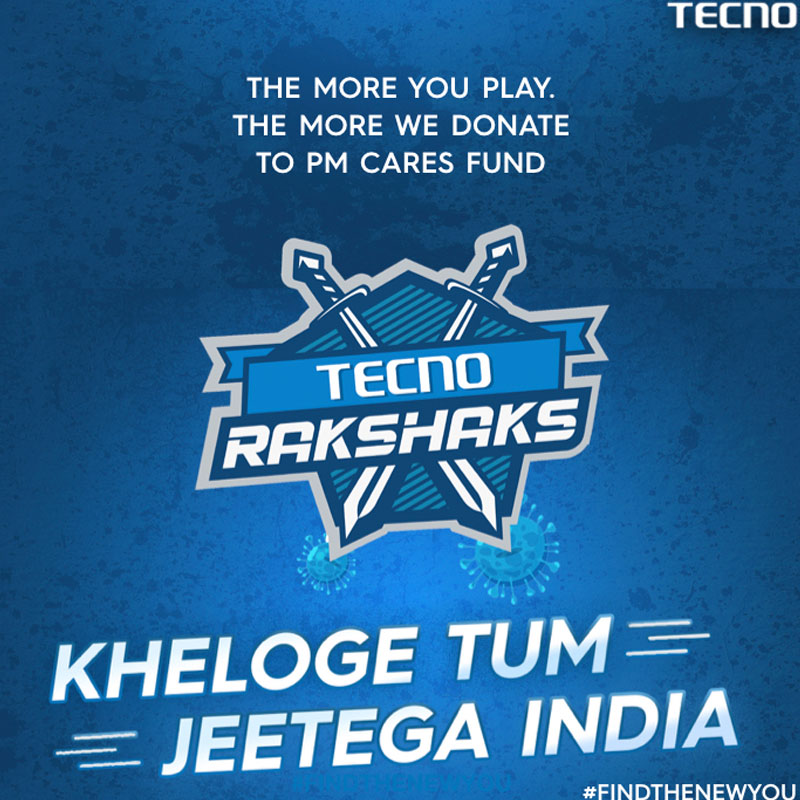
    ‘Tecno Rakshaks’ is a WAP-based game that lets people play and also raise funds for the Prime Minister’s war chest put together to fight COVID-19. But rather than the players paying for it, for every ten points that they will score, Tecno, on their behalf will contribute Rs 1 towards the PM Cares Fund.

    Consumers will not have to download third-party applications to access the game, it can be played on any browser. Participants need to log in using their Facebook profile or play as a guest. To score in the game, players need to swipe and kill the deadly coronavirus. There is no limit on the number of times the game can be played.

    Tecno has also initiated multiple partnerships to provide meals to people of the low-income communities affected by the outbreak of coronavirus. Through its alliance with Zomato Feeding India and 100+ channel partners, Tecno is distributing ration kits to support more than 60,000 people across India.

  • EEMA requests govt to cover cost of salaries, refund taxes for cos impacted by COVID-19

    EEMA requests govt to cover cost of salaries, refund taxes for cos impacted by COVID-19

    MUMBAI: Around 52.91 per cent of event and entertainment companies saw 90 per cent of their business being cancelled between March-July 2020, reveals a new member survey, conducted with 170 companies by the Events and Entertainment Management Association (EEMA). The report highlights the loss of business, the revenue impacted, employers affected and the funds required in the long run to attain stability during COVID-19. The findings of this report have been shared with “The Government of India” and “Ernst & Young” team

    Recently EEMA had filed a petition appealing to the government of India to intervene with measures to support the lives of the 60 million Indians the event industry employs – directly and indirectly.

    The report also highlighted that around 107 companies have suffered from a revenue loss of up to Rs 1 crore and around seven companies envisage a 50-80 per cent retrenchment of their current workforce and 35 between 25 per cent and 50 per cent. The ideal working capital/loan expected to keep afloat for the next six months is around Rs 2-5 crore for 39 companies and Rs 1-2 crore for 118 companies. Around 97 companies will need to raise capital or debt from institutions or shareholders, VC funding etc.

    EEMA has also requested the Government of India to consider releasing, with immediately effect, all tax refunds that are due including income tax and TDS for the industry, cover the cost of salaries/ daily wages, etc., for those infected by COVID 19 and unable to return to work, collateral-free line of credit to be used for employee’s salaries and statutory dues, and a moratorium of payback on loans, interest for a period of 9-12 months

    Further, it has suggested industry-wide reconstruction measures, including paying all dues to companies who have executed work orders for the government of India, public sector and for state governments, zero or minimal-interest loans to be made available by the department of MSME for the fiscal year 2020, government-initiated projects should replace the need of bank guarantees with corporate guarantees, loans to be provided for loss-making companies against future contractual work, instruct insurance companies to insure future events and activities against COVID-19 or similar medical/ biological disasters in addition to existing natural disasters, covering the cost of salaries/ daily wages of employees laid off for a period of 90 days minimum, and reduction of GST on entertainment and cultural events to 12 per cent  and the arts and entertainment segment may be covered

    The event and entertainment industry is going through challenging times since the outbreak of the coronavirus. The economic disruption has led businesses across various sectors to see a huge downfall in their growth. The worst affected are the event industry who are witnessing a major dip in their business due to the cancellation of events worldwide. Due to which, there has been a significant spike in the number of webinars, online discussions and live chats to keep the industry active. However, the daily wage workers and the small and medium scale agencies associated with the trade are facing the brunt and need immediate support, both from the events community and the government.

    The 170 member survey represents over a 1,00,000 of companies that were affected by this pandemic and EEMA urges the government to consider some steps  like the immediate payout of all income tax refunds, which have been due for a while, and the due payment from the central and state governments to event companies for work done or work-in-progress.

    EEMA president Sanjoy K Roy said, “The COVID-19 pandemic will impact the entire business community, and our team is focused on ensuring the health and safety of our employees. Industries have already faced an interlocking set of financial challenges for which we filed a petition to the government of India. The sectors are getting into a financial crisis which might soon result in increasing unemployment ratios. We hope that the Government takes the required decision which can help the country to survive with the results of the pandemic.”

  • Dentsu Aegis Network India CEO Anand Bhadkamkar salutes COVID warriors

    Dentsu Aegis Network India CEO Anand Bhadkamkar salutes COVID warriors

    MUMBAI: As COVID-19 disrupts everyone’s life, the essential service providers are the ones who have been working tirelessly and relentlessly so that we can be safe. The pandemic has paralyzed most countries, both economically and socially. While most of us are sitting within the comforts of our homes, there are brave hearts that are fighting from the frontline. Here, Dentsu Aegis Network India CEO Anand Bhadkamkar expresses his gratitude to those warriors: doctors, nurses, hospital staff members, food providers and cleaners who are supporting us during this crisis.  

  • NBF seeks e-meeting with I&B minister to discuss stimulus package

    NBF seeks e-meeting with I&B minister to discuss stimulus package

    MUMBAI: The News Broadcasters Federation (NBF) has requested a video conference meeting with union information and broadcasting minister Prakash Javadekar to discuss a 'comprehensive stimulus package’ for news broadcasters' to overcome the impact of the economic and financial challenges posed by the COVID-19 outbreak.

    Said an official statement of the federation, “The NBF in its letter has sought an appointment with I&B minister for an e-meeting through video-conference, during this week as per his convenience and availability to bring to attention about the most pressing issues the industry is facing due to lockdown for combating the spread of COVID-19.”

    NBF is an association representing the combined interests of 300 TV news channels. The agenda of the meeting is to discuss and resolve the extraordinary situation the members of NBF are facing due to the lockdown while discharging the service to the society, reads the statement.

    The issues that would be discussed with the minister during the e-meeting are: satellite and bandwidth charges, Prasar Bharti and DD Freedish, DAVP pending payments, unrestricted availability of FTS new channels, governmental support and liquidity issues.

    The NBF delegation comprises president Arnab Goswami, vice-president Jaggi Mangat Panda, vice-president Shankar Bala, vice-president Sanjivie Narain, vice-president Kartikeya Sharma, and vice-president Riniki B Sharma, among others.

  • Will COVID-19 help Netflix repeat 2019 subscriber gains?

    Will COVID-19 help Netflix repeat 2019 subscriber gains?

    MUMBAI: As Netflix is about to unveil its all-important quarterly results amid expectations that the ongoing pandemic will boost subscriptions, Futuresource Consulting reflects on 2019 as being its best ever year for net subscriber additions (net adds), highlighting countries which are showing significant momentum.

    Netflix gained nearly 28 million subscribers in 2019, driven by many countries which saw the highest yearly net adds since the service launched, indicating that they remain in an accelerating phase of growth. In Germany, Futuresource estimate there was an additional 2 million net sign ups, as Netflix continues to challenge incumbent Amazon Prime Video for the top spot.

    Japan grew by 1.7 million subscribers, significantly beating its previous highest additions. South Korea increased by 1.5 million, double the net adds of the year before, and we also saw Italy, Spain and India, among others, all posting their best year yet.

    With the ongoing COVID-19 pandemic shows no signs of abating, increasing the quantity of leisure time spent indoors, Futuresource expects to see Netflix’s next quarterly reporting to indicate how its library of fresh content, provided at good value for money, has driven strong uptake of both new and returning subscribers.

    What is impressive is that many of these countries, particularly Japan, South Korea and Germany have had a relatively long gestation period, during which the global streaming giant experimented with the content length, type and format which appealed most. Subscriber net adds growth reaching the highest level to date is typically indicative of key shows resonating with the audience and therefore becoming topics of discussion within society.

    It is this word-of-mouth and social media traction which inspires new consumers to sign up in order to “see what all the fuss is about”. This therefore creates a self-fulfilling prophecy, generating ever more attention and therefore translating to impressive growth figures, as we saw in 2019.

    Further subscriber growth has come from partnering with telcos and pay-TV operators. Combined billing and allowing consumers to remain within a Pay-TV user interface has added more access points to a growing list of connected devices and TVs it’s available on. Moreover, some operators such as Sky have taken this arrangement to a new level and provided slick integration of Netflix’s content into a carousel along with other premium third-party content, such as hit HBO shows.

    Furthermore, even within established markets such as Brazil, the UK, France, Australia and the Nordics, subscriber growth has continued, which highlights the broad appeal Netflix has. Once it has attracted subscribers, the voluminous content throughout and high quality of said content helps it maintain subscription growth. The UK for example saw subscriptions increase by 2 million in 2019, equal to its previous best ever year just one year prior, but arguably more impressive since it is now taken in 40 per cent of UK households.

    Country by country, Netflix continues to localise and work out what resonates with consumers. The continued momentum in Netflix subscriptions is now also against a backdrop of an increasingly dynamic and diverse competitive landscape. However, the high-profile new service launches are at least in the short term, complementary. In its key countries, Netflix remains the staple service, with the vast majority of SVoD households choosing to subscribe. As we head beyond the lockdown, the key objective won’t just be how many subscribers Netflix adds, but also how it will continue to retain existing subscribers.

  • Brands re-learning how to stay connected internally

    Brands re-learning how to stay connected internally

    MUMBAI: COVID-19 has drastically changed the way we live and work. Brands and agencies are finding virtual ways to stay connected with the internal teams and clients.

    In a virtual panel discussion organised by indiantelevision.com, industry experts spoke at length about adopting the work from home culture and how they have transformed themselves to adapt to this medium.

    The panel included Timex Group India head market Ajay Dhyani, Duroflex Mattresses India VP-marketing Smita Murarka and Mirum India joint CEO Sanjay Mehta.

    The panel was moderated by Indiantelevision.com founder, CEO and editor-in-chief Anil Wanvari.

    According to Murarka, it has enabled to bridge the gap between different generations using technologies like Zoom and activities like virtual town halls, etc.

    She also highlighted the importance of upskilling and learning new courses. “We also asked our team members to sign up for digital courses and upskill themselves. It is very important to keep your people and network around you positive because it is easy to get carried away with all sorts of discussions that are happening,” she added.

    The first and foremost thing that the Timex Group did was to shut down the factories operating around the globe in order to safeguard the health of the employees. According to Ajay Dhyani, the main challenge as an organisation was to stay connected with each other.

    “Initially safeguarding the safety of our employees was the priority. After that, the main concern was regarding our brand communication, external communication with clients, and internal communication with the team,” he said.

    Timex Group has a large workforce working across different parts of the world. So internal communication was a very important factor, because staying at home and not getting proper communication from different subsidiaries from different partners could lead to a difficult situation.

    Dhyani said, “We have internal Instagram pages, we are taking full advantage of the internet to stay connected with different folks in different countries."

    Mehta said that initially for the organisation it was just about coping with the lockdown, making sure people are doing work from home and keeping the organisation operational.

    He said, “We are also working towards HR-related issues, emotional balance management for the team because this is not something a lot of young people have seen. We are ensuring that collaboration goals are in place. Luckily with today’s technology we were able to get most of the operational issues in place in about five days. We have got a lot of HR initiatives to get people going and motivated."

    Even as the situation continues to be novel, companies are finding ways to get a grip on this evolving future.

  • A bleak future awaits print media?

    A bleak future awaits print media?

    NEW DELHI: The print industry, which already had been dealing with a tumultuous time given the influx of digital, has found itself in deeper troubling waters with the ongoing COVID-19 scare. And if the industry insiders are to be believed, the medium will take another two quarters to get back on its feet even after the situation commences to normal. 

    During a virtual roundtable hosted by Indiantelevision.com recently, Future Retail CMO-FBB Prachi Mohapatra stated: “I see a temporary disruption in print being a (media) investment. When I say temporary, I don’t mean a month or two. It is the case that the pie for print will shrink for eight to nine months.”

    But she remained hopeful that once the whole economy picks up momentum, the medium will emerge stronger. However, other panellists felt that it might be a lost territory for print even in the coming future if it does not reinvent itself now. 

    Dentsu One India president Harjot Singh Narang explained, “You will have to look at it from the perspective of the role that print plays and will that role stay relevant. Print used to be, and for a lot of clients continue to be, a favourite of the trade more than a favourite of the consumers. You will see OOH and digital nibbling away that role at this stage and it is just one of the many roles its plays. The nimbleness required for the print to survive is going to be a problem from the marketing point of view.”

    Timex Group India head marketing Ajay Dhyani noted that for the past few years, the print was playing a role to communicate with dealers or to make big announcements but digital is eating away that role. “Secondly, the newspaper space is so cluttered that there is no space for smaller brands,” he quipped. 

    Dhyani further noted, “Over the past few months, we are seeing a shift happening in the minds of our retailers and trade partners where social media and influencer marketing are playing an important role. If you take an influencer or celebrity on board and make them talk about your product, then reaching out to trade partners makes them feel more connected to the brand.” 

    Duroflex Mattresses India VP-marketing Smita Murarka added, “I think over the period of last two to three years, brands that are consumer-first are understanding where the consumption is happening and they have already reduced the role of print. For us, the print was anyway not a big part of our marketing strategy, irrespective of COVID-19 and now it has reduced much more. I guess that the case would be the same for many other categories.” 

    She added, “But there would be opportunities for print to reinvent and that’s for them to think whether they are really (just) a news medium or some source of knowledge or maybe a book. It’s really their survival instinct that should come into play now.”