Tag: Convergence

  • Riot Games announces India Closed Qualifiers for ‘Convergence’

    Riot Games announces India Closed Qualifiers for ‘Convergence’

    Mumbai: ‘Convergence’ by Riot Games in partnership with The Esports Club, is all set to showcase India’s esports prowess as the company today announced its plans to host an India Closed Qualifiers into the upcoming tournament. Joining forces with Lenovo as the Title Sponsor for its first ever international VALORANT esports tournament in India, Riot Games is committed to promoting local teams in the tournament scheduled between 14 to 17 December, 2023 at the Manpho Convention Center in Bangalore.

    The India Closed Qualifiers will witness Indian VALORANT teams earn a chance to compete with some of the best professional VALORANT teams from Riot’s International Leagues from across the Pacific, EMEA and Americas. Scheduled to begin on 30 November, the closed qualifiers will invite the top six professional VALORANT teams from India to battle it out and secure a spot in the main tournament. The six teams will follow a Double Elimination format to select the home team that will join the Convergence main event. The upper bracket and lower bracket finals, as well as a grand finale of the qualifiers will be streamed on The Esports Club’s YouTube Channel, starting from 29 November. All teams have secured their invitation to the qualifiers based on their performance in the Indian domestic season in 2023.

    Riot Games esports lead India & South Asia Sukamal Pegu said, “We are super excited to announce that the India Closed Qualifiers gives top local teams a great platform to showcase skills and play against some of the best professional VALORANT teams in the world. The goal behind Convergence is to grow esports talent in India and the qualifiers are a testament to the hyperlocal opportunities we are creating for our VALORANT community in the region.”

    “Lenovo India has been championing esports as a dedicated way to reach out to gaming audiences, and with VALORANT being a popular title that’s well enjoyed across India we have been engaging with the title during various online and offline events. With our portfolio of great gaming products on Legion and LOQ, we feel it’s a great way for Lenovo to be seen and experienced by relevant younger TG who we believe will be glad that we are able to bring a great esports event to India” said Lenovo India director – marketing Chandrika Jain.

    The main Convergence event starting from 14 December will be broadcast live in English on Riot’s Pacific Channels and in Hindi on Riot’s South Asia channels. The Esports Club will also carry the broadcasts on their channels.

    Bolstering the gaming culture in India, Riot Games has been actively involved in fostering community engagement and enhancing the player experience with multiple initiatives over the past year. Recently, Riot Games celebrated the one-year anniversary of VALORANT’s first ever Indian agent Harbor by conducting a beach clean-up with the Indian gaming community, and also commemorated the third anniversary of VALORANT in India with BHARAT VALORANT celebrations.

    The gaming community can witness the live action of the upcoming Convergence tournament through free and paid ticket options. Stay tuned for further details on ticketing set to be revealed in the coming weeks. 

  • Prasar Bharati developing next generation broadcast solution

    Prasar Bharati developing next generation broadcast solution

    Mumbai: Prasar Bharati has entered into an MoU with IIT Kanpur to develop next generation broadcast solution/roadmap for digital terrestrial broadcasting consistent with emerging standards such as 5G broadcast.

    “The sanction for the Proof of Concept (PoC) of next generation broadcasting has also been conveyed to IIT Kanpur,” the minister of information and broadcasting Anurag Thakur told the Lok Sabha on Tuesday. “The selection of an appropriate next generation broadcast technology and Digital Terrestrial Transmission (DTT) roadmap of Doordarshan depends upon evaluation of this PoC.”

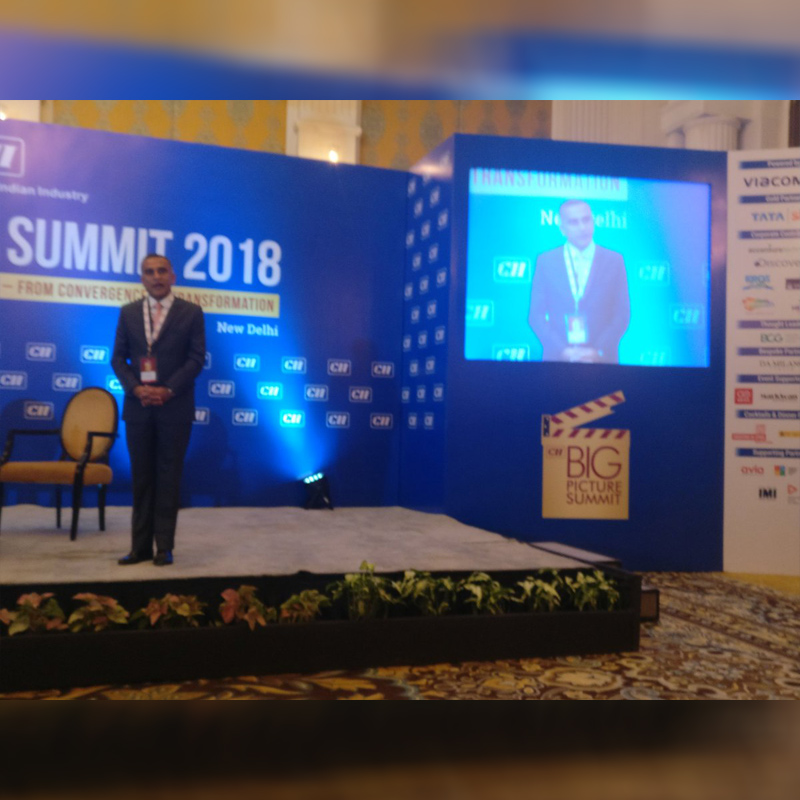
    Speaking at the CII Big Summit last month Prasar Bharti CEO Shashi Shekhar Vempati had also stressed upon the need for convergence across infrastructure and content creation.

    He said that if the collaboration with IIT Kanpur is successful it will be possible to directly receive broadcast signals on smartphones in future. “In the event of a high-viewership event like the Indian Premier League (IPL), there is no reason why millions of users need to receive that content on a unicast mode through the internet. If this works, all of the content can be delivered directly on broadcast frequencies to people on their smartphones or smart TVs,” he said.

    The public broadcaster is already working on bringing convergence across TV and radio so that a lot of exclusive radio content can be made visually rich and available for TV audiences. PM’s ‘Mann Ki Baat’ was the first such example. Prasar Bharati is following the same format where a camera is put up in the studio all-day long for another show ‘Rangoli’.

  • Transform by tackling moral dilemmas: Sudhanshu Vats

    Transform by tackling moral dilemmas: Sudhanshu Vats

    MUMBAI: Media companies can no longer ask ‘if’ changes are happening. They are, there’s no doubt about it. But now it’s a question of how to respond. Addressing the CII Big Picture 2018 in New Delhi, Viacom18 group CEO and MD Sudhanshu Vats spoke on the topic of ‘Changing M&E landscape – from convergence to transformation’.

    According to him, the industry is battling moral dilemmas. “If you step back and introspect about all that is happening with our industry across the world, you will agree that we are battling several changes – and most of them are a result of moral dilemmas and our response to them. If we can tackle these dilemmas successfully (and defining success is the hardest part), we can believe that we have transformed,” Vats commented.

    Another issue bothering the industry is about misusing its reach and credibility to influence electoral processes across the world. Equally troublesome is ensuring fairness in terms of availability of content to consumers and parity across distribution platforms, especially in the future when convergence is going to dial up vertical integration across value chains.

    As the content consumption on digital is increasing rapidly, the access of media companies to consumer data will also go up. He said, “As consumption moves online, our access to data will increase. In many ways, data will be a competitive advantage and drive advertising revenues and personalised user experiences – what processes do we put in place to ensure it is not misused – how and where do we draw the line differentiating personalization versus privacy?”

    Correctly treating their biggest asset, human resources, both on screen and off, is also necessary. “How do we react when their individual, personal behaviour questions the fabric of the society we want to create? Think of this especially in light of the recent issues around diversity and inclusion that we’ve experienced. It’s important for everyone, but especially so for our industry,” he said.

    He also added that the list of moral dilemmas is endless. Hence, everyone needs to be cognizant of these dilemmas as organisations, industry bodies, policymakers and governments as they look to scale up businesses.

    “I’ve always been an ardent supporter of data and its importance in driving decision making. In this address, I have not used a single data point – because I believe that the course we take over the next decade will be determined more by these fundamental issues of values and how we tackle moral dilemmas than just commercial considerations,” he said.

    “Driving consensus will be difficult yet more important than ever before. This is even more so given that India is today amongst the world’s largest ‘open’ media markets and home to a multitude of players from all over and of all sizes,” he added.

  • Zee, Star, NBA oppose converged regulator for broadcast and telecoms

    Zee, Star, NBA oppose converged regulator for broadcast and telecoms

    MUMBAI: Two of India’s biggest broadcasters Star India and Zee Network and industry association News Broadcasters Association (NBA) have opposed the TRAI’s proposal to have a converged regulator, a concept being debated as part of a consultation paper floated by the regulatory body. 

    In its lengthy submission to the TRAI’s paper on formulation of National Telecoms Policy 2018, Star, while suggesting a “separate regulator” for broadcasting sector was unfeasible, has said, “With a converged regulator for ICT and broadcasting there is always the risk of ‘false equivalence’ being drawn between the two sectors.”

    Pointing out that convergence was an aid to make content available to consumers and increasing the opportunities for content producers/rights holders to maximise monetisation opportunities involving intellectual property rights over content, Star highlighted, “Creative eco-system being an entirely separate unique value chain from ICT, should always be treated with a view to uphold and protect IPs.”

    Echoing similar sentiments, Zee said the Ministry of Information and Broadcasting (MIB) was the nodal ministry for all broadcasting related issues and it would be “inappropriate” for the Department of Telecommunications (DoT) to propose a converged regulator in its policy document without making the MIB a part of the process.

    “It may also be pointed out that setting up a convergent regulator would also require a convergence bill (to be okayed by Parliament) outlining the very scope of convergent regulations and various issues associated with it,” Zee explained its stance.

    Subhash Chandra-controlled Zee network has gone ahead and questioned the TRAI’s various consultation papers on broadcasting industry-related issues that include the one on NTP 2018 and another one on uplinking and downlinking.
    “It is astounding that there is no correlation between the two consultation papers,” Zee has submitted, “If the comments (from the industry) provided against one consultation paper are accepted, these would be counter to the comments/ recommendations against the other consultation paper.”

    Both Star and Zee in their submissions have cited in the defence of their stance views of Parliament’s Standing Committee on Information Technology on broadcast regulation articulated in its latest report tabled few weeks back.
    In its report, the parliamentary panel observed that the broadcast sector has developed so much that it would be advisable for the government to explore a separate regulator and till that happens, powers of TRAI could be explored to be expanded as an interim measure.

    By trying to bring in the “convergence issue”, wherein broadcasting and telecom were “treated under the same umbrella” in a converged manner, the TRAI “would be acting contrary” to the views articulated by the parliamentary panel that had pushed for separate regulators for telecoms and broadcast sectors, both Star and Zee pointed out.

    NBA, which is an apex industry body comprising most of the TV (and digital) news ventures as its members, also joined in the issue with Star and Zee to observe the regulatory authority dealing with content issues must be different from the body dealing with other issues in the broadcasting sector.

    The TRAI regulates the carriage side of the broadcast industry that includes issues such as tariff, inter-connect and quality of service. It also holds sway over matters like OTT, broadband and net neutrality that straddle both segments of broadcast and telecoms services.

    Also Read :

    MIB reverts to earlier norms of seeking nod from ISRO on uplink/downlink of TV channels

    Government toying easing downlink norms

    The Communication Convergence Bill, 2001

  • Guest Column: M&E industry in India: 5 not-to-be-missed trends

    The Indian M&E industry is growing at 15 per cent CAGR and is expected to double in size over the next five years. Almost all the sub-segments are growing in double digits. The existing ones are those in the middle of a consumption trend like on-demand content or beneficiaries of a regulatory push like digitisation.

    Here are the five biggest trends to watch out for:

    1.OTT

    Personalisation of content and delivery and real time access on multiple devices and platforms to make OTT mainstream. Big data through instant consumer analytics to become indispensable

    2.Digital Content as growth driver

    Growth to be driven by digital content in the internet industry in India as it doubles to $250bn in 5 years. Unprecedented proliferation of digital-first media brands like AIB, TVF, etc. Existing traditional media brands may reorient themselves to being digital-only brands. Repurposing widely popular content of the past on digital for consumption across multiple content formats may be a unique sound strategy.

    3.Immersive content as lead format

    Immersive content (VR/AR) to play an unexpected big role in the future. May become larger than any other format in the years to come.

    4.Technology to disrupt more than just content

    Technology to continue to disrupt the traditional ways of buying and selling advertising as programmatic, geo-targeting, etc becomes the new normal. TV and digital measurement to converge too as marketers look for platform-agnostic strategies.

    5.Convergence of M & E & Technology to undergird everything

    With cheap economics dictating the rationale, cloud-based services to drive content faster from creation to consumption thereby re-defining movement, distribution and management of content. Rapid convergence of media, entertainment and technology is interlinking content creation, distribution and consumption experiences.

    New media – signifying interplay between technology and media – is where the real excitement is. It offers a range of opportunities in content and platforms across gaming, video and music. Other than that, there are consolidation plays in traditional media like C&S distribution, film exhibition etc.

    public://Untitled-3_17.jpg

    (Piyush Sharma, a global tech, media and entrepreneurial leader, created the successful foray of Zee Entertainment in India and globally under the ‘Living’ brand. The views expressed here are of the writer’s and Indiantelevision.com may not subscribe to them.)


  • NDTV reports profit for fourth quarter

    MUMBAI: NDTV Group has recorded a net profit of Rs. 5 crore for the quarter compared to a loss of Rs. 1 crore in the same quarter previous year.

    NDTV Group’s costs as a part of strategic initiatives have gone down significantly by 17% from Rs. 164 crore in same quarter previous year to Rs. 137 crore in the current quarter.

    The EBITDA has increased by Rs. 15.4 crore from Rs. 8.3 crore in same quarter previous year to Rs. 23.7 crore in the current quarter.

    NDTV’s Hindi news channel “NDTV India”, the only non-tabloid Hindi news channel in India, has made a profit of Rs.7 crore in this quarter.
     

    public://ndtv.jpg

    NDTV Convergence, NDTV’s digital arm, has posted a 100% jump in net profit to Rs. 8 crore for the quarter compared to Rs. 4 crore in the same quarter previous year.

    NDTV.com now has 120 million unique visitors and page views exceeding 1 billion each month.

    Gadgets360.com (Red Pixels Ventures Ltd) had an operational break even (after tax in its first full year of operation before a one-off expense). Gadgets360’s content play continues to be the dominant player in gadget news and reviews, with more than twice the unique users compared with its nearest competitor.

  • Convergence: Sinclair Broadcast co ties up with India’s Saankhya

    MUMBAI: ONE Media 3.0, a wholly-owned subsidiary of Sinclair Broadcast Group, Inc. has announced an agreement with Saankhya Labs, a leader in the development of Cognitive Software Defined Radio (SDR) chips, to accelerate the development of ATSC 3.0 (the Next Generation standard) chipsets.

    Under the agreement, Saankhya Labs will begin the development of a global standards supporting ATSC 3.0 chipset that will enable various type of consumer devices to receive the Next Generation television standard. Those devices will include televisions, cell phones, tablets, dongles, gateways and automotive units.

    The intent is to accelerate and stimulate the activities associated with the incubation of the ATSC 3.0 chipset development as a pre-cursor to a full-fledged development program. During the project incubation stage, key team members of Saankhya Labs will engage in chip architecture definition and algorithm identification in collaboration with Sinclair and ONE Media 3.0 technical leads.

    The complete ATSC 3.0 standard is on track for final approval by the standard-setting body in the coming months and governmental approval for use in the U.S. is expected by year-end. This new standard promises to revolutionize the broadcast industry by permitting mobility, convergence with broadband Internet platforms, addressability, conditional access, increased capacity and dramatic quality improvements. Early development of the chipsets anticipating final approval should accelerate adoption of the dramatic new capabilities enabled by the standard as broadcasters begin deployment.

    “We are pleased to begin working with Saankhya Labs to fast-track development of a global ATSC 3.0 device ecosystem that is focused on mobility, and provides support for all global broadcast transmission standards,” said Sinclair’s Vice President for Advanced Technology Mark Aitken.

    “ONE Media 3.0 and Sinclair, as digital innovators and the largest U.S. broadcaster, are committed to “mobile first” services, advanced data delivery as well as emergency and educational connectivity. Saankhya Labs’ software defined technology will allow us to exploit the underlying flexibility of the Next Generation standard in evolving beyond ‘3.0’ in support of the unique needs of large markets like the United States and India.”

    “We are excited to partner with One Media 3.0 and Sinclair to develop an ATSC 3.0 chipset that is set to revolutionize the mobility broadcast and data delivery services industry. Based on ‘Pruthvi,’ Saankhya’s award winning Software Defined Radio (SDR) platform, the next generation ATSC 3.0 chipset will enable true convergence of networks and devices. The new-age chipset bears testimony to Sinclair and Saankhya’s commitment to innovate and Make in India,” said Saankhya Labs CEO Parag Naik.

    Sinclair is one of the largest and most diversified television broadcasting companies in the country. Including pending transactions, the Company owns, operates and/or provides services to 173 television stations in 81 markets, broadcasting 513 channels and having affiliations with all the major networks.

    ONE Media 3.0, LLC, a wholly-owned subsidiary of Sinclair, was formed for the purpose of developing business opportunities, products and services associated with the ATSC 3.0 “Next Generation” broadcast transmission standard and TV platform. Saankhya Labs, founded in 2007, is a fabless semiconductor company specializing in the development of Cognitive Software Defined Radio (SDR) communications processors and modules supporting a broad range of emerging data communication standards.

  • TRAI gives more time on responses to Paper on internet telephony which can affect mobile TV, IPTV

    TRAI gives more time on responses to Paper on internet telephony which can affect mobile TV, IPTV

    NEW DELHI: The Telecom Regulatory Authority of India today decided to give more time to stakeholders to respond to its consultation paper on internet telephony (VoIP).

    The paper had noted that unified IP based backbone and the benefits associated with the converged telecom access scenario has enabled service providers to launch more and more converged services such as Internet Telephony, IPTV, Mobile TV etc.

    TRAI has now asked stakeholders to respond by 22 August 2016 (which is exactly two months after the paper was issued on 22 June 2016) and give countercomments by 5 September 2016.

    The paper has sought to know the format of voice over internet telephony (VoIP) in India.

    The authority has pointed out that use of Internet Protocol (IP)-based networks, including the Internet, continues to grow around the world due to the multitude of applications it supports and particularly due to Voice Over IP (VoIP). IP-based networks are capable of providing real-time services such as voice and video telephony as well as non real-time services such as email and are driven by faster Internet connections, widespread take-up in broadband and the emergence of new technologies.

    The terms “IP Telephony”, “VoIP”, Internet Telephony and other variants often generates confusion as there are many different definitions used by various organizations. Some use them interchangeably while others give them distinct definitions. Further confusion is caused by using the terms to refer to both the IP-based technologies and the services that are enabled by these technologies.

    Convergence is primarily driven by increasing processing power, high capacity memory storage devices, reduced price, lesser power requirement and miniaturization of the devices. High-speed data transfer is now possible which is necessary for delivering innovative and advanced multimedia applications.

    Recent trends indicate that Telecom operators are adopting converged platforms to deliver multimedia rich applications containing voice, video and data.

    The separation of service provisioning and its management from the underlying network infrastructure in packet based networks is further increasing the acceptability of IP based Networks. It is now possible to separate provision of service contents, configuration and modification of service attributes regardless of the network catering such service. There has been enough evidence to suggest that in future IP networks will play much important role and may ultimately encourage migration of conventional networks towards Next Generation Networks or an All IP Network.

    The regulator wants to know what should the additional entry fee, Performance Bank Guarantee (PBG) and Financial Bank Guarantee (FBG) for Internet Service providers be if they are also allowed to provide unrestricted Internet Telephony.

    It says the point of Interconnection for Circuit switched Network for various types of calls is well defined, and should the same be continued for Internet Telephony calls or there is need to change Point of Interconnection for Internet Telephony calls.

    Trai has asked whether accessing of telecom services of the TSP by the subscriber through public Internet (internet access of any other TSP) can be construed as extension of fixed line or mobile services of the TSP.

    It wants to know whether the present ceiling of transit charge needs to be reviewed or it can be continued at the same level.

    The regulation has asked what the termination charge should be when call is terminating into Internet telephony network and whether an Internet telephony subscriber be able to initiate or receive calls from outside the SDCA, or service area, or the country through the public Internet thus providing limited or full mobility to such subscriber.

    Should the last mile for an Internet telephony subscriber be the public Internet irrespective of where the subscriber is currently located as long as the PSTN leg abides by all the interconnection rules and regulations concerning NLDO and ILDO, asks Trai.

    It wants to understand the framework if Number portability is allowed for Internet Telephony numbers.

    In case it is not possible to provide Emergency services through Internet Telephony, will it be enough to inform limitation of Internet Telephony calls in advance to the consumers, asks Trai.
    Since the 1960’s when digital voice communication first emerged, the Public Switched Telephone Network (PSTN) has been supported worldwide as the primary means of voice communication. The PSTN is a connection-oriented, circuit-switched network in which a dedicated channel (or circuit) is established for the duration of a communication. Originally transmitting only analog signals, the PSTN ultimately switched to digital communication, which offered solutions to the attenuation, noise and interference problems inherent in the analog system. The modern PSTN uses Pulse Code Modulation (PCM) to convert all analog signals into digital transmissions at the originating network and reverses the processes in the receiving network.

  • TRAI gives more time on responses to Paper on internet telephony which can affect mobile TV, IPTV

    TRAI gives more time on responses to Paper on internet telephony which can affect mobile TV, IPTV

    NEW DELHI: The Telecom Regulatory Authority of India today decided to give more time to stakeholders to respond to its consultation paper on internet telephony (VoIP).

    The paper had noted that unified IP based backbone and the benefits associated with the converged telecom access scenario has enabled service providers to launch more and more converged services such as Internet Telephony, IPTV, Mobile TV etc.

    TRAI has now asked stakeholders to respond by 22 August 2016 (which is exactly two months after the paper was issued on 22 June 2016) and give countercomments by 5 September 2016.

    The paper has sought to know the format of voice over internet telephony (VoIP) in India.

    The authority has pointed out that use of Internet Protocol (IP)-based networks, including the Internet, continues to grow around the world due to the multitude of applications it supports and particularly due to Voice Over IP (VoIP). IP-based networks are capable of providing real-time services such as voice and video telephony as well as non real-time services such as email and are driven by faster Internet connections, widespread take-up in broadband and the emergence of new technologies.

    The terms “IP Telephony”, “VoIP”, Internet Telephony and other variants often generates confusion as there are many different definitions used by various organizations. Some use them interchangeably while others give them distinct definitions. Further confusion is caused by using the terms to refer to both the IP-based technologies and the services that are enabled by these technologies.

    Convergence is primarily driven by increasing processing power, high capacity memory storage devices, reduced price, lesser power requirement and miniaturization of the devices. High-speed data transfer is now possible which is necessary for delivering innovative and advanced multimedia applications.

    Recent trends indicate that Telecom operators are adopting converged platforms to deliver multimedia rich applications containing voice, video and data.

    The separation of service provisioning and its management from the underlying network infrastructure in packet based networks is further increasing the acceptability of IP based Networks. It is now possible to separate provision of service contents, configuration and modification of service attributes regardless of the network catering such service. There has been enough evidence to suggest that in future IP networks will play much important role and may ultimately encourage migration of conventional networks towards Next Generation Networks or an All IP Network.

    The regulator wants to know what should the additional entry fee, Performance Bank Guarantee (PBG) and Financial Bank Guarantee (FBG) for Internet Service providers be if they are also allowed to provide unrestricted Internet Telephony.

    It says the point of Interconnection for Circuit switched Network for various types of calls is well defined, and should the same be continued for Internet Telephony calls or there is need to change Point of Interconnection for Internet Telephony calls.

    Trai has asked whether accessing of telecom services of the TSP by the subscriber through public Internet (internet access of any other TSP) can be construed as extension of fixed line or mobile services of the TSP.

    It wants to know whether the present ceiling of transit charge needs to be reviewed or it can be continued at the same level.

    The regulation has asked what the termination charge should be when call is terminating into Internet telephony network and whether an Internet telephony subscriber be able to initiate or receive calls from outside the SDCA, or service area, or the country through the public Internet thus providing limited or full mobility to such subscriber.

    Should the last mile for an Internet telephony subscriber be the public Internet irrespective of where the subscriber is currently located as long as the PSTN leg abides by all the interconnection rules and regulations concerning NLDO and ILDO, asks Trai.

    It wants to understand the framework if Number portability is allowed for Internet Telephony numbers.

    In case it is not possible to provide Emergency services through Internet Telephony, will it be enough to inform limitation of Internet Telephony calls in advance to the consumers, asks Trai.
    Since the 1960’s when digital voice communication first emerged, the Public Switched Telephone Network (PSTN) has been supported worldwide as the primary means of voice communication. The PSTN is a connection-oriented, circuit-switched network in which a dedicated channel (or circuit) is established for the duration of a communication. Originally transmitting only analog signals, the PSTN ultimately switched to digital communication, which offered solutions to the attenuation, noise and interference problems inherent in the analog system. The modern PSTN uses Pulse Code Modulation (PCM) to convert all analog signals into digital transmissions at the originating network and reverses the processes in the receiving network.

  • TRAI Chairmanship: An onerous responsibility fraught with delicate diplomacy & balancing acts

    TRAI Chairmanship: An onerous responsibility fraught with delicate diplomacy & balancing acts

    NEW DELHI: For any bureaucrat assigned to an autonomous organization under any Ministry, the biggest problem is to ensure smooth functioning between the Ministry and the organization.


    Even as Ram Sewak Sharma, a 1978-batch IAS officer of Jharkhand cadre who is currently serving as secretary in the Department of Electronics and Information Technology appears to be the favourite for the hotseat of chairman of the Telecom Regulatory Authority of India (TRAI), he is one of over seventy-five contenders who reportedly include Information and Broadcasting secretary Bimal Julka.


    Erstwhile chairman Rahul Khullar had taken charge of the regulatory body on 14 May 2012, and demitted office earlier this month on 13 May.


    TRAI had been established under an Act of Parliament to deal with telecom issues, but was given additional charge of broadcasting just over a decade earlier. Even though it appears to have handled broadcasting issues with fair competence, the bent of mind of the officials in the regulator is still towards telecom.


    Convergence: A delicate balancing act


    The task for the seventh chairman of TRAI becomes even more onerous: he has to ensure smooth coordination with two Ministries. Even though TRAI technically falls under the Communication and Information Technology Ministry, it has to also work at tandem with the Information and Broadcasting Ministry. 


    This balance between the two Ministries becomes crucial, considering that the National Democratic Alliance (NDA) Government is again talking about convergence at a time when two of the primary players who were involved on this issue a decade earlier when the matter had come up – to utter failure – are still in the cabinet. Arun Jaitley then headed Law and now heads the Finance and I&B Ministries, whereas Sushma Swaraj, who was then in charge of I&B Minister is now in External Affairs. In that round, the late Pramod Mahajan as Communications Minister was also part of the Group of Ministers headed by then Finance Minister Yashwant Sinha.


    The fact remains that convergence is bound to become a hotly debated subject during the tenure of the new chairman, and a lot of diplomacy will be required to balance the demands of the two ministries.


    Digital India and Broadband


    Even as a lot has been heard about programmes on Digital India and Make in India with little tangible showing so far in telecom and broadcasting, one of the greatest challenges the new incumbent will have to face is ensuring the growth of broadband.


    At present, India is at the 89th position in Network Readiness Index with countries like Singapore, Finland and Sweden having become leaders and by TRAI’s own admission the broadband connectivity is abysmally low with just 99.2 million subscribers by March this year. 


    In view of this, the government’s ambitious national broadband plan to connect as many as 2.5 lakh villages through optic fibre appears to be too far-fetched and even came in for sharp criticism from outgoing chairman Khullar, who termed the move as “impossible” to implement and something that is bound to “fail.” In fact, he said a plan to connect the entire country at one go is not the right way of providing broadband connectivity to all.


    Broadcasting Sector


    Expectedly, TRAI will need to not only strengthen its broadcasting team but also ensure greater coordination among officers in both broadcasting and telecom. This is also obvious from the number of policy decisions with regard to broadcasting, which have been taken to the Telecom Disputes Settlement and Addressable System and the Courts.


    The primary challenge that TRAI faces in broadcasting is to establish its credibility of being impartial and not playing into the hands of the broadcasting lobby. The cable operators and independent multi-system operators have been crying hoarse over this issue, often leading to litigation.


    In fact, the regulator has had to backtrack several times in the recent past, either on its own or because of Telecom Disputes Settlement and Appellate Tribunal (TDSAT) and court decisions and hopes the Supreme Court will come to its aid.


    A day after Khullar laid down office, TRAI on 13 May announced that amendments to its tariff orders issued on 1 October, 2004 and 21 July, 2010, which had been set aside by TDSAT earlier this month would be subject to the outcome of the appeal filed by the regulator before the Supreme Court.


    The two amendments made by the TRAI to its tariff orders that aimed at preventing broadcasters from giving their channels directly to the subscribers and putting commercial subscriber at par with ordinary subscribers were struck down by TDSAT on 9 March.


    TDSAT said TRAI must now undertake a fresh exercise ‘on a completely clean slate. It must put aside the earlier debates on the basis of which it has been making amendments in the three principal tariff orders none of which has so far passed judicial scrutiny. It must consider afresh the question whether commercial subscribers should be treated equally as home viewers for the purpose of broadcasting services tariff or there needs to be a different and separate tariff system for commercial subscribers or some parts of that larger body. It is hoped and expected that TRAI will issue fresh tariff orders within six months from to-day.’


    On 16 May, TRAI failed to get a stay from the Supreme Court of the order of TDSAT setting aside the amendments in two tariff orders, which had sought to put an inflation-linked hike of 27.5 per cent on addressable and non-addressable systems.


    The regulator also failed to get permission to take action against television channels violating its diktat of a total of 12 minutes of commercial and promotional advertisements every hour, though all broadcasters were asked to keep records of this by the Delhi High Court.


    Despite announcements, there has been little progress in the Make in India campaign as far as indigenous set top boxes for digital addressable systems go and most consumers have to put up with Chinese or other boxes.


    Similarly, analogue transmission continues in many parts of the cities and towns that have gone digital and the Government failed to get the stay of Digital Addressable Systems (DAS) in Chennai vacated.


    The subscription charges for the average consumer under DAS still continues to create confusion as far as free to air and pay channels go and that is the primary reason for the LCO’s inability to do proper billing – giving a reason for the broadcaster to complain.


    The Direct-to-Home (DTH) sector also complains about the fee charged by the Ministry, which they say makes it difficult for them to continue or earn profits.


    Both Internet Protocol TV (IPTV) and headend-in-the-sky (HITS) are still considered nascent technologies despite having been around for some years, and TRAI will have to find ways to encourage their growth, particularly in the face of smartphones which can receive live TV signals for which they often pay nothing.


    While the nation is talking about digital technology, Prasar Bharati feels that Frequency Modulation, which is an analogue technology, should be promoted until the nation is read for digital radio sets. This seems to militate against the crores of rupees spent by All India Radio (AIR) in Digital Radio Mondiale technology. Though TRAI has not interfered as it is a matter between the I&B Ministry and the public service broadcaster, it may have to do so if digitization has to succeed.


    Both the Government and TRAI have been announcing that e-auctions of the first batch of Phase III FM would begin in May but the month is almost at an end and no date has been fixed yet.


    Telecom Sector


    The new chairman would be taking charge at a time when the telecom sector is facing major turmoil with the emergence of over-the-top (OTT) operators. While the broadcasting community appears to be happy as the communication OTT will help popularize its programmes, the cellular operators feel OTT will affect their revenues adversely. The TRAI consultation paper also touched upon net neutrality, which is bound to gain controversy in the era of convergence.


    If the successor is Sharma, then his task will become even more challenging as it is bound to militate against the post he has been holding until now and where he had in fact set up a committee on the same subject even as a Parliamentary Committee is also considering this issue.


    Spectrum and the inability of the government to auction the entire spectrum available in the last e-auction – with 12 per cent remaining unsold – is bound to trouble the regulator. Added to that is the fact that despite the fact that the last e-auction was held in the tenure of the present government, Minister Prasad recently assuring the industry that the auction of spectrum in the future too would be conducted in a timely, fair and transparent way.


    Even as 3G is still to become a success, the regulator has been asked to look at 4G at a time when many telecom service providers are facing problems.


    Other challenges in telecom include extending the mobile network to rural India, and a debate whether India is ready for Virtual Network Operators.


    Clearly, the new chairman has to burn the midnight oil and at the same time avoid heartburn as he goes about his task of resolving the multifarious tasks before him.