Tag: Consumer Sentiment

  • Consumer sentiment improves for urban Indians in December 2023: Refinitiv-Ipsos PCSI monthly India report

    Consumer sentiment improves for urban Indians in December 2023: Refinitiv-Ipsos PCSI monthly India report

    Mumbai: Consumer sentiment shows recovery and uptick of 1.2 per cent points for urban Indians in December 2023, according to the Refinitiv-Ipsos Primary Consumer Sentiment Index (PCSI).

    The monthly PCSI result, which is driven by the aggregation of four weighted sub-Indices, displays a mixed response across the four sub-indices. The PCSI Current Personal Financial Conditions (“Current Conditions”) Sub-Index is up 3.2 per cent points; the PCSI Investment Climate (“Investment”) Sub-Index improves and is up 3.0 per cent points. On the contrary, PCSI Economic Expectations (“Expectations”) Sub-Index is down 0.1 percentage points and the PCSI Employment Confidence (“Jobs”) Sub- Index has dipped 1.9 percentage points.

    Ipsos India CEO Amit Adarkar said, “We see a slight recovery and upturn in consumer sentiment in December, after November’s downturn. The RBI has left the Repo Rate unchanged in its recent Monetary Policy, which means no hike in interest rates on home loans, vehicle loans, borrowings etc., which should have brought some cheer to consumers. Improvement in sentiment is seen more around the 2 sub-indices of current financial conditions and investments, which shows consumers do not need to observe frugality in their spending and savings. Sentiment around jobs and the economy continues to be pessimistic as the two wars in Israel and Ukraine and a significant slowdown in the global economy continue to impact most global markets, especially now that we are seeing job cuts by major global companies.”

    Consumer Sentiment in 29 Countries

    Among the 29 countries, India (64.3) holds the highest National Index score this month. Indonesia (63.9) and Mexico (60.0) are the only other countries with a National Index score of 60 or higher.

    Six other countries show a National Index above the 50-point mark: Thailand (58.1), Singapore (57.5), Brazil (56.5), the Netherlands (52.2), Poland (51.5), and the U.S. (51.1). For Poland, this month’s score is the country’s highest since November 2019.  

    In contrast, five countries now show a National Index below the 40-point mark: Chile (39.9), South Korea (39.1), Japan (37.5), Hungary (36.6), and Türkiye (35.5).

    https://lh7-us.googleusercontent.com/5xO87cdvNbhHl9HDHtm4WFTDVB7B6v_Xy2UT_51B8636SIBhhu2wUu4B2j0cgI7pC2bBJq-d1jDinzJjVsxZkRRNNPEQn8jii-aJj0ab2Tr2cmIJryEnhr6YWu3wmjx9l7iApwhGcLY561HR1u-gRg

    These findings are based on data from a monthly 29-country survey conducted by Ipsos on its Global Advisor online survey platform and, in India, on its IndiaBus platform. They are first reported each month by LSEG as the Primary Consumer Sentiment Index (PCSI).

    The results are based on interviews with over 21,200 adults aged 18+ in India, 18-74 in Canada, Israel, Malaysia, South Africa, Türkiye, and the United States, 20-74 in Thailand, 21-74 in Indonesia and Singapore, and 16-74 in all other countries.

    The monthly sample consists of 1,000+ individuals each in Australia, Brazil, Canada, France, Germany, Great Britain, Italy, Japan, Spain, and the U.S., and 500+ individuals in each of Argentina, Belgium, Chile, Colombia, Hungary, Indonesia, Israel, Malaysia, Mexico, the Netherlands, Peru, Poland, Singapore, South Africa, South Korea, Sweden, Thailand, and Türkiye. The sample in India consists of approximately 2,200 individuals of whom 1,800 were interviewed face-to-face and 400 were interviewed online.

    Samples in Argentina, Australia, Belgium, Canada, France, Germany, Great Britain, Hungary, Italy, Japan, the Netherlands, Poland, South Korea, Spain, Sweden, and the U.S. can be considered representative of their general adult populations under the age of 75. Samples in Brazil, Chile, Colombia, Indonesia, Israel, Malaysia, Mexico, Peru, Singapore, South Africa, Thailand, and Türkiye are more urban, more educated, and/or more affluent than the general population. The survey results for these countries should be viewed as reflecting the views of the more “connected” segment of their populations. India’s sample represents a large subset of its urban population — social economic classes A/B/C in metros and tier 1-3 town classes across all four zones.  

    The data is weighted so that the composition of the sample in each country best reflects the demographic profile of the adult population according to the most recent census data. The global indices and averages reported here reflect the average result for all the countries and markets in which the survey was conducted. They have not been adjusted to the population size of each country or market and are not intended to suggest “total” results.

    Sample surveys and polls may be subject to other sources of error, including, but not limited to coverage error and measurement error. The precision of Ipsos online surveys is calculated using a Bayesian credibility interval with a survey of N=1,000 being accurate to +/- 3.5 per cent points and a survey of N=500 being accurate to +/- 5.0 percentage points. For more information on credibility intervals, visit this page.

    The LSEG/ Ipsos Primary Consumer Sentiment Index (PCSI), ongoing since 2010, is a monthly survey of consumer attitudes on the current and future state of their local economy, personal financial situation, savings, and confidence to make major investments. The PCSI metrics reported each month for each of the countries surveyed consist of a “Primary Index” based on all 10 questions below and of several “sub-indices” each based on a subset of these 10 questions.

    The concerned publication of these findings abides by local rules and regulations. 

  • Second Covid wave weakens consumer sentiments, anxiety at an all-time high

    Mumbai: Consumer anxiety is at its highest level since the coronavirus outbreak hit India last year, shows the latest round of consumer sentiment survey conducted by Boston Consulting Group (BCG).

    The second wave of covid-19, which saw a huge spike in the country’s caseload and casualties numbers, has further weakened consumer sentiment as households cut their expenditure, says the report. At least 58 per cent of consumers think their income in the next six months will be lower than pre-COVID levels, as against 44 per cent in July last year. Similarly, the sentiment about spending has been impacted, with 51 per cent of consumers expecting their spending over the next six months to be lower, as compared to 40 per cent in July 2020.

    According to the survey, this fall in sentiment is steepest among the less affluent income groups or those with annual household income less than Rs five lakh. The study carried out between 23 May and 28 May covers 4000 consumers across all socio-economic groups in urban and rural India and is the sixth conducted by the group during the pandemic, since March last year.  

    Unlike last year, sentiments were impacted more uniformly across large towns, small towns, and rural areas in 2021 with 55-60 per cent of consumers across all feeling that the worst of the coronavirus is still ahead, BCG said in its report.

    Even amongst those in the Rs 10 lakh and above annual income bracket — termed as “affluent” households by the survey — expect their incomes to shrink in the next six months.

    The survey demonstrates uncertainty for more discretionary categories such as apparel, personal care, cosmetics, travel, and out-of-home entertainment in particular. “Travel, out of home entertainment continues to show negative sentiment with expected cutbacks reaching all-time highs,” as per the survey’s findings.

    The report sheds light on consumer anxiety, which is at its ‘highest levels’ since the pandemic hit India, with concerns around economic outlook, health, and lifestyle being accentuated.

    An overwhelming 86 per cent of those surveyed cited concerns over an economic recession due to the pandemic. Over 80 per cent reported feeling some sense of uncertainty toward their jobs and income—the highest ever recorded by the consulting firm.

    However, the forecast is not all bleak- there are certain positive themes too. Some categories like essentials, health, in-home entertainment, etc continued to show a stable, positive sentiment.

    “There is an impending sense of uncertainty however we have observed certain positive messages too. The spending sentiment has not been impacted similarly across categories. Essentials, health, in-home entertainment continue to be winners. Some of the discretionary categories, however, have been negatively impacted.” said BCG India MD & partner Nimisha Jain.

    There were also indicators that the shape of the new normal for consumer behaviour is beginning to emerge, now that we have been in the crisis for over a year.

    “Many of the newly adopted behaviours ranging from social commerce, online shopping, digital content/ payments – have continued to stick, even when the lockdowns were no longer in place. However, others like ‘do it yourself’ regimes, online doctor consultations have shown high sensitivity to the pandemic situation.” said BCG India Centre for Customer Insight lead Kanika Sanghi.

    A positive trend has also emerged, which shows a significant increase in the willingness to take vaccines after the lethal second Covid wave – especially in small towns and rural areas, which had shown high levels of hesitancy/ indifference earlier. At least 78 per cent of the eligible consumers in large towns said that they were very willing to take the vaccine now – compared to 62 per cent earlier. For rural, it stands at 63 per cent now as compared to 41 per cent earlier.

    BCG’s COVID-19 consumer sentiment research is based on a global survey that currently covered both developed and emerging markets. It is fielded in waves to provide a longitudinal view of consumer sentiments about the coronavirus pandemic, and changes in consumer consumption behaviour.

  • 82% people are worried about carrying germs in clothes: Whirlpool & Kantar survey

    82% people are worried about carrying germs in clothes: Whirlpool & Kantar survey

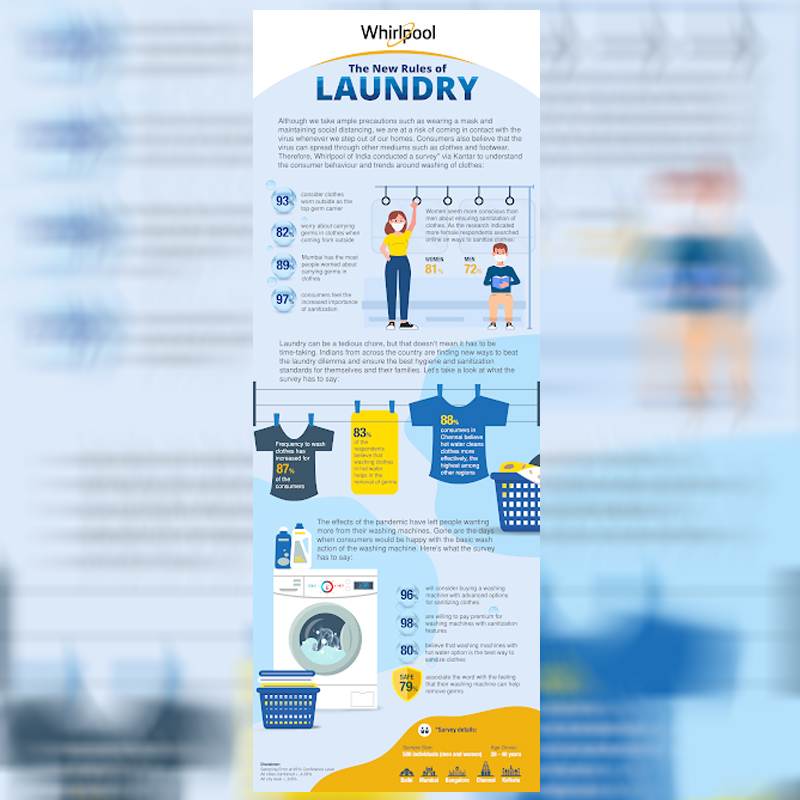
    KOLKATA: Whirlpool of India, the world’s leading kitchen and laundry home appliance company, facilitated a survey with Kantar to understand how consumers are responding to the hygiene and sanitation of their clothes. In the current environment, people world-over are concerned about keeping themselves and their surroundings germ-free and sanitized. Extra precautions are being taken every step of the way to minimize interaction with the outside world. 

    The detailed survey was conducted with a sample size of 500 individuals (men and women) aged 28-40 years in Delhi, Mumbai, Bangalore, Chennai and Kolkata. The primary objective of this survey was to arrive at hard-hitting facts on consumer’s awareness around the cleanliness of clothes and its implication in today’s time. 

    The survey reveals that 97 per cent of consumers feel the importance of sanitization has increased and the frequency with which they wash clothes has gone up for 87 per cent consumers.

    The other stark findings revealed by the survey include:

    Clothes worn outside the home tops the list of objects feared to carry germs with 93 per cent endorsements. The other carriers of germs include- 

    • Any surface area like lift, railings etc. and home delivered food (92 per cent)
    • Footwear (88 per cent)
    • Bags (83 per cent)
    • Mobile phones and money (82 per cent) 

    In the current situation, 82 per cent respondents claimed that they are worried about carrying germs in clothes when coming from outside. The other worries include- 

    • Sanitisation of hands and surfaces (80 per cent)
    • Sanitization of clothes (78 per cent)
    • Falling sick (76 per cent)
    • Lack of adequate medical help (73 per cent)
    • Increase in household chores (72 per cent)

    People from Mumbai are most worried about carrying germs in clothes when coming from outside at 89 per cent, followed by Chennai and Kolkata 

    87 per cent of the respondents claim that worrying has led to increase in washing of clothes for the following reasons: 

    • To maintain hygiene and cleanliness (91 per cent)
    • To keep our kids and elderly members safe from germs/allergens (83 per cent)
    • Prevention from falling sick (82 per cent)
    • Washing clothes worn outside after single wear (81 per cent)

    79 per cent of the respondents claim that hot water helps in Sanitizing clothes along with ‘effective cleaning’ and ‘removal of tough stains’

    • 88 per cent consumers in Chennai believe hot water cleans clothes more effectively, the highest among other regions

    Significantly higher number of female respondents (82 per cent) feel that hot water will help sanitize ‘kid’s toys, bedding and clothes’ more than males (73 per cent) 

    Respondents claimed that Germs/allergen in clothes can be removed by washing it with:

    • Detergent (82 per cent) 
    • Hot Water (76 per cent)
    • Disinfectant (71 per cent)
    • Using home remedies (43 per cent) 

    73 per cent of the consumers claimed that they use hot water to wash only a certain type of clothes such as:

    • Clothes with tough stains (91 per cent)
    • Baby clothes (86 per cent)
    • Clothes used in kitchen (85 per cent) 

    96 per cent of the consumers claimed that they will consider buying a washing machine that has an advanced option for sanitising clothes as well

    • In fact, 98 per cent of the consumers are even willing to pay premium while buying a washing machine with sanitisation feature rather than on other consumer appliances like AC, refrigerator, etc., shown to respondents

    93 per cent of the consumers believed that different water temperature is required for cleaning different type of clothes

    80 per cent of the consumers believe that washing clothes in a washing machine with hot water is the best way to remove stains and sanitise clothes

    • However, only 20 per cent of these respondents claim to use hot water wash for all types of clothes

    ‘Safe’ is the word that consumers associate with the feeling that their washing machine can help remove germs/allergens (79 per cent)

    Women are much more conscious about ensuring sanitization of clothes 

    • Significantly higher number of female respondents (81 per cent) have done online search to understand how to sanitize their clothes than male (72 per cent) respondents
    • There is a relatively higher concern among Moms (85%) on the worry of germs getting carried in from outside
    • 75 per cent of working women are more aware and highly concerned through online search on improving sanitisation
    • More working women (82 per cent) believe that hot water helps in sanitizing clothes

    Whirlpool of India vice president marketing KG Singh said, “People today are more vigilant of their health and hygiene than ever before. With sanitisation becoming the need of the hour, we commissioned a survey to gauge the behaviour patterns around their rising concerns of keeping clothes clean. With ‘Everyday, Care’ at the core of our brand, we wanted to be there for our consumers during this time by better understanding their needs and offering a portfolio of products that meet their expectations.” 

    “The survey clearly indicates the stress and worry around sanitization of clothes. Consumers are researching online to know of effective ways to clean their clothes and kill germs brought in from outside the home. Hot water which is known to be effective in cleaning stains has stood out as a top preference for consumers when opting for a washing machine along with the added benefits of sanitization features. It is extremely critical to take care of the hygiene and sanitization of one’s surroundings and clothes,” said the official spokesperson from Kantar.