Tag: Consumer Action Network (CAN)

  • CAN welcomes basic tier pricing post-CAS, cautions government to stay on alert on implementation

    MUMBAI:It’s once again the turn of the Consumer Action Network (CAN) to air its views on conditional access. President Ahmed M. Abdi has welcomed the government’s decision to fix the price of free-to-air television channels at Rs 40 per household per month.


    Says Abdi in a press release: “This is a price affordable by poorest of the poor section of our society and the government should not come under pressure of cable operators who want to increase this price to Rs 250 for the free to air bouquet. Cable operators are free to make profits from the generation of revenue from Pay Channels, which would be subscribed to by the affordable section of the society, and it is duty of the Govt. to come to rescue of the general public comprising of poor section of the society having limited avenues for entertainment.”

    Abdi has also cautioned the government to keep a close watch on cable ops, as they would try and arm twist cable TV viewers into subscribing to pay TV services by depriving them of basic free to air services if they don’t take up pay TV services. “If any such cases come to light, the government should act tough by labelling it a cognizable and non-bailable offence authorising the local police to initiate action as per law,” he says. “It is essential that a regulatory body be constituted and be empowered to look into the problems that consumers face and also take timely decisions.”
  • Consumer group demands government action on CAS

    Consumer group demands government action on CAS

    Delhi-based citizen’s forum Consumer Action Network (CAN), has censured the Central government for failing to implement the recommendations of the task force on the introduction of conditional access systems.


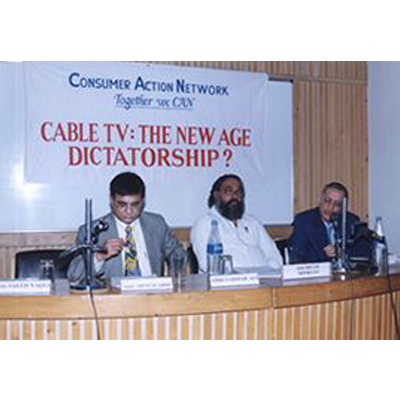
    CAN held a seminar on ‘Cable TV: New Age Dictatorship’ in New Delhi on 16 April, where speakers denounced ever increasing cable rates and subsequent government inaction. CAN claims the seminar helped raise several related issues faced by cable consumers.


    CAN president Ahmed Abdi, advocate Shyam Moorjani and Hinduja TMT executive VP Ashok Mansukhani at the seminar

    The purpose of the seminar was to highlight and voice issues currently faced by cable TV viewers in the country. It aimed at being a platform for face-to-face dialogue with cable ops and broadcasters. Speakers included former MRTP acting chairman Sardar Ali, journalist Saeed Naqvi, Hinduja TMT executive vice-president Ashok Mansukhani, Delhi high court advocate Shyam Moorjani, and CAN president Ahmed Abdi. 

    Some of the issues discussed at the seminar included freedom of choice, arbitrary rate hikes, absence of any regulatory authority in India unlike other countries and lack of initiative on the government’s part. 

    Abdi lamented the present state of the consumer who has neither choice in selection of channels nor in deciding the rates. Cable rates have increased by more than 400 per cent in five years, he pointed out. He alleged that it suited broadcasters to delay the introduction of conditional access as they would no longer be able to bundle their weak channels and sell them forcibly along with the popular channels. 

    Naqvi commented that there was a need to create awareness on such issues through forums, debates and seminars. Moorjani stressed on the need for a regulatory authority to be formed that can regulate the broadcasting and cable industry and protect consumers. Cable TV, which has more than 200 million users in India and which is projected to grow into a Rs 5000 billion advertising industry, does not have any regulatory authority, he said. 

    Speaking on behalf of the cable industry, Mansukhani said that transparency should come in and that the cable industry was sick of allegations of “underdeclaration”. He stressed the need for a regulatory authority and conditional access. He also stressed on the need to freeze the rates.

    The recordings of the findings and suggestions of the seminar will be forwarded to the information and broadcasting ministry.