Tag: Connected TVs

  • Fashion sizzles on CTV with 97 per cent ad completion rate: VDO.AI report

    Fashion sizzles on CTV with 97 per cent ad completion rate: VDO.AI report

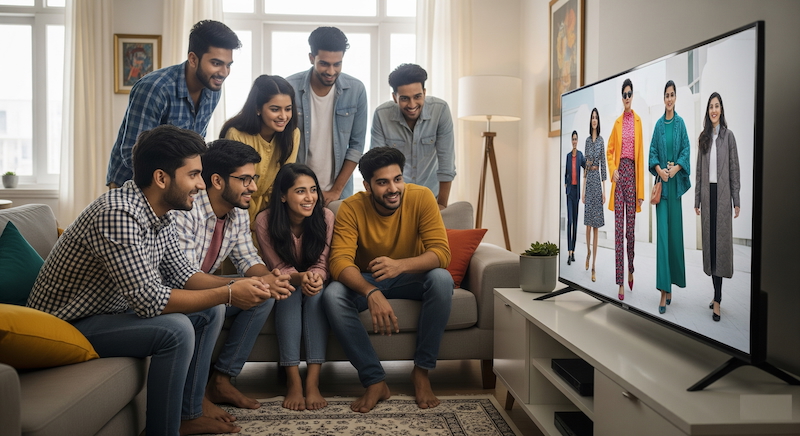
    MUMBAI;  Viewers in India are tuning in and staying glued to fashion ads on connected TV, with a staggering ~97 per cent video completion rate, according to a new report from adtech player VDO.AI. The study, released on 4 July, reveals that fashion brands are reaping the benefits of immersive, distraction-free CTV formats, with advanced formats like DCO and API-triggered ads powering 67 per cent of top-performing campaigns.

    Fashion storytelling is thriving in CTV’s premium environments, particularly in southern cities. Bengaluru, Chennai, Hyderabad and Goa are leading the charge, posting an 87 per cent higher engagement rate compared to their northern counterparts, including Delhi and Jaipur.

    Fashion Ads on CTVVDO.AI co-founder & chief executive Amitt Sharma said: “CTV represents the convergence of cinematic storytelling capability with precision target ing that fashion brands require. Such a heightened completion rate validates our thesis that when content quality meets the right viewing environment, consumer engagement follows naturally. We are sure these insights will help fashion marketers make the right decision to move beyond traditional impression-based campaigns toward more sophisticated storytelling approaches that build emotional connections with consumers.”

    What's powering Top fashion campaigns on CTVCo-founder & chief technology officer Arjit Sachdeva pointed to the visual appeal of CTV for fashion campaigns. “CTV provides a high-quality, distraction-free, full-screen experience, especially powerful for a visually driven category like fashion.,” he explained. “As a result, fashion brands are increasingly leveraging advanced CTV advertising formats to create shopping-like experiences. Interactive elements such as CTV carousel ads and store discovery units are enabling viewers to explore collections and brand offerings without leaving their screens, mimicking the intuitive browsing behaviour familiar from social media and e-commerce 
    platforms.”

    As fashion advertisers chase performance over reach, VDO.AI’s latest data signals a fundamental shift—CTV is no longer just for awareness; it’s driving real engagement, brand recall and intent.

  • Amagi acquires OTT recommendation & automation specialist Argoid AI

    Amagi acquires OTT recommendation & automation specialist Argoid AI

    MUMBAI: This is an Indian tech company which has been winning rave views in every market in which it operates. In fact, in most places it is  mistaken for an American firm. Now, Amagi – one of the top companies globally in  cloud-based SaaS technology for broadcast and connected TVs (CTVs) – is  gearing up to add some more  trophies to its already well-stacked award gallery. The company has acquired Argoid AI – a company specialising in recommendation engines and programming automation for OTT platforms.

    Amagi believes the acquisition strengthens its mission to empower media companies with intelligent content planning, distribution, and monetisation solutions.

    Argoid AI has as developed innovative AI products that enhance content recommendations and enable real-time programming decisions. Its solutions have been pivotal in increasing viewer engagement and optimising channel operations for customers in the streaming media space. By integrating Argoid AI’s advanced algorithms into Amagi’s existing platform, the  acquisition will significantly boost the functionality of Amagi’s product suite, Amagi Now and Cloudport’s offerings, enabling media companies to make faster, smarter, and personalised content scheduling decisions at scale.

    It will also allow Amagi to deepen its AI-powered content programming, metadata enrichment, and recommendation engine services, which are crucial for transforming to personalised streaming as part of the  FAST 2.0 innovation.

    Argoid's founders

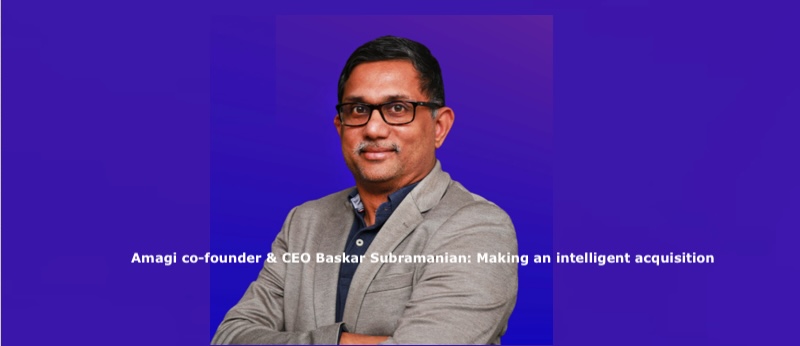
    “Amagi has been investing in AI/ML over the last couple of years. We strongly believe in AI/ML’s pivotal role in transforming the media and entertainment industry, creating efficiencies, enhanced monetisation, and a superlative viewer experience,” said Amagi co-founder & CEO  Baskar Subramanian. “With this acquisition, Amagi will integrate Argoid’s AI components into its award-winning cloud solutions, significantly enhancing value for our customers. The combined tech expertise of both companies will address key challenges in the streaming industry, such as content discoverability, viewer retention, and intelligent programming.”  

    Argoid’s founders, Gokul Muralidharan, Soundararajan Velu, and Chackaravarthy E will join the Amagi team, contributing to the future roadmap and further integrating AI into Amagi’s offerings. The three founders have one commonality: they all worked at the Walmart-owned Flipkart in Bengaluru around the same time.

    “We are thrilled to join forces with Amagi, a true leader in media technology,” said Gokul Muralidharan. “This partnership allows us to scale our AI-driven solutions, delivering even greater customer value. Together, we will revolutionise how content is programmed and distributed in the digital era.”

    Amagi provides a complete suite of channel creation, distribution, and monetisation solutions. The company’s clients include some of the world’s biggest names, including Hearst Networks UK, ABS-CBN, Astro, Cox Media Group, DAZN, Globo, Lionsgate Studio, NBCUniversal, Tastemade, and VIZIO.
     

  • Will mobile devices/alternate screens takeover television?

    Will mobile devices/alternate screens takeover television?

    In an age where the usage of connected devices is booming, it is a huge benefit for consumers to be able to watch content on alternate screens, alongside the conventional way, increasing the amount of overall content consumption in the Nation.

    The alternate screens for a television viewing experience include Connected TVs, Internet Set-Top Boxes, Personal Computers, Smart-phones, Tablets and Smart Blu-ray players. Connected TVs (Smart TVs) are integrated with the internet, providing a technological convergence between computers and television sets/set-top boxes – these provide online interactive media, Internet TV, over-the-top content and on-demand streaming of media. Similarly, computers can also be used for streaming live television over the internet via websites. In the context of India, the use of mobile devices in the Nation has sky-rocketed, owing to the combination of inexpensive devices, low tariffs and the introduction of various applications, including those made particularly to stream television content such as Hotstar (Star TV) and most recently, VOOT (Viacom). Hotstar outdid apps such as Facebook, Instagram and Twitter to become the fastest to cross the million downloads mark within a week. VOOT is the only OTT player to start with original content from Day 1, which has specifically been made only for the digital platform itself.

    With the advent of Netflix in India, we have the liberty to reap the benefits of the world’s top video streaming service, which allows users to watch content on various screens, now entering the Indian space with subscription for as low as Rs. 500. Globally, Netflix has been used extensively – with an average of 45GB of data consumed by their 20 million subscribers, across 130 countries per month. In the US, 36% of US homes are subscribed to the platform. In order to match increasing demands, Netflix pushed 329,400,000,000 GBs of data in 2015. Another factor that can be done away with whilst using alternate screens is to avoid watching advertisements; it was estimated that Netflix subscribers avoided watching 130 hours of commercials per year, by not watching broadcast TV.

    Another powerful entrant providing 4G-based digital services with offers such as on-demand content and launching with 450 channels is Reliance JioPlay, with cutting edge features such as voice control and program catch-ups. Yet another introduction by one of the kingpins, Zee Entertainment, is OZEE, leaving consumers spoilt for choice with their video-on-demand platform, whereby the content of Zee channels is made available almost instantly, complementing the wave of viewers breaking away from appointment television. Collaboratively, there is much to look forward to in the realm that is Live TV on alternate screens of content consumption.

    The success of these initiatives has come on the back of the increased usage of mobile devices and the internet; India currently has 980 million active mobile users, 171 million smart-phone users and 272 million wireless internet subscribers. To gauge an understanding of the current scenario of mobile usage around the world, the global internet average speed is supposedly 5.1 Mbps, with highest in South Korea at 23.6 Mpbs and 2.3 Mpbs in India.

    A report by Ernst and Young expresses that Smart-phone penetration in the country is expected to grow to 520 million by 2020. To add to this this, the next phase of internet usage is expected to come from Tier II and Tier III cities, through wireless mobile internet. Basis the fact that Indian consumers have a significant inclination towards watching regional content, by 2020, of the 650 million internet users, 50-55 per cent are expected to be rural users, from the earlier 33% in 2013.

    Pankaj Krishna, CEO & Founder of Chrome Data Analytics & Media, expressed his views, “Linear television continues to be the largest form of television viewing, in spite of technological advancements in the industry and alternate platforms to watch content, including tabs and mobile devices. They say old habits die hard; despite the paper and ink of newspapers being the costliest, they are still read as much as always – the same notion holds when it comes the conventional TV set. There are two qualities of viewing that one can choose – be it a 40″ TV screen or a 5″ tablet, the former is still as popular and, thus, may not be completely replaceable.”

    Thus, it is safe to say that omni-platform content is taking over the nation (and world) by storm, without greatly cannibalizing viewing through conventional television sets, but instead – increasing the usage of other forms of content distribution. This use of smaller screens will fuel watching content individually, with 45% of all content consumed expected to be on the small screen by the next four years. The question is whether the rise of these alternate platforms will eventually make a dent in conventional television content viewing, or not, in the years to come.

  • Will mobile devices/alternate screens takeover television?

    Will mobile devices/alternate screens takeover television?

    In an age where the usage of connected devices is booming, it is a huge benefit for consumers to be able to watch content on alternate screens, alongside the conventional way, increasing the amount of overall content consumption in the Nation.

    The alternate screens for a television viewing experience include Connected TVs, Internet Set-Top Boxes, Personal Computers, Smart-phones, Tablets and Smart Blu-ray players. Connected TVs (Smart TVs) are integrated with the internet, providing a technological convergence between computers and television sets/set-top boxes – these provide online interactive media, Internet TV, over-the-top content and on-demand streaming of media. Similarly, computers can also be used for streaming live television over the internet via websites. In the context of India, the use of mobile devices in the Nation has sky-rocketed, owing to the combination of inexpensive devices, low tariffs and the introduction of various applications, including those made particularly to stream television content such as Hotstar (Star TV) and most recently, VOOT (Viacom). Hotstar outdid apps such as Facebook, Instagram and Twitter to become the fastest to cross the million downloads mark within a week. VOOT is the only OTT player to start with original content from Day 1, which has specifically been made only for the digital platform itself.

    With the advent of Netflix in India, we have the liberty to reap the benefits of the world’s top video streaming service, which allows users to watch content on various screens, now entering the Indian space with subscription for as low as Rs. 500. Globally, Netflix has been used extensively – with an average of 45GB of data consumed by their 20 million subscribers, across 130 countries per month. In the US, 36% of US homes are subscribed to the platform. In order to match increasing demands, Netflix pushed 329,400,000,000 GBs of data in 2015. Another factor that can be done away with whilst using alternate screens is to avoid watching advertisements; it was estimated that Netflix subscribers avoided watching 130 hours of commercials per year, by not watching broadcast TV.

    Another powerful entrant providing 4G-based digital services with offers such as on-demand content and launching with 450 channels is Reliance JioPlay, with cutting edge features such as voice control and program catch-ups. Yet another introduction by one of the kingpins, Zee Entertainment, is OZEE, leaving consumers spoilt for choice with their video-on-demand platform, whereby the content of Zee channels is made available almost instantly, complementing the wave of viewers breaking away from appointment television. Collaboratively, there is much to look forward to in the realm that is Live TV on alternate screens of content consumption.

    The success of these initiatives has come on the back of the increased usage of mobile devices and the internet; India currently has 980 million active mobile users, 171 million smart-phone users and 272 million wireless internet subscribers. To gauge an understanding of the current scenario of mobile usage around the world, the global internet average speed is supposedly 5.1 Mbps, with highest in South Korea at 23.6 Mpbs and 2.3 Mpbs in India.

    A report by Ernst and Young expresses that Smart-phone penetration in the country is expected to grow to 520 million by 2020. To add to this this, the next phase of internet usage is expected to come from Tier II and Tier III cities, through wireless mobile internet. Basis the fact that Indian consumers have a significant inclination towards watching regional content, by 2020, of the 650 million internet users, 50-55 per cent are expected to be rural users, from the earlier 33% in 2013.

    Pankaj Krishna, CEO & Founder of Chrome Data Analytics & Media, expressed his views, “Linear television continues to be the largest form of television viewing, in spite of technological advancements in the industry and alternate platforms to watch content, including tabs and mobile devices. They say old habits die hard; despite the paper and ink of newspapers being the costliest, they are still read as much as always – the same notion holds when it comes the conventional TV set. There are two qualities of viewing that one can choose – be it a 40″ TV screen or a 5″ tablet, the former is still as popular and, thus, may not be completely replaceable.”

    Thus, it is safe to say that omni-platform content is taking over the nation (and world) by storm, without greatly cannibalizing viewing through conventional television sets, but instead – increasing the usage of other forms of content distribution. This use of smaller screens will fuel watching content individually, with 45% of all content consumed expected to be on the small screen by the next four years. The question is whether the rise of these alternate platforms will eventually make a dent in conventional television content viewing, or not, in the years to come.