Tag: Congress

  • Who will be the next PM?

    Who will be the next PM?

    MUMBAI: In a series of interrelated opinion and exit polls over the next two months NDTV will be conducting among the biggest and most rigorous polling exercises ever – covering over 350 (out of the 543) Lok Sabha constituencies with a total sample size of over 2 lakh. The sample selection methodology is based on electoral rolls to ensure a random sample with other technology innovations and new methods of interviewing voters (for example, wherever feasible, women field-workers interviewed female voters).

     
    Witness the biggest election coverage in the history of Indian television as NDTV presents the most credible, non-partisan, non-sensational election analysis.

    The channel will also undertake a separate re-contact exercise through phone calls just before the elections to gauge shift of voters’ opinion over time. More than 350 constituencies will be covered across the opinion polls and the Exit Poll will also cover more than 350 constituencies. These opinion polls will be conducted in three phases which will seek to understand the mood of the nation and electoral preferences for parties; get a pulse of the nation and analyse shifts in voter perception and preference followed by an Exit Poll for seat prediction state-by-state.


    NDTV will be using innovative methods to ensure  better data quality which will include regular updates and tracking through mobile telephonic-surveys, votes to seats conversion based on proprietary IPR using homogenous swing zones, multi-party swings and margins of victory and changes in the extent of vote-splitting in each homogeneous swing zone.

    Fieldwork and interviews conducted by Hansa Research Group. Watch Prannoy Roy and Dorab Sopariwala present India’s BIGGEST EVER Opinion Poll on Thursday 13 and Friday 14 March from 8-10pm


  • CNN-IBN & IBN7 are back with Kings & Queens

    CNN-IBN & IBN7 are back with Kings & Queens

    MUMBAI: Living up to its legacy of offering the most extensive and diverse election programming line-up in the industry, CNN-IBN & IBN7 are back with ‘Kings & Queens’. The show will profile key political leaders such as Narendra Modi, Arvind Kejriwal, Sonia Gandhi, Rahul Gandhi to name a few, who are likely to play a central and defining role in the 2014 General Elections.

    Fronted by IBN Network’s senior-most and best known anchors-Deputy Editor Sagarika Ghose, National Bureau Chief Bhupendra Chaubey, Deputy Foreign Editor Suhasini Haidar and Senior Editor Anubha Bhosle, ‘Kings & Queens’ will examine the life and political careers of these key individuals, and will examine how they could emerge as a King or a Queen or be a King-maker. The documentaries will include people who are significant in their lives-their classmates, close relatives, mentors, friends, strongest allies as well as critics.

    Rajdeep Sardesai, Editor-in-Chief, CNN-IBN, IBN7 & IBN-Lokmat, said, “As we approach the most crucial elections in the history of India, we have a diverse and extensive election based programming in the pipeline. To help our viewers know their leaders better, we bring to you our much acclaimed documentary series Kings and Queens, which will trace the journey of political leaders who are set to influence the upcoming General Election significantly.”

    Don’t miss this special documentary series starting from 28th February, every Friday 10.00 PM only on CNN-IBN & 1st March onwards every Saturday 10.30 PM only on IBN7.

  • NBA asks politicians to keep political discourse civil and sane

    NBA asks politicians to keep political discourse civil and sane

    MUMBAI: New channels normally throw the spotlight on politicians. As the ensuing elections to the Lok Sabha are turning out to be the most bitterly fought, it is the new channels that are coming under attack from politicians.


    Former Delhi chief minister Arvind Kejriwal recently lashed out at TV news channels. He accused the news channels of being biased towards BJP’s prime ministerial candidate Narendra Modi and Congress’ poll campaign chief Rahul Gandhi.


    On Monday, home minister Sushil Kumar Shinde shocked the media fraternity when he claimed that the intelligence wing had been keeping a tab on news channels and that the government would ‘crush’ the elements in electronic media engaged in spreading false propaganda.


    In the wake of these attacks, the News Broadcasters Association (NBA) has decided to hit back. It has objected to the kind of unwarranted criticism news channels are faced with.


    A statement issued by the NBA said:


    “News Broadcasters Association (NBA) objects to the unverified, unsubstantiated and highly defamatory charges being levelled against news channels by Mr Arvind Kejriwal of Aam Aadmi Party (AAP) and their members attributing corrupt motives and accusing the electronic media for not giving enough coverage or ignoring this or that party, without specific details to substantiate such charges. It is shocking to note that the very parties that gained immensely from media coverage are today turning against the electronic media, when they are under scrutiny on issues of governance.


    NBA is equally shocked by the statement of the Home Minister of India that he would crush the electronic media and that a “close watch” was being kept on them.


    NBA categorically states that a news channel’s endeavour is to cover news worthy events across all segments of national and international life and to present news to viewers, which is current and relevant. The media provides a service that is essential for any democratic society. This is particularly important when the most fundamental aspect of a democracy, the elections, are round the corner. At such a time, the media plays an indispensable role in enabling citizens to stay well informed and make important choices. There can be no acceptable reason for attacking the media on frivolous unsubstantiated grounds. Intimidation and preventing the media from performing its duties amounts to interfering with the freedoms enshrined in and guaranteed by the Constitution.


    NBA appeals to political leaders from all parties and public figures not to level baseless charges against the media and keep the discourse civil and sane.”

  • ABP NEWS NIELSEN – KAUN BANEGA PRADHANMANTRI – Modi most preferred as PM

    ABP NEWS NIELSEN – KAUN BANEGA PRADHANMANTRI – Modi most preferred as PM

    MUMBAI: NDA to bag 236 seats, BJP likely to get 217 seats in LS polls, AAP 10 and Cong 73 seats; Modi most preffered as PM: ABP News-Nielsen opinion poll


    BJP likely to emerge as the single largest party with 217 seats and NDA to get 236 in the 2014 Lok Sabha polls, predicts opinion poll conducted by ABP News-Nielsen. Congress to confine with 73 seats and Kejriwal’s AAP likely to get atound 10 seats in the Lok Sabha polls. NDA has gained 10 seats as compared to the opinion poll conducted in January, 2014. NDA predicted to get a vote share of 46 per cent from Western India and around 38 per cent vote share in northern India.


    UPA  92

    NDA  236

    Left.  29

    Others 186

    Total 543


    As per the ABP News-Nielsen opinion poll, Narendra Modi seems to be a clear choice as Prime Minister. Over 57 per cent respondents want Modi to be PM. Rahul Gandhi scores over Kejriwal with 18 per cent. Only 3 per cent respondents have voted for Arvind Kejriwal as prime minister.


    Narendra Modi 57%

    Rahul Gandhi 18%

    Arvind Kejriwal 3%


    As per the opinion poll, the so-called federal front is predicted to beat the UPA with around 186 seats.


    AIADMK 19

    AITC 29

    BJD 16

    BSP 13

    CPM 18

    CPI 7

    DMK 13

    JDU 9


    According to the ABP News-Nielsen opinion poll, Inflation emerges as the issue which affects people the most in their day to day life with 46% respondents saying so. According to 34 per cent respondents corruption is the biggest problem and 18 per cent feel unemployment is a major problem.


    Price rise./inflation 46%

    Corruption.             34%

    Unemployment.      18%


    As per the opinion poll, BJP likely to get around 80 seats in north India. NDA to get around 88 seats of the 151-seat north India. AAP likely to get 9 seats and Congress 17 seats. UPA predicted to get 23 seats.


    UPA. 23

    NDA. 88

    Left. 0

    Others 40

    Total 151


    As per the ABP News-Nielsen opinion poll, NDA likely to get 88 seats in western India. BJP alone to get 79 seats. Congress likely to get 15 seats and AAP to get only one seat in the 116- seat western India.


    UPA. 22

    NDA. 88

    Left. 0

    Others 6

    Total 116


    According to the ABP News-Nielsen opinion poll, UPA to lead marginally over NDA with 26 seats in southern India. Congress to get 23, BJP likely to get 20 seats in South.


    UPA. 26

    NDA. 21

    Left. 15

    Others 72

    Total 134


    As per the ABP News-Nielsen opinion poll, NDA to lead with 39 seats, BJP likely to get 38 seats. Congress predicted to get around 18 seats in Eastern India.


    UPA. 21

    NDA. 39

    Left. 14

    Others 68

    Total 142


    The opinion poll was conducted by ABP News- Nielsen in 129 constituencies with 29,252 respondents during 4th February to 15th February 2014.

  • ABP NEWS NIELSEN- KAUN BANEGA PRADHANMANTRI- BJP to bag 40 seats in UP

    ABP NEWS NIELSEN- KAUN BANEGA PRADHANMANTRI- BJP to bag 40 seats in UP

    MUMBAI: BJP to bag 40 seats in Uttar Pradesh; AAP predicted to get only one seat: ABP News-Nielsen opinion poll

    BJP predicted to emerge as the largest party with 21 seats in Bihar; JDU to face the heat of break-up from BJP, likely to get 9 seats: ABP News-Nielsen opinion poll
     

    BJP likely to have a major gain of 40 seats in Uttar Pradesh, predicts the opinion poll conducted by ABP News-Nielsen. As compared the poll conducted in Jauary, 2014, BJP shows a gain of another five with 40 seats and a vote share of 33 per cent. Arvind Kejriwal’s AAP likely to get only one seat in the house of 80-seat assembly. Congress predicted to get around 11 seats as compared to 21 seats in 2009 Lok Sabha polls. As per the poll, ruling Samajwadi Party likely to get around 14 and Mayawati’s BSP to get a close number of 13 seats in Uttar Pradesh.

    As per the ABP News-Nielsen opinion poll, BJP likely to get 2 seats of all four seats in Bundelkhand. Congress likely to be wiped off and SP and BSP to get one seat each.

    According to the ABP News-Nielsen opinion poll, BJP likely to lead in the 12-seat zone of Central Uttar Pradesh with 5 seats. Congress to get around 3 and BSP, SP to bag 2 seats each.

    As per the ABP News-Nielsen opinion poll, BJP predicted to lead with 17 seats in Eastern Uttar Pradesh. Congress to get 4 seats, BSP 9 seats and SP 5 seats in the 36-seat zone of Eastern Uttar Pradesh. Maywati’s BSP has gained 2 seats as compared to 7 seats in the opinion poll conducted in January, 2014.

    According to the ABP News-Nielsen opinion poll, BJP to lead in all 5 zones, predicted to get around 16 seats in Western Uttar Pradesh. BJP has gained 5 seats here, as compared to 11 seats in the opinion poll conducted in January, 2014. AAP to get its only seat from Western Uttar Pradesh. Ruling Samajwadi Party likely to get 6 seats.

    As per the ABP News-Nielsen opinion poll, BJP predicted to emerge as the largest party with 21 seats in Bihar; JDU to face the heat of break-up from BJP, likely to get 9 seats.

     BJP likely to emerge as the largest party in Bihar with 21 seats and a vote share of 32 per cent, predicts the opinion poll conducted by ABP News-Nielsen. Ruling JDU to face the heat after parting from ally BJP, to get 9 seats as compared to 20 seats in 2009 Lok Sabha polls. RJD likely to get around 5 seats in the 2014 Lok Sabha polls.

     
    According to the ABP News-Nielsen opinion poll, in a hypothetical scenario, Congress predicted to get 14 seats and a vote share of 32 per cent in alliance with RJD and LJP.

    The opinion poll was conducted by ABP News-Nielsen in 20 parliamentary constituencies of Uttar Pradesh on 4th February, 2014 to 15th February, 2014 with 4537 respondents. In Bihar, the poll was conducted in 10 constituencies with 2272 respondents.


  • Mission 2014: The rise of the political campaign

    Mission 2014: The rise of the political campaign

    While the two-horse race hasn’t disappointed so far, what with all the mudslinging, sloganeering, crowd-pleasing and promising, there seems to be not a marked difference between the election strategies of the main opponents.


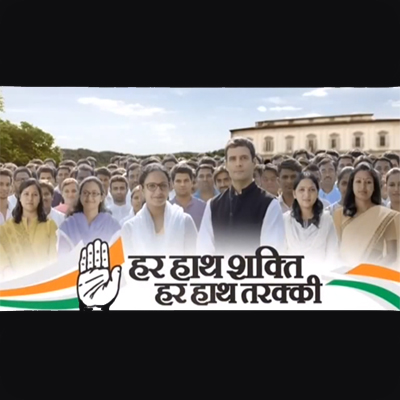
    The Congress Party has flagged off its Rs 500 crore advertising and publicity campaign to promote leading light Rahul Gandhi. With a slogan that reads ‘Har haath shakti, har haath tarakki’, the blitzkrieg mirrors the idea of power and progress to each and every person while focusing on the progress made by the nation in the past decade, albeit with the Congress at the helm of affairs. One of the ads even features a young, Muslim party member, Hasiba Amin, urging the youth to join RaGa along with the tagline ‘Kattar Soch Nahi, Yuva Josh’.


    Apart from this, the ruling alliance has initiated a Rs 100 crore Bharat Nirman campaign, which is being handled by ad agency Percept and run from the Information and Broadcasting Ministry’s budget headed by Manish Tewari.


    What’s more, recently, Times Now Editor-in-chief Arnab Goswami grilled the Gandhi scion in his first ever television interview since his political debut in 2004. RaGa answered questions including whether he is a reluctant politician and what are his views on the multiple scams facing UPA 2 but his answers elicited a mixed response where some found him frank and others felt he needed growing up, politically speaking.  


    Not far behind the Congress, the BJP is close to finalising the ad agency to kick-off its Rs 400 crore campaign around prime ministerial candidate Narendra Modi. It is learnt that McCann Worldgroup led by adman-lyricist Prasoon Joshi and WPP agency Contract Advertising are in the fray to grab the hotly-contested account.


    This – after the recent furore over Congress’ initial campaign slogan “Main nahin, hum”, which the party claimed had been lifted from NaMo’s tagline during the 2011 Gujarat Chintan Shivir. So much so, the Congress was forced to drop the tagline even after AICC media head Ajay Maken refuted BJP’s allegations by tweeting a picture featuring the slogan at a mushaira of Congress workers in Indore in 2010.


    So while the Congress and the BJP gear up for battle in the media space, it remains to be seen how much of this will translate into votes for their prime-ministerial hopefuls. Historically speaking, in 2004, the then ruling party, BJP, had run a similar campaign ‘India Shining’ highlighting all its good work but the aam junta wasn’t swayed. One of the main reasons for the failure of the campaign was people’s inability to relate to it.


    Whether things will work out differently this time one can’t really say but it might do well for both parties to take a cue from AAP’s unique strategy.


    Unlike its traditional parties, AAP has largely stuck to communicating through outdoor activation programs and social media while steering clear of mass media campaigns.


    The rookie party won 28 out of 70 seats in the Delhi Assembly Elections and went on to form the government in the national capital sans any campaigning worth writing home about.


    In establishing a door-to-door (person-to-person) connect with the common man in buses, trains, autos, juggis and bastis, the party’s volunteers stayed true to its one agenda – the aam aadmi.


    As Delhi Chief Minister, Arvind Kejriwal’s recent dharna won him (and the party) more brickbats than bouquets as it is unheard for a constitutional head in a democracy to resort to such means. However, it helped AAP become the darling of the masses at no humungous cost, allegations of using the media to advantage notwithstanding.


    Whether the junta will fall for the publicity and hype created by Congress and BJP or will give its nod to the AAP-brand of democracy, is highly debatable. Our only hope is let the best man (party) win!

  • ABP news Nielson opinion poll- Kaun Banega Pradhanmantri

    ABP news Nielson opinion poll- Kaun Banega Pradhanmantri

    MUMBAI: BJP set to emerge as the single-largest party with the highest-ever score of 210 seats in the 2014 Lok Sabha polls; Congress to hit the lowest-ever mark with 81 seats: ABP News-Nielsen National Opinion Poll.

    BJP likely to emerge as the largest party with around 210 seats in General Elections in 2014, predicts the opinion poll conducted by ABP News-Nielsen across the nation. Congress likely to suffer a major setback with lowest-ever figure of 81 seats in the 543-seat House. Kejriwal’s AAP predicted to get around 11 seats.

    According to the ABP News-Nielsen national opinion poll, NDA predicted to form the government at the Centre with an overall 226 seats.

    Narendra Modi most preferred PM, widens lead over Rahul Gandhi with 53%

    As per the ABP News-Nielsen national opinion poll, Narendra Modi seems to be the clear choice of people for the position of Prime Minister of India, with 53 per cent respondents voting for him. Rahul Gandhi is the choice of 15% respondents. Delhi CM Arvind Kejriwal gets a nod from 5 per cent.

     47% respondents do not think that snoopgate allegations against Modi are true

    As per the ABP News-Nielsen national opinion poll, majority (47%) of respondents do not think that the allegations leveled against Narendra Modi regarding illegal surveillance of a young woman are true. 36 per cent respondents feel that the Central government’s decision to probe the snoopgate is not right.

    61% do not want to give another chance to UPA government

    According to the ABP News-Nielsen national opinion poll, there is an anti-incumbent mood with majority (61%) saying that the UPA government should not get another chance. As per the opinion poll conducted across the nation, 43% respondents have rated UPA government performance as ‘poor’ or ‘very poor’ with a mean score of 2.69.

     According to the ABP News-Nielsen national opinion poll, at an overall level, half (52%) of the respondents feel that previous NDA government was better than the present UPA government at the Centre. As per the national opinion poll, 38% respondents have rated PM Manmohan Singh’s performance as ‘poor’ or ‘very poor’, and he has a mean score of 2.85.

    BJP-led NDA will form the government at the Centre in 2014

    As per the ABP News-Nielsen national opinion poll, if elections were held now, at an overall level, half (52%) respondents feel that BJP-led NDA will form the government at the Centre in 2014.

    Price control main reason for voting in 2014 LS polls

    According to the ABP News-Nielsen national opinion poll, BJP is more associated with an image of a party which can reduce Inflation.

    AAP gets awareness but 49 per cent not to vote for the party

    According to the ABP News-Nielsen national opinion poll, little less than two-third (63%) of respondents at an overall level are aware of Aam Aadmi Party. In Delhi almost all (99%) are aware of AAP as expected. But at the same time, 49% respondents saying that they will not vote for AAP. Majority of the respondents feel that it is good to replicate Gujarat development model to other States

    Only 10% welcome RTI, RTE, RTF as right s in UPA tenure

    According to the ABP News-Nielsen national opinion poll, only 10 per cent respondents welcomed the right to education, right to information, right to food has become rights, in UPA tenure. 33 per cent feel that these are political gimmicks to woo people.


    According to the ABP News-Nielsen national opinion poll, 58% of the respondents in Gujarat feel that it is good to replicate Gujarat development model to other States.

    In Maharashtra, as per the ABP News-Nielsen national opinion poll, 61% respondents feel that Raj Thackrey should get into an alliance with Shivsena and BJP.

    In Uttar Pradesh, as per the ABP News-Nielsen national opinion poll, Majority (51%) has rated overall performance of Akhilesh Yadav as ‘slightly poor’/’very poor’, and his mean score is 2.43 which is below average. 42% respondents feel that BJP has benefitted the most from the Muzzarfarnagar riots.

    In Bihar, as per the ABP News-Nielsen national opinion poll, according to 72 per cent respondents in Bihar feel that Nitish Kumar committed mistake by snapping ties with BJP.

    In West Bengal, as per the ABP News-Nielsen national opinion poll, almost half (49%) of the respondents surveyed in the state feel that Narendra Modi’s image will help BJP to gain more votes in West Bengal in 2014 general elections.

    The opinion poll was conducted by ABP News-Nielsen across the nation between 28th December, 2013 to 12th January, 2014 with 64,006 respondents. The confidence interval (margin of error) assumed for vote share prediction lies in the ranges of 5%.


  • ABP NEWS NIELSEN POLL- AAP likely to impact Congress the most in Lok Sabha polls.

    ABP NEWS NIELSEN POLL- AAP likely to impact Congress the most in Lok Sabha polls.

    MUMBAI: ABP News- Nielsen Snap Poll in Delhi-NCR & Mumbai: Arvind Kejriwal’s AAP likely to impact congress the most and other parties to a lesser extent in the Lok Sabha polls, predicts the Snap poll conducted by ABP News-Nielsen in Delhi and Mumbai.


    According to the Snap poll, In Mumbai and Thane, INC+NCP likely to get around 3 seats in 2014 general elections as compared to 8 seates in 2009. BJP+SHS predicted to get 6 as compared to the single seat in 2009 while AAP likely to bag only one seat.


    AAP predicted to sweep Delhi, to wipe off Congress: As per the ABP News- Nielsen Snap Poll in Delhi-NCR & Mumbai, in Delhi, Kejriwal’s AAP likely to wipe away INC, to get 6 seats. Congress might not get a single seat as compared to slean sweep of all 7 seats in 2009 polls.


    Modi scores over Kejriwal as the most preferred PM candidate: As per the ABP News- Nielsen Snap Poll in Delhi-NCR & Mumbai, the appeal of Arvind Kejriwal seems restricted to Delhi as BJP’s Narendra Modi leads in Mumbai and NCR with an overall votes of 48 per cent. Congress scion Rahul Gandhi stands third in the race for PM with an overall 16 per cent votes.


    BJP likely to hold its seats in NCR (Haryana): According to the ABP News- Nielsen Snap Poll in Delhi-NCR & Mumbai, BJP predicted to get 2 seats in NCR (Haryana- Gurgaon and Faridabad). BJP likely to hold its seats or gain, barring in Delhi. Congress predicted to lose both with around 12 per cent vote share as compared to the vote share of over 38 per cent in 2009.


    AAP predicted to win Ghaziabad, dent BSP: As per the ABP News- Nielsen Snap Poll in Delhi-NCR & Mumbai, in NCR (Uttar Pradesh- Ghaziabad and Gautam Budha Nagar, AAP and BJP likely to get one each in 2014. AAP likely to dent BSP which got a seat in 2009. As per the Snap polls, AAP could win in Ghaziabad.


    The Field work for the ABP News-Nielsen Snap poll was done in the 21 Parliamentary constituencies in Delhi, NCR and Mumbai region between 10th-12th January, 2014 with 2585 respondents.

  • INC’s revamped website is all about Rahul Gandhi

    INC’s revamped website is all about Rahul Gandhi

    MUMBAI: Soon after Prime Minister Manmohan Singh’s announcement that he isn’t in the race for the 2014 Lok Sabha election, the Congress party seems to be going for an overhaul. Reportedly, the national party has brought on board Dentsu India, the Japanese advertising and public relations company (along with JWT) that will be working on a massive campaign around the party’s vice-president Rahul Gandhi.


    However, Dentsu isn’t talking about the association as of yet. “No comments on Congress,” is what Dentsu India executive chairman Rohit Ohri who is holidaying in Koh Samui, Thailand said.


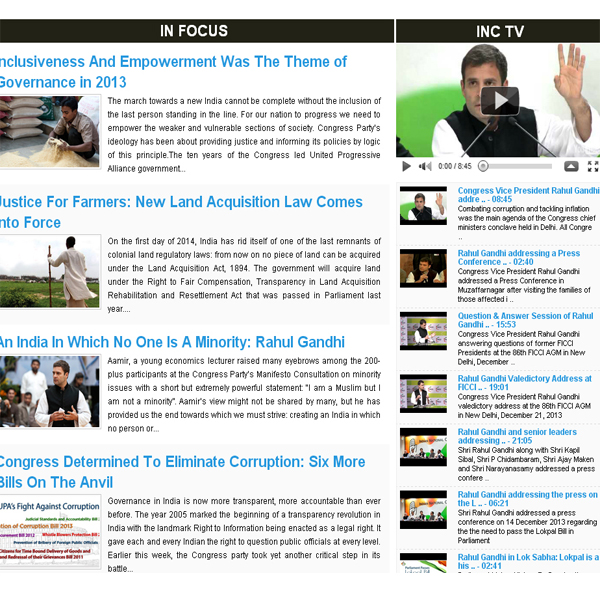
    But the idea is to build up the image of Gandhi before the election. And it seems the process has already begun. The homepage of the website of Indian National Congress shows Rahul Gandhi in the most positive light. The side panel on the website has stories just of Rahul Gandhi addressing people at different times. All his speeches that have made news till now also feature in the panel.


    Few of the highlights are: “An India In Which No One Is A Minority: Rahul Gandhi”; a video of Rahul Gandhi talking to the media in Delhi about combating corruption and tackling inflation; and also a report published in The Telegraph that talks about Rahul Gandhi already taking over the charge of the Indian National Congress. It says, “The new website the Congress launched a few days ago reflects the changes in the party, both in its content and approach, and provides evidence of Rahul Gandhi’s supremacy despite Sonia Gandhi still heading the hierarchy.”


    Besides, the Gandhi scion is the most highlighted person on the site’s homepage. The mention of everyone else who have contributed to the development of the Party is in different sections of the site.


    So, is it a beginning of announcing him as a PM candidate?

  • Marketing lessons a la AAP

    Marketing lessons a la AAP

    MUMBAI: The recent-concluded Delhi elections, took everyone by surprise when Aam Admi Party won 28 seats. We take a look at what one can learn from the new entrant.

    When it was formed less than a year ago on 26 November, 2012, little did the Aam Aadmi Party imagine it would make such a big splash at the polls.   

    Winning 28 out of 70 seats in the Delhi Assembly elections on 8 December, the AAP came a close second to the BJP which won 31 seats, pushing the ruling Congress to an irrelevant third position. What’s more, three-time Congress CM Sheila Dixit suffered defeat at the hands of AAP chief Arvind Kejriwal. Before the elections, the now ex-CM of the national capital, didn’t think before making statements like, “Arvind isn’t even on our radar.” Dixit probably forgot the legend of David Vs Goliath.

    For a fledgling party which emerged as an offshoot of the larger ‘India against Corruption’ movement launched by activist Anna Hazare -where people took to the streets to protest the many ills plaguing the current administration – this is no mean feat.

    And neither is the fact that AAP – registered as a political party with the Election Commission (EC) only in March this year – has successfully met the EC’s criteria to become a state party.

    So what did the AAP do right to banish all the scepticism its broom-wielding members met with from seasoned politicians who dismissed the party, at least initially, as ‘chillar’ or worse, a group that made a lot of noise but had no real impact.

    Looking at the AAP’s historic win from a marketing perspective, we at indiantelevision.com believe brands may do well to take a few lessons from the party’s promotional strategy:

    * Strong USP
    Each brand need to have a very strong USP which helps position it in the minds of the target audience. AAP’s USP is that it gives the common man a belief, a hope, that there is going to be a better tomorrow, and that it has been created by the common man who is fed up of the politics of politics, and will hence deliver on its promise.

    *Be consistent
    At the heart of the AAP’s party manifesto is its stand against corruption – which cuts through classes. And it has not deviated from that. It has refused to ally with either the Congress (I) or the BJP, despite there being a possibility of it occupying the seats of power in Delhi.

    Brands need to stick to their core premise and promise and not try to ride fads.
     
    * Marry your brand USP with the brand mnemonics
    The AAP has always had one agenda – the aam aadmi, and it has stayed true to it ever since inception. Party members are common people who have volunteered and are unpaid. They come across as common people; they dress up like common people; they move around like common people. Even though many of them are well educated.
    And during this election campaign there was none of the largesse distribution or ostentation that the general political parties generally resort.

    The choice of name and the symbol in the case of the AAP was also crucial. The name says it all -Aam  Aadmi Party. Then the symbol was the killer: what is the one thing that is still common across all homes in India, even in middle-class and upper class homes and hutments – it is the broom. Using the broom as the mnemonic meant many things: it will be used to sweep clean all the dirt in the political system, while it helped identify the common man with a tool that is used in his/her home every day.

    * Know your customer; make him your network and your ambassador
    The AAP needed to connect with its customer: the electorate of New Delhi. Almost 130,000 volunteers all over the world, some of whom descended on Delhi before the election campaign became both the best focus group and research agency anyone could ask for.

    Some executives even took leave from their high paying jobs in India and overseas, housewives found time from their day to day chores, young college students, technicians, labourers, cable TV operators – everyone pitched to connect with the consumer and pass on what troubled the common Delhi-ite – crucial information to the central headquarters of the AAP. And they then propagated that further themselves to the electorate.

    With millions of products overflowing on shop shelves and online, brands need to know what their customers really want, when they want it and how they want it, and in the process make them your ambassadors and messengers.

    * Choose the correct medium at the correct time
    AAP had little financial resources at its disposal; some say less than Rs 20 crore. That’s probably what’s spent by politicians on a couple of constituencies. Once again volunteers stepped in to build the buzz.

    Twitter, facebook, online, print, and television. AAP went the whole hog on all the mediums. But not to splurge; just to have its message heard. The media were relatively complying: did not the common man also work in media? It hooked the middle class and the upper middle class through social media.

    And what about the man on the street?  Well it used direct selling: volunteers went door to door to the electorate in Delhi, connected with the common man. In trains, in buses, on auto rickshaws, in jhuggis, in bastis – there was the huge poster campaign, and it was the educated folks who went where they normally would not.

    Brands have to be careful about the medium they choose and utilise it to maximise impact. Brands too have to keep themselves in people’s mind through various activations/campaigns especially in today’s market where the sharks are ready to rip apart any competition.