Tag: Congress

  • Manish Tewari’s views on I&B appear to be thinking of a frustrated mind

    Manish Tewari’s views on I&B appear to be thinking of a frustrated mind

    NEW DELHI: It is a well known truism that the administrative arm of the government is not run by politicians but by bureaucrats. And while there have been many cases where a minister had to bow because the bureaucracy in his own ministry did not support him or her, it is only seldom that the politician allows himself to be cowed down.


    One therefore wonders whether the statement by outgoing Minister Manish Tewari that there is no relevance of Information and Broadcasting Ministry (I&B) and that it belongs to ‘an era that is past’ is something that comes out of his own wisdom or his frustration in dealing with an ex-bureaucrat who now heads the public service broadcaster.


    Coming as it does on the eve of the government going out of office, the statement is either way misplaced. It is now open to the new government to decide whether this ministry needs to remain or go.


    And clearly, ‘Broadcasting’ does not mean just Prasar Bharati in a scenario where not only has the radio and television industry grown by leaps and bounds, but needs controls and regulations that only a Ministry can handle.


    At the same time, ‘Information’ does not just mean giving information to the people through the media and goes much beyond to an administrative regulatory role over various media units of the government. If this Ministry has no relevance today, one winders who will monitor the working of these media units!


    Experience of the past decades has shown that the role of the I&B Minister has probably been totally misunderstood by the heads of government. Because the designation says ‘Information’, the government thinks that it has to be led by a person who is well versed with the policies of not only the government but also the ruling party.


    Tewari, therefore, often found himself answering questions about the ruling party rather than his Ministry whenever he was mobbed by the media, particularly electronic media looking for sensational bytes!


    Factually speaking, questions about government policies should have been tackled by the Director General (Media and Communication) in the Press Information Bureau and those about the party by the official party spokespersons speaking in the respective party offices.


    Clearly, the government took ‘Information’ to mean ‘Information and PR’, which is the kind of designation given to ministers holding this charge in the states.


    Actually, the debate over whether one needs an Information and Broadcasting Ministry is not new.


    The issue had also come up about a decade earlier when Sushma Swaraj was in charge of the Ministry.


    At that time, a Group of Ministers had been set up under the chairmanship of the then Finance Minister Yashwant Sinha on the possibility of setting a Convergence Commission and also piloting a convergence bill. This was being considered as it was felt that Broadcasting and Information Technology were gradually merging.


    The issue could not be resolved even after several meetings of the GoM, and the whole thing was put in cold storage because of the change of government in 2004.


    While the then Communication and Information Technology Minister Pramod Mahajan and the then Law Minister Arun Jaitley appeared to be in favour of the Commission, it is understood that it was vehemently opposed by Swaraj.


    The possible reason for this is not far to seek: if a Convergence Commission (which would have also made the Prasar Bharati Act redundant) had been indeed approved, then the chances were that broadcasting ministry would have gone to the IT Minister and Swaraj would have been left with only Information and thus a reduced portfolio in terms of power – something no senior politician can afford to let go.


    As far as the broadcasting side goes, surely Tewari knows there is more to broadcasting than dealing with a former bureaucrat who insists that the government has backed out after creating an autonomous Prasar Bharati, by still keeping most powers to itself.


    The view of Prasar Bharati CEO Jawhar Sircar, who has also chosen the current time to express them in writing in an article in a popular magazine, may have its own merit. And while one could always argue on whether a public service broadcaster almost totally dependent for its existence and funds on the government can expect full autonomy!


    But he has deliberately chosen to air his views about ‘covert control raj’ to coincide with the entry of a new government and as well as the interview of Narendra Modi on Doordarshan. Interestingly, even DD News Director General S M Khan has gone on record to say that the decision to make cuts in the interview had nothing to do with the Ministry and were done internally by DD News staff as they wanted the interview to be more balanced.


    As a matter of fact, one wonders whether Prasar Bharati which was conceived at a time when only Doordarshan and All India Radio existed has a place in a scenario dominated by private radio and TV channels!


    And one can hardly deny that there are very few countries in the world which do not have radio or television channels of their own, and many even own news agencies and newspapers.


    In a country as large in population as India and with a low literacy rate, surely no one can deny that the government needs to have a channel to disseminate information about its programmes, and help people learn about their powers. And there is little gain saying the fact that both Doordarshan and All India Radio are today airing programmes which private channels running after TRPs and advertisers cannot do.


    Tewari’s view therefore about the “inherent redundancy” of the Ministry itself appears redundant.


    Perhaps his views about the Films Division can be judged on the same footing. While the Division has undergone various changes from the weekly news reviews to magazines and now short films, it is also an institution that is doing things no private agency would do and this is also becoming clear from the increasing number of National awards its films have been winning, apart from the fact that it was chosen by the Ministry itself to manage the country’s only Museum on Indian Cinema.


    The fate of private television and film training schools is also well-known as they end up as shops that want to give quick training but charge high fees. In that scenario, both the Film and Television Institute of India and the Satyajit Ray FTII have to remain under the I&B Ministry, though there one can hardly deny that greater participation of the private sector – particularly the film industry and TV channels – would help.


    In fact, Tewari himself had said in November 2012 that ‘however archaic its structure might be, I&B over a period of time seems to have got the nuances fairly right. It is to a very large extent, hands-off. If you were to abolish the ministry, what would you replace it with?’


    Interestingly, Tewari had initiated steps to grant more autonomy to it by constituting the Sam Pitroda Committee.


    Irrespective of which party comes to power, I&B is a subjects that will remain with the central government if there has to be a continuity of policy as far as the media and even freedom of speech and expression is concerned, especially in a country where business houses are waiting to gobble up whatever freedom the media enjoys today.
  • Election Campaigns: How they boosted OOH sector

    Election Campaigns: How they boosted OOH sector

    Since the 2014 elections is being touted to be one of the toughest elections of all time, parties are more than willing to dig deep into their pockets and spend on advertising…especially outdoor since their vote bank lies within the masses on the street of not just the metros but also the tier II, III, IV markets. Therefore, outdoor has become massively important for them. It’s much more rigorous this time.


    Election season has given a boost to outdoor advertising industry by more than 30 per cent. Understand, unlike television and print which also exude national presence, the power of outdoor lies in its local behaviour. It helps put up a larger than life picture wherein literacy is not a heavy requirement. You can easily look at the picture and understand the message. As a result outdoor has become a very significant medium for the parties to reach out to the masses who stay in the hinterlands of this country. They are their vote banks, most of whom who may not even have a television at home to watch an ad or are not literate enough to read the paper. It’s outdoor that helps the candidates and parties to reach out to such regions. Now talk of metros like Mumbai, where time is limited and people do not have the leisure to watch TV and read papers, since people are constantly on the run and outdoor helps capture their attention in a very big way. Outdoor inventories  such as hoardings, transit medium, street furniture, mobile vans, railway media all can be placed at strategic locations and just cannot go unnoticed by the target viewer. In a city like Mumbai where consumers are constantly travelling, hoardings play an exponential role in capturing their attention.


    The government has estimated a 4.9 per cent rise in economic growth this financial year, against a decade-low of 4.5 per cent last year. Parties have majorly used larger than life hoardings without much innovation in a bid to keep their campaign language simple and direct. National political parties such as Congress, BJP, NCP and the latest entrant in the political game Aam Admai Party (AAP) have also rolled out an outdoor campaign to woo voters pan India. Outdoor has come up as an effective mass communication tool for targeting people on the go as soon as they step out from their home.  This has given rise to the demand of outdoor inventories on big scale especially large size hoardings. Taking the professional approach, these parties have engaged highly lit, strategically located, clutter free hoardings along with bus media.


    Interestingly, political parties have also raised ad spend on OOH medium to cater to large number of diverse voters. Focused on innovation, diverse range of outdoor inventory and tactical media planning have brought national political parties closer to outdoor medium.


    Digital Marketing and OOH: Combination used?


    These political campaigns came up with single objective to influence the decision of voters. Therefore, the demand of quality outdoor products coupled with highest reach gained popularity amongst parties.


    Parties used combination of digital and outdoor campaigns for various political promotional events such as rallies, public appearance of prime ministerial and Lok Sabha seat candidate in every constituency, awareness campaign of party’s agenda and promises to the voters and many more.


     This year we have noticed many new trends such as advertising via mobile vans, LED, huge display screen at traffic junctions, public announcements, heavy advertising on railway and bus stations etc. A lot of BTL activities are also planned around the city like Narendra Modi T-shirts, Arvind Kejriwal’s Cap and Rahul Gandhi’s Mask to list a few.


     What after election?


    The elections this year is expected to boost the ad revenues across sectors in double digits. And this boost will help sustain even the OOH industry for the rest of the year. It is only an addition to the already existing and growing business of OOH as a whole. So, we do not think that there should be any coping issues. There will be business as usual. Elections are a once in a five year phenomenon. We do not depend on elections alone, therefore…right?! The elections will get over in a few days. And April-May are the best advertising months. Its summers…and holiday season for schools too. So, a lot of advertising happens across the summer FMCG brands, tourism and education too.


    (These are purely personal views of Global Advertisers MD Sanjeev Gupta and indiantelevision.com does not subscribe to these views)

  • Modi most popular, even as negative sentiments grow

    Modi most popular, even as negative sentiments grow

    MUMBAI: The eighth phase of the elections just ended and with only one last phase left, the 16th Lok Sabha general elections are turning out to be something that India has not seen in a long time.


    The media, especially the social media, has become a major part of these elections. Many even claim that the medium along with television has become a talking point amongst many and has been able to influence.


    Social media has become such an important part for news channels that they need to use it to know what people have to say about the various issues cropping up this election – be it Narendra Modi’s road show in Varansi or Priyanka Gandhi entering the battlefield to defend her younger brother, Rahul Gandhi.


    Various digital agencies have jumped on this golden opportunity and are trying to read and understand the trend as well as what creates Indians to log on to the virtual world and discuss.


    To The New, an integrated digital services network, is one such agency that has launched a comparative study of politicians and top political parties of the two weeks (Week 1: 22 to 28 April; Week 2:  29 April to 5 May).


    As per the report, as the elections come to its end the negative sentiments is what is gripping people. The report created on the basis of the analysis of digital conversations across various social platforms such as Twitter, blogs, forums and news sites, says that all the parties saw an increase in negative buzz compared to last week.


    AAP topped the chart with highest number of negative mentions. The negative mentions doubled wherein in week 1 there were 33575 negative mentions, in week 2 it went as high as 66245. Congress followed it with an increase of almost 10,000 negative mentions (43793 as compared to last week’s 33824).


    Bharatiya Janata Party (BJP) came in third with 45585 negative mentions as compared to previous week’s 38617. BJP’s prime ministerial candidate Narendra Modi’s negative sentiment has shot up drastically in week 2. The sentiments grew more than double for Modi with AAP’s Dr Kumar Vishwas coming second.


    What is interesting is the fact that on similar notes, the positive sentiments too were the highest for Modi while AAP’s founder Arvind Kejriwal came second. However, the difference between the two was of many yards. Having said that, the positive sentiments saw a minor negative slide.


    A lot of buzz was generated around Congress and AAP, whereas BJP witnessed a drop in this regard in week 2. Also, Modi was yardsticks ahead of others when it came to personalities. He, however, did see a decrease in the buzz around him. From 154,386 mentions it fell to 133,460 for Modi.


    Meanwhile, Dr Kumar Vishwas and Rahul Gandhi saw an increase in buzz during week 2. But Arvind Kejriwal came in second amongst the top 10 personalities.


    With just a week to go, the talks – good, bad or ugly – are only going to intensify as everyone waits with abated breath to see who will sit on the PM’s seat this time around.


    Click here for detailed report

  • Elections 2014: Live from Ground Zero

    Elections 2014: Live from Ground Zero

    MUMBAI: The 2014 election fever has gripped the nation and news channels in their quest to feed the hungry electorate with innovative and comprehensive news coverage, are venturing out, literally. Studio produced shows are steadily seen replacing on ground coverage ensuring that information is delivered at source. Some of these shows include Open Mike by CNN-IBN; Kaun Banega Pradhan Mantrai, Nukkad Bahas and Ghosnapatra by ABP; Campus Connect by NewsX; Janta Ka Agenda, Akhada, Pradhan Mantri Pachchisi by News Nation etc.  Well known journalists, the face of these channels including Barkha Dutt of NDTV, Sagarika Ghose of CNN-IBN, Ajay Kumar, Ramesh Bhatt from News Nation, Abhisar Sharma of ABP and Athar Khan of NewsX, have all stepped out of the four walls of the studio to reach out to the janta.


    What have been the primary reasons for news channels venturing out from the comforts of the studio? IBN Network managing editor Vinay Tewari says, “Elections have been always about people. Going out on the field and interacting with the 80 crore electorate is very important for us.”


    News Nation CEO and editor in chief Shailesh Kumar said, “Our endeavor is to give a feel that we are present at ground zero. We cannot call voters from far flung areas to our studios. But our studio can certainly move to the door steps of the voters.”  Echoing a similar thought about its show Campus Connect, NewsX says that the show has come up as a unique youth electorate engagement initiative that hopes to build the political power of young people in order to achieve progressive change in the country.


    Producing such shows in the open involves a lot more investment, manpower and planning compared to a studio produced show. According to Castle Media director Vynsley Fernandes, producing a half-an-hour show in a studio costs around Rs 45,000 which nearly triples for an hour long show produced on ground costing roughly around Rs 1, 25,000. “But news channels feel it’s worth the effort as they get to know the real pulse of the nation,” he says.


    News Nation has deployed about 100 crewmen including journalists, four OB vans and 30 bag packs for its different programmes while News   X ‘Campus Connect’ employs 20 odd personnel.  To transmit these shows a combination of 3G back packs and OB vans are being used. Some of these shows are broadcast live while others are pre-recorded.


    Bigger states like Uttar Pradesh (UP) and the Hindi speaking belt command more weightage as they send more MPs to the parliament. News Nation says that states like UP, Bihar, Karnataka and Rajasthan are more important as BJP expects maximum swing of votes in these areas while for ABP News states in the Hindi heartland are of utmost priority and its show Ghosnapatra is limited to bigger cities only. NewsX differs and says that every state is important for them.


    As the counting day draws nearer and the election mania reaches its peak, News Nation says that counting day is for results and therefore the studio will be more important to them although reporting from important constituencies will get equal importance. On the other hand, ABP News and NewsX have said that on ground reporting will see a surge on the day results will be declared. For all the effort that has gone in producing these shows and formats it is crucial that an efficient marketing plan is devised to pitch these shows to the right audience. NewsX is relying on considerable amount of word of mouth communication through the audience who take part in their shows. They are also promoting extensively through promos on the channel to build additional viewership. At the same time, each episode is uploaded on YouTube and promoted to digital subscribers.


    On the other hand according to MCCS marketing manager Vikas Singh ‘aap apni rajneetik rai kahan banate hain’ is the question that the ABP News brand campaign asks its viewers. Politics is national pastime and is perhaps the only thing after cricket where everybody has a point of view. People can be seen having animated political discussions at bus stops, cafeterias, inside trains, tea stalls, at work station in office, almost everywhere. However not all discussions are backed by sound knowledge. “The campaign tries to get the viewers watch ABP News to form the correct political opinion. It leaves behind a powerful message ‘sahi rajneetik rai banana ke liye dekhiye sirf ABP News’,” says Singh.


     According to Lowe Lintas executive vice president Syed Amjad Ali the key objective of the campaign was to take the thought further through an interesting story. “The story is so simple that anyone can connect with and understand it. People resonate with this campaign far more strongly given the timing of such a large scale election that’s going on in the country,” informs Ali. The social media space too is being used extensively to market these shows. ABP News is using interactive poll banners that run on popular sites to establish the message.


    As per IPSOS study-‘Kaun Banega Pradhan Mantri’ has the highest awareness amongst all election related shows across news genre. “Audiences specially the youth talk a lot of the Campus Connect show on social media,” says Singh. These dynamic formats have been a huge hit and have developed a big following among the ‘aam janta’ as it gives them an opportunity to share their views and thus makes the audience feels empowered.


    NewsX plans to integrate social media to a larger and greater extent to engage with their audience.  The audience response to these new shows has been positive.


    All the channels that indiantelevision.com spoke to said that this new format is here to stay even post elections, although the degree and extent to which currently these shows are produced might be low due to budget constraints.

  • 4 out of 10 manifestoes talk about child rights, says CRY

    4 out of 10 manifestoes talk about child rights, says CRY

    KOLKATA: After launching its nation-wide campaign ‘Vote for Child Rights’ election advocacy campaign in November last year, the Child Rights and You (CRY) has again attempted to look at the political parties’ manifestos from child rights perspective.


    CRY which had launched the campaign in all major metro cities now aims to see whether political parties have given enough importance to issues related to children in promises made for the next five year.


    Manifestos of 10 parties viz INC, BJP, NCP, BSP, CPI, CPI(M), SP, AIADMK, DMK and JDS were looked at from the framework of children’s Right to Survival, Development, Protection and Participation.


    Some of the key quantitative findings say that only four parties out of 10 – BJP, CPI, DMK and CPI(M) have mentioned children/child rights issues in a separate section. While for rest of the parties it is mentioned in a scattered way mostly under headers like ‘Education’ and ‘Health’.


    Average representation of content on children’s issues in 2014 party manifesto is around 11 per cent while in 2009 it was 9.75 per cent. “There is a marginal increase seen as far as quantitative representation is concerned,” the official added.


    It further reveals that none of the party talks about the societal role and steps that need to be taken to ensure that children have their right to live, develop, and build their capabilities and interests. Also, none of the parties has looked at all/ different perspectives of child rights/ children’s lives.


    CRY would love to ensure that political parties and people in power take heed to ‘Putting Children First’ always among other agendas and give top priority to children’s issues and commit to changing the situation of children in our country.


    The manifesto was based on CRY’s in-depth analytical report ‘Status and Trends in Child Rights in India-An overview of the Past Decade’, and covers the aspirations of children across the country. The report comprised of views of development thinkers and practitioners in the Child Rights arena and provides a detailed analysis of child rights indicators.


    Speaking about the campaign, CRY (East) regional director Atindra Nath Das, said, “Vote for Child Rights campaign is our way of ensuring that there is political will behind our justified demand to protect Child Rights. It is imperative that the best interest of the child be put at the centre of all policies, legislations and practices, and the Vote for Child Rights campaign focuses on that solely.”


     “This is our attempt to remind politicians and governments in power that it is their obligation to undertake all measures in protecting and promoting child rights,” Das concluded.

  • Interview of Narendra Modi at Zee News

    Interview of Narendra Modi at Zee News

    MUMBAI: Claiming to know the pulse of the nation, BJP Prime Ministerial candidate Narendra Modi took the fight to the enemy camp saying that the foundation for a new government had already been laid.


    He said recent statements by Congress leadership in regard to support likely to a Third Front meant that the party had accepted defeat. “When elections were announced there was talk of a hung Parliament. Now there is talk of support to non NDA government. I am not myself saying anything. Congress statements themselves show that the mother-son government is on the way out and the foundation for a new government has been laid.”


    Commenting on the idea behind the popular BJP’s slogan “Acche din aane wale hain”, Modi said, “While inaugurating Pravasi Bharatiya Sammelan PM Manmohan Singh assured good days will come despite gloomy economic scenario. Next day I had a meeting there where I narrated PM’s slogan and the entire hall burst into laughter. The message was clear.”


    Maintaining his attack on Congress, he said, “Look at all bad things in this country and they all add up to define Congress today. That is why all miss-governance gets identified with Congress. There is negativity all round.”


    Modi, however, sounded optimistic for May 16. “The moment results come out on May 16 we will move out of negativity. The country will take 125 core steps forward. 2014 is an election of hope. Aspiration yields positive energy which leads to growth of the country.”


    Refusing to be drawn further on the issue of ever growing personal attacks, BJP Prime Ministerial candidate said, “We are committed to the slogan of good governance and development. People have liked our pitch.”  To substantiate his view, he cited an earlier instance of good governance. “In 2001 the massive earthquake had devastated Gujarat and within a short span of time the state got back on the development track.”


    However, in response to another question, on heightened attacks on him and BJP by Mamata Banerjee and other regional leaders, he sounded aggressive in his response. “Six phases of polling have already taken place. The mood of the nation is known to everyone. That is why the heightened attack. They have nothing to offer of their own. Their objective is to aim to dislodge him.”


    On how he faced up to the Gandhi troika, he said, “It is not just the Gandhi family. All UPA allies are up against me. It is Modi versus the rest. The irony is that instead of evaluating the performance of their government, they are all auditing Gujarat model.”


    Modi reiterated that his brand of politics revolved purely on development. “I am not in favour of vote bank politics. I am not for communal and caste politics. I oppose them.”


    Citing his own humble background to buttress the point, he said, “Is it a sin to be poor in this country? I come from a poor background but I have never used poverty as a political ploy. I am here today having sold tea in train compartments.” He categorically denied he was in race for power but reiterated his commitment to work towards building a modern India.


    In response to another question on whether he had raised far too many expectations, he said he was no dream seller but had a sense of the pulse of the people of this country. “There has to be a commitment to governance and that is my promise. I have not made any tall claims.” Citing what these steps would be, he quoted the example of sanitation.  “Small steps will make a difference to shed all round negativity. There are no toilets for women in most part of India. This has to change.”     


    Modi said he was like any other citizen and lived life like a commoner. “I am not a robot. I am a common man. I think and act like a common man. I have a commitment to the common man. But I have my own limitations like any other human being.”    


    Evading question on Baba Ramdev’s measures to improve the economy, Modi said, “My expert team will decide about the economic decision. Don’t bring Baba Ramdev in such things”. Was he readying his team ahead of his party’s claim of NDA coming to power, Modi said, “My current KRA is to fight and win the election. I am not thinking of anything else.”


    On stock market rally ahead of elections, he said there had been a needless controversy. Without getting into directly attacking the finance minister, he said, “It is for investing community to respond to as to why it mentions my name and not that of the Prime Minister and finance minister.”

  • LS elections: Mumbai shows the finger

    LS elections: Mumbai shows the finger

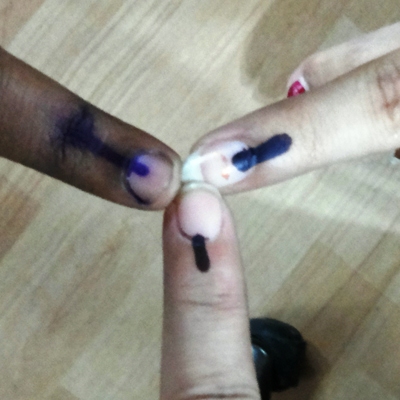
    MUMBAI:  It’s been 20 days since the largest democracy in the world started polling. Half of the country has already undergone the process while a few more wait eagerly to get inked.


    These elections unlike the others in the past are different. Thanks to the role media played this time around. Political parties of course didn’t leave any medium to woo people to vote for them. From television to online, their presence was and still is everywhere. What is more interesting is that even television channels – general entertainment as well as youth – along with print told people to step out and vote.


    In the sixth phase of polling, Mumbai, the financial capital of the country, was supposed to make a difference. Today almost 18 crore voters from whooping 117 constituencies, which comprised 11 states and one Union Territory went out for polling. 


    While Bihar witnessed 60 per cent voter turnout, Jharkhand-63.4 per cent, Madhya Pradesh-63 per cent, Assam-71 per cent, Puducherry-82 per cent, West Bengal- 81.42 per cent, Uttar Pradesh-58 per cent, Rajasthan-59 per cent, Chhatisgarh-65 per cent and Tamil Nadu saw a 73 per cent voter turnout. The six constituencies of Mumbai witnessed the lowest voter turnout amongst the lot- 53.1 per cent.


    And this after all the efforts taken by both the television channels and the brands, who went out and out to woo the voters of the city. 

    While the celebrities stepped out of their comfort zones and happily got clicked with their inked fingers, it was the common man of the city, who did not show up in the polling booth, and not like it was expected. The only saving grace, that by the end of the day, the city had recorded a 53.1 per cent voting turnout.   


    Looks like in the city of dreams, many didn’t want to wake up from their sleep and go out in the scorching heat. And this, even after most companies including a few media houses were shut as it wanted people to vote.


    Though, many in the city may rejoice over the better performance as compared to the last Lok Sabha polls, reality is that an even better voter turnout was expected from the city. And it is perhaps, the lowest amongst the states that have cast their votes so far.


    Somehow the city and its citizens that don’t get tired of cribbing, doesn’t cast its vote. The reason (educated) some feel is that what difference will it make? For them, the policies made by the government are made for the poor and the rich and the middle class is bound to suffer no matter who comes to power.


    While there are still a few who want to vote but couldn’t find their names in the list. They are tired of the officials and the process. A few also feel that at least in Mumbai, the political connect is missing. “The old style of campaigning has been taken over by twitter and electronic media, and so that personal touch is missing,” says an executive from the media house, who couldn’t vote since his name was not in the list.


    In fact if a few have to be believed, one entire housing society, which comprises some 8,000 plus houses in the North West part of Mumbai, could not find their names in the voting list. “They have lost so many votes by this,” adds a source from the industry.


    But at least some did go out and get inked.


    When we contacted RK Swamy BBDO chairman & MD, Srinivasan K Swamy, he said, “Yes, I did vote. I got to understand that many names were taken off the voter list from various booths. These were people who have voted in the past. Though they had their voter’s ID card they weren’t allowed to cast their vote.”


    Colors CEO Raj Nayak too showed off his inked finger but feels that today people have become insensitive and selfish. “It’s all about ‘I, me, myself’. They won’t make the effort to vote but then they will be laid back and criticise the government. I don’t think any other country in the world can have such a smooth process of voting such as in India. The staff is courteous and the police do their job well. It hardly takes time to go and cast your vote!”


    Curry-Nation founder Priti Nair mentioned, “Frankly, I thought there was huge buzz about voting this time and genuinely thought a lot more professionals are all enthusiastic about voting. I am quite shocked at this turn out.”


    DDB MudraMax OOH, Retail and Experiential president Mandeep Malhotra said, “Yes I did cast my vote and I am really sad on the turnout. While Bollywood and cricket celebrities did show up on the polling booth, where were the others? It is sad to see that this is how the city responds to a once in a five year event.”


    Samyak Chakravarthy of Operation Black Dot feels that though slowly the turnout did improve but the youth turnout was still less in comparison to the total size of electorate per booth, “and this is worrisome.”


    He along with his team through the initiative Operation Black Dot tried motivating people, especially the youngsters to go and fulfill their duty. Many youth icons too supported the initiative.


    May be the next time the city goes out for voting, more push and initiatives will be needed to get the city voting: How about taking the electoral machine to each house? Is the Election Commission listening?

  • BJP’s manifesto most-talked on social media

    BJP’s manifesto most-talked on social media

    MUMBAI: The 2014 elections have been very different from the previous ones; never before have elections created so much buzz especially among the youngsters.


    Media has played a major role in creating elections the hot topic for months now with social media playing a vital role in it. With the Lok Sabha elections already underway, voters have been closely evaluating the manifestos of AAP, BJP and Congress. Conversations on social networks have been buzzing with netizens discussing the various developmental programmes promised by the political parties.


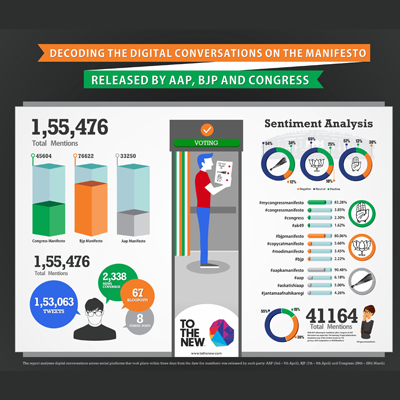
    To The New, an integrated digital services network, has released a report that analyses digital conversations across various social platforms such as Twitter, forums and news sites that took place within three days from the date the manifesto was released for that party. The report, powered by ThoughtBuzz, the social media analytics’ arm of the company, also tracks the sentiment around the manifesto and shares “word clouds” that highlights the key sentiments that are dominating the social platforms.


    To The New marketing head Irfan Khan said, “The 2014 General Elections has seen immense interest and vocal participation of the youth. The release of the manifestos by the political parties has given the young and the “first-time voters” the opportunity to evaluate and make an informed decision. The report on the buzz around manifesto enables us to understand the psyche of these voters.”


    The report reveals that mentions of BJP’s manifesto far outnumbered that of political rivals AAP and Congress with a whopping 76,662 mentions on the social platforms in the span of three days of the release of the party manifesto. In contrast, Congress had 45,604 mentions followed by AAP with 33,250 mentions.


    The report findings further revealed that the discussion on AAP manifesto had the most positive outcome amongst the three parties, 34 per cent had a positive tone, 54 per cent had a neutral tone and 12 per cent of the tonality was negative. 57 per cent of the discussion on Congress manifesto had a neutral tone, 30 per cent was negative while only a mere 13 per cent of the tonality was positive. On the other hand, 65 per cent of the discussion on BJP manifesto had a neutral tone, 25 per cent was positive while only 10 per cent of the tonality was negative. In the duration of three days of the release of BJP manifesto, the hashtag #copycatmanifesto, created a lot of buzz on the digital space receiving a total of 41,164 mentions.

  • After Congress and BJP, AAP enters ‘outdoor’ fray

    After Congress and BJP, AAP enters ‘outdoor’ fray

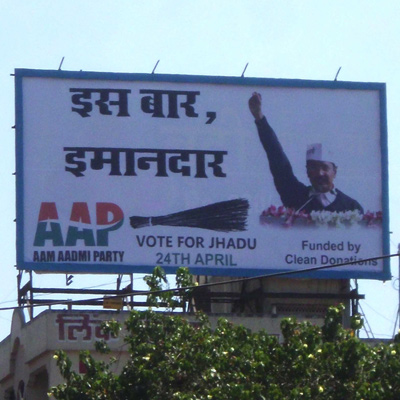
    MUMBAI: Barely days for the city to go to polls, and a party which had hitherto relied on unconventional methods such as word-of-mouth, foot soldiers and dharnas to gain popularity, has finally taken refuge in mainstream advertising, albeit out-of-home (OOH).


    Indeed, the Aam Aadmi Party (AAP) and its most public face, Arvind Kejriwal, are the latest to find their way to a string of hoardings plastered across Mumbai in the lead-up to voting day on 24 April.


    In the hoardings, Kejriwal is seen asking Mumbaikars for votes, alongside slogans in Hindi which read: “Jitne Sitam Karna Hai Kar Lo, Lekin Desh ko Badal kar Rahenge”, “Is baar Imaandaar” et al.


     According to Global Advertisers, which has the mandate for the main political parties, while BJP and Congress are utilizing 17 to 20 per cent and 25 to 27 per cent of the total outdoor hoardings, respectively, AAP is utilizing only 7 to 8 per cent.


    In terms of monies spent, “If Congress is spending around Rs 50 crore and BJP about Rs 20 crore on outdoor, AAP, which does not have as much money as BJP and Congress, should be spending much less than Rs 3 to 5 crore. However, it is important to note here that unlike Congress and BJP that are creating a very strong presence through TV and print advertising, AAP’s advertising backbone comprises just outdoor and word-of-mouth,” informs Global Advertisers managing director Sanjeev Gupta.


     For AAP, the outdoor agency is currently focusing on Mumbai’s high-visibility regions such as Worli, Andheri, Dadar and Thane. Despite having been approached at the nth hour, the agency’s media planning and buying teams have selected some of the best sites for the party.


    In this election year, Indian advertising is expected to witness an overall boost of around Rs 1,000 crore from political advertising, with outdoor advertising expected to see a 10 per cent rise within that. “We at Global expect to witness as much as a 30 per cent rise in our revenues just from political advertising,” says Gupta.


    While TV and print exude national presence, outdoor is very important for parties to reach out to masses who stay in the country’s hinterland. “And since the 2014 elections are being considered to be one of the toughest elections of all time, parties are more than willing to dig deep into their pockets and spend on advertising, especially outdoor, since their vote bank lies within these tier 2, 3, 4 markets,” Gupta points out.

  • Political advertising in India – social media and the first-time voter

    Political advertising in India – social media and the first-time voter

    If you’ve always wondered why and what’s the point of political advertising when the candidates get enough coverage around their sheninagans on a regular basis, then read on.

    The primary purpose of political advertising is to swing the perception of people who have ‘CONFUSION’ written all over their faces in capital letters, and ultimately, to win votes. Because for a larger percentage of the politicians, it’s all about obtaining and retaining power, fuelled by money and greed.

    Past demeanours do not count, and most political parties have cracked the seven deadly sins of Indian voters. To elaborate, here goes:

    1. The Indian public has extremely short-term memory

    2. Over time we learn to tolerate anything

    3. Nothing comes above religion and caste

    4. Political ignorance, even amongst the educated

    5. Petty appeasement through freebies

    6. Indians love to hate each other

    7. Need to hero worship and follow dynasties

    Courtesy: Ishaan Mohan Bagga, Editor, Indian Exponent. http://indianexponent.com/24298/7-weaknesses-of-indian-voter.html

    The economics of 2014 elections

    Having mentioned money, Reuters reports that ‘Indian politicians are expected to spend around US $5 billion (Rs 30,000 crores) on campaigning for elections next month (April 2014) – a sum second only to the most expensive US presidential campaign of all time – in a splurge that could give India’s floundering economy a temporary boost.

    India’s campaign spend, which can include cash stuffed in envelopes as well as multi-million-dollar ad campaigns, has been estimated at Rs 300 billion (US $4.9 billion) by the Centre for Media Studies, which tracks spending.

    That is triple the expenditure the Centre said was spent on electioneering in the last national poll in 2009.’

    Media is the largest beneficiary in the arsenal; and all related advertising, turns into a medium to deliver promises, attack and counter-attack opponents, and function as the political game changer. Swirling on a delicate ideological spindle – ‘A lie told often enough becomes the truth’ – Vladimir Lenin. Also successfully used by Hitler’s Propaganda minister Joseph Goebbels, who also served as chancellor for a day, following Hitler’s death.

    So couple greed with the seven deadly sins of Indian voters, stir in tonnes of cash and engage some of India’s leading advertising-PR-social media conglomerates to churn out propaganda and you have a volcanic blitz of media madness; where even educated, otherwise analytical minds can’t distinguish between hell or high water.

    The year 2014 is a very interesting year for India as the majority of the audience that will be voting this year will be very young. At a news conference in New Delhi, the election commission said that the process of voting in the sixteenth Lok Sabha will see the largest ever population of eligible voters, led by over 814 million voters, 100 million more than in 2009. This time round, more than 23 million voters are aged between 18 and 19. For the first time in a general election in India, voters will be allowed to cast a ballot for “None of the Above.”

    To the extent that the ultimate decision might also be in the hands of India’s youth because of the existing majority, the marketer has set up shop in the marketplace, i.e., political advertisers have looked into reaching out to the audience where they currently ‘hang out’.

    With advertising and communication being churned out faster than widgets, there is no thinking time for the creators; hence they all narrate versions of the same story, with a different overtones, over different platforms.

    The story goes something like this –

    Cause

    Here’s the starting point: what does the party stand for? Why does this party exist? What does the prime minister candidate stand for? There are many causes on offer: secular, development, safety, jobs, prices, pride, honesty and governance.

    The first-time voter is young, idealistic and seeks a motivating argument to come and vote. The best argument to this group is economic: the promise of jobs and a brighter future.

    Constituency

    Similar to brand marketing campaigns, the candidate who presents the best chance in the constituency is a combination of optimising many variables and micro-targeting, i.e., “Think national but choose local” being one of the most commonly used engagement strategies right now.

    Comparison

    By creating syndromes of fear, uncertainty and doubt amongst the people, political advertising portrays competitors in an unfavourable manner, thereby benefitting the attacking candidate and not marring his image; eventually leading to winning more votes.

    Celebrities

    Everyone from TV presenters, to actors, to former diplomats and government servants, will start offering their endorsements for the benefit of the voter. Such endorsements will multiply gradually in this election. Parties will rope in influential social commentators and feed them with talking points to build preference, especially among undecided voters.

    This election is therefore truly at the mercy of first-time voters and social media targeting, which will decide its outcome; since reliable stats reveal that over than half of the total youth audiences are on social websites. 

    According to a research by Autumn worldwide, ‘out of a million conversations on social media on elections in September 2013, first-time voters (overall 150 million) led 40 per cent of chats. They discussed the rupee, prices, women’s safety, governance and jobs. Their idea of accountability in politics will define India over the next 20 years’. So 2014 is the start…

    What’s important here is not which party wins the elections this time, but the power of crowd-sourcing and influencing opinion on the Indian social scene. This of course calls for a social and cultural mindset change, which is slowly experiencing what theologians call an ‘eschatological breaking in’, or a foretaste of things to come before they actually occur.

    Talk about bringing colour to Indian politics. While the political camps pore over rivals’ speeches looking for historical inaccuracies and discrepancies in political manifestos, a parallel analysis is unfolding across homes, public and individual spaces alike.

    Politics and the youth in India have never seemed to have had a liking for each other so far, the relationship between the two being pre-dominantly passive. But of late, with candidates like Meera Sanyal being active on social networks and using their personal pages to promote their ‘brand’ and reach out to the users by actually informing them about what they intend to do or what they are currently doing at the moment which helps them create a following amongst the dominant and previously dormant majority.

    This adoption of new media by Indian politicians, even though late provides a personal connect between the aspiring leaders and the junta making the game a little more complicated than it previously was keeping the users aware about the actual story instead of depending on paid media for biased information.

    There is another side to the story as well. Where there’s any form of advertising there are advertising agencies and this time they come with all guns blazing on the digital front too!

    The best example for this would be Narendra Modi who has managed to carve up a decent spot for himself in the cyberspace by making complete use of social networks along with the help of his agency by keeping the audience informed about his actions as well as sharing his opinions over different issues. Mr. Modi’s social pages also boast of web applications which look towards gathering volunteers for various causes as well as send festive audio greetings to his fans on the web.


    A bit too much you said? You be the judge, but you cannot undermine the fact that these are the reasons why the 2014 elections are so exciting.

    The future of the country is yet to be determined but advertising expenditure is enabling emulation of the likes of Lenin and Goebbels…

    Long live the Indian (r)evolution and heil to its leaders.

    Hello, anybody (with a conscience) home?

    (These are purely personal views of  Raising iBrows digital and engagement strategist Carl Noronha and indiantelevision.com does not subscribe to these views)