Tag: Conference

  • IBC2025 conference lines up global media heavyweights and bold ideas

    IBC2025 conference lines up global media heavyweights and bold ideas

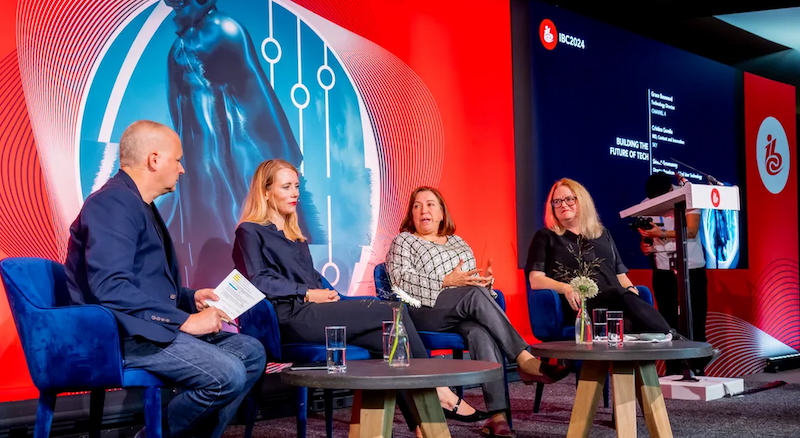
    LONDON: IBC 2025 has pulled back the curtain on a turbocharged conference programme packed with power players from across the global media, entertainment and tech ecosystem. From 12 to 14 September at RAI Amsterdam, the three-day summit promises to tackle media’s defining challenges—AI disruption, fragmentation, collapsing business models, and the war for attention.

    Top brass from Netflix, Walt Disney Studios, Paramount Global, Snap, TikTok, YouTube, Roku, TelevisaUnivision, PGA Tour, kweliTV and India’s JioStar are among the featured speakers. Industry provocateur Evan Shapiro will headline with a data-fuelled keynote, while seasoned commentator Mike Darcey closes the show with a sharp take on rights, economics and the shape of future broadcasting.

    “This year’s agenda is urgent, imaginative and provocative,” said IBC head of content Sally Watts. “We’re bringing together disruptors and legacy leaders to map the media universe as it shifts beneath our feet.”

    The conference kicks off with a heavyweight CTO roundtable featuring Avi Saxena (Warner Bros. Discovery), Simon Farnsworth (ITV) and Phil Wiser (Paramount). Big tech meets broadcast in sessions like YouTube’s Pedro Pina in conversation with Channel 4’s Grace Boswood, and Snap’s Jorrit Eringa alongside execs from Yahoo, Sky, Sling TV and A1 Group dissecting the future of content collaboration.

    TikTok’s Rollo Goldstaub will explore how short-form video is rewriting the rules of sports engagement, while Netflix’s Victor Marti and Vancouver Media’s Migue Amoedo offer a behind-the-scenes look at storytelling innovation.

    In a major AI-focused session, ABC’s Damian Cronin unpacks how the broadcaster is embedding machine learning into its core workflows. Meanwhile, DeShuna Spencer (kweliTV), Brad Danks (OUTtv), Rajat Nigam (JioStar India) and others weigh in on what’s next for the streaming wars.

    ‘MovieLabs – Leading the Vision’ sees Disney, Sony, Warner Bros. and Paramount map the road to 2030 for content creation, moderated by MovieLabs president Richard Berger. Sunday’s schedule spotlights Fremantle’s Jens Richter on global distribution in a post-peak TV world, while PGA Tour execs reveal how they deployed live AR shot-tracking across all 18 holes — winning a Sports Emmy in the process.

    In the closing session, Mike Darcey, now managing director at Tide End Consulting and former News UK boss, breaks down how rights, economics and regulation must evolve to fit the new media order.

    Beyond the main stage, the IBC Technical Papers Programme offers 10 peer-reviewed sessions delving deep into bleeding-edge R&D across 5G, 6G, AI, immersive formats and content authentication. Topics include:
    * AI in speech, postproduction and curation
    * Provenance, privacy and content trust
    * Wireless tech advances from 5G to 6G
    * IP Studio 2.0 and live production
    * Sport tech, AR, avatars and AI-enhanced streaming

    Registration is now open at show.ibc.org.

  • Smartphone based VAS to generate Rs Ten Trillion business

    Smartphone based VAS to generate Rs Ten Trillion business

    MUMBAI: The wireless Value Added Services (VAS) would subsume all services that today are delivered through different devices which are expected to create over 25,000 highly scalable new businesses with a revenue potential of Rs ten lakh crores over a period of time.

    While addressing the 14th VAS Asia 2013 Conference, at New Delhi on 12 July Telecom Regulatory Authority of India (TRAI) member R. K. Arnold said, “To achieve this, all the stake holders involved in telecom industry will have to work together to create a low cost smartphone device and make people aware of the potential of such a device.” The 14th VAS Asia 2013 conference was organised by Bharat Exhibitions.

    Welcoming the delegates to the conference Bharat Exhibitions managing director Shashi Dharan said, “The issue today with TRAI is not against the industry making money, but how does it make money is surely an issue.”

    Today the country needs to examine the fact that less than 40 per cent of the Indian population has the connectivity and out of which about four per cent own smartphones. “Mobile data could generate revenues worth Rs 40,000 crores by 2015. To achieve these numbers we need to look at the bottom of the pyramid where Mobile VAS will be most useful and economical,” said BSNL chairman & managing director Rakesh K Upadhyay.

    Dependence on the Internet for day to day life is on increase, said Bharti Airtel chief of strategy, architecture and engineering Shyam P. Mardikar, while dwelling on the vast changes that were already evident in the common man‘s work due to the mobile delivering newer and newer services.

    In a wide ranging presentation at the conference the Bharti Airtel executive demonstrated how the onrush new innovations were overtaking several traditional services like SMS. “Messaging applications have depleted dependence on SMS”, he said.

    M-Wallet, M-health services, are changing the market scenario. Text books are being replaced by wireless access to books that makes knowledge available to a much larger mass at low cost. The viability of this mode of information is making data consumption an opportunity.

    “The last mile connectivity is being replaced by a first mile super highway. The challenge for the operator is to make this happen by a dense network that would have flatter architecture with dynamic and on demand capacity as against the layered one. The move is towards a network that would be closer to the user forcing the last mile to shrink.”

    “The challenge which needs to be addressed is to create a situation where-in cross operators platform(s) needs to develop and deploy services with ease, in local language, across operators,” said OnMobile Global Ltd. co-founder & chief executive officer Mouli Raman. “The industry stakeholders need to collaborate to find the right solutions through technology.”

    Analysing the problems faced by the telecom service operators Cellular Operators Association of India director-general Rajan S. Mathews welcomed the latest changes that the TRAI has made in the regulations in VAS service provision. “However, we need to rethink on revenue sharing model between operators, application providers and government. If the Government wanted broadband to be universal, the operators should be offered 500 MHz of spectrum and not the small quantities now placed on auction,” he said.

    On the issue of refarming of spectrum use, Mathews said that the operators should be allowed to use it in the way they consider best rather than government forcing it on them as it involved huge costs that would impact service charges. He specifically pleaded for AADHAR being incorporated into the mobile to expand the services the user could obtain from them. “There is a huge opportunity in penetration of vernacular languages in the mobile smartphones specifically in speech recognition at the bottom of the pyramid level.”

    The possible fall in profitability for the operator as voice was substituted by data was a matter of concern, said Robi Axiata CMO Pradeep Shrivastava. Scale was the next step forward in Mobile VAS.

    OnMobile, Qualcomm, Radisys, IMImobile, Tri-O-Tech Solutions, One97, Dialogic, DigiVive, Gemalto, IPgallery, Ehangcom, MediaTek, Synway, BincaTunes, DONJIN, SUPRANETCOM, DSNL, D‘Well Research, InCights Mobile, Nexge and Teracom participated in the event, making it a truly global platform to conduct business.

  • Third Indian Screenwriters conference in Mumbai from 25-27 Feb

    Third Indian Screenwriters conference in Mumbai from 25-27 Feb

    MUMBAI: The 3rd Indian Screenwriters‘ conference will be held from 25 to 27 February at Bandra in Mumbai.

    Organised by the Film Writers Association (FWA), the conference will be attended by a host of senior writer-directors from the industry and experienced lawyers and legal experts. But, there is a hitch, only members of the FWA are eligible to attend the event. Non-members will need to register as members first.

    The agenda of the conference has been divided in two parts. One is the ‘creative issues‘ of television and film writers and the other is professional and legal issues faced by them.

    According to the FWA website, the first includes deliberations on the “disconnect/connect of popular entertainment with our social reality, questions of why a society in dramatic transition is not reflected in our cinema and TV, the representation and portrayal of women in our stories, whether and how these interpretations influence audiences, the new definition of heroism in cinema today and the rise of machismo, what happened to the common man‘s issues, why most TV shows seem to lose the plot, what is really driving content on TV today, does the screenwriter have a social responsibility, and such.

    The latter will address the provisions of the Minimum Basic Contract for film writers and the Minimum Basic Contract for TV writers and the Copyright Act.