Tag: Conditional Access

  • Sub: Memorandum- Implementation of Conditional Access

    Sub: Memorandum- Implementation of Conditional Access

    First of all on behalf of all Lastmile Service Providers (LSPs) we welcome you to the coveted post of Minister for Information and Broadcasting and assure you of our wholehearted support in performing your duties.
     

    There are thousands of Lastmile Service Providers who, for the last 12 years, are providing Cable TV and other broadband services like Internet and video-on-demand to about 40 million households in the country. These service providers are innovative entrepreneurs who have provided employment to lakhs of workers all over the country training them for day and night services all the year around. In forming any regulation or policies for the Satellite and Cable TV industry, we request you to kindly keep the interest of these lakhs of people who are the breadwinners of their families.

     
    Our organisation has been bringing to the notice of the I & B Ministry the problems faced by these entrepreneurs and have been instrumental in bringing changes in the legislation with the kind co-operation of your staff and support of your predecessors. The latest danger faced by these people is possibility of their takeovers by the big business houses who are the MSOs (Multi System Operators) and Broadcasters, in the wake of implementation of Conditional Access for the delivery of pay channels on their networks. Everyday, new methods are being devised by these MSOs and Broadcasters to push out the lastmile service providers and take over the lucrative satellite and cable TV market for their vested interest.

  • Conditional Access: A basic guide

    Conditional Access: A basic guide

    MUMBAI: What is conditional access? How does it work? Is it prevalent globally? What should India do? Is the CAS Amendment a good enough framework?

    These are among many more questions that are plaguing industry, planners and the viewer. To make CAS simpler and understandable for both the technophile and the technophobe, Indiantelevision.com scoured the net and came up with a list of resources on the WWW. We hope these will help clear out some of the cobwebs and haze around CAS. Happy Reading!!

    Conditional access (CA) is a technology used to control access to digital television (DTV) services to authorized users by encrypting the transmitted programming. CA has been used for years for pay-TV services. There are numerous ATSC and DVB-compliant CA systems available for a broadcaster to choose from. The CA system provider provides the equipment and software to the broadcaster who then integrates the CA system into his equipment.

    The following describes the conditional access process: 
    *The receiver receives the digital data stream. 
    *The data flows into the conditional access module, which contains the content provider’s unscrambling algorithms. 
    *The conditional access module verifies the existence of a smart card that contains the subscriber’s authorization code. 
    *If the authorization code is accepted, the conditional access module unscrambles the data and returns the data to the receiver. If the code is not accepted, the data remains scrambled restricting access. 
    *The receiver then decodes the data and outputs it for viewing.

    A CA system consists of several basic components:

    Subscriber Management System (SMS): The SMS is a subsystem of the CA system that manages the subscriber’s information and requests entitlement management messages (EMM) from the Subscriber Authorization System (SAS). An EMM provides general information about the subscriber and the status of the subscription. The EMM is sent with the ECM. The ECM is a data unit that contains the key for decrypting the transmitted programs.

    Subscriber Authorization System (SAS): The SAS is a subsystem of the CA system that translates the information about the subscriber into an EMM at the request of the SMS. The SAS also ensures that the subscriber’s security module receives the authorization needed to view the programs, and the SAS acts as a backup system in case of failure.

    Security module: The security module, usually in the form of a smart card, extracts the EMM and ECM necessary for decrypting the transmitted programs. The security module is either embedded within the set-top box or in a PC Card that plugs into the set-top box.

    Set-top box: The set-top box houses the security module that gives authorization for decrypting the transmitted programs. The set-top box also converts the digital signal to an analogue signal so an older television can display the programs. .

    Smart Cards: For years, smart cards have been used for pay TV programming. Smart cards are inexpensive, allowing the content provider to issue updated smart cards periodically to prevent piracy. Detachable PC cards allow subscribers to use DVB services anywhere DVB technology is supported. 

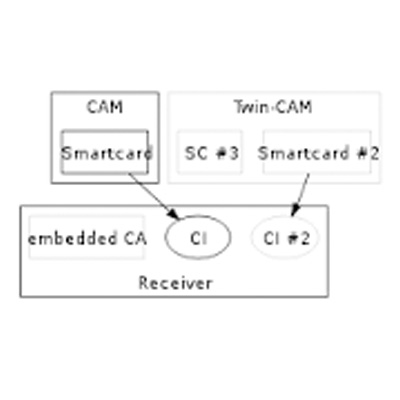
    There are two DVB protocols used by CA systems: SimulCrypt and MultiCrypt. SimulCrypt uses multiple set-top boxes, each using a different CA system, to authorize the programs for display. The different ECMs and EMMs required by each CA system are transmitted simultaneously. Each set-top box recognizes and uses the appropriate ECM and EMM needed for authorization. The ATSC standard uses SimulCrypt. MultiCrypt allows multiple CA systems to be used with one set-top box by using a PC card with an embedded smart card for each CA system used. Each card is then plugged into a slot in the set-top box. Each card recognizes the ECM and EMM needed for authorization.

    A typical CA process involves three basic elements: the broadcast equipment, the set-top box, and the security module. The broadcast equipment generates the encrypted programs that are transmitted to the subscriber. When these are transmitted, the set-top box filters out the signals and passes them to the security module. The security module then authorizes these programs for decryption. The programs are then descrypted in real time and sent back to the set-top box for display
  • Conditional Access: A basic guide

    Conditional Access: A basic guide

    MUMBAI: What is conditional access? How does it work? Is it prevalent globally? What should India do? Is the CAS Amendment a good enough framework?

    These are among many more questions that are plaguing industry, planners and the viewer. To make CAS simpler and understandable for both the technophile and the technophobe, Indiantelevision.com scoured the net and came up with a list of resources on the WWW. We hope these will help clear out some of the cobwebs and haze around CAS. Happy Reading!!

    Conditional access (CA) is a technology used to control access to digital television (DTV) services to authorized users by encrypting the transmitted programming. CA has been used for years for pay-TV services. There are numerous ATSC and DVB-compliant CA systems available for a broadcaster to choose from. The CA system provider provides the equipment and software to the broadcaster who then integrates the CA system into his equipment.

    The following describes the conditional access process: 
    *The receiver receives the digital data stream. 
    *The data flows into the conditional access module, which contains the content provider’s unscrambling algorithms. 
    *The conditional access module verifies the existence of a smart card that contains the subscriber’s authorization code. 
    *If the authorization code is accepted, the conditional access module unscrambles the data and returns the data to the receiver. If the code is not accepted, the data remains scrambled restricting access. 
    *The receiver then decodes the data and outputs it for viewing.’

    A CA system consists of several basic components:

    Subscriber Management System (SMS): The SMS is a subsystem of the CA system that manages the subscriber’s information and requests entitlement management messages (EMM) from the Subscriber Authorization System (SAS). An EMM provides general information about the subscriber and the status of the subscription. The EMM is sent with the ECM. The ECM is a data unit that contains the key for decrypting the transmitted programs.

    Subscriber Authorization System (SAS): The SAS is a subsystem of the CA system that translates the information about the subscriber into an EMM at the request of the SMS. The SAS also ensures that the subscriber’s security module receives the authorization needed to view the programs, and the SAS acts as a backup system in case of failure.

    Security module: The security module, usually in the form of a smart card, extracts the EMM and ECM necessary for decrypting the transmitted programs. The security module is either embedded within the set-top box or in a PC Card that plugs into the set-top box.

    Set-top box: The set-top box houses the security module that gives authorization for decrypting the transmitted programs. The set-top box also converts the digital signal to an analogue signal so an older television can display the programs. .

    Smart Cards: For years, smart cards have been used for pay TV programming. Smart cards are inexpensive, allowing the content provider to issue updated smart cards periodically to prevent piracy. Detachable PC cards allow subscribers to use DVB services anywhere DVB technology is supported. 

    There are two DVB protocols used by CA systems: SimulCrypt and MultiCrypt. SimulCrypt uses multiple set-top boxes, each using a different CA system, to authorize the programs for display. The different ECMs and EMMs required by each CA system are transmitted simultaneously. Each set-top box recognizes and uses the appropriate ECM and EMM needed for authorization. The ATSC standard uses SimulCrypt. MultiCrypt allows multiple CA systems to be used with one set-top box by using a PC card with an embedded smart card for each CA system used. Each card is then plugged into a slot in the set-top box. Each card recognizes the ECM and EMM needed for authorization.

    A typical CA process involves three basic elements: the broadcast equipment, the set-top box, and the security module. The broadcast equipment generates the encrypted programs that are transmitted to the subscriber. When these are transmitted, the set-top box filters out the signals and passes them to the security module. The security module then authorizes these programs for decryption. The programs are then descrypted in real time and sent back to the set-top box for display
  • Conditional Access: A basic guide

    MUMBAI: What is conditional access? How does it work? Is it prevalent globally? What should India do? Is the CAS Amendment a good enough framework?


    These are among many more questions that are plaguing industry, planners and the viewer. To make CAS simpler and understandable for both the technophile and the technophobe, Indiantelevision.com scoured the net and came up with a list of resources on the WWW. We hope these will help clear out some of the cobwebs and haze around CAS. Happy Reading!!

     
    Conditional access (CA) is a technology used to control access to digital television (DTV) services to authorized users by encrypting the transmitted programming. CA has been used for years for pay-TV services. There are numerous ATSC and DVB-compliant CA systems available for a broadcaster to choose from. The CA system provider provides the equipment and software to the broadcaster who then integrates the CA system into his equipment.


    The following describes the conditional access process:

    *The receiver receives the digital data stream.

    *The data flows into the conditional access module, which contains the content provider’s unscrambling algorithms.

    *The conditional access module verifies the existence of a smart card that contains the subscriber’s authorization code.

    *If the authorization code is accepted, the conditional access module unscrambles the data and returns the data to the receiver. If the code is not accepted, the data remains scrambled restricting access.

    *The receiver then decodes the data and outputs it for viewing.

    A CA system consists of several basic components: Subscriber Management System (SMS): The SMS is a subsystem of the CA system that manages the subscriber’s information and requests entitlement management messages (EMM) from the Subscriber Authorization System (SAS). An EMM provides general information about the subscriber and the status of the subscription. The EMM is sent with the ECM. The ECM is a data unit that contains the key for decrypting the transmitted programs.


    Subscriber Authorization System (SAS): The SAS is a subsystem of the CA system that translates the information about the subscriber into an EMM at the request of the SMS. The SAS also ensures that the subscriber’s security module receives the authorization needed to view the programs, and the SAS acts as a backup system in case of failure.


    Security module: The security module, usually in the form of a smart card, extracts the EMM and ECM necessary for decrypting the transmitted programs. The security module is either embedded within the set-top box or in a PC Card that plugs into the set-top box.


    Set-top box: The set-top box houses the security module that gives authorization for decrypting the transmitted programs. The set-top box also converts the digital signal to an analogue signal so an older television can display the programs. .


    Smart Cards: For years, smart cards have been used for pay TV programming. Smart cards are inexpensive, allowing the content provider to issue updated smart cards periodically to prevent piracy. Detachable PC cards allow subscribers to use DVB services anywhere DVB technology is supported.


    There are two DVB protocols used by CA systems: SimulCrypt and MultiCrypt. SimulCrypt uses multiple set-top boxes, each using a different CA system, to authorize the programs for display. The different ECMs and EMMs required by each CA system are transmitted simultaneously. Each set-top box recognizes and uses the appropriate ECM and EMM needed for authorization. The ATSC standard uses SimulCrypt. MultiCrypt allows multiple CA systems to be used with one set-top box by using a PC card with an embedded smart card for each CA system used. Each card is then plugged into a slot in the set-top box. Each card recognizes the ECM and EMM needed for authorization.


    A typical CA process involves three basic elements: the broadcast equipment, the set-top box, and the security module. The broadcast equipment generates the encrypted programs that are transmitted to the subscriber. When these are transmitted, the set-top box filters out the signals and passes them to the security module. The security module then authorizes these programs for decryption. The programs are then descrypted in real time and sent back to the set-top box for display