Tag: comScore

  • Comscore ranks India Today Group at No.1 in video news streaming

    Comscore ranks India Today Group at No.1 in video news streaming

    Mumbai: As the nation’s top multi-platform news outlet and the provider with the highest digital viewing reach for streaming news platforms according to Comscore, India Today Group has persevered in outshining the competition on its relentless journey.

    As per the Comscore Videometrix MultiPlatform Report for July 2022, the media giant tops the rankings list with a digital viewership of 98,600 in the streaming video attribute of the news/information streaming ranked category.

    This development showcases the group’s focus on constantly innovating and servicing its trusted viewership base in the digital ecosystem.

    The India Today Group’s enormous success can be attributed to its strategy of emphasising video, being strong on mobile, and making sure it has a strong social media presence and ranks at the top of YouTube, Facebook, Instagram, and Twitter.

    In the Comscore Videometrix MultiPlatform Report for July 2022, the India Today Group tops the charts by over 15,000 points, beating Times Internet (83,000), Network18 (79,000), and ABP News on YouTube (73,000) by a distance.

    The group’s multiplatform products have had enormous success, which can be credited to its strengths in mobile, video, and social media, and to being the most popular brand on YouTube, Facebook, Instagram, and Twitter.

  • BARC India exhorts TRAI to ‘empower’ it as digital measurer

    BARC India exhorts TRAI to ‘empower’ it as digital measurer

    MUMBAI: In a smart move that could lead to further enhancing of its credibility and importance, Broadcast Audience Research Council India (BARC India) has exhorted Telecom Regulatory Authority of India (TRAI) to “empower” it to be the uniform measurer of audience and other data related to TV, and OTT and digital platforms.   

    “BARC, which provides significant granular measurement data on television, if empowered by this Hon’ble authority, shall provide unbiased and accurate measurement data on contents broadcasted, streamed, re-transmitted, downloaded and shared in OTT platforms. The outcome of the above will lead to one single robust measurement report for television, OTT and digital platforms,” the Indian measurement organisation has said in its submission on TRAI’s consultation paper on regulatory framework for OTT communication services.

    Interestingly, while BARC India’s commitment to roll out digital media measurement services Ekam is a work in progress, the present TRAI consultation paper is more focussed on OTT voice or communications services like WhatsApp, Facebook’s Messenger and similar Indian products like Hike. However, it must be made clear here that many of the over 80 submissions from diverse stakeholders, including big TV companies like Star India and Zee, do dwell on video OTT and possibilities relating to regulations.

    Quoting from the Mobile Eco-system and Ad-sizing Report 2018 that highlights India has 250 million registered online video viewers, 100 million OTT viewers and that viewing of video content increased by 75 per cent in recent times, BARC India drives home the point if the contents streamed, viewed, re­transmitted and downloaded on OTT services “are measured and rated” by it, “more transparency in the digital eco-system” would follow.

    Highlighting the many strengths of the system and technology that the organisation presently employs and deploys, BARC India has submitted: “The OTT platforms prevail in the mobile and virtual worlds, which allow advertisers to easily and efficiently target well-defined groups or even individual consumers across various mediums…Hence, it is imminent to regulate, analyse and derive audience measurement system on OTT platforms.”

    Although several global agencies like comScore, Nielsen, App Annie and SimilarWeb provide third-party analytics on OTT platforms, the Indian industry lacks a credible and neutral measurement agency, it has been contended. As digital ad spends increase gradually, proper data analytics will offer additional opportunity to advertisers and clients to compare the effectiveness of media spends amongst various distribution platforms.

    BARC India, which has successfully set up a transparent, accurate, and inclusive TV audience measurement system that’s built upon a robust and future-ready technology backbone, while strengthening its case to measure and analyse the digital realm, has added the “big data and insights” generated by it presently powers “efficient media spends and content decisions” in a highly dynamic and growing television sector of India.

    With a panel that is currently being scaled up to 180,000 individuals, BARC India is also the largest measurement company of its kind in the world.

  • Online majors are biggest spenders on TV, says a global report

    Online majors are biggest spenders on TV, says a global report

    MUMBAI: Some of the biggest tech giants are the biggest spenders on TV.Figures from around the world show the extent to which online businesses are now investing in TV advertising.

    For example, in Australia in 2017, Google spent sixtimes as much on TV advertising, reaching A$11.3 million and Apple increased its ad spend by 17.4 per cent to A$20.2 million. Amazon backed its Australian launch with a TV ad investment of A$3.2 million, and Uber increased its TV spend with a first investment of A$3.4 million, according to Nielsen Adex,.

    Using comScore data in the US, the Video Advertising Bureau found that online businesses see an immediate and significant lift in web traffic once they launch TV campaigns – data from 14 online businesses showed the lift ranged from 11 per cent to 1,075 per cent. Studies from around the world have proven the impact that TV advertising has on online activity. A study in France by SNPTV found that organic traffic to a pure players’s website increases by 66 per cent during a TV advertising campaign.

    The global figures were compiled by The Global TV Group, an informal grouping of TV broadcasters’ and sales houses’ trade bodies in Europe, the US, Canada, Australia and Latin America. Findings show that from Brazil to Germany, brands such as Amazon, Zalando, Netflix, Expedia and Airbnb are building their image, reputation and sales through the reach and influence of TV.

    The investment trend demonstrates the strong relationship between TV and online, with viewers armed with Internet-connected devices able to respond to TV advertising immediately.

    According to Google Australia and New Zealand marketing director Aisling Finch,”Like most marketers, we use a range of channels to achieve campaign objectives. We know that audiences engage with content across different platforms at different times, and marketers do the same. For campaigns such as the launch of Google Home we used a combination of radio, TV, cinema, print, outdoor and online channels including search, YouTube and social. In this campaign we found the combination of contextual media and creative drove stronger uplift.”

    In Belgium, during 2016, TV represented a 62 per cent share of the online business sector’s media investments. The Rocket Internet group, the second biggest spender, which owns companies like HelloFresh and Home24, spent a total of €6,072,463 in 2017 on TV advertising.

    Online businesses’ TV ad spend grew by 17 per cent in Brazil between 2015 and 2017. When including the e-commerce players owning physical stores, the increase is almost 20 per cent. In Canada, online businesses represent one of the fastest growing sectors in TV advertising. Online businesses have doubled spend on TV over the past five years, with spend in 2017 topping $105 million.

    Over a 3-year period (2015 to 2017), Airbnb’s TV ad spend increased by 44 per cent. Expedia and Amazon show even more impressive figures with an increase of 65 per cent each. In Italy, online businesses invested a total of €95,653,000 in TV in 2017, representing a 10.7 per cent increase compared to 2015 whereas in Netherlands, e-commerce advertisers increased their TV investment by 26 per cent between 2015 and 2017 to become the fourth biggest category of TV-advertisers. 200 e-commerce advertisers invested €300 million gross in TV in 2017. The highest TV investor was the German booking site Trivago with a gross investment of €25 million. Spain saw Amazon’s TV ad spend go from €106,990 in 2015 to €11,006,360 in 2017, more than 100 times the investment in 2015. Google’s investment in TV went from €40,250 in 2015 to €603,620 in 2017, 15 times more.

    In United Kingdom, online businesses including brands Amazon, Trivago, Google and Purple Bricks invested a total of £682 million in TV advertising in 2017, up from £590 million in 2015. Despite cuts in other categories due to ongoing economic uncertainty, online businesses, which in 2016 became the biggest spenders on TV in the UK, remained steadfast in their TV investment.

    United States of America in 2017, saw digital-native companies including brands like Amazon, Expedia, Wayfair and eBay spend over $5.9 billion US dollars on TV, representing a 10 per cent increase over 2016.  Within this spend is a group of 50 “direct-disruptor” newcomer brands, including Gwynnie Bee, Peloton and Leesa – who only recently began investing in TV but now collectively spend over $1.3 billion US dollars in TV annually.

    The positive trend is set to continue in 2018 as more e-commerce brands around the globe put their trust in TV advertising to strengthen their image, drive traffic and generate return.

    Video Advertising Bureau president and CEO Sean Cunningham said, “We’ve been analysing digital-native companies since 2014 and found that those who turned to a heavy reliance on TV early in their company’s history saw substantial benefits.”

    n a more recent study, featuring various case studies, the VAB looked into how TV drives business outcomes for disruptor brands. For example, expanding brands saw an average increase of 188 per cent in their search volume as they increased their TV investment.

  • WATConsult launches DASH (board) to view data insights

    WATConsult launches DASH (board) to view data insights

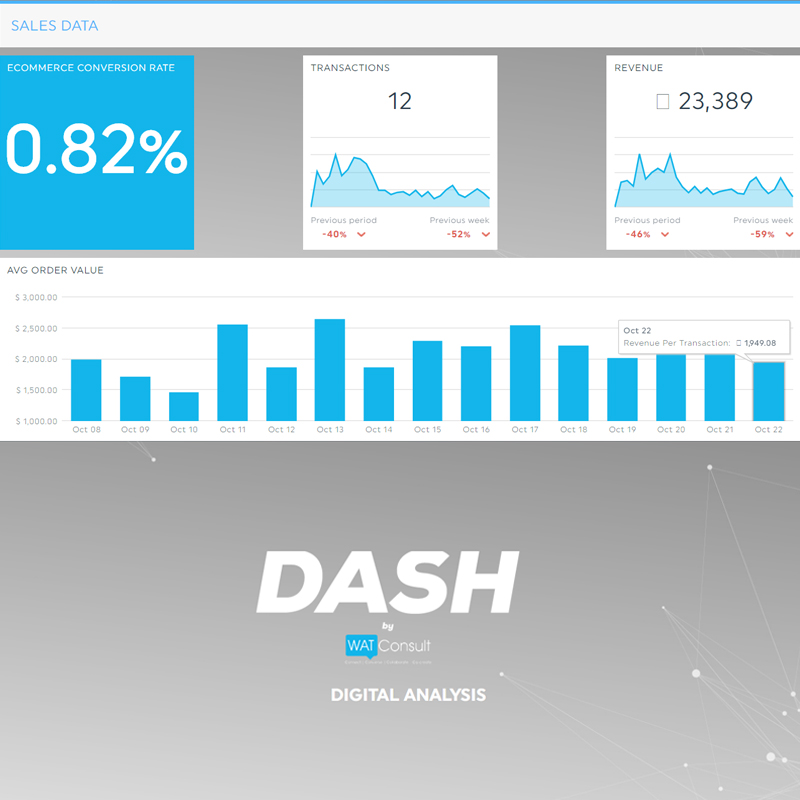
    MUMBAI: Digital and social media agency WATConsult, part of Dentsu Aegis Network, has announced the launch of DASH, a singular dashboard to view all digital data with insights.

    DASH will be a new service as a part of its digital solution stack, which is designed to offer Integrated Digital Services. DASH will allow tracking of paid, owned & earned POV on a single Dashboard, thus allowing brands to view and look at metrics across platforms and campaigns at a glance.

    It has integrated various platforms like ComScore, Facebook, Facebook Ads, Twitter, Twitter Ads, LinkedIn, LinkedIn Ads, Instagram, Instagram Ads, AdWords and DCM. With this, brands can now get access to real time data; integration of social media platforms, ad platforms, web analytics; ability to add titles, sections, comments & notes and include custom data with CSV files.

    WATConsult founder and CEO Rajiv Dingra says, “We aim to be at the forefront of cracking digital solutions using automation for planning and operational processes to drive effective results. With the launch of DASH, we continue to drive efficiencies through deployment of technology on digital media for clients.”

  • comScore introduces free viewability measurement across digital ad market

    MUMBAI: comScore  will offer free viewability measurement to clients across global markets. comScore Viewability allows digital media buyers and sellers to measure viewability rates across display, video, and mobile inventory. The new service will deliver key metrics for display and video campaigns across mobile and desktop platforms.

    comScore  announced that it will offer free viewability measurement to clients across global markets. comScore Viewability is a baseline offering that allows digital media buyers and sellers to measure viewability rates across display, video, and mobile inventory. This initiative promotes trust and transparency in digital advertising and improves cross-media comparability.

    ComScore’s move to eliminate fees on metrics coincides with its launch of a self-serve interface that integrates both its fraud detection and viewability reporting.The product, which was partly built on comScore’s acquisition of MdotLabs, will be generally available by June, said comScore CEO Gian Fulgoni.

    Viewability is an increasingly expected part of advertising verification, but can consume measurement budgets and displace other important campaign metrics. As a result, ad effectiveness is often gauged by viewability metrics alone, even though these speak only to whether or not an ad impression is seen and not whether it made an impact.

    By enabling media buyers and sellers to measure viewability at no cost, comScore Viewability increases clients’ ability to focus on deeper performance metrics, such as reach within geographic and demographic targets and lift in brand awareness, purchase intent, visitation or product sales.

    “Viewability is critical, but for too long it has dominated industry discussion at the expense of other metrics that also really matter,” said Dan Hess, executive vice president of products at comScore. “We think it’s time to make viewability a table stake for digital advertising, and move the market forward to a broader realm of more meaningful ad measurement across platforms.”

    Also Read:

    BARC India & Israeli company explore customised digital measurement tools

    Planning & buying in India’s digital video landscape: A primer

  • BARC India & Israeli company explore customised digital measurement tools

    BARC India & Israeli company explore customised digital measurement tools

    NEW DELHI: The Broadcast Audience Research Council of  India (BARC India) is said to be in talks with an Israeli media technology company to customise for it tools for digital measurement, which is likely to be rolled out in phases from sometime in 2017 or early 2018 and could go on to make BARC India an organisation measuring TV+digital eco-systems.

    After having issued Request for Information (RfI) for digital measurement in December 2015 and having received responses from 11 leading vendors from across the world, BARC India had come out last year Request for Proposals for the same.

    BARC India is presently working on digital proof of concept that will help it in testing different technologies, methodologies and potential capabilities of the shortlisted vendors.

    The companies that had responded to the RfI included agencies such as Kantar Media, IMRB, ComScore, Nielsen, MediaMetrie, Gracenote (in December 2016  it entered into an agreement to be acquired by Nielsen), Informate, GfK, Accenture, EY, eywa Media, Gemius and Verto Analytics.

    It was in October 2015 that BARC India CEO Partho Dasgupta had announced at a panel discussion on new TAM models at CASBAA Convention in Hong Kong that the audience measurement organisation was looking at launching digital measurement and will float a global tender for vendor(s).

    Industry sources indicated that the Israeli company could be Actus Digital, a global provider of broadcast media and video technologies, and that the exploratory talks between the company and BARC India could be revolving around customising measurement tools for India instead of simply re-deploying universal tools generally used by big companies for digital data collection.

    However, it must be admitted that Indiantelevision.com could not independently confirm the name of the Israeli company from either BARC India or the company concerned till the time of writing this report.

    The barely two-year-old BARC India, which initially focussed on measuring TV viewing habits via BAR-O-Meters through watermarking technology, is now expanding into the digital realm.

    BARC India is jointly promoted by the Indian Broadcasting Foundation (IBF), the Indian Society of Advertisers (ISA) and the Advertising Agencies Association of India (AAAI) with the latter two organisations holding 20 per cent each, while the broadcasting body holds 60 per cent.

    ALSO READ:

    BARC issues RFP for playout monitoring and DB system

    BARC India eyes digital measurement; calls for global RFIs

    BARC India ropes in Nielsen’s Jamie Kenny as DAM head


  • BARC India & Israeli company explore customised digital measurement tools

    BARC India & Israeli company explore customised digital measurement tools

    NEW DELHI: The Broadcast Audience Research Council of  India (BARC India) is said to be in talks with an Israeli media technology company to customise for it tools for digital measurement, which is likely to be rolled out in phases from sometime in 2017 or early 2018 and could go on to make BARC India an organisation measuring TV+digital eco-systems.

    After having issued Request for Information (RfI) for digital measurement in December 2015 and having received responses from 11 leading vendors from across the world, BARC India had come out last year Request for Proposals for the same.

    BARC India is presently working on digital proof of concept that will help it in testing different technologies, methodologies and potential capabilities of the shortlisted vendors.

    The companies that had responded to the RfI included agencies such as Kantar Media, IMRB, ComScore, Nielsen, MediaMetrie, Gracenote (in December 2016  it entered into an agreement to be acquired by Nielsen), Informate, GfK, Accenture, EY, eywa Media, Gemius and Verto Analytics.

    It was in October 2015 that BARC India CEO Partho Dasgupta had announced at a panel discussion on new TAM models at CASBAA Convention in Hong Kong that the audience measurement organisation was looking at launching digital measurement and will float a global tender for vendor(s).

    Industry sources indicated that the Israeli company could be Actus Digital, a global provider of broadcast media and video technologies, and that the exploratory talks between the company and BARC India could be revolving around customising measurement tools for India instead of simply re-deploying universal tools generally used by big companies for digital data collection.

    However, it must be admitted that Indiantelevision.com could not independently confirm the name of the Israeli company from either BARC India or the company concerned till the time of writing this report.

    The barely two-year-old BARC India, which initially focussed on measuring TV viewing habits via BAR-O-Meters through watermarking technology, is now expanding into the digital realm.

    BARC India is jointly promoted by the Indian Broadcasting Foundation (IBF), the Indian Society of Advertisers (ISA) and the Advertising Agencies Association of India (AAAI) with the latter two organisations holding 20 per cent each, while the broadcasting body holds 60 per cent.

    ALSO READ:

    BARC issues RFP for playout monitoring and DB system

    BARC India eyes digital measurement; calls for global RFIs

    BARC India ropes in Nielsen’s Jamie Kenny as DAM head


  • POKKT announces the launch of a first-of-its kind technology revolutionizing ad-viewing for brands and consumers

    POKKT announces the launch of a first-of-its kind technology revolutionizing ad-viewing for brands and consumers

    Mumbai: POKKT, Asia’s leading rewarded video ad network co-founded by Rohit Sharma, Manish Tewari and Vaibhav Odhekar, is creating and setting industry benchmarks again with the launch of their cutting edge technology that promises to transform the functioning of the ad-tech industry. With this in-house technology, a first of its kind in the region, brands will be able to pay only for viewable impressions through tracking sensors in real time that will observe if the user is watching the video or not, thereby negating misleading or fraud traffic numbers.

    Launched in 2012, POKKT enables over 500 global and local game publishers and developers to monetize their apps through branded video ads by integrating their Software Development Kits (SDKs) and has a reach of over 100 million unique users in the region.

    While ensuring 100% viewership of all in-app mobile video ad campaigns, POKKT’s new technology also aligns to the Media Rating Council’s* guidelines for measurement of in-app viewable impressions. It applies to all in-app video ads bought directly or via private programmatic deals.

    This technology aims to do away with the current ad-tech and mobile video advertising industry challenges related to ad blocking and fraud traffic. Ensuring 100% viewership is an important Key Performance Indicator (KPI) for POKKT to re-innovate mobile advertising by providing top notch ads and measurements that advertisers can understand.

    Speaking about their latest innovation, Manish Tewari, CTO & Co-Founder, POKKT said, “The ad tech and mobile industry had been facing a major roadblock in measuring effectiveness of their campaigns and its exact reach. To resolve this for all of our clients, we have developed this technology wherein the advertisers and we can measure whether the target is actually watching the video through tracking sensors which provides us with data such as if there is a change in the angle at which the video is being watched etc. If the sensors indicate that the person is not watching the video, we pause the ad, thereby reducing fraud traffic numbers.”

    POKKT’s new proprietary technology will give all campaigns and advertisers the most comprehensive viewership offering possible. Advertisers will only have to pay on viewable impressions that are calculated on a CPM-basis (Cost per thousand impressions) verified by an independent third party ad rating tools like Nielsen, Moat, Comscore.

  • POKKT announces the launch of a first-of-its kind technology revolutionizing ad-viewing for brands and consumers

    POKKT announces the launch of a first-of-its kind technology revolutionizing ad-viewing for brands and consumers

    Mumbai: POKKT, Asia’s leading rewarded video ad network co-founded by Rohit Sharma, Manish Tewari and Vaibhav Odhekar, is creating and setting industry benchmarks again with the launch of their cutting edge technology that promises to transform the functioning of the ad-tech industry. With this in-house technology, a first of its kind in the region, brands will be able to pay only for viewable impressions through tracking sensors in real time that will observe if the user is watching the video or not, thereby negating misleading or fraud traffic numbers.

    Launched in 2012, POKKT enables over 500 global and local game publishers and developers to monetize their apps through branded video ads by integrating their Software Development Kits (SDKs) and has a reach of over 100 million unique users in the region.

    While ensuring 100% viewership of all in-app mobile video ad campaigns, POKKT’s new technology also aligns to the Media Rating Council’s* guidelines for measurement of in-app viewable impressions. It applies to all in-app video ads bought directly or via private programmatic deals.

    This technology aims to do away with the current ad-tech and mobile video advertising industry challenges related to ad blocking and fraud traffic. Ensuring 100% viewership is an important Key Performance Indicator (KPI) for POKKT to re-innovate mobile advertising by providing top notch ads and measurements that advertisers can understand.

    Speaking about their latest innovation, Manish Tewari, CTO & Co-Founder, POKKT said, “The ad tech and mobile industry had been facing a major roadblock in measuring effectiveness of their campaigns and its exact reach. To resolve this for all of our clients, we have developed this technology wherein the advertisers and we can measure whether the target is actually watching the video through tracking sensors which provides us with data such as if there is a change in the angle at which the video is being watched etc. If the sensors indicate that the person is not watching the video, we pause the ad, thereby reducing fraud traffic numbers.”

    POKKT’s new proprietary technology will give all campaigns and advertisers the most comprehensive viewership offering possible. Advertisers will only have to pay on viewable impressions that are calculated on a CPM-basis (Cost per thousand impressions) verified by an independent third party ad rating tools like Nielsen, Moat, Comscore.

  • comScore – Rentrak merger moves one step closer to completion

    comScore – Rentrak merger moves one step closer to completion

    MUMBAI: comScore, Inc and Rentrak Corporation have said that the registration statement on Form S-4 filed with the U.S. Securities and Exchange Commission (SEC) by comScore on 30 October, 2015, and as subsequently amended, which includes a joint proxy statement/prospectus of comScore and Rentrak, was declared effective by the SEC on 23 December, 2015.


    comScore and Rentrak have each scheduled special shareholder meetings for 28 January, 2016, in order to seek shareholder approval of the proposed merger. Each company’s shareholders of record at the close of business on 10 December, 2015 will be entitled to vote at their respective meetings.


    On 23 December, 2015, comScore filed a revised joint proxy statement/prospectus pursuant to Rule 424(b) of the Securities Act of 1933, as amended, in order to make available the document that will be mailed to comScore and Rentrak shareholders in connection with the respective special meetings. The joint proxy statement/prospectus is available through the SEC’s website at www.sec.gov and via comScore’s IR website and Rentrak’s IR website. comScore and Rentrak will begin mailing the joint proxy statement/prospectus to their respective shareholders to provide additional information and instructions for voting by 28 December, 2015.


    The closing of the merger remains subject to approval by comScore and Rentrak shareholders. As was reported earlier by Indiantelevision.com, the merger agreement was unanimously approved by the boards of directors of both companies, and comScore and Rentrak expect the deal to close promptly after the shareholder approval. Assuming shareholder approval, the combined company is expected to trade under the comScore ticker symbol (SCOR) by the end of January.


    On 29 September, 2015, comScore and Rentrak entered into a definitive agreement to merge in an all-stock, tax-free transaction. Under the terms of the agreement, Rentrak shareholders will receive 1.15 comScore shares for each Rentrak share they own. Upon completion of the merger, comScore shareholders are expected to own approximately 66.5 per cent and Rentrak shareholders are expected to own approximately 33.5 per cent of the combined company on a fully diluted basis.