Tag: Community Radio stations

  • TV, Radio urged to mark International Yoga day in befitting manner

    TV, Radio urged to mark International Yoga day in befitting manner

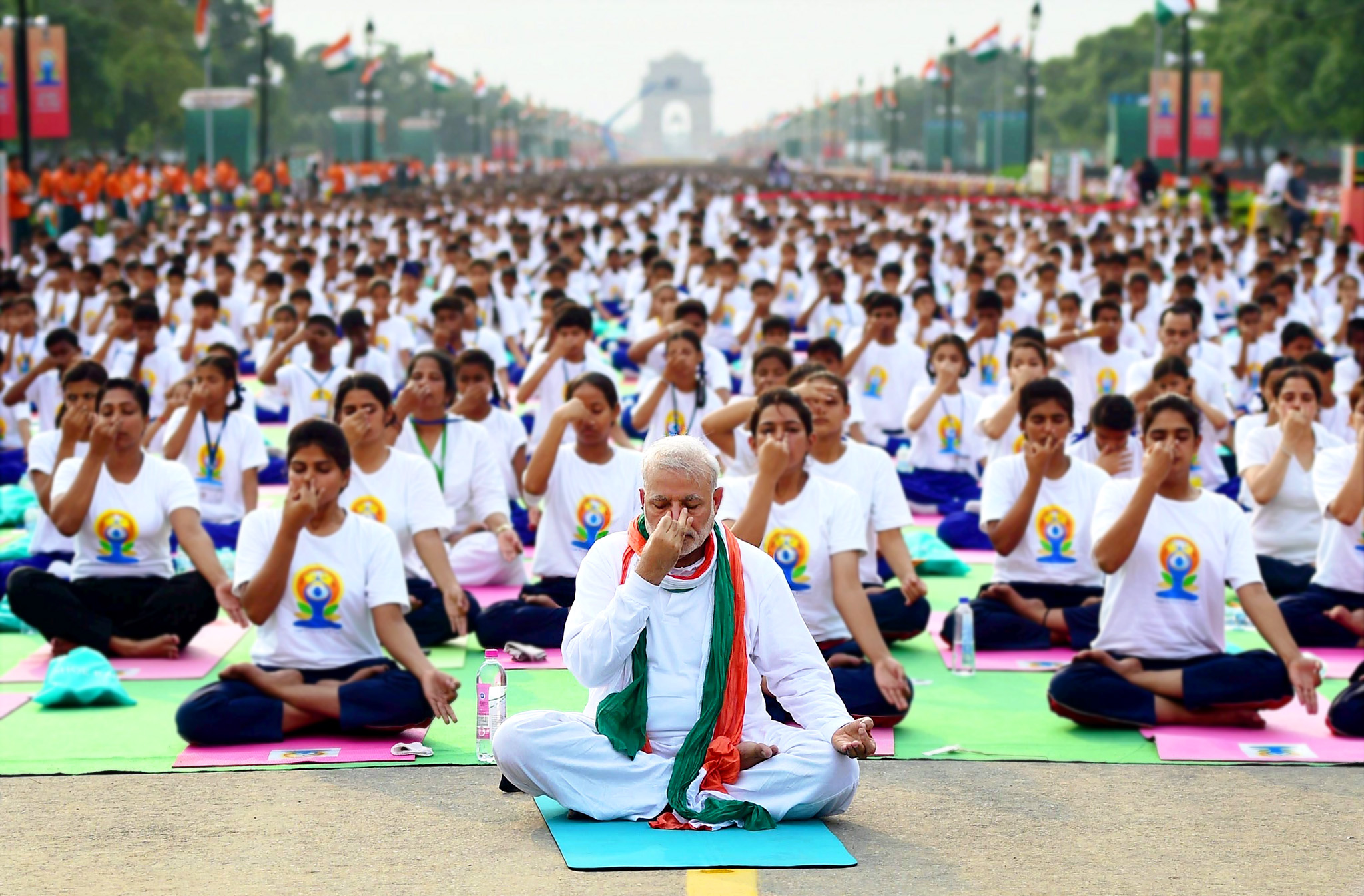
    NEW DELHI: All television channels, FM Radio, and Community Radio stations are expected to take ‘all possible steps this year also to promote the International Yoga Day (lYD) on 21 June by carryrng special features or in any other befitting manner during the period leading to the occasion’.

    In a note on the Information and Broadcasting Ministry website, it has been pointed out that all TV channels, FM channels and community radio stations have contributed immensely to the cause of promotion of Yoga and International Day of Yoga in the past.

    The message from the ministry says that it has special significance for India to mark the day in a befitting manner since the genesis of Yoga is associated with this country.

    Meanwhile Ayush Minister Shripad Naik said while the Government was prepared to consider the demand for declaring the day as a holiday, no such demand had come so far as Yoga gets over before 8 am in the morning and so there is no need for a holiday

    As part of the Internatinal Yoga Day, video clips of 20 celebrity endorsements including Amitabh Bachchan, Shilpa Shetty, Virat Kohli, etc. will be telecast on multiple channels.

    Video spots of thirty secnds each on important Yog Asnanas will be telecast on Doordarshan as Asana of the Day. 

    There will be articles in the print media and social media is expected to carry blogs, on mobile apps, Twitter, Facebook etc.

    A new dynamic and interactive IDY Web Portal has been launched on 25 May and carries interesting online quizzes and contests. 

    The I and B note says that the United Nations General Assembly had on 11 December 2014 declared 21 June to be celebrated as the International Yoga Day (lYD) each year, after the call in this regard by Prime Minister Narendra Modi during his address to the UN General Assembly on 27 September 2O14. Modi had stated that “Yoga is an invaluable gift of India’s ancient tradition which embodies unity of mind and body that provides a holistic approach to health and well-being.”

    The note said several initiatives have been taken by institutions, both public and private, to promote the cause.
  • TV, Radio urged to mark International Yoga day in befitting manner

    TV, Radio urged to mark International Yoga day in befitting manner

    NEW DELHI: All television channels, FM Radio, and Community Radio stations are expected to take ‘all possible steps this year also to promote the International Yoga Day (lYD) on 21 June by carryrng special features or in any other befitting manner during the period leading to the occasion’.

    In a note on the Information and Broadcasting Ministry website, it has been pointed out that all TV channels, FM channels and community radio stations have contributed immensely to the cause of promotion of Yoga and International Day of Yoga in the past.

    The message from the ministry says that it has special significance for India to mark the day in a befitting manner since the genesis of Yoga is associated with this country.

    Meanwhile Ayush Minister Shripad Naik said while the Government was prepared to consider the demand for declaring the day as a holiday, no such demand had come so far as Yoga gets over before 8 am in the morning and so there is no need for a holiday

    As part of the Internatinal Yoga Day, video clips of 20 celebrity endorsements including Amitabh Bachchan, Shilpa Shetty, Virat Kohli, etc. will be telecast on multiple channels.

    Video spots of thirty secnds each on important Yog Asnanas will be telecast on Doordarshan as Asana of the Day. 

    There will be articles in the print media and social media is expected to carry blogs, on mobile apps, Twitter, Facebook etc.

    A new dynamic and interactive IDY Web Portal has been launched on 25 May and carries interesting online quizzes and contests. 

    The I and B note says that the United Nations General Assembly had on 11 December 2014 declared 21 June to be celebrated as the International Yoga Day (lYD) each year, after the call in this regard by Prime Minister Narendra Modi during his address to the UN General Assembly on 27 September 2O14. Modi had stated that “Yoga is an invaluable gift of India’s ancient tradition which embodies unity of mind and body that provides a holistic approach to health and well-being.”

    The note said several initiatives have been taken by institutions, both public and private, to promote the cause.
  • FM advertisement revenue up by Rs 216 crore in 2013-2014: TRAI

    FM advertisement revenue up by Rs 216 crore in 2013-2014: TRAI

    MUMBAI: Radio is not just an affordable means for mass communication but is also very popular, thanks to its wide coverage, terminal portability, low set up costs and affordability.


    The medium is seeing a strong growth of advertisement revenue according to TRAI’s annual report for the year 2013-14. From Rs 1191 crore in 2012-2013 it rose to Rs 1407 crore in 2013-2014, up by Rs 216 crore. Not only this, the medium has been growing at a steady pace since 2008-09. From Rs 539 crore in 2008-09, it rose further by Rs 717 crore, Rs 1017 crore, and Rs 1078 crore for 2009-10, 2010-11 and 2011-12 respectively.


    India has definitely seen a spurt in the number of private FM radio stations. But the number has been stagnant for the year’s 2013 and 2014 with 242 private FM radio stations. In 2008 there were a total of 210 private FM radio stations. This increased to 241 in 2009 and went up by 245 in 2010 and continued till 2012. The number dropped to 242 in 2013 and has been still till 2014.  Besides the 242 private FM radio stations operational as of March 2014, there is also the public service broadcaster- All India Radio (AIR) having a network of 277 stations and 432 broadcast transmitters (148 are MW, 236 FM and 48 SW). In India FM Radio broadcasting, due to its versatility, is considered as the main medium to provide entertainment, information and education within the radio sector.


    With a view to further expand the spread of FM services to other cities particularly in Jammu and Kashmir, North Eastern states and island territories and to address certain other issues, the government on 25 July 2011 issued consolidated policy guidelines on phase III of expansion of FM radio broadcasting through private agencies. “The phase III is intended to extend FM radio’s reach to 294 cities with additional 839 FM radio stations thereby boosting the regional growth of FM radio stations. It is expected that post phase III, FM radio will cover around 85 per cent of the territory of the country,” states the report.


    The scheme to rope in private broadcasters for FM radio has significantly contributed to enhance the coverage and provide good quality of reception to radio listeners. This has also encouraged local talent and generated employment opportunities in various cities.


    The radio sector in the country witnessed another expansion with the opening up of Community Radio Stations (CRS). The annual report highlights that there is a huge    potential    in   India   for establishment of CRS given the vast landscape of this country, numerous languages, various cultures and diverse social stratification.


    Community Radio is known to serve the purpose of networking of small communities with an objective to focus on the common man’s day-to-day concerns and help them realize local aspirations. As on March 2014, out of the 194 licenses issued for the setting up of community radio stations, 161 community radio stations have become operational. 

  • States asked to involve community radio stations in disseminating info on govt policies

    States asked to involve community radio stations in disseminating info on govt policies

    NEW DELHI: District magistrates of Indian states have been asked to proactively involve community radio stations in the dissemination of information regarding government policies. 


    A communication on the same will be sent across to District Magistrates soon. The move is a part of steps that are being taken to facilitate the enhanced role of CRS stations at the state level.


    Addressing the closing session of the fifth Community Radio Sammelan, Information and Broadcasting secretary Bimal Julka said that appropriate directions would be issued to the Directorate of Advertising and Visual Publicity to address all important issues including the enhanced presence of the medium across the media plans concerning the Central Government ministries and departments.


    Julka assured participants of the Sammelan that the inputs and suggestions given during the three-day workshop would be included in the future policy planning and deliberations of the Ministry. 


    Regarding operational issues being faced by the stations, Julka said that the Ministry had been involved in discussions with concerned stakeholders at appropriate forums including the Inter-Ministerial Committee of CRS Stations.


    He said the Sammelan convened by the Ministry provided critical inputs for harnessing the potential of the medium. As a medium, CRS stations led the way in facilitating interactive platforms amongst the community enabling an opportunity for the local communities to highlight their success stories and learn from each other. As an outreach tool, the medium played an important role in facilitating information on key flagship schemes of the government namely ‘Swachh Bharat Abhiyan’, ‘Beti Bachao. Beti Padhao’ and ‘Jan Dhan Yojna’ amongst others. 


    Julka also said that the objective was to ensure high trajectory of growth. He added that Community Radios not only made people aware about their rights and entitlements but acted as an important tool for empowerment of masses especially women and marginalized communities. As a platform, it encouraged the local youth to mainstream their talents. As a medium of communication, the CR Stations also promoted and acted as a repository of local folk songs and culture. The repository of rich heritage showcased across CR stations reiterated the diversity of the country in a language and form understood by the people.


  • Community Radio Stations to get extension for up to 5 years at a time

    Community Radio Stations to get extension for up to 5 years at a time

    NEW DELHI: Even as the term of permission for community radio stations (CRS) should continue to be five years, the extension should also be for five years at a time.


    In recommendations made relating to community radio stations in the country, the Telecom Regulatory Authority of India (TRAI) has said CRS seeking extension should submit an application and verification to the terms and conditions of the permission in the fourth year of operation.


    CRSs should be allowed to broadcast news and current affairs content, sourced exclusively from AIR, in its original form or translated into the local language/ dialect. It will be the responsibility of the CRS permission holder to ensure that the news is not distorted during translation.


    CRSs should be allowed to take advertisements from other sources to encourage self-sustainability and enhance its relevance to the community, and the stipulation that Directorate of Advertising and Visual Publicity approved rates are their lowest rates and cannot be offered to any other agency should be relaxed.


    The Information and Broadcasting Ministry should develop a performance evaluation format in consultation with the stakeholders and place it in the public domain.


    CRSs applying for extension beyond 10 years should submit the performance evaluation report, duly filled in, along with their application one year before end of the permission period. The application for extension will be considered along with other fresh applications, if any.


    The same procedure will be adopted for all applications for extension beyond 10 years of operation.


    The duration of advertisement on a CRS should continue to be five minutes per hour.


    The Ministry should establish an online ‘single window’ system that will reengineer and integrate the entire process from the stage of filing application with MIB; grant of the Wireless Operating Licence (WOL) by WPC and signing of the GOPA. The online system must provide feedback on stage and status of the application in accordance with the time-lines already prescribed by the Ministry.


    The National Disaster Management Authority in consultation with the I& B Ministry and WPC establish detailed guidelines for use of CRSs in disaster management operations. The guidelines should include the procedure to be followed in case relocation of an existing CRS is required or for the establishment of a new CRS in the disaster affected region.


    As on 1 July 2014, 200 Grant of Permission Agreements (GOPA) have been signed. Of these 170 CRSs are operational 101 CRSs of which are run by educational institutes and universities, six by Krishi Vigyan Kendras and the rest 63 by civil society organisations. Currently, CRSs in rural and remote areas are generally being run by NGOs and campus CRSs by educational institutions mostly in urban and semi-urban areas.


    The TRAI recommendations are in response to a letter sent by the government on 8 January. As validity of GOPA for some of the CRSs had already expired on completion of five years, TRAI suggested some interim measures on 23 January. TRAI also issued a Consultation Paper on the subject on 21 May.


    The government announced its policy for the grant of permission for setting up of CRS in December 2002. Under those guidelines well established educational institutions, including IITs and IIMs, were permitted to setup CRSs.


    In December 2006, the government revised the policy for CRSs, bringing non-profit community based organisations, apart from other educational institutes, within its ambit. Non-profit organisations like civil society and voluntary organisations, state agriculture universities (SAU), Indian council of agricultural research (ICAR) institutions, Krishi Vigyan Kendras, registered societies and autonomous bodies and public trusts registered under Societies Act or any other such Act relevant for the purpose, were permitted to operate CRSs.


    The period of permission was increased three years to five years. All the operational CRS permission holders under the 2002 guidelines were permitted to migrate to the new policy regime without any financial implications.