Tag: Commonwealth Games

  • ‘Television has brought life back to many sports that were waning on account of declining viewership’

    ‘Television has brought life back to many sports that were waning on account of declining viewership’

    Sports in India today is no longer a leisure activity to be played or watched at one’s own convenience.

    With an increase in exposure through television as well as new technologies like the internet and the mobility space, sports has become a full fledged industry in its own right. This trend is reflected in increasing number of corporate organisations who have realised that the target audience for their product/services are better reached through the medium of sports – the passion of a sports fan today is therefore being tapped in newer ways with every passing day.

    So much so that even non-conventional businesses and companies with smaller pockets are increasingly looking at leveraging opportunities with sports as a medium to further their business goals.

    Though cricket still remains the No.1 sport in India, in recent times, there has been growing interest in non-cricket sports like hockey, soccer, tennis and golf, which has provided options for corporates to find out which sport resonates with their target audience. Looking at the sheer numbers, there has been a significant rise in sponsorships and advertising across all the sporting disciplines.

    As the sports fan becomes more discerning, the consumption pattern of sport is also changing – today’s fan is not happy with whatever is on offer.

    This has seen the growth of interactive broadcasting, quality opinions on air and innovative features which add more impact to the event coverage. This trend is healthy and I expect that in the years to come this will lead to a more specialist approach catering to the individual fan.

    Another heartening fact is that national level tournaments in non-cricket sports are also gaining in stature with increased viewership, leading to more sponsors and advertisers. Events like the Premier Hockey League (PHL), which is now in its fourth edition, have made a mark not just as a quality national event but also garnered sufficient international interest through its high quality offering of entertaining, end-to-end hockey. I believe the years to come will be even more exciting.

    Where does India stand in the global sports business, and where are we headed?

    To my mind, while we have indeed come a long way, India is still a small player compared to countries like the USA, China and West European nations, in terms of global size. But the potential has been clearly recognised and with every passing day the outlook seems brighter.

    To reach the next level, we need to get international sporting events and tournaments like Commonwealth Games and Men’s Hockey World Cup staged in India. This will not only boost viewership but also unlock the vast marketing potential to international sponsors.

    This will help the business grow to the next level. Such events will also provide a further boost to market India as a tourist destination. I am confident about the future – and I think if we can groom the available talent in non-cricket disciplines and create a few home grown superstars in basketball, soccer, tennis and golf over the next few years, there is no reason for India not to catch up with the rest of the world.

    Another factor that has impacted sports and sports media is the Indian economy. It has been booming over the past few years and its ripple effect is being felt in every industry, including sports. With more money flowing in and increased purchasing power leading to more spends, sports has also been cashing in a big way.

    Over the last decade, television has especially influenced the growth of the business of sports. It ensures greater reach across the country, more eyeballs / viewership per match, and, thereby, larger sponsor interest. This has also helped create the base for a host of affiliated businesses to thrive as well sports marketing agencies, celebrity management firms, et al.

    But, more than anything else, what seems most important to me is that television has brought life back to many sports that were waning on account of declining viewership. It has helped provide a stage for the enormous talent that exists in this country of more than a billion people – and hopefully this will help create many more Sania Mirzas and Vishwanathan Anands in the future.
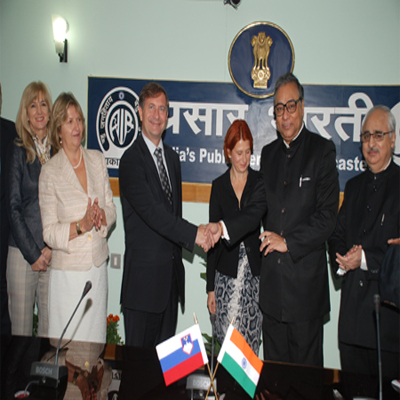

  • DTT should be completed in Delhi by 2010

    DTT should be completed in Delhi by 2010

     NEW DELHI: A sub-group on ‘Going Digital’, set up by the Planning Commission, has recommended that digital terrestrial transmission by Doordarshan should be launched with a slogan Digital Delhi by 2010 to coincide with the Commonwealth Games in that year.

    The Sub-Group headed by Rajeev Ratna Shah, Member Secretary in the Planning Commission and a former CEO of Prasar Bharati, said a phased approach should be taken for going digital covering all the seven mega cities by 2011 in the first phase and the rest of the country by 2013.

    The sub-group, comprising 17 members, was set up by the Committee on Information, Communication and Entertainment (ICE) that has been examining the larger issue of convergence and advent of modern technology. Members include the secretaries in Information and Broadcasting and Department of Telecommunications, the Prasar Bharati CEO, the presidents of Cetma, Mait, Nasscom, and ISP Association of India, co-chairman of the Ficci entertainment committee Kunal Dasgupta, chairman of the CII entertainment committee, chairman of the Film & Television Producers Guild of India, president of the Cable TV Operators Association, Rajiv Mehrotra who is the managing trustee of the Public Service Broadcasting Trust, Virat Bhatia from AT&T Communications Services, Zee Telefilms President Abhijit Saxena, Sameer Rao who is vice-president in charge of strategy, planning & regulatory in STAR India, and a representative of the Prime Minister’s Office.
     

    It was also agreed that a group chaired by BS Lalli, the CEO of Prasar Bharati who is also chairman of the Indian Broadcasting Foundation, and some private broadcasters like Star, Zee, Sony, Eenadu etc. and their major MSOs will examine an 11-stage process and firm up their sequencing and put the entire process on a “digital upgrade timeline”.

    Digital migration process

    Ideally, the Sub-Group said the migration process must commence from Delhi in 2010, coinciding with the Commonwealth Games, and proceed to other mega cities by 2011 and Tier II and Tier III cities by 2012. In non-urban areas simulcast can continue for a few more years. Analogue transmission should be completely phased out by 2015 as the outer limit. It was decided that to keep the transition costs to the minimum, the switching over time as well as the simulcasting period should be kept to the minimum.

    There is need for convergence in regulation in the light of developments in technology and the I&B Ministry was requested by the sub-group to take a fresh look at the proposal for having a common communications convergence regulator with separate bureaus under it for dealing with content and carriage. A supplementary report will be submitted with regard to regulatory issues relating to going digital.

    All the content producers – Prasar Bharati as well as private operators – should provide agreed and identified channels in the digital / HDTV format to MSO / cable operators under “Must Carry” clause.

    High Definition TV should be introduced in a phased manner starting from Delhi (2008-09), extending it to all the six mega cities. Commonwealth Games should be covered in HDTV format in 2010.
     
    Spectrum planning

    The I&B Ministry, private broadcasters and service providers along with the Department of Telecommunications (WPC cell) should work in a coordinated manner to identify spectrum requirements keeping their rollout plans so that spectrum planning could be proactively made. A Spectrum Management Group could be set up to achieve this.

    Prasar Bharati should work out the financial implications of going digital, covering AIR and Doordarshan operations and submit the same to the Planning Commission.

    Prasar Bharati should digitally archive all its contents including educational contents for providing them for distribution streaming audio-video technologies. Prasar Bharati may also work out a mechanism to leverage the rich content available by appropriately pricing them and retailing them. All Prasar Bharati content of Classics or Fiction should be made web accessible with premium content accessible through payment gateway. Public service broadcasting content should be freely accessible on the web.

    Digital cinema

    The Sub-Group has also recommended amending the Cinematograph Act 1952 for inclusion of digital cinema. It said digital cinema should be seen as a means of securing the Intellectual Property Rights of the producer. Digitally recorded content taken from satellite in an encrypted conduit provides a failsafe method of delivering films to exhibitors directly, without intermediary or distributor’s interface at multiple locations simultaneously, in streaming audio-video-mode. It said this was the best guarantee against piracy. Digital cinema should, therefore, be encouraged by recourse to various fiscal and non-fiscal incentives.

    Production of cinema in digital format could be on lower tax regime and the theaters that have installed digital cinema exhibition facilities can be subjected to say lower entertainment tax. This would need to be taken up with State Governments, the Sub-Group said.

    It said all conditional access devices (and Set Top Boxes) should be built on common standards for inter-operability, so that customers are not put to inconvenience. This will also help in better absorption, acceptability of digital technology. The plain-vanilla-STB should lend itself to modular insertion of proprietary data to include value-added services.

    Content providers should be encouraged to work on creation of domain specific server farms and data depositories. The concept of digital libraries promoted by the Department of Information & Technology should also be publicly made available. Create open access platforms like Google libraries and others should also be encouraged. Memory modules could specially be created for lawyers, doctors, accountants and other professionals for instant data mining and retrieval in respect of their domain.

    Triple play services

    Triple play services riding on entertainment related applications would be able to create the most viable business models for spread of rural connectivity. Applications of Wi Max technology will allow entertainment to rural areas and this will provide ubiquitous Broadband experience to rural areas. Just as Wi Fi band has been delicensed, we need to move to the next step in encouraging proliferation of Wi Max technology for which the Wi Max band (2.5 GHz / 3.5 GHz / 700 MHz or existing Wi Fi band 2.4 – 2.48 GHz) could be delicensed for rural connectivity.

    Content creation would be a specialised area requiring thorough understanding of the local requirements and language that can only be done through local entrepreneurs. The Rural Content Provider (RCP) would provide content and other facilities, including entertainment, which will be of interest to the rural population. Delivery of services could be through home TV or Mobile telephone. The business model of such an RCP would vary from region to region and would be driven by the market. The department of IT and the Department of Telecommunications need to evolve a suitable policy framework that would encourage such RCPs.

    The Deparment of Information & Technology/National Informatics Centre should work out a comprehensive plan for rollout of statewise, regionwise and citywise GIS database and encourage private enterprise to do customized applications and value addition for various public sector as well as private sector applications.

  • ABU delivers excellent results for Commonwealth Games

    ABU delivers excellent results for Commonwealth Games

    MUMBAI: The Asia Pacific Broadcasting Union (ABU) has announced that over a billion people had access to free-to-air coverage of the Melbourne 2006 Commonwealth Games, stretching from Mongolia in Central Asia, down to the Republic of Timor Leste.

    ABU’s head of sport in Melbourne John Barton says, “We have built the biggest television platform in Asia and the Pacific for the Melbourne games and we will continue to see it grow over the years, especially with New Delhi hosting the next event in 2010.”

    Televising multi sport events such as the Olympics and Commonwealth Games on free-to-air television would have lasting economic benefits for a nation, says Barton.

    “We are not just investing in a sporting contest. It is much greater than that. We are showcasing the character of a host nation, its many cultural and commercial assets, and the character and values of the competing nations. That was why it is extremely important for the events to be seen on the free-to-air television markets around the world where their countrymen could share the highs and lows that come with the great sporting occasion.

    “Governments and broadcasters have a dual responsibility to make sure that their athletes and teams are given due recognition on television for their years of effort and training. So when they step out onto the international sporting stage they know that their nation is with them, right at that moment, sharing their joy or sadness” he adds.

    Governments in Asia are spending hundreds of millions of dollars on sporting infrastructure, facilities, coaches and new training methods. “Asia is thriving as a regional sporting powerhouse with the increasing numbers of Olympic champions. But without television, which has been the engine for growth for many years, that development could be arrested,” he added.