Tag: Coca-Cola

  • WPP, Coca-Cola, BBDO Worldwide top Effie Effectiveness Index

    WPP, Coca-Cola, BBDO Worldwide top Effie Effectiveness Index

    MUMBAI: Effie Worldwide has released its global rankings for the most effective marketers, brands, agency holding groups, agency networks, agency offices and independent agencies according to results of the 2015 Effie Effectiveness Index.


    Now in its fifth year, the Effie Index recognizes the architects of the most effective marketing communications ideas from around the world, determined by their success in more than forty national & regional Effie Award competitions.


    Companies ranked highest in the 2015 Effie Effectiveness Index globally include The Coca-Cola Company (marketer) and Coca-Cola (brand), WPP (agency holding group), BBDO Worldwide (agency network), Colombian agency Sancho BBDO (individual agency office) and Ukraine’s Banda Agency (independent agency).


    “Effie Worldwide’s annual Effie Index recognizes the exceptional ideas that delivered results and made a difference for businesses globally. The Index is distinctively comprehensive in that it shines a light on the incredible ideas that worked around the globe, from local to international campaigns, and from both multi-nationals and independent brands. This year’s honorees have set the bar higher for the industry and proven that great creative combined with thoughtful strategy equates to successful marketing initiatives,” said Effie Worldwide chair of the board of directors and Facebook vice president, global marketing solutions Carolyn Everson.


    Highlights from this year’s rankings include TheCoca-Cola Company unseating Effie Index incumbent Unilever (now second) as the top ranked marketer. Procter & Gamble retained its third place position. Coca-Cola remained the most effective global brand for the third year in a row. Vodafone jumped to second place, bumping McDonald’s down to third in the global brand ranking.


    The top three most effective holding groups remained unchanged from last year, with WPP Group ranked as the most effective agency holding group for the fourth consecutive year, followed by Omnicom and Interpublic. For the second year in a row, BBDO Worldwide topped the world’s most effective agency network ranking, with McCann Worldgroup moving up one spot to second, pushing Ogilvy & Mather to third.


    Sancho BBDO topped the Global Individual Agency Office rankings for the second year in a row. Banda Agency regained its spot as the most effective independent agency in 2015. It was previously ranked first in the 2013 rankings.


    “The Effie Effectiveness Index is the world’s most prestigious ranking of effective marketing, and five years of data allows for a bigger picture to compare and contrast the trends in marketing. What’s more, by having access to the cases that led to success in the Effie Index, marketers can study best in class examples of effective marketing from around the globe,” said Effie Worldwide president and CEO Neal Davies.


    The 2015 Effie Effectiveness Index is compiled from 3,136 finalists and winning entries from worldwide Effie Award competitions between 1 January, 2014 – 31 December, 2014. This is the first time the Effie Index rankings were calculated using a January-December qualifying period, which will provide marketers with a better understanding of their success over a single calendar year. Previous rankings were tabulated over a June-June eligibility time period.


    Effie Index Global Rankings:


    The top five most effective marketers in the world are: The Coca-Cola Company, Unilever, Procter & Gamble, Mondelēz and PepsiCo.


    The top five most effective brands in the world are: Coca-Cola, Vodafone, McDonald’s, Pepsi and Movistar.


    The top five most effective agency holding groups are: WPP Group, Omnicom, Interpublic (IPG), Publicis Groupe and Havas.


    The top five most effective agency networks are: BBDO Worldwide, McCann Worldgroup, Ogilvy & Mather, Lowe & Partners and Young & Rubicam.


    The top five most effective individual agency offices are: Sancho BBDO (Bogota), FP7/DXB (Dubai), Lowe Lintas (Mumbai), Ogilvy & Mather (Mumbai) and FCB New Zealand (Auckland).


    The top five most effective independent agencies are: Banda Agency (Kiev), MINT (Dubai), thjnk (Hamburg), ACG Advertising Agency (Budapest) and Barnes, Catmur & Friends (Auckland).


    The Index can also be analyzed by region and the companies that ranked highest in each region in 2015 are:


    Asia Pacific

    Unilever (marketer), Coca-Cola (brand), WPP Group (agency holding group), Ogilvy & Mather (agency network), Lowe Lintas – Mumbai (agency) and Barnes, Catmur & Friends – Auckland (independent agency).


    Europe

    Unilever (marketer), Coca-Cola (brand), WPP Group (agency holding group), McCann Worldgroup (agency network), Adler, Chomsky & Warshavsky Grey in Tel Aviv (agency) and Banda Agency in Kiev (independent agency).


    Latin America

    The Coca-Cola Company (marketer), Movistar (brand), WPP Group (agency holding group), BBDO Worldwide (agency network), Sancho BBDO – Bogotá (agency) and a tie between Madre Buenos Aires and Beat (Bogota) (independent agency).


    Middle East & Africa

    Unilever (marketer), Coca-Cola (brand), Interpublic (IPG) (agency holding group), McCann Worldgroup (agency network), FP7/DXB – Dubai (agency) and MINT – Dubai (independent agency)


    North America

    Procter & Gamble (marketer), Dove (brand), Publicis Groupe (agency holding group), Starcom MediaVest Group (agency network), Starcom MediaVest Group, Chicago (agency) and Cramer-Krasselt, Chicago (independent agency).

     

  • Grey India appoints Vishal Ahluwalia as Bangalore head

    Grey India appoints Vishal Ahluwalia as Bangalore head

    MUMBAI: Grey Group India has appointed Vishal Ahluwalia as vice president and office head of its Bangalore ops. He will be reporting to Grey Group India chairman and managing director Sunil Lulla.


    Ahluwalia joins Grey with two decades of marketing communications experience, across various geographies and disciplines. In his various avatars, he has headed businesses and has been an entrepreneur. Until recently, he worked as a member of the Board of IRIS Worldwide, in which he spearheaded the digital and retail verticals. Prior to that he was TBWA South India head; JWT -Taipei head for Unilever business and has also had stints with Contract and JWT.


    “Vishal brings a great blend of advertising savviness and digital smarts to Grey. His experience across geographies and diverse categories, will strengthen the leadership team at Grey. He will take further our integrated offerings to various clients and enable their brands to be famous and effective,” said Lulla.


    Ahluwalia added, “I am very excited about the prospect to bring my skills across various stream to Grey Group’s rich and diverse client roster. I do believe the future requires us to be able to deliver services in a wholesome and integrated fashion. I am delighted to return to Bangalore which has always been a springboard for my learning and my success.”


  • MTV revamps Coke Studio format; to air all year round

    MTV revamps Coke Studio format; to air all year round

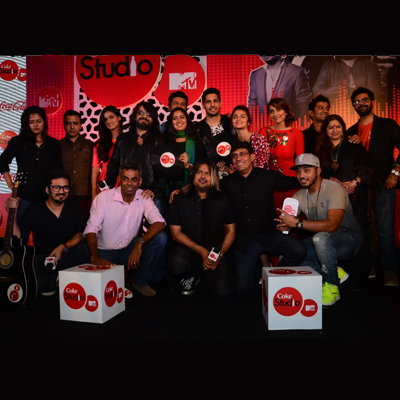
    MUMBAI: An experiment that began with fusion music over three seasons back is all set to return once again. Coke Studio @MTV season four is all set to telecast in a new format this year.


    Speaking to Indiantelevision.com about the same, MTV EVP and business head Aditya Swamy said that the success of the property today lay in the fact that filmmakers have started asking music composers to produce songs, which have a Coke Studio feel to them.


    MTV and Coca Cola have followed two cues to take the show’s new season forward. “Firstly, we have decided to bring audio and video together to refresh audiences through music videos. Secondly, it has been learnt that people are consuming singles rather than albums. Therefore, we will move from episodes to singles throughout the year.”


    The format for this year will see a change. The property will move from seasons to “always on” for one year now. It will be narrated in the form of a story instead of just vanilla songs. The series will begin on 1 March 2015 and will air every first Sunday of the month at 8 pm. 


    The production will include three elements. The first element of the show will include producer profiles and the idea behind the song. Secondly, it will have studio sessions and the setup of the band and lastly there will be a novel element, which will be a stylized video and audio told in the form of a story. Each of these videos and audios will release simultaneously across all MTV platforms. It will be deployed across all audio and video platforms like YouTube, Saavn, Gaana and iTunes by Zee Music. The channel will also be re-releasing two audience favourites “Madari” and “Kattey” with new music videos.


    Speaking about the learning’s the channel has picked up so far, Swamy said that it has been to come up with better innovations. “In the technical sphere we have learnt to produce audio and video side by side. With the response we have garnered, we could find courage to innovate and come up with a format that not only caters to loyalists but also help bring on board new consumers,” Swamy informed.


    Talking about the brand integration concept, Swamy said that the two have seen a long term investment partnership. “People will take to branded content if the music is good, but if the content is not good and is in the consumers face directly they will hate the same,” he opined.


    The global beverage brand Coca Cola owns the IP of the property, which has its presence in other countries like Pakistan and therefore the channel does not resort to other advertisers coming onboard. 


    Speaking about the brand’s association with MTV, Coca Cola India and South West Asia VP marketing and commercial Debabrata Mukherjee said, “We are constantly in touch to come up with engaging content. When we began, we did not realise the groundswell response we would receive. Since 2013 to 2014 we have visited more than 15 cities visiting different colleges as part of our on ground events.” 


    This year Coke Studio will continue bring the live experiences through 50 concerts and outreach programmes reaching 100 colleges across 10 cities.


    Mukherjee informed that the property has become hugely popular over seasons. Sharing some insights, he said Coke Studio @MTV has registered over 150 million+ reach across all three seasons. On social media platforms, it has garnered 64 million view on YouTube and 2.9 million fans on Facebook. He also informed that the brand is open to inviting international artists to India.


    Speaking on the association of the two partners Group M ESP national director- entertainment sports and live events Vinit Karnik opined, “The property has become very much synonymous with the brand. There is also a lot of cult following that consumes this kind of music. At some point in time, it will definitely resonate with the brand and the TG. From a relevance point of view this has worked for the brand Coca Cola as people have become very much synonymous with the brand.”


    The line up for this season includes the likes of Amit Trivedi, Pritam, Papon, Clinton Cerejo, Sachin-Jingar, Ram Sampath, Sneha Khanwalkar, Harshdeep Kaur, Raftaar and Rekha Bhardwaj. 


    When asked about the property’s USP, Bhardwaj said, “Coke Studio @MTV has allowed us artists to treat the platform as our own. It has also helped popularise folk as well contemporary music through fusion. Every episode will feature a single song and will allow us to take our own interpretation to the audiences.”

  • I -League set to return on 17 January 2015

    I -League set to return on 17 January 2015

    MUMBAI: The launch of Indian Super League (ISL), made many doubt if the country’s original football league would be able to sustain or not. However, putting fears to rest about the future sustainability of the I–League, it is all set to take off from 17 January 2015 in Bengaluru and will be telecast on Ten Sports.


    The official broadcaster, which will air 75 out of the total 110 matches live on the channel, is optimistic about it.  Ten Sports CEO Rajesh Sethi says, “We have had a long-standing partnership with the All India Football Federation (AIFF) and the I-League. We have seen this property grow leaps and bounds on our network in terms of audience interest and viewership numbers.”  


    He goes on to say that the network values the primary national league on its platform and is looking forward to an exciting new season of the tournament from January 2015 as well as the Federation Cup, which will commence from December 2014.


    While some sports experts feel that the ongoing Hero Indian Super League (ISL) would cause sustainability problems for the league, the announcement comes as a welcome move.  Sports columnist Hemant Kenkre says, “The I-League was introduced in India as a professional football league. While India may have a low ranking in terms of world football standings, foreign leagues like the EPL are popular in the country. The I-League together with the Indian Super League can co-exist together, as a large number of football leagues will provide not just an opportunity for youngsters to play but also give international exposure for the game.”


    The decision on the dates for the league, were taken at the recent I-League and Federation Cup committee meeting. It was also decided that the inaugural edition of the AIFF U-15 tournament for I-league clubs will be held in the next calendar year and will consist of 16 teams wherein besides the 10 league clubs, four other academies and two AIFF academies will be a part of the final round.


    “With the new clubs in the league giving more importance to infrastructure and grassroots development programmes, and with AIFF’s initiatives for new tournaments in the junior categories, it is definitely going to impact the quality of youngsters in the game in India and I am confident that these initiatives will bear fruit in the Indian teams performances and results in the U-17 World Cup,” adds Sethi.


    While coming up with the fixture of the championship, the schedule of school examinations will be kept in mind, and only post discussions with sponsors like Coca Cola and AIFF marketing partners IMG-Reliance, will intimate the clubs. It has also been decided that the registration of players would be done centrally through the state associations and all ID cards would be issued by AIFF. No club would be allowed to register a player after the completion of the 11th round of I-League.


    As per the release of players for the AFC U-22 Qualifiers, slated to be held from 23 to 31 March 2015, the clubs have agreed to get back to the governing body over the same. Meanwhile, the second division league would take place in two venues which are to be finalised post inspection by AIFF. The eight participating Clubs are Aizawl FC, Chanmari FC, United Sports Club, Mohammedan Sporting, PIFA Sports, Kenkre Sports, Hindustan FC and Lonestar Kashmir FC. The U-19 I-League will kick-off in the second week of December.


    The last season of the championship was won by the newcomer Bangalore FC, which was led by India’s national football team captain, Sunil Chhetri.  When asked for his expectations for the upcoming league he says, “Expectations remain same in the I-League; we want to defend our title. We want to make it as difficult as possible for the competition. We also have an AFC competition and the Federation Cup so we have our work cut out.”


    “The players obviously want to put up performances that the audiences can enjoy,” he concludes.

  • Coca-Cola IPTL names FedEx as the official logistics partner

    Coca-Cola IPTL names FedEx as the official logistics partner

    MUMBAI: One of the world’s largest express transportation company FedEx, has announced its association with the Coca Cola International Premier Tennis League.  The league will be held at Manila, Singapore, New Delhi and Dubai from 28 November to 13 December 2014. 


    FedEx services executive vice president marketing and communications Raj Subramaniam commented, “In the past, FedEx has successfully leveraged sports marketing to connect with customers. IPTL provides an additional platform to communicate with customers in addition to sharing the FedEx brand characteristics of speed and precision.”


    The Coca-Cola IPTL presented by Qatar Airways is a professional team tennis competition founded by India’s Mahesh Bhupathi, featuring some of the best current and past champions and played across four countries in Asia. 


    FedEx Express vice president EMEA customer service, MEIA marketing and  communications  Nathalie Amiel-Ferrault  said, “FedEx is pleased to share the passion and excitement of the team based professional tennis league and of having the best of the best in tennis playing in front of the public in the four key cities. We share many attributes with tennis as a sport and that’s what makes this association such a great fit.” 


    The Coca-Cola IPTL will showcase iconic tennis players like Roger Federer, Andy Murray, and Novak Djokovic in these countries. The league is expected to reach over 125 countries and 300 million households internationally and will be broadcasted in the US, Brazil, Europe, South-East Asia, the Middle East and Sub-Saharan Africa. FedEx has a history of tennis sponsorships and currently sponsors Roland-Garros in France and the Association of Tennis Professionals (ATP) across 13 countries. 


  • Coca Cola IPTL gets Qatar Airways onboard as presenting sponsor

    Coca Cola IPTL gets Qatar Airways onboard as presenting sponsor

    MUMBAI: The national carrier of the state of Qatar, Qatar Airways, has teamed up with Coca-Cola International Premier Tennis League (IPTL) as the presenting sponsor for the inaugural edition of the event. In its capacity as the presenting sponsor, it will be undertaking a series of on-ground activations to engage with tennis fans across the globe.  


    Founder of IPTL Mahesh Bhupathi said, “Qatar Airways’ legacy as a committed sponsor of global sports events is well known. We’re glad to partner with an award winning airline like them as presenting sponsor and look forward to enjoying a long and fruitful association during and after the IPTL season.”


    The tennis league is the first of its kind initiative in tennis to encourage a competitive franchise based competition. The league will travel to the cities of Manila, Singapore, New Delhi and Dubai featuring current and former ATP and WTA players in its inaugural season from 28 November until 13 December 2014.


    Qatar Airways Group chief executive Akbar Al Baker said: “We are extremely excited about our partnership with the Coca-Cola International Premier Tennis League. At Qatar Airways, we have a long-standing history of associations with large-scale sporting events which allows us to connect with sporting fans and legendary sportsmen across the globe through our widespread global route network. Qatar Airways’ associations with this event will further promote the game among the increasing fan base of tennis enthusiasts across the world.”


    Starting from the Philippines, the league will travel to Singapore and India before culminating in Dubai. In its inaugural season, the championship will feature players such as Roger Federer, Novak Djokovic, Andy Murray, Serena Williams, Maria Sharapova and others playing for four tournament franchises – Manila Mavericks, DBS Singapore Slammers, Micromax Indian Aces and the UAE Royals, that have been sponsored by corporates and leading sports legends.


  • Coca-Cola teams up with IPTL as title sponsor

    Coca-Cola teams up with IPTL as title sponsor

    MUMBAI: The upcoming International Premier Tennis League (IPTL) has got a title sponsor in Coca-Cola.


    The brand which is associated with large sporting events ranging from the Olympic Games, FIFA World Cup, NASCAR, NBA etc is now making a foray into tennis through the tennis league.


    In its capacity as title sponsor, the cola company will undertake a series of initiatives to engage with tennis fans across the globe. These include a special promotion to select three lucky fans to be the ‘Coin Toss’ boys/girls for three matches.


    It will be adopting IPTL’s special competition feature called the Happiness PowerPoint, which will allow each team to call for a Happiness PowerPoint once in each single-set match. Upon winning the point, a player trailing 15-0 will directly get to 15-30 by winning the ‘Happiness PowerPoint’ and lose a point upon losing the Happiness PowerPoint. In case the score is tied at the end of five single-set matches, a seven point men’s singles shoot-out will be played and the result will count as a game point won.


    Coca-Cola India vice president marketing and commercial Debabrata Mukherjee said, “Our purpose of associating with the IPTL is twofold. On one hand, it will allow millions of passionate tennis fans to enjoy their favorite sport and also witness some of the world’s most iconic tennis stars display their skills. On the other hand this initiative will serve as a perfect platform to launch a ‘Culture of Tennis’ in India. The initiative will provide great impetus to the youngsters of today who will get inspired by some of the world’s most accomplished and inspirational tennis stars to take up the sport”.


    IPTL founder Mahesh Bhupathi commented, “I welcome Coca-Cola to the IPTL family today. We’re excited to present the Coca-Cola International Premier Tennis League to the growing base of tennis enthusiasts across the world and look forward to providing to them superior recognition and visibility among fans internationally.”


    In its inaugural season, the multi-million dollar tennis league will feature top stars such as Roger Federer, Novak Djokovic, Andy Murray, Serena Williams, Maria Sharapova and others playing for four franchises in India, Singapore, Philippines and the UAE.

  • Trick or Treat: Bring out the troll in you

    Trick or Treat: Bring out the troll in you

    With just couple of hours to go before people dress up to trick or treat for Halloween, one thing that comes to mind is the Pepsi versus Coca Cola war.

    So, what is new between the two cola giants taking on each other, which they have been doing for years now? Well, it is the response which the campaign by Pepsi generated.

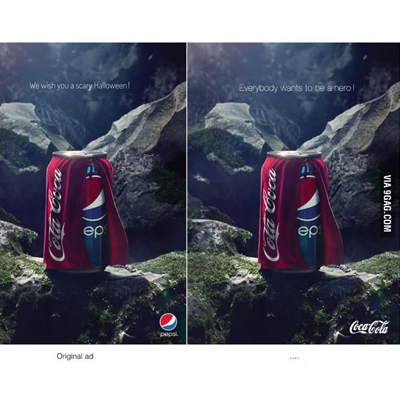
    Last year, Pepsi released a campaign during Halloween wherein a Pepsi can wore a red cape with “Cola Coca” written on it and with a tagline saying, “Have a scary Halloween”. Of course, the campaign went viral, but what was more interesting was the response from one of the avid Coca Cola fan.

    The new tagline read, “Eveybody wants to be a superhero”, hinting that the red cape was that of the Superman.

    Ambush advertising is nothing new, but it takes a lot of wit and guts for the players to take a jab at each other and take it in their stride as well. And not to forget, to make it worth a while for the costumers as well.

    The objectives of ambush marketing are twofold: to get maximum returns on the marketing buck and to undermine the branding efforts of the rivals by stealing the attention, increasing the clutter and confusing the viewers.

    Who can forget the Pepsi’s ‘Nothing official about it’ campaign during the 1996 cricket World Cup that introduced the concept of ambush marketing in India.

    Indiantelevision.com takes a look at a few memorable advertising wars between brands in India.

    Kingfisher vs. Jet Airways

    In April 2007, Jet Airways had an image makeover and had released an outdoor campaign that stated, ‘We have changed.’ Soon, Kingfisher placed a hoarding above that which read, ‘We made them change’.

    Samsung vs. Nokia

    It was in 2012, in a packed theatre in New Delhi, as scores of excited movie buffs sat to watch an exclusive premier of SRK-starrer Ra.One for mobile phone maker Nokia’s premium users at PVR Select City Walk mall, what took everyone by surprise were the advertisements that had been running for the previous few minutes were of Samsung mobile.

    HUL vs. P&G

    Hindustan Unilever’s shampoo brand “Dove” and Procter & Gamble’s shampoo brand “Pantene” caught it out in 2010. P&G launched its intriguing ad campaign for Pantene with the tagline “A mystery shampoo. Eighty per cent women said it is better than anything else.” A few days later and before P&G could announce the launch the new Pantene, Hindustan Unilever ambushed the campaign by placing an adjacent hoarding with the tagline “There is no mystery. Dove is the No. 1 shampoo.”

    The Hindu vs. Times of India

    For its Chennai edition, Times of India in late 2011, launched a ‘Wake Up!’ campaign, provoking the readers (mainly targeted at Chennai readers) to shift from the newspaper that puts them to sleep with its boring and dreary news (indirectly pointing out at the Hindu). Soon afterwards, The Hindu hit back with the tag line ‘Stay Ahead of the Times’, telling the readers to move out of the Bollywood and Page 3 gossips and take up the news that is relevant to current affairs of the country and the world.

    Flipkart vs. Snapdeal

     The latest to enter the bandwagon is none other than the highly-competitive e-commerce sector. On 6 October, Flipkart announced its ‘The Big Billion Sale’ as a jacket ad in the Times of India, announcing, ‘Today Don’t Look Anywhere Else, India’s Greatest Ever Sale is here’. But the thunder was stolen on the page immediately following with a Snapdeal ad announcing, ‘For Others it is a Big Day. For us, today is no different’.

  • Aligned with 2020 vision, Coca Cola launches Zero

    Aligned with 2020 vision, Coca Cola launches Zero

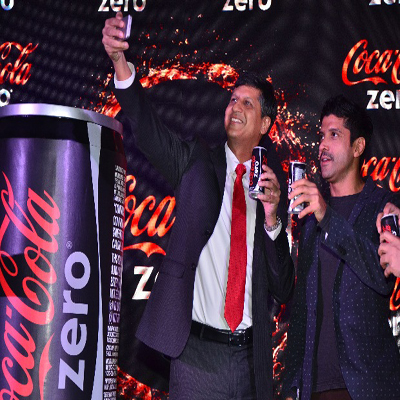
    MUMBAI: Continuing the expansion of the its product portfolio, the beverage giant Coca Cola India unveiled yet another strategic bet in its journey to achieve its 2020 vision, by launching Coca Cola Zero.


    With its launch in the national capital, the Coca Cola Zero brand is now available in all the top six markets of the Coca-Cola Company, the others being USA, Mexico, China, Brazil and Japan.


    The sugar free soft drink was launched by Farhan Akhtar, Olympian luger Shiva Keshavan, fashion designer Sabyasachi Mukherjee and fashion photographer Atul Kasbekar.


    In another first for the Company, the entire launch event was broadcast live on www.coca-colaindia.com and fans of Coca Cola Zero joined the launch conversation on twitter and facebook with the #cokezero.


    Speaking at the launch Coca Cola India and south west Asia president Venkatesh Kini said, “As we move towards the halfway mark of the decade, it is important we add offerings to our portfolio even as we nurture the existing brands.” After October 5, Coca Cola Zero will be available across the top 100 towns in India in 180,000 outlets.


    “Coca-Cola Zero comes at a time when Coca Cola classic has established itself and the new product therefore, complements the company’s sparkling portfolio,” he added.


    Coca Cola India marketing VP Debabrata Mukherjee said, “To ensure that consumers get their first taste of Coca Cola Zero, we will be sampling more than 1.5 million packs of the product in the next four months. We also have a strong communication plan which includes digital media, television and print campaigns.”


    The company sells a variety of both carbonated and non-carbonated drinks in India, including Coca Cola, Thums Up, Sprite, Maaza and Minute Maid.


    The Coca Cola system is innovating with new channels to build preference and anticipation for the beverage prior to the national, on ground, roll out. Initially, the new product will be available on the growing online portal Amazon India as well as modern retail outlets, starting with the Reliance Retail chain. Besides, it would also be first made available to various partners like low cost carrier IndiGo, quick service restaurant chain Subway and INOX Leisure. Coca Cola’s own portal www.Coke2Home.com will also be listing Coca Cola Zero after 15 days of launch at Amazon.


    Talking about Coca Cola’s latest innovation, INOX Leisure CEO Alok Tandon said,” The entire movie experience in multiplexes like INOX seems to have graduated to another level. The choice of snacks, beverage options, pre-screening and post screening experience has seen a sea change over the years.”


    “I guess the one thing that has remained constant though, is Coca Cola as a part of the movie going experience. We are happy to know that consumers can now choose the zero sugar option also along with the regular Coca Cola,” he added.


    Coca-Cola Zero is one of the $17 billion brands of The Coca Cola Company in revenue terms and is one of the fastest to this milestone. It was first launched in 2005 and is now available in 149 countries including India.


    Elaborating on the product attributes, Mukherjee reckoned, “Coca Cola Zero is a part of our global Red-Silver-Black model on Coca Cola Trademark. It has done well in matured as well as emerging markets, across the globe. We expect that Coca Cola Zero will hit all the right notes with consumers in India.”


    In 2012, Coca Cola, along with its partners, had announced to more than double investments in India to US $5 billion (about Rs 28,000 crore) by 2020.


    Talking about their 2020 vision Kini said, “Atlanta-based beverages giant remained committed towards the US $5 billion investment in the country till 2020 and was happy to say that they were on track for the investment.”


    Coca Cola Zero will be available in 300 ml slim cans, 400 ml PET bottles and 600 ml PET at the same price points as regular Coca Cola. For instance in Delhi, the MRP of a 300 ml can will be Rs 30 while that of a  600 ml PET will be Rs 35.

  • Missed call from FB will accelerate digital engagement: Valerie R Wagoner

    Missed call from FB will accelerate digital engagement: Valerie R Wagoner

    It was in April that Facebook announced that it had 100 million active users in India, and was aiming at touching the one billion landmark. The social networking site which now has an established subscriber base, is looking at launching more ad inventories. The latest from its kitty is the missed call ad product, which according to Facebook has already started generating some buzz.  


    The announcement of this new ad format had come at a time when Facebook COO Sheryl Sandberg was visiting India hobnobbing with government officials, and small and medium business owners.


    Facebook has partnered with ZipDial, a Bangalore based mobile agency for this. Indiantelevision.com’s Priyanka Nair speaks to ZipDial founder and CEO Valerie R Wagoner at length to understand the mobile marketing ecosystem in India, partnership with Facebook, the agency’s journey and much more.


    How has marketers’ demand from mobile marketing changed in recent years? 


    In emerging markets where the vast majority of consumers are still not online and still pay for things in cash, there is exceptionally little data on consumers and their preferences and behaviours. However, only this year, marketers we work with, are ready to embrace a comprehensive data strategy.


    Four years ago at the end of 2009 when we started ZipDial, marketers were barely getting comfortable with using the mobile at all, and it was an era of small experiments. By around two-three years ago in early 2012, using the mobile for media activations had become an industry standard. By now, marketers are truly embracing both, bridging offline-to-online consumer experience over the long-term, and driving a real business impact from data and analytics.


    You have been in the business for four years. How were the initial days?


    The idea for ZipDial was born from a brainstorming session between Sanjay Swamy (now chairman of ZipDial) and me on a late night flight back to Bangalore from New Delhi. Over next couple months, we fine tuned the idea further with as many as 600 varied user cases.


    The idea just stuck, and within a few more weeks, we had launched a minimum viable product. I think the ideation and execution happened within a short time. But ideas are cheap. Anyone can have an idea. To be really successful, an entrepreneur has to be great at execution, to think strategically about how to drive real inflection points in the business, and have the stamina to see through. What was launched as a mere polling product, over time transformed into a full-fledged mobile marketing and analytics platform.


    ZipDial founder and COO Amiya Pathak and the tech brain created a prototype during IPL 2010 wherein users could give a missed call and get live cricket scores. With zero marketing, within a couple of months, millions of users were zipdialing millions of times a day. It took off completely word-of-mouth. That was the first sign of success. Shortly thereafter we cracked P&G Gillette as our first big client, and we never looked back.


    How did you partner with Facebook? Can you elaborate on how the partnership will work?


    We launched the Facebook-ZipDial missed call ad product with Facebook as its partner for emerging markets (only company in the world). We collaborated and drove conception, design, development, sales, and analytics. In fact, given that the vast majority of the engagement happens on ZipDial after the user clicks on the Facebook ad, we have a lot of interesting data comparing performance across different media as well as performance between Android and feature phones.


    The purpose of the Facebook-ZipDial ad product is to create online-to-offline engagement and driving results. Facebook can track to the level of a click and online engagement. Upon user dialing, ZipDial takes over the consumer experience to drive actual outcomes in the offline world via retargeting, for example reminders to the user encouraging them to buy a product, visit an outlet, watch a particular TV channel, download particular content or an app, etc. Everything is 100 per cent permission-driven by the user and is targeted to them.


    We also need to track performance of Facebook v/s other media channels because ZipDial integrates across all media channels, including print, TV, OOH, and non-Facebook digital ads. We can track which media drives higher RoI for the advertiser.


    To put this in simple words, Facebook is the media where the ad is displayed. The user clicks on the ad. As soon as the user responds to the ad, it bridges from Facebook into a 100 per cent ZipDial experience.

    Coca-Cola (Coke Studio), L’Oreal (Garnier Men), P&G (Gillette), Mondelez (Cadbury Dairy Milk), Disney Channel and Nestle are a few campaigns that have used the inventory so far.


    We also need to give a performance analysis across media. This includes results from analysing the cost effectiveness of each media in terms of driving unique user acquisition. The metric used is user acquisition cost = spend on media / number of unique users who engaged from that media, averaged across all client campaigns.


    It can be noted that digital (including Facebook and non-Facebook digital) performed 10.40 times better than print and Facebook performed 3.02 times better than non-Facebook digital ads.


    How does the Garnier Men campaign for which Facebook has partnered with you work?


    Garnier Men had been for long planning to run a campaign with ZipDial for print and digital media. ZipDial designed and implemented the campaign on the platform in order to drive engagement with brand content around IPL 2014. The ZipDial campaign for Garnier Men was planned well in advance.


    Luckily the Facebook-ZipDial product was launched in time such that Facebook could also become part of L’Oreal’s marketing plan for the Garnier Men campaign. The results have been phenomenal with the Facebook-ZipDial ad performing 16 times better in terms of RoI than the same ZipDial integration with Garnier’s Print Ads.


    What according to you makes a campaign hit on mobile?


    There are many reasons. But, one of the major reasons is that today almost 100 per cent of all emerging market consumers have mobile phones. There is an ease of use in the design format that makes it a single click transition from online to offline in a seamless and user-friendly manner.


    Mobile is the unique ID for the customer. Even when consumers bridge from the on-Facebook experience to an offline experience such as watching a TV show or purchasing a product, there can be an offline-engagement in a targeted way.


    What are the key things that brands should keep in mind to build a healthy social conversation? 


    We strongly believe in the six best practices for social and mobile activations. One, know your customer; a visit from an anonymous user is not enough. All engagement should be verified and known-user engagement so that the brand can personalise the experience later.


    Two, don’t lose your customer, use re-targeting and follow-up engagement, don’t just make it a one-off transactional experience. However, never ever spam your consumers, and always make the experience permission-driven and privacy protected. Three, there is simplicity in the call-to-action, do not overwhelm consumers with too many options. Give them one single compelling message and way to engage.


    Four, there is multiplicity after the call-to-action. Target your response to users on a personalised basis in terms of content and interface. No two users with different profiles should receive the same content/interface. Five, it allows to measure your media. Never run a campaign without the ability to track and measure response rates and RoI. This applies across all digital and traditional channels, including print, television, etc.


    Six, every media can go viral, including offline. Never miss an opportunity for a viral campaign. ZipDial achieves between 60-400 per cent increase in reach of media through viral campaigns even when the only media used is offline traditional media. This improves RoI immensely.


    Mobile being a personal medium, there is a lot that a brand needs to keep in mind before making that one missed call. How do you make sure that a user doesn’t hang up?


    The ZipDial platform does all the hard work automatically for the brand. Marketers only need to think about what their brand benefits and the message they want to get. The ZipDial platform does all of the hard work in analysing data and results, profiling users based on preferences and behaviours, and automatically delivering the right personalised message to the right user at the right time, and even through the right user interface (i.e. voice, text, WAP, Apps).


    ZipDial always puts the consumer’s interests and the consumer’s privacy first. If this is broken, then ultimately it reflects poorly on the brand. Conversion rates on ZipDial campaigns are between 9-45 per cent compared to industry standard conversion rates of less than 0.5 per cent. Users trust the privacy-protected and personalised ZipDial experience and therefore stay more engaged.


    Typically how does ZipDial help a brand to roll out its mobile campaign?


    ZipDial keeps a close watch on the needs and trends in the market before advertisers even realise it themselves. We invest in developing our engagement, retargeting and analytics to keep the industry move forward.


    We also work closely with all for brand marketing as well as for trade marketing. Our focus is also to integrate our advanced platform into their overall consumer loyalty, data and marketing strategies. We work hand-in-hand with our most forward thinking marketers and then replicate and scale the solutions across the industry.


    How has H1 of 2014 been for Digital ZipDial?


    ZipDial has already more than doubled its revenue run rate in the first quarter of the financial year. We look forward to working further with clients about their comprehensive mobile, data and loyalty strategies.


    What is at top of your wish list for 2014? 


    Taking ZipDial’s innovative platform global is one of our main priorities for this year. We have already started to expand into the rest of Asia, but we are even more excited to take our expansion further into Africa very soon.